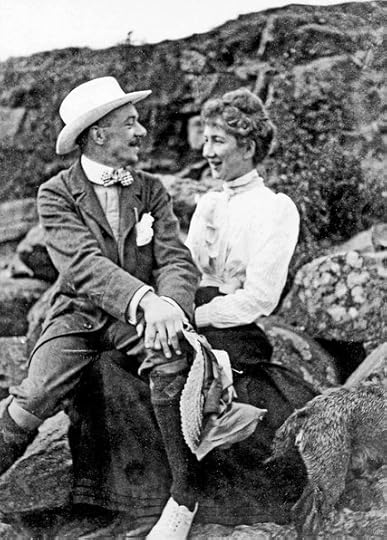
McCall Smith is a talented and prolific writer who has over one hundred books to his name, many of which I have read. Although I am not a fan of the short story genre, I was completely won over by this small charming book of stories based on old abandoned early twentieth century photographs he found while researching another project. They are based on the possibility of love in one form or another, a longed for state many imagine and hope for in their lives.
McCall Smith has chosen six from his stack of black and white photos and imagined a story behind them. Much as we wonder about the people we watch every day as we pass them on the street, wait at the train station or eat at a restaurant, McCall Smith asks who the people in the photograph are and what has made them joyful or sad. He spins his various tales from a variety of locations, from the Highlands of Scotland to the Tuscan hills and across continents. McCall Smith has the imagination to create an entire life story from a photograph, not just create a narrative from the single moment captured on film. Each of the stories is very different, filled with fully fleshed characters easily imagined by the reader.
In the first story ”Sister Flora’s First Day of Freedom”, we meet a thirty-two year old woman who has spent ten years as a teaching nun in a convent. She has come to realize that living a sequestered life is not the way she wants to spend her remaining days and has decided to leave the order. She has not lost her faith, she has just found it increasingly impossible to continue to live a life based on a doctrinaire faith to which she is not fully committed. She believes she can still find God without Father Sullivan or the bishop telling her what she can think or do and she intends to continue looking for God in the way she herself chooses. A sudden unexpected inheritance from an Uncle facilitates her decision and she goes to live with an Aunt. McCall Smith’s story emerges from the most compelling photograph in the collection. In it we see a young woman emerging from the train station in Edinburgh, passing under a shaft of light from the glass roof and heading to Princes Street for a shopping trip and lunch in town. The photography tellingly marks her emergence from a closed life to the possibilities of another future as she begins a new life. She has decided she wants a husband and is out to get one.
The second story, “Angels in Italy” takes place in southern Tuscany where an older woman holds a picture of herself as a young girl. In the photograph, she clings to the reins of a pony on which another girl is seated. Beside them is a rather unhappy younger boy on a tricycle. The older woman with the photograph is talking to a gentleman who is writing an article for a magazine, doing a profile on the boy on the bike, a boy who later became a famous painter. The older woman tells the story of her complicated relationship with the painter, how their lives came together when they were young, were forced apart by circumstance and the edicts of their families, but were reunited in later years. The story shows how two people who were meant to be together were finally able to achieve what they had long hoped for.
The third story “Dear Ventriloquist”, takes place in Canada where the reader meets Eddie, a young man living at home who enjoys conjuring and magic tricks. His parents are anxious for him to get a proper job, leave home and make a living. Eddie joins a traveling circus, a place where his talents are recognized and appreciated. There he meets Frank, a man known as the human cannonball and Ruby, a ventriloquist who works with a man in a box called Harold. When a fire destroys the ventriloquist’s puppet, Eddie cleverly suggests they replace their act with another, using a human perched on the lap of the performer to replace Harold in the box. The idea proves successful and a romance between the ventriloquist and the human puppet results, leaving Eddie wistful and alone. He is glad to see Ruby happy, but he had feelings for her and wanted to be with her himself.
The next story “The Woman in the Beautiful Car” takes place in Ireland where a young man, a teacher at a school in a nearby village, is mulling over his dull life and hoping for a different future. He notices a beautiful young woman who regularly drives by in a car and longs to meet her. He creates that opportunity by stealthily placing tacks on the road, causing the tires on her car to blow a flat and forcing her to stop. He then courteously offers to change the tire and begins a relationship which helps him embark on a more fulfilling life.
The fifth and final story “He Wanted to Believe in Tenderness” takes place in Australia and is the longest in the collection. The photo shows David, a young man sitting on the deck of a boat with a young woman at his side. It is wartime and he is about to ship out to Malaya and leave Hannah, his newfound love behind. Hannah has promised to wait for him. After a terrible period in a prisoner of war camp in Japan, David returns home and takes months to recover physically and mentally from his war experience. Hannah helps care for him but their relationship does not stand the test of time and she leaves him for another. The story tells how the couple finds, loses and regains love, able to spend their final years together.
McCall Smith writes about a generous caring world rather than one locked in fear, despair and violence. Politics rarely enters his writing. Everything usually turns out well, although not always the way some of the characters had hoped. In that way although readable, charming and positive, his books may not suit everyone and his critics often accuse him of seeing the world through rose colored lenses. But he rejects that criticism and responds, saying he knows there is sadness in the world but has chosen to respond to it in a positive way, looking for happiness rather than just thinking of the world as an unhappy weary place. Others, he says, can write about that world, but he has chosen the alternate route, one with which he is more comfortable.
An excellent, enjoyable and light read.