What do you think?
Rate this book


A Strangeness In My Mind is a novel Orhan Pamuk has worked on for six years. It is the story of boza seller Mevlut, the woman to whom he wrote three years' worth of love letters, and their life in Istanbul.
In the four decades between 1969 and 2012, Mevlut works a number of different jobs on the streets of Istanbul, from selling yoghurt and cooked rice, to guarding a car park. He observes many different kinds of people thronging the streets, he watches most of the city get demolished and re-built, and he sees migrants from Anatolia making a fortune; at the same time, he witnesses all of the transformative moments, political clashes, and military coups that shape the country. He always wonders what it is that separates him from everyone else - the source of that strangeness in his mind. But he never stops selling boza during winter evenings and trying to understand who his beloved really is.
What matters more in love: what we wish for, or what our fate has in store? Do our choices dictate whether we will be happy or not, or are these things determined by forces beyond our control?
A Strangeness In My Mind tries to answer these questions while portraying the tensions between urban life and family life, and the fury and helplessness of women inside their homes.
591 pages, Paperback
First published December 12, 2014


"I can only meditate when I am walking. When I stop, I cease to think; my mind works only with my legs." Jean-Jacques Rousseau
"I will sell boza until the day the world ends." Mevlut Karatas (p. 584)This book is long and meandering, its power like that of a fire built slowly from a bit of kindling and a single spark. From the beginning, it is carefully tended and coaxed along in a quiet but steady fashion until Whoosh!, it ignites in full glory.
So this is how Mevlut came to understand the truth that a part of him had known all along: walking around the city at night made him feel as if he were wandering around in his own head. That was why whenever he spoke to the walls, advertisements, shadows, and strange and mysterious shapes he couldn't see in the night, he always felt as if he were talking to himself. (p. 579)I cannot escape my impression that, if one were to put a gender to Istabul, it would be a woman: a grand and beautiful dowager who has been roughly treated but maintains her dignity and grace nevertheless. This is how the women in the book are presented, too. Though not all are roughly treated, they all have difficult lives, made all the more difficult by living in an oppressive patriarchy and struggling at various time with grinding poverty and lack of proper reproductive healthcare. In this way, I came to feel that Mevlut loved three women deeply and passionately during his lifetime: first, his crush, Samiha; then, his wife, Rayiha; and, from the age of twelive, his adopted city, Istanbul.
But just like believing in God, falling in love is such a sacred feeling that it leaves you with no room for any other passions.By about halfway through A Strangeness... had hooked me. I realised how completely invested I had become in the characters' well-being. I had not felt terribly attached to Melvut before then and, really, it was the women becoming more of a presence in the book that made it take off for me (Melvut's wife, Rayiha, their daughters, and Rayiha's sisters). Over six hundred pages, I fell in love with Melvut, Rayiha, their girls, the girls' aunties, and the rampaged and rambling sprawl of old Istanbul. These are very ordinary people, with ordinary lives, but the story of these lives is rich and proves the point that no one's story is boring if you attend closely enough to the telling. Pamuk is masterful in the telling, but it's a subtle mastery. He does not bash you over the head with bigness. The dramas, while intense and worrying, are not over-played. There are deaths, even one murder, but the details given are only enough to tell us that these things happened. Nothing gratuitous. I appreciate Pamuk's discretion and feel that his choices of when to zoom in and out of focus are near perfect.
"No, I'm not joking. Boza is holy," said Mevlut.Two desires that will linger with me now are to wander aimlessly through the nighttime streets of Istanbul and to try boza for myself. Pamuk is a beautiful writer. I am looking forward to more of his books.
"I'm a Muslim," said Suleyman. "Only things that obey the rules of my faith can be holy."
"Just because something isn't strictly Islamic doesn't mean it can't be holy. Old things we've inherited from our ancestors can be holy, too," said Mevlut. "When I'm out at night on the gloomy, empty streets, I sometimes come across a mossy old wall. A wonderful joy rises up inside me. I walk into the cemetery, and even though I can't read the Arabic script on the gravestones, I still feel as good as I would if I'd prayed." (p. 271)
 Istanbul painted by Ivan Konstantinovich Aivazovsky (1817-1900)
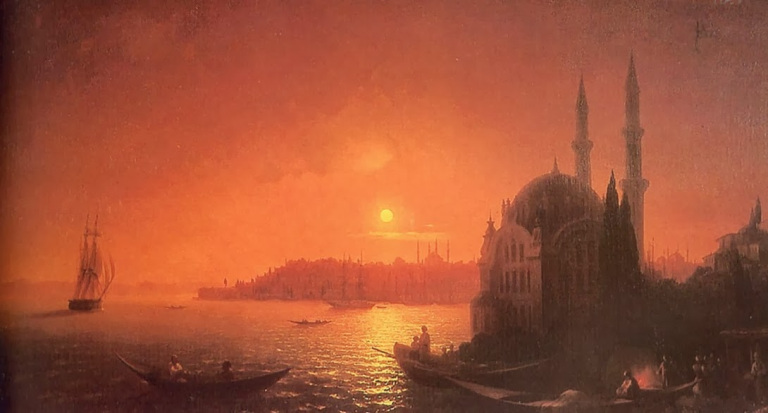 Istanbul painted by Ivan Konstantinovich Aivazovsky (1817-1900)