

What do you think?

The Beetle: A Mystery
'I saw him take a different shape before my eyes. His loose draperies fell about him...and there issued out of them a monstrous creature of the beetle tribe...'
From out of the dark and mystic Egypt comes The Beetle, a creature of horror, 'born of neither God nor man', which can change its form at will. It is bent on revenge for a crime committed against the devotees of an ancient religion. At large in London, it pursues its victims without mercy and no one, it seems, is safe from its gruesome clutches.
Richard Marsh's weird, compelling and highly original novel, which once outsold Dracula, is both a horror masterpiece and a fin de siecle melodrama embracing the fears and concerns of late Victorian society. Long out of print, The Beetle is now available in this Wordsworth edition, ready to chill you to the marrow and give you nightmares.
From out of the dark and mystic Egypt comes The Beetle, a creature of horror, 'born of neither God nor man', which can change its form at will. It is bent on revenge for a crime committed against the devotees of an ancient religion. At large in London, it pursues its victims without mercy and no one, it seems, is safe from its gruesome clutches.
Richard Marsh's weird, compelling and highly original novel, which once outsold Dracula, is both a horror masterpiece and a fin de siecle melodrama embracing the fears and concerns of late Victorian society. Long out of print, The Beetle is now available in this Wordsworth edition, ready to chill you to the marrow and give you nightmares.
288 pages, Paperback
First published January 1, 1897
About the author
Richard Marsh
445 books53 followersRichard Marsh was the pseudonym of the English author born Richard Bernard Heldmann. A best-selling and prolific author of the late 19th century and the Edwardian period, Marsh is best known now for his supernatural thriller novel The Beetle, which was published the same year as Bram Stoker's Dracula (1897), and was initially even more popular, outselling Dracula six times over. The Beetle remained in print until 1960. Marsh produced nearly 80 volumes of fiction and numerous short stories, in genres including horror, crime, romance and humour. Many of these have been republished recently, beginning with The Beetle in 2004. Marsh's grandson Robert Aickman was a notable writer of short "strange stories".
Ratings & Reviews
Friends & Following
Create a free account to discover what your friends think of this book!
Community Reviews
Displaying 1 - 30 of 605 reviews

June 19, 2020
A Horrific Mystery!
Richard Bernard Heldmann aka Richard Marsh, was born in 1857 and died in 1915 of heart disease. Marsh lived in North London.
When Marsh wrote The Beetle in 1897, it outsold Bram Stokers’s Dracula six times over. The book stayed in publication until the 1960’s.
Marsh used multiple narration to tell the story of the beetle and this helped make the story seem more interesting and more realistic.
The story opens with a young man who is down on his luck (we don’t discover that his name is Robert Holt until the middle of the story) looking for shelter.
He wanders into a neighborhood where he comes upon a house that looks empty, so he climbs through an open window to get out of the rain. What he climbs into is a terror so thick and paralyzing that it leads to the path of a powerful world of fear.
Marsh, of course, lives during a time when racial bigotry and class snobbery is common, so expect some views of that in this story.
However, it is a story of horrific horror and mystery that prevails you to suspend your disbelief and invite you in to enjoy yourself.
Five fantastic stars! ⭐️⭐️⭐️⭐️⭐️
Richard Bernard Heldmann aka Richard Marsh, was born in 1857 and died in 1915 of heart disease. Marsh lived in North London.
When Marsh wrote The Beetle in 1897, it outsold Bram Stokers’s Dracula six times over. The book stayed in publication until the 1960’s.
Marsh used multiple narration to tell the story of the beetle and this helped make the story seem more interesting and more realistic.
The story opens with a young man who is down on his luck (we don’t discover that his name is Robert Holt until the middle of the story) looking for shelter.
He wanders into a neighborhood where he comes upon a house that looks empty, so he climbs through an open window to get out of the rain. What he climbs into is a terror so thick and paralyzing that it leads to the path of a powerful world of fear.
Marsh, of course, lives during a time when racial bigotry and class snobbery is common, so expect some views of that in this story.
However, it is a story of horrific horror and mystery that prevails you to suspend your disbelief and invite you in to enjoy yourself.
Five fantastic stars! ⭐️⭐️⭐️⭐️⭐️

October 7, 2012
"A face looked into mine, and, in front of me, were those dreadful eyes. Then, whether I was dead or living, I said to myself that this could be nothing human,--nothing fashioned in God's image could wear such a shape as that. Fingers were pressed into my cheeks, they were thrust into my mouth, they touched my staring eyes, shut my eyelids, then opened them again, and--horror of horrors!--the blubber lips were pressed to mine--the soul of something evil entered into me in the guise of a kiss."

OMG those LIPS those EYES!!!
The Beetle was published in 1897 the same year as the Bram Stoker's classic book Dracula. Initially The Beetle outsold Dracula, but as word got around the Stoker book became the hit of the season. I pulled up a time line to see what else of significance happened in 1897 and the one interesting literary tidbit that jumped out at me was it was the year that Marcel Proust fought a pistol duel with Jean Lorrain. What I know about Proust it seems so improbable, but there you have it mentioned on a history timeline. I'm sure the Proustians among us can confirm or deny the validity of that occurrence.
The story is told by four narrators. The first by Robert Holt, a man who has fallen on hard times. Caught in a downpour, he sees an open window, and in a moment of desperation to secure shelter from the drumming on his head he enters the house. He finds a creature there that goes way beyond his imagination to comprehend. He is stripped naked, mounted, fondled, and kissed most vile. He is mesmerized and turned into a...ZOMBIE.
Poor Robert Holt, a man no longer worried about the weather
The second narrator is Sydney Atherton, a brilliant scientist in love with Majorie Lindon, but who should be in love with Dora Grayling. Don't worry as the story progresses the women get him straightened out on this fact. He is drawn into the action of this story by his association with Lindon and more importantly by her association with Paul Lessingham. He sees a transformation that tests the bounds of what he believes to be true of the natural world.

The third narrator is Majorie Lindon who is engaged to Paul Lessingham. She enlists the aid of Atherton to help her discover what is troubling her fiance. This is a most cruel assignment as Atherton is a most bitter rival of Lessingham for the love of Majorie, and the last thing he wants to do is help him.
The last narrator is Augustus Champnell a confidential agent who is brought into the plot by the solicitation by Paul Lessingham for help. His objective thinking does turn out to be a key to resolving the case.
Now it turns out that this creature is a follower of Isis and has pursued Paul Lessingham from Cairo to London to exact revenge. Lessingham took a walk on the wild side along the Rue de Rabagas while he was in Cairo and drank the drink the young lady offered him and woke up on a pile of rags.

Isis
"By my side knelt the Woman of the Songs. Leaning over, she wooed my mouth with kisses. I cannot describe to you the sense of horror and of loathing with which the contact of her lips oppressed me. There was about her something so unnatural, so inhuman, that I believed even then I would have destroyed her with as little sense of moral turpitude as if she had been some noxious insect.
Lessingham escapes and brings the horror back to London where he is just beginning a promising political career.
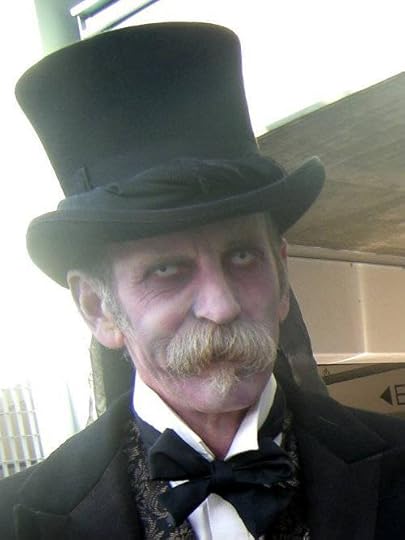
I usually try to include a picture of the author in my reviews. Below is the only picture I could find.
A very mysterious man this Richard Marsh. I thoroughly enjoyed this book. It is of course pulp horror so if you are looking for a more literary work I would suggest Dracula. This book is well written for the genre and certainly intriguing from the stand point of presenting some of the fears of the Victorian Age. This is considered Marsh's best book, but I will certainly not hesitate to read another of his books. If anyone has enjoyed other books besides Wilkie Collins that falls into this genre please share your suggestions.
OMG those LIPS those EYES!!!
The Beetle was published in 1897 the same year as the Bram Stoker's classic book Dracula. Initially The Beetle outsold Dracula, but as word got around the Stoker book became the hit of the season. I pulled up a time line to see what else of significance happened in 1897 and the one interesting literary tidbit that jumped out at me was it was the year that Marcel Proust fought a pistol duel with Jean Lorrain. What I know about Proust it seems so improbable, but there you have it mentioned on a history timeline. I'm sure the Proustians among us can confirm or deny the validity of that occurrence.
The story is told by four narrators. The first by Robert Holt, a man who has fallen on hard times. Caught in a downpour, he sees an open window, and in a moment of desperation to secure shelter from the drumming on his head he enters the house. He finds a creature there that goes way beyond his imagination to comprehend. He is stripped naked, mounted, fondled, and kissed most vile. He is mesmerized and turned into a...ZOMBIE.
Poor Robert Holt, a man no longer worried about the weather
The second narrator is Sydney Atherton, a brilliant scientist in love with Majorie Lindon, but who should be in love with Dora Grayling. Don't worry as the story progresses the women get him straightened out on this fact. He is drawn into the action of this story by his association with Lindon and more importantly by her association with Paul Lessingham. He sees a transformation that tests the bounds of what he believes to be true of the natural world.
"The light was full on, so that it was difficult to suppose that I could make a mistake as to what took place in front of me. As he replied to my mocking allusion to the beetle by echoing my own words, he vanished,--or, rather, I saw him taking a different shape before my eyes. His loose draperies all fell off him, and, as they were in the very act of falling, there issued, or there seemed to issue out of them, a monstrous creature of the beetle type, --the man himself was gone. On the point of size I wish ot make myself clear. My impersion, when I saw it first, was that it was as large as the man had been, and that it was, in some way, standing up on end, the legs towards me. But, the moment it came in view, it began to dwindle, and that so rapidly that, in a couple o seconds at mos,t a little heap of drapery was lying on the floor, on which was a truly astonishing example of the coleoptera. It appeared to be a beetle. It was perhaps, six or seven inches high, and about a foot in length. Its scales were of a vivid golden green. I could distinctly see where the the wings were sheathed along the back, and, as they seemed to be slightly agitated, I looked, every moment, to see them opened, and the thing take wing.
The third narrator is Majorie Lindon who is engaged to Paul Lessingham. She enlists the aid of Atherton to help her discover what is troubling her fiance. This is a most cruel assignment as Atherton is a most bitter rival of Lessingham for the love of Majorie, and the last thing he wants to do is help him.
The last narrator is Augustus Champnell a confidential agent who is brought into the plot by the solicitation by Paul Lessingham for help. His objective thinking does turn out to be a key to resolving the case.
Now it turns out that this creature is a follower of Isis and has pursued Paul Lessingham from Cairo to London to exact revenge. Lessingham took a walk on the wild side along the Rue de Rabagas while he was in Cairo and drank the drink the young lady offered him and woke up on a pile of rags.
Isis
"By my side knelt the Woman of the Songs. Leaning over, she wooed my mouth with kisses. I cannot describe to you the sense of horror and of loathing with which the contact of her lips oppressed me. There was about her something so unnatural, so inhuman, that I believed even then I would have destroyed her with as little sense of moral turpitude as if she had been some noxious insect.
Lessingham escapes and brings the horror back to London where he is just beginning a promising political career.
I usually try to include a picture of the author in my reviews. Below is the only picture I could find.
Richard Marsh
A very mysterious man this Richard Marsh. I thoroughly enjoyed this book. It is of course pulp horror so if you are looking for a more literary work I would suggest Dracula. This book is well written for the genre and certainly intriguing from the stand point of presenting some of the fears of the Victorian Age. This is considered Marsh's best book, but I will certainly not hesitate to read another of his books. If anyone has enjoyed other books besides Wilkie Collins that falls into this genre please share your suggestions.

August 22, 2017
Click here to watch a video review of this book on my channel, From Beginning to Bookend.

Set in London amidst the Victorian era, The Beetle gives the testimonial account of four characters whose lives intersect as they struggle to solve the mystery behind a terrifying creature – a gruesome beetle originating from Egyptian lore – sent to enact revenge on a British politician.
As a gothic novel, The Beetle’s claim to fame is that it was published in 1897 – the same year as Bram Stoker’s Dracula and, for the first twelve months after publication, outsold Stoker’s eminent novel.
Through its four protagonists – Robert Holt, Sydney Atherton, Marjorie Lindon, and Augustus Champnell – Marsh explores multiple genres within one book.
Horror is the defining element of Robert Holt’s encounter with the beetle. Starving and desperate for shelter, he crawls through an open window in a seemingly abandoned house and finds himself face-to-face with an unknown entity in the pitch dark.
I became, on a sudden, aware, that something was with me in the room. There was nothing, ostensibly, to lead me to such a conviction; it may be that my faculties were unnaturally keen; but, all at once, I knew that there was something there. What was more, I had a horrible persuasion that, though unseeing, I was seen; that my every movement was being watched.
In tantalizing fragments, the many-legged creature creeping through the darkness materializes in the reader’s imagination, and Holt’s fear is quickly justified.
From the account given by Sydney Atherton, Marsh delights readers with social drama and unrequited love. Politics, the demands of polite society, and a torrid exchange of love letters command Atherton’s attention, though he’s distracted by his affection for Miss Marjorie Lindon and by a rogue encounter with the hellish beetle. Many would seek to explain-away the horrid sight of the beetle, but Atherton embraces the prospect of the supernatural.
That all things are possible I unhesitatingly believe – I have, even in my short time, seen so many so-called impossibilities proved possible. That we know everything, I doubt; that our great-great-great-great grandsires, our forebears of thousands of years ago, of the extinct civilizations, knew more on some subjects than we do, I think is, at least, probable. All the legends can hardly be false.
Testament to what would have been contemporary social issues at the time of its publication, Miss Marjorie Lindon emerges as a progressive female figure. She’s beautiful, her dance card is always full, and she’s pursued by two men, but Miss Lindon is not your average female. Rather than being demure and obedient, Miss Lindon proudly asserts an interest in suffragist politics and defies her father at every turn. It’s a shame that the men who long for her hand in marriage unintentionally pull her into the mystery of the beetle, for she is afraid of only one thing . . .
My whole life long I have had an antipathy to beetles – of any sort or kind. I have objected neither to rats nor mice, nor cows, nor bulls, nor snakes, nor spiders, nor toads, nor lizards, nor any of the thousand and one creatures, animate or otherwise, to which so many people have a rooted, and, apparently, illogical dislike. My pet – and only – horror has been beetles.
Finally, the fourth leg of Marsh’s book is an homage to the classic detective novel à la Sherlock Holmes. The honorable Augustus Champnell, confidential agent, arrives to investigate the mysterious happenings involving the skittering beetle. Blending crime fiction with horror, Champnell reveals his own experience with dark forces.
I can only suppose that through all those weeks she had kept me there in a state of mesmeric stupor. That, taking advantage of the weakness which the fever had left behind, by the exercise of her diabolical arts, she had not allowed me to pass out of a condition of hypnotic trance.
Champnell arrives just in time to assert his investigative prowess and, in due time, it becomes necessary to give chase to the beetle, closing out the story in a race against time before one or more lives are lost.
Due to the year in which it was first published, The Beetle includes some racially insensitive terms. Less offensive, though somewhat irritating, it’s four-character format lends itself to some repetition.
Articulately constructed and unduly forgotten, The Beetle is an intriguing examination of social concerns relevant to Victorian London and a thrilling horror novel.
Set in London amidst the Victorian era, The Beetle gives the testimonial account of four characters whose lives intersect as they struggle to solve the mystery behind a terrifying creature – a gruesome beetle originating from Egyptian lore – sent to enact revenge on a British politician.
As a gothic novel, The Beetle’s claim to fame is that it was published in 1897 – the same year as Bram Stoker’s Dracula and, for the first twelve months after publication, outsold Stoker’s eminent novel.
Through its four protagonists – Robert Holt, Sydney Atherton, Marjorie Lindon, and Augustus Champnell – Marsh explores multiple genres within one book.
Horror is the defining element of Robert Holt’s encounter with the beetle. Starving and desperate for shelter, he crawls through an open window in a seemingly abandoned house and finds himself face-to-face with an unknown entity in the pitch dark.
I became, on a sudden, aware, that something was with me in the room. There was nothing, ostensibly, to lead me to such a conviction; it may be that my faculties were unnaturally keen; but, all at once, I knew that there was something there. What was more, I had a horrible persuasion that, though unseeing, I was seen; that my every movement was being watched.
In tantalizing fragments, the many-legged creature creeping through the darkness materializes in the reader’s imagination, and Holt’s fear is quickly justified.
From the account given by Sydney Atherton, Marsh delights readers with social drama and unrequited love. Politics, the demands of polite society, and a torrid exchange of love letters command Atherton’s attention, though he’s distracted by his affection for Miss Marjorie Lindon and by a rogue encounter with the hellish beetle. Many would seek to explain-away the horrid sight of the beetle, but Atherton embraces the prospect of the supernatural.
That all things are possible I unhesitatingly believe – I have, even in my short time, seen so many so-called impossibilities proved possible. That we know everything, I doubt; that our great-great-great-great grandsires, our forebears of thousands of years ago, of the extinct civilizations, knew more on some subjects than we do, I think is, at least, probable. All the legends can hardly be false.
Testament to what would have been contemporary social issues at the time of its publication, Miss Marjorie Lindon emerges as a progressive female figure. She’s beautiful, her dance card is always full, and she’s pursued by two men, but Miss Lindon is not your average female. Rather than being demure and obedient, Miss Lindon proudly asserts an interest in suffragist politics and defies her father at every turn. It’s a shame that the men who long for her hand in marriage unintentionally pull her into the mystery of the beetle, for she is afraid of only one thing . . .
My whole life long I have had an antipathy to beetles – of any sort or kind. I have objected neither to rats nor mice, nor cows, nor bulls, nor snakes, nor spiders, nor toads, nor lizards, nor any of the thousand and one creatures, animate or otherwise, to which so many people have a rooted, and, apparently, illogical dislike. My pet – and only – horror has been beetles.
Finally, the fourth leg of Marsh’s book is an homage to the classic detective novel à la Sherlock Holmes. The honorable Augustus Champnell, confidential agent, arrives to investigate the mysterious happenings involving the skittering beetle. Blending crime fiction with horror, Champnell reveals his own experience with dark forces.
I can only suppose that through all those weeks she had kept me there in a state of mesmeric stupor. That, taking advantage of the weakness which the fever had left behind, by the exercise of her diabolical arts, she had not allowed me to pass out of a condition of hypnotic trance.
Champnell arrives just in time to assert his investigative prowess and, in due time, it becomes necessary to give chase to the beetle, closing out the story in a race against time before one or more lives are lost.
Due to the year in which it was first published, The Beetle includes some racially insensitive terms. Less offensive, though somewhat irritating, it’s four-character format lends itself to some repetition.
Articulately constructed and unduly forgotten, The Beetle is an intriguing examination of social concerns relevant to Victorian London and a thrilling horror novel.

November 1, 2021
A middling read - it had some interesting elements and strong characters, but the pacing, and especially the ending, was rushed and didn't quite work for me. It's also a fairly uncomfortable read for a modern reader for several reasons.

January 31, 2020
mainly i enjoyed the clear voice/writing of March. it was nice to put aside for a moment contemporary thrillers and dive into end of 19th century victorian London with it fears, alleys, dreams of empire. beside being an early horror or pulp horror i found interesting that March had a point relevant to nowadays - in a way colonialism brought on itself its own destruction. The beetle comes from Egypt after plundering a grave. fun read.
November 19, 2019
This book really grabbed me initially. It was a strange, weird, creepy story that really held my interest because hey, who doesn't like strange, weird, creepy stories, am I right? I liked the fact that the book was broken down into four parts but somewhere along the way my initial "wow" turned into "yawn". Still glad that I read it because it's not your "run of the mill" classics. Shout out to my Goodread's friend Marina for the recommendation! 😊
April 7, 2021
Many horror and mystery fans will recognize the title of this Victorian chiller as the one that was in direct competition with Brahm Stoker's "Dracula," even outselling it at one point. But for those who haven't yet read "The Beetle," I feel I must share my thoughts.
There are a lot of similarities to "Dracula," and in some places, it is far scarier. In fact, the first part of the novel has to be one of the creepiest I've ever read. It reminds me of the fate of Jonathan Harker trapped in Dracula's castle. There are strong tones of sexual violation and humiliation in this opening and in the closing sections that may be very disturbing to some readers, especially if you have a phobia of prickly beetle legs crawling over your skin. I know I certainly do, having grown up in New Orleans where the flying cockroaches love to intrude on your sleep by getting in your hair or crawling on your feet. If I woke up in the middle of the night to find a burglar in my house, I'd probably kick the tar out of him. If I awakened to find myself in the middle of an earthquake, I'd probably roll over and go back to sleep (which I've already done when a rare tremor rattled St. Louis where I was living at the time--true story). But if I was disturbed from my blessed slumber by a bug crawling up my face, you'd better believe I'd be screaming louder than Linnea Quigley in an 80s horror flick.
Richard Marsh was truly ahead of his time in delivering unsettling terror, and in portraying a character that defies gender, though that character is the titular villain, "The Beetle." Marsh does a great job in crafting the unearthly speech patterns of the Beetle, so much so that I could not help but imagine the Beetle's voice as something akin to Brother Theodore's brilliant performance as Gollum from the Rankin/Bass adaptation of "The Hobbit."
But as much as this novel gets things right, it fails as an overall product. It was written an marketed as a mystery to please the Sherlock fans and other armchair detectives, but the mystery should have remained one of awe of the unknown rather than as a cop caper. A tight little supernatural thriller gets dragged out to become merely a drag.
Most annoying of all were the superfluous Victorian sensibilities on display in the dialogue, where characters preempt a narrative with verbose and circumstantial introductory remarks for page after page, until the reader is left shouting at the book, "Get on with it, already!" There was so much unnecessary chatter and histrionics in this book that contributed little to the plot, and I wondered if this was not another example of an author being reimbursed by the word.
The end result was overall disappointingly mediocre. But there are still moments in this novel I will never forget, and which have rekindled my New Orleans kaiju roach phobia.
As a horror fan, I'm glad I experienced this classic. I think that if you give this a try, you will feel the same way.
SCORE: 3 beetles out of 5
WORD OF THE DAY: Elytra
There are a lot of similarities to "Dracula," and in some places, it is far scarier. In fact, the first part of the novel has to be one of the creepiest I've ever read. It reminds me of the fate of Jonathan Harker trapped in Dracula's castle. There are strong tones of sexual violation and humiliation in this opening and in the closing sections that may be very disturbing to some readers, especially if you have a phobia of prickly beetle legs crawling over your skin. I know I certainly do, having grown up in New Orleans where the flying cockroaches love to intrude on your sleep by getting in your hair or crawling on your feet. If I woke up in the middle of the night to find a burglar in my house, I'd probably kick the tar out of him. If I awakened to find myself in the middle of an earthquake, I'd probably roll over and go back to sleep (which I've already done when a rare tremor rattled St. Louis where I was living at the time--true story). But if I was disturbed from my blessed slumber by a bug crawling up my face, you'd better believe I'd be screaming louder than Linnea Quigley in an 80s horror flick.
Richard Marsh was truly ahead of his time in delivering unsettling terror, and in portraying a character that defies gender, though that character is the titular villain, "The Beetle." Marsh does a great job in crafting the unearthly speech patterns of the Beetle, so much so that I could not help but imagine the Beetle's voice as something akin to Brother Theodore's brilliant performance as Gollum from the Rankin/Bass adaptation of "The Hobbit."
But as much as this novel gets things right, it fails as an overall product. It was written an marketed as a mystery to please the Sherlock fans and other armchair detectives, but the mystery should have remained one of awe of the unknown rather than as a cop caper. A tight little supernatural thriller gets dragged out to become merely a drag.
Most annoying of all were the superfluous Victorian sensibilities on display in the dialogue, where characters preempt a narrative with verbose and circumstantial introductory remarks for page after page, until the reader is left shouting at the book, "Get on with it, already!" There was so much unnecessary chatter and histrionics in this book that contributed little to the plot, and I wondered if this was not another example of an author being reimbursed by the word.
The end result was overall disappointingly mediocre. But there are still moments in this novel I will never forget, and which have rekindled my New Orleans kaiju roach phobia.
As a horror fan, I'm glad I experienced this classic. I think that if you give this a try, you will feel the same way.
SCORE: 3 beetles out of 5
WORD OF THE DAY: Elytra

May 24, 2018
Probably the most interesting thing I can say about this book was that it was published in 1897, the same year as Stoker’s Dracula and was initially a much better seller. Though I think in the end, the good Count has had the last laugh given that his book can be found in nearly every bookstore and library (not to mention the countless film adaptations) whereas The Beetle is one of those books you most likely would need to special order.
I’ve had this book sitting on my shelf for years. I picked it up for a college course called “Horror and Insanity in Victorian Literature” (and yes, that class was as awesome as it sounds), but due to a snowstorm than knocked out power and made classes canceled for over a week, a book needed to be cut from the syllabus and this was the one chosen. Considering how many books I was reading at the time for classes, any loses were a relief and thus the book went forgotten on my shelf for some time.
I’ve finally corrected this, and how did I react? Was it a lost classic worthy of outsell Dracula? Did it deserve to be mostly forgotten by the public? What did I really think of it? Honestly, I have a mixed opinion.
The book is broken down into four sections, each with a different narrator telling a piece of the tale. Occasionally these stories overlap and we will see the same scene from a different point of view. Sometimes (much to my annoyance) a character will recap something we saw from a different point of view and go on at great length despite the fact that we already read this. While this aspect can be frustrating, part of me wishes it would have been played with more in depth for a more Rashomon style effect.
The problem lies in that the book uses the best section up first. The narration of Robert Holt is a shockingly disturbing read. This section creates a genuinely frightening monster and a scenario that starts off sadly realistic then goes into the genuinely eerie. I read a lot of horror novels and I was startled at how disturbing this section was given the age of the book and looked forward to seeing where it would go next.
Well it goes into a tediously boring section about love lost and plotted revenge. This section is so slow and tedious that when the supernatural starts up again, I genuinely sat there for a moment with a sense of wonder at how tonally it had felt like an entirely different book for a good portion of the novel. Seriously, most of this section could be cut as we get recaps of it in future sections and most of this goes nowhere. The only thing worthy of note in this section is that the narrator could be the villain of another novel, and the fact that this is seemingly ignored in the other sections is just frustrating.
The third section kicks the horror back in again and fairly successfully. This section has feels the most tonally like a classic horror novel, and is quite entertaining. While I don’t have the page counts on me, this felt like the fastest paced and also the shortest section, but set up nicely for the final.
The fourth section is a mixed bag. Aspects of horror here are quite effective (with some truly disturbing aspects hinted at, but never quite made explicit), that said it is also borderline ridiculous at times. It can be summed up with a lot of traveling and an abrupt ending… and when I say abrupt, I mean ABRUPT. Without spoiling anything I genuinely thought we were still setting up for the ending when the story was concluded (not helped by the fact that the edition I have has several essays printed in the back, thus suggesting a higher page count).
There are aspects of the book that I like. Had I not known the date of publication, I would have thought it influenced by H.P. Lovecraft given the “go mad from the revelation” aspect in some parts of the story as well as the unknowable nature of the creatures true from. I suspect that the book probably influence good old H.P. instead, but would have to do more research there. I also love the first section and had it bee a short story, it would rate as one of the underrated in horror literature.
Good aspects aside, the pace is incredibly off with some sections moving at the pace of a bullet and others unbearably slow. The horror works in the first section wonderfully, but seemingly becomes another book as it goes on until it abruptly remembers that it is a horror novel and kicks back in with some pretty good scenes. Sadly nothing captures the horror and helplessness of the first section.
Overall I sadly cannot say that I like this book. There are some truly wonderful aspects, but overall (other than the first section) it does very little for me. Recommended only for classic horror fans who have already checked out the major works.
I’ve had this book sitting on my shelf for years. I picked it up for a college course called “Horror and Insanity in Victorian Literature” (and yes, that class was as awesome as it sounds), but due to a snowstorm than knocked out power and made classes canceled for over a week, a book needed to be cut from the syllabus and this was the one chosen. Considering how many books I was reading at the time for classes, any loses were a relief and thus the book went forgotten on my shelf for some time.
I’ve finally corrected this, and how did I react? Was it a lost classic worthy of outsell Dracula? Did it deserve to be mostly forgotten by the public? What did I really think of it? Honestly, I have a mixed opinion.
The book is broken down into four sections, each with a different narrator telling a piece of the tale. Occasionally these stories overlap and we will see the same scene from a different point of view. Sometimes (much to my annoyance) a character will recap something we saw from a different point of view and go on at great length despite the fact that we already read this. While this aspect can be frustrating, part of me wishes it would have been played with more in depth for a more Rashomon style effect.
The problem lies in that the book uses the best section up first. The narration of Robert Holt is a shockingly disturbing read. This section creates a genuinely frightening monster and a scenario that starts off sadly realistic then goes into the genuinely eerie. I read a lot of horror novels and I was startled at how disturbing this section was given the age of the book and looked forward to seeing where it would go next.
Well it goes into a tediously boring section about love lost and plotted revenge. This section is so slow and tedious that when the supernatural starts up again, I genuinely sat there for a moment with a sense of wonder at how tonally it had felt like an entirely different book for a good portion of the novel. Seriously, most of this section could be cut as we get recaps of it in future sections and most of this goes nowhere. The only thing worthy of note in this section is that the narrator could be the villain of another novel, and the fact that this is seemingly ignored in the other sections is just frustrating.
The third section kicks the horror back in again and fairly successfully. This section has feels the most tonally like a classic horror novel, and is quite entertaining. While I don’t have the page counts on me, this felt like the fastest paced and also the shortest section, but set up nicely for the final.
The fourth section is a mixed bag. Aspects of horror here are quite effective (with some truly disturbing aspects hinted at, but never quite made explicit), that said it is also borderline ridiculous at times. It can be summed up with a lot of traveling and an abrupt ending… and when I say abrupt, I mean ABRUPT. Without spoiling anything I genuinely thought we were still setting up for the ending when the story was concluded (not helped by the fact that the edition I have has several essays printed in the back, thus suggesting a higher page count).
There are aspects of the book that I like. Had I not known the date of publication, I would have thought it influenced by H.P. Lovecraft given the “go mad from the revelation” aspect in some parts of the story as well as the unknowable nature of the creatures true from. I suspect that the book probably influence good old H.P. instead, but would have to do more research there. I also love the first section and had it bee a short story, it would rate as one of the underrated in horror literature.
Good aspects aside, the pace is incredibly off with some sections moving at the pace of a bullet and others unbearably slow. The horror works in the first section wonderfully, but seemingly becomes another book as it goes on until it abruptly remembers that it is a horror novel and kicks back in with some pretty good scenes. Sadly nothing captures the horror and helplessness of the first section.
Overall I sadly cannot say that I like this book. There are some truly wonderful aspects, but overall (other than the first section) it does very little for me. Recommended only for classic horror fans who have already checked out the major works.
March 6, 2026
her 'böcek!' denildiğinde 'beetlejuice, beetlejuice, beetlejuice' dememek için zor tuttum kendimi.
böcek, korkuyu göstermeden de gücünü o kadar iyi hissettirebildi ki sayfalar ilerledikçe o ürperti hissi peşimi bırakmadı. marsh, o büyülü, korkulan canavarı gözümüze sokmak yerine onun sürekli şeklini değiştiriyor; lessingham için tiksinti, holt için korku, atherton içinse yalnızca bir düşünceden ibaret oluyor. çok sesli anlatılıyor bu korku ve bu, hikâyeyi aydınlığa kavuşturmak yerine daha da bulanıklaştırıyor ancak bu bulanıklık sürükleyicilik de katıyor. ve okur olarak biz de bu bulanıklığın içinde kalıyoruz. her ne kadar sonunu muallakta bıraksa da marsh, her böcek kelimesini duyduğumuzda içimizde o ürperti kalıcı olacak!
böcek, korkuyu göstermeden de gücünü o kadar iyi hissettirebildi ki sayfalar ilerledikçe o ürperti hissi peşimi bırakmadı. marsh, o büyülü, korkulan canavarı gözümüze sokmak yerine onun sürekli şeklini değiştiriyor; lessingham için tiksinti, holt için korku, atherton içinse yalnızca bir düşünceden ibaret oluyor. çok sesli anlatılıyor bu korku ve bu, hikâyeyi aydınlığa kavuşturmak yerine daha da bulanıklaştırıyor ancak bu bulanıklık sürükleyicilik de katıyor. ve okur olarak biz de bu bulanıklığın içinde kalıyoruz. her ne kadar sonunu muallakta bıraksa da marsh, her böcek kelimesini duyduğumuzda içimizde o ürperti kalıcı olacak!
September 18, 2024
I have to admit that because I acquire most of the books I read for free, I tend to acquire and hold on to the books for years without cracking them open. I know I will eventually get to them, but there are others that immediately become a priority over what I already own. I remember this was on one of my reading lists. I had never heard of it before, and to think this was published at the same time as Stoker published Dracula, strikes me numb with awe.
They really are similar in tone, plot, even style of storytelling with multiple narrators to validate the veracity of the testimonials. While this one includes a mystery along with the horror, understand that there is real horror here in the Egyptian cult and the magical, supernatural elements of mesmerism. The main character is motivated by a hate that is blindingly poisonous, and in many ways is so, so similar to Dracula that the story feels like Stoker and Marsh were drawing from the same font of lore.
Robert Holt is looking for food, when he breaks into a house, where lives the Beetle that takes over his body via mesmerism. The Beetle "kisses" Robert to drain some of his strength and then sends him on a mission (practically naked) to steal some papers from Paul Lessingham, a member of the House of Commons. As the possessed Holt leaves the Lessingham home, Sydney Atherton stops Holt to ask if he has stolen things from Lessingham, and when Holt admits truthfully what he has done, Atherton seems pleased.
Atherton and Lessingham are vying for the affections of Marjorie Lindon (or the Lady Lucy Westenra in Dracula). Atherton retires to the laboratory with Percy Woodville (or Igor in Dracula). There the reader is treated to some interesting experiments by Atherton. There is a startling transformation sequence and a chase scene climax and denouement that is very close to the Dracula finale. I loved this novel for the fresh feel of a new classic I get to explore.
They really are similar in tone, plot, even style of storytelling with multiple narrators to validate the veracity of the testimonials. While this one includes a mystery along with the horror, understand that there is real horror here in the Egyptian cult and the magical, supernatural elements of mesmerism. The main character is motivated by a hate that is blindingly poisonous, and in many ways is so, so similar to Dracula that the story feels like Stoker and Marsh were drawing from the same font of lore.
Robert Holt is looking for food, when he breaks into a house, where lives the Beetle that takes over his body via mesmerism. The Beetle "kisses" Robert to drain some of his strength and then sends him on a mission (practically naked) to steal some papers from Paul Lessingham, a member of the House of Commons. As the possessed Holt leaves the Lessingham home, Sydney Atherton stops Holt to ask if he has stolen things from Lessingham, and when Holt admits truthfully what he has done, Atherton seems pleased.
Atherton and Lessingham are vying for the affections of Marjorie Lindon (or the Lady Lucy Westenra in Dracula). Atherton retires to the laboratory with Percy Woodville (or Igor in Dracula). There the reader is treated to some interesting experiments by Atherton. There is a startling transformation sequence and a chase scene climax and denouement that is very close to the Dracula finale. I loved this novel for the fresh feel of a new classic I get to explore.

Read
May 23, 2015The Beetle may not be the greatest book in terms of literary value, but I will say that it is a hell of a lot of fun to read. To me it is the literary equivalent of comfort food, and its Egyptian flavor along with all of its over-the-top moments remind me a lot of the old pulpy horror/gothic books I devoured as a nerdy kid on rainy days.
It seems that no matter where I turn to find a literary review of this novel, everyone wants to compare it to Bram Stoker's Dracula. The two books were published in the same year, both stories are related through the use of journal entries from the principal players, both imagine an evil force coming into England from outside for its own wicked and abominable purposes, and in both books, the vile alien threat has to be neutralized to keep England from peril. Yet, while I see that between the two, in terms of "literary" value, most people prefer Stoker's book, to me Dracula wasn't nearly as entertaining. The Beetle is a lovely, unputdownable mix of supernatural horror, revenge tale, creepy gothic fiction and mystery all rolled into one, and bottom line, it's just plain fun. Sometimes the fun is what it's all about -- and that's definitely the case here.
There are four narrators in this novel; the first is Robert Holt whose bizarre story throws us right into the midst of the strange. Entering a deserted house to escape the rain after having been denied lodging at the modern equivalent of a homeless shelter, he is set upon by a "creature" that reminds him of a spider (the "Beetle" of the title). As he tries to make his escape back out the window, suddenly a light comes on in the house and Holt finds himself face to face with a deformed man whose eyes were his most "marked" feature. As Holt notes,
"Escape them I could not, while, as I endeavored to meet them, it was as if I shrivelled into nothingness. They held me enchained, helpless, spell-bound. I felt that the could do with me as they would; and they did."
Holt discovers that he has no choice but to do what he is commanded by this horrific figure and he is ordered to break into the home of Paul Lessingham, member of Parliament. While carrying out his task, he is confronted by Lessingham who is stopped in his tracks when Holt screams out "THE BEETLE!" Holt's narrative sets the tone for the remainder of the story, which is revealed in turns from the points of view of Sydney Atherton, an inventor of weapons who just happens to be in love with Lessingham's love Marjorie Lindon, Miss Lindon herself, and the Honorable Augustus Champnell, Confidential Agent. It is during this last section that we discover exactly why this threat has appeared in England and why it is targeting Lessingham (and through him, Miss Lindon) specifically.
Barebones outline, for sure, but there's a LOT churning around in this novel. Under its surface, though, as Minna Vuohelainen explains in the introduction, Marsh also explores "constant, traumautic shifting of class, social, gendered, sexual, ethnic and national identities." How all of these thematic elements are manifested becomes pretty self evident without having to seek them out, especially in terms of sexuality. I would imagine that this was a pretty daring tale back in 1897 -- for one thing, we don't even leave the first section before Holt in his hypnotized state is set upon sexually by the Beetle in masculine form, although this creature can also manifest itself as a woman. For another, Lessingham's account, as given to Champnell, refers to a strange cult that kidnaps English victims, both male and female, holding them for prolonged periods to be used in strange rituals involving torture and sexual depravity. I suppose one could also read the novel as a story that plays on the fear of invasion by foreign elements or fear of those outsiders already living among the English, obviously with sinister intentions toward England's men and women.
Recommended, without any hesitation whatsoever. Even if it's a little silly sometimes, it is truly a delight. Once again, my thanks to Valancourt Books for publishing some of the finest old books ever.
It seems that no matter where I turn to find a literary review of this novel, everyone wants to compare it to Bram Stoker's Dracula. The two books were published in the same year, both stories are related through the use of journal entries from the principal players, both imagine an evil force coming into England from outside for its own wicked and abominable purposes, and in both books, the vile alien threat has to be neutralized to keep England from peril. Yet, while I see that between the two, in terms of "literary" value, most people prefer Stoker's book, to me Dracula wasn't nearly as entertaining. The Beetle is a lovely, unputdownable mix of supernatural horror, revenge tale, creepy gothic fiction and mystery all rolled into one, and bottom line, it's just plain fun. Sometimes the fun is what it's all about -- and that's definitely the case here.
There are four narrators in this novel; the first is Robert Holt whose bizarre story throws us right into the midst of the strange. Entering a deserted house to escape the rain after having been denied lodging at the modern equivalent of a homeless shelter, he is set upon by a "creature" that reminds him of a spider (the "Beetle" of the title). As he tries to make his escape back out the window, suddenly a light comes on in the house and Holt finds himself face to face with a deformed man whose eyes were his most "marked" feature. As Holt notes,
"Escape them I could not, while, as I endeavored to meet them, it was as if I shrivelled into nothingness. They held me enchained, helpless, spell-bound. I felt that the could do with me as they would; and they did."
Holt discovers that he has no choice but to do what he is commanded by this horrific figure and he is ordered to break into the home of Paul Lessingham, member of Parliament. While carrying out his task, he is confronted by Lessingham who is stopped in his tracks when Holt screams out "THE BEETLE!" Holt's narrative sets the tone for the remainder of the story, which is revealed in turns from the points of view of Sydney Atherton, an inventor of weapons who just happens to be in love with Lessingham's love Marjorie Lindon, Miss Lindon herself, and the Honorable Augustus Champnell, Confidential Agent. It is during this last section that we discover exactly why this threat has appeared in England and why it is targeting Lessingham (and through him, Miss Lindon) specifically.
Barebones outline, for sure, but there's a LOT churning around in this novel. Under its surface, though, as Minna Vuohelainen explains in the introduction, Marsh also explores "constant, traumautic shifting of class, social, gendered, sexual, ethnic and national identities." How all of these thematic elements are manifested becomes pretty self evident without having to seek them out, especially in terms of sexuality. I would imagine that this was a pretty daring tale back in 1897 -- for one thing, we don't even leave the first section before Holt in his hypnotized state is set upon sexually by the Beetle in masculine form, although this creature can also manifest itself as a woman. For another, Lessingham's account, as given to Champnell, refers to a strange cult that kidnaps English victims, both male and female, holding them for prolonged periods to be used in strange rituals involving torture and sexual depravity. I suppose one could also read the novel as a story that plays on the fear of invasion by foreign elements or fear of those outsiders already living among the English, obviously with sinister intentions toward England's men and women.
Recommended, without any hesitation whatsoever. Even if it's a little silly sometimes, it is truly a delight. Once again, my thanks to Valancourt Books for publishing some of the finest old books ever.

August 13, 2010
The Beetle was published in the same year as Bram Stoker's Dracula (1897), and there are many aspects of the two gothic novels that are similar: the multiple narrators, the exotic and mysterious supernatural threat, the remarkable sense of place. The Beetle initially was the more popular novel, and I can appreciate its appeal. It's got a little bit of everything sensational, from orgies, shape shifters, and human sacrifice to cross-dressing, hypnotized victims, Isis worship, and dead bodies in disreputable hotels. In the end, it did not quite compare with Dracula for me, and the fault perhaps lies mostly with its characters, who overall were less sympathetic and well formed. The pacing also seemed uneven at times. Despite these quibbles, this is a "must read" for lovers and students of the gothic -- especially those who have already read and enjoyed its contemporaries such as Dracula and George du Maurier's Trilby (1894), both of which I recommend.

March 6, 2018
La historia se abre con un hombre que está pasando una mala racha e intenta entrar en un albergue. Al no dejarle pasar, este personaje, deambulando por la calle, da con una casa que tiene una ventana abierta. Como parece que la casa esté sin habitar, se cuela por la ventana. Pero cuál será su sorpresa cuando se encuentre con un extraño hombre, aunque a veces parece una mujer. Esta es la típica novela en la que mejor no contar demasiado, ya que es un placer ir descubriendo lo que acontece según se va leyendo.
‘El Escarabajo’ (The Beetle, 1897), del inglés Richard Marsh, es un thriller sobrenatural, con enredo, romance y misterio. Hay algo de terror, pero yo no catalogaría esta novela bajo este género. Me ha gustado la manera de escribir del autor, y la estructura de la trama, basada en las diferentes voces de los personajes. Al empezar la historia, admito que me descolocó un tanto, es un poco extraña, y no era lo que me esperaba, aunque no sé realmente lo que me esperaba porque no quise leer nada sobre el argumento, así que me costó un poco entrar. El libro va de menos a más, y mi parte favorita es la última, que resulta trepidante.
‘El Escarabajo’ (The Beetle, 1897), del inglés Richard Marsh, es un thriller sobrenatural, con enredo, romance y misterio. Hay algo de terror, pero yo no catalogaría esta novela bajo este género. Me ha gustado la manera de escribir del autor, y la estructura de la trama, basada en las diferentes voces de los personajes. Al empezar la historia, admito que me descolocó un tanto, es un poco extraña, y no era lo que me esperaba, aunque no sé realmente lo que me esperaba porque no quise leer nada sobre el argumento, así que me costó un poco entrar. El libro va de menos a más, y mi parte favorita es la última, que resulta trepidante.
July 9, 2013
This sounded so tremendous, and then it turned out to be your standard Victorian Orientalist hissy fit with a healthy side of period-appropriate sexism. Yay.
In fairness, the first part is elegantly creepy, so that alone is worth a read. However, that momentum is simply not sustained throughout, in spite of some snappy dialogue here and there. The book fails as a weird tale but succeeds as a social document of its era's anxieties regarding gender roles and imperialist attitudes.
Except that's not what enticed me to read it. I'm still stuck on giant vengeful Svengali beetle. There needs to be more literature about that.
In fairness, the first part is elegantly creepy, so that alone is worth a read. However, that momentum is simply not sustained throughout, in spite of some snappy dialogue here and there. The book fails as a weird tale but succeeds as a social document of its era's anxieties regarding gender roles and imperialist attitudes.
Except that's not what enticed me to read it. I'm still stuck on giant vengeful Svengali beetle. There needs to be more literature about that.

November 28, 2012
It was a pleasant surprise, this book. Very readable in a totally unpretentious way, a typical Victorian gothic story, which seems to have been more successful than Dracula at its apparition (both were published the same year) but was eclipsed by the latter in time, unduly, I’d say.
There is nothing really extraordinary in its structure, which resembles Dracula’s and many other novels’ of the nineteenth century – with its several narrative voices that intend to increase the contrast between real and fantastic, nor in the shaping of the characters’, which are not very complex (with one exception), nor in the ambiguity of its end, which insinuates that evil is everywhere, waiting to surface. No, as any horror book that is true to form, The Beetle relies mainly on the tension generated by the plot to attract its readers, and the plot, with its allusions to ancient rituals, barbaric sacrifices and sexual perversions, is interesting enough.
However, there is more (isn’t it always?). To begin with, it is noteworthy the author’s ability to describe the fear, the pure and naked fear that contaminates the reader:
Higher and higher! It had gained my loins. It was moving towards the pit of my stomach. The helplessness with which I suffered its invasion was not the least part of my agony,— it was that helplessness which we know in dreadful dreams. I understood, quite well, that if I did but give myself a hearty shake, the creature would fall off; but I had not a muscle at my command.
But this desire to capitalize on the darkness of our subconscious is cleverly counterbalanced by a fine irony that eases the tension and allows the reader to notice some interesting facts: various aspects of different levels of British society, the never-ending political war between radicals and Tories, the true purpose of scientific discoveries, etc. With a merciless sarcasm, Sydney Atherton delivers two undeniable truths. One about the infinite power of the scientist:
What a sublime thought to think that in the hollow of your own hand lies the life and death of Nations.
The other about the quality of the politician’s followers:
… it is essential to a politician that he should have his firmest friends among the fools; or his climbing days will soon be over.
Finally, Paul Lessingham, with his mixture of weakness and moral strength in both his public and private image could have become a memorable character, should have he been fully developed. If it is not so, maybe the fault lies not entirely with the author’s lack of skill but also with the reader’s horizon of expectation regarding the genre.
After all, no matter how talented, Richard Marsh is no Edgar Poe.

June 5, 2011
once i realized that the beetle's author, richard marsh (pseudonym for richard bernard heldmann), was the grandfather of one of my favourite writers, robert aickman, i was very excited to read it, and it is clear that a talent for horror was passed down the generations. the novel was published in 1897, just prior to bram stoker's dracula, and i'd say the rather more engaging novel of the two.
horror stories quite often depend on the idea that none of us are safe from random chance. any innocent person might stumble into a nightmare, enter into the wrong place at the wrong time, and have their life destroyed. the beetle relies on this device: in its opening section, robert holt, a clerk who has lost his job and cannot find another, becoming a tramp, seeking and being shut from the last place of refuge he has the energy to strike for, a workhouse in hammersmith. he wanders up the streets, in the pouring rain, starved and exhausted, and then sees a opened window in what appears to him to be a derelict house. he climbs through the window, and finds his doom there: a horrifying skittering heard brings a creature to him that he cannot resist, and a strange person, that he cannot tell is man or woman, who kisses him with swollen, blubbery lips that revolt him, that he wishes he could turn from, but finds he cannot resist. simply by climbing in a window, he has lost the only thing he had left to him: his free will. he is commanded to break into the house of paul lessingham, a up-and-coming politician, who has a dark past that he thought he had escaped, a nightmare that he too, stumbled into, many years ago.
the book is told in four parts, by holt, sydney atherton a romantic rival of lessington's, marjorie linton, lessington's betrothed, and finally a detective lessington engages, augustus champnell.
i enjoyed the first three sections much more than the last: i found the chasing of trains a little rushed and anticlimactic, but also appreciate that chance turns on you, it takes no sides, and might spin its wheel again.
i liked marjorie, but had rather hoped that dora grayling had played a larger part but they are both strong female characters, and the book seems rather open on many questions around sex and gender. of course, we speak of women of fine white english stock -- colonial attitudes as regards race are very prevalent here. a good creepy summer read, especially throughout sydney atherton's section -- the beetle is not the only one to fear in the book.
3.5 stars
horror stories quite often depend on the idea that none of us are safe from random chance. any innocent person might stumble into a nightmare, enter into the wrong place at the wrong time, and have their life destroyed. the beetle relies on this device: in its opening section, robert holt, a clerk who has lost his job and cannot find another, becoming a tramp, seeking and being shut from the last place of refuge he has the energy to strike for, a workhouse in hammersmith. he wanders up the streets, in the pouring rain, starved and exhausted, and then sees a opened window in what appears to him to be a derelict house. he climbs through the window, and finds his doom there: a horrifying skittering heard brings a creature to him that he cannot resist, and a strange person, that he cannot tell is man or woman, who kisses him with swollen, blubbery lips that revolt him, that he wishes he could turn from, but finds he cannot resist. simply by climbing in a window, he has lost the only thing he had left to him: his free will. he is commanded to break into the house of paul lessingham, a up-and-coming politician, who has a dark past that he thought he had escaped, a nightmare that he too, stumbled into, many years ago.
the book is told in four parts, by holt, sydney atherton a romantic rival of lessington's, marjorie linton, lessington's betrothed, and finally a detective lessington engages, augustus champnell.
i enjoyed the first three sections much more than the last: i found the chasing of trains a little rushed and anticlimactic, but also appreciate that chance turns on you, it takes no sides, and might spin its wheel again.
i liked marjorie, but had rather hoped that dora grayling had played a larger part but they are both strong female characters, and the book seems rather open on many questions around sex and gender. of course, we speak of women of fine white english stock -- colonial attitudes as regards race are very prevalent here. a good creepy summer read, especially throughout sydney atherton's section -- the beetle is not the only one to fear in the book.
3.5 stars

March 11, 2008
So far, so splendid.
The Beetle was first published in 1897, the same year as Dracula, which it outsold consistently for the next 25 years or so, until the Hamilton Deane play revived interest in Stoker's book and made the Count the cultural icon he is today, while Marsh's book fell into undeserved obscurity.
There are a lot of similarities between the two, from the shifting narrators (admittedly done better and with greater complexity in Dracula) to their stories, both of which involve sinister foreigners wreaking havoc on the fabric of proper Victorian society. Both deal with the social concerns of that society, and both address the coming of the emancipated (although not too emancipated) New Woman then emerging. What The Beetle really has going for it, though, is an air of decadent perversity that far surpasses anything in Dracula.
The first section, in particular, is quite charged with androgyny and ambiguous sexuality, and it really should have been illustrated by Beardsley, or even better, Austin Osman Spare (sort of a less classy Beardsley during this period).
The air of decadence dissolves with the second section, which concerns itself more with the social structure of polite, upper-class Victorian society. A bit too much so, actually, although the second narrator, Sydney Atherton, is delightfully amoral, and the dialogue is witty enough to almost pass as Wildean, if you squint hard enough. But then there's a near death by poison gas, a transformation of the androgynous villain into beetle form, and suddenly things are back in fine perverse form.
To be continued...
The Beetle was first published in 1897, the same year as Dracula, which it outsold consistently for the next 25 years or so, until the Hamilton Deane play revived interest in Stoker's book and made the Count the cultural icon he is today, while Marsh's book fell into undeserved obscurity.
There are a lot of similarities between the two, from the shifting narrators (admittedly done better and with greater complexity in Dracula) to their stories, both of which involve sinister foreigners wreaking havoc on the fabric of proper Victorian society. Both deal with the social concerns of that society, and both address the coming of the emancipated (although not too emancipated) New Woman then emerging. What The Beetle really has going for it, though, is an air of decadent perversity that far surpasses anything in Dracula.
The first section, in particular, is quite charged with androgyny and ambiguous sexuality, and it really should have been illustrated by Beardsley, or even better, Austin Osman Spare (sort of a less classy Beardsley during this period).
The air of decadence dissolves with the second section, which concerns itself more with the social structure of polite, upper-class Victorian society. A bit too much so, actually, although the second narrator, Sydney Atherton, is delightfully amoral, and the dialogue is witty enough to almost pass as Wildean, if you squint hard enough. But then there's a near death by poison gas, a transformation of the androgynous villain into beetle form, and suddenly things are back in fine perverse form.
To be continued...

September 23, 2014
First published in 1897, The Beetle is a strange little mystery adventure story. I mistakenly went into it thinking it was a horror or dark fiction tale. And while I guess it could be considered horror, only the very first portion was the least bit scary.
A blend of Isis worship, mystery, Keystone Cop chases, hypnosis, politics, humor and romance, it's difficult to categorize The Beetle. It is well written-it's just all over the place. Even though it wasn't horror, I did enjoy this book-uneven though it was, but I only recommend it to those that think this description sounds interesting. I don't regret reading it, but in all honesty? I'm glad that it's over.
A blend of Isis worship, mystery, Keystone Cop chases, hypnosis, politics, humor and romance, it's difficult to categorize The Beetle. It is well written-it's just all over the place. Even though it wasn't horror, I did enjoy this book-uneven though it was, but I only recommend it to those that think this description sounds interesting. I don't regret reading it, but in all honesty? I'm glad that it's over.

November 6, 2009
Everyone should read this. It was released the same year as Bram Stoker's Dracula and was actually more popular at the time, but has since fallen into obscurity. I think it's even better than Dracula and definitely twice as weird, a genre-spanning supernatural romp that draws from Dickens, Conan Doyle, Victorian romance, and weird scientist fiction and involves cross-dressing, sex cults, and just about everything else. Make sure if you get the Broadview edition to not read the footnotes the first time 'round, they're chock-full of spoilers.

November 9, 2020
Robert Holt vaga por las calles de Londres en busca de refugio, en su camino llega a una casa, aparentemente deshabitada, entra por la ventana y a los pocos minutos siente una presencia con él. Tras descubrir que realmente hay alguien ahí, este se paraliza, pero esta parálisis va más allá de lo normal, no puede moverse y experimenta algo inimaginable. Esta presencia, lo trata de ladrón y lo obliga a ir a robar unas cartas en la casa de un famoso y joven político, Paul Lessingham indicandole que si lo descubren diga las siguientes palabras "El Escarabajo", este hecho revelará secretos, curiosidad y caos en torno a este extraño, escalofriante y repugnante ser.
Una historia de misterio, suspenso, amor, desesperación, secretos, sacrificios y antiguos rituales.
El libro se divide en 4 partes, cada una narrada por diferentes personajes, comenzando con Holt el vagabundo, siguiendo con Sidney un científico enamorado y amigo de Marjorie, el tercer libro está narrado por Marjorie, una mujer fuerte enamorada de Paul, y el cuarto por el investigador Champbell, a quien recurre Paul.
Posee una atmósfera de misterio muy bien implementada alrededor de este ser egipcio con fascinantes cualidades, aunque, tanto espacio a la disputa del amor por Marjorie me ha terminado por agobiar, quizás el machismo de Sydney es el culpable, a mi parecer la narración menos atractiva, mis favoritas son la primera y la última.
La habilidad narrativa de Marsh es indiscutible, la estructura, las descripciones de los personajes y los escenarios me han fascinado, además Marsh aborda temas muy interesantes para la época.
Es una lectura envolvente, todo esto de seres y rituales ancestrales me gustó. Pienso que merece mayor reconocimiento sobre todo por la creación de esta maligna, despiadada y fascinante criatura del Oriente.
Una historia de misterio, suspenso, amor, desesperación, secretos, sacrificios y antiguos rituales.
El libro se divide en 4 partes, cada una narrada por diferentes personajes, comenzando con Holt el vagabundo, siguiendo con Sidney un científico enamorado y amigo de Marjorie, el tercer libro está narrado por Marjorie, una mujer fuerte enamorada de Paul, y el cuarto por el investigador Champbell, a quien recurre Paul.
Posee una atmósfera de misterio muy bien implementada alrededor de este ser egipcio con fascinantes cualidades, aunque, tanto espacio a la disputa del amor por Marjorie me ha terminado por agobiar, quizás el machismo de Sydney es el culpable, a mi parecer la narración menos atractiva, mis favoritas son la primera y la última.
La habilidad narrativa de Marsh es indiscutible, la estructura, las descripciones de los personajes y los escenarios me han fascinado, además Marsh aborda temas muy interesantes para la época.
Es una lectura envolvente, todo esto de seres y rituales ancestrales me gustó. Pienso que merece mayor reconocimiento sobre todo por la creación de esta maligna, despiadada y fascinante criatura del Oriente.

May 24, 2019
As a work of literature: very bad. As a window into late Victorian cultural anxieties: fascinating.
"If there's one thing I know," said Richard Marsh to himself one day, "it is that the top three scariest things in this world are sexy women, gay men, and, of course, people of colour. If I write a book whose antagonist is all three of these things and is also sometimes a GIANT BUG then that's just gonna be the scariest goddamn book anybody ever wrote." Is the most frightening scene in this story the one where the titular bad guy transforms into a big bug and crawls over the immobilized body of the narrator in the dark? Is it when he takes the form of a beautiful woman in order to make a young Englishman his sex slave? Or is it when he actually dares to walk around London looking kind of foreign and wearing a burnous??? Brrrrrrrr.
This was not a particularly fun book to read, but it would be a very fun book to write a paper about. If anybody's looking for a case study on the effect of colonialism and social change on gothic literature of the late Victorian era, check this bad boy out.
"If there's one thing I know," said Richard Marsh to himself one day, "it is that the top three scariest things in this world are sexy women, gay men, and, of course, people of colour. If I write a book whose antagonist is all three of these things and is also sometimes a GIANT BUG then that's just gonna be the scariest goddamn book anybody ever wrote." Is the most frightening scene in this story the one where the titular bad guy transforms into a big bug and crawls over the immobilized body of the narrator in the dark? Is it when he takes the form of a beautiful woman in order to make a young Englishman his sex slave? Or is it when he actually dares to walk around London looking kind of foreign and wearing a burnous??? Brrrrrrrr.
This was not a particularly fun book to read, but it would be a very fun book to write a paper about. If anybody's looking for a case study on the effect of colonialism and social change on gothic literature of the late Victorian era, check this bad boy out.

September 20, 2022
Το "Ο σκαραβαίος" του Ρίτσαρντ Μαρς κυκλοφόρησε την ίδια χρονιά με το "Δράκουλας" του Μπραμ Στόκερ και είναι γνωστό ότι εκείνη την εποχή έκανε πολλές περισσότερες πωλήσεις από το δεύτερο, αν και φυσικά με το πέρασμα των χρόνων το βιβλίο του Μαρς μάλλον έπεσε στην αφάνεια (ή σχεδόν) ενώ το βιβλίο του Στόκερ πέταξε στα ουράνια. Τέλος πάντων, λίγη σημασία έχουν αυτά, σημασία έχει ότι διάβασα και τον Σκαραβαίο τώρα, και μπορώ να πω ότι πέρασα εξαιρετικά καλά την ώρα μου. Είναι ένα αρκετά παλιομοδίτικο μυθιστόρημα μυστηρίου με μπόλικα στοιχεία υπερφυσικού τρόμου, όμως αυτό ακριβώς είναι που μου αρέσει στα μυθιστορήματα της Βικτωριανής περιόδου, ενώ μπορώ να πω ότι το συγκεκριμένο έχει και κάποιες... τσαχπινιές ως προς την αφήγηση, μιας και χωρίζεται σε τέσσερα μέρη, όπου σε κάθε μέρος αλλάζει και ο αφηγητής. Όπως και να 'χει, ο Μαρς κατάφερε να με κρατήσει στην τσίτα από την αρχή μέχρι το τέλος, με έμπασε με σχετική ευκολία στον αρκετά σκοτεινό κόσμο του, μου προσέφερε και λίγες ανατριχίλες εδώ κι εκεί, καθώς επίσης με έκανε να κοιτάω πού και πού και πάνω από τον ώμο μου. Βέβαια, η ιστορία δεν τελειώνει ακριβώς με θεαματικό τρόπο, περίμενα κάτι διαφορετικό, κάτι ανατρεπτικό, αλλά δεν με πείραξε και τόσο, εγώ μια χαρά το ευχαριστήθηκα το βιβλίο και ας μην με ξετρέλανε κιόλας η κατάληξή του. Η γραφή είναι καλή, καθαρή και ευκολοδιάβαστη, με κάποιες πολύ δυνατές περιγραφές, ενώ φυσικά η ατμόσφαιρα είναι εξαιρετική, σε σημεία αρκετά καθηλωτική και ανατριχιαστική. Γενικά, το βιβλίο ήταν όπως το περίμενα, και δεν μπορώ να καταλάβω γιατί έπρεπε να περάσουν δυόμισι χρόνια από την αγορά του για να κάτσω να το διαβάσω επιτέλους!

October 19, 2015
This was an interesting tale to read while watching the latest version of Universal Pictures "The Mummy". My full review is on my blog page: http://quirkyreader.livejournal.com/4...
November 2, 2019
As he came on, something entered into me, and forced itself from between my lips, so that I said, in a low, hissing voice, which I vow was never mine, “THE BEETLE!”
***
Paul Lessingham! Beware! THE BEETLE!
Poisoned Pen Press is an American publisher of (primarily) crime and detection novels, including the US editions of the highly successful British Library Crime Classics series which is resurrecting many forgotten classics of the Golden Age of crime fiction. Poisoned Pen has recently embarked on a new project which promises to be just as exciting Together with the Horror Writers Association, it is launching The Haunted Library of Horror Classics, a collection of classic horror novels presented in new editions, with commentaries and notes to introduce the contemporary reader to the historical and cultural context of the featured works.
One of the first publications in the series is The Beetle by Richard Bernard Heldmann, better known by his pen-name Richard Marsh. The novel was originally issued as “The Beetle: A Mystery” in 1897. This was the same year which saw the publication of Bram Stoker’s Dracula and it may come as a surprise that The Beetle initially outsold Stoker’s cult vampire novel, going into no less than 15 editions before the Great War. Like Dracula, Marsh imagines a supernatural entity unleashed in Victorian London, except that the monster here is no vampire, but an entity rather more difficult to pin down: a “Nameless Thing” which, although vaguely bearing the features of a hideous man, scarcely seems to be human and, if it is, is of indeterminate sex. This Being, which calls itself one of the “Children of Isis”, and I therefore, presumably, of Egyptian origin, appears to have mesmeric powers and the magical ability to turn into a beetle – or rather THE BEETLE. Indeed, the characters who come across this infernal monster tend to lose their composure as soon as they hear the said two words, which Marsh generally expresses in GARISH CAPITAL LETTERS whenever they appear in the text. Although it is not clear how THE eponymous BEETLE ended up in Kensington, it seems that the main purposes of its City sojourn is to haunt one Paul Lessingham, an upcoming politician who, in younger days, made the fatal mistake of visiting a dubious Egyptian establishment, ending up a prisoner of an ancient esoteric cult. Lessingham’s past has caught up with him with a vengeance and threatens to put his and his fiancée’s life in mortal danger.
As is common in many Gothic and sensation novels of the era, each one of The Beetle’s four “books” features a different first-person narrator. In “The House with the Open Window”, unemployed clerk Robert Holt seeks shelter in a seemingly abandoned house, only to fall under the mesmeric powers of the Egyptian fiend. In “The Haunted Man”, the story is taken up by eccentric, hyperactive inventor Sydney Atherton, an acquaintance of Lessingham and his rival in love. The object of their attention is Miss Marjorie Lindon, who seems to be the most wanted young woman in London and is also being pursued by the monster him/her/itself. Marjorie is also the narrator of the third Book: “The Terror by Night and the Terror by Day”. The novel ends with notes “extracted from the Case-Book of the Hon. Augustus Champnell, Confidential Agent”, a Sherlock-Holmes-like figure who tries to bring his detective skills to bear on the lurid mystery of THE BEETLE and leads a feverish hunt all over London for the elusive Egyptian insectoid.
This edition opens with a rather convoluted warning that THE BEETLE and novels of its ilk might “exemplify ideas that are no longer current, attitudes and behaviours that are no longer tolerated, standards that are no longer judged valid”. You don’t say so! Like most examples of “Egyptian Gothic”, Marsh’s novel relies for its effect on racist and xenophobic fears, much as first and second-wave Gothic was often decidedly prejudiced against Southern Europeans and Roman Catholics. Knowing the cultural context helps one to turn a blind eye on ideas which are past their sell-by date. Even so, the constant references to “that Arab” and “diabolical Asiatic” and the idea that the civilised Western world is under threat from a creature hailing from the “dirty streets and evil smells” of Egypt starts to become jarring. And, frankly, the very thought that an ancient cult favours as choice cuts for human sacrifice, not just “white women” but, more specifically, fine examples of English maidenhood, is frankly ludicrous.
Marsh’s attitudes to women and the working classes are not much better. In that respect, however, the narrative has several redeeming features, not least the strong character of Marjorie Lindon (so much more than just a demure “damsel in distress) and the fact that he lampoons all sectors of society (the farcical figure of Marjorie’s politician father is a case in point).
This brings me to another aspect of Marsh’s novel which might be puzzling to a modern reader. Horrific though it is, THE BEETLE has an underlying comedic streak, which is particularly evident in Atherton’s narrative segment. This ambivalence might not be to everyone’s taste and, to be honest, I found that the changes in tone dampened the more horrific aspects of the novel and sometimes hovered towards self-parody. To a generation used to explicit horror or, on the other hand, to subtly unsettling psychological thrills, THE BEETLE might seem like a madcap roller-coaster ride.
There’s no doubt however that at its best, as in Holt’s encounter with the fiend, or the final, thrilling chapters, THE BEETLE still packs a punch and is a worthy addition to The Horror Library. This edition features an introduction by Chelsea Quinn Yarbro, together with biographical details about Richard Marsh (including the fact that he is the grandfather of Robert Aickman, celebrated author of ‘weird fiction’), questions for discussion and suggestions for further “horrific reading”.
***
Paul Lessingham! Beware! THE BEETLE!
Poisoned Pen Press is an American publisher of (primarily) crime and detection novels, including the US editions of the highly successful British Library Crime Classics series which is resurrecting many forgotten classics of the Golden Age of crime fiction. Poisoned Pen has recently embarked on a new project which promises to be just as exciting Together with the Horror Writers Association, it is launching The Haunted Library of Horror Classics, a collection of classic horror novels presented in new editions, with commentaries and notes to introduce the contemporary reader to the historical and cultural context of the featured works.
One of the first publications in the series is The Beetle by Richard Bernard Heldmann, better known by his pen-name Richard Marsh. The novel was originally issued as “The Beetle: A Mystery” in 1897. This was the same year which saw the publication of Bram Stoker’s Dracula and it may come as a surprise that The Beetle initially outsold Stoker’s cult vampire novel, going into no less than 15 editions before the Great War. Like Dracula, Marsh imagines a supernatural entity unleashed in Victorian London, except that the monster here is no vampire, but an entity rather more difficult to pin down: a “Nameless Thing” which, although vaguely bearing the features of a hideous man, scarcely seems to be human and, if it is, is of indeterminate sex. This Being, which calls itself one of the “Children of Isis”, and I therefore, presumably, of Egyptian origin, appears to have mesmeric powers and the magical ability to turn into a beetle – or rather THE BEETLE. Indeed, the characters who come across this infernal monster tend to lose their composure as soon as they hear the said two words, which Marsh generally expresses in GARISH CAPITAL LETTERS whenever they appear in the text. Although it is not clear how THE eponymous BEETLE ended up in Kensington, it seems that the main purposes of its City sojourn is to haunt one Paul Lessingham, an upcoming politician who, in younger days, made the fatal mistake of visiting a dubious Egyptian establishment, ending up a prisoner of an ancient esoteric cult. Lessingham’s past has caught up with him with a vengeance and threatens to put his and his fiancée’s life in mortal danger.
As is common in many Gothic and sensation novels of the era, each one of The Beetle’s four “books” features a different first-person narrator. In “The House with the Open Window”, unemployed clerk Robert Holt seeks shelter in a seemingly abandoned house, only to fall under the mesmeric powers of the Egyptian fiend. In “The Haunted Man”, the story is taken up by eccentric, hyperactive inventor Sydney Atherton, an acquaintance of Lessingham and his rival in love. The object of their attention is Miss Marjorie Lindon, who seems to be the most wanted young woman in London and is also being pursued by the monster him/her/itself. Marjorie is also the narrator of the third Book: “The Terror by Night and the Terror by Day”. The novel ends with notes “extracted from the Case-Book of the Hon. Augustus Champnell, Confidential Agent”, a Sherlock-Holmes-like figure who tries to bring his detective skills to bear on the lurid mystery of THE BEETLE and leads a feverish hunt all over London for the elusive Egyptian insectoid.
This edition opens with a rather convoluted warning that THE BEETLE and novels of its ilk might “exemplify ideas that are no longer current, attitudes and behaviours that are no longer tolerated, standards that are no longer judged valid”. You don’t say so! Like most examples of “Egyptian Gothic”, Marsh’s novel relies for its effect on racist and xenophobic fears, much as first and second-wave Gothic was often decidedly prejudiced against Southern Europeans and Roman Catholics. Knowing the cultural context helps one to turn a blind eye on ideas which are past their sell-by date. Even so, the constant references to “that Arab” and “diabolical Asiatic” and the idea that the civilised Western world is under threat from a creature hailing from the “dirty streets and evil smells” of Egypt starts to become jarring. And, frankly, the very thought that an ancient cult favours as choice cuts for human sacrifice, not just “white women” but, more specifically, fine examples of English maidenhood, is frankly ludicrous.
Marsh’s attitudes to women and the working classes are not much better. In that respect, however, the narrative has several redeeming features, not least the strong character of Marjorie Lindon (so much more than just a demure “damsel in distress) and the fact that he lampoons all sectors of society (the farcical figure of Marjorie’s politician father is a case in point).
This brings me to another aspect of Marsh’s novel which might be puzzling to a modern reader. Horrific though it is, THE BEETLE has an underlying comedic streak, which is particularly evident in Atherton’s narrative segment. This ambivalence might not be to everyone’s taste and, to be honest, I found that the changes in tone dampened the more horrific aspects of the novel and sometimes hovered towards self-parody. To a generation used to explicit horror or, on the other hand, to subtly unsettling psychological thrills, THE BEETLE might seem like a madcap roller-coaster ride.
There’s no doubt however that at its best, as in Holt’s encounter with the fiend, or the final, thrilling chapters, THE BEETLE still packs a punch and is a worthy addition to The Horror Library. This edition features an introduction by Chelsea Quinn Yarbro, together with biographical details about Richard Marsh (including the fact that he is the grandfather of Robert Aickman, celebrated author of ‘weird fiction’), questions for discussion and suggestions for further “horrific reading”.

September 29, 2024
Questo horror d'annata è stata una splendida sorpresa! La narrazione è avvincente sin dalle prime pagine e i momenti da incubo sono tesissimi e coinvolgenti. La storia è divisa in quattro parti, ognuna raccontata da un diverso punto di vista. Lo stile narrativo cambia sensibilmente passando dall'una all'altra e ognuna riflette il carattere del personaggio protagonista. A cambiare è anche il punto di vista sugli altri personaggi e questo è uno degli elementi che mantengono il lettore in uno stato di incertezza per tutto il libro. Non si riesce a farsi un'opinione precisa della storia e dei suoi protagonisti fino all'ultima pagina, perché ogni racconto potrebbe portare alla luce nuovi elementi chiave. Oltre alla storia dell'orrore, vengono fuori anche altri aspetti sempre coinvolgenti come il rapporto tra uomo e donna, la politica e la critica sociale. Tutti aspetti che con le dovute differenze ci portiamo sempre dietro.
February 11, 2012
The first few chapters of this are almost a prologue. Seemingly quite separate from the main story although overshadowing everything. Its this prologue area which is the best part of the book, it really gets to you, if your sensitive at all to stories of domination or emasculation then this should creep the hell out of you, i certainly did to me. The rest of the stories a good mystery / horror story but the ending is rather abrupt and anti-climatic. Definitely the most disturbing of any 19th century stories that i've read.

March 30, 2018
Una historia gótico-victoriana muy entretenida. Lluvia, brumas, un Londres desangelado habitado por políticos, cinetíficos inventores, damas enamoradas en apuros, caballeros enamorados también en apuros, cocheros, desempleados, suburbios devastados por la especulación, viejas cotillas y un malo oriental muy malo, muy oriental y muy vengativo. Hay capítulos magníficos (desde mi punto de vista, sobre todo los del científico) y deliciosamente divertidos. Una sorpresa inesperada que recomiendo a los amantes del misterio y las aventuras de ambientes victorianos.

September 24, 2020
A genuine joy to read that kept me on the edge of my seat. There was quite a bit here in terms of racist and sexist language, which I sort of expect from a classic of this period but I found extremely blatant here. If you are particularly sensitive to that, I think it’s good to be aware before diving in. The characters were well drawn and genuinely funny! Such a wonderful, spooky read for this time of year.
February 2, 2017
I found this in Second Hand shop it is classic Horror but unlike Dracula or Frankenstein this not well known .Which a great shame because it's every bit as good & certainly better than Phantom of The Opera.
One not to be missed if can find it.
One not to be missed if can find it.

April 14, 2011
This entire review has been hidden because of spoilers.
Displaying 1 - 30 of 605 reviews