I had never heard of Theroux before this book appeared on our local library’s new acquisitions list, so I had no preconceived notions about the book or the writer. The draw for me was the pitch claiming it to be a travelogue through an area that is usually stereotyped, either by heavily romanticizing it or deeply demonizing it. Theroux claimed he wanted to experience the area as he had the foreign countries he has visited and written about, as a new experience in an unknown land. As it turns out, that was a false promise. Theroux brought lots of baggage with him on his trips.
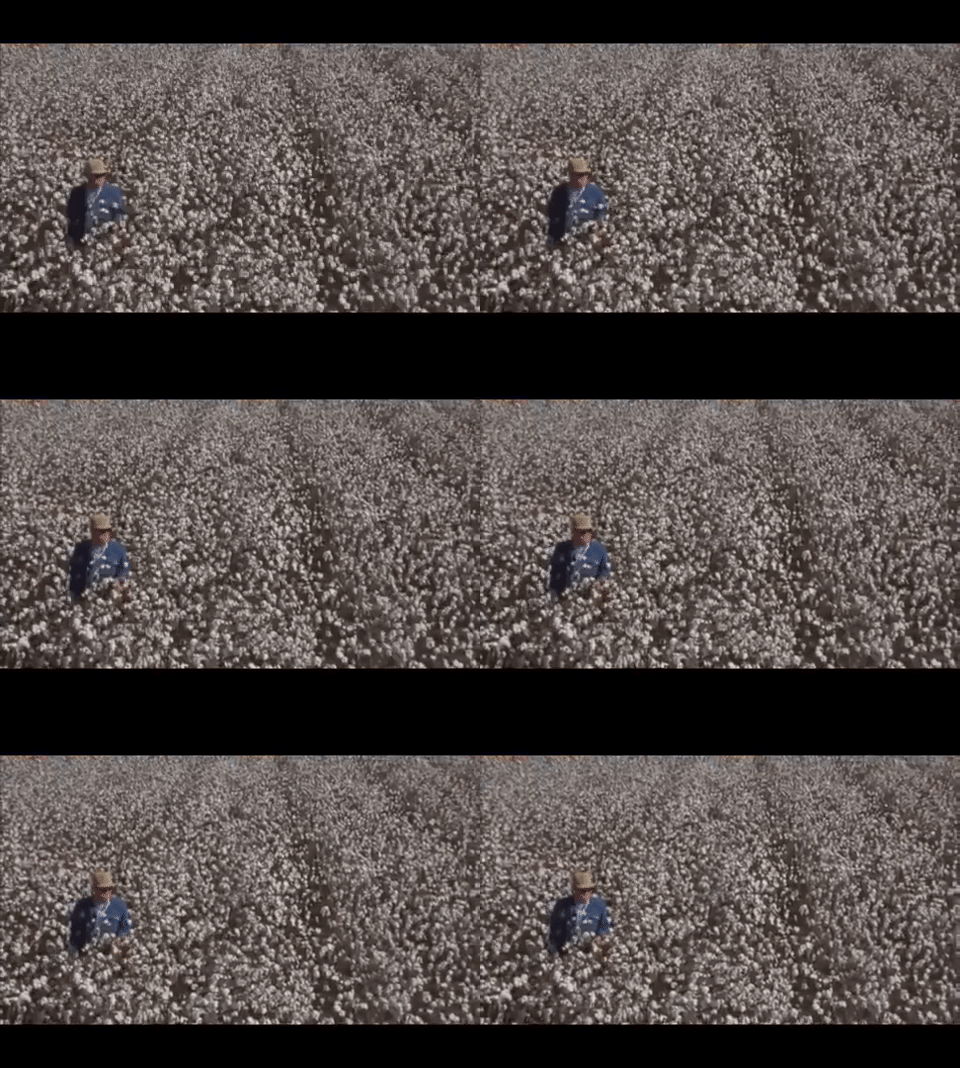
First, the good. Theroux writes rich, detailed descriptions of place and face that engage all the senses. When he tells you what a place looks, smells, sounds like, you can almost feel it yourself. You smell the musty, vegetative delta, feel the humidity press on your skin, see the play of light across the denuded cotton stalks or through pine woods. What kept me reading were the descriptions of the road, of cheap motels and dive diners, of people’s face, voices, and hands. I was entranced for about half the book.
The second good thing is that the author revisited the same towns multiple times over a year, traveling through in each season and writing beautifully about the subtle changes. Fall and winter in the deep south are subtle seasons compared to more northern climates.
Somewhere in the middle of the book, however, I began to feel annoyed, then irritated, then pissed off. I wasn’t sure why. I pushed on because I wanted to figure out why I was feeling increasing irritation when I had loved the first chapters so much. With a couple of weeks between me and the book, I now know why what I thought would be a five-star read turned to a three-star read.
I’ve been to all the states in the deep south, some many times, but I can’t claim to know them or have a deep understanding of their social and economic environments. Places and people are complicated, and I know that no place can be understood fully in a few short visits.
I also know that “seek and ye shall find” holds true in travel as in life. Whether it’s a form of selective perception or expectation bias, I don’t know, but when you arrive at a place looking for something to support what you already believe, making a bee-line for where you'll find what proves stereotypes and preconceptions, you’ll find exactly what you seek. In spite of Theroux claiming to tour the area with an open mind, it became obvious that he purposely went only where he was certain to find the specific people and situations to add living flesh to images already held as his truth. After reading far too much Southern Gothic fiction--which he quotes frequently for any and no reason--he’s looking to put faces to his cherished stereotypes. Oh, the poor, misguided South! So steeped in injustice, so impoverished in coin and intellectualism, so delusional in its mores. The Great World Traveler has arrived to explain your impecunious condition to the rest of the world so they can understand and feel pity. The Great Traveler will compare you to Africa and feign indignation on your behalf. He is worldly and can fully comprehend your entire being after passing through town a couple of times. Yeah. Right.
For someone who rails against stereotyping so much, Theroux does a lot of it. He seems to have the idea that all southern blacks are impoverished, downtrodden, uneducated, noble pawns with infinite patience and willingness to share their life story with strangers (or, at least, Theroux.) Meanwhile, all the whites are portrayed as either poor, bitter, paranoid, ignorant bigots or else somewhat educated, marginally affluent, pseudo-genteel, elder Southern belles and Beauregards pining for Antebellum days.
Theroux hit a mental speedbump when he encountered blacks who don’t fit in his little model of the deep south. If the allegedly rare confident, successful, eloquent black person was cooperating with his endless personal questions and requests, Theroux was effusive, almost cloying in his descriptions. When he came up against a busy nonprofit manager put off because Theroux rudely showed up late to an appointment with no phone call or apology, he made himself out to be the hapless victim. He claimed no wrongdoing: her annoyance was her fault rather than his; the problem was her defensiveness rather than his offense. When he tried to gain unscheduled access to John Lewis at the end of a book signing event and was neither recognized now welcomed by Lewis’ well-heeled, obviously affluent handlers, he was miffed at their coolness, tried--and failed--to explain the rebuff away as anything other than the fact that a strange road-worn guy being overly-familiar, creepy, and suspicious arouses a reasonable wariness in others simply because he was being creepy, entitled, and stalkerish. It’s not like John Lewis has never had a death threat directed at him, which alone is enough to make his inner circle vigilant and wary.
Theroux seems to indulge in a form of cultural appropriation or “collector” mentality about people. I felt like he was treating people as zoo exhibits, there for his convenience and entertainment--and to provide fodder for his book and thus augment his income. He didn’t seem interested in them as individuals as much as he was being a Lexus Liberal, someone who professes outrage at perceived social injustice because it makes them feel virtuous and holier-than-thou. Yes, there’s still plenty of racial disparity in the south. There’s still far too much racial disparity and prejudice everywhere. But there are also smart, affluent, well-educated people of color, yes, even in the deep south. It is insulting to treat them as anomalies, as if their successes aren't normal, as if they are rare unicorns unknown in the real world.
Theroux also claims that he liked being anonymous, but he certainly seemed put out when he wasn't recognized as “the famous travel writer.” Well, buddy, I consider myself a fairly broadly-read southerner, and I’d never heard of you either. I asked half a dozen people from various parts of the country, all of whom have college degrees, well-worn library cards and are well-traveled. They didn’t recognize your name either. I suspect, Mr. Theroux, it’s not that the entire south is illiterate or ignorant of celebrity, as you suggest: it’s that you are not as famous as you’d like to think you are.
He certainly detests Bill Clinton, that’s for certain. While I agree with his point that the Clinton Global Initiative and similar organizations could and should tackle domestic issues rather than pouring billions into other continents, Theroux’s dislike of Clinton came across as far deeper than a conflict of where to funding projects. It felt like a personal vendetta. He goes on and on about what he sees as Clinton’s character flaws and faults long after they cease to be relevant to the point at hand. He even tried egging on other people he met to join him in Clinton-bashing. When quietly shut down hard by one black farmer on the subject, he claims he never mentioned Clinton again. If only! He wrote about little else for several chapters. (The thought crossed my mind to wonder how much of the proceeds from this book will be donated to any of the organizations Theroux used as fodder for his book. I’m betting very little…as in zero. Never mind he didn’t hint at so much as picking up the lunch tab for any of the people whose time and stories he milked for material.)
Another thing that nagged at me was that Theroux detailed conversations where people tell him a flood of very personal information or opinions within a few minutes of meeting him. Why would they do that? Or, more specifically, did they really? How much of the conversations actually happened as written and how much was fabricated "for the story"? I have no idea, but I remain suspicious at the authenticity of the transcripts. These instantly-deep conversations are just too convenient, too immediately intimate, too in service of Theroux’s romanticized images about southern segregation and poverty. Yes, southerners have a reputation for hospitality and storytelling, but most of us have the sense to be wary when a stranger starts asking a lot of questions, especially when it’s obvious he’s on a fishing expedition.
In the end, I simply felt patronized and condescended to by the constant comparisons to other places, the agenda to dig up the past rather than look at the present, the stereotyping of the region while claiming to be objective, the newcomer expert who was going to tell everyone "how it is" after short exposure.
I think the book is worth reading simply because Theroux does know how to turn a phrase and write beautiful descriptions. It may also be worth reading because it does contain some historical information about the area. As an introduction to the region, however, I can't recommend it; there's just too much author agenda for a travel book--which is how the book is marketed--and not enough substance or information for it to be legitimate social commentary.
Oh, and one last thing, a minor geographic quibble: the Ozarks are not the deep south. They are the Ozarks. Trying to lump them together in any way is akin to comparing Bangor, Maine to Falls River, MA or Appalachia to the Gullah low country.
So, there was some lovely syntax and descriptions of buildings and scenery in the book, but I think Paul Theroux is merely a tourist making a dime off the locals and looking to validate cherished presumptions. I don’t think he knows or understands the social climate of the deep south any more than I comprehend the strange appropriative gestures of affluent white Cape Cod travel writers.