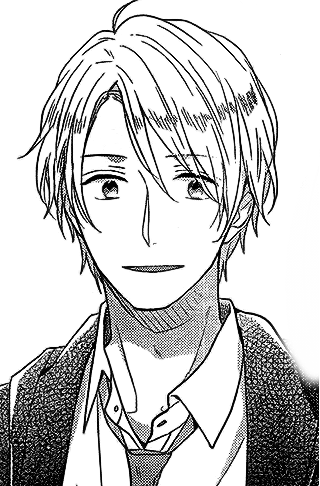
Mochizuki decides to flame out in spectacular fashion with his confession, but the person who really feels it is actually Anna. This leaves her out of commission as Mari decides that she has to make her own move before her chance is lost forever.
This isn’t bad and might actually be pretty solid except for a not so shocking revelation that I’ll make in due course. Lots of this volume is focused on poor Anna and her sudden influx of suitors, but, unlike a lot of manga, the way this drags out the end game is pretty smart.
Anna is not exactly experienced in matters of the heart, but she’s also a very nice person. So, when she reaches her answer for Mocchi, he might be taking it better than you’d expect, but she can’t get over the fact that she had to hurt him because she doesn’t share his feelings.
Which leads to a spiral of stress and worry that actually lays her up for large chunks of the volume. There’s a lot of anxiety here and Anna quickly brushes Natsuki’s desire to talk to the side because she’s absolutely not ready for this, even as she realizes that she likes him.
It’s the person you love versus the idea of love and Natsuki is good enough to step back and give her some space, even if he checks up on her because he’s a nice guy who cares. He’s also held back after a conversation with Mari, who realizes that she needs to say something now before Anna is lost forever (and Mari knows this is a lost cause, same as Mochizuki did).
Which leads to the big reveal of Mari’s backstory and Matsunaga’s endless pursuit of her paying off at last, when he is there for her to hear that story and provide the support she needs.
All of it sounds fine, but Mari’s love for Anna and her backstory are complicated and fraught and, bluntly, I don’t think this manga has the writing chops to give it anywhere close to the nuance that it needs. It is such a blunt force object.
This is also coming way, way too late in the proceedings, as Mari’s been awful for nine previous volumes and this would have helped make her slightly less unpalatable overall.
Then again, you’re looking at two different versions of this. In one, a charming young man saves a confused young woman and helps her learn what she finally wants. In the other, a pushy boor hammers on a bullied girl confused about her sexuality until she succumbs to her advances. And both are coexisting as one.
This is tricky and Mari’s backstory goes just shy of the usual taboo with her infatuation with her brother, but only just. There’s a lot of implication that she needs somebody to just be there for her, regardless of gender, but that really smacks of queer erasure given (again) NINE previous volumes.
Is there a way to pull this off? I think so. Just not in this story by this mangaka. If you’re not looking at it through my cranky lens, sure, it maybe, possibly works. But to me this whole thing feels like trying to thread a dirigible through the eye of the needle - best to not have done it in the first place.
Which is too bad because I do think most of Mari’s story creates a certain amount of ‘oh, now I get it’ that she needed. And Anna’s troubles are well done too. It might be the best that the series has ever done emotionally, but it still can’t work it out right.
People seem to like this quite a bit and I don’t think that’s wrong; I just cannot get past the disingenuous way it deals with issues that it really has no business touching if it’s going to be this half-assed about it (see also: the way it represents BDSM). It’s trying to be fluff and succeeding, but I think it crosses into territory it shouldn’t without proper understanding.
3.5 stars - credit where it’s due, but then the realization that every time this series comes close to a topic that needs a lighter touch it goes for the laziest, broadest outcome it can muster every time.
Mari mi ha sorpreso un po' alla fine del capitolo #36. Ha acconsentito che Nacchan e quelle parole alla fine del capitolo... Comunque viene alla luce il passato di Mari. . Adesso si capisce tutto quell'attaccamento verso Anna. Anna .
Matsun and Tsutsui were so adorable in this volume<3 On the other hand, Kobayakawa is my second favorite female character in the entire series but I just couldn't stand her this time.
My eyes are full of tears, I'd decided to binge this series till the end and omg, it's breaking all the stupid typical high school tropes past few volumes I'm so happy (っ˘̩╭╮˘̩)っ
"-Don't worry. When you're ready, come to me. -Me? -Yeah. -And you? -Yeah. -... you must be joking" *Proceden a abrazarse* MIRA YO NO PUEDO MÁS. AMO A MATTSUN Y AMO A MARI. TOMO REDONDO Y QUÉ GANAS DEL SIGUIENTE SOS
I liked this quite a bit. The kids are having some serious conversations and making a few things clearer for the reader. I don't know what I'll write that might end up as a spoiler, so going into stealth mode...
Look, Mattsun's seemed creepy at times, but this is supposed to be a manga about four friends who are good kids with different qualities taken to extremes. From that approach, there's nothing nefarious here. These boys aren't going to take advantage of these girls. They weren't designed that way and it's not that type of manga. It's awkward at times for sure. Like - I don't know how to take Kei-chan's fetishes seriously. But that's the point right? Does any high school kid in a manga have everything figured out? High school kids in life don't have it figured out. Everyone learns and grows and adjusts on the go.
This isn't a drama. It's silly and supposed to be mostly lighthearted, but it's still high school where drama and uncertainty abound so it's going to hit certain topics and go over the top on absurd ways. It might not always hit the mark. For me, personally, the issue has been more about consistent entertaining quality. Some of the previous books have been boring to read ("Like a Butterfly" also falls into this category). But this one was a decent read. There are better manga out there that hit the nuances, like "Waiting for Spring", or that hit the comedy balance perfectly like "Monthly Girls' Nozaki-kun." But I like the extreme personalities here and enjoy reading Rainbow Days when something is actually happening, like it does here.
The bonus is seeing the conversations started in the reviews. It takes time and a measure of care to write lengthy dissections of the characters and plot points, and that's maybe the more interesting part of reading and reviewing this manga (and other books in general). For the most part, the psychology is there correctly, but it's not perfect and we get to point that out and theorize or critique, and share our thoughts - which vary from reader to reader, as it should. I rather enjoy that.
This volume focused like 66% on my least favorite couple (the ones on the cover), and, just, siiiiiiiiiigh. I’ve hated their arc the entire time, and I continue to do so. (Diversity win! You get a wlw character in a mainstream shojo romcom, but she’s a man-hating lesbian stereotype who gets paired with the womanizing guy by the end of things! /sarcasm)
the end of the school trip!! my ship is like thriving but also this volume was a much somber mood than the others. i feel like they had some meaningful conversations and hopefully all the problems they have in their head gets resolved
Finally some real progress between Matsugun and Mari. Natsuke and Anna are really taking their time to build their relationship and it is almost frustrating.