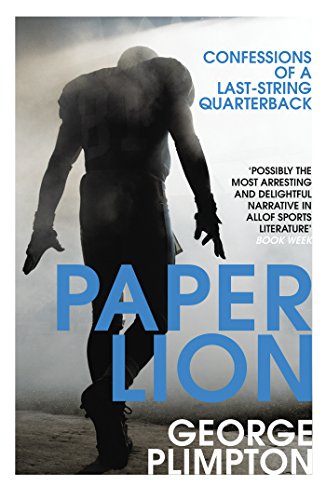
Paper Lion is perhaps the first behind the scenes look at a pro football training camp. The excellent George Plimpton, first Editor in Chief of the Paris Review, wrote a series of pieces using "participatory journalism," a technique where he actually joined in the games he covered. In 1958 he pitched against National League all-stars in an exhibition baseball game at Yankee Stadium and wrote about it in his book "Out of My League." While on assignment with Sports Illustrated he stepped in the ring for three rounds with boxing legends Archie Moore and Sugar Ray Robinson. He trained as a goalie and took a turn between the pipes for the Boston Bruins in an NHL preseason game, writing about it in his book "Open Net." He also took turns golfing on the PGA tour ("The Bogey Man"), playing Pancho Gonzalez in tennis, playing world-class bridge, walking the tightrope as a circus performer, and more.
George joins the NFL's Detroit Lions for their 1963 preseason training camp trying to make the team, a 36 year old league rookie, as their "last string quarterback." The coaches know that a writer is in their midst, but the players, at least initially, do not. Plimpton formulates an elaborate story about having played quarterback the previous season in Canada for the "Newfoundland Newfs," but his cover is blown in one of several laugh out loud funny scenes the first time he attempts to take a snap from center and doesn't know where to put his hands.
Plimpton lives with the team throughout training camp, attends the meetings, studies the plays, participates in night raids on other players wearing `fright masks," and spends exhausting days with them on the practice field, notebook and pencil ever at the ready and often stashed when he is called onto the field. We meet legendary characters such as cornerback Dick "Night Train" Lane (who was married to singer Dinah Washington), middle linebacker Joe Schmidt (Pro Football Hall of Fame, 1973), and the incomparable Alex Karras, defensive tackle and actor (Blazing Saddles, Webster). Karras was on suspension that year (along with Paul Hornug) for gambling, but makes appearances in Paper Lion nonetheless through the hysterical stories of his teammates. The 1968 film version of Paper Lion does feature the reinstituted Karras, incidentally, who very nearly steals the show from star Alan Alda and launches his own screen career.
Plimpton has a gift for understatement. He enters the story with the uninitiated eyes of the average "everyman" allowing the reader to jump right in and experience everything "firsthand" through him. We are there with him when he finally takes the field in an intra-squad scrimmage in Pontiac Michigan before of thousands of Lions fans who wonder exactly who this new player is wearing the number "0" jersey. Plimpton actually ends up taking five snaps in the game, running each of the five plays he has learned, with hilarious results.
Paper Lion was one of the first glimpses behind the scenes into the world of NFL football, and it was a huge hit. Paper Lion is a fun and somewhat revealing read, but I am left wondering if pro sports of the early 1960's was really full of the innocent fun portrayed here, or if more incriminating things were left out as revealed in books which came out soon thereafter such as Ball Four by Jim Bouton (1970), which chronicled the rampant womanizing, alcohol, and drug abuse in the far less violent world of professional baseball. Plimpton briefly touches on the problems of alcohol and gambling, but I am left wondering what else could have been said.
Special Note: Alex Karras' own book about his playing days, titled "Even Big Guys Cry," is another terrific read. Even though it is out of print, it's stories of football legends "Champagne" Bobby Layne and Eugene "Big Daddy" Lipscomb are true gems that will have you rolling with laughter. If you can find it I highly recommend picking it up.