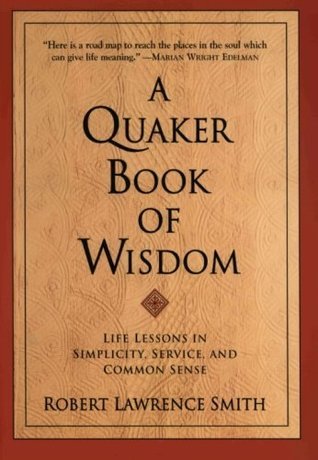
"The most valuable aspect of religion," writes Robert Lawrence Smith, "is that it provides us with a framework for living. I have always felt that the beauty and power of Quakerism is that it exhorts us to live more simply, more truthfully, more charitably." Taking his inspiration from the teaching of the first Quaker, George Fox, and from his own nine generations of Quaker forebears, Smith speaks to all of us who are seeking a way to make our lives simpler, more meaningful, and more useful. Beginning with the Quaker belief that "There is that of God in every person," Smith explores the ways in which we can harness the inner light of God that dwells in each of us to guide the personal choices and challenges we face every day. How to live and speak truthfully. How to listen for, trust, and act on our conscience. How to make our work an expression of the best that is in us. Using vivid examples from his own life, Smith writes eloquently of Quaker Meeting, his decision to fight in World War II, and later to oppose the Vietnam War. From his work as an educator and headmaster to his role as a husband and father, Smith quietly convinces that the lofty ideals of Quakerism offer all of us practical tools for leading a more meaningful life. His book culminates with a moving letter to his grandchildren which imparts ten lessons for "letting your life speak."
A delicate whiff of sanctimony wafts from these pages, beginning with the title - there's some wisdom being bestowed on us from above. Is it a little self-aggrandizing to call your book a "book of wisdom"? Smith has done admirable things. One of them was serving in an Army platoon in Europe during World War II, when he didn't have to. He went against his Quaker heritage of pacifism, which would have encouraged him to become a conscientious objector. In some other, less necessary war, he probably would have objected, but he had spent most of his childhood being aware of Hitler and tyranny.
"Life lessons in simplicity," the title continues, which makes it sound as if we're discussing the Amish. The Quakers I know are extremely well educated. They have three or four degrees, usually from Ivy League schools. As a result money tends to accrue to them. They are prosperous. Some of their money is earned through their own diligence and meritocratic efforts, but some of it is inherited from their parents and grandparents. It is a bit offputting to be getting "life lessons in simplicity" from this group of people. I don't want to be too critical, because many of them are doing good in the world (much of the book is about service and good works). But the whole simplicity trope, as if we're still in the early 19th century, needs to be shelved.
The phrase that popped into my head reading this was "virtue signaling." That's not entirely accurate; it's not empty posturing. There is well-meaningness behind the motives. But there is something grating in the messaging. Your Quaker peer was spending her summer digging wells in Guatemala; what were you doing? (You had a summer job that earned you money, because you actually needed to earn some money.)
And although Smith writes about faith, and occasionally mentions something biblical, when I think about the Quakers I've known - practicing Quakers (is there another kind?) - faith wasn't central to their lives. I never heard them mention God. If it was there at all, it was well hidden. Their virtues, their religious questing, were completely secularized into charitable acts and social justice.
Service, to serve, to be a servant - this is where humbleness and greatness become a single thing. One of the most beautiful utterances ever said was this, by Martin Luther King Jr. from the pulpit of Ebenezer Baptist Church on February 4, 1968: “If you want to be important—wonderful. If you want to be recognized—wonderful. If you want to be great—wonderful. But recognize that he who is greatest among you shall be your servant. That’s a new definition of greatness. And this morning, the thing that I like about it: by giving that definition of greatness, it means that everybody can be great, because everybody can serve. You don’t have to have a college degree to serve. You don’t have to make your subject and your verb agree to serve. You don’t have to know about Plato and Aristotle to serve. You don’t have to know Einstein’s theory of relativity to serve. You don’t have to know the second theory of thermodynamics in physics to serve. You only need a heart full of grace, a soul generated by love.”
Shortly after starting the chapter on pacifism I became annoyed. Why is someone who gave up his principles and went to war writing in support of that subject? As they say, being a pacifist between wars is like being a vegetarian between meals. Then I realized that he wasn't actually writing about satyagraha or even peace. He was writing a bunch of feel good mush, vague in the way horoscopes are, so they can apply to anybody no matter what's really going on. Still, I hung in. My dearest friend gave it five stars and I didn't want to give up on it before reading her notes and talking to her. After all, she holds that place in my life because I always find her perspective enlightening. But when the author ended the chapter with, "All we have to bring to the task is love, and the will to bestow it more generously than we have in the past," I had to restrain myself from throwing the book against the wall. (It's a library book.) Do I need to explain why? I will. Because pacifism is SO MUCH HARDER than that. Who could apply that statement of the author's to real life? It makes you feel good, but how does it help you deal with questions like, "if we don't hurt them, will they hurt us?" or "what do we do with the anger this whole nation feels?" or "I just need my three-year-old to stop screaming and does one smack really hurt him?" It doesn't. It just makes you feel good while reading it.
Except for the few paragraphs at the start of each chapter describing the history of Quaker implementation of each virtue, this book was a bunch of simplistic drivel.
I reserve the right to completely change my mind after I see Ami's notes.
I've been attending Quaker meetings for close to three years now. I read this book toward the beginning of this phase of my spiritual trek. Though occasionally the book contains a gem of insight I don't think it accurately depicts the state of unprogrammed friends or their values with much accuracy. The author certainly doesn't speak for my experience in the society of friends; his qualifications for presenting the views of this very diverse bunch seem to be mainly that he was birthright and that he led a large friends school (itself not much of a qualification given the rampant elitism of most friends schools and their almost complete abandonment of what made them distinctly Friendly in the first place). His chapter on pacifism is particularly egregious as is his insistence on pointing out his Ivy League education on seemingly every page. Rex Ambler's the Quaker Way, pink dandelion's very short introduction to Quakerism, or John punshon's encounter with silence are better as far as introductions to unprogrammed Quaker experience, with the VSI demonstrating the extraordinary diversity existing amongst those that call themselves friends.
I think I like the Quakers the best. They have no church and no service, instead having "Meeting" at which someone may feel compelled to say a few words or it may be an approximate hour of complete silence. Silence is revered as a time of reflection, introspection, whatever.
Quakers refuse to take oaths, believing if you always are truthful an oath to be truthful is redundant. You cannot distinguish one truth from another by oath.
Simplicity is sought in all areas of life. All people are equal regardless of gender, color, age, occupation, etc. Education is a priority and many Quaker schools and colleges exist. Being pacifists, they avoid violence in any form. Service to all in need is their ultimate goal and life's objective.
The "Friends" seem to have adopted the best of human nature. Nothing crazy or freaky that i could discern. Oh yeah, and they have nothing to do with Quaker Oats but, if you like Cadbury eggs, thank the Quakers.
This is the best introduction to the Quaker way of life that I have come across. I'm not a Quaker, but there is a Meeting House very close to where I live and I attend some of the meetings.
"For Quakers wisdom begins in silence." (page 16)
It is both a mystical and a practical approach to life, that very much suits current eco-priorities: waste is anathema to Friends.
Absolute stress is placed on speaking truthfully. "The truth shall set you free." (John)
There is a story about Quaker farmer who was walking down the road and saw a shorn sheep in a field. When asked later if the sheep was shorn or not he said, "Well, certainly he was shorn on the side facing the road."
I recommend this book to anyone who wishes to gain an understanding of what it means to be a Quaker.
A quiet & inspiring look at basic beliefs & tenets of living a life of love & service. A very nice little book with valuable & thoughtful ideas for today's world.
Well . . . let me begin by telling you why I read this book. I am not a Quaker, but I remember the first time I ever heard about it - in an 8th grade history class. I felt a bit of interest, like a chord was struck, and I liked the idea of silent worship. However, in my adult life I've never pursued any affiliation with the Quakers... and now I'm a Bible believing born again Christian, so I'm looking at Quakerism through that lens.
I decided to read this book because I recently got involved with researching my family tree and discovered one branch dates back to 1682 when William Penn came to America from England on a ship called the Welcome filled with Quakers including a man named William Smith, who I believe was my ancestor. Now, in 1882 my ancestor was a teenager, but he lived with another family for a while then built his own home in Pennsylvania, and lived there the rest of his life. His house still stands near Wrightstown.
Naturally this discovery made me want to learn everything I could about William Smith, the Quaker, and that led me to look for information on Quakerism. When I saw that this author's last name was Smith his book became irresistible to me as I wondered if he was a long lost distant relative. Unfortunately he barely mentions his Smith relatives who were living in Philadelphia. He had much more contact with his mother's Quaker family (last name: Stokes) in the small town they lived in, so family anecdotes in this book are mainly about those local grandparents who he apparently adored.
Now, as a Christian I am very disappointed to learn that Quakers don't honor Christ's request for us to be baptized. There may be some sects of Quakerism that do that, but the main group of Quakers on the East Coast don't seem to care much about the Bible or what's in it. There are videos on YouTube that verify this. They also ignore Christ's request for us to take communion. I personally have a problem with a group that gives lip-service to Christ and cherry picks verses from the Bible to quote, like 1 Corinthians 13, then ignores whatever parts they want to dispense with. This doesn't compute for me, and puts Quaker into a category, in my mind, of big overgrown cults. I have run into other groups that do this same thing. It is like they want to affiliate with Christ just enough to justify their philosophy as being connected with Jesus, but they don't think enough of Him to honor His requests like baptism and communion.
I know there are quite a few sects of Quakerism these days and many Quaker churches on the West Coast (where I live) are likely to have sermons in church and honor the Bible more, but I don't know to what extent, and it really doesn't concern me much. I don't belong to any denomination and figure God knows each person's heart and can decide on all matters of salvation. I don't know the hearts and am no judge of others.
While reading this book I marveled at how reasonable and wonderful everything was. Non-violence, good idea. Serving others, good idea. Ethical business practices, good idea. Who can argue with things like this? I wouldn't. I couldn't find anything to disagree with in most of this book, and it all sounded fantastic except for the naivete about Jesus.
"Quakers do not accept the idea of original sin, nor do they believe in a personal God who rewards and punishes. Friends do not baptize . . . . Despite their Christian roots and the continued interest of many Quakers in the lessons of the Gospels, the relationships between the sufferings of Christ on the cross and what Quakers call "the light within" has always been pretty murky. Forget eternal damnation. Forget salvation. And hell, heaven, and purgatory. Look for truth within yourself and within the Meeting for Worship. Live a life of simplicity, love and service." (pages 18-19)
So Quakers (the traditional groups) gather in a meeting house weekly and sit silently together. When someone gets an inspiration, he or she starts to speak.
Now, I can see some benefit in group meditation, silence and contemplation. I see benefit in everything the Quakers do: service, simplicity, conscience and everything else. However I think they've gone astray in setting aside the Word of God in favor of just what's in their hearts. I know we have a still small voice within, and that there's much to be learned that way, but it doesn't have to negate the Word of God, the Holy Bible, and Jesus Christ, son of God.
While researching my ancestry I learned that my Quaker ancestor, William Smith, had a family Bible that was apparently important enough that there's a record of which of his 15 children was given possession of it when he passed away. I've heard that the early Quakers were much more dependent on their Bibles. I'm curious about how the founder, George Fox, felt about the Bible and Jesus Christ, so I'm planning to read his autobiography (journals he kept) later this year. While scanning through that text on the Project Gutenberg website I found he mentioned William Smith, a man he was in jail with in England. I believe that was the father of the William Smith that immigrated to America on William Penn's ship, the Welcome. They both had the same name.
Now the hard part - what do I do about giving this book a star rating? I liked 99.9 percent of everything written in there. Like I said, who can argue about these philosophical ideas on how best to live? I liked the way the book was organized. I liked the writing style. While it is a nonfiction explanation of Quakerism, it is also at times similar to a memoir as he talks about his personal experiences as a lifelong Quaker. I don't want to give the book one star only, because I disagree with the non-Christian philosophy. It wasn't a bad enough reading experience to give it only two or three stars. So I've decided on four. I can't ignore the quote above from pages 18 and 19. That breaks my heart for whoever thinks the teachings of Jesus can be dispensed with in favor of only listening to the inspiration within.
Traditionally I am not a religious person, but there is something about the simple rationality and fairness of this book that speaks to me. It's lessons on finding one's own truth amid a noisy, chaotic, and uncertain world provide valuable insight and unintentionally oblige us to reflect on our own lives.
Favorite quotes:
“How much of life can we learn from books? … Deuteronomy reminds us ‘We all warm outserves by fires we did not build and drink from wells we did not dig.’”
“Life is not a problem that can be solved. It must be lived each day, and each day brings a jumble of choices that challenge our practical wisdom, our common sense, and our yearning for truth. Your choices in life are enormous. They come at you in battalions.”
“We miss the possibilities of the present by continuously thinking ahead to the next activity, planning for the next day, the next weekend, the future. Our conscious lives are continuous fast-forward. Others of us seek to escape current problems or dissatisfaction or boredom by constantly looking back to events that took place in the past."
I'm glad that I picked up this little gem of a book. It's pages are filled with pearls of wisdom. The book was written by the author as a living legacy for his family. When I picked the book up there wasn't much that I knew about the Quakers, this book opened up my eyes to their faith, and put me in tune with the "whys" of their simplistic life style. First and foremost I think it's very important to let my fellow readers know that Quaker wisdom begins in silence. Their founder, George Fox, asks fellow believers to listen to the "still small voice". The voice that dwells within us - the voice of God that speaks to us and that we express in our deeds. Fox believed that the divine spark is inside all of us, and that spark leads us towards the good, towards the best of ourselves. The Quaker's faith is very optimistic, not a lot of fire and brimstone. We are to seek our inner voice, heed it, and let our lives speak.
I found this book sitting in a box of discarded items outside my apartment building. I am not at all a religious person, but I picked it up anyway. I was able to take away some important points and themes and bypass the parts that did not really speak to me. Historically speaking, they are an interesting group of people--they were anti-slavery and promoted peace, social justice, and sustainability.
I think the parts of the book that spoke to me personally were the sections on Silence, Truth, and Service.
I loved this book. I am intrigued enough from this book that I think I'm going to find a Friends meeting in my area and attend. I'm also going to look more into the Quakers; I'm not very familiar with them and I'd like to know more.
I revisited this book for the first time in a long time. Part Quaker history, part Quaker theology, part personal memoir, it reads as somewhat quaint and old-fashioned 26 years after it was first published. The first few chapters on silence, worship, and truth are my favorite, for they really distill the essence of what I hold dear about Quakerism.
I've long admired Quakers and Quaker enterprises. This book gave keen insight into Quaker philosophy. I recommend it to anyone seeking to learn more about Quakers.
Part memoir part Quaker theology and practice, offering good advice and nuggets of wisdom for daily living from a Quaker perspective. I found it to be a bit idealistic, but had some good things to say. The author comes from a long line of Quakers, and was raised a Quaker so it seemed a bit foreign to me after coming from many generations of dysfunctional and non-religious families. As a result, I couldn't really connect with much of what the author shared about his white-picket-fence life. Nevertheless, to not throw the baby out with the bathwater, I did glean some good nuggets of wisdom from this book. My favorite quote:
"History teaches us that darkness and death take different forms in every generation, but the challenge of gathering the forces of light and love to oppose them remains the same."
- Robert Lawrence Smith pg. 79.
Overall, a decent book. But, one I couldn't really recommend as it seemed a bit dated, self-centered, and idealistic.
I originally picked up this book in hopes of finding a clue to my never ending search of how to simplify my life. I found instead a guide book for a way to live my life. Robert Smith talks about the ethics and simple guidelines that Quakers aspire to live by. He explains why telling the truth is just simpler and that the difference between happiness and pleasure is that pleasure is something you pay for. It is a fast read with chapters on service and family. I had been looking at the teaching of Buddah for peace of mind. This book however says stop thinking about your own peace of mind and just get out there and help the world become a better place. "let your life speak"
Quick and interesting read about the fundamentals of the Quaker religion. The "Ten Life Lessons" presented at the end of the book are helpful tools regardless of religious preference. Now if only I could better execute the concept of silence ...
LOVED it. I'm so glad it was my first non-fiction book of the year. The first three chapers were full of jaw-dropping wisdom. I highlighted paragraph upon paragraph.
required reading for my new job...I am thrilled to be working in in Friends school and love the ideals Quakerism strives to uphold. a wonderful inside look.
Well written and steady insider examination of the sometimes misunderstood Quaker viewpoint. I thought in spots humility wavered in biographical backdrop and flow was sometimes borderline preachy. These were my own picayune flaw interpretations. The silence aspect of Quaker Meetings remains mysterious to me, albeit one I'm curious to learn more about or experience. I would recommend the book to inquisitive searchers. This is a good book about a good way to live.
My favorite takeaway was this timeless observation. Smith wrote, "Most public discourse is suffocated by rhetoric in the service of an effect and argumentation that insults thought in the service of a chosen conclusion. Facts and Truth often seem to be incidental and accidental." Quite an apt description of fractious political discourse today.
Here are other thoughtful quotes:
Smith wrote:
[Truth seeking] is an interactive process that requires openness, diligence, and discipline in equal measure. The search for truth is a lifelong pact with our inner lives that encompasses seeking the truth, recognizing the truth, speaking the truth, and living the truth - which is to say, letting our lives speak. P. 27
Speaking the truth is the first step toward letting your life speak in a way that is honest and authentic. P. 27
Quaker simplicity in a nutshell...has little to do with how many things you own and everything to do with not letting your possessions own you. P. 36
At the end of the day, it isn't the things we accumulate and that have cushioned us that count for anything. What counts is our ability to recognize the small miracles sprouting in our midst and to share them with others. P. 40
The French philosopher and essayist Montaigne wrote, "If you have known how to compose your life, you have accomplished a great deal more than the man who knows how to compose a book. All other things - to reign, to hoard, to build - are, at most, inconsiderable props and appendages. The great and glorious masterpiece of man is to be able to live to the point." P. 41
History teaches us that darkness and death take different forms in every generation, but the challenge of gathering the forces of light and love to oppose them remains the same. P. 50
The sense of fulfillment in all altruistic efforts must come from the doing, not from tangible results - and certainly not from expressions of gratitude from the people you're trying to help. P. 66
"The light is available yesterday, today, and to eternity. What is thee doing about it?" Lucretia Mott p. 73
[E]veryone wants to buy from people that trust and avoid those they don't. If a manufacturer makes false claims for his products, he does fatal damage to the unspoken covenant with his customers. P. 80
In some ways it's become much more difficult to educate a child than it was in generations past. Students tote along with them to school, just as surely as they carry their backpacks, a media culture that functions as a highly competitive educational system. It is a culture focused on television, film, advertising, and pop music - media that promotes lifestyles that often include drugs, promiscuous sex, and misogyny. It is omnivorous in its consumption of idealism and masterful and it's substitution of lesser gods. It's seduces our children away from the habit of real thought and substitutes self-absorption and materialism. P. 84
Formal education is only a jumping-off point for a lifetime of learning and doing, and what concerns good schools are good teachers is how students apply the learning they acquired to living their lives. P. 84
I’ve always felt drawn to the quiet simplicity and peaceful values of Quakerism. When this little book that I’d never heard of before showed up in my Little Free Library, I decided to learn more about the philosophy behind this religion. Quaker wisdom, through the values of humility, service and non-violence is discussed at length here in every aspect of life: work, family, school and community. The messages here felt like a breath of fresh air at a time when so much self promotion and material acquisition seem to dominate our culture. Even some religions have fallen into this type of messaging, touting prosperity and abundance as somehow among our highest human ideals. And though I’m not one inclined to join a particular religious organization, I do consider myself a seeker, always looking for the kind of spiritual wisdom that just rings true to me and inspires me to be a better human. So when I kept reading the phrase “letting your life speak”, I knew that the theme of this book held something truly meaningful for me.
Smiths book is a deeply personal reflection on the Quaker experience in America. Each chapter looks at a specific lesson that Smith has learned from his being a life long quaker, including service, simplicity, business, education, and family. While at times it is difficult to separate out Smith's resistance to contemporary culture from his quaker experience, even in these moments he offers a moderated and nuanced resistance. Overall, his book not only communicates quaker ideas, but transmits quaker experiences in personal stories and affect-laden reflection. Smiths book helps the reader to feel "Quakerly"
There is value here, but not as much as you’d think.
My biggest hangup is his insistence on talking about Sidwell as a model for schools and how education should be done. The tuition there for a single year is about $60k.
The students there are not typical of an American school, nor are the support structures built into a place like Sidwell. If you want to demonstrate incredible educational models, it needs to work in the lowest funded, most difficult schools across America. This reeks of an elitism that seems to have good intentions but misses out on the fact that most students don’t come from the kinds of families or backgrounds that Smith discusses.
This is a small book that takes the reader through the basic lessons of the Quaker life, written by a man whose forebears brought Quaker life to America. I enjoyed the lesson and found the book had a quiet dignity, with chapters on silence/truth/simplicity/ conscience/ non-violence/ service/ business/ education and family. I particularly enjoyed the Service chapter, and could relate to the essential beauty of service that can be seen in the life of people of many faiths. Robert Smith writes convincingly, emphasizing his belief in the essential godliness in all of us. Highly recommended.
In actuality a 3.5. Warm and welcoming yet truly not as deep as it might’ve gone. This is an inspiring book. I enjoyed learning about the Quakers and loved the small amount of history thrown in. But the book suffers somewhat in its focus on memoir. So much of that is just not relatable and almost jaw-dropping. I don’t know that I’ve ever ‘seen’ a more stable background and family, even through the generations. Wouldn’t that make life sooo much easier. This was recommended to me though and I am glad I read it.
This book was a disappointment. Instaed of actually being a book that helps me understand Quakerism better, this became a long rambling autobiographical narrative that offered few insights. He did cover George Fox and the creation of the Friends Sociity in the book. He describes a few of his own journeys in concluding conflicting beliefs with reality and how he handled them.
This book started out with a lot of potential but it failed ot live up to its title. Two stars.
Man, quite a book. In some ways a glaring product of the 90's in the same vain as Tuesdays With Morrie. But so much better though. Fuck, I wanna be a quaker. Honestly, I think if more people affirmed and practices these values, a hell of a lot of the world's problems would be wayyyy better right now.
A great summary of one man’s experience as a birthright Quaker. I am the daughter of a birthright Quaker and Episcopalian. My dad also was a descendant of a long line of Friends. I attended meeting quite often as a child and spent time amongst Friends. The author provided what I was seeking, a reference that provides a sense of Quaker beliefs and values. I plan to share it with my children.
Man, quite a book. In some ways a glaring product of the 90's in the same vain as Tuesdays With Morrie. But so much better though. Fuck, I wanna be a quaker. Honestly, I think if more people affirmed and practices these values, a hell of a lot of the world's problems would be wayyyy better right now.