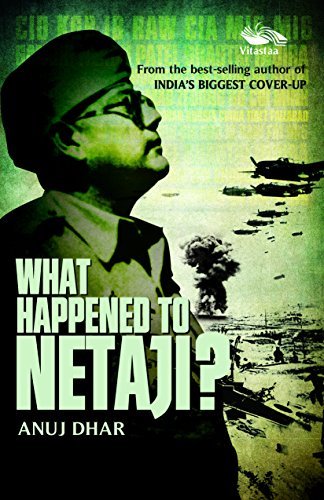
In 2013, the Lucknow Bench of the Allahabad High Court described as ‘genuine and based on relevant material’, Anuj Dhar’s writings regarding the controversy surrounding the fate of Subhas Chandra Bose. So, what really happened to Netaji? What is the factual position with regard to the air crash that reportedly killed him in 1945? Is there any truth behind Subramaniun Swamy's belief that Netaji was killed in Soviet Russia at Jawaharlal Nehru's behest? How do the biggest names of the past and present, from Mahatma Gandhi and Vallabhbhai Patel to President Pranab Mukherjee, and Atal Bihari Vajpayee fare in India's longest-running controversy? Who was Gumnami Baba of Faizabad, and if indeed he was Netaji, why did he not surface? Above all, what is preventing the Narendra Modi government from declassifying the Netaji files? The answers would make you believe that truth is stranger than fiction.
Anuj Dhar is an Indian author and former journalist. Dhar has published several books on the death of Subhas Chandra Bose which (according to official and academic views) occurred on 18 August 1945, when a Japanese plane carrying him crashed in Japanese-occupied Taiwan.
The book gets an 8 rating pretty much because of the explosive content and the thoroughness of the underlying research. This is the third book by journalist cum researcher Anuj Dhar. I have read his second book i.e. “India’s Biggest Cover up”. To pass the good word around, I gave it to an acquaintance and of course never got the book back.
Dhar and his friends at Mission Netaji have been working tirelessly for almost a decade to generate public awareness and put pressure on the Bharatiya government to declassify the Netaji files. It is primarily due to their dogged approach that a large volume of files on Netaji has been made available to the public. Their extensive use of the RTI instrument to force the bureaucratic crocodile to open its mouth is quite unique, especially where contentious historical issues are concerned.
I will briefly summarize the book contents before giving my comments on the book.
Book summary:
The book is essentially an updated version of Dhars 2012 book, “India’s Biggest Cover up”. The book picks up from the India Today story of 2015 which used the declassified documents to show that Netaji’s family has been extensively spied upon by the West Bengal (WB) government and the Government of India (GOI). It then updates the reader on the present status of the demand with pressure increasing on the Modi government to declassify the files (At the time of writing the major bulk of documents has been put online by GOI thanks to Narendra Modi). Mamata Banerjee stole a march on the vacillating BJP government by declassifying the files lying in WB closets. Also chronicled are Mission Netajis efforts to coax the files out of the government.
From the 2nd chapter onwards the reader is taken back into the late 1940s with the dramatic declaration of Netajis death in 1945 and the doubts which were expressed about the air crash theory by Allied intelligence agencies. The underhanded manoeuvring by “Chacha” Nehru, who setup the first sham commission in 1956 led by ex-INA Shah Nawaz Khan, is well described and backed up by solid evidence. Dhar skilfully describes the shoddy and biased investigation conducted by the congressified Shah Nawaz. The shenanigans of the second sham commission setup under Indira Gandhi in 1975, the Khosla commission, is also described in great detail.
The integrity and frustration of the head of the third commission, Justice Mukherjee, is also documented in detail. The Mukherjee commission was setup in 1999 towards the fag end of the NDA government and presented its report in 2006. The conclusion of the report was: the air crash story of Netaji’s death was fake. The Congress government rejected the report outright. The undercurrent running throughout the book and something that literally hits you in the face is that of “Bhagwanji” alias “Gumnami Baba”, a sadhu who lived in Faizabad, Uttar Pradesh. By the skilful use of first-hand accounts and credible evidence, Dhar shows that Gumnami Baba was Netaji. For those who do not know this, Gumnami Baba passed away in 1985 and in Uttar Pradesh there was a strong outcry in the local media for the government to take action. A case was lodged in 1986 and in 2013 the court gave a decision to preserve and inventory Bhagwanji’s belongings. As I follow Dhar on Twitter, the items that are coming out from Bhagwanjis belongings are truly incredible: personal photos of Netajis family, intimate records, rimmed spectacles, Omega watch…the list is endless.
Some of the most interesting and startling bits about the book are the chapters on Bhagwanji and extracts from a Bengali book called “Oi Mahamanab Ase” . I won’t spoil the suspense and would encourage people to read the book. Needless to say, the thrust is that Netaji was alive post 1945 and was involved in epoch making events in India and across Asia. Another interesting aspect brought out is that Netaji in his incarnation as “Bhagwanji” was strongly pro Hindu. This contrasts with Netaji’s blinkered view of Islam, which has been analysed by Sarvesh Tiwari in his blog (https://bharatendu.com/2011/02/10/sub...). The confused attitude of great Hindu leaders towards Islam is hardly new and the catastrophic consequences are well recorded.
My comments: The write-up is solidly backed by historical and documentary evidence. The book is well written. For outsiders it is quite enlightening to learn of the different factions in the Bose family (pro air crash theory and anti-air crash). For me personally, the air crash theory never held water. There was never a doubt in my mind that Netaji did not die in the air crash.
There are no quibbles about the content except that Dhar professes himself to be an anglophile. For anyone who has read or knows about the magnitude of British atrocities in India, this is quite annoying. However this attitude is held by a considerable number of well-meaning Bharatiyas, an artefact of our malfunctioning education system.
The major quibble is about the quality of book production. The paper and cover are good, but the typesetting is patchy and quite haphazard. The editing also is not upto the mark. Quite a few typos in the text. The book was clearly brought out in a hurry, possibly to pre-empt the release of the Netaji files by GOI. The previous book was well laid out and the planning showed through. I hope the next edition will correct these issues.
My recommendation is to buy the book . As I said previously, the content is excellent.
This entire review has been hidden because of spoilers.
If you haven’t read any book on Netaji Subhas Chandra Bose’s controversial death, then this is the book that is recommended for the first reading on the subject. This book can be considered as a condensed form of the author’s earlier book “India’s Biggest Cover-up”, which invariably substantiate the fact that, the death of Netaji in aircraft crash is an elaborate hoax.
However, this book, which was published four years after “India’s Biggest Cover-up” have the following shortcomings. 1) It still fails to find conclusion in the mystery. 2) We may get the feeling that, the author was trying to malign the legitimacy of Netaji’s daughter, Mrs. Anita Pfaff (the topic wasn’t raised in the first book). 3) We may also doubt that, the author has become more voracious critic of past Indian Governments (particularly ruled by Indian National Congress) involvement in the mystery, compared to his last book, for appeasing interested parties in the current Indian Government (ruled by Bharatiya Janata Party). 4) The author fails to give a clear explanation on why, several governments including the current government, is reluctant to release information regarding Netaji’s mystery. 5) The author completely believes that Gumnami Baba is the re-appearance of Netaji after independence. However he fails terribly to make us understand the real cause of such transformation. His possible claim of secret pact between British and Indian government to handover Netaji is logically absurd at best.
Nevertheless, after reading the book. you may have the following interesting questions. 1) Why IJA’s Lt. Gen. Shidei travelled with Netaji on the so called ill-fated flight, if the purpose of that flight is to create a smoke screen? Whose death was really faked? 2) If Gumnami Baba is indeed Netaji, then why did he chose to live in Faizabad, a city, instead of all other places in India? 3) Is there any connection between Netaji, Dogra people and SSB (of R&AW)?
Name of the Book: What Happened to Netaji Name of the Author: Anuj Dhar Pages: 280 Original Price: ₹425
It is a fantastic book. It's an eye-opener for all Indians who are interested in Netaji and his life and contribution or even for the readers interested in Indian History and the Freedom struggle. A book that contains an enormous amount of information. Anuj Dhar has made extensive research before penning down his thoughts. Every fact forces you to pause and think. And it's not just an inference-based book but every fact is backed by evidence. This book has newspaper cuttings, photos of people, pictures of official letters, and photos of papers from national archives as proofs. It changes all your preconceived thoughts about Netaji Subhas Chandra Bose. This book deals with the controversial death of Netaji. So there are 3 theories related to his death which are: He died in a plane crash, in 1945 He was murdered by Joseph Stalin at the behest of Nehru, near 1953 He lived on after the plane crash as a saint named Gumnaami Baba in Faizabad of UP. So this Book deals with the third point. This Book tells us that the secret of Netaji is classified as a top secret by the Indian government and if it is out to the public, it can spoil the relations of India with other countries. In 2013, the Lucknow Bench of the Allahabad High Court described as ‘genuine and based on relevant material’, Anuj Dhar’s writings regarding the controversy surrounding the fate of Subhas Chandra Bose. The author, Anuj Dhar has written 3 books on the same topic. He has successfully blown the lid off the biggest cover-up story. Unfortunately, such a great Indian Leader who threatened the British Empire of their end in the subcontinent has not been given that much importance in our Indian History. I wonder when will Netaji be given that position and recognition in our History. Thanks to the author for this fantastic book and for helping to connect the readers with the topic and Netaji Subhas Chandra Bose.
As a lifelong history addict with a particular fascination for untold or obscured narratives, *What Happened to Netaji* by Anuj Dhar is nothing short of riveting. This isn't just a book—it's an investigation, a challenge to official versions, and a compelling invitation to question the sanitized chapters we’ve long accepted as fact.
Dhar dives deep into the enduring mystery of Subhas Chandra Bose’s disappearance with the tenacity of a forensic historian and the boldness of a political detective. The book dismantles the 1945 plane crash theory with precision and backs it with declassified intelligence, eyewitness accounts, and governmental inconsistencies spanning decades. He gives voice to suppressed reports, secret files, and international intrigue involving the USSR, Japan, and even the Indian government itself.
What I found most gripping was the way Dhar connects dots that official narratives have deliberately left scattered. He doesn’t simply speculate—he scrutinizes. And while his conclusions may ruffle the feathers of institutional history, they are rooted in facts that are hard to ignore.
For those of us obsessed with India’s freedom struggle and the fate of its most enigmatic revolutionary, this book is a breath of fresh air—and a gut punch. It forces us to confront the idea that history, as we know it, might be a curated version of the truth.
Verdict A must-read for any history enthusiast who values truth over textbooks. *What Happened to Netaji* doesn’t just ask uncomfortable questions—it demands that we seek answers.
It's unfortunate that such a great Indian Leader who really threatened the British Empire of their end in the subcontinent has not been given that much of importance in our Indian History. I really wonder when will Netaji be given that position and reconization in our History.
absolutely gripping, brutally fact based narrative of how the actual story of the great patriot has been locked away in the archives or destroyed deliberately so that the evil objectives of the powers that be is fulfilled
Mind Boggling!! Each and every fact forces you to pause and think. And it's not just inference based book but every fact is backed by substance. Great Work!!
"What happened to Netaji" is a real 'unputdowanable' – so full of exciting revelations, as always backed by meticulously dug up references.
Why is this book important?
The main drive of the book is connected with the process of historical revisionism ongoing in large parts of world that suffered from colonialism, especially India. Historical revisionism can be either the fact-based and thorough re-examination of existing knowledge about the past and how we interpret things, or the wilful distortion of the historical narrative, which was a typical endeavour during colonialism or brutal dictatorships. Anuj Dhar’s book leads the movement to question handed-down versions of history and find the real facts by carefully avoiding making unfounded claims.
A book that contains enormous amount of information. Anuj Dhar has made extensive research before penning down his thoughts. The way comparisons are drawn between the disappearance of Wallenberg in Russia and the possibility of Netaji's presence there is worthy of note. The inscriptions presented in the book make it even more interesting and credible. The treachery of the Congress leaders in exposed in a sweet yet sarcastic language. The use of language is very good. Only the titles of the chapters are missing unlike India's Biggest Cover Up where the titles make it even more complete. However the explanations taken from the cryptic Bengali book "Oi Mahamanab Ashe" makes it a must read for all of us. Dhar has successfully blown the lid off the biggest cover up story.
The truth about the supreme leader of the freedom movement will surely be vindicated shortly officially. Unofficially it has been accepted long ago. Our great nation has a another chance to prove that this civilization is unique in terms of co-existence with all and uphelding truth amidst the abundance of daily life of lies, deceit and vandalism. Hailing Anuj Dhar for the real brand of investigative journalism.
An Exceptionally path breaking book which questions the perception we thought we had about Netaji Mystey.Makes every Indian question the respects paid to The Greatest Contributor in Indian Freedom .The author has given exceptional Evidence abundant to judge by one's own intellectual capacity.
It talks about all the possible angles regarding the mystery about Netaji's death.The sheer volume of information is enormous. Must read for every Netaji fan.