

What do you think?
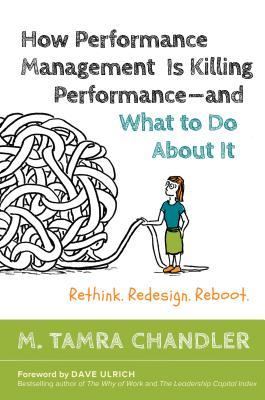
How Performance Management Is Killing Performance—and What to Do About It
Rethink, Redesign, Reboot.
Most people associate performance management with the annual review, which is universally dreaded by employees, management, and HR professionals alike. It’s a cookie-cutter, fear-based, top-down approach that emphasizes negatives over positives and stifles healthy career conversations. It’s never been shown to motivate anyone to do anything but try to avoid it, but nobody feels like they have any alternative. Tamra Chandler has one—and it works.
Actually, Chandler doesn't offer a single alternative—she offers an infinite number of them. Each organization that uses her Performance Management Reboot is able to develop its own unique version since it doesn’t make a lot of sense for organizations with different cultures, in different industries and sectors, to do things exactly the same way. Grounded in the latest scientific findings about motivation, it’s a transparent, employee-driven process that values collaboration over competition and rewards people for acquiring new skills and increasing their contribution instead of hitting arbitrary benchmarks.
Chandler lays out the general principles and then walks you through each step in creating a performance management process that employees will actually embrace rather than avoid and that will help you meet the three objectives of great performance developing your people, rewarding them equitably, and driving your organization’s performance. It’s the first comprehensive, step-by-step guide to creating a performance management solution that’s tailored to your organization’s needs and goals and that places the emphasis squarely on your greatest your people.
Most people associate performance management with the annual review, which is universally dreaded by employees, management, and HR professionals alike. It’s a cookie-cutter, fear-based, top-down approach that emphasizes negatives over positives and stifles healthy career conversations. It’s never been shown to motivate anyone to do anything but try to avoid it, but nobody feels like they have any alternative. Tamra Chandler has one—and it works.
Actually, Chandler doesn't offer a single alternative—she offers an infinite number of them. Each organization that uses her Performance Management Reboot is able to develop its own unique version since it doesn’t make a lot of sense for organizations with different cultures, in different industries and sectors, to do things exactly the same way. Grounded in the latest scientific findings about motivation, it’s a transparent, employee-driven process that values collaboration over competition and rewards people for acquiring new skills and increasing their contribution instead of hitting arbitrary benchmarks.
Chandler lays out the general principles and then walks you through each step in creating a performance management process that employees will actually embrace rather than avoid and that will help you meet the three objectives of great performance developing your people, rewarding them equitably, and driving your organization’s performance. It’s the first comprehensive, step-by-step guide to creating a performance management solution that’s tailored to your organization’s needs and goals and that places the emphasis squarely on your greatest your people.
256 pages, Hardcover
First published March 14, 2016
Ratings & Reviews
Friends & Following
Create a free account to discover what your friends think of this book!
Community Reviews
Displaying 1 - 8 of 8 reviews

July 15, 2019
I keep picking up new books on employee performance management hoping to one day find one that gives you it's "secret sauce", sadly this is also not that book. The one word that I would use to describe it would be shallow. For example it did not bring much examples from real companies and the entire reference examples part was built up with artificial stories of artificial companies that also sounded... well, artificial. Also the execution part felt a bit weak and naive to me (disregarding the sociological complexities of real life).
What I did get from this book is the three common goals of every performance management framework:
1) Develop people (individual development, coaching and mentoring, retention of top performers, leadership development)
2) Reward equitably (pay for contribution, promotion and advancement, total rewards)
3) Drive organizational performance (Goal alignment, strategic communications, culture development)
When your performance management framework does not support the three above goals (in relative correlation with each other depending on the organization) it is probably a waste of time and money.
Salary should primarily be aimed to cover competence and and other rewards (i.e. bonuses) for contribution (both are essential).
The eight fatal flaws of traditional performance management (could not quite agree with all of them, but our cognitive fallacies might indeed contribute to all such shortcomings):
1) A theory without evidence is just a (bad) theory -no evidence that traditional approach leads to improved performance.
2) Traditional performance management impedes the reception of feedback and limits honest dialogue (nobody opens up with the person who pokes them in the eye).
3) Performance reviews generally emphasize the negative, rather then focusing on the strengths (nobody remembers the good work).
4) The focus is on the individual, even through system or organizational challenges often have significant influence on individual performance (no man(or woman) is an island).
5) Fairness and standardization in ratings and the judgement of performance simply cannot be achieved (we are not machines).
6) Review output is unreliable for making talent decisions (we are not machines, redux).
7) Comparing people to one another erodes efforts to create a collaborative culture (let me introduce you to your competition - now play nice!)
8) Pay-for-performance does not deliver improved performance (we are not Palvov's dogs).
“The performance appraisal nourishes short-term performance, annihilates
long-term planning, builds fear, demolishes teamwork, nourishes rivalry and
politics… it leaves people bitter, crushed, bruised, battered, desolate,
despondent, dejected, feeling inferior, some even depressed, unfit for work
for weeks after receipt of rating, unable to comprehend why they are inferior.
It is unfair, as it ascribes to the people in a group differences that may be
caused totally by the system that they work in.”
– Dr. Edwards Deming
SHIFT FROM:
Need to know TO transparency
Management-driven TO employee-powered
Past performance TO future capability
One size fits all TO customized and nuanced
A chosen few TO diverse input and rich dialogue
Control and oversight TO managing by exception
Individual metrics TO shared commitments
Paying for performance TO paying for capabilities and rewarding for contributions
There is a relatively detailed slideshow that sums up the book in the company's web page that captures the essence: http://rewardspnw.com/downloads/prese...
What I did get from this book is the three common goals of every performance management framework:
1) Develop people (individual development, coaching and mentoring, retention of top performers, leadership development)
2) Reward equitably (pay for contribution, promotion and advancement, total rewards)
3) Drive organizational performance (Goal alignment, strategic communications, culture development)
When your performance management framework does not support the three above goals (in relative correlation with each other depending on the organization) it is probably a waste of time and money.
Salary should primarily be aimed to cover competence and and other rewards (i.e. bonuses) for contribution (both are essential).
The eight fatal flaws of traditional performance management (could not quite agree with all of them, but our cognitive fallacies might indeed contribute to all such shortcomings):
1) A theory without evidence is just a (bad) theory -no evidence that traditional approach leads to improved performance.
2) Traditional performance management impedes the reception of feedback and limits honest dialogue (nobody opens up with the person who pokes them in the eye).
3) Performance reviews generally emphasize the negative, rather then focusing on the strengths (nobody remembers the good work).
4) The focus is on the individual, even through system or organizational challenges often have significant influence on individual performance (no man(or woman) is an island).
5) Fairness and standardization in ratings and the judgement of performance simply cannot be achieved (we are not machines).
6) Review output is unreliable for making talent decisions (we are not machines, redux).
7) Comparing people to one another erodes efforts to create a collaborative culture (let me introduce you to your competition - now play nice!)
8) Pay-for-performance does not deliver improved performance (we are not Palvov's dogs).
“The performance appraisal nourishes short-term performance, annihilates
long-term planning, builds fear, demolishes teamwork, nourishes rivalry and
politics… it leaves people bitter, crushed, bruised, battered, desolate,
despondent, dejected, feeling inferior, some even depressed, unfit for work
for weeks after receipt of rating, unable to comprehend why they are inferior.
It is unfair, as it ascribes to the people in a group differences that may be
caused totally by the system that they work in.”
– Dr. Edwards Deming
SHIFT FROM:
Need to know TO transparency
Management-driven TO employee-powered
Past performance TO future capability
One size fits all TO customized and nuanced
A chosen few TO diverse input and rich dialogue
Control and oversight TO managing by exception
Individual metrics TO shared commitments
Paying for performance TO paying for capabilities and rewarding for contributions
There is a relatively detailed slideshow that sums up the book in the company's web page that captures the essence: http://rewardspnw.com/downloads/prese...
April 6, 2016
I’ve managed people for over 20 years and there have been a lot of positive changes since my newbie banker days. I have a passion for discovering the strengths and uniqueness that each individual brings to the table. After unearthing the special traits that we all have, I love unlocking the magic and bringing out the best in people. Growing people’s strengths and watching them excel is like mothering a garden into full bloom and stepping back to enjoy the beauty. What I hate about management? Performance reviews! There is no worse experience out there for an employee or a manager. They are like a dreaded once a year reunion with the side of the family that no one wants to see. We do it because we have to and move on.
Technology and innovation have thrust us all into a fast changing and tumultuous world. Change is an everyday experience. Performance management has remained the same old agenda with newer, fresher names and warm fuzzies. In short, they demotivate rather than uplift and motivate people. M. Tamra Chandler isn’t content in keeping with the past. Her book How Performance Management is Killing Performance – and What to Do about it kicks performance reviews to the curb and offers hope for leaders to change the performance management process to truly coach, give relevant feedback, motivate, and engage, and grow people.
The first step that we need to take is to reboot the performance management (PM) process. Leaders need to rethink what they know and believe. The process of mid-year and annual reviews with assessments sprinkled in doesn’t cut it anymore. It just isn’t working and employees only become discouraged and far from motivated. Next, we need to redesign what we do. Rebooting the process means that leaders need to trust their people and be willing to customize the PM process because no two organizations are the same. We need change with the entire performance management process.
Ultimately all leaders want to develop people, reward them equitably, and really drive organizational performance. It’s a simple process but so much can go wrong. Ms. Chandler eagerly shows us eight flaws to the process and eight fundamental shifts.
8 Flaws of Performance management
1. A Theory without evidence is just a bad theory. There’s just no evidence that traditional performance appraisals do anything to actually help people perform.
2. Nobody opens up to the person who pokes them in the eye. The ways we measure performance today hinder feedback and limit honesty.
3. Nobody remembers the good work. Amen! Did you ever notice that the tiny thing you did wrong morphs into a monster during review time?
4. No man or woman is an island. We focus way too much on the individual even though it takes a tribe to bring change and innovation. Let not just focus on the island.
5. We are not machines. Some may act like it however….
6. We are not machines – redux. Reviews are judgments and fairness and standardization are thrown out the window folks. Put the people back in the process.
7. Let me introduce you to your competition – now play nice together. Comparing people is a bad idea. It breeds competition especially when companies use a ranking system and pits them against one another.
8. We are not Pavlov’s dog. Let’s face it. Most people want more than money and it just won’t buy happiness. We want personal rewards and to feel valued like we are really making a difference.
At this point I am sure that you are vigorously shaking your head up and down in agreement. We’ve all been dropped into the performance appraisal chair on both sides of the desk. I hate giving reviews and I really dread receiving them. Both chairs feel more like its judgment day than an enriching growth process that benefits the individual or teams. To make change, we need to shift how we look at the PM process and think differently.
8 Fundamental shifts that can impact the performance management process
1. Open the door. If there is no transparency there will not be any trust. Ms. Chandler urges us to stop the secrets and let people know where they stand.
2. Give the steering wheel to your employees. Shift from management driven thinking to employee driven action.
3. Change your focus. Don’t beat people up for past performance. Shift to focus on future capabilities and on the “performance preview” for each person. Look at how people can work together.
4. Abandon uniformity. Quit relying on structure and a one size fits all approach. Bring more customization and new ideas to the process.
5. Welcome more voices to the conversation. Most organizations have a set and concise PM system. It’s bland and singular. Instead we need to look at employee differences, cultural backgrounds, and a more customized approach.
6. Stop policing, start empowering. Managers need to stop controlling and granting too much oversight. Become more flexible and step in when there are issues that need addressing and then step back.
7. Incent collaboration. Pull away from individual metrics and become more collaborative. It offers more ideas and opportunities to everyone.
8. Get real with rewards. We need to get away from just paying for performance. Let’s get back to paying for capabilities and really rewarding contributions. Link pay to market value, experience. And capabilities.
Once we learn what is wrong with the whole PM process and start to look at it in new ways with fresh eyes we are given some meat on how to redesign the performance management process. How Performance Management is Killing Performance – and What to Do About it introduces five phases to redesign your process, people, and organization. M. Tamra Chandler offers some key tools and techniques to lead us through redesigning what isn’t working for organizations today. Here are the five phases:
1. Mobilize. Plan properly, invite people, and get started.
2. Sketch. Verify that your team is aligned and understands the facts and where they are going. Sketch your frames against your goals.
3. Configure. After you plan and have a blueprint on where you are going it’s time to pick your practices, options, then test and validate solutions.
4. Build solutions. This can be tough. You need to be aware of dependencies and variations as you build.
5. Implement.
Ms. Chandler offers in-depth intricate tools and techniques that will enable teams to dig deep and bring up some fresh ideas and solutions. There is an entire tool box chapter that is worth spending time on. We are introduced to design principal questions, sample statements, sketch pads and many others. The tool box is designed for real hands on use and paired with real stories in real organizations that set about making changes to their systems. The knowledge and tools are priceless! The examples that M. Tamra Chandler shares bring all the ideas in the book together and show how the tools put forth work in action.
Whenever we spend time, energy, blood, sweat, and tears on making change and positively impacting others we want it to last and build. Look at all the projects or changes you have either worked on or seen crumble. It hurts, it’s discouraging, and it can deflate your confidence. In short, any changes you make need to stick. They need to remain steady yet become a life of their own. Here’s what you need to do to for lasting change:
1. Lead the change.
2. Make the case and sell it.
3. Plan the change but don’t shove it down people’s throats.
4. Create your change plan.
5. Gather change champions.
6. Expect resistance.
7. Defend against naysayers.
8. Build your courage
How Performance Management is Killing Performance – and What to Do about it is a book that I would love to drop into every leader’s lap that touches any piece of a performance review. Too many organizations try to plot people into boxes or graphs and never go any further to find new ways to truly engage people during this process to bring empowerment and increased engagement. Why do we still stick with a process that we can prove has no impact on performance? Why do we stack rate people and pit them against their coworkers like animals?
Organizations have come so far the last ten years in finding innovative ways to allow people to work remotely with technology or connect and lead projects across countries. We are better at identifying and offering solutions in more than half the time it took us years ago. Yet we still can’t solve for the most important part of our organizations – PEOPLE. Pick up Chandler’s book today and become part of the movement to bring needed impactful change in your company and for your people.
Technology and innovation have thrust us all into a fast changing and tumultuous world. Change is an everyday experience. Performance management has remained the same old agenda with newer, fresher names and warm fuzzies. In short, they demotivate rather than uplift and motivate people. M. Tamra Chandler isn’t content in keeping with the past. Her book How Performance Management is Killing Performance – and What to Do about it kicks performance reviews to the curb and offers hope for leaders to change the performance management process to truly coach, give relevant feedback, motivate, and engage, and grow people.
The first step that we need to take is to reboot the performance management (PM) process. Leaders need to rethink what they know and believe. The process of mid-year and annual reviews with assessments sprinkled in doesn’t cut it anymore. It just isn’t working and employees only become discouraged and far from motivated. Next, we need to redesign what we do. Rebooting the process means that leaders need to trust their people and be willing to customize the PM process because no two organizations are the same. We need change with the entire performance management process.
Ultimately all leaders want to develop people, reward them equitably, and really drive organizational performance. It’s a simple process but so much can go wrong. Ms. Chandler eagerly shows us eight flaws to the process and eight fundamental shifts.
8 Flaws of Performance management
1. A Theory without evidence is just a bad theory. There’s just no evidence that traditional performance appraisals do anything to actually help people perform.
2. Nobody opens up to the person who pokes them in the eye. The ways we measure performance today hinder feedback and limit honesty.
3. Nobody remembers the good work. Amen! Did you ever notice that the tiny thing you did wrong morphs into a monster during review time?
4. No man or woman is an island. We focus way too much on the individual even though it takes a tribe to bring change and innovation. Let not just focus on the island.
5. We are not machines. Some may act like it however….
6. We are not machines – redux. Reviews are judgments and fairness and standardization are thrown out the window folks. Put the people back in the process.
7. Let me introduce you to your competition – now play nice together. Comparing people is a bad idea. It breeds competition especially when companies use a ranking system and pits them against one another.
8. We are not Pavlov’s dog. Let’s face it. Most people want more than money and it just won’t buy happiness. We want personal rewards and to feel valued like we are really making a difference.
At this point I am sure that you are vigorously shaking your head up and down in agreement. We’ve all been dropped into the performance appraisal chair on both sides of the desk. I hate giving reviews and I really dread receiving them. Both chairs feel more like its judgment day than an enriching growth process that benefits the individual or teams. To make change, we need to shift how we look at the PM process and think differently.
8 Fundamental shifts that can impact the performance management process
1. Open the door. If there is no transparency there will not be any trust. Ms. Chandler urges us to stop the secrets and let people know where they stand.
2. Give the steering wheel to your employees. Shift from management driven thinking to employee driven action.
3. Change your focus. Don’t beat people up for past performance. Shift to focus on future capabilities and on the “performance preview” for each person. Look at how people can work together.
4. Abandon uniformity. Quit relying on structure and a one size fits all approach. Bring more customization and new ideas to the process.
5. Welcome more voices to the conversation. Most organizations have a set and concise PM system. It’s bland and singular. Instead we need to look at employee differences, cultural backgrounds, and a more customized approach.
6. Stop policing, start empowering. Managers need to stop controlling and granting too much oversight. Become more flexible and step in when there are issues that need addressing and then step back.
7. Incent collaboration. Pull away from individual metrics and become more collaborative. It offers more ideas and opportunities to everyone.
8. Get real with rewards. We need to get away from just paying for performance. Let’s get back to paying for capabilities and really rewarding contributions. Link pay to market value, experience. And capabilities.
Once we learn what is wrong with the whole PM process and start to look at it in new ways with fresh eyes we are given some meat on how to redesign the performance management process. How Performance Management is Killing Performance – and What to Do About it introduces five phases to redesign your process, people, and organization. M. Tamra Chandler offers some key tools and techniques to lead us through redesigning what isn’t working for organizations today. Here are the five phases:
1. Mobilize. Plan properly, invite people, and get started.
2. Sketch. Verify that your team is aligned and understands the facts and where they are going. Sketch your frames against your goals.
3. Configure. After you plan and have a blueprint on where you are going it’s time to pick your practices, options, then test and validate solutions.
4. Build solutions. This can be tough. You need to be aware of dependencies and variations as you build.
5. Implement.
Ms. Chandler offers in-depth intricate tools and techniques that will enable teams to dig deep and bring up some fresh ideas and solutions. There is an entire tool box chapter that is worth spending time on. We are introduced to design principal questions, sample statements, sketch pads and many others. The tool box is designed for real hands on use and paired with real stories in real organizations that set about making changes to their systems. The knowledge and tools are priceless! The examples that M. Tamra Chandler shares bring all the ideas in the book together and show how the tools put forth work in action.
Whenever we spend time, energy, blood, sweat, and tears on making change and positively impacting others we want it to last and build. Look at all the projects or changes you have either worked on or seen crumble. It hurts, it’s discouraging, and it can deflate your confidence. In short, any changes you make need to stick. They need to remain steady yet become a life of their own. Here’s what you need to do to for lasting change:
1. Lead the change.
2. Make the case and sell it.
3. Plan the change but don’t shove it down people’s throats.
4. Create your change plan.
5. Gather change champions.
6. Expect resistance.
7. Defend against naysayers.
8. Build your courage
How Performance Management is Killing Performance – and What to Do about it is a book that I would love to drop into every leader’s lap that touches any piece of a performance review. Too many organizations try to plot people into boxes or graphs and never go any further to find new ways to truly engage people during this process to bring empowerment and increased engagement. Why do we still stick with a process that we can prove has no impact on performance? Why do we stack rate people and pit them against their coworkers like animals?
Organizations have come so far the last ten years in finding innovative ways to allow people to work remotely with technology or connect and lead projects across countries. We are better at identifying and offering solutions in more than half the time it took us years ago. Yet we still can’t solve for the most important part of our organizations – PEOPLE. Pick up Chandler’s book today and become part of the movement to bring needed impactful change in your company and for your people.

March 2, 2017
The title says it all, doesn't it? Traditional performance management systems had their genesis in a different era altogether.
“Doesn’t it seem a little crazy that we’re investing so much time and resources trying to create experiences that are unique to our organization’s wants and needs, yet we’re so often still grabbing that dusty, off-the-shelf performance management manual published in 1950 in hopes that it will get us there?”
Obvious, or at least it should be. The organizational realities were very different back then, and you needed to 'force-rank' employees. Now, you do need to differentiate performance but without going through the painful process of rating, moderating, ranking, and communication. Seriously, root canal treatments are significantly less painful.
Tamra Chandler brings in a great perspective by talking about some of the things that ail performance management. She talks about how unique roles get bucketed into the same category as mass roles, and how current systems destroy collaborative behaviour. Also, current systems don't often have a clear linkage with intangible rewards.
Modern research clearly shows that employees are motivated as much as or even more by non-monetary rewards. (Suggested reading: Drive: The Surprising Truth About What Motivates Us)
The great thing is that the author also attempts to offer a fix for the ailment. She talks about how to bring in change and what to do next. The only criticism I have of her approach is that it is a little too broad and not clearly actionable. But in all fairness, she has created a loose framework that can be customized to any business at all.
The bottomline is that current performance management systems suck. They might have got us from somewhere to here, but are surely not getting us from here to there. So, high time we change the way we look at performance, or prepare to face the consequences.
“Doesn’t it seem a little crazy that we’re investing so much time and resources trying to create experiences that are unique to our organization’s wants and needs, yet we’re so often still grabbing that dusty, off-the-shelf performance management manual published in 1950 in hopes that it will get us there?”
Obvious, or at least it should be. The organizational realities were very different back then, and you needed to 'force-rank' employees. Now, you do need to differentiate performance but without going through the painful process of rating, moderating, ranking, and communication. Seriously, root canal treatments are significantly less painful.
Tamra Chandler brings in a great perspective by talking about some of the things that ail performance management. She talks about how unique roles get bucketed into the same category as mass roles, and how current systems destroy collaborative behaviour. Also, current systems don't often have a clear linkage with intangible rewards.
Modern research clearly shows that employees are motivated as much as or even more by non-monetary rewards. (Suggested reading: Drive: The Surprising Truth About What Motivates Us)
The great thing is that the author also attempts to offer a fix for the ailment. She talks about how to bring in change and what to do next. The only criticism I have of her approach is that it is a little too broad and not clearly actionable. But in all fairness, she has created a loose framework that can be customized to any business at all.
The bottomline is that current performance management systems suck. They might have got us from somewhere to here, but are surely not getting us from here to there. So, high time we change the way we look at performance, or prepare to face the consequences.

January 17, 2026
2-stars in Goodreads World means 'It was Ok'.
For me, the overriding impression I gained from reading How Performance Management Is Killing Performance—and What to Do About It was 'what a missed opportunity'.
And boy, was that chance missed.
Published in 2016, Chandler's book appeared just three years after the universal recognition of the worst disaster caused by a misfiring performance management methodology came to light. And no, I don't mean the damage caused to many organisations by Balanced Scorecard. I mean 'Stack-Ranking'.
Stack-Ranking, introduced by the aircraft engine manufacturer GE (General Electric) by its CEO Jack Welch in his tenure as CEO in the 80s, saw the corporation take-up the '20/70/10 Rule': Typically, the top 20% were rewarded, the middle 70% developed, and the bottom 10% were put on performance improvement plans or let go. The initial results suggested the methodology had a positive impact, but that was rapidly reversed, with managers having 'favourites' ranked in the top 20%, whilst innovative and high-performance staff who they didn't get on with, were put in the 10% and invariably lost their jobs. The result; disaster, as fear and loathing, siloing (like that associated with Balanced Scorecard) took over. GE persisted with Stack-Ranking until 2015-16.
Not though before the concept was taken-up by Microsoft Corp. And for Microsoft, this Performance Management methodology proved to be nothing short of a complete catastrophe.
Wonder why you don't possess or know anyone who possesses a Microsoft-manufactured mobile phone?. Wonder what happened to Windows Mobile? That'll be because of what is universally known as 'Microsoft's Lost Decade' (roughly 2000-2010), which saw;
Microsoft lose ground to Apple and Google, a period largely attributed to its toxic, internal-focused culture, with stack ranking (forced bell curve performance reviews) identified as a primary culprit that fostered internal competition over collaboration, drove out talent, and stifled innovation, leading to its eventual ditching in 2013 for a more teamwork-focused approach under new leadership.
(AI summary of Vanity Fair article)
Specifically;
In those years Microsoft had stepped up its efforts to cripple competitors, but—because of a series of astonishingly foolish management decisions—the competitors being crippled were often co-workers at Microsoft, instead of other companies. Staffers were rewarded not just for doing well but for making sure that their colleagues failed. As a result, the company was consumed by an endless series of internal knife fights. Potential market-busting businesses—such as e-book and smartphone technology—were killed, derailed, or delayed amid bickering and power plays.
(from Microsoft’s Lost Decade by Kurt Eichenwald, Vanity Fair, August 2012)
Stack-Ranking killed-off Microsoft's innovation and teamwork at a vital moment in time, enabling its competitors to leapfrog over it.
Microsoft executives couldn’t understand why the company was struggling in the quality of its innovation compared with competitors such as Apple and Google. Endless surveys were conducted and everytime the same answer would appear: Employees at Microsoft simply did not want to work together.
“I wanted to build a team of people who would work together and whose only focus would be on making great software”. “But you can’t do that at Microsoft” said one manager, Bill Hill. Stack-ranking crippled the ability to innovate at Microsoft, as employees were left despondent and disengaged.
(from: Microsoft Throws Employee Stack-Ranking Out The Window by Steffen Gerhard Maier, published on LinkedIn, 27th January 2016)
In my working life I've not been subject to Performance Management very often. I've worked mostly as a contractor, and the general rule is; if your manager is anything less than 100% satisfied, you didn't get renewed, and that was the end of it!
I have though regrettably, witnessed quite a few instances when Performance Management has gone horribly wrong. One example was an American firm I was attached-to through another division of the corporation. I worked in a team of five; myself, a contractor and three 'permies'. On the same day, the permies had their performance appraisals. Not though, as they expected, with their manager, but with his manager. Each of them attended in turn, and after 30 minutes-or-so, each returned to his desk and declared their intent to get a new job. They didn't go into much detail as to why (with myself and the contactor about) but each was pretty upset.
Within two months the team had broken-up. One found another role outside the firm, one moved to Dallas, Texas, into a new role, and one...went contracting. I hung-on for a few more weeks and then went back to my 'home' division. The damage caused to the business by those appraisals was enormous.
Years later and I was working for a Dutch-US firm as a contractor. I thought I was delivering well (I was told I was). I wasn't renewed though, because my department managers Balanced Scorecard targets included getting rid of contractors. The snag was, I'd sold some expensive kit to one of the firm's leading customers, and they had expected me to help install and commission it...the Saturday after I was let go on the Friday, the day before. Cue some awkwardness and a breakdown in trust between the firm and a top account.
Yet all of that pales into insignificance against Microsoft's Lost Decade, which continues to have an impact, measured in billions-of-$'s lost each year.
Stack-ranking though has pretty much gone the way of the dinosaur. No self-respecting HR President/VP/Director is going to try to introduce that, without the risk of ridicule and being walked-off-the-premises!
Nonetheless, I can say I've only ever witnessed two outstanding Performance Management methodologies in-use, over 5 decades of work. Perhaps not surprisingly, both were employed by global organisations universally respected for having High Performance Cultures. It's probably obvious, but you can't have a HP Culture without a top-notch Performance Management structure.
In-between, I've seen, the good, the bad, and the plain daft. They range from the hideously complex, the embarrassingly simple - the once-a-year 'sit down chat with your manager', and the half-hearted (Performance Management plans that have no influence on salary, promotion).
Trust in the methodology and what it is supposed-to-achieve is probably the key distinguisher. Is the Performance Management structure supposed to enrich the employee, the firm, or is it being used simply to identify who to fire next? If that isn't clear, it probably does more damage than good.
Another is Feedback. If the Performance Management structure doesn't provide distinct, written feedback from the employees manager/team-leader, it's not really of any use whatsoever. Performance Management is two-way street; if the staff are defining their goals themselves (something currently popular) but not getting that written feedback, what's the point?
So, how did my experiences stack-up (sorry!) with Chandler's book?
Well, for starters, no mention of Microsoft Corp. The greatest disaster of Performance Management not mentioned as all. Nothing. Not even a footnote. Nor of GE.
Strangely though, there are references to stack-ranking;
When it comes to scoring people-giving people a rating that's going to be documented in their employee record-we generally tend to be more lenient than accurate
(unless we have to stack-rank people, but that's another story).
(Page 23)
and
Maybe your company falls into that grim group of stack rankers...
(Page 25)
So, the GE and Microsoft examples were likely known about, and Stack-Ranking was expressed with sufficient disrespect. Why no specific mention of the disaster? Nor even a relevant Index entry?
Ok. let's put that aside. What is good about How Performance Management Is Killing Performance—and What to Do About It?
Well, the first 66 pages are terrific, and of those, the first 53 are brilliant. There's a lot of detail from surveys on Performance Management, from the perspectives of employees, CEO's and HR. Although published in 2016, ten years ago (I wrote this review in 2026) it's disappointing that current surveys pretty much report similar, and often, worse results. For some reason, a disappointingly large percentage of organisations just can't get to grips with Performance Management. I would have thought Microsoft's Lost Decade would be a sufficient inducement?
Chandra provides that 'executive summary' that I (and execs) actually adore.
Sylvia Vorhauser summed it up well with the following damning points regarding traditional performance management:
Everyone hates it - employees and managers alike.
Nobody does it wall - it's a skill that seemingly fails to be acquired despite exhaustive training efforts.
It doesn't do what it was designed to do-i.e. increase performance.
(Page 7)
Then, a bit more detail;
In a recent Reuters poll, four out of five US workers said they were satisfied with their job performance reviews. In a survey of forty-eight thousand CEO's, managers and employees, only 13 percent of managers and employees and a mere 6 percent of CEOs thought their year-end reviews were effective.
(also Page 7)
And the killer
Well, a recent Psychology Today article notes that at least 30 percent of performance reviews result in decreased employee performance. Take a moment to ponder that: it's actually achieving the opposite of its original intent.
(also Page 27)
Chandler also includes a somewhat vicious quote from W. Edwards Deming's Out Of The Crisis, the American inspiration for modern Japanese manufacturing, and whose concept of TQM (Total Quality Management) was introduced to me through working for a number of Japanese companies (Toyota and Fujitsu);
[The annual review] nourishes short-term performance, annihilates long-term planning, builds fear, demolishes teamwork, nourishes rivalry and politics...It leaves people bitter, crushed, bruised, battered, desolate, despondent, dejected, feeling inferior, some even depressed, unfit for work for weeks after receipt of rating, unable to comprehend why they are inferior, as it ascribes to people in a group difference that may be caused totally the system they worked in.
(Page 28)
There's (disturbingly) plenty more of that.
Moving on, Chandler identifies the The Eight Fatal Flaws of Performance Management, followed by The Eight Fundamental Shifts needed to address them. The next chapter The Three Common Goals provide a welcome simplification of what is needed from an effective Performance Management process.
And then the remainder of the book is dedicated to how to pursue that change, if the reader is in a role that enables them to implement it, or at least have some influence upon it.
Chandler introduces her 'five-phase process' for us to follow;
Mobilise
Sketch
Configure
Build
Implement
For those readers (like myself) who were taught PDSA (Plan, Do, Study, Act) created by, of all people...W. Edwards Deming, this seems unnecessarily complicated. But hey ho!
What follows, for pretty much the remainder of the volume, are workbooks for a number of of imaginary scenarios, companies that require Performance Management to achieve custom, specific goals. A key element Chandler emphasises it that 'one size absolutely doesn't fit all'; different organisations require different methodologies, and often, different teams, functions or departments within the same organisation need a customised Performance Management approach.
These pages though reveal another flaw in How Performance Management Is Killing Performance. We really need real-world cases, evidence of successful implementations of the suggestions, with (preferably) independent appraisal of the previous methodology employed, and the post-delivery results of the new strategy. We don't get that, and indeed the book s a bit thin on the subject of examples. For anyone employing it to provoke change in their organisation, there's not much to use to answer the inevitable obvious question 'where has this worked elsewhere?'.
So, in summary, despite its age, How Performance Management Is Killing Performance has its uses. It was though, a missed chance. It could have been a leading text on the subject of Performance Management. As-it-is, that reputation lies with the likes of Harvard Business School's On Performance Management and Gary Cokin's Performance Management: Integrating Strategy Execution, Methodologies, Risk, and Analytics.
For me, the overriding impression I gained from reading How Performance Management Is Killing Performance—and What to Do About It was 'what a missed opportunity'.
And boy, was that chance missed.
Published in 2016, Chandler's book appeared just three years after the universal recognition of the worst disaster caused by a misfiring performance management methodology came to light. And no, I don't mean the damage caused to many organisations by Balanced Scorecard. I mean 'Stack-Ranking'.
Stack-Ranking, introduced by the aircraft engine manufacturer GE (General Electric) by its CEO Jack Welch in his tenure as CEO in the 80s, saw the corporation take-up the '20/70/10 Rule': Typically, the top 20% were rewarded, the middle 70% developed, and the bottom 10% were put on performance improvement plans or let go. The initial results suggested the methodology had a positive impact, but that was rapidly reversed, with managers having 'favourites' ranked in the top 20%, whilst innovative and high-performance staff who they didn't get on with, were put in the 10% and invariably lost their jobs. The result; disaster, as fear and loathing, siloing (like that associated with Balanced Scorecard) took over. GE persisted with Stack-Ranking until 2015-16.
Not though before the concept was taken-up by Microsoft Corp. And for Microsoft, this Performance Management methodology proved to be nothing short of a complete catastrophe.
Wonder why you don't possess or know anyone who possesses a Microsoft-manufactured mobile phone?. Wonder what happened to Windows Mobile? That'll be because of what is universally known as 'Microsoft's Lost Decade' (roughly 2000-2010), which saw;
Microsoft lose ground to Apple and Google, a period largely attributed to its toxic, internal-focused culture, with stack ranking (forced bell curve performance reviews) identified as a primary culprit that fostered internal competition over collaboration, drove out talent, and stifled innovation, leading to its eventual ditching in 2013 for a more teamwork-focused approach under new leadership.
(AI summary of Vanity Fair article)
Specifically;
In those years Microsoft had stepped up its efforts to cripple competitors, but—because of a series of astonishingly foolish management decisions—the competitors being crippled were often co-workers at Microsoft, instead of other companies. Staffers were rewarded not just for doing well but for making sure that their colleagues failed. As a result, the company was consumed by an endless series of internal knife fights. Potential market-busting businesses—such as e-book and smartphone technology—were killed, derailed, or delayed amid bickering and power plays.
(from Microsoft’s Lost Decade by Kurt Eichenwald, Vanity Fair, August 2012)
Stack-Ranking killed-off Microsoft's innovation and teamwork at a vital moment in time, enabling its competitors to leapfrog over it.
Microsoft executives couldn’t understand why the company was struggling in the quality of its innovation compared with competitors such as Apple and Google. Endless surveys were conducted and everytime the same answer would appear: Employees at Microsoft simply did not want to work together.
“I wanted to build a team of people who would work together and whose only focus would be on making great software”. “But you can’t do that at Microsoft” said one manager, Bill Hill. Stack-ranking crippled the ability to innovate at Microsoft, as employees were left despondent and disengaged.
(from: Microsoft Throws Employee Stack-Ranking Out The Window by Steffen Gerhard Maier, published on LinkedIn, 27th January 2016)
In my working life I've not been subject to Performance Management very often. I've worked mostly as a contractor, and the general rule is; if your manager is anything less than 100% satisfied, you didn't get renewed, and that was the end of it!
I have though regrettably, witnessed quite a few instances when Performance Management has gone horribly wrong. One example was an American firm I was attached-to through another division of the corporation. I worked in a team of five; myself, a contractor and three 'permies'. On the same day, the permies had their performance appraisals. Not though, as they expected, with their manager, but with his manager. Each of them attended in turn, and after 30 minutes-or-so, each returned to his desk and declared their intent to get a new job. They didn't go into much detail as to why (with myself and the contactor about) but each was pretty upset.
Within two months the team had broken-up. One found another role outside the firm, one moved to Dallas, Texas, into a new role, and one...went contracting. I hung-on for a few more weeks and then went back to my 'home' division. The damage caused to the business by those appraisals was enormous.
Years later and I was working for a Dutch-US firm as a contractor. I thought I was delivering well (I was told I was). I wasn't renewed though, because my department managers Balanced Scorecard targets included getting rid of contractors. The snag was, I'd sold some expensive kit to one of the firm's leading customers, and they had expected me to help install and commission it...the Saturday after I was let go on the Friday, the day before. Cue some awkwardness and a breakdown in trust between the firm and a top account.
Yet all of that pales into insignificance against Microsoft's Lost Decade, which continues to have an impact, measured in billions-of-$'s lost each year.
Stack-ranking though has pretty much gone the way of the dinosaur. No self-respecting HR President/VP/Director is going to try to introduce that, without the risk of ridicule and being walked-off-the-premises!
Nonetheless, I can say I've only ever witnessed two outstanding Performance Management methodologies in-use, over 5 decades of work. Perhaps not surprisingly, both were employed by global organisations universally respected for having High Performance Cultures. It's probably obvious, but you can't have a HP Culture without a top-notch Performance Management structure.
In-between, I've seen, the good, the bad, and the plain daft. They range from the hideously complex, the embarrassingly simple - the once-a-year 'sit down chat with your manager', and the half-hearted (Performance Management plans that have no influence on salary, promotion).
Trust in the methodology and what it is supposed-to-achieve is probably the key distinguisher. Is the Performance Management structure supposed to enrich the employee, the firm, or is it being used simply to identify who to fire next? If that isn't clear, it probably does more damage than good.
Another is Feedback. If the Performance Management structure doesn't provide distinct, written feedback from the employees manager/team-leader, it's not really of any use whatsoever. Performance Management is two-way street; if the staff are defining their goals themselves (something currently popular) but not getting that written feedback, what's the point?
So, how did my experiences stack-up (sorry!) with Chandler's book?
Well, for starters, no mention of Microsoft Corp. The greatest disaster of Performance Management not mentioned as all. Nothing. Not even a footnote. Nor of GE.
Strangely though, there are references to stack-ranking;
When it comes to scoring people-giving people a rating that's going to be documented in their employee record-we generally tend to be more lenient than accurate
(unless we have to stack-rank people, but that's another story).
(Page 23)
and
Maybe your company falls into that grim group of stack rankers...
(Page 25)
So, the GE and Microsoft examples were likely known about, and Stack-Ranking was expressed with sufficient disrespect. Why no specific mention of the disaster? Nor even a relevant Index entry?
Ok. let's put that aside. What is good about How Performance Management Is Killing Performance—and What to Do About It?
Well, the first 66 pages are terrific, and of those, the first 53 are brilliant. There's a lot of detail from surveys on Performance Management, from the perspectives of employees, CEO's and HR. Although published in 2016, ten years ago (I wrote this review in 2026) it's disappointing that current surveys pretty much report similar, and often, worse results. For some reason, a disappointingly large percentage of organisations just can't get to grips with Performance Management. I would have thought Microsoft's Lost Decade would be a sufficient inducement?
Chandra provides that 'executive summary' that I (and execs) actually adore.
Sylvia Vorhauser summed it up well with the following damning points regarding traditional performance management:
Everyone hates it - employees and managers alike.
Nobody does it wall - it's a skill that seemingly fails to be acquired despite exhaustive training efforts.
It doesn't do what it was designed to do-i.e. increase performance.
(Page 7)
Then, a bit more detail;
In a recent Reuters poll, four out of five US workers said they were satisfied with their job performance reviews. In a survey of forty-eight thousand CEO's, managers and employees, only 13 percent of managers and employees and a mere 6 percent of CEOs thought their year-end reviews were effective.
(also Page 7)
And the killer
Well, a recent Psychology Today article notes that at least 30 percent of performance reviews result in decreased employee performance. Take a moment to ponder that: it's actually achieving the opposite of its original intent.
(also Page 27)
Chandler also includes a somewhat vicious quote from W. Edwards Deming's Out Of The Crisis, the American inspiration for modern Japanese manufacturing, and whose concept of TQM (Total Quality Management) was introduced to me through working for a number of Japanese companies (Toyota and Fujitsu);
[The annual review] nourishes short-term performance, annihilates long-term planning, builds fear, demolishes teamwork, nourishes rivalry and politics...It leaves people bitter, crushed, bruised, battered, desolate, despondent, dejected, feeling inferior, some even depressed, unfit for work for weeks after receipt of rating, unable to comprehend why they are inferior, as it ascribes to people in a group difference that may be caused totally the system they worked in.
(Page 28)
There's (disturbingly) plenty more of that.
Moving on, Chandler identifies the The Eight Fatal Flaws of Performance Management, followed by The Eight Fundamental Shifts needed to address them. The next chapter The Three Common Goals provide a welcome simplification of what is needed from an effective Performance Management process.
And then the remainder of the book is dedicated to how to pursue that change, if the reader is in a role that enables them to implement it, or at least have some influence upon it.
Chandler introduces her 'five-phase process' for us to follow;
Mobilise
Sketch
Configure
Build
Implement
For those readers (like myself) who were taught PDSA (Plan, Do, Study, Act) created by, of all people...W. Edwards Deming, this seems unnecessarily complicated. But hey ho!
What follows, for pretty much the remainder of the volume, are workbooks for a number of of imaginary scenarios, companies that require Performance Management to achieve custom, specific goals. A key element Chandler emphasises it that 'one size absolutely doesn't fit all'; different organisations require different methodologies, and often, different teams, functions or departments within the same organisation need a customised Performance Management approach.
These pages though reveal another flaw in How Performance Management Is Killing Performance. We really need real-world cases, evidence of successful implementations of the suggestions, with (preferably) independent appraisal of the previous methodology employed, and the post-delivery results of the new strategy. We don't get that, and indeed the book s a bit thin on the subject of examples. For anyone employing it to provoke change in their organisation, there's not much to use to answer the inevitable obvious question 'where has this worked elsewhere?'.
So, in summary, despite its age, How Performance Management Is Killing Performance has its uses. It was though, a missed chance. It could have been a leading text on the subject of Performance Management. As-it-is, that reputation lies with the likes of Harvard Business School's On Performance Management and Gary Cokin's Performance Management: Integrating Strategy Execution, Methodologies, Risk, and Analytics.

February 5, 2022
This is not a bad book, but not a good one either. It is somewhere in-between a manual and a convince-me book.
TLDR There is too much story telling to my liking, and I lack evidence, research, testing about the ideas presented.
In a way the author falls short to her own critique of the "traditional way". She says there is no theory that would prove the traditional management system works. But she doesn't show enough evidence that her theory works either.
Why the following are the three common goals of performance management: Develop people, Reward equitably, and Drive organisational performance? "I believe that the Three Common Goals of any performance program should be as shown in figure 4.1". (page 58) There are some references in the annex to back up these partially, but the whole concept is in the air. I could debate each of these, add or remove. It's not like there was a research to collect 20 potential common goals, which were tested, and these were retained at the end of the experiments.
My other big critique is that there is no such thing as "traditional performance management". There are zillions of companies, with a wide range of practices. If she had went through let's say 100 companies covering a wide range of sizes, cultures and practices, distilling the major learning, I could see some value. The message si that "old is bad", and that's it.
I also miss real case studies, where her ideas have been implemented, and with results and benefits shown, challenges faced and overcome.
All in all, this is a great book to inspire to question your current practices, and offers some ideas to try in practice.
But there is no guarantee those will work, and no advice what to do if you hit obstacles, or you don't get the results that you wanted.
Don't get me wrong, I like the ideas presented, and I can identify myself with many of them, but to me they are not more than ideas of an experienced professional.
In terms of reading, I suggest you look for a summary, so you can skip the story parts.
TLDR There is too much story telling to my liking, and I lack evidence, research, testing about the ideas presented.
In a way the author falls short to her own critique of the "traditional way". She says there is no theory that would prove the traditional management system works. But she doesn't show enough evidence that her theory works either.
Why the following are the three common goals of performance management: Develop people, Reward equitably, and Drive organisational performance? "I believe that the Three Common Goals of any performance program should be as shown in figure 4.1". (page 58) There are some references in the annex to back up these partially, but the whole concept is in the air. I could debate each of these, add or remove. It's not like there was a research to collect 20 potential common goals, which were tested, and these were retained at the end of the experiments.
My other big critique is that there is no such thing as "traditional performance management". There are zillions of companies, with a wide range of practices. If she had went through let's say 100 companies covering a wide range of sizes, cultures and practices, distilling the major learning, I could see some value. The message si that "old is bad", and that's it.
I also miss real case studies, where her ideas have been implemented, and with results and benefits shown, challenges faced and overcome.
All in all, this is a great book to inspire to question your current practices, and offers some ideas to try in practice.
But there is no guarantee those will work, and no advice what to do if you hit obstacles, or you don't get the results that you wanted.
Don't get me wrong, I like the ideas presented, and I can identify myself with many of them, but to me they are not more than ideas of an experienced professional.
In terms of reading, I suggest you look for a summary, so you can skip the story parts.
This entire review has been hidden because of spoilers.

July 17, 2023
Somehow I find the author is a bit inexperienced in the field, I don't find convincing with the suggestion, they are not practical enough.
"Convince employee that career is their choice, not the company's", I think the companies I've worked for, have passed this stage.
"Convince employee that career is their choice, not the company's", I think the companies I've worked for, have passed this stage.

May 15, 2016
For anyone who has recognized the challenges of existing performance management programs, this book is for you! Chandler clearly outlines all the reasons that traditional performance management practices actually do the opposite of what they set out to do - increase performance. Then she lays out a detailed plan of how to create a system that works for your unique organization. The key of this plan? Involve the people - not just the HR team, not just the Executives, but a cross-section of teams and departments who will represent the entire organization and bring a variety of perspectives to a creative solution that will get the outcomes you desire.
Throughout the chapters, Chandler shares her years of experience which led her this recognition of the need to drastically change how organizations approach performance management. She backs up her experience with extensive research on change, human behavior and organizational development. She's also incredibly honest -- this work is hard, you are dealing with people and massive change -- however she provides insights, a toolbox, and even an online community to learn and find support from others working on this change!
Throughout the chapters, Chandler shares her years of experience which led her this recognition of the need to drastically change how organizations approach performance management. She backs up her experience with extensive research on change, human behavior and organizational development. She's also incredibly honest -- this work is hard, you are dealing with people and massive change -- however she provides insights, a toolbox, and even an online community to learn and find support from others working on this change!

August 9, 2016
Excellent read. Addresses the process and implementation of building consensus around performance management. This is something a lot of companies get wrong.
Displaying 1 - 8 of 8 reviews