
What do you think?
Rate this book


From the Nobel Prize winner and best-selling author of Snow and My Name Is Red: a soaring, panoramic new novel – his first since The Museum of Innocence – telling the unforgettable tale of an Istanbul street vendor and the love of his life.
Since his boyhood in a poor village in Central Anatolia, Mevlut Karataş has fantasized about what his life would become. Not getting as far in school as he'd hoped, at the age of twelve, he comes to Istanbul – 'the center of the world' – and is immediately enthralled both by the city being demolished and the new one that is fast being built. He follows his father's trade, selling boza (a traditional Turkish drink) on the street, and hoping to become rich, like other villagers who have settled the desolate hills outside the booming metropolis. But chance seems to conspire against him. He spends three years writing love letters to a girl he saw just once at a wedding, only to elope by mistake with her sister. And though he grows to cherish his wife and the family they have, his relations all make their fortunes while his own years are spent in a series of jobs leading nowhere; he is sometimes attracted to the politics of his friends and intermittently to the lodge of a religious guide. But every evening, without fail, he still wanders the streets of Istanbul, selling boza and wondering at the 'strangeness' in his mind, the sensation that makes him feel different from everyone else, until fortune conspires once more to let him understand at last what it is he has always yearned for.
Told from the perspectives of many beguiling characters, A Strangeness in My Mind is a modern epic of coming of age in a great city, and a mesmerizing narrative sure to take its place among Pamuk's finest achievements.
624 pages, Kindle Edition
First published December 12, 2014


"I can only meditate when I am walking. When I stop, I cease to think; my mind works only with my legs." Jean-Jacques Rousseau
"I will sell boza until the day the world ends." Mevlut Karatas (p. 584)This book is long and meandering, its power like that of a fire built slowly from a bit of kindling and a single spark. From the beginning, it is carefully tended and coaxed along in a quiet but steady fashion until Whoosh!, it ignites in full glory.
So this is how Mevlut came to understand the truth that a part of him had known all along: walking around the city at night made him feel as if he were wandering around in his own head. That was why whenever he spoke to the walls, advertisements, shadows, and strange and mysterious shapes he couldn't see in the night, he always felt as if he were talking to himself. (p. 579)I cannot escape my impression that, if one were to put a gender to Istabul, it would be a woman: a grand and beautiful dowager who has been roughly treated but maintains her dignity and grace nevertheless. This is how the women in the book are presented, too. Though not all are roughly treated, they all have difficult lives, made all the more difficult by living in an oppressive patriarchy and struggling at various time with grinding poverty and lack of proper reproductive healthcare. In this way, I came to feel that Mevlut loved three women deeply and passionately during his lifetime: first, his crush, Samiha; then, his wife, Rayiha; and, from the age of twelive, his adopted city, Istanbul.
But just like believing in God, falling in love is such a sacred feeling that it leaves you with no room for any other passions.By about halfway through A Strangeness... had hooked me. I realised how completely invested I had become in the characters' well-being. I had not felt terribly attached to Melvut before then and, really, it was the women becoming more of a presence in the book that made it take off for me (Melvut's wife, Rayiha, their daughters, and Rayiha's sisters). Over six hundred pages, I fell in love with Melvut, Rayiha, their girls, the girls' aunties, and the rampaged and rambling sprawl of old Istanbul. These are very ordinary people, with ordinary lives, but the story of these lives is rich and proves the point that no one's story is boring if you attend closely enough to the telling. Pamuk is masterful in the telling, but it's a subtle mastery. He does not bash you over the head with bigness. The dramas, while intense and worrying, are not over-played. There are deaths, even one murder, but the details given are only enough to tell us that these things happened. Nothing gratuitous. I appreciate Pamuk's discretion and feel that his choices of when to zoom in and out of focus are near perfect.
"No, I'm not joking. Boza is holy," said Mevlut.Two desires that will linger with me now are to wander aimlessly through the nighttime streets of Istanbul and to try boza for myself. Pamuk is a beautiful writer. I am looking forward to more of his books.
"I'm a Muslim," said Suleyman. "Only things that obey the rules of my faith can be holy."
"Just because something isn't strictly Islamic doesn't mean it can't be holy. Old things we've inherited from our ancestors can be holy, too," said Mevlut. "When I'm out at night on the gloomy, empty streets, I sometimes come across a mossy old wall. A wonderful joy rises up inside me. I walk into the cemetery, and even though I can't read the Arabic script on the gravestones, I still feel as good as I would if I'd prayed." (p. 271)
 Istanbul painted by Ivan Konstantinovich Aivazovsky (1817-1900)
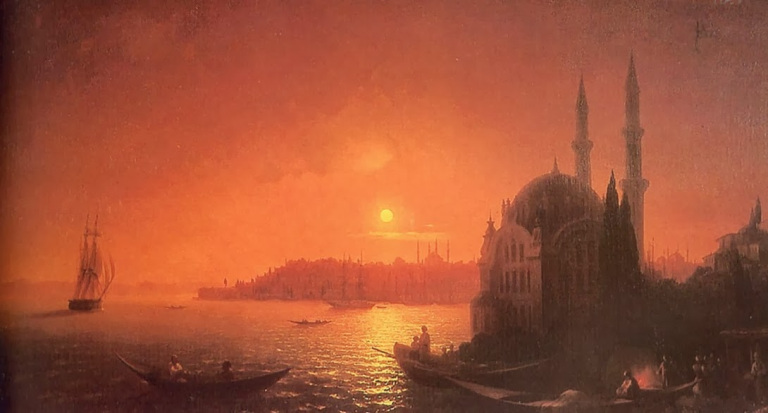 Istanbul painted by Ivan Konstantinovich Aivazovsky (1817-1900)


