

What do you think?

Alex + Ada #11-15
Alex + Ada, Vol. 3
In this final arc of the sci-fi drama, Alex and Ada struggle against the growing hatred for sentient robots and their human allies. Can they survive what’s around the corner?
Collects Alex + Ada #11-15.
Collects Alex + Ada #11-15.
138 pages, Kindle Edition
First published August 12, 2015
About the author
Jonathan Luna
182 books191 followersJONATHAN LUNA co-created and illustrated THE SWORD, GIRLS, and ULTRA (all Image Comics) with his brother, Joshua Luna. He co-created and illustrated ALEX + ADA with Sarah Vaughn. He wrote and illustrated STAR BRIGHT AND THE LOOKING GLASS (Image Comics). His work also includes the art for SPIDER-WOMAN: ORIGIN (Marvel Comics), written by Brian Michael Bendis and Brian Reed.
Jonathan was born in California and spent most of his childhood overseas, living on military bases in Iceland and Italy. He returned to the United States in his late teens.
Writing and drawing comics since he was a child, he graduated from the Savannah College of Art and Design with a BFA in Sequential Art.
He currently resides in Northern Virginia.
Jonathan was born in California and spent most of his childhood overseas, living on military bases in Iceland and Italy. He returned to the United States in his late teens.
Writing and drawing comics since he was a child, he graduated from the Savannah College of Art and Design with a BFA in Sequential Art.
He currently resides in Northern Virginia.
Ratings & Reviews
Friends & Following
Create a free account to discover what your friends think of this book!
Community Reviews
Displaying 1 - 30 of 703 reviews

November 15, 2017
This is the final volume in Alex and Ada's story, and it was rather sweet. Or bittersweet?
But mostly sweet.

Everything the first two books were leading up to Alex & Ada's forbidden love, finally came together (or apart?) in this last one.

This isn't so good that I would run around pushing it in people's faces screeching, "Read this! Read this!", but it was different enough to be interesting. Although, don't go into this one expecting a fast-paced story about A.I. ladies and the men who love them. Because while it's not exactly slow, there's also not a lot of action, either.

I'm not sure how I thought it would all turn out, but I know I didn't imagine this.
However, I felt oddly satisfied when I closed the book, so...

Sweet.
But mostly sweet.
Everything the first two books were leading up to Alex & Ada's forbidden love, finally came together (or apart?) in this last one.
This isn't so good that I would run around pushing it in people's faces screeching, "Read this! Read this!", but it was different enough to be interesting. Although, don't go into this one expecting a fast-paced story about A.I. ladies and the men who love them. Because while it's not exactly slow, there's also not a lot of action, either.
I'm not sure how I thought it would all turn out, but I know I didn't imagine this.
However, I felt oddly satisfied when I closed the book, so...
Sweet.

January 1, 2016
awwww i love this series and it made me so happy to get this as a late christmas present, I literally opened it then read it in one sitting. This world was so great to return to, but I really should have done a series reread before diving in. But I immediately was reminded of how much I LOVE the art and the world in this book. But the plot in this one seemed to go by so much quicker than the previous volumes. Everything kind of unfolded conveniently and since I didn't remember much from the earlier books in the series, I was just left to roll with the punches. There were a few things in here that I feel were supposed to evoke emotion from the reader, but it was so rushed that the reader was not provided a lot of time or capacity to mourn or comprehend anything that happens to the characters. Maybe I shouldn't have read this in one sitting and it would have gone over better, but this was a very interesting take on a conclusion to a sci-fi series that I adored altogether and i'll definitely be getting my hands on to reread in the future! I highly recommend this series if you're just starting out reading graphic novels.

November 5, 2015
It was so good, but it just went in a different direction than I expected I think! I definitely recommend this series though, I absolutely adore it.

July 6, 2015
It’s the near future. Alex is a lonely human man. Ada is a human-like robot bought to keep Alex company. Ada becomes sentient after Alex gets some hackers to “unlock” her - but this is against the law. Alex + Ada must keep their taboo relationship a secret or Alex will go to jail and Ada will be… deleted.
In this third and final volume, events conspire against our star-crossed lovers and they must flee the authorities. Is this the end for the couple - or will love prevail?
I did like the conclusion to this sweet and involving series but I felt a lot of it was both predictable and repetitive. For example, the events of the second book where Ada’s accosted by the authorities plays out again here, as does the stiffness of Alex’s human friends being around the couple. There’s more anti-robot stuff in the news, mirroring the recent battles for gay marriage and older civil rights cases, and you can pretty much guess how it all ends (particularly with that opening dream scene), though I’m glad that’s how it finished.
It’s a bit like Sarah Vaughn and Jonathan Luna did such a great job setting up the story, that you could see how it would play out without them having to tell you because of course that’s how it’d go. There aren’t many surprises though it’s pleasant to see everything unfolding, and I really loved reading about these two characters’ burgeoning relationship.
I’ve always viewed Alex + Ada as a romance story more than sci-fi though it asks some interesting questions on what is life, sentience, and reality. When does a creation like Ada start being treated as equally as a human and who are we to say whether or not her rights are less than ours? I know I liked Alex’s housebot, Otto, far more than most of the human characters and he wasn’t even sentient!
Luna’s art is wonderfully high quality as it has been throughout the series with crisp, clear lines and convincingly futuristic designs. But he doesn’t draw many new things that readers haven’t already seen from earlier books. Still great though and that action sequence is awesome!
After the second book I thought I could read many more in the series and was disappointed to see it ending at 15 issues; having read this final volume, I’d say Vaughn and Luna got the length just right. Volume 3 ends the series in a satisfying way and that’s the best you can expect from a final volume.
I’m not a romance guy but this title totally won me over - check it out if you haven’t already, it’s definitely one of Image’s best titles of the last couple years. Farewell, Alex + Ada - all you need is (robot) love!
In this third and final volume, events conspire against our star-crossed lovers and they must flee the authorities. Is this the end for the couple - or will love prevail?
I did like the conclusion to this sweet and involving series but I felt a lot of it was both predictable and repetitive. For example, the events of the second book where Ada’s accosted by the authorities plays out again here, as does the stiffness of Alex’s human friends being around the couple. There’s more anti-robot stuff in the news, mirroring the recent battles for gay marriage and older civil rights cases, and you can pretty much guess how it all ends (particularly with that opening dream scene), though I’m glad that’s how it finished.
It’s a bit like Sarah Vaughn and Jonathan Luna did such a great job setting up the story, that you could see how it would play out without them having to tell you because of course that’s how it’d go. There aren’t many surprises though it’s pleasant to see everything unfolding, and I really loved reading about these two characters’ burgeoning relationship.
I’ve always viewed Alex + Ada as a romance story more than sci-fi though it asks some interesting questions on what is life, sentience, and reality. When does a creation like Ada start being treated as equally as a human and who are we to say whether or not her rights are less than ours? I know I liked Alex’s housebot, Otto, far more than most of the human characters and he wasn’t even sentient!
Luna’s art is wonderfully high quality as it has been throughout the series with crisp, clear lines and convincingly futuristic designs. But he doesn’t draw many new things that readers haven’t already seen from earlier books. Still great though and that action sequence is awesome!
After the second book I thought I could read many more in the series and was disappointed to see it ending at 15 issues; having read this final volume, I’d say Vaughn and Luna got the length just right. Volume 3 ends the series in a satisfying way and that’s the best you can expect from a final volume.
I’m not a romance guy but this title totally won me over - check it out if you haven’t already, it’s definitely one of Image’s best titles of the last couple years. Farewell, Alex + Ada - all you need is (robot) love!

March 28, 2016
To quote Blitz:

Phew. This was a disappointment. I mean, it wasn't super bad but I still expected much more from it. The ending is cute. But cheesy, let's be real. And everything seemed to be rushed. This trilogy will have a special place in my heart, though. The art is lovely. I'm just sad that they didn't exactly execute this amazing idea well.
Phew. This was a disappointment. I mean, it wasn't super bad but I still expected much more from it. The ending is cute. But cheesy, let's be real. And everything seemed to be rushed. This trilogy will have a special place in my heart, though. The art is lovely. I'm just sad that they didn't exactly execute this amazing idea well.

January 14, 2017
What a let-down... that ending was so disappointing. I'm not saying it ruined the series as a whole but it definitely cheapened the whole series for me. It was going okay right up until the climax; it was just so unsatisfying, it made me angry! It was so rushed, it was clichéd, it was unoriginal and I felt cheated. I don't regret reading this, there were a lot of positives in the series but I'm just so frustrated over that ending.
Overall, I would still recommend this series & I would read more by Jonathan Luna and Sarah Vaughn.
Overall, I would still recommend this series & I would read more by Jonathan Luna and Sarah Vaughn.

November 10, 2015
The promotional message regarding shiny, attractive, state-of-the-art androids comes to a touching and downright soulful conclusion in this third and final volume, as it ends with a deep, long, yearning look straight into the gorgeous eyes of artificial intelligence. What came before can be described as a cross between 1950's romance and Bonnie and Clyde, perfected for those special desires of the corporate age. For risks and side effects ask your doctor or pharmacist.

September 16, 2019
Η αλήθεια είναι πως ξεκινώντας την σειρά αυτην δεν περίμενα πως θα πάει προς τα εκεί η τροπή της. Ειδικά ο χαρακτήρας του Alex νομίζω αδικήθηκε πολύ 😣
Στεναχωρήθηκα έντονα και μετά από όλα αυτά ένιωσα ότι έγιναν όλα πολύ εσπευσμένα για να δοθεί μια μορφή ευτυχίας. Αλλά ως γενικό σύνολο πιστεύω ότι αξίζει πολύ να διαβαστεί ειδικά αν είστε λάτρεις των sci-fi!
*3.5/5*
Στεναχωρήθηκα έντονα και μετά από όλα αυτά ένιωσα ότι έγιναν όλα πολύ εσπευσμένα για να δοθεί μια μορφή ευτυχίας. Αλλά ως γενικό σύνολο πιστεύω ότι αξίζει πολύ να διαβαστεί ειδικά αν είστε λάτρεις των sci-fi!
*3.5/5*
December 25, 2016

4.5 stars
While I loved this arc and the way that the story progressed, the ending felt a little rushed for me and I wish we could have gotten a little more. Overall, this was a solid series! I loved all three volumes and I highly recommend them all!

November 30, 2015
Actual rating 4.5 stars!
I really enjoyed this series and got choked up at the end. Definitely recommend!
I really enjoyed this series and got choked up at the end. Definitely recommend!

May 21, 2019
OH MY GOSH THAT ENDING THOUGH!!! I'LL SEE YOU ALL AFTER THE CRYING :(
What a conclusion to a good graphic novel series involving humans and android robots. Alex and Ada were interesting characters and their backstories are incredibly interesting to read about. Although the pacing for this volume felt mainly off, the suspense was sky-rocketing as both of them realised how much they wanted to be together. I do recommend this for anyone interested in robots and adventure stories!
What a conclusion to a good graphic novel series involving humans and android robots. Alex and Ada were interesting characters and their backstories are incredibly interesting to read about. Although the pacing for this volume felt mainly off, the suspense was sky-rocketing as both of them realised how much they wanted to be together. I do recommend this for anyone interested in robots and adventure stories!

September 23, 2015
*2.5 stars*
I don't know how I feel about this...
///////////////////////////////////
OKAY, so. I slept on it and I finally came to the conclusion that I really didn't enjoy this volume that much.
I had the feeling that the ending was a little bit too rushed without any reasons for it to be like that.
I don't know how I feel about this...
///////////////////////////////////
OKAY, so. I slept on it and I finally came to the conclusion that I really didn't enjoy this volume that much.
I had the feeling that the ending was a little bit too rushed without any reasons for it to be like that.

March 27, 2016
Find this and other Reviews at In Tori Lex
Things got dark and scary in this conclusion, and I relished every moment. The world that Ada's in begins to challenge her existence, and the tension is raised around Alex's friends. As things change Alex and Ada have to find quiet moments with each other and learn how to be on the run, while on the run. As robots start dying Ada gets scared. She starts to question the limits of her mortality as a robot, and what could be next. Humans continue to pick sides, and everyone that's for the robots has to hide that allegiance or face the consequences.

Humans seem to be projecting their insecurities onto Robots, reacting in violence out of fear. While Alex and Ada lose their safe spaces to go, they choose each other. We get to see how the future develops for them both, and how sentient robots become apart of it. I really wish this series was longer, so that the finale wouldn't have seemed rushed. The romance came off as sincere, and there were definitely some surprises. But the ending was heartbreaking and hopeful at the same time. This was a great series full of memorable moments that make you think and wonderful sci-fi elements.

Reviews in Series
Alex + Ada Vol. 1 (Alex + Ada #1-5) by Jonathan Luna, Sarah Vaughn
Alex + Ada Vol. 2 (Alex + Ada #6-10) by Jonathan Luna, Sarah Vaughn
Things got dark and scary in this conclusion, and I relished every moment. The world that Ada's in begins to challenge her existence, and the tension is raised around Alex's friends. As things change Alex and Ada have to find quiet moments with each other and learn how to be on the run, while on the run. As robots start dying Ada gets scared. She starts to question the limits of her mortality as a robot, and what could be next. Humans continue to pick sides, and everyone that's for the robots has to hide that allegiance or face the consequences.
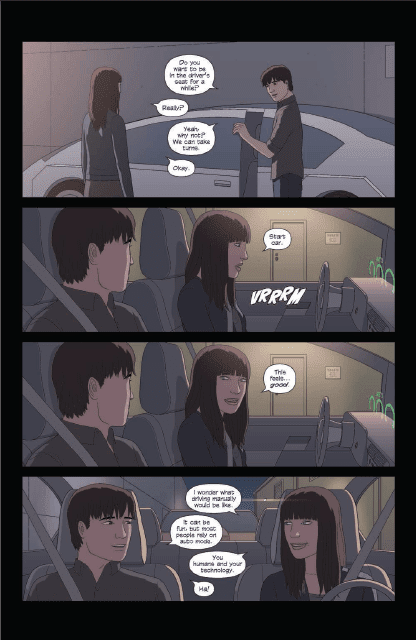
Humans seem to be projecting their insecurities onto Robots, reacting in violence out of fear. While Alex and Ada lose their safe spaces to go, they choose each other. We get to see how the future develops for them both, and how sentient robots become apart of it. I really wish this series was longer, so that the finale wouldn't have seemed rushed. The romance came off as sincere, and there were definitely some surprises. But the ending was heartbreaking and hopeful at the same time. This was a great series full of memorable moments that make you think and wonderful sci-fi elements.

Reviews in Series
Alex + Ada Vol. 1 (Alex + Ada #1-5) by Jonathan Luna, Sarah Vaughn
Alex + Ada Vol. 2 (Alex + Ada #6-10) by Jonathan Luna, Sarah Vaughn

July 3, 2015
(3.5 stars)
Overall, I felt like this conclusion was a bit rushed. The ending, while surprising, removed the main characters from the actual action. I will be doing a video review on my channel soon for this series!
Side note: I definitely think this series is worth the read, and as a whole, I'd rate it a solid four stars.
**Series review can be found here: https://www.youtube.com/watch?v=c9QqB...
Overall, I felt like this conclusion was a bit rushed. The ending, while surprising, removed the main characters from the actual action. I will be doing a video review on my channel soon for this series!
Side note: I definitely think this series is worth the read, and as a whole, I'd rate it a solid four stars.
**Series review can be found here: https://www.youtube.com/watch?v=c9QqB...

August 16, 2015
I hope that by the time a period of this technological advancement occurs, we will be well-versed in what is like to be a humanoid so as to not turn our world into a dystopia. This graphic novel, alongside Battlestar Galactica, I, Robot, Neuromancer, Mockingbird, and Do Androids Dream of Electric Sheep?, have thought us what can happen to society when we are unfair to our "children," and how our desire to create life might lead us to extinction if we pertain a cruel species.
Alex + Ada just reminded me of it, since it has been a long time since I have read about humanoids and unfair treatment of "lesser forms" in science-fiction. I thought I would dislike this comic, but I loved it, it was very fast-paced and the characters easy to connect to and understand where they were coming from. However in this third volume I felt like the last few pages were too rushed, I really wanted more of an explication for that ending and what led to that.
This seems a comic I will come back to once I get my hands on my own copies.
Alex + Ada just reminded me of it, since it has been a long time since I have read about humanoids and unfair treatment of "lesser forms" in science-fiction. I thought I would dislike this comic, but I loved it, it was very fast-paced and the characters easy to connect to and understand where they were coming from. However in this third volume I felt like the last few pages were too rushed, I really wanted more of an explication for that ending and what led to that.
This seems a comic I will come back to once I get my hands on my own copies.
October 13, 2015
Bullet Review:
I swear, this is NOT an ugly cry! I don't even know how to ugly cry - I'm a robot after all! I don't get humor, don't get incredible books...NOPE no tears on this girl!

I'm not fooling anyone, am I?

I swear, this is NOT an ugly cry! I don't even know how to ugly cry - I'm a robot after all! I don't get humor, don't get incredible books...NOPE no tears on this girl!
I'm not fooling anyone, am I?

January 12, 2016
This was so good. :'(

January 15, 2016
Aaaand the last volume took a nose dive and crashed into the valley of WHAT THE EVER LOVING FUCK??!!
I'm thoroughly disappointed.
I'm thoroughly disappointed.
October 3, 2017
What a great series!!!

August 18, 2015
This series is perfection.

August 6, 2015
The trilogy by Luna and Vaughn closes out with some dramatic action and a somewhat surprising twist. But just to make it clear, it's not The Martian, it's not technical SCIENCE fiction, it sides more with Ray Bradbury in exploring the human issues of science fiction. It's essentially a romance, and it works well for that. It doesn't tell us anything we didn't already know from Isaac Asimov about robots, it's not shockingly deep about AI, I suppose, but if you can imagine, as I do, that this is a young person's first encounter with these issues, it's a story that I imagine would be a little provocative, but primarily just emotionally affecting.
I guess on one level it's a feminist tale, about the need for self-efficacy and mutual respect in a relationship. Both Alex and Ada are thoughtful and quiet and dignified and sweet, as are most of their friends and family. And Ada becomes sentient, with the help of supportive Alex and other sentient robots, but society has some initial struggles with this, because one sentient robot goes on a rampage and murders some people. So they make it illegal to be sentient, which puts thoughtful Alex and sentient Ada in a dangerous position.
So then there is a conformation we are not so surprised about, but also there are some surprises. OR I was surprised, anyway. Not huge surprises, but ones that involve emotional tugs, just as you would expect from a romance. It worked on that level for me, anyway, as I said, if not for all reviewers. I note at a glance that this volume is the least highly rated of the three volumes, but for me, I thought it worked. I liked Alex and Ada. I liked Alex's grandma. It largely for me avoided the creep-factor that is obviously possible in the story and gets that aspect of it over with early on, and they made the relationship between them real and affecting.
And Luna's art is "cool" in the sense that it fits the cool robot Ada and her cool boyfriend Alex, (I mean emotional cool, here) and coolly, cleanly somewhat distantly creates a "cool" surface (which is to say I liked it!). That emotional engagement arises out of this apparent coolness/distance is interesting to me. It works, imo.
I guess on one level it's a feminist tale, about the need for self-efficacy and mutual respect in a relationship. Both Alex and Ada are thoughtful and quiet and dignified and sweet, as are most of their friends and family. And Ada becomes sentient, with the help of supportive Alex and other sentient robots, but society has some initial struggles with this, because one sentient robot goes on a rampage and murders some people. So they make it illegal to be sentient, which puts thoughtful Alex and sentient Ada in a dangerous position.
So then there is a conformation we are not so surprised about, but also there are some surprises. OR I was surprised, anyway. Not huge surprises, but ones that involve emotional tugs, just as you would expect from a romance. It worked on that level for me, anyway, as I said, if not for all reviewers. I note at a glance that this volume is the least highly rated of the three volumes, but for me, I thought it worked. I liked Alex and Ada. I liked Alex's grandma. It largely for me avoided the creep-factor that is obviously possible in the story and gets that aspect of it over with early on, and they made the relationship between them real and affecting.
And Luna's art is "cool" in the sense that it fits the cool robot Ada and her cool boyfriend Alex, (I mean emotional cool, here) and coolly, cleanly somewhat distantly creates a "cool" surface (which is to say I liked it!). That emotional engagement arises out of this apparent coolness/distance is interesting to me. It works, imo.

September 3, 2015
Well I am sad that this is the ending of the series because honestly I thought that this could have gone on for so much longer. I don't know if it was a creator/publisher decision but I wish they'd decided to extend things and make the series a little longer because I felt as if we really could have explored this story and world so so much more than we did. Again this focuses on our main two characters, Alex and Ada, and the story of after the sad news they receive and the threats and abuse they're falling prey to, what they do next.
I really felt as thought the pacing of this one could have been a bit better. I believe that the last two issues within this, although fairly satisfactory as an ending to the series, really did feel a bit too compacted for my liking and I was hoping that we'd see more of the characters as they went on to explore more. Unfortunately this is not the path the creators chose to take and they decided to end the series, but on the whole it was a very satisfactory and final end point, so at least that's something. Also, I suppose that the fact that I want more is a good sign :)
The artwork, pacing and development all continue to be at the same level as before and it's a great little story to go along with all this. I felt like we addressed some of the worlds problems well and others were left a little more open to allow the reader their chance to think about what they would do in that situation.
The last page made me a bit emotional, and it's very good as a series, albeit short. 4.5*s for this Volume and a series I would certainly recommend :)
I really felt as thought the pacing of this one could have been a bit better. I believe that the last two issues within this, although fairly satisfactory as an ending to the series, really did feel a bit too compacted for my liking and I was hoping that we'd see more of the characters as they went on to explore more. Unfortunately this is not the path the creators chose to take and they decided to end the series, but on the whole it was a very satisfactory and final end point, so at least that's something. Also, I suppose that the fact that I want more is a good sign :)
The artwork, pacing and development all continue to be at the same level as before and it's a great little story to go along with all this. I felt like we addressed some of the worlds problems well and others were left a little more open to allow the reader their chance to think about what they would do in that situation.
The last page made me a bit emotional, and it's very good as a series, albeit short. 4.5*s for this Volume and a series I would certainly recommend :)

February 6, 2016
The conclusion to a good series of graphic novels. At the conclusion of Volume 2, Alex and Ada have found each other, and Ada continues to develop her intellect and imagination? But the societal pressure to destroy sentient robots, like Ada, is rising. Having been captured by television cameras at a protest in Volume 2, one of Alex's "friends" goes after her and they are forced to flee, after someone anonymously turns reports her. Things take several unfortunate turns and they are separated. The ending was satisfying, at least for me. Luna's graphics are bright, clean and contribute much to the story.


November 26, 2017
4.5 stars.
My only complaint about this one was the ending, I just wished it were fleshed out more because it felt a bit rushed.
SO SAD ITS OVER
My only complaint about this one was the ending, I just wished it were fleshed out more because it felt a bit rushed.
SO SAD ITS OVER

September 2, 2015
I received this from Netgalley in exchange for an honest review.
First off, I haven't read the previous volumes, but that made little difference; the story was very easy to pick up and follow. In short, it's a story about robots becoming sentient and the prejudices they (and the people who support/love them) face from society in general and from relatives and friends specifically.
The story raises some interesting moral questions, questions we've faced many times in the past. This time, instead of declaring on race superior over another, it's the question of how "equal" robots/androids can be with humans. This isn't a new concept in science fiction by any means; Isaac Asimov dealt with this very issue in his Robots series (among others).
Luna did a great job at bringing it to the "printed" page. The artwork was very minimalistic, which lent itself to the story: there were simply no distractions. Barebones and straightforward.
I'll definitely be going back to read volumes 1 and 2.
First off, I haven't read the previous volumes, but that made little difference; the story was very easy to pick up and follow. In short, it's a story about robots becoming sentient and the prejudices they (and the people who support/love them) face from society in general and from relatives and friends specifically.
The story raises some interesting moral questions, questions we've faced many times in the past. This time, instead of declaring on race superior over another, it's the question of how "equal" robots/androids can be with humans. This isn't a new concept in science fiction by any means; Isaac Asimov dealt with this very issue in his Robots series (among others).
Luna did a great job at bringing it to the "printed" page. The artwork was very minimalistic, which lent itself to the story: there were simply no distractions. Barebones and straightforward.
I'll definitely be going back to read volumes 1 and 2.

April 15, 2016
4.5 stars.
This was my absolute favourite volume of the whole series. What a wonderful way to wrap up a stellar graphic novel story - I had tears in my eyes as I made my way to the last, beautiful page.
The only issue that I had with this volume was that I felt the ending was a little bit rushed. I would have happily had another 50 pages or so just to flesh it out a little bit, and I think this would have really helped the pacing. But overall I thought this was wonderful, and I know I will re-read this series time and time again.
This was my absolute favourite volume of the whole series. What a wonderful way to wrap up a stellar graphic novel story - I had tears in my eyes as I made my way to the last, beautiful page.
The only issue that I had with this volume was that I felt the ending was a little bit rushed. I would have happily had another 50 pages or so just to flesh it out a little bit, and I think this would have really helped the pacing. But overall I thought this was wonderful, and I know I will re-read this series time and time again.
January 27, 2016
4.5 stars
I really, really love this series. It's probably my favorite graphic novel series to date. The only reason I didn't give it a full five stars is because this last installment sometimes felt a bit rushed, and it also felt like everything fell into place so easily compared to the other volumes of this series.
Either way, I really enjoyed the characters and the story, and I'm very happy with the ending.
I really, really love this series. It's probably my favorite graphic novel series to date. The only reason I didn't give it a full five stars is because this last installment sometimes felt a bit rushed, and it also felt like everything fell into place so easily compared to the other volumes of this series.
Either way, I really enjoyed the characters and the story, and I'm very happy with the ending.

April 1, 2017
Unfortunately this final volume suffered from incredibly rushed pacing. I wish it would have gotten longer to wrap up.

March 19, 2016
I honestly have no idea where people are getting their feelings for this book.
To preface my review, I want to make a point of the fact that I love SF, particularly books about robots and people. I am interested enough in this trope to comfortably say that if your book has this, I will saddle up that pony and ride it to the ground. The only movies that consistently make me uglycry are AI, The Iron Giant, and Her. My favorite anime is The Big O. I literally just volunteered tearing tickets for a showing of Blade Runner dressed as Rachael at my local theater. I have been working on a tattoo design of Isaac Asimov's Andrew Martin for three years. I have a large section of my bookshelf at home devoted to nothing but AI, robotics, the singularity, Brian Aldiss' Supertoys Last All Summer Long, and the Robot Series by Asimov.
I am telling you all of this for a reason. I want you to know how seriously I love this genre and how much room I give these ideas in my heart. I am incredibly sentimental about human machines.
So, what went so horribly wrong?
First off, as my roommate so articulately put it, Ron Swanson talks about the importance of not half-assing, but instead full-assing. This book is the definition of this. In trying to be both Sci-Fi and romance without proper attention and commitment to what makes either of the genres work, it fails the story on both counts. Usually, a SF story of this type follows a certain structure that tends to be there because the formula effectively gives opportunities to drum up the ideas they start with. In the case of our robot/human love story, most of the time, this means a robot has a chance to go from being a slave to being a curious learner, as evidenced in Bicentennial Man's Andrew Martin. In his role as caregiver, he grows close to the children and experiences the joy of a child's curiosity secondhand, coming to understand what a gift a curious mind is. It is through this connection to the children that he is able to begin to think for himself some and to ask questions as they do.
Ada ...eats an orange and is trapped in the beige wonderman's house while he goes to his boring job.
Andrew goes into business for himself, making art and trying to support himself financially. This leads him to thinking about dressing as a person and interacting with others as a person would and exploring the differences between people and machines, making note of the disparity in rights between them and trying to examine them. His former master has many conversations with him about why this is and the troubles he will face if he takes this path, but ultimately supports him in the idea that he can be more than a slave.
Ada's one transgressive act of -*gasp!* going into the back yard!!!- is met with gossip, gross comments, and distaste from neighbors. Rather than stand up from her or use it as an experience to grow Alex, theyyyyy....have Alex tell her not to go outside again or to "act more robotic." So romantic.
I am so disgusted by this series on so many levels. I was told that it could be seen as an allegory for experiences of racism, transphobia, etc. What message are they communicating here from this virtuous Nice Guy we are all supposed to be so moved by? Why does Ada's curiosity and wonder begin and end with what he deems acceptable, and why is she okay with this? Why doesn't she even try to question it again? How does this reinforce the idea of her sentience?
Point the second: they have an argument and Ada runs off to see some friends she knows from an online community. Stuff goes down. Things get bad. She reaches out to others for help when she literally can't feed herself with her owner's credits...
...aaaand they end up ratting her out and returning her to him.
There are so many instances of this book that, if we were going for allegory, I would have come up with "classical symptoms of abusive relationships glorified into the romantic." She can try to run, but she can't get far, because she depends on him to survive. She seeks help and advice from friends who only downplay the matter and put her right back into her place. She is told where to go and when for her benefit and not trusted to think critically for herself or to learn. Robot or not, this is a really disturbing trend to have in a book about love, so it doesn't sell me on the romance side.
Female robots in stories like this have a long-standing history of only following the potentials that the world expects of female women, namely sex-bot, emotional nursemombot, training-wheels-for-insecure-men-bot, and sexy-interpreter/untreatening slavebot, and badassly-not-that-clothed-killing-machine/toy. There are not enough sassy ladybots out there, so the ones I do find, I shove under my wing like a mother hen and cluck lovingly over their awesomeness. R. Dorothy Wayneright of The Big O, for example, gives a scarce amount of damns, has a lot of fun ragging on her human companion (Sorta-boss? Landlord? Hume-crush? This is always delightfully unclear and explored in simple moments between them as well as larger, character-centric episodes.), humoring him in his attempts to make himself more comfortable with her inhuman state (or sometimes, in her state of swan-diving into the Uncanny Valley without presage or warning), and adjusting his life schedule as she sees fit by taking advantage of her status as a robot to do so. Even if she fits some of these tropes at times, the story gleefully smacks them out of the way when they find they would prefer to, I dunno...WRITE HER LIKE A DYNAMIC CHARACTER. They don't simply use her status as a robot to weasel out of writing her creatively, compellingly, humorously, and brilliantly. She plays piano with precision, but it has no soul, so Roger takes her for music lessons to learn to feel music as she plays it. She finds a stray cat on her errands one day and connects with it deeply, causing Roger to question what she is capable of feeling and feel guilt when he has to tell her the cat has an owner already. She responds by aggressively demanding that he "do his job and negotiate" to get him back for her. Roger similarly has a hard time understanding what feelings he has for Dorothy, even struggling with whether or not she mentally qualifies as a robot to him as it is. She makes him mad. She argues with him. She has curiosities. She does things for her own enjoyment. She questions the right he has to question her mindsets at all. He often tries to browbeat or argue her to his will. Most the time, he fails, and his best victories are usually met with a verbal eyeroll.
...Remember that thing about half-assing? Yeah. I guess we're back to this book then.
In trying to do the SF angle with the romance angle, you need to borrow and build some from both. What role does technology play in this story? What limitations do we have? This is one of the first major problems I have with this plot. Consider this:
Your grandma buys you a million dollar robot toy from a massive company that screwed up bigtime and now consumers have lost some faith and become nervous about their product because it CAUSED THE DEATH OF THREE DOZEN PEOPLE due to a failure in their tech that you conveniently avoid explaining or developing in your plot in any way beyond "OH YEAH IT GOT AWARE AND TOTES TOASTED SOME PEOPLE, GUYS." You tell me it is expensive. You tell me the product is so authentic looking that it has ONLY ONE VISUAL MARKER THAT IS EASILY CONCEALED to identify it as an android. Okay, I might swallow that, but it won't go down smooth.
...But THEN you tell me that the tech that is likely to have DIRECTLY CAUSED the slaughter of 36 people is STILL IN THE PRODUCTS YOU ARE SELLING and can just be... unlocked. And easily. By answering a few dumb questions on a forum on the internet by a complete stranger. Okay, stupid, but we have seen massive car companies avoid recalls for years before. Sure. Recalls are expensive. But THEN you tell me that not only can you unlock this thing that caused a very real, very LETHAL problem that the media is STILL talking about and that this can give these robots choice and sentience ON THE SAME TECH WHERE THEY ARE PROGRAMMED TO BE SOLD AS SLAVES. Wearing a bit thin. But then, ~*~magically~*~and inexplicably, Ada is still devoted to /only/ him, has known only him and his home, has experienced only connection with him.
But is it that inexplicable?
So my next question for you is...who..../really/ thinks that Ada had any choice over loving Alex? I sure as hell don't. Do you think the multi-billion dollar company would also have left in a huge flaw that could lead to their customers losing these /extremely expensive slaves/ they bought, even if they had to illicitly jailbreak their iPho--Imean, Macbot--Imean, /android lovers? How many customers do you think they would retain with that logic? Do they just like...hand them a new 'bot if they whine about it like Apple does when your kid drops their iPhone in the toilet to keep you loyal?
But, of course, we conveniently ignore how any of the tech actually works to try to dodge this plot-critical problem, and yet STILL want to depend on the tech when they can't write something more challenging. Cool.
Ada is the Kimmie Schmidt of romance. Literally doesn't know better and has little option or frame of reference to make another decision. She's literally in a box for years at one point, for crissakes.
I guess all is fair in love and voided warranties.
Who are these people and what do they see in each other? This last question has baffled me since I finished reading.
In writing a romance, the genre is character-driven by nature. What that means is that in order for the plot and premise to work, you need to have some idea who these people are, what they value, how they react to things, and what they see in each other. If Alex were a Home Depot paint swatch, he'd be the one with "eggshell white", "medium taupe", and "Caribbean sand" on it. His personality and features are nearly indistinguishable from the robots around him, and the whole cast is pretty much like that or one-note, like 'ol Ouchleg, Bitter McFriendzonia, and ....uh....Ungrateful Ex. Boring. Dull. Flat. Ultimately without impact or meaning and simply used as spokes in this broken, shambling wagon wheel of a cast to roll this stagecoach into the Moderately OK Book Corral.
Just...god, what a trainwreck.
To preface my review, I want to make a point of the fact that I love SF, particularly books about robots and people. I am interested enough in this trope to comfortably say that if your book has this, I will saddle up that pony and ride it to the ground. The only movies that consistently make me uglycry are AI, The Iron Giant, and Her. My favorite anime is The Big O. I literally just volunteered tearing tickets for a showing of Blade Runner dressed as Rachael at my local theater. I have been working on a tattoo design of Isaac Asimov's Andrew Martin for three years. I have a large section of my bookshelf at home devoted to nothing but AI, robotics, the singularity, Brian Aldiss' Supertoys Last All Summer Long, and the Robot Series by Asimov.
I am telling you all of this for a reason. I want you to know how seriously I love this genre and how much room I give these ideas in my heart. I am incredibly sentimental about human machines.
So, what went so horribly wrong?
First off, as my roommate so articulately put it, Ron Swanson talks about the importance of not half-assing, but instead full-assing. This book is the definition of this. In trying to be both Sci-Fi and romance without proper attention and commitment to what makes either of the genres work, it fails the story on both counts. Usually, a SF story of this type follows a certain structure that tends to be there because the formula effectively gives opportunities to drum up the ideas they start with. In the case of our robot/human love story, most of the time, this means a robot has a chance to go from being a slave to being a curious learner, as evidenced in Bicentennial Man's Andrew Martin. In his role as caregiver, he grows close to the children and experiences the joy of a child's curiosity secondhand, coming to understand what a gift a curious mind is. It is through this connection to the children that he is able to begin to think for himself some and to ask questions as they do.
Ada ...eats an orange and is trapped in the beige wonderman's house while he goes to his boring job.
Andrew goes into business for himself, making art and trying to support himself financially. This leads him to thinking about dressing as a person and interacting with others as a person would and exploring the differences between people and machines, making note of the disparity in rights between them and trying to examine them. His former master has many conversations with him about why this is and the troubles he will face if he takes this path, but ultimately supports him in the idea that he can be more than a slave.
Ada's one transgressive act of -*gasp!* going into the back yard!!!- is met with gossip, gross comments, and distaste from neighbors. Rather than stand up from her or use it as an experience to grow Alex, theyyyyy....have Alex tell her not to go outside again or to "act more robotic." So romantic.
I am so disgusted by this series on so many levels. I was told that it could be seen as an allegory for experiences of racism, transphobia, etc. What message are they communicating here from this virtuous Nice Guy we are all supposed to be so moved by? Why does Ada's curiosity and wonder begin and end with what he deems acceptable, and why is she okay with this? Why doesn't she even try to question it again? How does this reinforce the idea of her sentience?
Point the second: they have an argument and Ada runs off to see some friends she knows from an online community. Stuff goes down. Things get bad. She reaches out to others for help when she literally can't feed herself with her owner's credits...
...aaaand they end up ratting her out and returning her to him.
There are so many instances of this book that, if we were going for allegory, I would have come up with "classical symptoms of abusive relationships glorified into the romantic." She can try to run, but she can't get far, because she depends on him to survive. She seeks help and advice from friends who only downplay the matter and put her right back into her place. She is told where to go and when for her benefit and not trusted to think critically for herself or to learn. Robot or not, this is a really disturbing trend to have in a book about love, so it doesn't sell me on the romance side.
Female robots in stories like this have a long-standing history of only following the potentials that the world expects of female women, namely sex-bot, emotional nursemombot, training-wheels-for-insecure-men-bot, and sexy-interpreter/untreatening slavebot, and badassly-not-that-clothed-killing-machine/toy. There are not enough sassy ladybots out there, so the ones I do find, I shove under my wing like a mother hen and cluck lovingly over their awesomeness. R. Dorothy Wayneright of The Big O, for example, gives a scarce amount of damns, has a lot of fun ragging on her human companion (Sorta-boss? Landlord? Hume-crush? This is always delightfully unclear and explored in simple moments between them as well as larger, character-centric episodes.), humoring him in his attempts to make himself more comfortable with her inhuman state (or sometimes, in her state of swan-diving into the Uncanny Valley without presage or warning), and adjusting his life schedule as she sees fit by taking advantage of her status as a robot to do so. Even if she fits some of these tropes at times, the story gleefully smacks them out of the way when they find they would prefer to, I dunno...WRITE HER LIKE A DYNAMIC CHARACTER. They don't simply use her status as a robot to weasel out of writing her creatively, compellingly, humorously, and brilliantly. She plays piano with precision, but it has no soul, so Roger takes her for music lessons to learn to feel music as she plays it. She finds a stray cat on her errands one day and connects with it deeply, causing Roger to question what she is capable of feeling and feel guilt when he has to tell her the cat has an owner already. She responds by aggressively demanding that he "do his job and negotiate" to get him back for her. Roger similarly has a hard time understanding what feelings he has for Dorothy, even struggling with whether or not she mentally qualifies as a robot to him as it is. She makes him mad. She argues with him. She has curiosities. She does things for her own enjoyment. She questions the right he has to question her mindsets at all. He often tries to browbeat or argue her to his will. Most the time, he fails, and his best victories are usually met with a verbal eyeroll.
...Remember that thing about half-assing? Yeah. I guess we're back to this book then.
In trying to do the SF angle with the romance angle, you need to borrow and build some from both. What role does technology play in this story? What limitations do we have? This is one of the first major problems I have with this plot. Consider this:
Your grandma buys you a million dollar robot toy from a massive company that screwed up bigtime and now consumers have lost some faith and become nervous about their product because it CAUSED THE DEATH OF THREE DOZEN PEOPLE due to a failure in their tech that you conveniently avoid explaining or developing in your plot in any way beyond "OH YEAH IT GOT AWARE AND TOTES TOASTED SOME PEOPLE, GUYS." You tell me it is expensive. You tell me the product is so authentic looking that it has ONLY ONE VISUAL MARKER THAT IS EASILY CONCEALED to identify it as an android. Okay, I might swallow that, but it won't go down smooth.
...But THEN you tell me that the tech that is likely to have DIRECTLY CAUSED the slaughter of 36 people is STILL IN THE PRODUCTS YOU ARE SELLING and can just be... unlocked. And easily. By answering a few dumb questions on a forum on the internet by a complete stranger. Okay, stupid, but we have seen massive car companies avoid recalls for years before. Sure. Recalls are expensive. But THEN you tell me that not only can you unlock this thing that caused a very real, very LETHAL problem that the media is STILL talking about and that this can give these robots choice and sentience ON THE SAME TECH WHERE THEY ARE PROGRAMMED TO BE SOLD AS SLAVES. Wearing a bit thin. But then, ~*~magically~*~and inexplicably, Ada is still devoted to /only/ him, has known only him and his home, has experienced only connection with him.
But is it that inexplicable?
So my next question for you is...who..../really/ thinks that Ada had any choice over loving Alex? I sure as hell don't. Do you think the multi-billion dollar company would also have left in a huge flaw that could lead to their customers losing these /extremely expensive slaves/ they bought, even if they had to illicitly jailbreak their iPho--Imean, Macbot--Imean, /android lovers? How many customers do you think they would retain with that logic? Do they just like...hand them a new 'bot if they whine about it like Apple does when your kid drops their iPhone in the toilet to keep you loyal?
But, of course, we conveniently ignore how any of the tech actually works to try to dodge this plot-critical problem, and yet STILL want to depend on the tech when they can't write something more challenging. Cool.
Ada is the Kimmie Schmidt of romance. Literally doesn't know better and has little option or frame of reference to make another decision. She's literally in a box for years at one point, for crissakes.
I guess all is fair in love and voided warranties.
Who are these people and what do they see in each other? This last question has baffled me since I finished reading.
In writing a romance, the genre is character-driven by nature. What that means is that in order for the plot and premise to work, you need to have some idea who these people are, what they value, how they react to things, and what they see in each other. If Alex were a Home Depot paint swatch, he'd be the one with "eggshell white", "medium taupe", and "Caribbean sand" on it. His personality and features are nearly indistinguishable from the robots around him, and the whole cast is pretty much like that or one-note, like 'ol Ouchleg, Bitter McFriendzonia, and ....uh....Ungrateful Ex. Boring. Dull. Flat. Ultimately without impact or meaning and simply used as spokes in this broken, shambling wagon wheel of a cast to roll this stagecoach into the Moderately OK Book Corral.
Just...god, what a trainwreck.
This entire review has been hidden because of spoilers.
Displaying 1 - 30 of 703 reviews