Junk has become ubiquitous in America today. Who doesn’t have a basement, attic, closet, or storage unit filled with stuff too good to throw away? Or, more accurately, stuff you think is too good to throw away.
When journalist and author Alison Stewart was confronted with emptying her late parents’ overloaded basement, a job that dragged on for months, it got her thinking: How did it come to this? Why do smart, successful people hold on to old Christmas bows, chipped knick-knacks, VHS tapes, and books they would likely never reread? She discovered she was not alone.
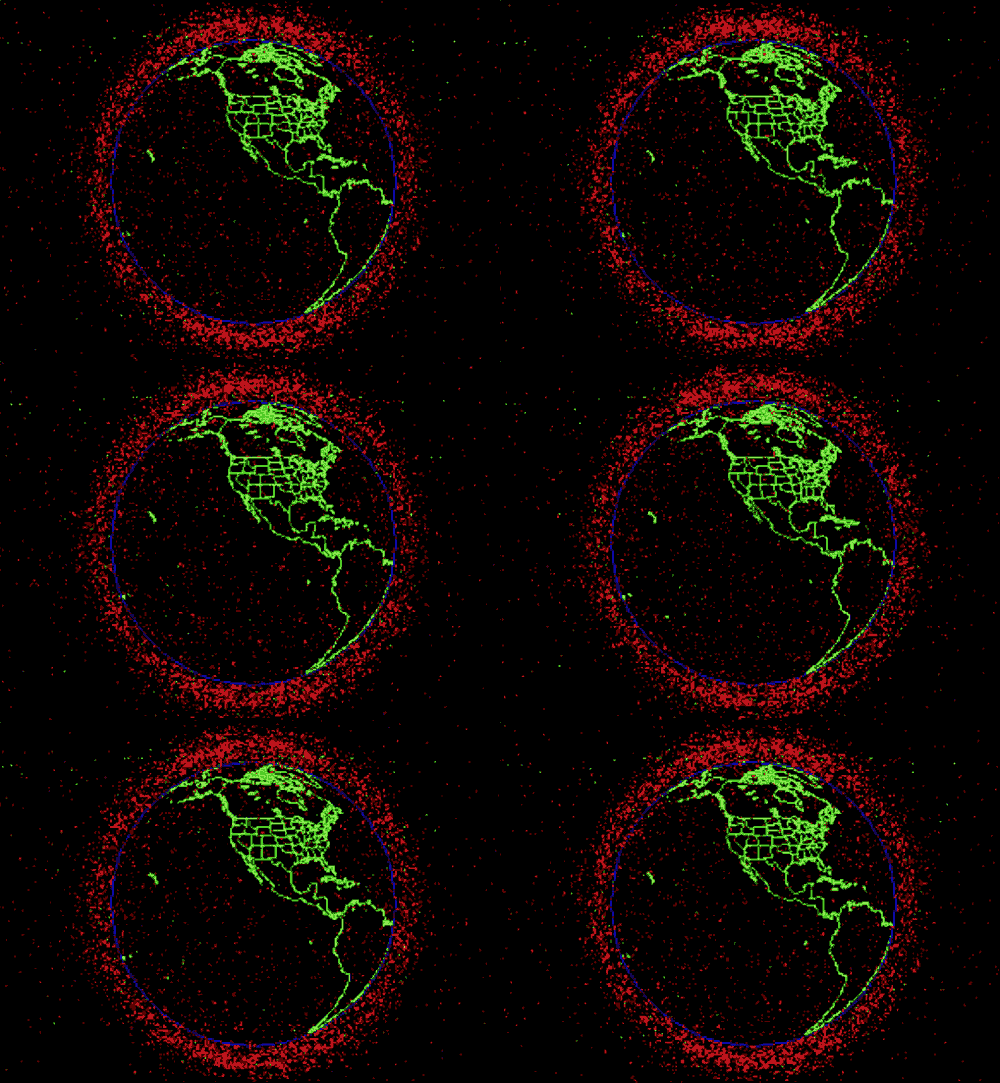
Junk details Stewart’s three-year investigation into America’s stuff, lots and lots and lots of stuff. Stewart rides along with junk removal teams from around the country such as Trash Daddy, Annie Haul, and Junk Vets. She goes backstage to a taping of Antiques Roadshow, and learns what makes for compelling junk-based television with the executive producer of Pawn Stars. And she even investigates the growing problem of space junk—23,000 pieces of manmade debris orbiting the planet at 17,500 mph, threatening both satellites and human space exploration.
But it’s not all dire. There are creative solutions to America’s overburdened consumer culture. Stewart visits with Deron Beal, founder of FreeCycle, an online community of people who would rather give away than throw away their no-longer-needed possessions. She spends a day at a Repair Café, where volunteer tinkerers bring new life to broken appliances, toys, and just about anything. Stewart also explores communities of “tiny houses” without attics and basements in which to stash the owners’ trash.
Junk is a delightful journey through 250-mile-long yard sales, and packrat dens, both human and rodent, that for most readers will look surprisingly familiar.
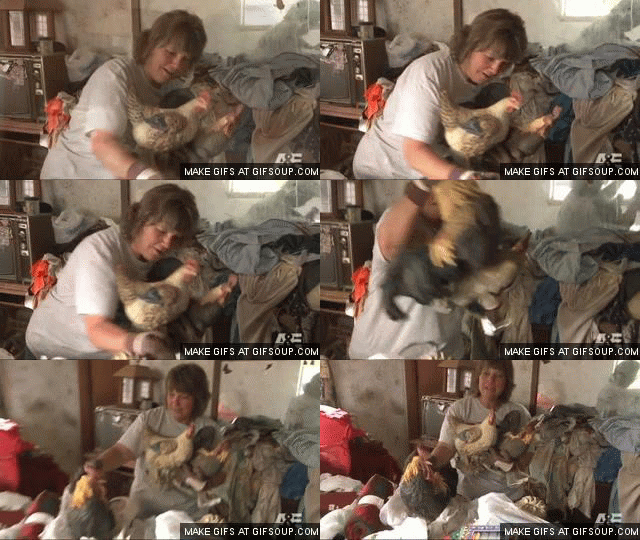
When I think about junk my mind automatically heads towards Hoarders territory, because like several million people I have a fascination with all types of junk. The author of this book obviously does also because she made me think of types of junk that had not even popped into my little mind. It all starts when she and her sister have to clean out her parents basement. They had let their basement become the collect all for a lifetime of their children's mementos and like most of us...just stuff that had some sentimental value at the time. It takes months before they give up and hire some help.
This book covers so much that I'm just hitting the highlights. Such as junk that didn't enter my mind..until now and I'll probably dream about someone's space junk hitting my house tonight. Because yes, even our planet has junk just swirling around it. The law in space is that you're responsible for it; even if it's abandoned, no one else can go up and touch it or you're breaking the law. And in severe cases, a nation might even consider it an act of war because by getting even a dead satellite, you're trying to learn how they're made or, you know, learn some secrets.
So it just gets left there, until it either enters our atmosphere and is hopefully burned up or some collision burst it into a million little pieces of more junk. This could get depressing.
We are so covered up and obsessed with junk that we have stores to go to just to store our junk. For Valentine's Day my husband gave me flowers and a Container Store gift card.
So many shows about junk and the wishes that our junk might be worth something that it could be a channel all to itself like the Food Network or sports channel.
Then even the junk that resides in our pants. You knew I was going to stay classy in this review didn't you?
So if like me, you are interested in the obsession of junk..this book gives you an insight. It made me realize that I have way too much stuff. I would clean it up but I have a book to read right now.
Booksource: Netgalley in exchange for review.
This review (Abby's) is great for this book and I do agree..the book needs some clean up and I would have starred it higher.
An uninspired tome about junk. This is differentiated from crap by being potentially useful to someone, somewhere, somehow. Crap is unequivocal trash. She bounced a bit from space junk, junk transport, junk on TV and somehow it felt unconnected. There were a lot of editing errors - enough to make them irritating. Some (like p 254 - “she does not want to dictate or lecturer people about why..” - who wants to lecturer people?) were just bleh; but some were fun: p 245 - “colorful spools of threat” p 275 - “the answer to all ove it is yes” So close to “love” you almost can’t fault her. Maybe she meant “the answer to al love is yes” ?? These errors made the number of times she felt it necessary to tell us she went to Brown all the more sad.
I don’t feel like i learned anything, except a pearl or two from youth: “Once you turn fifty you should just have to start giving things away.” And a family whose home had burnt down along with all of their family photos: “So Mother would find paintings of other people’s families, and the ugly ones were my father’s side of the family.”
I liked Chapter Two on pack rats – human and otherwise. Apparently Arizona is home turf for animal pack rats known as Neotoma albigula, and there are enough of them in Tucson, Arizona to support Kris Brown who has been in the pest control business for forty years and he gets called to dismantle pack rat dens. This was the best chapter in the book.
The rest of the book was up and down for enjoyment, there were some interesting paragraphs and some paragraphs that would have improved the book by their omission. Chapter Six entitled "Space Junk" was uninteresting. Several other chapters were boring. Much of the book was chapters on different businesses hauling away junk. There was "Junk Vets" in Chicago, owned by veterans. There was "Annie Haul" in Oregon, the "Regeneration Station" in North Carolina. Free Cycle was in a chapter as were the many television shows featuring hoarders and pawnshops. I liked the chapter toward the end about the Repair Cafe where volunteers repair broken things without pay. I wonder why the book seemed jerky, the writing almost seemed like it was done by a team of different people.
My least favorite part of the book was its sporadic defective grammar and punctuation. Several sentences had to be re-read and puzzled over and some of them never made sense to me, and were out of context, so I just skipped past them. I had to spend too much time struggling to understand what the author was trying to say to me, so the book did not have enough rewards in its good parts to justify my time spent reading it.
I think my favorite line in the book was a quote from one of the junk haulers: "Once you turn fifty you should just have to start giving things away." (p133)
The author takes a look at many aspects of junk - the stuff we usually think of filling attics and basements, but also space junk and pack rats (the furry kind) and the business of junk. I think my favorite parts were the interviews with junk haulers and the people recycling used goods by either donating or reselling or remaking/fixing the items to sell. Loved the idea of a free repair event too. For so many items, the cost of repairing means the item goes to the landfill when it could be repaired.
Stewart has delivered a clever, entertaining book about America's fascination with "junk". A quick read, well written, with many chapters delving into lots of different subject matter. It is written in such a manner that you could pick and choose chapters at will, as each tells a different story. The author takes you along on rides with several junk removal teams, with names such as Annie Haul and Junk Vets. She also explores behind the scenes activities at the popular TV shows Antiques Roadshow and Pawn Stars. There are also chapters on the tiny house movement and yard sales. She goes deep into the psychology of "hoarders", as well as other serious subjects like "space junk". Throughout the book, Stewart delivers each story from a human perspective, hitting on the good parts of people's activities, and never looking down on people with some admittedly odd problems. And she manages to make each subject fun to read about. A good book!
I was disappointed in this book for several reasons, but the main one was how sloppily it was edited. Not just in terms of the outright errors (although there were plenty of those), but Stewart's writing did not flow very well. Structurally, the book was a bit scattered, as well. The Q&As were not interesting to me and, in fact, seemed as though they were added just to fill some space.
It was astonishing to see that Stewart actually thanked her editors in the acknowledgement. Did she not read through the galleys before this thing went to print? Did *they* not? Is there no proofreading staff at Chicago Review Press? As a professional editor and proofreader, I would be embarrassed to have my name connected to a book as filled with typos and other errors as this one.
This is a very interesting exploration of our national obsession with stuff or junk as the author calls it. The story is told in a breezy style that keeps you reading and includes interviews, anecdotes, and research on topics such as hoarders, junk removal companies, yard sale culture, spam email, and even space junk. The stories are told sympathetically throughout and it is clear that the author is as interested in the people she is speaking with as she is their mounds of stuff.
This review was written from a NetGalley eArc review copy.
i picked up this book because i thought it was going to be a scientific look into the minds of hoarders, and/or how to cope with hoarders in your life. instead it's an opener about the author cleaning out the basement of her deceased parents, and a bunch of interviews with junk haulers from around the country. the interviews were kind of interesting but repetative. the interview with the tv producer was cool, but the final interview is practically incomprehensible. i really wouldn't recommend this book, it was alright to flip through but didn't offer any concrete information or solutions.
I started disappointed that the prologue wasn't the entire book (cleaning out her parents' basement after 50 years), but ended up really enjoying everything except the super-boring chapter on space junk. Parts of it have a slight "anthropologist discovers mysterious jungle tribe" tint, as if she'd never visited a garage sale or thrift store before in her life (or was writing for people who hadn't), but for the most part it's written like an unusually engaging grad school thesis. I had fun reading along with her adventures on 100-mile garage sales, junk removal services both independent and franchised, the rise of TV shows like Pawn Stars and Storage Wars, and even a taping of Antiques Roadshow.
Unfortunately, it didn't make me want to clean or downsize so much as bound forth to go explore all the thrift stores / estate sales I can find in search of cool new treasure...but that's okay.
This book wasn't what I expected, but it was still very entertaining, thought provoking and interesting to read. The author, Alison Stewart, interviewed many young professionals in the cleaning, junk removal and entertainment industries all pertaining to the junk, clutter and stuff American's accumulate these days. I was fascinated by the inner workings of places from flea markets, trash collection to pawn shops and television shows, all dealing with our junk. The author actually visited, rode with and interviewed these people in person.
I bookmarked many passages that are share-worthy, but I don't want to give all her best thoughts away, so I'll just add one: "After the "go-go greedy" 1980's, the next decade became the "What the hell do we do with all this stuff?". The answer" Self storage is now a $24 billion industry... The growth of this industry has been swift. 1-800-Got-Junk started with a $700 pickup truck. In 1999, it made $1 million. In 2011, the company earned $91.5 million."
Surprisingly, I got another book in the mail the day I finished this one titled: American Junk by Mary Randolph Carter. At first, I only glanced at it and it appeared to be a hefty coffee table book. The last person Alison Stewart interviewed for her book was Mary Randolph Carter. This made me pick up American Junk once more for a closer inspection before reading. Just when Stewart had me thinking I needed to remove some junk, Carter blew that theory out of the water with her absolute gorgeous photos of junk. Oh well, all good entertainment. Love both books.
This book takes a deeper look at junk, examining not just where the word came from, but also how people across the country define it. Alison Stewart interviews a variety of people, including people who own junk hauling businesses, pawn shops, resale shops, and work to repair items. She also discusses the rise of TV where the main topic is stuff (such as Antiques Roadshow and Pawn Stars). While parts of the book are interesting, it can get repetitive. There were a lot of interviews with people who own businesses hauling away junk, many who are independent-owners and found this career after the 2008 recession (either because their original careers didn't pan out, because they wanted a change of pace, or both). I felt that one or two people's stories would have been sufficient to cover this topic. I also found a lot of typos, which ended up distracting me from the main point of the book. It's interesting to take a look at something that is so common (junk), but I felt that this could have been done in fewer pages.
An interesting, if often repetitive, look at America's "junk" industry. Stewart chose well the colorful characters that she focuses on in chapters about junk hauling and removal, junk art, pawn shops, etc. Less successful are the tangents about things like space junk and pack rats (the actual rodents), all of which are interesting in themselves, but within the context of this book felt like an off-topic attempt to appeal to fans of Mary Roach. It was also a weird decision to end the book with an out-of-place, incredibly boring interview with Mary Randolph Carter.
I had no idea there is an organization that will repair your broken items for free. https://repaircafe.org/en/
It's all over the world (currently in 29 countries) and you can find the repair cafe nearest to you at the site. Run by volunteers and non-profit.
from the website: "Goal The Repair Café Foundation wants to make repair a part of the local community once again. It aims to maintain and spread repair expertise, and to promote social cohesion by bringing together neighbours from all walks of life and sets of motivations in the form of inspiring and accessible meetings."
Why do we acquire and keep stuff we really don't need or use?
No great insights here, but there are some interesting anecdotes. Stewart touches on the acquisition phase and on hoarding, but most of the book is about various organizations that take away (junk haulers) or receive (pawn shops) junk and what happens to it. The ideal characteristics for a junk hauler seem to be patience, a sympathetic ear, a pleasing manner, a psychology degree, a strong back, and an impaired sense of smell. This is in order of priority.
Not an academic study of junk, more a grab bag about junk from different angles -- how do people accumulate junk, the people who cart away people's lifetime collections of junk, space junk, reality programs featuring junk (Antiques Road Show, Hoarders, Pawn Stars, etc.), and more. If one subject doesn't click, move to the next, but they're all pretty interesting and it's written in an easy conversational style. It's also great inspiration to start clearing out your own collection of junk.
I enjoyed this book, if only because I learned so much about the huge numbers of businesses to help us get rid of our junk. We all consume too much, and apparently we can't handle the problem ourselves. The author explores all the different options and types of junk. I confess that the section on space junk left me cold. I know the junk is up there, but it's hard for me to see how it affects my habits and solutions.
I’ve been looking forward to reading this book since I attended the southern festival of books and heard the author speak. It was very interesting and thought provoking. I was intrigued by some of the information. I was also surprised to read about local boy Daniel Norris in one of the chapters.
Author relies too heavily on bulky, unedited Q&As. Book spends too much time on some subjects (junk removal companies) and far too little on others; felt imbalanced.
When Alison Stewart and her sister have to clean out their late parent's house to get it ready to sell they make short work of the main level - most things were in working order and could be donated and they each wanted to keep a few family mementos. But the basement was another story. After spending months of Saturdays working hard they had barely made a dent and Stewart knew it was time to get professional help. Sorting through her parent's basement and subsequently paying someone to help clean it out made Stewart think about junk - why do we keep so much stuff "just in case," the companies and TV shows that make a living from junk (selling it, organizing, hoarders, etc.), new uses for junk, and even embracing your junk. This is a really interesting and unique look at junk - however you define it, because there is not just one definition of junk. And you have the old saying, "one man's trash is another man's treasure." I think this is more than timely with the new popularity of minimalism and tiny houses in our culture today. One thing I found really interesting is the people she interviewed who were in the professional business of helping clean out other people's junk live much more minimally. Overall, a really interesting and unique book that really looks at every aspect of junk.
Two things I really liked - the Regeneration Station, a business in Asheville, NC that will come and collect good quality "junk" furniture and other things and then refurbishes them to sell at the Regeneration Station.
Repair Cafe - started in Amsterdam, but is now all over the world. Mostly a quarterly meeting with craftspeople of all types who volunteer their time to repair most anything - furniture, clothing, dolls, toys, light fixtures, etc.
Some quotes I really liked:
"Rats are a big problem in Portland. Apparently, it is so bad that one man in the neighborhood told the local news, 'They're like their own little gang. When I killed one...they pulled him back in there like it was like Saving Private Ryan or something.'" (p. 180)
"Wiens is part of the Right to Repair movement, an effort to pass strong legislation that would allow individual and independent repair shops to fix electronics. Many companies keep their manuals close to the vest and only allow them in the hands of dealers. A bizarre example has surfaced with farm tractors. Now there are John Deere tractors that are wildly computerized. If one of these tractors breaks down, a farmer can't really get in there and fix it himself. He has to have a Deere-approved repair person do it with certain parts and manuals only available to certain people...The Fair Repair bill put forth in two states in 2015, New York and Minnesota, would empower the average person or repair person to have access to the information and parts to be able to fix smartphones, computers, and yes, farm equipment. There is a precedent for a law like this passing. Automotive repair folks won the right to repair in 2012. Now that cars are borderline spaceships, for a while independent mechanics and owners who were handy with a wrench were being turned down when they requested manuals and parts to fix cars, based on the proprietary argument." (p. 250)
In my head, it's more of a 3.75, but I rounded up. This was a really interesting look at "junk" and many different facets of what it means to interact with junk/stuff/crap/belongings.
From an information standpoint, I really enjoyed this. Stewart's ridealongs with the various junk removal companies featured in the book gave you a good sense of the different people who get into this field and what they do. The chapter on pack rats was cute, and the chapter on space junk more than a little terrifying. Most of the shining moments are interactions with people and their stories.
There were some style hiccups - typos, especially in the last two chapters (did an editor get tired at the end?) and some interviews and chapters that could have been more succinct or flowed more neatly one into the the other. The subject matter and Stewart's affability really saves it despite this. People love stuff, and this is a very non-judgmental examination of that love and what it can lead to.
I saw this book as Freecycle's January Book selection and gave it a try. It hooked me right from the start but parts definitely felt like a slog. It is hard to pinpoint what "junk" is. I am glad the book didnt focus on hoarding as that definitely requires books on that topic alone (and she references good ones). I would have liked a website listing to things like Repair Cafe or the junk haulers she traveled with at the end. The book did feel like it gave about 50% airtime to junk haulers. If you've been reading on hoarding or "stuff" or the lifecycle of stuff, there isn't much new ground covered here, but it is a great introductory work if you haven't been able to get into a work like The Story of Stuff.
A surprisingly good read about the increased consumerism and the role of junk collectors in all their forms to counter it. Stewart's start with junk began when she needed to clean out her parents' house for sale and it turned into a look at the industry that has grown out of the disposable nature of our society. From the Junk Cathedral in Texas to the local spin offs of GotJunk, Stewart profiled a number of people who have made their living from others' junk. She also spent some time differentiating between junk and crap. I really loved her chapter on the Repair Cafe - such a great example of volunteerism and keeping some things out of the landfill.
I appreciated the editorial writing-style; it sounded like she quoted all of her interviewees directly, verbal stumbles and all. Alison has a great sense of humor, multiple times I laughed out loud. She does a good job of assessing Junk as a whole. Alison dove into the definition, the related jobs, the TV shows, the disorders, space junk, junk food, fixing junk, every aspect of Junk.
Do I feel like doing a big material item purge? Kind of but this is not Marie Kondo's: The Art of Tidying Up. The subject of the book was Junk. She picked a topic and wrote about it thoroughly. It was a unique type of non-fiction.
This book started off so strong, with the story of cleaning out her parents packed basement. But what started off closer to wonderful "Hoarders" with plenty of details on each piece of crap, totally transformed into several repetitive chapters on junk haulers. I was very much looking forward to the end, but couldn't give up on it, just in case she started talking about hoarders! Each chapter began to sound like an advertisement for 1-800-GOTJUNK, or someone exactly like them. And when it wasn't get another story on some grassroots junkers, it was an unending interview with some blowhard.
Page 86: "It's really depressing, what we all want is to trust science, because science itself is based on trust. That's how this whole thing works: we trust each other! If I so a particular experiment, you shouldn't have to wonder if I did the experiment if my analysis and data holds up. The the problem with junk science and junk journals that publish it is it is polluting the pool of knowledge. The longer this goes on the more everything is getting degraded. We are losing trust in what scientists are saying."
I found this to be interesting and well researched as you see how our desire or undesirable interest in things have shaped the way we live. Writer and journalist Alison Stewart takes a look into the world of junk which includes the business aspect of storage units and junk removal.
The only thing I didn't enjoy reading were the few interviews that included, they didn't really add anything to the book.
Alison Stewart covers a lot of junk but there's not a lot of persuasion of how to change society to rethink junk. It's a little depressing that throughout the United States it's pretty much the same. Call a company to get rid of stuff when you have become overwhelmed. You just want it gone, sometimes with a reassurance that the stuff is still usable. I'm glad some people are trying to recycle, reuse but we need to rethink our buying habits.
A quick read. Stewart covers a bunch of angles on the subject: space junk, junk hauling businesses, repair "cafes" that fix items to keep them out of landfills. It was interesting to think on why we keep items since once we die, it's a problem for someone else- our families will have to get rid of most everything we leave behind.
The interviews are interesting, but this feels like a series of articles loosely connected by a vague term. Lots of interviews with junk removal folk around the country. I finished it, but the whole thing lacked cohesion and the author's conclusion chapter was horrific. No sense of depth or insight, just interesting bits and pieces from around the country.
It's a great light read about junk, what junk is, people who have junk, people who hoard junk, people who clean junk, terms containing the word junk, space junk, etc. It's more like lightly coherent essays than one big narrative, which is what I was in the mood for anyway. Upon some reflection, I need to throw more stuff away...