

What do you think?
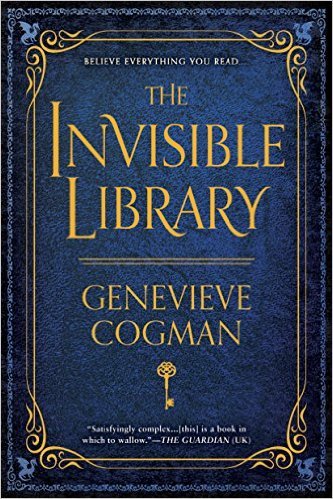
The Invisible Library #1
The Invisible Library
Collecting books can be a dangerous prospect in this fun, time-traveling, fantasy adventure—the first in the Invisible Library series!
One thing any Librarian will tell the truth is much stranger than fiction...
Irene is a professional spy for the mysterious Library, a shadowy organization that collects important works of fiction from all of the different realities. Most recently, she and her enigmatic assistant Kai have been sent to an alternative London. Their Retrieve a particularly dangerous book. The By the time they arrive, it's already been stolen.
London's underground factions are prepared to fight to the death to find the tome before Irene and Kai do, a problem compounded by the fact that this world is chaos-infested—the laws of nature bent to allow supernatural creatures and unpredictable magic to run rampant. To make matters worse, Kai is hiding something—secrets that could be just as volatile as the chaos-filled world itself.
Now Irene is caught in a puzzling web of deadly danger, conflicting clues, and sinister secret societies. And failure is not an option—because it isn’t just Irene’s reputation at stake, it’s the nature of reality itself...
FEATURING BONUS including an interview with the author, a legend from the Library, and more!
One thing any Librarian will tell the truth is much stranger than fiction...
Irene is a professional spy for the mysterious Library, a shadowy organization that collects important works of fiction from all of the different realities. Most recently, she and her enigmatic assistant Kai have been sent to an alternative London. Their Retrieve a particularly dangerous book. The By the time they arrive, it's already been stolen.
London's underground factions are prepared to fight to the death to find the tome before Irene and Kai do, a problem compounded by the fact that this world is chaos-infested—the laws of nature bent to allow supernatural creatures and unpredictable magic to run rampant. To make matters worse, Kai is hiding something—secrets that could be just as volatile as the chaos-filled world itself.
Now Irene is caught in a puzzling web of deadly danger, conflicting clues, and sinister secret societies. And failure is not an option—because it isn’t just Irene’s reputation at stake, it’s the nature of reality itself...
FEATURING BONUS including an interview with the author, a legend from the Library, and more!
351 pages, Kindle Edition
First published December 15, 2014
About the author
Genevieve Cogman
47 books4,645 followersGenevieve Cogman got started on Tolkien and Sherlock Holmes at an early age, and has never looked back. But on a perhaps more prosaic note, she has an MSC in Statistics with Medical Applications and has wielded this in an assortment of jobs: clinical coder, data analyst and classifications specialist. Although The Invisible Library is her debut novel, she has also previously worked as a freelance roleplaying game writer. Genevieve Cogman’s hobbies include patchwork, beading, knitting and gaming, and she lives in the north of England.
Ratings & Reviews
Friends & Following
Create a free account to discover what your friends think of this book!
Community Reviews
Displaying 1 - 30 of 8,116 reviews

January 3, 2016
“I am a librarian. I am a servant of the Library.”
With great ideas, comes great responsibility. Said no comic book character ever, but probably should have. Think about it as an avid reader. You see a book cover that looks gorgeous, you turn it around and read the summary and it tells you the story of a young woman, working for a secret library that recovers books from alternate realities. Add a Doctor Who comparison to the mix and you have one of the most interesting sounding books in a sort of fantasy/science fiction Genre of its time.
Now read that book and tell me what you are feeling when it just doesn’t deliver what it promised to you.
I can tell you in advance, you feel disappointed and most likely kind of bumped.
The Invisible Library tells the story of Irene, a young woman who works for a mysterious library that collects precious books through many alternate realities and their librarians act like a kind of spy. There are worlds similar to ours and a lot of ones that are filled with magic and supernatural creatures. Librarians also use a specific kind of magic called ‘The Language’. After coming back from her latest mission Irene gets the task to accompany new young librarian Kai to his first fieldwork mission. They are ordered to collect an edition of Grimm’s Fairytales from an alternate London, filled with Steampunk elements and mystical creatures like vampires and werewolves. When they arrive the book they are looking for has already been stolen and thus a hunt for it begins and soon the twosome discovers that more than one party is after the book. Things soon get dangerous when an old enemy of the library gets involved.
I’ll be honest with you, I went into this wanting to love it. Books about the love for books are a great thing, a celebration even for every passionate reader and throw in some Doctor Who-esque elements and a great adventure is guaranteed.
Or rather should be guaranteed.
I’m still trying to wrap my head around what went wrong. First of all let me tell you, this book is probably as in medias res as it can get. The reader is literally thrown into the story without any explanation. While this can work very well, as proven countless times by other works of fiction, here the start is already clumsy, jarring and confusing. I was raising my eyebrow a bit, but initial confusion aside I was at least intrigued to find out more about the world and the characters living in it. Confusion also can work in a story’s advantage and in the beginning I was convinced this was the case here. Sadly, it wasn’t.
Before however I start to pin down what went wrong in my opinion, let’s start with the positive aspects first.
The idea of this book is fantastic. The Library is probably every bibliophile’s dream place and being an adventurous, alternate world-travelling spy librarian probably a job all of us would like to apply for or at least have an internship. While alternate realities are nothing new to fiction, the idea that they all have several editions of famous and valuable books that need to be protected is. Oh, how I wished this world would have sucked me in. I wanted to get lost into it so bad and go on book-related adventures with Irene. Okay, already starting with the negative I see, let’s dive into it.
I think we can all agree that a book rises and falls with the writing. For a book that celebrates the wonderfulness of literature and language the writing was very stern and, excuse my harsh wording here, kind of ugly. There are writers who manage to make every word come alive with sheer beauty, that write with a certain flow and let the reader dive into the prose allowing them to get lost in it and absorb every little detail. Then there are those who want to do that and unfortunately manage the exact opposite. Despite a lot of descriptions it was hard to imagine the world(s) in this book. It was hard to imagine the characters. It was hard to feel anything or connect to anyone. The action fell flat, the pacing was way off and even the dialogue ranged from cheesy and clichéd to very strict and overcorrect. Speaking of dialogue, speech patterns were practically none existent. Irene has a certain overly correct way of articulation and while I thought it was a quirk belonging to her, emphasizing her love for grammar and language, I quickly noticed that most characters in the book talked in a similar manner. There was no clear distinction, apart from very rare moments. I also got the impression that this book is intended for more mature readers (direct references to sex and alcohol, in a very clumsy way) but the writing itself seemed more aimed at young adults.
The second problem comes from the world building. Now I personally firmly believe that creativity knows no boundaries and that it does not need guidelines. Writing however does. If you as a writer create fantastical worlds, do whatever you like with them, but explain how these world work to your readers. Especially if that world considers several kinds of magic. A reader needs to know how a world works and how magic in a world works to understand the limitations of what characters are capable off and to know how high the stakes are. Same goes for magical creatures living in a world. You have vampires, werewolves and dragons? Awesome, but what kind of? Nowadays vampires differ from the image Bram Stoker gave us withDracula and not all werewolves are constantly shirtless and play lacrosse like Teen Wolf shows us, so what kind of creatures do live in this world? While there are brief explanations they are a little bit all over the place and are dropped in the middle of action scenes or in rather long, dialogue heavy expositions. In my opinion books like this need at least one character that functions as an avatar for the reader. That is why say Harry Potter works so well. The reader discovers the wizarding world through him and with him. There is a sense of childlike wonder and adventure attached to it rather than just loads of exposition between action scenes. Irene is already well-established in the world of the library and knows her way around alternate realities as well, so she is definitely ruled out as an avatar from the beginning. An interesting choice for the protagonist, I might add. When the reader is introduced to Kai it seems like he will become the character for readers to relate to, until it is pretty clear that he has a secret and knows a lot more than he is letting on. Finally we get the character of Vale, a kind of Sherlock Holmes variation of alternate London who fills in the shoes of reader surrogate in a semi way. Through him the reader will get some needed answers and explanations but not until almost the last third of the book and then, instead of an exciting way, in almost two chapters only containing expositional dialogue and Irene answering questions. Way to go. In the end the world is not really approachable despite interesting rudiments and magic just seems to work the way it is convenient to the plot.
The plot is half fantasy/steampunk adventure and half a classic detective story. It promises fun and action, but never really takes off. There is a confusion up and down between clumsy action scenes and rather uninspiring detective work. Now, I do believe that a good detective story is one that allows readers to connect dots and guess plot twist, but it shouldn’t present everything on a silver platter. Everything is far too obvious to make the mystery intriguing. Even the identity of villain (hilariously named) Alberich does not come as a shock or even a little surprise. Like the rest of the story the twists feel almost static
The book also suffers from a feeling of being overstuffed. There is just too much, with too little explanation. I got the feeling that the author wanted to create all these great characters and forms of magic, wanted to have all these different worlds and use every supernatural creature she had ever seen on a CW show and while I do see a certain enthusiasm there, she forgot to develop anything beyond the rough framework. Someone, probably an editor, should have said ‘stop’. This, being the first book in a series, should have focused on a slow world building and not on throwing everything there is at the reader without giving him time to breathe or give him a chance to understand how it all goes together.
But all of this is nothing compared to the characters. I have said this in plenty reviews now and I will always repeat it: If you give me engaging and three dimensional characters, I’ll probably ignore a lot of stuff that would normally bother me.
Irene caught me on the wrong foot from the beginning. “But hey it happens, we had a tough start but things can get better if I get to know her better.“ Oh what a sweet summer child I was. There was something oddly cold and distant about her from the first chapter that, instead of getting better, actually got worse. I was indifferent towards her in the beginning and started to dislike her probably half way through the book, only to return to my initial indifference in the end. Tell you what, a strong dislike would have been more favorable, at least it would mean I care at all, but indifference is an alarming sign. Irene is somewhat unattainable and irritating to me. We get to know parts of her backstory but never in a way that it makes her remotely interesting, because it is never quite enough. That also results in the fact that her decisions and choices are sometimes odd and don’t make much sense. Her personality falls flat due to the lack of detail about her life. I guess Cogman tried to make her more mysterious by actively keeping her past from the reader and only dropping hints now and then, but since there wasn’t much to go for otherwise it backfired a lot.
The other characters are not doing much better. Kai is the most interesting in my opinion due to his backstory and heritage but sadly gets sidelined a lot in favor of Irene doing whatever Irene does and sending him off to do whatever she wants him to do. This also brings out another problem in the writing. We have a limited third person, meaning that while the narrator is in fact telling the story from a third person perspective it is still somewhat limited to Irene’s point of view, which is really unfortunate here.
Vale is an attempt to create a Sherlock Holmes type of character, but in less mesmerizing and far more average. He is just not as compelling as his famous prototype. Though again, he is more interesting than Irene herself, also due to his hinted and never fully explained backstory (btw I know this is only the first book and not everything gets an explanation just yet, but repeating the same pattern with every single character gets old pretty fast).
The rest of characters stay very one dimensional, which says a lot since the three most developed ones aren’t that compelling either.
Irene’s rival Bradamant has potential to be interesting, but also suffers from a lack of motivation, backstory and personality. Her feud with Irene is briefly explained in the end and rather laughable and makes both women look very childish and adds to the overall irritation (did we ever learn how old any of these characters are? I literally just finished this book and can’t remember it). The supposedly mysterious and sinister Fae ambassador Lord Silver gets a nice introduction, but later on turns a little bit into a parody of himself when he orders his minions around like a mustache twirling villain and never actually does anything impressive. Finally main villain Alberich (seriously that name) is more of an invisible entity during most part of the book and only shows up half way through with somewhat of a threatening entrance. Again, that later falls flat. The ‘big twist’ is not really a surprise and Alberich quickly turns into ‘Monologuing Bad Guy XY’ that is quickly outwitted and possibly would have had more success if he had simply stopped talking and just killed the heroes. But whatever. “Join me on the dark side, we can monologue.” Don’t you hate it when villains do that? Alberich basically fulfills every villain trope there is.
In the end of the day an idea can be fantastic and intriguing, but if not executed well it doesn’t become a good book.
I can see why people enjoy this book. I can even see the potential for future installments to actually become better, however I don’t have any desire to continue with the series. If there is not one character to truly care about, why should I follow their stories?
Conclusion: A fine idea with the potential to grow, but suffering due to a very clumsy execution.
Recommendation: If you like books about books and fantasy/science fiction adventures with steampunk elements you might as well check it out. Just because I couldn’t connect to the characters doesn’t mean others can’t.
With great ideas, comes great responsibility. Said no comic book character ever, but probably should have. Think about it as an avid reader. You see a book cover that looks gorgeous, you turn it around and read the summary and it tells you the story of a young woman, working for a secret library that recovers books from alternate realities. Add a Doctor Who comparison to the mix and you have one of the most interesting sounding books in a sort of fantasy/science fiction Genre of its time.
Now read that book and tell me what you are feeling when it just doesn’t deliver what it promised to you.
I can tell you in advance, you feel disappointed and most likely kind of bumped.
The Invisible Library tells the story of Irene, a young woman who works for a mysterious library that collects precious books through many alternate realities and their librarians act like a kind of spy. There are worlds similar to ours and a lot of ones that are filled with magic and supernatural creatures. Librarians also use a specific kind of magic called ‘The Language’. After coming back from her latest mission Irene gets the task to accompany new young librarian Kai to his first fieldwork mission. They are ordered to collect an edition of Grimm’s Fairytales from an alternate London, filled with Steampunk elements and mystical creatures like vampires and werewolves. When they arrive the book they are looking for has already been stolen and thus a hunt for it begins and soon the twosome discovers that more than one party is after the book. Things soon get dangerous when an old enemy of the library gets involved.
I’ll be honest with you, I went into this wanting to love it. Books about the love for books are a great thing, a celebration even for every passionate reader and throw in some Doctor Who-esque elements and a great adventure is guaranteed.
Or rather should be guaranteed.
I’m still trying to wrap my head around what went wrong. First of all let me tell you, this book is probably as in medias res as it can get. The reader is literally thrown into the story without any explanation. While this can work very well, as proven countless times by other works of fiction, here the start is already clumsy, jarring and confusing. I was raising my eyebrow a bit, but initial confusion aside I was at least intrigued to find out more about the world and the characters living in it. Confusion also can work in a story’s advantage and in the beginning I was convinced this was the case here. Sadly, it wasn’t.
Before however I start to pin down what went wrong in my opinion, let’s start with the positive aspects first.
The idea of this book is fantastic. The Library is probably every bibliophile’s dream place and being an adventurous, alternate world-travelling spy librarian probably a job all of us would like to apply for or at least have an internship. While alternate realities are nothing new to fiction, the idea that they all have several editions of famous and valuable books that need to be protected is. Oh, how I wished this world would have sucked me in. I wanted to get lost into it so bad and go on book-related adventures with Irene. Okay, already starting with the negative I see, let’s dive into it.
I think we can all agree that a book rises and falls with the writing. For a book that celebrates the wonderfulness of literature and language the writing was very stern and, excuse my harsh wording here, kind of ugly. There are writers who manage to make every word come alive with sheer beauty, that write with a certain flow and let the reader dive into the prose allowing them to get lost in it and absorb every little detail. Then there are those who want to do that and unfortunately manage the exact opposite. Despite a lot of descriptions it was hard to imagine the world(s) in this book. It was hard to imagine the characters. It was hard to feel anything or connect to anyone. The action fell flat, the pacing was way off and even the dialogue ranged from cheesy and clichéd to very strict and overcorrect. Speaking of dialogue, speech patterns were practically none existent. Irene has a certain overly correct way of articulation and while I thought it was a quirk belonging to her, emphasizing her love for grammar and language, I quickly noticed that most characters in the book talked in a similar manner. There was no clear distinction, apart from very rare moments. I also got the impression that this book is intended for more mature readers (direct references to sex and alcohol, in a very clumsy way) but the writing itself seemed more aimed at young adults.
The second problem comes from the world building. Now I personally firmly believe that creativity knows no boundaries and that it does not need guidelines. Writing however does. If you as a writer create fantastical worlds, do whatever you like with them, but explain how these world work to your readers. Especially if that world considers several kinds of magic. A reader needs to know how a world works and how magic in a world works to understand the limitations of what characters are capable off and to know how high the stakes are. Same goes for magical creatures living in a world. You have vampires, werewolves and dragons? Awesome, but what kind of? Nowadays vampires differ from the image Bram Stoker gave us withDracula and not all werewolves are constantly shirtless and play lacrosse like Teen Wolf shows us, so what kind of creatures do live in this world? While there are brief explanations they are a little bit all over the place and are dropped in the middle of action scenes or in rather long, dialogue heavy expositions. In my opinion books like this need at least one character that functions as an avatar for the reader. That is why say Harry Potter works so well. The reader discovers the wizarding world through him and with him. There is a sense of childlike wonder and adventure attached to it rather than just loads of exposition between action scenes. Irene is already well-established in the world of the library and knows her way around alternate realities as well, so she is definitely ruled out as an avatar from the beginning. An interesting choice for the protagonist, I might add. When the reader is introduced to Kai it seems like he will become the character for readers to relate to, until it is pretty clear that he has a secret and knows a lot more than he is letting on. Finally we get the character of Vale, a kind of Sherlock Holmes variation of alternate London who fills in the shoes of reader surrogate in a semi way. Through him the reader will get some needed answers and explanations but not until almost the last third of the book and then, instead of an exciting way, in almost two chapters only containing expositional dialogue and Irene answering questions. Way to go. In the end the world is not really approachable despite interesting rudiments and magic just seems to work the way it is convenient to the plot.
The plot is half fantasy/steampunk adventure and half a classic detective story. It promises fun and action, but never really takes off. There is a confusion up and down between clumsy action scenes and rather uninspiring detective work. Now, I do believe that a good detective story is one that allows readers to connect dots and guess plot twist, but it shouldn’t present everything on a silver platter. Everything is far too obvious to make the mystery intriguing. Even the identity of villain (hilariously named) Alberich does not come as a shock or even a little surprise. Like the rest of the story the twists feel almost static
The book also suffers from a feeling of being overstuffed. There is just too much, with too little explanation. I got the feeling that the author wanted to create all these great characters and forms of magic, wanted to have all these different worlds and use every supernatural creature she had ever seen on a CW show and while I do see a certain enthusiasm there, she forgot to develop anything beyond the rough framework. Someone, probably an editor, should have said ‘stop’. This, being the first book in a series, should have focused on a slow world building and not on throwing everything there is at the reader without giving him time to breathe or give him a chance to understand how it all goes together.
But all of this is nothing compared to the characters. I have said this in plenty reviews now and I will always repeat it: If you give me engaging and three dimensional characters, I’ll probably ignore a lot of stuff that would normally bother me.
Irene caught me on the wrong foot from the beginning. “But hey it happens, we had a tough start but things can get better if I get to know her better.“ Oh what a sweet summer child I was. There was something oddly cold and distant about her from the first chapter that, instead of getting better, actually got worse. I was indifferent towards her in the beginning and started to dislike her probably half way through the book, only to return to my initial indifference in the end. Tell you what, a strong dislike would have been more favorable, at least it would mean I care at all, but indifference is an alarming sign. Irene is somewhat unattainable and irritating to me. We get to know parts of her backstory but never in a way that it makes her remotely interesting, because it is never quite enough. That also results in the fact that her decisions and choices are sometimes odd and don’t make much sense. Her personality falls flat due to the lack of detail about her life. I guess Cogman tried to make her more mysterious by actively keeping her past from the reader and only dropping hints now and then, but since there wasn’t much to go for otherwise it backfired a lot.
The other characters are not doing much better. Kai is the most interesting in my opinion due to his backstory and heritage but sadly gets sidelined a lot in favor of Irene doing whatever Irene does and sending him off to do whatever she wants him to do. This also brings out another problem in the writing. We have a limited third person, meaning that while the narrator is in fact telling the story from a third person perspective it is still somewhat limited to Irene’s point of view, which is really unfortunate here.
Vale is an attempt to create a Sherlock Holmes type of character, but in less mesmerizing and far more average. He is just not as compelling as his famous prototype. Though again, he is more interesting than Irene herself, also due to his hinted and never fully explained backstory (btw I know this is only the first book and not everything gets an explanation just yet, but repeating the same pattern with every single character gets old pretty fast).
The rest of characters stay very one dimensional, which says a lot since the three most developed ones aren’t that compelling either.
Irene’s rival Bradamant has potential to be interesting, but also suffers from a lack of motivation, backstory and personality. Her feud with Irene is briefly explained in the end and rather laughable and makes both women look very childish and adds to the overall irritation (did we ever learn how old any of these characters are? I literally just finished this book and can’t remember it). The supposedly mysterious and sinister Fae ambassador Lord Silver gets a nice introduction, but later on turns a little bit into a parody of himself when he orders his minions around like a mustache twirling villain and never actually does anything impressive. Finally main villain Alberich (seriously that name) is more of an invisible entity during most part of the book and only shows up half way through with somewhat of a threatening entrance. Again, that later falls flat. The ‘big twist’ is not really a surprise and Alberich quickly turns into ‘Monologuing Bad Guy XY’ that is quickly outwitted and possibly would have had more success if he had simply stopped talking and just killed the heroes. But whatever. “Join me on the dark side, we can monologue.” Don’t you hate it when villains do that? Alberich basically fulfills every villain trope there is.
In the end of the day an idea can be fantastic and intriguing, but if not executed well it doesn’t become a good book.
I can see why people enjoy this book. I can even see the potential for future installments to actually become better, however I don’t have any desire to continue with the series. If there is not one character to truly care about, why should I follow their stories?
Conclusion: A fine idea with the potential to grow, but suffering due to a very clumsy execution.
Recommendation: If you like books about books and fantasy/science fiction adventures with steampunk elements you might as well check it out. Just because I couldn’t connect to the characters doesn’t mean others can’t.

February 14, 2015
Reread as of 01/03/2016: Still as good as ever. Now, I'm ready for the book 2.
******
Dear Invisible Library,
Are you guys hiring?
I saw your book and I was highly interested in the position of a junior librarian. If I was correct,and assuming that I am because I'm rarely wrong when it comes to my obsessions, your job descriptions are as of follows:
1. To be able to retrieve (or steal, whatever) a certain book assigned to a particular mission.
2. To assist The Library at all times.
If so, what are the qualifications? Should one be as awesome as Irene ? An immortal librarian whose loyalty to the Library is note worthy? Or should one be as cool (or hot) as Kai ? I should tell you though, I'm not as awesome as Kai, who is a dragon shifter.
But I'm awesome if we're talking about how fast can I read a book, or how fast can I change from a timid lady to a raging bitch and how fast can I burn your library if you're not going to hire me as a librarian.
Sorry, I digress.
Attached in this email is my resume for your perusal. If at the end you're still not going to hire my amazing self, I totally understand.
But please bear in my mind that me, my matches and my gasoline are ever ready.
No hard feelings.
Your local psycho,
Paige..
******
Dear Invisible Library,
Are you guys hiring?
I saw your book and I was highly interested in the position of a junior librarian. If I was correct,and assuming that I am because I'm rarely wrong when it comes to my obsessions, your job descriptions are as of follows:
1. To be able to retrieve (or steal, whatever) a certain book assigned to a particular mission.
2. To assist The Library at all times.
If so, what are the qualifications? Should one be as awesome as Irene ? An immortal librarian whose loyalty to the Library is note worthy? Or should one be as cool (or hot) as Kai ? I should tell you though, I'm not as awesome as Kai, who is a dragon shifter.
But I'm awesome if we're talking about how fast can I read a book, or how fast can I change from a timid lady to a raging bitch and how fast can I burn your library if you're not going to hire me as a librarian.
Sorry, I digress.
Attached in this email is my resume for your perusal. If at the end you're still not going to hire my amazing self, I totally understand.
But please bear in my mind that me, my matches and my gasoline are ever ready.
No hard feelings.
Your local psycho,
Paige..

January 30, 2018
Titles with 'library' and 'bookstore' are irresistible to readers. Add in a cover that looks like faded and cracked leather with gilt lettering and it is like leaving a plate of freshly baked cookies in a work breakroom. Sure, you may have started a January diet, but really, just one won't ruin anything, right? I'm often adverse to YA, but a friend's enthusiastic review (thanks, Mikhail!) had me reconsidering. Plus, there's that cover. I gave it a shot and am pleased with how it went. Like a Pixar comic, there may be quite a bit that is young/new adult, but it is done well enough to be enjoyed by all ages, even precocious younger ones (unlike my recent read of Wake of Vultures).
Irene is a resident of the Library, capital intended, a sort of reverse-Plutonian ideal library in which all books reside. Only they don't yet, and so junior librarians like Irene are assigned to retrieve unique books from worlds connected to the Library. Books apparently exist across multiple worlds, so I haven't quite worked out the logistics on that one, but why let petty multiple-world details bother me? After an adventurous opening chapter in which Irene completes a retreval, she heads back to the Library hoping for time to work on her own projects. Alas; her supervisor has other ideas and sends her with a new apprentice, Kai, to a world that has both technical and magical phenomena to retrieve a particular edition of Grimm's Fairy Tales. Worlds with high levels of 'magic' are subject to be thrown out of balance by the forces of Chaos, unless the dragonic race intervenes to help restore order to the magical forces. Before long, Irene and Kai find the situation is (of course) more than they expected and will require some compromise.
Because of the unique confluence of tech and magic, the world Irene and Kai enter feels like a fairly standard Victorian steam-punk setting. Thankfully, Cogman concentrates more on the fun/innovative parts of the world, like robotic centipedes, zeppelins and werewolves, rather than spending endless time describing corsets, top hats, and how gas lamps work.
I often steer clear of the steampunk genre because it seems like authors enjoy the late-Victorian setting as much as the story, and I'll be honest--I haven't cared for parasols since I was ten, and the sexism inherent in the era inevitably causes me cognitive dissonance. But the parallel-worlds theory allows Cogman to bypass such unpleasantness:
"Irene agreed. 'What's the gender situation here?'
'Women are generally accepted in most trades, except as serving soldiers in the army. They often end up in engineering divisions there. Nothing unusual about a female reporter, though they often end up with the high-society and scandal pages."
On a related note, there's some nice humor mixed in:
"'I'll be counter-fashionable. Let's just be grateful that corsets aren't required wear any longer.'
'Why should I be grateful?' Kai asked, raising an eyebrow.
'Because you don't have to deal with me while I'm wearing one,' Irene said flatly."
I thought characterization was decent. Irene is conscientious of her role as Kai's preceptor, tending to think about what she is role-modeling and his possible perspective as student. She has the final say in their mission, and if she occasionally makes too many mental notes to 'apologize to Kai later,' at least we have a nice reversal of the 'older man, younger female wizard/gifted/etc' shtick that I've seen so many times. There are a few times when Irene seemed almost unacceptably naive, missing at least one very obvious situation, but overall I feel okay with how the characterization works. It isn't inconsistent with someone who would have had the in/out world experiences she has had. I like her mostly confident, common-sense attitude.
I enjoyed the way the situation became more complicated with a couple of surprises (rather than the typical 'stay undercover' premise), as well as allowing for a variety of characters to have both antagonistic and helpful actions. I appreciate that kind of complexity. There are a couple of spots where I had to pause and re-read, because something just seemed awkward in phrasing or action, but that seemed in line with a first book. There's also a bit of Kitchen-Sink-Syndrome going on here, which some may find distracting. It means there's a lot of interesting stuff that isn't really explained or necessarily even needed.
Overall, it was a cute story with significant--but again, obvious--potential for a long-term conflict arc. I'll move on to the next, especially as it promises to take place in a difference world than this one.
Three stars books on the technical level, four on the story-telling level.
Irene is a resident of the Library, capital intended, a sort of reverse-Plutonian ideal library in which all books reside. Only they don't yet, and so junior librarians like Irene are assigned to retrieve unique books from worlds connected to the Library. Books apparently exist across multiple worlds, so I haven't quite worked out the logistics on that one, but why let petty multiple-world details bother me? After an adventurous opening chapter in which Irene completes a retreval, she heads back to the Library hoping for time to work on her own projects. Alas; her supervisor has other ideas and sends her with a new apprentice, Kai, to a world that has both technical and magical phenomena to retrieve a particular edition of Grimm's Fairy Tales. Worlds with high levels of 'magic' are subject to be thrown out of balance by the forces of Chaos, unless the dragonic race intervenes to help restore order to the magical forces. Before long, Irene and Kai find the situation is (of course) more than they expected and will require some compromise.
Because of the unique confluence of tech and magic, the world Irene and Kai enter feels like a fairly standard Victorian steam-punk setting. Thankfully, Cogman concentrates more on the fun/innovative parts of the world, like robotic centipedes, zeppelins and werewolves, rather than spending endless time describing corsets, top hats, and how gas lamps work.
I often steer clear of the steampunk genre because it seems like authors enjoy the late-Victorian setting as much as the story, and I'll be honest--I haven't cared for parasols since I was ten, and the sexism inherent in the era inevitably causes me cognitive dissonance. But the parallel-worlds theory allows Cogman to bypass such unpleasantness:
"Irene agreed. 'What's the gender situation here?'
'Women are generally accepted in most trades, except as serving soldiers in the army. They often end up in engineering divisions there. Nothing unusual about a female reporter, though they often end up with the high-society and scandal pages."
On a related note, there's some nice humor mixed in:
"'I'll be counter-fashionable. Let's just be grateful that corsets aren't required wear any longer.'
'Why should I be grateful?' Kai asked, raising an eyebrow.
'Because you don't have to deal with me while I'm wearing one,' Irene said flatly."
I thought characterization was decent. Irene is conscientious of her role as Kai's preceptor, tending to think about what she is role-modeling and his possible perspective as student. She has the final say in their mission, and if she occasionally makes too many mental notes to 'apologize to Kai later,' at least we have a nice reversal of the 'older man, younger female wizard/gifted/etc' shtick that I've seen so many times. There are a few times when Irene seemed almost unacceptably naive, missing at least one very obvious situation, but overall I feel okay with how the characterization works. It isn't inconsistent with someone who would have had the in/out world experiences she has had. I like her mostly confident, common-sense attitude.
I enjoyed the way the situation became more complicated with a couple of surprises (rather than the typical 'stay undercover' premise), as well as allowing for a variety of characters to have both antagonistic and helpful actions. I appreciate that kind of complexity. There are a couple of spots where I had to pause and re-read, because something just seemed awkward in phrasing or action, but that seemed in line with a first book. There's also a bit of Kitchen-Sink-Syndrome going on here, which some may find distracting. It means there's a lot of interesting stuff that isn't really explained or necessarily even needed.
Overall, it was a cute story with significant--but again, obvious--potential for a long-term conflict arc. I'll move on to the next, especially as it promises to take place in a difference world than this one.
Three stars books on the technical level, four on the story-telling level.
November 30, 2016

I LOVE THIS BOOK! It earned its place on my favourites shelf.
Yes, I am sucker for books about books and/or libraries and this novel very much satisfied my every need in this department. Throw in a bit of steampunk & dragons & sprinkle with detective fiction and an alternate-world Sherlock Holmes type of character & you have me floating on air with happiness.
It struck the same chords as The Thursday Next series by Jasper Fforde and the magical Library of the Unseen University of the Discworld series by Terry Pratchett in a sense that I love both, but kudos to Genevieve Cogman to have created a library-story with its own right.
So there is this secret library, THE LIBRARY -existing between worlds, where space-time-matter rules seem suspended - that harvests books from all possible realities with the help of dedicated librarians(-turned-secret agents).
The protagonist, Irene, is one of them. She is sent with her new, mysterious apprentice Kai to an alternate, chaos-infested, Victorian London (with Zeppelins, Faes, werewolves & vampires) to obtain a copy of Grimms’ Fairy Tales, only to find the book missing and others on its trail, and willing to commit murder to get what they want. They get unexpected help from Peregrine Vale (an aristocrat with a penchant and talent for investigating crime) & they meet Irene's former mentor and nemesis, Bradamant, who is also out there to get the book by all means possible. And we have not mentioned the arch enemy of The Library, ex-librarian Alberich, who has an agenda of his own.
The writing is crisp, tight-paced & dryly witty with no superfluos descriptions & Irene, the MC is refreshingly & delightfully "ordinary" (no signs of superspecialsnowflake-ness anywhere ). Possibly that is why she is so relatable. She is a level-headed, dependable, composed book-lover who knows her serious library-stuff, but sucks at "sourcery" and has a weakness for detective fiction. And suprisingly there is not a single description in sight of her looks apart from the fact that she is 5.9 and prefers wearing her hair in a bun.
I also like the fact the her assistant, Kai, though a man, is totally OK with Irene being in the lead. He respects her & her authority, trusts and supports her almost from the very beginning.
The alternate London conjures images of the city in Guy Ritchie's Sherlock Holmes movie, which was a welcome sensation, again.
The world-building is very good & promises some more in the next instalments that I hope will not disappoint.

March 28, 2018
ETA Charles Urbach's lovely artwork, "Not All Treasure Is Gold," epitomizes how I see Kai:

Rating: 4* of five
I want to be a Librarian.
Need I say more?
Now. Are you sold? If not, skip it and regret nothing. The rest of us who aren't dead-souled potato heads will be happily reading the five extant volumes for the sheer verve with which Author Cogman lobs twists at us.
Rating: 4* of five
I want to be a Librarian.
The atmosphere of the place soothed her automatically; the rich lantern lights, the sheer scent of paper and leather, and the fact that everywhere she looked, there were books, books, beautiful books.
***
She was a Librarian, and the deepest, most fundamental part of her life involved a love of books. Right now, she wanted nothing more than to shut the rest of the world out and have nothing to worry about except the next page of whatever she was reading...
***
And then they were inside, and out of the wind, and surrounded by comforting walls and walls of books. The rich, delightful smell of old paper, leather and ink permeated the place, washing away the pettier odours of blood and oil and smog.
Need I say more?
A high level of chaos would mean that they could expect to meet the Fae, creatures of chaos and magic, who were able to take form and cause disorder on such a corrupted world. And that was never good news.
***
A Librarian’s mission to seek out books for the Library developed, after a few years, into an urge to find out everything that was going on around one. It wasn’t even a personal curiosity. It was a simple, impersonal, uncontrollable need to know. One came to terms with it.
***
And if she’d been able to choose her options a few hours ago, being trapped in a dead vampire’s private study with an angry Fae would not have been one of them.
***
Irene sighed. “So we have an incredibly glamorous female cat burglar who slinks around in a black leather cat-suit, who kills vampires in her spare time?”
Now. Are you sold? If not, skip it and regret nothing. The rest of us who aren't dead-souled potato heads will be happily reading the five extant volumes for the sheer verve with which Author Cogman lobs twists at us.

July 8, 2018
A little gem of a fantasy novel, The Invisible Library is smart and elegant and bewitching. It has lots of action, great characters and world building. Irene, the Librarian, with a capital L is tasked to seek out and deliver an important version of Grimm's Fairy Tales to the Library. The Library is the repository of all the best books in all the worlds, and there are many worlds.
The Librarians are a cross between secret agents and holy orders. They are trained not to ask too many questions and to see their task as divine. Irene is fairly new, but with a grit and determination unparalleled, she knows how to get the job done. Unexpectedly, this trip she has to take along a newbie, who is unsettling for many reasons. Oh! I wish I could be a Librarian too. Sigh. . .
The Librarians are a cross between secret agents and holy orders. They are trained not to ask too many questions and to see their task as divine. Irene is fairly new, but with a grit and determination unparalleled, she knows how to get the job done. Unexpectedly, this trip she has to take along a newbie, who is unsettling for many reasons. Oh! I wish I could be a Librarian too. Sigh. . .

Read
October 21, 20159/30/17 - ON SALE for $2.99:


http://amzn.to/2xJDGRK
So I'm only 12% into this thing, but as far as I can tell, it's about librarians. SPY librarians. Spy librarian THIEVES. Spy librarian THIEVES who can travel to PARALLEL DIMENSIONS for the express purpose of stealing books unique to that world.
And depending on how much chaos exists in an individual world, DRAGONS might show up to breathe firey order into said chaos. (<------I don't actually know yet how the dragons correct the balance, just that they do, but WHO CARES?? B/c DRAGONS).
Chaos-filled worlds are also prone to having a variety of other supernatural creatures (like FAE), as well as BIOMUTATIONS and technology that doesn't work the way one would expect.

http://amzn.to/2xJDGRK
So I'm only 12% into this thing, but as far as I can tell, it's about librarians. SPY librarians. Spy librarian THIEVES. Spy librarian THIEVES who can travel to PARALLEL DIMENSIONS for the express purpose of stealing books unique to that world.
And depending on how much chaos exists in an individual world, DRAGONS might show up to breathe firey order into said chaos. (<------I don't actually know yet how the dragons correct the balance, just that they do, but WHO CARES?? B/c DRAGONS).
Chaos-filled worlds are also prone to having a variety of other supernatural creatures (like FAE), as well as BIOMUTATIONS and technology that doesn't work the way one would expect.

May 8, 2019
1.5** rounded up.
While I really enjoyed the premise of the book and Irene, the library spy, as a main character. The actual story just fell completely flat for me and I found it difficult to keep up interest.
While I really enjoyed the premise of the book and Irene, the library spy, as a main character. The actual story just fell completely flat for me and I found it difficult to keep up interest.

January 16, 2015
This was absolutely the best fun I’ve had with a book in ages. Brilliant characters, magical world building and a whole load of adventure.
Irene is sent into one alternate London to retrieve a dangerous book – shadowed by new assistant Kai, this mission is anything but straightforward and what follows is a rip roaring race to find the book, involving Vampires, Werewolves, Fai and, well, alligators….
I absolutely adore the world the author has created here – it is a brilliant mix of mundane and magic, the mysterious “library” having a life all of its own, spreading out throughout the many different worlds that exist. The librarians are an eclectic bunch, although we only meet a small section of that society, I definitely want to find out more in (hopefully) future adventures. The London that Irene ends up in is very different to our own, and the people she encounters there are a heady mix of hero and villain – even those closest to her are not always what they seem and it is highly engaging throughout, with some laugh out loud moments, some edge of the seat thrills, with some real emotional resonance mixed up right in there.
The mythology is intelligently created, it really is beautifully written, a real page turner where anything can happen and often does – right at the heart of it though is Irene and her love of books, which of course for any reader is a magical thing. It makes her highly relatable and you will be with her all the way as she tries to work out who is friend and foe, fights the good fight and maybe discovers more about herself along the way.
Absolutely and utterly sparkling. Highly HIGHLY recommended.
Irene is sent into one alternate London to retrieve a dangerous book – shadowed by new assistant Kai, this mission is anything but straightforward and what follows is a rip roaring race to find the book, involving Vampires, Werewolves, Fai and, well, alligators….
I absolutely adore the world the author has created here – it is a brilliant mix of mundane and magic, the mysterious “library” having a life all of its own, spreading out throughout the many different worlds that exist. The librarians are an eclectic bunch, although we only meet a small section of that society, I definitely want to find out more in (hopefully) future adventures. The London that Irene ends up in is very different to our own, and the people she encounters there are a heady mix of hero and villain – even those closest to her are not always what they seem and it is highly engaging throughout, with some laugh out loud moments, some edge of the seat thrills, with some real emotional resonance mixed up right in there.
The mythology is intelligently created, it really is beautifully written, a real page turner where anything can happen and often does – right at the heart of it though is Irene and her love of books, which of course for any reader is a magical thing. It makes her highly relatable and you will be with her all the way as she tries to work out who is friend and foe, fights the good fight and maybe discovers more about herself along the way.
Absolutely and utterly sparkling. Highly HIGHLY recommended.

January 28, 2017
This was fun. A librarian/secret agent for a library that exists between dimensions (and rather outside of time) is sent in pursuit of a rare edition of the Grimm tales in an alternate steampunk world; hijinks ensue. An alternate Sherlock-Holmes avatar from the local world and the librarian's apprentice who is more than he seems add a lot of interest.
While sequels could obviously go to many alternate worlds if the writer gets bored with this one, I gather the immediate sequel returns to this first one.
I have a personal interest in the author; earlier in her career when she was developing her chops doing freelance work, she wrote the excellent text for the GURPS Vorkosigan role-playing book. https://www.goodreads.com/book/show/1...
Ta, L.
While sequels could obviously go to many alternate worlds if the writer gets bored with this one, I gather the immediate sequel returns to this first one.
I have a personal interest in the author; earlier in her career when she was developing her chops doing freelance work, she wrote the excellent text for the GURPS Vorkosigan role-playing book. https://www.goodreads.com/book/show/1...
Ta, L.

March 18, 2018
This was one of the most painful books I've read in recent memory. The book I'd compare it to most is something I can't remember the name of, and while I think it's still in my attic, looking for it feels like a waste of energy. Anyways, this was bad.
I don't have anything good to say about it. The story didn't make sense, the character motivations were non-existent, the asides (in parentheses) were obnoxious, the logic was completely fallacious. The main character was the worst undercover detective I've ever heard of--I've seen children play more convincing games of cops and robbers. The rules changed every time they needed to for the author to justify something, the plot was reiterated so many times to so many characters that towards the end I skipped literal pages, found a paragraph starting "Now, tell me about..." and just read that to see what I'd missed.
Also, this is the type of book that makes me cringe when people say a story has a "strong female protagonist." There was in fact a woman from whose perspective we heard this story, and she was in fact someone imbued with something like authority. But still. Irene did literally nothing on her own. Every step of the way, a man did it better or offered to impale himself to help her. A love triangle is already brewing (GAH.) and while it's been explained or made evident that she's not actually very smart, pretty, charming, or otherwise skilled, men who are these things keep throwing themselves at her. PLUS the only other women we really see are a taciturn bitch, a manipulative former prostitute, and a literal backstabbing drama queen who constantly fights with the main character.
In sum, this was a huge waste of my time and rage.
I don't have anything good to say about it. The story didn't make sense, the character motivations were non-existent, the asides (in parentheses) were obnoxious, the logic was completely fallacious. The main character was the worst undercover detective I've ever heard of--I've seen children play more convincing games of cops and robbers. The rules changed every time they needed to for the author to justify something, the plot was reiterated so many times to so many characters that towards the end I skipped literal pages, found a paragraph starting "Now, tell me about..." and just read that to see what I'd missed.
Also, this is the type of book that makes me cringe when people say a story has a "strong female protagonist." There was in fact a woman from whose perspective we heard this story, and she was in fact someone imbued with something like authority. But still. Irene did literally nothing on her own. Every step of the way, a man did it better or offered to impale himself to help her. A love triangle is already brewing (GAH.) and while it's been explained or made evident that she's not actually very smart, pretty, charming, or otherwise skilled, men who are these things keep throwing themselves at her. PLUS the only other women we really see are a taciturn bitch, a manipulative former prostitute, and a literal backstabbing drama queen who constantly fights with the main character.
In sum, this was a huge waste of my time and rage.

December 16, 2023
As a reader it's always exciting to read books about books, secret magical libraries and adventurous librarians who obsessed with rear editions. This novel has all of it + multiverse through which you can travel with a help of mentioned magical library. The idea of travelling to parallel realities gave the author a lot of freedom to create interesting and a bit crazy mash-up of Victorian London, fairies and steampunk. Although I don't really like that type of mixture, it has an intriguing investigation and nice characters. But I unlikely will read the rest of the series because it has far too many books in it.

November 27, 2015
3.5 of 5 stars at The BiblioSanctum https://bibliosanctum.com/2016/06/09/...
Speaking as someone who loves to read, I just can’t help but get these warm fuzzy feelings for books about libraries. After all, what could be better for an avid bookworm, than being immersed in a story about a place filled with books, books, and more books?
Well, Genevieve Cogman’s The Invisible Library does one even better.
Oh, this book has libraries, all right—interdimensional libraries, established across multiple worlds, all interconnected and run by a secret society of librarian spies! Collectively, this network is known as the Invisible Library, and their members are tasked with the utmost important mission: to procure and archive important works of fiction from all of the different realities, for the purposes of preservation and research.
Our protagonist is Irene, a junior librarian agent. When the book opens, Irene is just returning home to the Library, having completed her latest assignment in the field and looking forward to some time off. However, no sooner had she reported in than she is given a new mission. This time, her superiors are sending her off to an alternate London where magic and steampunkish technologies dominate. Furthermore, Irene is given a new assistant, a mysterious young man named Kai. Together, they are to retrieve a rare book of fairy tales and bring it back to the Library before it can fall into the wrong hands.
Yet by the time Irene and Kai arrive at their destination, they find that the book has already been stolen. Tangled in a mystery involving vampires and fae, killer automatons and dashing detectives, it soon becomes clear they are on no ordinary mission.
As soon as I heard the premise, I just knew I had to check it out! This novel ended up being an incredibly fun book which uses the idea of parallel worlds to great effect, allowing the reader to ponder its infinite possibilities. This particular story takes us to an alternate London with magic and paranormal creatures, but then who knows what might come next? The potential here is simply staggering. And of course, the Library itself is also fascinating concept, with librarians who can work magic by using a secret Language. Their order’s primary purpose raises some important questions—questions that I was glad to see are ultimately addressed by the main character. For instance, what responsibilities, if any, does the Library have? What good is keeping a vast store of knowledge after all, if you don’t ever apply the information you learn? Is it even ethical what Irene and her peers are doing, plundering alternate realities for important books with no thought to what will happen to the worlds and their people? The argument is that a love for books should be good enough, but is it really?
That Irene is willing to consider these questions shows that she is different from a lot of her fellow librarians. Despite being born to life in the Library, she’s also not one to follow its rules blindly, making her a flexible agent who can think quickly on her feet. Still, her loyalty is beyond reproach. Even when faced with a competitor trying to steal credit for her work, Irene will never let pride or anything else get in the way of her mission, thinking instead of the greater goal. When the stakes are this high, it’s nice to have such a smart, efficient and good protagonist at the helm.
Still, in spite of the interesting ideas and thoughtful themes, the plot of The Invisible Library is relatively simple. It’s also a light read that has the distinct feel of being the first book a series, with room to grow in terms of character development and world-building. I for one would love to see more of the Library itself, and to learn more about its inner workings. Several of the secondary characters could use some fleshing out as well, including Vale, who is currently shaping up to be a romantic interest for Irene. For all that she is attracted to his Sherlock Holmes-like persona, I personally wouldn’t mind seeing Vale’s character grow a bit further past the “great detective” archetype. Similarly, the villain feels too lightly sketched at the moment, and needs to become more than just a bogeyman-type character for me to feel like he is a true threat, though by the end of the book I think we’re taking a step in the right direction.
While there’s no denying The Invisible Library is a book more about action than substance, I can hardly complain about that! The story is loads of fun, the characters are great, and the concept holds lots of promise. Any weaknesses I felt were very minor, and I have a feeling subsequent novels in this series will have everything covered. I had an amazing time with this book, which I would heartily recommend to all bibliophiles and lovers of “books about books”. Looking forward to the sequel!
Speaking as someone who loves to read, I just can’t help but get these warm fuzzy feelings for books about libraries. After all, what could be better for an avid bookworm, than being immersed in a story about a place filled with books, books, and more books?
Well, Genevieve Cogman’s The Invisible Library does one even better.
Oh, this book has libraries, all right—interdimensional libraries, established across multiple worlds, all interconnected and run by a secret society of librarian spies! Collectively, this network is known as the Invisible Library, and their members are tasked with the utmost important mission: to procure and archive important works of fiction from all of the different realities, for the purposes of preservation and research.
Our protagonist is Irene, a junior librarian agent. When the book opens, Irene is just returning home to the Library, having completed her latest assignment in the field and looking forward to some time off. However, no sooner had she reported in than she is given a new mission. This time, her superiors are sending her off to an alternate London where magic and steampunkish technologies dominate. Furthermore, Irene is given a new assistant, a mysterious young man named Kai. Together, they are to retrieve a rare book of fairy tales and bring it back to the Library before it can fall into the wrong hands.
Yet by the time Irene and Kai arrive at their destination, they find that the book has already been stolen. Tangled in a mystery involving vampires and fae, killer automatons and dashing detectives, it soon becomes clear they are on no ordinary mission.
As soon as I heard the premise, I just knew I had to check it out! This novel ended up being an incredibly fun book which uses the idea of parallel worlds to great effect, allowing the reader to ponder its infinite possibilities. This particular story takes us to an alternate London with magic and paranormal creatures, but then who knows what might come next? The potential here is simply staggering. And of course, the Library itself is also fascinating concept, with librarians who can work magic by using a secret Language. Their order’s primary purpose raises some important questions—questions that I was glad to see are ultimately addressed by the main character. For instance, what responsibilities, if any, does the Library have? What good is keeping a vast store of knowledge after all, if you don’t ever apply the information you learn? Is it even ethical what Irene and her peers are doing, plundering alternate realities for important books with no thought to what will happen to the worlds and their people? The argument is that a love for books should be good enough, but is it really?
That Irene is willing to consider these questions shows that she is different from a lot of her fellow librarians. Despite being born to life in the Library, she’s also not one to follow its rules blindly, making her a flexible agent who can think quickly on her feet. Still, her loyalty is beyond reproach. Even when faced with a competitor trying to steal credit for her work, Irene will never let pride or anything else get in the way of her mission, thinking instead of the greater goal. When the stakes are this high, it’s nice to have such a smart, efficient and good protagonist at the helm.
Still, in spite of the interesting ideas and thoughtful themes, the plot of The Invisible Library is relatively simple. It’s also a light read that has the distinct feel of being the first book a series, with room to grow in terms of character development and world-building. I for one would love to see more of the Library itself, and to learn more about its inner workings. Several of the secondary characters could use some fleshing out as well, including Vale, who is currently shaping up to be a romantic interest for Irene. For all that she is attracted to his Sherlock Holmes-like persona, I personally wouldn’t mind seeing Vale’s character grow a bit further past the “great detective” archetype. Similarly, the villain feels too lightly sketched at the moment, and needs to become more than just a bogeyman-type character for me to feel like he is a true threat, though by the end of the book I think we’re taking a step in the right direction.
While there’s no denying The Invisible Library is a book more about action than substance, I can hardly complain about that! The story is loads of fun, the characters are great, and the concept holds lots of promise. Any weaknesses I felt were very minor, and I have a feeling subsequent novels in this series will have everything covered. I had an amazing time with this book, which I would heartily recommend to all bibliophiles and lovers of “books about books”. Looking forward to the sequel!

July 31, 2017
I'm really bummed about how this one turned out. When I first picked it up it seemed like a book that would be right up my alley. I was under the impression that it would be a combination of Jonathan Strange and Mr. Norrell and Death of a Necromancer. Add the library aspect and I should have enjoyed this so much more than I did. As it happens, I did not care for it very much. For me, the writing was just so-so and I felt that the library served as simply a vehicle where the author could introduce a bunch of cool worlds. The problem is that yeah the worlds were pretty cool, but there should also be a compelling or interesting story driving that world-building. When I got to the end of the book I realized that I read about a lot of different fantastic settings but ultimately I didn't care for any of the characters or the endeavors that they were involved in. This series definitely has its devotees but I'm not one of them unfortunately. Just too much fluff for my liking and not enough substance.

August 26, 2019
I had been told by many, many people (in particular my 'buddy' Mary S.R. comes to mind!) that I needed to read this series. They were all so very right! Let me start this review by saying if you like fun, clever fantasy novels that feel a little like a Doctor Who episode then go read this immediately! Don't even read the rest of this review; just go get The Invisible Library.
Like Doctor Who
I don't know if it's because the opening description of the Library made me think of the Doctor Who episode in which we first encounter River Song (my favourite character ever on this series) or that there are multiple dimensions that feel like time travel in their own way? Whatever the reason I had immense Doctor Who vibes within the first couple chapters.
Humour and Sarcasm
There is a humour that Genevieve Cogman has injected into each of her characters that reminds me of the banter on any good sci-fi show (ie: Firefly, Doctor Who, etc.) that helps to relieve some of the intense moments that are liable to happen. Much of the comedy included in The Invisible Library is sarcastic (my fave kind!) and requires you to appreciate how complex this world of multiple 'worlds' is. Whether it's Irene, Kai or (yummy, yummy) Vale keeping the reader on their toes with quick witty comments it doesn't even matter. The overall feel is just wonderful!
Intense
Don't let the laughs you may have at moments dispel from the fact that this is an action-packed, psychopathic starring story. Our villain(s) are complex and hard to anticipate. A nice change from the usual black and white you might get from others in a similar story format. There is nothing simple or easy about The Invisible Library's characters, plot or set-up. Yet it's a quick and enjoyable read. I know it sounds like this isn't possible; but truly Cogman conjures magic unlike most other authors and makes her novel one that is good to pick-up no matter mood you're in.
Overall
I'm sure everything has been said about this series already as it's been around (and beloved by many) for a few years now. So if you don't believe me then believe the thousands of others who've read and loved The Invisible Library. This book was so good I immediately (literally the next day) went out of my way to stop in at a bookstore and pick-up the next two books. I've since acquired the whole series to date.
I did previous have a note in here about how exciting it was the series was complete as well. But I’ve since found out there is a 7th book planned. I will say that based on this first books format (and my reading into the second book) each one seems to have its own plot and it’s just some character arcs that carry forward. So I’m hopeful that means no major cliffhangers that create issues with waiting for the next book to be released.
Like Doctor Who
I don't know if it's because the opening description of the Library made me think of the Doctor Who episode in which we first encounter River Song (my favourite character ever on this series) or that there are multiple dimensions that feel like time travel in their own way? Whatever the reason I had immense Doctor Who vibes within the first couple chapters.
Humour and Sarcasm
There is a humour that Genevieve Cogman has injected into each of her characters that reminds me of the banter on any good sci-fi show (ie: Firefly, Doctor Who, etc.) that helps to relieve some of the intense moments that are liable to happen. Much of the comedy included in The Invisible Library is sarcastic (my fave kind!) and requires you to appreciate how complex this world of multiple 'worlds' is. Whether it's Irene, Kai or (yummy, yummy) Vale keeping the reader on their toes with quick witty comments it doesn't even matter. The overall feel is just wonderful!
Intense
Don't let the laughs you may have at moments dispel from the fact that this is an action-packed, psychopathic starring story. Our villain(s) are complex and hard to anticipate. A nice change from the usual black and white you might get from others in a similar story format. There is nothing simple or easy about The Invisible Library's characters, plot or set-up. Yet it's a quick and enjoyable read. I know it sounds like this isn't possible; but truly Cogman conjures magic unlike most other authors and makes her novel one that is good to pick-up no matter mood you're in.
Overall
I'm sure everything has been said about this series already as it's been around (and beloved by many) for a few years now. So if you don't believe me then believe the thousands of others who've read and loved The Invisible Library. This book was so good I immediately (literally the next day) went out of my way to stop in at a bookstore and pick-up the next two books. I've since acquired the whole series to date.
I did previous have a note in here about how exciting it was the series was complete as well. But I’ve since found out there is a 7th book planned. I will say that based on this first books format (and my reading into the second book) each one seems to have its own plot and it’s just some character arcs that carry forward. So I’m hopeful that means no major cliffhangers that create issues with waiting for the next book to be released.

September 26, 2018
Sale Alert: Kindle Daily Deal 10Mar22 $1.99
I’m not sure how this book fell through my radar.

It has so many things I love.
ღ - Libraries (Duh)
ღ - Dragons, seriously hot dragons (Um…Double Duh)
ღ - Fae (It is a love/hate thing)
ღ - Sherlock Holme’s type character (Elementary, dear Watson)
ღ - Steampunk Alligators (So much more scary than regular ones)
ღ - A murder mystery (see above like of Sherlock Holmes)
So I should have found this book forever ago. But alas, we just found each other now. Still well worth the wait and now I don’t have to wait years between books. Yay!!!
The important thing to know if this has multiple worlds with various magic/technology in each with a Library in the middle of all of them tying all the worlds together somehow. Worlds that have been touched by chaos will have things like Fae, Vampires and Werewolves. Worlds that haven’t fallen into chaos will have humans and a blend of both magic and technology that follows rules.
Most of our story is spent on one world touched by Chaos as Irene and her new apprentice Kia search for a book to take back to the Library. The book is of great importance but it seems to have been stolen and the owner killed. So off Irene and Kia go to meet the locals and try to figure out who took the book, if they solve the murder too all the better.
I love Irene. She and I would totally get along in the real world
Kia, the apprentice, wasn’t too bad either. Sure he is there to from Irene, but he is also somewhat of a mystery. Add in the Sherlock Holmes guy, a seductive fae type and a bad man with a vendetta against the library and you have a winner.
Potenential, that is what this series has in droves. This was a fantastic, get your feet wet, installment and it made me so much most interested in the not only the other worlds but the politics of the Library and what is really going on there.
If there is a love story happening (and I totally hope that there is) it will be the long play. I’m shipping Irene and Kia a lot but there are going to be some big hurdles to jump if that happens. Still crosses fingers and wishes on a star and all that.
On to the Masked City to see where the story takes us.
I’m not sure how this book fell through my radar.
It has so many things I love.
ღ - Libraries (Duh)
ღ - Dragons, seriously hot dragons (Um…Double Duh)
ღ - Fae (It is a love/hate thing)
ღ - Sherlock Holme’s type character (Elementary, dear Watson)
ღ - Steampunk Alligators (So much more scary than regular ones)
ღ - A murder mystery (see above like of Sherlock Holmes)
So I should have found this book forever ago. But alas, we just found each other now. Still well worth the wait and now I don’t have to wait years between books. Yay!!!
The important thing to know if this has multiple worlds with various magic/technology in each with a Library in the middle of all of them tying all the worlds together somehow. Worlds that have been touched by chaos will have things like Fae, Vampires and Werewolves. Worlds that haven’t fallen into chaos will have humans and a blend of both magic and technology that follows rules.
Most of our story is spent on one world touched by Chaos as Irene and her new apprentice Kia search for a book to take back to the Library. The book is of great importance but it seems to have been stolen and the owner killed. So off Irene and Kia go to meet the locals and try to figure out who took the book, if they solve the murder too all the better.
“We have to report this."
Kai sighed deeply in relief. "I was afraid you were going to say that we had to investigate it ourselves."
"Don't be ridiculous," Irene said briskly. "We may collect fiction, but we are not required to imitate the stupider parts of it.”
I love Irene. She and I would totally get along in the real world
“She was a Librarian, and the deepest, most fundamental part of her life involved a love of books. Right now, she wanted nothing more than to shut the rest of the world out and have nothing to worry about except the next page of whatever she was reading,”
Kia, the apprentice, wasn’t too bad either. Sure he is there to from Irene, but he is also somewhat of a mystery. Add in the Sherlock Holmes guy, a seductive fae type and a bad man with a vendetta against the library and you have a winner.
Potenential, that is what this series has in droves. This was a fantastic, get your feet wet, installment and it made me so much most interested in the not only the other worlds but the politics of the Library and what is really going on there.
If there is a love story happening (and I totally hope that there is) it will be the long play. I’m shipping Irene and Kia a lot but there are going to be some big hurdles to jump if that happens. Still crosses fingers and wishes on a star and all that.
On to the Masked City to see where the story takes us.

October 12, 2016
Irene is an agent for The Library, a timeless place balanced among many parallel universes. Their goal: to collect all the stories ever put into print, everywhere … by whatever means it takes. When Irene and a handsome young newly-minted agent are assigned to seek a collection of Grimm’s fairy tales from a steampunk Victorian London replete with vampires, werewolves, and Fae, it seems like a standard run -- until the Library’s arch-enemy appears, seeking the same book, and chaos ensues, literally.Oh, Invisible Library, where did we go wrong? You’re exactly the kind of book I should love. An urban fantasy/steampunk/mystery/magic story, with ninja-wizard bad-ass librarians and plenty of literary winks and nods? We should have been a perfect match. And we had an enjoyable time, I can’t deny that. You were charming and clever. You had an adorably wry sense of humor. Your plot was tight, your pacing good. You managed to be both highly creative and comfortably familiar all at the same time. There was never any doubt that I’d make it to the last page with you.
And yet. Something was missing, that little frisson of chemistry that would have made for a lasting bond, and a rush to my library for your sequels. Was it that perhaps you seemed a little too familiar, some of your plot twists a little too predictable? Was it the way the Language too often served as a deus ex machina, so that too many predicaments seemed too easily resolved? Was it the long sentences full of filter words, so that you had far too much tell and not nearly enough experiencing things? (For instance, “Irene could feel her stomach clench inside her in cold fear, slowly and deliberately.” Unless something has gone horribly wrong, her stomach certainly should be inside her, and I assume she can feel it. So could you just say, “Irene’s stomach clenched” and get on with it?) You would make a great movie with all your action sequences, but I only ever felt as if I was watching you, not living the story along with you.
Maybe it’s just me. So many other people love you. At least I know you won’t suffer from my lukewarm affections.
And who knows. Perhaps sometime down the road I’ll get an urge to revisit your literary mashup of a world, and pick up a sequel after all. But until then, I’m content to give you a handshake, wish you a nice life, and walk myself home.

October 1, 2016
I am really impressed by this book. It is a solid 4 stars, impressive in its flow and writing.
The book feels like a tribute to two extremely relevant British authors, Agatha Christie and Sir Arthur Conan Doyle.
To some extent is a book about investigation, spying and magic creatures. The writing style is really good, it involved me since the very first beginning.
The Library itself is a simple concept probably but it is developed in fantastic way. The simplicity of the underlying concept helps in better understanding how the Library and its magic works. Also, for a book lover, what is better than a book? A place where you can store all the books !
Irene is a great character. There is not much in terms of character development but I do not even think this is the type of book that would require such element. I truly enjoyed her and her trail of thoughts. It was just the right person, with the right people surrounding her!
Kai was absolutely convincing in this support role and I am curious to see if his past will be more developed in the following books.
Vale is all you can expect from a man with his role
The villain is also purely creepy and it is convincing in his nature and tendency of a psychopath .
In essence, a great shortish book for a fun entertainment!
Have you read it? what are your thoughts?
The book feels like a tribute to two extremely relevant British authors, Agatha Christie and Sir Arthur Conan Doyle.
To some extent is a book about investigation, spying and magic creatures. The writing style is really good, it involved me since the very first beginning.
The Library itself is a simple concept probably but it is developed in fantastic way. The simplicity of the underlying concept helps in better understanding how the Library and its magic works. Also, for a book lover, what is better than a book? A place where you can store all the books !
Irene is a great character. There is not much in terms of character development but I do not even think this is the type of book that would require such element. I truly enjoyed her and her trail of thoughts. It was just the right person, with the right people surrounding her!
Kai was absolutely convincing in this support role and I am curious to see if his past will be more developed in the following books.
Vale is all you can expect from a man with his role
The villain is also purely creepy and it is convincing in his nature and tendency of a psychopath .
In essence, a great shortish book for a fun entertainment!
Have you read it? what are your thoughts?

September 27, 2018
I absolutely adored this book. :)
One part Doctor Who, one part Steampunk, one part Chronicles of St Mary's... toss in dragons and fae. Stir vigorously. Voila! The Invisible Library!
One part Doctor Who, one part Steampunk, one part Chronicles of St Mary's... toss in dragons and fae. Stir vigorously. Voila! The Invisible Library!
May 24, 2017
This was such a fun start to a new series that I know I am going to love (four books so far with the promise of a fifth soon!).
Irene is an undercover librarian in a secret library that exists between alternate worlds. The role of the library is to collect important books from the worlds to compare and protect them. Irene is sent into a dangerous world where chaos is unregulated, steampunk rules and the Fae are attempting to take control. The owner of the book she is to find (a vampire) has just been killed and several unscrupulous and downright dangerous people are now hunting for the book. She's been given an apprentice, Kai, to take with her who fortunately turns out to be more of an asset than a hinderence. (My only gripe - I did hope it would be explained at the end why a junior Librarian and a trainee were sent on such a dangerous mission as I thought there would be a plausible reason, but there wasn't).
I loved the characters in this novel, Irene, Kai, the detective Vale, Irene's Librarian competitor Bradamant and the arch villain Alberich and look forward to meeting them again in the sequel where Irene is to be sent back to the same world to take on the role of Local Librarian. There is also the promise of dragons - how could I resist?
Irene is an undercover librarian in a secret library that exists between alternate worlds. The role of the library is to collect important books from the worlds to compare and protect them. Irene is sent into a dangerous world where chaos is unregulated, steampunk rules and the Fae are attempting to take control. The owner of the book she is to find (a vampire) has just been killed and several unscrupulous and downright dangerous people are now hunting for the book. She's been given an apprentice, Kai, to take with her who fortunately turns out to be more of an asset than a hinderence. (My only gripe - I did hope it would be explained at the end why a junior Librarian and a trainee were sent on such a dangerous mission as I thought there would be a plausible reason, but there wasn't).
I loved the characters in this novel, Irene, Kai, the detective Vale, Irene's Librarian competitor Bradamant and the arch villain Alberich and look forward to meeting them again in the sequel where Irene is to be sent back to the same world to take on the role of Local Librarian. There is also the promise of dragons - how could I resist?

September 15, 2016
THE INVISIBLE LIBRARY is a book that I've been curious to read for a while now and I was quite happy when I got the chance to read it. I mean how can you not, if you are a bookworm, find the description of the book tantalizing? A Library that collects fiction from different realities. The book is intriguing right from the start as we get to know Irene who is on a mission to retrieve or rather steal a book. Finding rare books is what Irene and others that work for the Library do, they blend in and steal books and especially rare books that only exist in one reality or differ in another reality.
READ THE REST OF THE REVIEW OVER AT FRESH FICTION!
READ THE REST OF THE REVIEW OVER AT FRESH FICTION!
September 15, 2015
The existence of a secret library set between alternate worlds is a very pleasing idea and it made for some great fun and games. This story has a bit of everything-magic, dragons, werewolves, vampires, fae and more. I enjoyed the book and read it pretty fast but felt that it trailed off a bit by the end. There were pages of Agatha Christie type denouement and then it just fizzled out. Nevertheless I will be back for more because I have to find out what happens next to our intrepid librarian and her unlikely sidekicks.

July 12, 2016
2019 Re-read
When life gets complicated, my reading needs simplify. Ms. Cogman’s Invisible Library series had seen me through a challenging week. Our February here in Alberta was a bitterly cold one, and it has seen a lot of frozen water pipes as the frost went deeper than usual. Just before the Easter weekend, there was a water main break as the result of frozen, split pipes on the road just outside my building. Hauling water from a tank on the street to my apartment became a several-times-a-day requirement. However, my cousin was on vacation and I also had responsibility for her cat--what a relief to be able to decamp to her house, with hot and cold running water and a cuddly kitty.
Suffice it to say, I enjoyed the series all over again, maybe more this second time through. I love Irene, the librarian spy, and all of her friends and allies. Having read all the available books, I didn’t find this one quite so “busy” this time around. It helps to know where things are headed to see why all the complexity is required.
Ms. Cogman, I will read as many of these adventures as you choose to write. I hope there are plans for several more, as this is too good a fantasy world for me to abandon it happily.
Original review:
While not perfect, this book was certainly enjoyable for me. It had many of the things that appeal to my reading sensibilities—libraries, book collecting, an urban fantasy vibe, espionage, detectives, and it was not overloaded with romance. It reminded rather strongly of Lisa Shearin’s SPI Files, which in my books is a good thing.
It was kind of overloaded with concepts, however, which prevents it from reaching the pinnacle of 5 stardom, in my opinion. So many different kinds of creatures/people just got thrown in, it was almost overwhelming. Vampires, Fae, werewolves, black magicians, dragons (who can appear human), not to mention the somewhat shady librarians. The one vampire, for example, just seems to get tossed in—he only makes an appearance as a body, truly dead this time. Add to that the use of the expert detective, à la Sherlock Holmes, plus alternate realities, and there was an awful lot going on. In fabric, I’d say that the pattern is “busy.”
Still, I enjoyed every page of this adventure. It is a first book of a series and I hope that the clotting of too many ideas will even out a little in the second book. And that second book is still “on order” at my public library—this will force me to pace myself while reading this series.
Highly recommended to others who toil in libraries and sometimes feel unappreciated!
When life gets complicated, my reading needs simplify. Ms. Cogman’s Invisible Library series had seen me through a challenging week. Our February here in Alberta was a bitterly cold one, and it has seen a lot of frozen water pipes as the frost went deeper than usual. Just before the Easter weekend, there was a water main break as the result of frozen, split pipes on the road just outside my building. Hauling water from a tank on the street to my apartment became a several-times-a-day requirement. However, my cousin was on vacation and I also had responsibility for her cat--what a relief to be able to decamp to her house, with hot and cold running water and a cuddly kitty.
Suffice it to say, I enjoyed the series all over again, maybe more this second time through. I love Irene, the librarian spy, and all of her friends and allies. Having read all the available books, I didn’t find this one quite so “busy” this time around. It helps to know where things are headed to see why all the complexity is required.
Ms. Cogman, I will read as many of these adventures as you choose to write. I hope there are plans for several more, as this is too good a fantasy world for me to abandon it happily.
Original review:
While not perfect, this book was certainly enjoyable for me. It had many of the things that appeal to my reading sensibilities—libraries, book collecting, an urban fantasy vibe, espionage, detectives, and it was not overloaded with romance. It reminded rather strongly of Lisa Shearin’s SPI Files, which in my books is a good thing.
It was kind of overloaded with concepts, however, which prevents it from reaching the pinnacle of 5 stardom, in my opinion. So many different kinds of creatures/people just got thrown in, it was almost overwhelming. Vampires, Fae, werewolves, black magicians, dragons (who can appear human), not to mention the somewhat shady librarians. The one vampire, for example, just seems to get tossed in—he only makes an appearance as a body, truly dead this time. Add to that the use of the expert detective, à la Sherlock Holmes, plus alternate realities, and there was an awful lot going on. In fabric, I’d say that the pattern is “busy.”
Still, I enjoyed every page of this adventure. It is a first book of a series and I hope that the clotting of too many ideas will even out a little in the second book. And that second book is still “on order” at my public library—this will force me to pace myself while reading this series.
Highly recommended to others who toil in libraries and sometimes feel unappreciated!

March 27, 2016
'The Invisible Library' feels like the author made a conscious effort to Include All The Cool Things. Starting with, of course, a secret extra-dimensional library with All The Books, connecting parallel universes, and librarians who are secret agents traversing these worlds in search of rare manuscripts. I mean, would it be POSSIBLE to write a book with that concept and have it be a bad book? I'm not sure, but it would be Very, Very, Difficult. This is absolutely a very enjoyable book.
Cool as a library with All The Books might be, this particular library is not quite as high-principled as it at first might seem. In particular, their acquisitions policy is a bit suspect. If they can't beg, buy or borrow, they're not above stealing. And that's pretty much junior librarian Irene's mission: get a certain book (a collection of fairytales) at any cost. To accompany her, she's assigned a new trainee, a young man called Kai. Together, they're sent into a steampunk-style world to track down the book. It soon becomes clear that this mission is a bit out of the ordinary, when people start turning up dead and it seems that the Library's treasonous arch-nemesis is involved - as well as some plain old jealousy and 'office politics.' Why on earth were two such junior Librarians assigned to this hazardous mission?
Part detective story, part adventure-fantasy, the hijinks that ensue are good fun. I've already got the sequel in the YA series queued up to read.
Many thanks to Roc and Netgalley for the copy of the book. As always, my opinions are solely my own.
Cool as a library with All The Books might be, this particular library is not quite as high-principled as it at first might seem. In particular, their acquisitions policy is a bit suspect. If they can't beg, buy or borrow, they're not above stealing. And that's pretty much junior librarian Irene's mission: get a certain book (a collection of fairytales) at any cost. To accompany her, she's assigned a new trainee, a young man called Kai. Together, they're sent into a steampunk-style world to track down the book. It soon becomes clear that this mission is a bit out of the ordinary, when people start turning up dead and it seems that the Library's treasonous arch-nemesis is involved - as well as some plain old jealousy and 'office politics.' Why on earth were two such junior Librarians assigned to this hazardous mission?
Part detective story, part adventure-fantasy, the hijinks that ensue are good fun. I've already got the sequel in the YA series queued up to read.
Many thanks to Roc and Netgalley for the copy of the book. As always, my opinions are solely my own.

October 30, 2017
This is a wild mashup if there ever was one. Just the list of elements is freaking weird and the way it's pulled off makes it a really fast read.
Multidimensional library association, linking texts to fulcrum points across worlds. Check.
Spies and thieves and detectives, a heist novel focused on a book. Check.
Dragons and Fae and chaos necromancers and Library Words that function as Words of Power. Check.
Worlds of magic and worlds of steampunk and worlds of cybernetics and mixtures all in-between. Check.
All these worldbuilding features are great. The potential for really huge blowout effects and stories is enormous. I'd like to say it comes pretty close, too, but for all the potential, it really just reads like a simple heist novel with all the ups and downs and mishaps associated with a heist gone wrong. Repeatedly.
That's not to say the leading character is at fault in any of this. In fact, she's always got her eyes on the prize and puts aside rivalries and other annoyances for the sake of finishing the mission with a noob who is more than he seems in tow and a rival who seems dead set on bringing her down. Our leading lady takes the high road.
It's fun. It reads like a very fine UF that spans all SF and F in potential with a love of literature at its roots.
I may not be squealing about this first novel, but the potential is really there. Chances are, I'm going to start squealing very soon. :)
Multidimensional library association, linking texts to fulcrum points across worlds. Check.
Spies and thieves and detectives, a heist novel focused on a book. Check.
Dragons and Fae and chaos necromancers and Library Words that function as Words of Power. Check.
Worlds of magic and worlds of steampunk and worlds of cybernetics and mixtures all in-between. Check.
All these worldbuilding features are great. The potential for really huge blowout effects and stories is enormous. I'd like to say it comes pretty close, too, but for all the potential, it really just reads like a simple heist novel with all the ups and downs and mishaps associated with a heist gone wrong. Repeatedly.
That's not to say the leading character is at fault in any of this. In fact, she's always got her eyes on the prize and puts aside rivalries and other annoyances for the sake of finishing the mission with a noob who is more than he seems in tow and a rival who seems dead set on bringing her down. Our leading lady takes the high road.
It's fun. It reads like a very fine UF that spans all SF and F in potential with a love of literature at its roots.
I may not be squealing about this first novel, but the potential is really there. Chances are, I'm going to start squealing very soon. :)

July 5, 2020
A multiverse of earths with fae invasions, steampunk machines, dragons, and evil Wizards, all bound together by a secret and possibly infinite library. Oh and a book heist. What else can you ask for?
I feel like I've been reading a lot of fun books lately, and this was extra fun. The pacing is a little uneven, especially at the beginning, but mostly I'm in awe of the author for pulling together so many elements and making them look totally cohesive.
I feel like I've been reading a lot of fun books lately, and this was extra fun. The pacing is a little uneven, especially at the beginning, but mostly I'm in awe of the author for pulling together so many elements and making them look totally cohesive.

April 4, 2015
Interesting world...
A bit boring.
Complicated and inconsistent setting.
Irene, a Librarian...

I felt detached while reading this: I didn’t really care about the characters or the events. The writing was bland,there was no excitement. It was pretty boring for me.This book just didn’t work for me.
I like the detective and investigating parts. I appreciate the idea of a Library, placed in between alternate worlds, that collects books from those worlds. Though alternate world is a pretty common idea, I like the notion that there are many possibilities such as the existence of supernatural ability and creatures.
Even if the idea was good, it still felt lacking and inconsistent. For example is the usual reference of fiction . How could Irene call supernatural things such as vampire, werewolves, Fae, dragon and magic fiction and illogical and unexpected if they are aware that they exist? What world is the basis of how they call something fictional and unexpected? What type of society did the characters live in and what’s thebasis of their speech and behavior? More importantly, what’s the exact date of the book’s premise? Though, it is mentioned that time flows different in the Library, it doesn’t explain about the alternate world’s time.
It was also mortifying that Irene, as a Librarian who should be knowledgeable about the place she’s sent for mission, makes the mistake of dressing wrong and unbelievably ignorant how the society works. She’s supposed to be calm and smart but I couldn’t believe she figures out late that the human skin they’ve found means that someone has impersonated the owner of the skin and Irene have been misled. So basic.
I don’t see the point of putting romantic hints between Irene and his apprentice, Kai. Is it because Kai is a guy and he’s handsome? I just don’t imagine how the two could end up. They’re like brothers and sisters. Irene act as an old person, not the teenager acting mature, but as in the old acting old while Kai is definitely a teenager through and through. It’s perfect if their relationship ends as teacher and student and nothing else.
Vale may be the only character who caught my attention. Regardless of him being a detective, he’s the only one who is obviously smart and thinking and who makes sense.
Personally, I don’t think this is a very poor book. I think it’s interesting—it has great ideas and has potential but not effective and it didn’t work for me.
2.5
A bit boring.
Complicated and inconsistent setting.
Irene, a Librarian...
I felt detached while reading this: I didn’t really care about the characters or the events. The writing was bland,there was no excitement. It was pretty boring for me.This book just didn’t work for me.
I like the detective and investigating parts. I appreciate the idea of a Library, placed in between alternate worlds, that collects books from those worlds. Though alternate world is a pretty common idea, I like the notion that there are many possibilities such as the existence of supernatural ability and creatures.
Even if the idea was good, it still felt lacking and inconsistent. For example is the usual reference of fiction . How could Irene call supernatural things such as vampire, werewolves, Fae, dragon and magic fiction and illogical and unexpected if they are aware that they exist? What world is the basis of how they call something fictional and unexpected? What type of society did the characters live in and what’s thebasis of their speech and behavior? More importantly, what’s the exact date of the book’s premise? Though, it is mentioned that time flows different in the Library, it doesn’t explain about the alternate world’s time.
It was also mortifying that Irene, as a Librarian who should be knowledgeable about the place she’s sent for mission, makes the mistake of dressing wrong and unbelievably ignorant how the society works. She’s supposed to be calm and smart but I couldn’t believe she figures out late that the human skin they’ve found means that someone has impersonated the owner of the skin and Irene have been misled. So basic.
I don’t see the point of putting romantic hints between Irene and his apprentice, Kai. Is it because Kai is a guy and he’s handsome? I just don’t imagine how the two could end up. They’re like brothers and sisters. Irene act as an old person, not the teenager acting mature, but as in the old acting old while Kai is definitely a teenager through and through. It’s perfect if their relationship ends as teacher and student and nothing else.
Vale may be the only character who caught my attention. Regardless of him being a detective, he’s the only one who is obviously smart and thinking and who makes sense.
Personally, I don’t think this is a very poor book. I think it’s interesting—it has great ideas and has potential but not effective and it didn’t work for me.
2.5
This entire review has been hidden because of spoilers.

January 16, 2015
Public Service Announcement: This book is not Steampunk. It's Fantasy.
Liked it, but am not a fan of the narrator for the audiobook. She did ok, and her voice is pleasant enough, but she reads in a breathy style with inflections that seemed wrong sometimes. I got used to it though. Just an FYI if you're considering the audio version, might check the sample first.
Liked it, but am not a fan of the narrator for the audiobook. She did ok, and her voice is pleasant enough, but she reads in a breathy style with inflections that seemed wrong sometimes. I got used to it though. Just an FYI if you're considering the audio version, might check the sample first.

October 20, 2018
Der Anfang in diese Geschichte fiel mir tatsächlich nicht ganz einfach, doch nach den ersten 50 Seiten war ich wirklich begeistert. Abenteuerlich, fantasievoll und toll geschrieben. Mit dem Bücherthema auch noch perfekt für jede Leseratte. Die Charaktere waren super sympathisch und die Story ungewöhnlich und spannend - ich bin gespannt auf Band 2!

October 17, 2017
I like books. If you are reading this you probably like books too.
A lot.
You also probably realize that there is not nearly enough time in the world to read all the amazing books out there. We have to pick and prioritize what books we spend our precious free time indulging knowing there will always be another series or author we will never actually get to as our TBR shelf grows exponentially. Reality can be so aggravating like that.
But Irene, the heroine of this story, doesn't have to worry about that. She is a member of the eponymous Invisible Library. A library that exists outside of space and time, where the residents never age and have access to alternative dimensions where books unique to that world exist. Imagine reading a Hemingway from a world never killed himself or a Shakespeare play in a world where England never broke from Catholic church. Not to mention a whole slew of "lesser" authors that didn't exist in our world. The sheer possibilities boggle the mind.
But of course Irene doesn't live a life of leisure, whiling away eternity reading books. She is a Librarian, an agent of the library who travels to alternative worlds to procure particular, special editions of books for the Library. But these aren't mundane alternative worlds where history took a slightly different path. These worlds have monsters, mad scientists, airships, and dangerous Fae. Across these worlds the powers of Chaos (the Fae) and Order (Dragons) vie in a conflict the Library does what it can to stay neutral in.
It is in this fascinating universe that we find Irene dispatched on a seemingly run of the mill mission saddled with a trainee, Kai (who naturally some air of mystery about him that is not immediately apparent). Things quickly go sideways when she discovers her assignmnet sends her to a chaos invested world meaning monsters (vampires in this case), Fae, and mad scientists. Already a dangerous situation Irene and Kai are quickly immeshed in a local murder mystery. Things proceed to get worse after that and shenanigans ensue at rapid pace. (Oh, and lots of death and destruction and mayhem).
I really enjoyed this book. It had a nice mix of world building, character chemistry, and story.
First off the world building. The universe that Cogman created was pretty neat. First the Library was refreshingly frustrating. Most technologies don't work in it. It was huge and Librarians have no control over where they end up when they return from missions. So Librarians could end up in an isolated wing of the immense complex and huff it 8 hours to get back to main area. There is no easily accessible transit system so walking is the order of the day. It is perfectly imperfect.
Further the structure of the Library organization is also interesting. We aren't given a lot of insight into the origins or the formal structure of the library but we get a good enough view from Irene's perspective to get a sense that the Senior Librarians have their own agendas and priorities they pursue, even if it may come into conflict with other Senior Librarians. Cogman leaves a lot of space to expand this area in subsequent books but offers enough of a view to help the plot move along. Plus there is a nice dash of mystery about its origins that is rich for subsequent books to explore.
The world Irene and Kai find themselves in is also pretty neat. It serves both as a neat setting (Mad Scientists with mind controlled alligators! Zeppelins! Vampires! Magic!) and as a basis to discuss the physics and qualities of other worlds. This particular one is Chaos-infested, meaning it is increasing twisting towards adhering to literary conventions, defying what we would consider the laws of physics. This tends to be very bad for the humans of the world as it becomes more dominated by Fae. But it isn't there yet and Irene and Kai fall in with a real world analogue of Sherlock Holmes (also with a mysterious past because genre).
I liked the characters and their chemistry a lot in this book. Irene was great, being a combination of a professional, frustrated by the many barriers the universe as thrown at her, and haunted by some past failures. She was a great character who was by no means perfect but did the best given the circumstances she found herself in. I also liked how she and Kai got along. She remained professional and mission focused but still took time to teach Kai and get to know him as a person. Their relationship unfolded organically and they maintained a healthy level of respect for each other throughout.
In fact all of the relationships in this book were delightful and well handled. Nothing felt forced or out of place. While the relationships certainly moved the plot forward it was in a way that was natural for the respective relationships, nothing happened for the sake of advancing the plot.
Speaking of plot the story was rather gripping. First off I liked the idea of the Librarians mission, going off to acquire rare books from fantastical worlds. So getting to see one of those missions unfold (and nearly immediately go sideways HARD) was enjoyable. Cogman weaves a cool story about the mission, the happenings of the world Irene and Kai finds herself in, the greater conflict between Order and Chaos, and the secret history of the Library. It was quite the page turner and had some nice plot twists.
I look forward to checking out some of the subsequent books. Hopefully we learn more about the Library and its origins. There is still a lot of blank space in the map of this universe that could be filled in with some really great ideas and concepts. So if you like books (which I would think anyone on this site would) and a rollicking adventure you would do well to check this book out.
A lot.
You also probably realize that there is not nearly enough time in the world to read all the amazing books out there. We have to pick and prioritize what books we spend our precious free time indulging knowing there will always be another series or author we will never actually get to as our TBR shelf grows exponentially. Reality can be so aggravating like that.
But Irene, the heroine of this story, doesn't have to worry about that. She is a member of the eponymous Invisible Library. A library that exists outside of space and time, where the residents never age and have access to alternative dimensions where books unique to that world exist. Imagine reading a Hemingway from a world never killed himself or a Shakespeare play in a world where England never broke from Catholic church. Not to mention a whole slew of "lesser" authors that didn't exist in our world. The sheer possibilities boggle the mind.
But of course Irene doesn't live a life of leisure, whiling away eternity reading books. She is a Librarian, an agent of the library who travels to alternative worlds to procure particular, special editions of books for the Library. But these aren't mundane alternative worlds where history took a slightly different path. These worlds have monsters, mad scientists, airships, and dangerous Fae. Across these worlds the powers of Chaos (the Fae) and Order (Dragons) vie in a conflict the Library does what it can to stay neutral in.
It is in this fascinating universe that we find Irene dispatched on a seemingly run of the mill mission saddled with a trainee, Kai (who naturally some air of mystery about him that is not immediately apparent). Things quickly go sideways when she discovers her assignmnet sends her to a chaos invested world meaning monsters (vampires in this case), Fae, and mad scientists. Already a dangerous situation Irene and Kai are quickly immeshed in a local murder mystery. Things proceed to get worse after that and shenanigans ensue at rapid pace. (Oh, and lots of death and destruction and mayhem).
I really enjoyed this book. It had a nice mix of world building, character chemistry, and story.
First off the world building. The universe that Cogman created was pretty neat. First the Library was refreshingly frustrating. Most technologies don't work in it. It was huge and Librarians have no control over where they end up when they return from missions. So Librarians could end up in an isolated wing of the immense complex and huff it 8 hours to get back to main area. There is no easily accessible transit system so walking is the order of the day. It is perfectly imperfect.
Further the structure of the Library organization is also interesting. We aren't given a lot of insight into the origins or the formal structure of the library but we get a good enough view from Irene's perspective to get a sense that the Senior Librarians have their own agendas and priorities they pursue, even if it may come into conflict with other Senior Librarians. Cogman leaves a lot of space to expand this area in subsequent books but offers enough of a view to help the plot move along. Plus there is a nice dash of mystery about its origins that is rich for subsequent books to explore.
The world Irene and Kai find themselves in is also pretty neat. It serves both as a neat setting (Mad Scientists with mind controlled alligators! Zeppelins! Vampires! Magic!) and as a basis to discuss the physics and qualities of other worlds. This particular one is Chaos-infested, meaning it is increasing twisting towards adhering to literary conventions, defying what we would consider the laws of physics. This tends to be very bad for the humans of the world as it becomes more dominated by Fae. But it isn't there yet and Irene and Kai fall in with a real world analogue of Sherlock Holmes (also with a mysterious past because genre).
I liked the characters and their chemistry a lot in this book. Irene was great, being a combination of a professional, frustrated by the many barriers the universe as thrown at her, and haunted by some past failures. She was a great character who was by no means perfect but did the best given the circumstances she found herself in. I also liked how she and Kai got along. She remained professional and mission focused but still took time to teach Kai and get to know him as a person. Their relationship unfolded organically and they maintained a healthy level of respect for each other throughout.
In fact all of the relationships in this book were delightful and well handled. Nothing felt forced or out of place. While the relationships certainly moved the plot forward it was in a way that was natural for the respective relationships, nothing happened for the sake of advancing the plot.
Speaking of plot the story was rather gripping. First off I liked the idea of the Librarians mission, going off to acquire rare books from fantastical worlds. So getting to see one of those missions unfold (and nearly immediately go sideways HARD) was enjoyable. Cogman weaves a cool story about the mission, the happenings of the world Irene and Kai finds herself in, the greater conflict between Order and Chaos, and the secret history of the Library. It was quite the page turner and had some nice plot twists.
I look forward to checking out some of the subsequent books. Hopefully we learn more about the Library and its origins. There is still a lot of blank space in the map of this universe that could be filled in with some really great ideas and concepts. So if you like books (which I would think anyone on this site would) and a rollicking adventure you would do well to check this book out.
Displaying 1 - 30 of 8,116 reviews