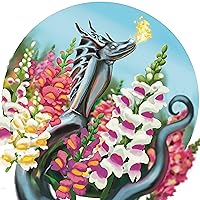
"The lordship of Christ should include an interest in the arts," writes Francis Schaeffer. "A Christian should use these arts to the glory of God, not just as tracts, mind you, but as things of beauty to the praise of God."
Many Christians, wary of creating graven images, have steered clear of artistic creativity. But the Bible offers a robust affirmation of the arts. The human impulse to create reflects our being created in the image of a creator God.
Art and the Bible has been a foundational work for generations of Christians in the arts. In this book's classic essays, Francis Schaeffer first examines the scriptural record of the use of various art forms, and then establishes a Christian perspective on art. With clarity and vigor, Schaeffer explains why "the Christian is the one whose imagination should fly beyond the stars."
Francis August Schaeffer was an American Evangelical Christian theologian, philosopher, and Presbyterian pastor. He is most famous for his writings and his establishment of the L'Abri community in Switzerland. Opposed to theological modernism, Schaeffer promoted a more historic Protestant faith and a presuppositional approach to Christian apologetics which he believed would answer the questions of the age.
This little book had me scribbling notes and underlining furiously the whole way through! It was excellent. There were so many times when I couldn't resist laughing in joy as I read. Just the very first words on the very first page are dynamite. I also really liked what he said about "great art" and the necessity for judging art not only on how well it is done, but by what message is taught. That is a needed message in our day, and he delineated that so well. (See pages 43-45)
I did, however, disagree with Dr. Schaeffer on one point. In the last section, he claims that,
"In one way, styles are completely neutral." pg 56
And again, "let me say firmly that there is no such thing as a godly style or an ungodly style."
He uses the example of rock music to support his claim. "Let us say, for example, that you are playing in a Christian rock group. Suppose further that you are going into coffee houses and using rock as a bridge to preach the Christian message. That is fine. But then you must be careful of the feedback. When you are finished playing, have the people heard your message?"
His view is that while a style in itself is not godly or ungodly, that the style has a relation to the message.
"Styles themselves are developed as a symbol or vehicle for a certain worldview or message." pg 52
While this is very true, he is missing the even deeper level: that the styles *in themselves* teach a message. That is the very reason why the artist chooses it in the first place, whether they consciously realize that fact or not. So while Dr. Schaeffer admits that the style reflects the artists worldview, he does not believe that the style has an intrinsic message.
I disagree with this position because I believe that it ignores an important fact: God created our world, and we cannot escape the fact that there is a message that is necessarily carried in the form or method.
Art bridges the divide created by language, and speaks unmistakably to everyone.This is the same in all times and cultures. Surely, there are differing degrees to this, but heavy metal music communicates *in the style itself* a message. Forms, methods, and vehicles, themselves are not neutral. They too carry a message.
This to me, seems to be in opposition to all the truths he so beautifully and clearly lays out in the book. Still, apart from this small section, I agreed most heartily with everything else. His distinctively Christian worldview is refreshing in a time when many do not understand the significance of the tie between worldview and aesthetics/culture.
______________ Excerpt from the book:
"Despite our constant talk about the lordship of Christ, we have narrowed its scope to a very small area of reality. We have misunderstood the concept of the lordship of Christ over the whole man and the whole of the universe and have not taken to us the riches that the Bible gives us for ourselves, for our lives, and for our culture."
I would give this a 4.7 if I could. It is a good introduction to a subject that demands further attention. Some points that especially stood out to me: 1. "...creativity has value because God is the Creator." 2. "Being in the image of the Creator, we are called upon to have creativity." 3. "The Christian is the one whose imagination should fly beyond the stars." 4. "He may have no gift of writing, no gift of composing or singing, but each man has the gift of creativity in terms of the way he lives his life." 5. "The Christian's life is to be a thing of truth and also a thing of beauty in the midst of a lost and despairing world."
Disclaimer: îi de 4, dar tot ce merită recitit primește 5
Un eseu cuprinzător despre integrarea artei în viața creștinului și a artistului în viața bisericii. Debutează cu o apologie pentru toate felurile de artă ( muzică, sculptură, pictură, dans, teatru) ancorată în istoria veterotestamentară. Continuă cu prezentarea unui set de principii care servesc ca ghid în aprecierea și crearea artei. Vorbește despre excelență tehnică, autenticitate și onestitatea artistului, conținutul intelectual al operei, integrarea contextului social și corelarea vehiculului cu mesajul transmis. Multe ar fi de zis... Poate altădată. E o cărticică folositoare artiștilor dar nu numai.
Excellent, thorough and well communicated… this was exactly what I was hoping for and I enjoyed reading through Schaeffer’s thoughts. He brought up several points I hadn’t considered.
This little book (really just two essays) is short, but packed with truth. Schaeffer lays out a theology of art that includes both great freedom and great responsibility. We must glorify God through our art, he says, but that doesn't mean reducing it to an evangelistic tool. Art has value because of who God is, and because of our identity as bearers of His image.
We also don't need to be afraid of fantasy or imagination. "The Christian is the one whose imagination should fly beyond the stars."
The last section, right at the end, spoke to me as well - that as Christians, our life itself is to be our greatest work of art.
"The Christian is the really free man - he is free to have imagination." A quick read with good food for thought on why Christians should care about the arts.
Great little book on art and the Christian life. The first essay offered an alternative to traditionally reformed rejections of most artistic expressions of faith (especially ones depicting Jesus) by suggesting that Scripture only forbids artistic images when venerated or used in corporate worship outside of the bounds God allowed.
Basically, he argued that Christians need to have a robust but likely individual appreciation of art in various forms and styles.
I appreciated this because I was anticipating him regurgitating the old iconoclasm / icon arguments and he actually went through exodus and Leviticus and made fresh commentary on art and images from scripture.
One thing I appreciated, if Christians do not teach appreciation of art then other Christians may develop something of a pop theology “taste” (although he is careful to avoid classist assertions about depth being related to how educated someone is). Basically, pop art leads to pop theology, which I thought was insightful.
I want my reformed friends to give their forefather a read and talk to me about their opinions on this!
A great little book for the Christian to understand the nature, purpose, and other aspects of art. Highly recommended for any Christian that produces art, whether visual arts, performing arts, literary arts (which includes preaching!), or culinary arts. Schaefer is always worth reading.
"If Christianity is really true, then it involves the whole man, including his intellect and creativeness."
These two essays were published in 1973. For anyone familiar with the Scriptures, the first essay holds no revelations. He cites dozens of references to art found in the Bible from visual art in the temple to music and poetry. He makes a case for the fact that art does not have to be "religious" to bring glory to God.
The second essay gives criteria for evaluating art. I appreciated his call to Christian artists to be honest in their work by showing man's brokenness and sinfulness. But he also emphasizes that the optimism of the gospel message must be incorporated to make the work of art complete. This does not mean that every work of art comes with a sermon. It just means that the message of brokenness must be joined with one of hope in order to be truly biblical. "We create out of a worldview and it is our responsibility to align that point of view with Scripture."
Schaeffer demonstrates the importance of art in the Kingdom of God through the exposition of scripture--particularly the construction of the temple, and later, David's palace. The lessons he extrapolates are that God enjoys beauty, that art is an important way of worshipping God, and of man expressing his "mannishness." God is the first and only true Creator, but because man is made in the image of God, man is a sub-creator who can create his own works of art--not just in the formal arts of painting, music, sculpture, poetry, etc. but in the everydayness of life.
This is an important book for Christians. It is short enough to read in a single reading and is highly recommended.
I recommend this to any current artists or aspiring artists that may be apprehensive of modern art due to the polarization of topics most commonly represented. These essays encourage the spiritual artist to consider their spiritual subject matter valid but to also not fear secular topics in art.
This is a little book composed of two essays, the first looking at various forms of art in Scripture, and the second proposing a Christian view of art. A wonderful treatment of the value of beauty created by humans, who have ourselves been created in the image of the God who also created beauty.
The first essay is very straightforward and an easy read; the second is a little more dense and academic, with references to schools of art and philosophy, as well as prominent figures in them. You can get a fair amount out of it without being familiar with all of those things, but someone who has studied modern philosophy to some extent, or who takes the time to look up unfamiliar concepts and people and works of art, will get more out of it.
Content considerations: Draws distinctions between God-honoring art and that which is base, including the “pornographic” (first essay). References a painting by Picasso that is inspired by a brothel and, if looked up, features stylized nudes (second essay).
The first essay could probably be appreciated by mature middle school and up; the second, because of the depth of ideas and possible content concern, probably for upper high school and adults.
Very thorough and helpful walk through of how Christians are to best relate to art. (Art all the way from music to poetry and painting.) I found it very interesting and will definitely reread chunks. However, for my generation, I feel that this book may not be as helpful on certain points. It is aimed for people “wary of creating graven images” which, even as a pretty conservative Christian, has never even crossed my mind in relation to drawing or such. I feel that for my fellow young artists, it would be helpful to also read on the subtle power of art (and perhaps delve even further into cultural/moral aspects?) Overall, wonderful little book!
A book that Christians who believe that only religious books, music and art should be enjoyed or used by believers need to read. The lawfulness of secular art is defended while it shown that it should be brought under the Lordship of Christ.
The place of Art in its various forms is considered and is shown to reflect our being made in the image of God. God is the Creator and Man made in his image also has a role as a creator.
There is a section which preachers need to reflect upon that preaching needs to be contemporary language and this is applied to Bible translation.
A great and accessible starter for thinking about the arts through a Christian worldview. It’s written as a defence for the arts and addresses common 20th century Christian perspectives (which still persist in the 21st). The ideas while thought provoking and deep, are just a start, and I wished for more theological and philosophical discourse, especially in the first essay which I thought was brief and somewhat shallow.
Still, these essays are deep in the sense that they lend themselves to be read multiple times, for the arguments presented are good food for thought and beckon further inquiry. Also for the simple fact that this writing is still applicable a generation later.
So grateful someone took the time to write about art as it relates to the Christian faith. Schaefer thoroughly sought out examples of art in Scripture and I think his applications are really good. Certainly very helpful for my own artistic endeavors, but honestly good read for artists and non artists. Considering the void of visual fine artistry in the Protestant church today, this was an exciting read!
A favorite quote of mine: “A Christian should use these arts to the glory of God, not just as tracts, mind you, but as things of beauty to the praise of God. An art work can be a doxology in itself.”
I read this at the recommendation of a parent of one of my students. I can see why he recommended it as I'm now trying to figure out a way to include it in the curriculum somehow. I already go over most of the contents of this book in some way or another over the course of the literary analysis class I teach, but this has it all in one place that can be consistently referenced. It is short and easy to read yet full of strong, exceptional Christian practical theology on every page.
This was very short (it felt like a college lecture) and I found it shockingly broad while still being very deep. It went over art and artists we see in the Bible, how to view and criticize art with a Christian worldview, and how our relationship with Christ and the Holy Spirit should inform us as artists. Will probably listen to it again!
A helpful introductory pamphlet to a Christian approach to the arts. Although the first essay is a pretty run-of-the-mill biblical survey of the arts, the second essay offers Schaeffer’s holistic-redemptive view of the arts that is worth pondering and applying more deeply.
This is another one of those “so glad this exists but this barely scratches the surface” types of books. I’m so grateful for Schaeffer’s advocacy of Christians in the arts. I just wish the book itself came across with more wonder and mystery rather than serving as a rigid thumbs up to Christian art.
This is a very short, sweet, but concisely written book that will not demand too much time from you, while also gifting you with wise insight into the association of Christianity and the Arts. This book is largely divided into two sections: in the first, Schaeffer explores in specific detail the biblical commandment for art, examining moments in the Old Testament where art was created for the glorification of God. He makes an important point here that this biblical art was not merely "religious" art. God did not only command his creation to create heavenly or angelic art (the cherubim), but also to create art representational of the natural and material (oxen, lions, pomegranates, lilies). In this first section he provides substantial evidence and reasoning why Christians, who are artistically inspired, ought to create art. In the second half, Schaeffer relates these truths into our modern day, and what this charge as Christians to create beautiful art means in our practical lives. He explores the importance of being able to reveal Christ's glory through modern means, freeing us from a legalistic view on art. As Christian's we are alive, which means we are always changing (continually being sanctified), and art, as a living medium, also always changes, and is individualized to the person or subculture it grew out of. Schaeffer writes, "Christian art should differ from country to country. Why did we ever force the Africans to use Gothic architecture? It's a meaningless exercise. All we succeeded in doing was making Christianity foreign to the African." And I think, principally, that this idea is what art should be doing. Art, through its intrinsic power, invested by the Great Artist himself, ought to, through any form, style, apparatus, or genre, make Christ intimate, not foreign, to the viewer. An artist does not need to sit around drawing images of Jesus walking on a beach all day long to do this--they simply need to pursue truth and beauty, and allow God's nature as Creator to indwell within them as little creators. Ultimately, as short as this book was, I felt that Schaeffer used every word to great advantage, and articulated many critical points in regards to the reality of art, and its importance to God.
In Art in the Bible Schaeffer states “The lordship of Christ over the whole of life means that there are no platonic areas in Christianity, no dichotomy or hierarch between the body and the soul. God made the body as well as the soul and redemption is for the whole man.” Schaeffer very clearly presents the fact that Christianity involves the whole man, including his intellect and creativeness. These are not periphery, side areas – these are the central areas. The arts and the sciences all have a central place in the Christian life. He is also clear to point out the fact that any artist (painter, sculptor, writer, or musician) makes a body of work that clearly reflects and displays his, or her, world view. He also challenges modern Christianity by saying that “Christian art is by no means always religious art, that is, art which deals with religious themes.” Christian music is not simply music that is played on Christian radio stations, but music where Christians are reflecting their world view and often times not explicitly saying the word “God”. His point is that “No work of art is more important than the Christian’s own life, and every Christian is cared upon to be an artist in this sense. He may have no gift of writing, no gift of composing or singing, but each man has the gift of creativity in terms of the way he lives his life. In this sense, the Christian’s life is to be an art work. The Christian’s life is to be a thing of truth and also a thing of beauty in the midst of a lost and despairing world.” This is a great book, short and easy to read and highly recommended for anyone with any interest in the reality of Christ in our culture.
As an artist, as well as an ardent admirer of the arts in general, these essays were so helpful and inspiring to me. Francis Schaeffer, as always, provided some interesting insights I’ve never thought about before. I need to go back and annotate—there were just SO many good points made, ones that I had to stop and chew on for a bit. I really enjoyed both of the essays: “Art in the Bible”, and “Some Perspectives on Art”, although the latter was probably my favorite of the two. I think I shall go into my next drawing, or painting, or poem, or story (whichever I work on next, and quite possibly all of the above) with a fresh perspective.
I recommend these essays especially for the Christian artist, (doesn’t matter the medium, whether it be visual arts, music, drama or literature…. He covers them all!) but I would say any Christian, and any admirer of the arts would find them interesting, and indeed very helpful. Neither of them are very long—probably each between 10 and 20 pages, the first one being shorter than the second, so there’s no overwhelming-ness about them, and you could go back and reread some favorite points quite easily, if you wanted. I certainly will.
2.5 😞 Que triste empezar el año con una decepción. Tenía mucho tiempo queriendo leer este libro por qué habla de lo que entiendo que encapsula mi profesión y mi filosofía de vida. Perooo se quedó muy corto. (no pun intended por que el libro tiene menos de 100 páginas)
Toca los temas de manera muy superficial, aparecen argumentos sin una base sólida, y siento que por lo menos en la etapa en la que estoy no son conceptos ajenos entonces se sentía algo obvio y aburrido. Sentía que entraba en un tema y o abundaba mucho o terminaba muy rápido. Y sinceramente se inclinaba usualmente por acortar los mensajes.
Rescato algunas frases que estaban dichas de manera linda y el tema de manera general me toca mucho pero buenos. A veces se gana a aveces se pierdeeee
A helpful read. Schaeffer has a lot of very thought through and helpful things to say on the relationship between Christianity and the arts - and on being a Christian artist. Though dated a bit now I’m not aware of a 21st century equivalent that’s better. Schaeffer quotes the bible often enough, and the gospel is present, though I wouldn’t describe it as a gospel centred approach, and therefore I was left wanting. Still, plenty of helpful stuff to take away, and I’ll be adding it to my list of recommended reading for young artists who want to think more about being a Christian and an artist at the same time.
A solid, short essay on how the arts ought to be used and viewed in a world where everything is under the lordship of Christ and all is to be done to the glory of God. Not a lot of new information here, but much refreshment in reviewing what God has to say on this subject.