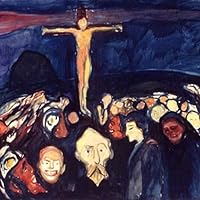
'...John’s work is also apocalyptic, because the way that it enables its readers to see their situation with prophetic insight into God’s purpose is by disclosing the content of a vision in which John is taken, as it were, out of this world in order to see it differently. ....John (and thereby his readers with him) is taken up into heaven in order to see the world from the heavenly perspective. He is given a glimpse behind the scenes of history so that he can see what is really going on in the events of his time and place. He is also transported in vision into the final future of the world, so that he can see the present from the perspective of what its final outcome must be, in God’s ultimate purpose for human history. The effect of John’s visions, one might say, is to expand his readers’ world, both spatially (into heaven) and temporally (into the eschatological future), or, to put it another way, to open their world to divine transcendence.... It is not that the here-and-now are left behind in an escape into heaven or the eschatological future, but that the here-and-now look quite different when they are opened to transcendence.'
'In this prophetic process of confronting the present with God’s final purpose for history there is the implicit recognition that the End of history bears a unique relationship to the whole of history. It is not just the last thing to happen, coming after the penultimate historical event. It is the point at which the truth of all history comes to light. It is the divine judgment on the value and meaning of all history.'
'The continuing and ultimate victory of God over evil which the rest of Revelation describes is no more than the working-out of the decisive victory of the Lamb on the cross.'
'In the form, ‘the first and the last’, the designation derives from Isaiah, where it occurs, as in Revelation, as a divine self-designation: ‘I am the first and the last; besides me there is no god’ (44:6); ‘I am he; I am the first, and I am the last’ (48:12; cf. also 41:4). In those chapters of Isaiah the designation encapsulates the understanding of the God of Israel as the sole Creator of all things and sovereign Lord of history, which Isaiah so magnificently expounds and asserts polemically against the idols of Babylon. Unlike human-made gods, this God is the utterly incomparable One, to whom all nations are subject, whose purpose none can frustrate (cf. Isa. 40:12–26). It is precisely this exclusive monotheistic faith that determines the prophetic outlook of Revelation. Hence the unique importance of the designation: ‘the Alpha and the Omega’. God precedes all things, as their Creator, and he will bring all things to eschatological fulfillment. He is the origin and goal of all history. He has the first word, in creation, and the last word, in new creation. Therefore, within John’s literary structure, he speaks twice, declaring himself Alpha and Omega first, before the outset of John’s vision (1:8), and last, in declaring the eschatological accomplishment of his purpose for his whole creation: ‘it is done!’ (21:6).'
'It is worth noticing how far from anthropocentric is this vision of worship. Humanity is radically displaced from the centre of things where human beings naturally tend to place themselves. At its heart and in its eschatological goal the creation is theocentric, orientated in worship towards its Creator. But even among the worshippers human beings are not pre-eminent. The four living creatures who lead the worship of the whole creation are not portrayed as anthropomorphic beings, as angelic beings often are. Only the third has a face resembling a human face. The others resemble a lion, an ox and an eagle, and with their six wings and myriad eyes all have a heavenly superiority to all earthly creatures (4:6–8). Their representative function is to worship on behalf of all creatures, and therefore it is fulfilled when the circle of worship expands to include not only humans, but ‘every creature in heaven and on earth and under the earth and in the sea’ (5:13).'
'Revelation, by avoiding anthropomorphism, suggests the incomparability of God’s sovereignty. In effect, the image of sovereignty is being used to express an aspect of the relation between God and his creatures which is unique, rather than one which provides a model for relationships between humans. Of course, the image of the throne derives from the human world, but it is so used as to highlight the difference, more than the similarity, between divine sovereignty and human sovereignty. In other words, it is used to express transcendence. Much of the modern criticism of images of this kind seems unable to understand real transcendence. It supposes that the relation between God and the world must be in every respect comparable with relations between creatures and that all images of God must function as models for human behaviour. It is critical of images of transcendence, such as sovereignty, but it takes transcendence to mean that God is some kind of superhuman being alongside other beings. Real transcendence, of course, means that God transcends all creaturely existence. As the source, ground and goal of all creaturely existence, the infinite mystery on which all finite being depends, his relation to us is unique. We can express it only by using language and images in odd ways that point beyond themselves to something quite incomparable with the creaturely sources of our language and images.'
'In the conflict of sovereignties the lines are drawn between those who worship the beast and those who worship God. Every stage of God’s victory – through chapters 7–19 – is accompanied by worship in heaven. The issue of true and false worship is fundamental to John’s prophetic insight into the power-structures of the world his readers lived in. In the end, the book is about the incompatibility of the exclusive monotheistic worship portrayed in chapter 4 with every kind of idolatry – the political, social and economic idolatries from which more narrowly religious idolatry is inseparable.'
'...so far from legitimizing human autocracy, divine rule radically de-legitimizes it. Absolute power, by definition, belongs only to God, and it is precisely the recognition of God’s absolute power that relativizes all human power. The image of God’s sovereignty functioned rather similarly in seventeenth-century England, where it played a part in the religious origins of modern democracy. Because God is king, it was said, all men and women are equally his subjects, and no man should arrogate to himself to rule over his fellows.'
'Revelation offers a different way of perceiving the world which leads people to resist and to challenge the effects of the dominant ideology. Moreover, since this different way of perceiving the world is fundamentally to open it to transcendence it resists any absolutizing of power or structures or ideals within this world.'
'The alternative vision of the world which Revelation claims to be orientated to the truth is strongly theocentric. In this it shows the power of a theocentric vision to confront oppression, injustice and inhumanity. In the end it is only a purified vision of the transcendence of God that can effectively resist the human tendency to idolatry which consists in absolutizing aspects of this world. The worship of the true God is the power of resistance to the deification of military and political power (the beast) and economic prosperity (Babylon). In the modern age we may add that it is what can prevent movements of resistance to injustice and oppression from dangerously absolutizing themselves.'
'In the beginning God had planted a garden for humanity to live in (Gen. 2:8). In the end he will give them a city. In the New Jerusalem the blessings of paradise will be restored, but the New Jerusalem is more than paradise regained. As a city it fulfills humanity’s desire to build out of nature a human place of human culture and community. True, it is given by God and so comes down from heaven. But this does not mean humanity makes no contribution to it. It consummates human history and culture insofar as these have been dedicated to God (cf. 21:12, 14, 24, 26), while excluding the distortions of history and culture into opposition to God that Babylon represents (cf. 21:8, 27; 22:15). It comes from God in the sense that all good comes from God, and all that is humanly good is best when acknowledged to come from God. But the city that both includes paradise unspoiled (22:1–2) and is adorned with the beauty of paradise (21:19) points to that harmony of nature and human culture to which ancient cities once aspired but which modern cities have increasingly betrayed.'
'In Revelation’s universal perspective, the doctrines of creation, redemption and eschatology are very closely linked. It is God the Creator of all reality who, in faithfulness to his creation, acts in Christ to reclaim and renew his whole creation. Because he is creation’s Alpha he will also be its Omega. The scope of his new creation is as universal as the scope of creation. It is as Creator that he claims his universal kingdom. It is as Creator that he can renew his creation, taking it beyond the threat of evil and nothingness into the eternity of his own presence. An important contribution of Revelation to New Testament theology is that it puts the New Testament’s central theme of salvation in Christ clearly into its total biblical–theological context of the Creator’s purpose for his whole creation. This is a perspective that needs recovering today.'