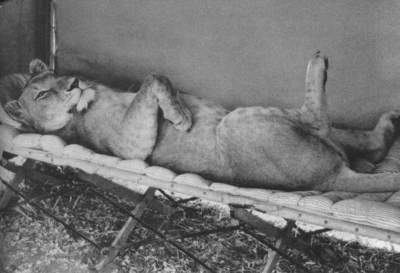
"Dzimusi brīvībai", kurā ietvertas trīs grāmatas: "Dzimusi brīvībai", "Dzīve brīvībā" un "Mūžam brīvībā", ir vēstījums par lauveni Elsu, kas augusi pie cilvēkie, bet audzināta dzīvei brīvībā. Džoja Adamsone ar lielu sirsnību un vienlaikus arī zinātniski precīzi stāsta par augošās lauvenes uzvedību un paradumiem, stāsta arī par citiem Āfrikas savvaļas dzīvniekiem, jo, vairāk nekā divdesmit gadu nodzīvojusi Kenijā, labi pazīst šīs zemes dabu. Grāmata ir ne tikvien interesanta lasāmviela, tā sniedz vērtīgu materiālu etoloģijai - mācībai par dzīvnieku izturēšanos.
Joy Adamson (born Friederike Victoria Gessner) was a naturalist, artist, and author best known for her book, Born Free, which describes her experiences raising a lion cub named Elsa. Born Free was printed in several languages, and made into an Academy Award-winning movie of the same name. In 1977, she was awarded the Austrian Cross of Honour for Science and Art.
Born to Victor and Traute Gessner in Troppau, Silesia, Austria-Hungary (now Opava, Czech Republic) and was the 2nd of 3 girls. Her father was a wealthy architect. After the divorce of her parents, Joy went to live with her grandmother. In her autobiography The Searching Spirit, Adamson wrote about her grandmother, saying, "It is to her I owe anything that may be good in me."
Adamson considered careers as a concert pianist, and in medicine, but did not take her finals in medicine, instead chosing to get married. She married 3 times in the span of ten years. Her husbands were Viktor von Klarwill (Ziebel) 1902-1985, (Jewish Austrian), the botanist Peter Bally (divorced in 1942), who gave her the nickname "Joy", and lastly game warden George Adamson. Viktor sent her to Africa, Bally influenced her painting and drawing of the people and the plant life of Africa. 600 of her paintings now belong to the National Museum of Kenya. The Colonial Government of Kenya commissioned her to paint portraits of members of 22 tribes whose culture was vanishing.
It was during her marriage to George Adamson that she lived in tent camps in Kenya and first met Elsa, the topic of her famous book Born Free. Adamson is best known for her conservation efforts associated with Elsa the Lioness. They decided to set her free rather than send her to a zoo, and spent many months training her to hunt and survive on her own. They were successful in the end, and Elsa became the first lioness successfully released back into the wild, the first to have contact after release, and the first known to have cubs. The Adamsons kept their distance from the cubs, getting close enough only to photograph them. After the book was written and published in 1960, it became a bestseller, spending 13 weeks at the top of The New York Times Best Seller list and nearly a year on the chart overall.
After Elsa died, George and Joy Adamson separated and were not together after 1971. On 3 January 1980, in Shaba National Reserve in Kenya, Joy Adamson's body was discovered by her assistant, Peter Morson (sometimes reported as Pieter Mawson). He mistakenly assumed she had been killed by a lion, and this was what was initially reported by the media. Police investigation found Adamson's wounds were too sharp and bloodless to have been caused by an animal, and concluded she had been murdered. Paul Nakware Ekai, a discharged laborer formerly employed by Adamson, was found guilty of murder and sentenced to imprisonment at President Daniel arap Moi's pleasure. Joy's widower, George Adamson, was murdered 9 years later, in 1989, near his camp in Kora National by poachers.
A captivating story of a lioness Elsa, and her adoptive human parents. The interactions between the Adamsons and Elsa, and later her cubs are beautiful and showed how intelligent lions can be. I never knew that a lioness can be affectionate to humans, but this book is a testament to it.
This volume is a reprint of the three books written by Joy Adamson about Elsa the lioness. The first Born Free is sweet, so terribly sweet that you have to brush your teeth before and after reading, it narrates how her husband shot a lioness (I think actually the wrong one) and how the couple adopted her three cubs, two were eventually air freighted to Rotterdam, they live with the third, Elsa, for a while before letting her loose in a part of Kenya decided upon by Adamson's husband, a game warden. This book is full of the playfulness of animals, lions are not for nothing known as big cats it seems and some of their other playful behaviour reminded me of dogs, so reading I had to pause to take laughter and memory breaks to recall similar things done by a house cat and a dog of disreputable character who unlike Elsa did not roll in elephant dung (due to general absence of elephants in English fields and woods) but in fox faeces, her wild delight matched by my deep despair as her fine perfume was for my non-canine nose a malodorous stink that necessitated immediate bathtime . Adamson does not attempt to give Elsa a bath, though she does chase after her while trying to give her an enema at one point. Otherwise Elsa does all the things that domestic cats and dogs do - meow, purr, stalk animals, knock drinks off tables with her tail, get stuck climbing trees, jump up on people she likes, play with sticks, go swimming in the Indian Ocean, and so on with the slight difference that she is a wild animal, big and heavy. This all takes place at the end 1950s, and the book is published in 1960. Elsa is three years old and has finally learnt to kill her own dinner.
The next book is Living Free Adamson repeatedly visits the area where Elsa has been released, there are various reunions, Elsa becomes pregnant, gets into fights (you know your typical teenaged mother from a broken home story), gives birth, causes Adamson some panic as lions (as do some other mammals) can retract their teats so they can go about their business as needed and then at leisure lower them to nurse their young, eventually Elsa allows Adamson et al to make acquaintance with her cubs. Adamson receives fan mail from readers of Born Free Their publisher comes out from Britain and is introduced to Elsa, at which point Adamson does not mention raising the question of her royalties, this part is somewhat less sweet.
The final section is Forever Free which is about Elsa's cubs. The area where the Adamson's released Elsa had within her range a number of villages and given that she and her cubs where extensively fed on goat on by the Adamsons there was a certain, ahem, disquiet among the human population and the Adamsons are told they have to relocate the lions somewhere more suitable. At this the author has a burst of temper blaming 'political agitation' - this is still a few years before independence - for this decision, I don't know quite what she is implying, possibly no more than that the black people are being uppity and complaining about her doing as she pleases playing at being Dr Dolittle or Tarzan, the desire not to have a growing population of lions as your neighbours getting into your stockades and eating your goats seems a perfectly understandable one to me, neither of the Adamsons come out of this looking partially well to my mind. Then the story gets into the deeply ridiculous, the Serengeti national park offers to take in the lions - now the subject of two published books - but no soon have the lions been transported there then the Adamsons are informed that they must be moved on to a different part of the national park before the tourist season starts, at the same time the Serengeti seems to be rather crowded with lions, and the Adamson's bunch skedaddle to find somewhere more private, George Adamson is still working elsewhere as a game warden, one of the cubs has an arrow in his rump as a result of helping himself to other people's goats, the Adamsons are roaming around trying to find their lions while requesting permission to camp overnight in the national park, kill animals for the wounded cub to eat, and trying to persuade a vet to operate on the cub that they can't find, while shooing away copulating lions who seem to be everywhere and eventually the story peters out in June 1962.
Reading the sensation of sweetness was cloying, now looking bad over what I have written it strikes me instead as a story of arrogance and stupidity , perhaps more revealing of the Adamson's needs than about lionesses and lions, the couple didn't have children and eventually separated, maybe it is just me, but it is hard not to see the lions, if not directly as child substitutes, than an attempt to cement the relationship around these lions. The amount of effort they put into Elsa's cubs is prodigious. In the end it is all about the Adamsons and their needs, not about the lions.
Joy Adamson put me in mind a little of Karen Blixen and Out of Africa and Shadows on the Grass, two non-Britons writing these archetypal books about British Empire Kenya. Blixen though was more of a stylist. Adamson's prose is plain and simple, ideal for young readers or those learning English. Adamson was born Friederike Viktoria Gessner in the Austro-Hungarian Empire (specifically the area of the Czech republic), she proceeded through a series of marriages to end up as Joy Adamson married to a game warden, both she and her husband eventually died violent deaths, Joy's murderer eventually claiming that he killed her over a wage dispute after she shot at him .
She does towards the end say The longer I live among animals the more I want to help them and the more I believe that in helping them we also help man, for if we exterminate all the wild animals we shall upset the balance of creation of which we ourselves are a part (p.378) but she is no Aldo Leopold learning to think like a mountain. These are quick unreflective works rushed into print, having got past the sweetness of animal behaviour I am unsettled, the phrase 'wild animal' is not an accidental one.
This is a Large Print edition of the entire "Born Free" trilogy, which I have read in various editions many times. I had intended to read it yet again to review here, but find I cannot bring myself to do so. There are parts which I simply don't want to put myself through again. Plus over the years I have learned enough about the whole thorny issue of Kenyan wildlife, to make this book far too upsetting for me to read again.
Someone perhaps will pounce on this almost new book when they discover it in a charity shop, and feel as happy as I did that all three books are here in an accessible format. But it's no longer for me. I also received the DVDs as a gift, took off the cellophane, but could not get past the opening credits. Those are set to pass on too.
It's probably me. Perhaps we just become more emotionally fragile as time goes on, and look at least some of the time for less disturbing reads.
The well-known story of raising a lion cub - and successfully releasing her into the wild, the first time that this had been attempted. The challenges, both natural and bureaucratic, were enormous and are well-documented. The books (three "parts" in this particular volume) were written based on Joy's notes and George's journals. This is the weakest point, as certain sections, probably those written more from the sources than directly from memory, are a bit dry. Nonetheless a wonderful story - both about Elsa and the cubs and also about Joy and George, who dedicated their lives to the protection of East African wildlife.
This is, in fact, three books in one. The story of Elsa is probably among the best known out of all 'animal stories', but I suspect most people have only heard her name, saw one of the movies or a documentary, a mention here or there (guilty!) The books are worth reading though. It may take a bit to get used to the style, but once you immerse yourself, there's no resurfacing till you've reached the last page.
Can I call this a leobiography? I think it is technically an autobiography, however it doesn't feel right to say so, since we learn very little about Joy and her husband. In some ways, Joy's writing is refreshing, as it's almost completely about Elsa and her cubs. Never once does Joy complain about her living conditions or dwell on her disappointments; even after .
Although in saying that, Born Free is a much more human story than I was expecting. Bar the fact that Elsa had some very human, relatable characteristics, her relationship with Joy was almost too familiar for comfort. I'm thinking specifically at a time in the story when
I learnt a lot about lions, and the African wilderness in general. And I loved it. I get so caught up in myself and the world around me, that I forget about the world that isn't outside my doorstep. And I don't just mean my surroundings and country, but the entire Western culture too. For example, it was so insanely refreshing to hear biological words in their natural non-sexualised context. When words like 'siring' and 'love making' stopped making me giggle after a while, I pondered whether I spend too much time consuming immature internet content. It got so far as to be initially aghast that the word 'bitch' was used, only to remember it had another non-derogatory definition.
Imagine my confusion. All my life I've been able to see Born Free, Living Free and Forever Free on my mum's bookshelf. I know roughly what size they are. This was much longer than I was expecting and although I tried vainly to convince myself that perhaps it was just an effect of reading a digital edition (how accurate are those page numbers, really?) it was a third of the way into the book that the truth was revealed to me: this is not Born Free, it's The Story of Elsa. Perhaps that subtitle should have made it plain, but it didn't. This seems like terrible re-branding by the publishers - nothing online gave the game away and I notice that several other books matching this description are wrongly catalogued as the first volume, rather than the collected volume, on GoodReads.
Rant over, what of the book? Reading all three together certainly doesn't detract from any of the volumes - they flow on nicely from one to the next. Joy Adamson's prose can at times be a bit workmanlike though and it's perhaps best to take a break or two when the opportunity arises. The story of Elsa remains fascinating fifty years on, even if its familiarity lessens some of its impact. Ultimately then, this is something to be read for the story rather than the prose and most people in the Western world will know exactly what to expect. It delivers that, but nothing more and nothing less.
I've been a fan of Elsa the lioness since I was young. I have seen the movie multiple times, but this is my first experience with the book. I loved it! Altough the movie is nice, the book gives a new perspective to Elsa's life. I loved how detailed it was and there were pictures - that really helped me to get a nice vision. I got seriously attached to Elsa.
Every page of this book had me questioning how it could be real, it feels like a fantasy: that Joy and George Adamson not only adopted a young lion cub but were able to live alongside her in the wild. The main thing I took away from this is the fact that you can't help but fall in love with Elsa and the other lions throughout. Reading this book some 67 years after the events took place, it's hard not to focus on the wrongs that Joy and George did during their time in Africa, but that is through a privileged lens of the 21st century where the continent is nowhere near as rich with wildlife as it was when the book was written and we are much more aware of our impact on the natural world. Ultimately I loved this book and connected with every individual in some way. The only reason it's not getting five stars is simply because I like a more descriptive writing style. I would recommend this to anyone. It's a real life nature fairytale.
Горький осадок от этой книги. У меня сложилось впечатление, что Джой Адамсон самая настоящая авантюристка, в плохом смысле этого слова. Приручение львицы, которым Адамсон так гордилась, ничем хорошим не закончилось. А от того, сколько сил и средств было потрачено на то, чтоб научить потомство львицы жить самостоятельно, у меня буквально волосы дыбом вставали. Целая команда людей обслуживала прихоти Адамсон и её мужа вместо того, чтоб заниматься защитой заповедника, по которому рассекали десятки браконьеров. Могу ошибаться, конечно, но пока вот такие ощущения.
Firstly, is the Born Free Foundation Not For Profit? I can't see this mentioned anywhere on their website ??????
Secondly, don't read this book. Save your time for a more inspirational story, such as Gorillas in the Mist by the remarkable Dian Fossey (what a legend!)
I read Born Free about a year ago &, despite being an animal lover, I was absolutely exasperated by the actions of Joy & George Adamson. They were certainly not the people I had thought they were before going into this book, far from it.
For starters, I was appalled by the way the Adamson's attempted to domesticate Elsa without any idea or foresight as to what the consequences of this would be. It was naive, selfish & incredibly careless.
There was a particularly distressing episode when they had to travel by foot for several days across a large mountain range (A 300 mile trip no less). I can't remember the ludicrous reason why they had to do this, but they took Elsa with them & cruelly decided to keep her on a chain lead like a dog the whole time, & Joy Adamson attempted to defend this by arguing "Elsa had seen more of the world than she would have done living with a pride".
Moreover, the Adamson's were undoubtedly hypocrites & I specifically remember a page or so where Joy Adamson was trying to defend her actions from being double standards, but it was not at all convincing. Yes, they rescued Elsa & helped raise / protect her cubs, but how many animals did the Adamson's kill during their time in Africa? The answer is a hell of a lot. George Adamson shot many animals in his job, & to "protect" Elsa & her cubs, including killing other Lions, & many of these killings seemed totally unnecessary in my mind (like the male Lion on the beach). Furthermore, the whole reason the Adamson's felt responsible for raising Elsa in the first place was because George Adamson needlessly shot Elsa's mom, which was admittedly acknowledged in the book, though quickly glossed over.
Elsa's mom was being overly aggressive in the wild when George Adamson first encountered her (because she was protecting her cubs - one of which was Elsa). He shot her, & wounded her, & she then disappeared, but for some reason George Adamson continued to search for her & then finished her off with a final shot of his rifle - a totally avoidable killing!!!!
And what about the other two cubs (Elsa's siblings) which the Adamson's had left stranded without their mom? Well they were quickly despatched to a zoo in Rotterdam. In other words, they were sentenced to a miserable life in captivity because of George Adamson's thirst for killing Lions. Yes folks, for a couple who were supposedly a great lover of Lions they sure did kill a lot of them
I was likewise deeply uncomfortably with some of the comments Joy Adamson makes in this book. For instance - "they [Elsa & her cubs] loved Europeans and especially many small children, but they had a marked dislike of Africans".
Thus, in summary, the Adamson's caused more trouble than good & their story should be regarded as nothing more than a cautionary tale for what happens to wild animals when their lives have needlessly been interfered with by human beings. The Matt Monro song is beautiful, & so our Lions, but the story of Born Free is most certainly not
(Joy Adamson was also accused of expelling local populations from land she wanted for animals)
I do recognise that the Born Free trilogy has its place in history, but reading it wasn't the best experience for me. It is about the author and her husband adopting three lion cubs after he accidentally kills their mother and releasing one, Elsa in the wild.
I had a few issues with the book, one of which was the writting. Adamson's style is pretty dry and dull, sometimes using a lot more detail than needed for fairly mundane things like setting up camp (which they do a lot, if I read about setting camp again I'm going to lose it). Another problem the book had was that Elsa never seemed trully living in the wild - till her last day she lived close to the Adamsons' camp, frequently recieved food which George A. killed himself. Despite the numerous times Joy A. said she hoped Elsa could learn to hunt on her own it didn't seem like the two of them let her get hungry enough to attempt hunting on her own consistently.
On a different topic, the Adamsons are kind of racist - the scene in which the author complains about how her black cook can't make a Christmas dish according to her exact instructions served no purpose to the story other than unintentionally portraying her as a bigot. On top of that as a game warden her husband frequently arrests black tribesman for poaching, but allows himself to kill a pleathora of animals (sometimes in the same circumstances as black people he has arrested) to feed the lions, in some case even acting against authority (namely killing an animal and bringing it in Serengeti National Park for the lion cubs despite explicit instructions not to do so). I also noticed that when the lions were left without a mother and started attacking settlements, the author seemed a lot more concerned with the safety of the lions than the actual tribes they were endangering.
The book wasn't all bad, for example I found myself invested in the relationship that Adamson had with Elsa and the safety of the cubs. I'm probably going to reread The Spotted Sphynx - a book about how she introduced a cheetah to the wild, which I loved as a child, I hope I like it more than Born Free, but I can't be sure.
This entire review has been hidden because of spoilers.
I loved watching Born Free as a child and wanted to delve deeper into the story. Unfortunately that story left me really conflicted. Some passages had beautiful descriptions of the landscapes, and the tenderness that Elsa shows to Joy and George. On the other side I started to wonder at times whether they did more harm than good when repeatedly going back to visit Elsa, especially when she seemed reluctant to come and see them. No doubt their intentions were good, but it felt they were trying to satisfy their own needs rather than hers.
I appreciate this was wrote in the late 50's, so alot of the language is not necessarily PC and at times felt a bit uncomfortable. I also understand this was about trying to introduce a lioness to the wild, but there was alot of "we saw a cobra, george shot it", "there was a fly, we shot it", with some of the animal killings feeling pointless.
Their arrogance, which they acknowledge, starts to show when elsa prevents them from seeing the cubs and they repeatedly keep searching, despite Elsa giving very clear signals to leave her and the cubs alone. By this point i just started to feel uncomfortable and didn't want to read on.
This entire review has been hidden because of spoilers.
I know that I read this as a child, and of course, I have seen the movie many times, but it is as amazing a story now as it was back in the 1950s and 1960s when it was happening. This is a true story about a couple who hand-raise a lion cub named Elsa and then release into the wild when she becomes an adult. They share a magical once-in-a-lifetime relationship with her and are able to visit her often even after she has become a "wild" lioness capable of injuring or even killing them.
Are you surprised this book sat on my bookshelf for many years before getting around to read it? I'm not! This seems to be a recurring theme with me. At any rate, this was an excellent story and an easy read. I shouldn't have waited so long in reading it. The same author has at least two other books I may check in to reading. Born Free is definitely worthwhile reading. Don't wait as long as I have in doing so.
Když jsem se jednou dívala na Animal Planet, právě tam běžel pořád o lvech z rezervace, a jak se o ně občas starají strážci - odchytnou je, zjistí biometrické údaje, případné očkování nebo ošetření, a pustí je zpátky. Tenkrát měmina pronesla něco jako: "Proč nenechají ty lvy být?" A přesně tohle jsem si říkala, když jsem četla tuhle knížku.
I had a tough time with this one. As with most animals, I loved Elsa and her cubs, their side of the story was beautiful and heartbreaking - the reason for two stars instead on 0. But Joy and George? Didn't like them at all, infact they ruined the book for me. My only good thoughts about them is that atleast they cared for those lions, they could have done a lot worse than they did, but if only they did it the correct way, everything would certainly have worked out a lot better than it did.
Joy is said to be a conservationist, praised for her love and care for animals, especially lions. Unfortunately that's just not the case, and those constantly praising her for it should read this book and have a re-think. The worst thing about this book is that it's seen as a good thing, and it really shouldn't be.
As many of the bad reviews before this one states - they killed more than they saved. They raised a tame lion (after sending her sisters off to a zoo) and then when they realised they couldn't keep her, absolutely failed to release her too. She went on to have cubs, but instead of them leaving her alone to raise them, they interferred and then the cubs became reliant on humans too, until evenyually they were told they could no longer stay and feed them, so had to abandom them. However much they did interferre, unfortunately they didn't interferre enough to save Elsa, they decided the let her 'build her natural immunity' and she died, leaving the cubs alone, not yet old enough to hunt.
The book from start to finish is contradictory, and it's hard to read when you yourself want to climb in the book, remove Joy and George and help the lions. It even ends terribly - I know it's a true story of course and what happens is the truth, but they even failed in giving the reader hope for the lions finally free in the Serengeti, which I felt was the whole point of 'Born Free' which it turns out none of them were. Bearing in mind, Elsa and her sisters would have lived a long free life most likely if instead of shooting Elsas mum, they relocated her away from humans.
I've read plenty of incredible books by some amazing conservationists that have given me hope for the world. This book did the opposite. I finished it feeling concerned for what impression Joy and George will have left on people. It's a shame this all went the way it did, but I hope now when people read it, they don't praise Joy, they learn from her mistakes.
Joy's writing style is so appalling that I spent the entire time longing for the end and wondering why she didn’t hire a ghost writer. There is no story telling, its actively disengaging and has unfortunately managed to dictate a story with vast potential, in the most boring way possible.
Some critical comments on the story itself: 1. Joy is immediately painted as the hero who "saves" Elsa and her siblings. But outrageously omitted from the synposis is that the only reason they were without a mother was because Joy's husband killed her. I'm not an animal expert but even I know that mothers are aggressive and confrontational when they are protecting their young in the wild. It is unbelievably stupid that these supposedly "experts" didn't think that this "aggressive" lioness may have a reason for being so. And instead of leaving her alone, they set out to kill her. Only then realising what they had done and consequently, taking the cubs, who they just orphaned, in. 2. She raised Elsa with regular medicine. Then decided at a random point in Elsa's adulthood that actually she should develop her immune system without the drugs. Irresponsible. By that point it's obviously too late, so is it a surprise that Elsa then died from her infection? And who's fault was that? 3. Fast forward and they have transported Elsa's cubs to the Serengeti. Props to them on this journey, they had the cubs best interests at heart here. But the story telling over this journey was SO boring, I didn't think it possible to make lions sound boring but Joy manages it. 4. The ending is so unsatisfactory. Did they ever find Jespah and help him? The end of the book isn't even an ending. I just slogged through 400 pages or poor writing for an ambiguous ending.
Also the picture pages are placed so randomly; they disrupt the small amount of flow the book has. You'd think they'd come at the end of chapters or at the very least, paragraphs. But they literally interrupt sentences midway.
This isn't a book worth reading, in my opinion. The Adamsons supposedly prioritise conservation yet constantly, intentionally, and arguably needlessly, kill so many animals during just this one story. They say they want the lions to be wild but clearly domesticated Elsa. Their behaviours were contradictory and selfish. This book was written in the 50s and you can tell.
(DNF @ 60%. I don't normally star-rate books I don't finish, but after 200+ exhausting pages, I GOT IT. I don't think what remains of the book has any surprises left that might shift my rating.)
It was with a groan that I realised one of the only two books about lions in my local library was Born Free, but actually? you know what? I see the appeal.
Baby Elsa the lion cub is unbearably cute. IS THIS WHAT IT'S LIKE TO BE BROODY? I want babies, but only lion babiessss.
This true story, of white conservationists in 1960s Kenya who adopt a lion cub after its mother is killed, is Of Its Time, to put it mildly, but it is extremely compelling.
Get ready to MELT as Elsa forms a real bond with her human parents. GASP as they try to reintroduce her into the wild but she's threatened by other lions. GET SLIGHTLY BORED as the narrative becomes rinse-repeat.
The whole thing is, of course, wildly problematic. (Should they have left Elsa to die? Yeah, probably. :/) Every moment of tenderness between Elsa and the author is checked by reminders that they beat Elsa (to make sure she remained scared of them, I assume). And these 'conservationists' sure do like to shoot OTHER wildlife, seemingly for very little reason.
So that's the content. How's the writing? At best: fine. Joy Adamson conjures up life in the Kenyan wilderness admirably and I really did feel like I got to know Elsa. The person I didn't get to know was Joy herself. And, once the jeopardy of releasing Elsa into the wild passes, Adamson doesn't seem to have any clue how to structure a story. The whole thing becomes repetitive and tedious to read.
‘Born Free’ is Joy Adamson’s classic true story of raising Elsa, an orphaned lion cub, and eventually re-releasing her into the wild. This collection comprises all three books in the series, ‘Born Free’, ‘Living Free’ and ‘Forever Free’, telling the full story of Elsa and her cubs (though one chapter of the original ‘Born Free’ is missing – possibly because it deals with the hunt for a man-eating lion and has next to nothing to do with Elsa. The introductory chapters to the sequels may also be missing in order to make the story flow more naturally).
These events took place in the ’50s and ’60s, so certain things will stick out to today’s reader – the (white) Adamsons have black servants, lions are classified as Felix leo (now Panthera leo), Tanganyika is referenced (now Tanzania), and so on. It’s mentioned early on how little impact “civilisation” has had on Kenya, which is sadly no longer true!
There are a few errors regarding lion biology and behaviour, which is surprising given that Joy’s husband George was a game warden and the pair of them literally lived with lions. For example, it’s stated repeatedly that mother lions regurgitate food for their young, which they don’t.
The story has its sad moments (I remember certain parts making me cry when I first read these books as a child), but the tale of successfully teaching a tame lion to survive in the wild is fascinating, and Elsa’s bond with the Adamsons touching. If you’re a nature-lover, you’ll likely appreciate this book.
Living in South Africa, I have always been awed by the nature of wild animals. Although I am not the biggest fan of non-fiction, books about animals always fascinate me.
I had read about Joy and George in previous books I had read - A Lion Called Christian and Born Wild, so I felt it necessary to read about Joy's own experiences.
The first part of the book deals with Elsa the lioness. Her mother was killed and her sisters sent to a zoo a bit later on. She was raised by Joy Adamson and eventually the decision was made to rehabilitate Elsa into the wild.
Later on, Elsa has three cubs. They are not nearly as tame or accepting towards humans as their mother, and they constantly struggle between imitating her actions and following their instincts.
The final part of the book follows Joy, George and the cubs as they move the cubs and try to get them to live independently.
The bond between Elsa and Joy is amazing. I loved how clearly the lions' personalities were shown throughout the book. Their antics thoroughly amused me, and their harships made me sad.
The writing was a bit stilted at times, and generally it was a bit hard to read. Not that I had any expectations of it being an easy read. The book was highly informative.
All in all, I loved reading about Joy's experiences, and seeing the lions grow up through her eyes. I would definitely recommend this to anyone who is interested in wild animals and their behaviour.
This captivating story of the Adamson's adoption of Elsa the lioness and later on her three cubs is now 60 years old. Joy and George Adamson lived in the northern frontier province of Kenya where George worked as a Senior Game Warden which necessitated living in close proximity with a range of wild animals. A very hard life is described in Joy's diaries, living in a remote area, in all seasons, attempting to safely bring up the tiny cub while at the same time allowing for her potential return to the wild. Having successfully taught her to hunt, and live apart, she mated with a wild lion and the Adamsons then encouraged Elsa to introduce them to her cubs. The lion family quickly became part of the human family but the cub's predilection for tribesmen's goats resulted in a deportation order. After heavy negotiating the Adamsons eventually found a place in the Serengeti Reserve in neighbouring Tanganyika where the cubs resettled. The Adamsons stayed in touch with the three cubs as tourists, but eventually totally lost sight of them. This is a very moving portrait of the affection shared between Elsa, her cubs and the human family, and the early death of Elsa through infection is hard to read. The film avoids tackling that element but is otherwise a very good interpretation of their lives and well worth watching.
Having grown up watching Okavango on Rupavahini, any story set in the veldts of Africa still feels close to the heart. And indeed this felt like revisiting a favorite childhood haunt. The book is an omnibus containing all three of the Born free series, featuring the real life story of Elsa the lioness and her curious relationship with humans and the wild in equal parts. The plot is engaging, but the prose does feel a struggle at times, when sometimes for pages on end the same details keep on being repeated. However, such is life, and at no time during the read did i feel resentful towards the author, for she was just being faithful to the events, rather than choosing to gloss over the more tedious bits.
By the end though, the resounding theme for me here was the age old truth; Endearment begets sorrow. What began as an instinctive nurturing of a motherless cub gradually turned into so deep a love to rival any between a human mother and daughter, and the story says enough for the reader to get a measure of the physical, emotional, professional and financial toll this ultimately took on the Adamsons. But then again, love is love, and who are we to judge..
An enchanting tale of a lioness and her cubs that warmed my heart.
The story began with the tragedy of a mother lion dangerously threatening the life of a man and being shot therefore leaving behind her three cubs. The man threatened and his wife, Joy adopted the cubs of sorts. Joy was a naturalist, author and artist living with her husband in Kenya.
The couple did an amazing job of walking the fine line of caring for the cubs and keeping them wild so they could fend for themselves. As two of the cubs were sent off the a zoo in Europe, the runt, Elsa was left in the wild. Her journey to maturity and then having a litter of her own was captivating. It was also interesting to learn the ways of wild cats and how Joy did her best to keep them wild. It was a fascinating story.
The tale of Elsa the lion, as portrayed in the 1974 TV series Born Free, was my favourite childhood story. Revisiting the it now, as an adult, has conjured just as many tears as in my youth. There is something profoundly moving, beautiful yet unfathomable about the lives of wild animals. It is the duty of us all to ensure we do everything we can to protect our magnificent world from the threat of extinction.
I'd give this 3.75 stars so not quite 4 stars. This is three books in one and I enjoyed the third book the most, the second book gets a bit repetitive always out looking for the lions but overall it was a good book. The author basically dedicated her life to raising a stranded cub, it was amazing the lengths she went to.
Elsa! Elsa! Elsa! Her story really made me wonder about the course of animal evolution. How much hardship did the author n her husband have been through. Just so they can free the lion Cubs to a better habitat..... Their dedication is compelling to read and observe, truly extra ordinary couple who dedicated their life for the wild.... Truly I have a new filtered eye towards the wild and life .
Born Free the movie (1960s) was a huge part of my childhood in the 90s, I always cried at the ending, knew every lyric from the song 15-20 yrs after my last watch. I was super excited to get ahold of this. it's an interesting account, written in a very different time, but I think the real story, working with wild animals makes it a classic.