

What do you think?
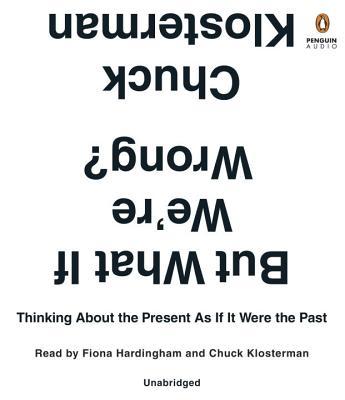
But What If We're Wrong?: Thinking About the Present As If It Were the Past
Goodreads Choice Award
Nominee for Readers' Favorite Nonfiction (2016)We live in a culture of casual certitude. This has always been the case, no matter how often that certainty has failed. Though no generation believes there’s nothing left to learn, every generation unconsciously assumes that what has already been defined and accepted is (probably) pretty close to how reality will be viewed in perpetuity. And then, of course, time passes. Ideas shift. Opinions invert. What once seemed reasonable eventually becomes absurd, replaced by modern perspectives that feel even more irrefutable and secure—until, of course, they don’t.
But What If We’re Wrong? visualizes the contemporary world as it will appear to those who'll perceive it as the distant past. Chuck Klosterman asks questions that are profound in their simplicity: How certain are we about our understanding of gravity? How certain are we about our understanding of time? What will be the defining memory of rock music, five hundred years from today? How seriously should we view the content of our dreams? How seriously should we view the content of television? Are all sports destined for extinction? Is it possible that the greatest artist of our era is currently unknown (or—weirder still—widely known, but entirely disrespected)? Is it possible that we “overrate” democracy? And perhaps most disturbing, is it possible that we’ve reached the end of knowledge?
Kinetically slingshotting through a broad spectrum of objective and subjective problems, But What If We’re Wrong? is built on interviews with a variety of creative thinkers—George Saunders, David Byrne, Jonathan Lethem, Kathryn Schulz, Neil deGrasse Tyson, Brian Greene, Junot Díaz, Amanda Petrusich, Ryan Adams, Nick Bostrom, Dan Carlin, and Richard Linklater, among others—interwoven with the type of high-wire humor and nontraditional analysis only Klosterman would dare to attempt. It’s a seemingly impossible achievement: a book about the things we cannot know, explained as if we did. It’s about how we live now, once “now” has become “then.”
From the Hardcover edition.
But What If We’re Wrong? visualizes the contemporary world as it will appear to those who'll perceive it as the distant past. Chuck Klosterman asks questions that are profound in their simplicity: How certain are we about our understanding of gravity? How certain are we about our understanding of time? What will be the defining memory of rock music, five hundred years from today? How seriously should we view the content of our dreams? How seriously should we view the content of television? Are all sports destined for extinction? Is it possible that the greatest artist of our era is currently unknown (or—weirder still—widely known, but entirely disrespected)? Is it possible that we “overrate” democracy? And perhaps most disturbing, is it possible that we’ve reached the end of knowledge?
Kinetically slingshotting through a broad spectrum of objective and subjective problems, But What If We’re Wrong? is built on interviews with a variety of creative thinkers—George Saunders, David Byrne, Jonathan Lethem, Kathryn Schulz, Neil deGrasse Tyson, Brian Greene, Junot Díaz, Amanda Petrusich, Ryan Adams, Nick Bostrom, Dan Carlin, and Richard Linklater, among others—interwoven with the type of high-wire humor and nontraditional analysis only Klosterman would dare to attempt. It’s a seemingly impossible achievement: a book about the things we cannot know, explained as if we did. It’s about how we live now, once “now” has become “then.”
From the Hardcover edition.
11 pages, Audio CD
First published June 7, 2016
About the author
Chuck Klosterman
114 books5,370 followersCharles John Klosterman is an American author and essayist whose work focuses on American popular culture. He has been a columnist for Esquire and ESPN.com and wrote "The Ethicist" column for The New York Times Magazine. He was awarded the ASCAP Deems Taylor award for music criticism in 2002.
Ratings & Reviews
Friends & Following
Create a free account to discover what your friends think of this book!
Community Reviews
Displaying 1 - 30 of 2,113 reviews

February 14, 2016
As the opening chapter questions whether we could be wrong about the existence of gravity, I thought this would be a book about philosophy and the nature of existence. Of course, I should have looked closely at the author's name - Chuck Klosterman writes about the arts and pop culture, so rather than questioning the nature of existence, mostly this book questions our value judgements on the arts and pop culture. The chapter on books asks just how wrong we can be about who will be the voice of this generation. The chapter on music asks how rock music will be remembered 100 years in the future. And so on through TV and televised sports.
There is one chapter of philosophical questions, asking: what if reality is just a computer simulation? What if our dreams are more significant than we think? This was my favourite chapter, and I wish the whole book was more along these lines. Oh well, no use wishing a book was something that it's not.
Each chapter is slightly too long - the reader already gets the point, but Klosterman still gives us one more example just in case. Still, his style is always enjoyable, and this book did change the way I thought about what I (and everyone) consider 'good' art.
I'm currently struggling with the first draft of my second novel, and this book reminded me that it doesn't matter what I write anyway - in time I will be forgotten or remembered based on future criteria we can't even begin to imagine. So I might as well just try to tell a good story.
One of my favourites of 2016, in the category 'Best Book About Pop Culture':
http://www.kirstylogan.com/best-books...
There is one chapter of philosophical questions, asking: what if reality is just a computer simulation? What if our dreams are more significant than we think? This was my favourite chapter, and I wish the whole book was more along these lines. Oh well, no use wishing a book was something that it's not.
Each chapter is slightly too long - the reader already gets the point, but Klosterman still gives us one more example just in case. Still, his style is always enjoyable, and this book did change the way I thought about what I (and everyone) consider 'good' art.
I'm currently struggling with the first draft of my second novel, and this book reminded me that it doesn't matter what I write anyway - in time I will be forgotten or remembered based on future criteria we can't even begin to imagine. So I might as well just try to tell a good story.
One of my favourites of 2016, in the category 'Best Book About Pop Culture':
http://www.kirstylogan.com/best-books...

August 27, 2017
Excuse me. I just have to go pat myself on the back for ninety minutes for having read nonfiction voluntarily. My brain is bigger than yours, and I am the greatest person alive.
I don’t run, so I don’t know what a runner’s high feels like and I never will and I never want to, but I imagine it’s a lot like finishing a nonfiction book you read without anyone making you. Because, like, wow. I feel like I just won a MacArthur grant, or discovered a new law of physics, or something.
Despite the fact that this book was pretty much a pleasure to read! I’m still all cocky and half-convinced my brain doubled in volume.
Anyway.
But What If We’re Wrong? is a fascinating book with a terrible cover. (I never stopped picking it up upside down. Never.) Divided into chapters by subject (like “books,” “science,” etc.), the author attempts to predict the ways we’ll have changed our thinking in a handful of decades or so - the ways that we’re wrong.
Really, it’s an attempt to predict the future. And it’s grueling and confusing and far from comprehensive and overexcused and absolutely, totally awesome.
I’m obsessed with the simulation theory, and I was long before this book, but it took me doing a lot of reading and annoying, hard critical thinking to understand it. This book contains such a streamlined explanation that, in the week following my completion of it, I ranted at essentially everyone who would listen about the simulation theory.
I completely stole Klosterman’s explanation.
I can’t stress enough that this book includes way too many caveats. (We get it, Chuck. You can’t actually predict the future, or even really give a very good guess. It’s the future; that’s the point. You’re reducing your ethos!!!!) (Yes, I just took a public speaking class. Shut up, it was required.)
Some of the chapters were also much less interesting than others, which is my fault for only being interested in like 3 subjects.
Chunks of this were very confusing, which was also confusing because a lot of it was so well-explained. But I imagine I have a much lower knowledge base than a lot of people reading this, so. Also forgiven.
Overall, this was a much funner and easier and more likable nonfiction read than practically all of them.
Or maybe I’m just really, really hard on nonfiction as a subject.
Bottom line: VERY GOOD STUFF. Read this and feel smart and pretentious.
I don’t run, so I don’t know what a runner’s high feels like and I never will and I never want to, but I imagine it’s a lot like finishing a nonfiction book you read without anyone making you. Because, like, wow. I feel like I just won a MacArthur grant, or discovered a new law of physics, or something.
Despite the fact that this book was pretty much a pleasure to read! I’m still all cocky and half-convinced my brain doubled in volume.
Anyway.
But What If We’re Wrong? is a fascinating book with a terrible cover. (I never stopped picking it up upside down. Never.) Divided into chapters by subject (like “books,” “science,” etc.), the author attempts to predict the ways we’ll have changed our thinking in a handful of decades or so - the ways that we’re wrong.
Really, it’s an attempt to predict the future. And it’s grueling and confusing and far from comprehensive and overexcused and absolutely, totally awesome.
I’m obsessed with the simulation theory, and I was long before this book, but it took me doing a lot of reading and annoying, hard critical thinking to understand it. This book contains such a streamlined explanation that, in the week following my completion of it, I ranted at essentially everyone who would listen about the simulation theory.
I completely stole Klosterman’s explanation.
I can’t stress enough that this book includes way too many caveats. (We get it, Chuck. You can’t actually predict the future, or even really give a very good guess. It’s the future; that’s the point. You’re reducing your ethos!!!!) (Yes, I just took a public speaking class. Shut up, it was required.)
Some of the chapters were also much less interesting than others, which is my fault for only being interested in like 3 subjects.
Chunks of this were very confusing, which was also confusing because a lot of it was so well-explained. But I imagine I have a much lower knowledge base than a lot of people reading this, so. Also forgiven.
Overall, this was a much funner and easier and more likable nonfiction read than practically all of them.
Or maybe I’m just really, really hard on nonfiction as a subject.
Bottom line: VERY GOOD STUFF. Read this and feel smart and pretentious.

August 23, 2021
Just Think Apocalypse
The trouble with ideals is that they become less than ideal almost as soon as they’re stated. When we articulate them, to ourselves or others, we subject them to reflection and discussion. We immediately learn something that makes us want to change, refine or amend them. But our emerging commitments to these ideals inhibit any change in direction. Who wants to be considered flighty or lacking in serious thought?
It’s not just ideals of course. Our preferences, our expectations, our intellectual conclusions, our concepts, as well as our prejudices are never stable. At least they shouldn’t be because this is what we call learning. But do we really want to learn anything that inhibits our progress toward an objective, no matter how obsolete it might have become?
Learning, then, is problematic. But not because of lack 0f experience or incompetence. The traditional locus of the issue of learning is that of formulating the rules for identifying valid chunks of knowledge. This is the domain of epistemology - how do we know what we know? Epistemology is an area of study that has been given a great deal of attention, both philosophical and practical, without much result. We still don’t know how to tell the difference between news and fake news.
But there is another, rather ignored, aspect of the process of learning that may be much more significant than epistemology. Learning, all learning whether in science, literature, the arts, politics, ethics, or just understanding how a new computer functions, undermines, relativises, and often negates everything previously learned. When physicists latched onto Einstein’s Theory of Relativity, it took decades for many of them to unlearn what they knew about their trade, for example.
There is no word, no concept, no technique (except perhaps psychotherapy) that I know of which addresses the dramatic adverse consequences of learning. Yet it is clear that learning, when it occurs, can indeed be traumatic. And where it doesn’t occur it is often due to the anticipatory fear of this very trauma. Some part of our psyche knows just what we’re in for if we let go of any number of established truths we rely on for mental balance. I suspect, given the overwhelming publicly available evidence to the contrary, that this is what’s going on in the heads of American Republicans. To admit that they’ve made commitments to a self-avowed con man is more than their fragile minds can manage.
In other words, obdurate ignorance can be a very purposeful activity. And not just for Trumpists. To accept the possibility, no the certainty, that literally everything we know, and likely take for granted, will be shown to be bogus at some time in the future - perhaps by ourselves but most certainly by others - is disconcerting at least, and devastating to some. Yet many continue to believe that things like facts, evidence, rationality will convince others to adopt a conclusion or a point of view. Ain’t gonna happen. Far to scary.
In any case, at least one school of philosophy (to which I subscribe) has it that true facts will only emerge in that moment just before the extinction of all thinking creatures, that is to say, the human species or its replacements on the planet. At thst moment everything that can be known will be known. Facts will have verified and truth revealed. Before that climactic moment epistemology is a dead end.
Unfortunately, of course, no one will be able to appreciate the epistemological breakthrough at that apocalyptic moment. And we are utterly unable to predict or anticipate what the final truth(s) might be. This, of course, makes the threat of our current tentativeness in all forms of knowledge even greater. We will never know the truth despite our frantic investment in inquiry. All our inquiry will ultimately fail. Isn’t it safer, certainly more comfortable, to just ignore those loonies who go on about climate change, fascist threats, and lack of public education?
Our fear of learning is humiliating. Of course it is. And every previous generation would have felt the same about what they knew. Yet we know they were wrong in every area of knowledge from physics to what constitutes good fiction to how to parent children. If nothing else history shows that future generations will perceive our level of knowledge, our tastes, and our methods (for literally everything, including learning) as passé at best but more likely downright silly.
Accepting that what we think we know is always wrong is like previous generations accepting that the earth isn’t flat or that is not the centre of the universe and is moving at tremendous speed, not through a hypothetical ether but through a field of space-time which itself is warping as we pass through it. Next year’s science may have us wrapped up in x-dimensional strings.
The futility of learning will not stop us from learning. We are, for better or worse, inquiring animals. Perhaps it is language which provokes us to find just the right language about ourselves and the world. Or perhaps it is desire to get beyond language entirely in the hope of discovering what we casually call reality.
What is certain is that recognising what we know now is wrong, will accelerate learning. It might also make less arrogant, obdurate, and pig-headed. My wife has convinced me that this is the only way to live long ago.
The trouble with ideals is that they become less than ideal almost as soon as they’re stated. When we articulate them, to ourselves or others, we subject them to reflection and discussion. We immediately learn something that makes us want to change, refine or amend them. But our emerging commitments to these ideals inhibit any change in direction. Who wants to be considered flighty or lacking in serious thought?
It’s not just ideals of course. Our preferences, our expectations, our intellectual conclusions, our concepts, as well as our prejudices are never stable. At least they shouldn’t be because this is what we call learning. But do we really want to learn anything that inhibits our progress toward an objective, no matter how obsolete it might have become?
Learning, then, is problematic. But not because of lack 0f experience or incompetence. The traditional locus of the issue of learning is that of formulating the rules for identifying valid chunks of knowledge. This is the domain of epistemology - how do we know what we know? Epistemology is an area of study that has been given a great deal of attention, both philosophical and practical, without much result. We still don’t know how to tell the difference between news and fake news.
But there is another, rather ignored, aspect of the process of learning that may be much more significant than epistemology. Learning, all learning whether in science, literature, the arts, politics, ethics, or just understanding how a new computer functions, undermines, relativises, and often negates everything previously learned. When physicists latched onto Einstein’s Theory of Relativity, it took decades for many of them to unlearn what they knew about their trade, for example.
There is no word, no concept, no technique (except perhaps psychotherapy) that I know of which addresses the dramatic adverse consequences of learning. Yet it is clear that learning, when it occurs, can indeed be traumatic. And where it doesn’t occur it is often due to the anticipatory fear of this very trauma. Some part of our psyche knows just what we’re in for if we let go of any number of established truths we rely on for mental balance. I suspect, given the overwhelming publicly available evidence to the contrary, that this is what’s going on in the heads of American Republicans. To admit that they’ve made commitments to a self-avowed con man is more than their fragile minds can manage.
In other words, obdurate ignorance can be a very purposeful activity. And not just for Trumpists. To accept the possibility, no the certainty, that literally everything we know, and likely take for granted, will be shown to be bogus at some time in the future - perhaps by ourselves but most certainly by others - is disconcerting at least, and devastating to some. Yet many continue to believe that things like facts, evidence, rationality will convince others to adopt a conclusion or a point of view. Ain’t gonna happen. Far to scary.
In any case, at least one school of philosophy (to which I subscribe) has it that true facts will only emerge in that moment just before the extinction of all thinking creatures, that is to say, the human species or its replacements on the planet. At thst moment everything that can be known will be known. Facts will have verified and truth revealed. Before that climactic moment epistemology is a dead end.
Unfortunately, of course, no one will be able to appreciate the epistemological breakthrough at that apocalyptic moment. And we are utterly unable to predict or anticipate what the final truth(s) might be. This, of course, makes the threat of our current tentativeness in all forms of knowledge even greater. We will never know the truth despite our frantic investment in inquiry. All our inquiry will ultimately fail. Isn’t it safer, certainly more comfortable, to just ignore those loonies who go on about climate change, fascist threats, and lack of public education?
Our fear of learning is humiliating. Of course it is. And every previous generation would have felt the same about what they knew. Yet we know they were wrong in every area of knowledge from physics to what constitutes good fiction to how to parent children. If nothing else history shows that future generations will perceive our level of knowledge, our tastes, and our methods (for literally everything, including learning) as passé at best but more likely downright silly.
Accepting that what we think we know is always wrong is like previous generations accepting that the earth isn’t flat or that is not the centre of the universe and is moving at tremendous speed, not through a hypothetical ether but through a field of space-time which itself is warping as we pass through it. Next year’s science may have us wrapped up in x-dimensional strings.
The futility of learning will not stop us from learning. We are, for better or worse, inquiring animals. Perhaps it is language which provokes us to find just the right language about ourselves and the world. Or perhaps it is desire to get beyond language entirely in the hope of discovering what we casually call reality.
What is certain is that recognising what we know now is wrong, will accelerate learning. It might also make less arrogant, obdurate, and pig-headed. My wife has convinced me that this is the only way to live long ago.

December 17, 2016
3.5-4 stars
I loved this book up until about half way through. It was covering topics like string theory, the multiverse, and our understanding of gravity. One of my favorites- "As a species, the concept of infinity might be too much for us. I suspect the human conception of infinity is akin to a dog's conception of a clock". -love this!
Discussions with Tyson and Greene-Aristotle and Galileo make appearances throughout-I also loved the chapter on history- with Klosterman's saying, "history is defined by people who don't really understand what they are defining".
Then, about half way through the book, it just switches to the NFL and TV- Both of which I'm not a huge fan of, so I couldn't really understand the hype or ponder too much on these subjects.
All the major questions presented in the book though are never answered-maybe, for the reader, to come up with your own conclusions.
Overall, I do have to say I really did enjoy this book and tabbed so many quotes.
I loved this book up until about half way through. It was covering topics like string theory, the multiverse, and our understanding of gravity. One of my favorites- "As a species, the concept of infinity might be too much for us. I suspect the human conception of infinity is akin to a dog's conception of a clock". -love this!
Discussions with Tyson and Greene-Aristotle and Galileo make appearances throughout-I also loved the chapter on history- with Klosterman's saying, "history is defined by people who don't really understand what they are defining".
Then, about half way through the book, it just switches to the NFL and TV- Both of which I'm not a huge fan of, so I couldn't really understand the hype or ponder too much on these subjects.
All the major questions presented in the book though are never answered-maybe, for the reader, to come up with your own conclusions.
Overall, I do have to say I really did enjoy this book and tabbed so many quotes.

April 26, 2016
Don't go into this book if you really expect to learn something or encounter firm opinions from Chuck Klosterman (except, of course, his wholly incorrect view on the movie Independence Day). I thought I might hate this book going by the first chapter, which seemed to talk in circles about doubt and certainty. Fortunately, subsequent sections are arranged around different themes, and the focus does Klosterman a world of good. Nobody wants to read nearly 300 pages of that annoying devil's advocate friend talk to themselves (except, of course, possibly THAT annoying friend).
How you'll feel about this book really depends on your interests. I found the section on music the most compelling both due to my views and Klosterman's past covering pop culture. Dreams? I don't really care so much. Sports? Not really my bag, but considering the end of their relevance was definitely more engaging than I expected. It's fun at the length it is, but any longer and it would just get tedious.
I was slightly disappointed to find that a couple of the cultural references in But What If We're Wrong? are already dated. Perhaps that proves Klosterman's point in writing the book, but I don't think it bodes well for the book aging well. But hey, what do I know?
I received an advance review copy from Penguin's First to Read program in exchange for a review.
How you'll feel about this book really depends on your interests. I found the section on music the most compelling both due to my views and Klosterman's past covering pop culture. Dreams? I don't really care so much. Sports? Not really my bag, but considering the end of their relevance was definitely more engaging than I expected. It's fun at the length it is, but any longer and it would just get tedious.
I was slightly disappointed to find that a couple of the cultural references in But What If We're Wrong? are already dated. Perhaps that proves Klosterman's point in writing the book, but I don't think it bodes well for the book aging well. But hey, what do I know?
I received an advance review copy from Penguin's First to Read program in exchange for a review.

December 31, 2016
In his latest book, Chuck Klosterman takes a look at the present as if it were the distant past, posing some interesting thought experiments: what will people think of the early 21st century in 500 years’ time? Will rock music still be popular and who will be remembered as the epitome of the genre? Will team sports like football still be popular? Who will be remembered as the most significant writer of this time? Has science reached an impasse or are we about to discover a major new bountiful field of research? Will democracy become a distant memory as humanity discovers a better political system?
But What If We’re Wrong? isn’t a bad book but I didn’t love it either, mostly for the style it was written in rather than the content.
Klosterman was a Rolling Stone writer for many years so it’s no surprise the sections on pop culture are the best in the book. Coming to the conclusion that Chuck Berry will be the defining figure of rock’n’roll for future people was an amusing journey though his answer as to who will be the defining writer of this age - unknown - was a cop-out.
In his chapter on how colours are viewed through the years, I learned about a 2015 meme called The Dress which was fascinating. It’s a photo of a white and gold dress that’s actually black and blue - google it and make up your own mind! Also a number of the interviewees like filmmaker Richard Linklater, scientist Neil deGrasse-Tyson and writer George Saunders have some fascinating ideas on their subjects - Linklater’s views on dreams and how we should view them as far more important than we currently do was very thoughtful and convincing.
Some of Klosterman’s theses though are a bit outrageous. Team sports like American football will be completely unpopular in just a few decades? Come on. And while Klosterman is strong on pop culture, he’s weak on science, history and philosophy. He claims that democracy didn’t work for people in the Ancient World which is why they turned to tyrants to rule over them.
What?! No examples, just a sweeping, stupid statement that fails to take into account how different their concept of democracy was to ours today and the lack of choice in that sort of switch - people don’t select tyrants (that would be democratic), they seize power themselves! And contemporary people are turned off of the idea of tyrants because of bad recent examples like Hitler and Stalin? What a doofus. There have never been benevolent tyrants ever. The same goes for the sections on science and philosophy which are similarly shakily constructed and questionable. He really should’ve just stuck with pop culture in this book.
The premise seems obvious and can’t be argued with; after all the present is always changing and what we believe in a hundred years will of course be vastly different from what we believe today. It’s still amazing though to contemplate the sheer amount of information each of us has about whatever we’re interested in will become largely forgotten to all but future scholars of this time.
What do most of us know about 19th century France off the top of our heads? Napoleon I to III, some French writers like Alexandre Dumas and Victor Hugo, the Eiffel Tower - surface level stuff! Take that back even further to 500 years ago and what do we know about the 16th century world? Everything now will be recorded but most people 500 years from now won’t care to look it up - it’ll all largely be forgotten.
Maybe the only significant factoid future people will remember about the early 21st century will be that America elected its first black president (shortly before electing its second, Kanye West)! Puts it all in perspective doesn’t it? All the bullshit we yammer on about, gone, replaced with the bullshit future generations will be yammering on about, and so on.
It’s not the content that lets the book down, it’s Klosterman’s writing style. He has this rambling, circular, extremely pedantic way of writing that becomes tiresome after getting through, say, 10 pages - that’s why it took me nearly two months to make my way through a relatively short 262 page book! The TV chapter felt especially overlong. Klosterman makes the case that prestige TV - The Wire, Breaking Bad, etc. - will be far less valuable to cultural historians in the future than the news and footage ordinary people shot and uploaded to YouTube. Fair enough - but an entire chapter to make that point??
Actually you could make the case for the entire book - the thesis is fairly succinct and self-explanatory from the start! It more or less reads like a great magazine article pitch that got out of hand, especially as its length doesn’t really improve on its central thesis, it just shows you that Klosterman can witter on at length when he needs to!
But of course that’s not really the point. Even though wondering about how people 500 years from now will view our time makes no difference to anyone currently alive and the whole exercise is based on Klosterman’s thoughts and is admittedly pointless, parts of it are entertaining to read about, even if his plodding, must-include-every-possible-angle style of writing makes you want to brain him! Really patient readers will get the most out of this one but I’d say for more general readers, But What If We’re Wrong? is an easy one to skip even if you’re a Chuck Klosterman fan.
But What If We’re Wrong? isn’t a bad book but I didn’t love it either, mostly for the style it was written in rather than the content.
Klosterman was a Rolling Stone writer for many years so it’s no surprise the sections on pop culture are the best in the book. Coming to the conclusion that Chuck Berry will be the defining figure of rock’n’roll for future people was an amusing journey though his answer as to who will be the defining writer of this age - unknown - was a cop-out.
In his chapter on how colours are viewed through the years, I learned about a 2015 meme called The Dress which was fascinating. It’s a photo of a white and gold dress that’s actually black and blue - google it and make up your own mind! Also a number of the interviewees like filmmaker Richard Linklater, scientist Neil deGrasse-Tyson and writer George Saunders have some fascinating ideas on their subjects - Linklater’s views on dreams and how we should view them as far more important than we currently do was very thoughtful and convincing.
Some of Klosterman’s theses though are a bit outrageous. Team sports like American football will be completely unpopular in just a few decades? Come on. And while Klosterman is strong on pop culture, he’s weak on science, history and philosophy. He claims that democracy didn’t work for people in the Ancient World which is why they turned to tyrants to rule over them.
What?! No examples, just a sweeping, stupid statement that fails to take into account how different their concept of democracy was to ours today and the lack of choice in that sort of switch - people don’t select tyrants (that would be democratic), they seize power themselves! And contemporary people are turned off of the idea of tyrants because of bad recent examples like Hitler and Stalin? What a doofus. There have never been benevolent tyrants ever. The same goes for the sections on science and philosophy which are similarly shakily constructed and questionable. He really should’ve just stuck with pop culture in this book.
The premise seems obvious and can’t be argued with; after all the present is always changing and what we believe in a hundred years will of course be vastly different from what we believe today. It’s still amazing though to contemplate the sheer amount of information each of us has about whatever we’re interested in will become largely forgotten to all but future scholars of this time.
What do most of us know about 19th century France off the top of our heads? Napoleon I to III, some French writers like Alexandre Dumas and Victor Hugo, the Eiffel Tower - surface level stuff! Take that back even further to 500 years ago and what do we know about the 16th century world? Everything now will be recorded but most people 500 years from now won’t care to look it up - it’ll all largely be forgotten.
Maybe the only significant factoid future people will remember about the early 21st century will be that America elected its first black president (shortly before electing its second, Kanye West)! Puts it all in perspective doesn’t it? All the bullshit we yammer on about, gone, replaced with the bullshit future generations will be yammering on about, and so on.
It’s not the content that lets the book down, it’s Klosterman’s writing style. He has this rambling, circular, extremely pedantic way of writing that becomes tiresome after getting through, say, 10 pages - that’s why it took me nearly two months to make my way through a relatively short 262 page book! The TV chapter felt especially overlong. Klosterman makes the case that prestige TV - The Wire, Breaking Bad, etc. - will be far less valuable to cultural historians in the future than the news and footage ordinary people shot and uploaded to YouTube. Fair enough - but an entire chapter to make that point??
Actually you could make the case for the entire book - the thesis is fairly succinct and self-explanatory from the start! It more or less reads like a great magazine article pitch that got out of hand, especially as its length doesn’t really improve on its central thesis, it just shows you that Klosterman can witter on at length when he needs to!
But of course that’s not really the point. Even though wondering about how people 500 years from now will view our time makes no difference to anyone currently alive and the whole exercise is based on Klosterman’s thoughts and is admittedly pointless, parts of it are entertaining to read about, even if his plodding, must-include-every-possible-angle style of writing makes you want to brain him! Really patient readers will get the most out of this one but I’d say for more general readers, But What If We’re Wrong? is an easy one to skip even if you’re a Chuck Klosterman fan.

October 30, 2019
The starting point of this book is absolutely interesting: let us imagine what people would think about our own age in 500 or 1,000 years, assuming that there still are humans. Not a simple matter, of course, but there is a strong tendency to immediately conclude that what we now take for granted will turn out to be completely wrong, just as we now see that what was thought 500 or 1,000 years ago largely was wrong or at least not adequate enough.
Klosterman illustrates this by asking, for example, who will be considered the greatest rock musician of the late 20th century: Chuck Berry, Elvis Presley, the Beatles or Bob Dylan. He rightly points out that even after a few decades, the judgment about these people has shifted considerably, and probably will continue to change. In the literature and sports sector too, valuations can change very quickly, certainly in the much longer run. Up to this point, Klosterman is very entertaining, with often nice one-liners such as: "the future world will be fundamentally unlike our present world", or "history is defined by people who don't really understand what they are defining".
But then he also starts venturing into the field of science, historical studies and politics, and then things are going pretty wrong. You can clearly feel that these are less familiar terrains for him, that he remains very shallow and sometimes hits the ball completely wrong. Einstein's theory of relativity, for example, did not make Newtonian physics wrong, but just placed it in a broader context. And the tendency of historians to build more on factual data and on statistical material instead of telling stories may be problematic for understanding the past correctly, it is not necessarily a wrong way: provided that transparency and continuous addition and adjustment of the data are achieved, a gradual better understanding of the past is possible without losing sight of the narrative aspect.
In short, Klosterman certainly raises pertinent issues, and he does so in a very entertaining way (sometimes with a too American focus), but in fact he does not go beyond busting through open doors: the future is uncertain, our views and valuations are shifting constantly, so we better assume that we are wrong. In the end you think: so what?
Klosterman illustrates this by asking, for example, who will be considered the greatest rock musician of the late 20th century: Chuck Berry, Elvis Presley, the Beatles or Bob Dylan. He rightly points out that even after a few decades, the judgment about these people has shifted considerably, and probably will continue to change. In the literature and sports sector too, valuations can change very quickly, certainly in the much longer run. Up to this point, Klosterman is very entertaining, with often nice one-liners such as: "the future world will be fundamentally unlike our present world", or "history is defined by people who don't really understand what they are defining".
But then he also starts venturing into the field of science, historical studies and politics, and then things are going pretty wrong. You can clearly feel that these are less familiar terrains for him, that he remains very shallow and sometimes hits the ball completely wrong. Einstein's theory of relativity, for example, did not make Newtonian physics wrong, but just placed it in a broader context. And the tendency of historians to build more on factual data and on statistical material instead of telling stories may be problematic for understanding the past correctly, it is not necessarily a wrong way: provided that transparency and continuous addition and adjustment of the data are achieved, a gradual better understanding of the past is possible without losing sight of the narrative aspect.
In short, Klosterman certainly raises pertinent issues, and he does so in a very entertaining way (sometimes with a too American focus), but in fact he does not go beyond busting through open doors: the future is uncertain, our views and valuations are shifting constantly, so we better assume that we are wrong. In the end you think: so what?

July 3, 2016
This was my first Klosterman book and my first nonfiction book in a minute as the kids say. I really liked most of the book. It's pretty abstract, there aren't any answers to the questions he's asking since we can't see into the future, but I enjoyed the discussion and trying to gaze into the crystal ball.
The premise of the book is trying to look at the present as if it were the past, basically putting ourselves into a time machine and looking back at our current times from a variety of angles. Each chapter tackles a different part of our culture from books to TV to football to science to politics and beyond. His writing is excellent. Klosterman can weave sentences together with adjectives you may not use everyday in a very readable fashion. I loved his prose and the ideas he presented throughout the book.
Is Breaking Bad going to be viewed as the best show off all time in 100 years? Will TV even matter anymore, or will it be done archaic thing people did in the past like listening to radio programs or buying cassette tapes?
Will the NFL still exist in the future, or will concussions and possible deaths end the sport? Or do we really wanna see more violence after all and keep it going?
Are there other universes out there we don't even know about and never will know about? Can we ever know more about the infinite universe wet live in? How far can science take us in understanding ourselves and the world?
Big questions, few answers, but the intellectual arguments and opinions shared by Klosterman and others are very interesting to consider and think about pop culture from a completely different perspective. Plus, wet have a lot in common. All the bands, TV shows, movies, and celebrities were stuff I consume and enjoy. It made the whole thing thought provoking but also something I could relate to personally. It felt at times like talking to a friend while drinking a local bar drinking a local IPA because every else would you be drinking anyway?
The premise of the book is trying to look at the present as if it were the past, basically putting ourselves into a time machine and looking back at our current times from a variety of angles. Each chapter tackles a different part of our culture from books to TV to football to science to politics and beyond. His writing is excellent. Klosterman can weave sentences together with adjectives you may not use everyday in a very readable fashion. I loved his prose and the ideas he presented throughout the book.
Is Breaking Bad going to be viewed as the best show off all time in 100 years? Will TV even matter anymore, or will it be done archaic thing people did in the past like listening to radio programs or buying cassette tapes?
Will the NFL still exist in the future, or will concussions and possible deaths end the sport? Or do we really wanna see more violence after all and keep it going?
Are there other universes out there we don't even know about and never will know about? Can we ever know more about the infinite universe wet live in? How far can science take us in understanding ourselves and the world?
Big questions, few answers, but the intellectual arguments and opinions shared by Klosterman and others are very interesting to consider and think about pop culture from a completely different perspective. Plus, wet have a lot in common. All the bands, TV shows, movies, and celebrities were stuff I consume and enjoy. It made the whole thing thought provoking but also something I could relate to personally. It felt at times like talking to a friend while drinking a local bar drinking a local IPA because every else would you be drinking anyway?

July 6, 2016
I really want to give this more stars, I should have liked it- but, ugh. Yes, I'm sure lots of the things we now believe about reality may one day be proven wrong, but so what? How does that effect our lives? Well, as the author states it doesn't because most people don't care. The shepherd in 1500 A.D. who was suddenly told the earth went around the sun and not vice versa, was shocked and then went back to his sheep. We're just the same, centuries from now when we finally unlock the secrets of the quantum and launch the star-ships most people will probably still be more concerned about finding money, power, and love than awed by the fact we can actually understand and colonize the universe.
And why so much space spent on analyzing TV? Yes the future will have a much different understanding of ourselves then we will, and I'm sure we have ridiculous ideas about how ancient Egyptians lived and felt, but so what?
Everyone will seem ridiculous when they're dead, or if they live long enough; hopefully that represents progress.
And why so much space spent on analyzing TV? Yes the future will have a much different understanding of ourselves then we will, and I'm sure we have ridiculous ideas about how ancient Egyptians lived and felt, but so what?
Everyone will seem ridiculous when they're dead, or if they live long enough; hopefully that represents progress.

July 13, 2017
The reason so many well-considered ideas appear laughable in retrospect is that people involuntarily assume that whatever we believe and prioritize now will continue to be believed and prioritized later, even though that almost never happens. It’s a mistake that never stops being made.Do you like Chuck Klosterman? Are you ok with essays that ask questions without ever really answering them? Then have I got a book for you.
But What If We’re Wrong asks lots of interesting questions, and makes many fascinating arguments and counter-arguments. It’s witty, fun, and full of logical and philosophical discussions. But even though it is a bit unfair, there is something ultimately unsatisfying about a book that cannot answer its main thesis. Still, this book is an enjoyable read if you, like me, are a fan of Chuck Klosterman’s writing.

Read
October 31, 2019Futurism is not a science and it will never become one, unless of course I am mistaken, and the chance that I'm wrong actually is pretty high. Perhaps this is a rather dizzy-making statement, but this book is full of such contradictory propositions. And that is not surprising, most of them are actually open doors. For example, Klosterman offers a nice sample of predictions and imaginations of the future, made in the past, that turned out to be completely wrong. And that is rather easily done, of course, because the future simply cannot be predicted.
The nice thing is that Klosterman examines concrete judgmental mechanisms about the worth of things in a distant past. With that he is steering in the field that interests me personally: the study of history. In his case-studies on rock music, literature and sports, he presents interesting elements. There is the very predictable conclusion that nothing is predictable: our judgment about what was valuable in the past is constantly shifting, and that makes sense. So, that’s not a revolutionary insight. Nevertheless Klosterman does offer some elements about the process of forming judgments that are relevant. For example, he notes that in a first phase, experts and insiders in a particular sector determine the value of people, events and things; but afterwards the wider public mostly gets the upper hand, certainly in this time of globalized social media. And so his conclusion is that people who are not really familiar with the matter ultimately determine the judgment (“history is defined by people who don't really understand what they are defining”, 91). Another pertinent finding is that the farther a time period shifts in the past, the more fragmented the knowledge of that period becomes. For example, to many people classical music of the 18th and 19th centuries is limited to Bach, Mozart and Beethoven; even the expertise of real specialists has its limits. That too may be rather predictable, but it does make the assessment of the value of events and people much less nuanced and therefore more unpredictable.
All this leads to the conclusion that, retrospectively, no logic can be detected in our perception of history: it seems that the evolution of history contains a very strong irrational element, and thus "logic doesn't work particularly well when applied to the future"(17). Klosterman's book was written in early 2016, apparently just before the 'disruption craze' (so no references to the Brexit or Trump in this book), otherwise he would have put more emphasis on this notion and rightly so, though you have to be careful with it.
In the end, Klosterman concludes with another predictable saying: “this is how the present must be considered whenever we try to think about it as the past: it must be analyzed through the values of a future that’s unwritten”. And when he adds: "the future world will be fundamentally unlike our present world", then you know everything there is to know.
Intuitively I know he's right, and it all confirms that we must be rather modest in our estimations of past, present and future. But a little voice inside me keeps on whispering: no, in all modesty, there is a real - even positive - tendency to differentiate and distinguish into history. See my review on the books of Stephen Pinker (https://www.goodreads.com/review/show...) and of Rutger Bregman (https://www.goodreads.com/review/show...). I guess her I'm stumbling at a paradox within myself that I have to cope with.
The nice thing is that Klosterman examines concrete judgmental mechanisms about the worth of things in a distant past. With that he is steering in the field that interests me personally: the study of history. In his case-studies on rock music, literature and sports, he presents interesting elements. There is the very predictable conclusion that nothing is predictable: our judgment about what was valuable in the past is constantly shifting, and that makes sense. So, that’s not a revolutionary insight. Nevertheless Klosterman does offer some elements about the process of forming judgments that are relevant. For example, he notes that in a first phase, experts and insiders in a particular sector determine the value of people, events and things; but afterwards the wider public mostly gets the upper hand, certainly in this time of globalized social media. And so his conclusion is that people who are not really familiar with the matter ultimately determine the judgment (“history is defined by people who don't really understand what they are defining”, 91). Another pertinent finding is that the farther a time period shifts in the past, the more fragmented the knowledge of that period becomes. For example, to many people classical music of the 18th and 19th centuries is limited to Bach, Mozart and Beethoven; even the expertise of real specialists has its limits. That too may be rather predictable, but it does make the assessment of the value of events and people much less nuanced and therefore more unpredictable.
All this leads to the conclusion that, retrospectively, no logic can be detected in our perception of history: it seems that the evolution of history contains a very strong irrational element, and thus "logic doesn't work particularly well when applied to the future"(17). Klosterman's book was written in early 2016, apparently just before the 'disruption craze' (so no references to the Brexit or Trump in this book), otherwise he would have put more emphasis on this notion and rightly so, though you have to be careful with it.
In the end, Klosterman concludes with another predictable saying: “this is how the present must be considered whenever we try to think about it as the past: it must be analyzed through the values of a future that’s unwritten”. And when he adds: "the future world will be fundamentally unlike our present world", then you know everything there is to know.
Intuitively I know he's right, and it all confirms that we must be rather modest in our estimations of past, present and future. But a little voice inside me keeps on whispering: no, in all modesty, there is a real - even positive - tendency to differentiate and distinguish into history. See my review on the books of Stephen Pinker (https://www.goodreads.com/review/show...) and of Rutger Bregman (https://www.goodreads.com/review/show...). I guess her I'm stumbling at a paradox within myself that I have to cope with.

April 26, 2016
This was a fun book. I received an ARC in exchange for my review, and I have to say that I would strongly recommend this to anyone who loves to ask "What if?" This is one of those books you just can't take seriously at all, but if you're willing to follow the author down the hypothetical scenario rabbit hole, it's quite amusing. You will ponder who the next Kafka will be, whether the Beatles will still be historically important in the far future, whether there is another version of you (or multiple versions of you) out in the vast universe, among many other silly things.
Klosterman is funny, but he's also intelligent despite his self-deprecating nature. If you like philosophy, or just want to read something that is unusual, pick this up. It's a fast read and is thought provoking in its own right.
Klosterman is funny, but he's also intelligent despite his self-deprecating nature. If you like philosophy, or just want to read something that is unusual, pick this up. It's a fast read and is thought provoking in its own right.

February 12, 2016
Best thing I've read this year.
The premise is pretty simple. Basically, Klosterman spends most of a book...not PROVING that we're wrong about just about everything, but asking questions that make us think, "If I step outside myself for a second, I COULD be wrong."
You'd be amazed the places he goes with this. He starts with fucking gravity! STARTS with. Not proving that gravity is nonexistent as we experience it, but that it may be an emergent force, which is a force that results from other things and therefore isn't its own force. Does that make any goddamn sense? He's better at this than I am. That's why I give his book 5 stars and mine 3. Plus, his covers look better. Plus, everything else besides his covers and clarity is also better.
I have some favorite parts, but I'm going to limit myself to one because I could be here all damn day.
I have to do this one because this is a point of personal passion for me, and I think Klosterman expresses something really important about the first amendment:
"There is no amendment more beloved, and it's the single most American sentiment that can be expressed. Yet its function is highly specific. It stops the government from limiting a person or an organization's freedom of expression (and that's critical, particularly if you want to launch an especially self-righteous alt weekly or an exceptionally lucrative church or the rap group N.W.A.). But in a capitalist society, it doesn't have much application within any scenario where the government doesn't have a vested interest in what's being expressed. If someone publishes an essay or tells a joke or performs a play that forwards a problematic idea, the US government generally wouldn't try to stop that person from doing so, even if they could. If the expression doesn't involve national security, the government generally doesn't give a shit. But if enough vocal consumers are personally offended, they can silence that artist just as effectively. They can petition advertisers and marginalize the artist's reception and economically remove that individual from whatever platform he or she happens to utilize, simply because there are no expression-based platforms that don't have an economic underpinning. It's one of those situations where the practical manifestation is the opposite of the technical intention: As Americans, we tend to look down on European countries that impose legal limitations on speech, yet as long as speakers in those countries stay within the specified boundaries, discourse is allowed relatively unfettered (even when it's unpopular). In the US, there are absolutely no speech boundaries imposed by the government, so the citizenry creates its own limitations, based on the arbitrary values of whichever activist group is most successful at inflicting its worldview upon an economically fragile public sphere. As a consequence, the United States is a safe place for those who want to criticize the government but a dangerous place for those who want to advance unpopular thoughts about any other subject that could be deemed insulting or otherwise. Some would argue that this trade-off is worth it. Time may prove otherwise."
Yes. Thank you.
There's this thing that people say. "Freedom of speech doesn't mean freedom from consequence."
I really hate that saying. Because if there are consequences for speech, then what part of it is free, exactly? Are you just reaffirming that you don't have the ability to physically stop a person from saying something? You're telling me that you're not Beetlejuice?

God, I can't tell you how long I've been waiting to use this GIF. I need to use a Beetlejuice GIF in everything. And also, I need to not say his name again in this review, lest I call him forth.
But anyway, are we saying that once unappreciated words leave a person's mouth, as long as we act within the law, it's game on to bring down whatever consequences we can? Because that's not freedom of expression at all. That's freedom of thought. Once the thought is expressed, it's subject to some pretty heavy restrictions.
I can write a blog about how I think my boss is stupid (I don't), and I can be fired for that. And if I DID get fired for that, people would blame me, not for thinking my boss is stupid (because my guess is 90% of people have expressed this), but for saying it. Off work time, not using work tools, I'm still an idiot for saying how I feel in the medium of my choosing.
I agree with Klosterman, it may be worse to have non-delineated consequences for non-specific types of speech than to have what appear to be restrictive laws. If the law makes some specifications, I can knowingly violate those and accept the consequences, or I can choose to operate within them and stay safe.
In the US, you don't have that option. If you say something that makes an individual or group upset, they may not be able to put you in jail, but they could certainly attack your personal life, your livelihood, just about anything they wanted to. This has happened many, many times, and I encourage you to check out Jon Ronson's So You've Been Publicly Shamed to find out more about just how devastating this type of consequence can be and how uneven and disproportionate its application is.
Frankly, I think what's fair and just is for everyone to know the rules. It's fair to pull me over for speeding when the limit is posted.
And the other thing, who the fuck died and made you the decider of what consequences a person deserves for pissing you off? And why did they have to die to make you in charge? Where were you at the time of the murder/coup? Seems like you had something to gain from the untimely demise of this unnamed individual who was formerly in charge. I have a lot of questions for you, buddy, and I think you should probably answer some of them before you get all high and mighty.
In all seriousness, I really dislike that we tout our freedom of speech when, in reality, the freedom is in your freedom to express things within parameters. You're free to say whatever you want as long as you're polite, considerate, on the right side of current events, and as long as you don't say something about someone who can fire you. Or you can be independently wealthy and above any significant consequence in terms of your ability to get and keep a gig. Of course, as with most rules, freedom of expression applies most to rich people. Go figure.
I feel, and I feel very strongly, that the right path is not to limit speech, whether we do that by participating in retweeting or blasting people with fire hoses, but to create more speech in opposition to the things we don't like. Not to ask for removal of or apologies for expression, creating what we assume to be a vacuum that we assume will SURELY be occupied by something good and wonderful and acceptable, but to instead skip straight to creating the good and wonderful thing that would occupy the space directly adjacent to what we find distasteful. When it comes to books and art and movies and tweets, space is something we've got in spades. Trust me, I took a grad level class on information storage and retrieval, a field that, in the digital realm, is all about the ability to classify and locate things within an infinite space. There is no limit to the quantity of space we have for art and for expression anymore. The only limit is the one we put on, the limit of what we see as quality, but is more accurately boiled down to what we do and don't "like."
Klosterman said it better, of course:
"...there are intrinsic benefits to constantly probing the possibility that our assumptions about the future might be wrong: humility and wonder. It's good to view reality as beyond our understanding, because it is. And it's exciting to imagine the prospect of a reality that cannot be imagined, because that's as close to pansophical omniscience as we will ever come. If you aspire to be truly open-minded, you can't just try to see the other side of an argument. That's not enough. You have to go all the way."
I could be wrong. After reading this book, I could definitely be wrong.
And I could be wrong in thinking that limiting speech is not ultimately a good thing. I've been wrong about things before. I listened to ska music. A lot.
My perspective on it is just that we've tried it this way. We've tried to let faceless citizens decide what is and isn't acceptable speech. And it's worked, sort of, and it's not worked, sort of. And so, if we try it another way, the likely result is that it will ALSO sort of work and sort of not work.
But if we have a larger variety to choose from, a 31 flavors, if you will, as opposed to the single pint of ice cream in the fridge, I can make a choice. I can consume the flavors I like, or I can try out a new flavor, or I can be crazy, say fuck off to that pink tester spoon and get a whole scoop of something that turns out to be Mint Chocolate Chip, by which I mean a flavor lots of people love and I'm not crazy about.
And yes, there's a risk. Some disaffected youth working at 31 Flavors might cross-contaminate a flavor I love with some bullshit flavor, and once in a while I'll get a taste of something I don't care for. Perhaps I'll become sick because I ate a bit of something I'm allergic to.
But ultimately, my dislike of a flavor doesn't remove that flavor's right to exist, and doesn't have any bearing on whether or not someone else might enjoy that flavor.
I say, with full knowledge I could be totally wrong, that if you don't like any of the 31 flavors, your answer is not to ask that the store remove a flavor in hopes they'll replace it with something you love. It's to ask them to get 32 flavors.
Please note that this analogy does not apply in any way to that pink ice cream with the bubble gum bits in it. That's vile. That's like dipping your Bubble Tape into a glass of milk before chewing.
The premise is pretty simple. Basically, Klosterman spends most of a book...not PROVING that we're wrong about just about everything, but asking questions that make us think, "If I step outside myself for a second, I COULD be wrong."
You'd be amazed the places he goes with this. He starts with fucking gravity! STARTS with. Not proving that gravity is nonexistent as we experience it, but that it may be an emergent force, which is a force that results from other things and therefore isn't its own force. Does that make any goddamn sense? He's better at this than I am. That's why I give his book 5 stars and mine 3. Plus, his covers look better. Plus, everything else besides his covers and clarity is also better.
I have some favorite parts, but I'm going to limit myself to one because I could be here all damn day.
I have to do this one because this is a point of personal passion for me, and I think Klosterman expresses something really important about the first amendment:
"There is no amendment more beloved, and it's the single most American sentiment that can be expressed. Yet its function is highly specific. It stops the government from limiting a person or an organization's freedom of expression (and that's critical, particularly if you want to launch an especially self-righteous alt weekly or an exceptionally lucrative church or the rap group N.W.A.). But in a capitalist society, it doesn't have much application within any scenario where the government doesn't have a vested interest in what's being expressed. If someone publishes an essay or tells a joke or performs a play that forwards a problematic idea, the US government generally wouldn't try to stop that person from doing so, even if they could. If the expression doesn't involve national security, the government generally doesn't give a shit. But if enough vocal consumers are personally offended, they can silence that artist just as effectively. They can petition advertisers and marginalize the artist's reception and economically remove that individual from whatever platform he or she happens to utilize, simply because there are no expression-based platforms that don't have an economic underpinning. It's one of those situations where the practical manifestation is the opposite of the technical intention: As Americans, we tend to look down on European countries that impose legal limitations on speech, yet as long as speakers in those countries stay within the specified boundaries, discourse is allowed relatively unfettered (even when it's unpopular). In the US, there are absolutely no speech boundaries imposed by the government, so the citizenry creates its own limitations, based on the arbitrary values of whichever activist group is most successful at inflicting its worldview upon an economically fragile public sphere. As a consequence, the United States is a safe place for those who want to criticize the government but a dangerous place for those who want to advance unpopular thoughts about any other subject that could be deemed insulting or otherwise. Some would argue that this trade-off is worth it. Time may prove otherwise."
Yes. Thank you.
There's this thing that people say. "Freedom of speech doesn't mean freedom from consequence."
I really hate that saying. Because if there are consequences for speech, then what part of it is free, exactly? Are you just reaffirming that you don't have the ability to physically stop a person from saying something? You're telling me that you're not Beetlejuice?
God, I can't tell you how long I've been waiting to use this GIF. I need to use a Beetlejuice GIF in everything. And also, I need to not say his name again in this review, lest I call him forth.
But anyway, are we saying that once unappreciated words leave a person's mouth, as long as we act within the law, it's game on to bring down whatever consequences we can? Because that's not freedom of expression at all. That's freedom of thought. Once the thought is expressed, it's subject to some pretty heavy restrictions.
I can write a blog about how I think my boss is stupid (I don't), and I can be fired for that. And if I DID get fired for that, people would blame me, not for thinking my boss is stupid (because my guess is 90% of people have expressed this), but for saying it. Off work time, not using work tools, I'm still an idiot for saying how I feel in the medium of my choosing.
I agree with Klosterman, it may be worse to have non-delineated consequences for non-specific types of speech than to have what appear to be restrictive laws. If the law makes some specifications, I can knowingly violate those and accept the consequences, or I can choose to operate within them and stay safe.
In the US, you don't have that option. If you say something that makes an individual or group upset, they may not be able to put you in jail, but they could certainly attack your personal life, your livelihood, just about anything they wanted to. This has happened many, many times, and I encourage you to check out Jon Ronson's So You've Been Publicly Shamed to find out more about just how devastating this type of consequence can be and how uneven and disproportionate its application is.
Frankly, I think what's fair and just is for everyone to know the rules. It's fair to pull me over for speeding when the limit is posted.
And the other thing, who the fuck died and made you the decider of what consequences a person deserves for pissing you off? And why did they have to die to make you in charge? Where were you at the time of the murder/coup? Seems like you had something to gain from the untimely demise of this unnamed individual who was formerly in charge. I have a lot of questions for you, buddy, and I think you should probably answer some of them before you get all high and mighty.
In all seriousness, I really dislike that we tout our freedom of speech when, in reality, the freedom is in your freedom to express things within parameters. You're free to say whatever you want as long as you're polite, considerate, on the right side of current events, and as long as you don't say something about someone who can fire you. Or you can be independently wealthy and above any significant consequence in terms of your ability to get and keep a gig. Of course, as with most rules, freedom of expression applies most to rich people. Go figure.
I feel, and I feel very strongly, that the right path is not to limit speech, whether we do that by participating in retweeting or blasting people with fire hoses, but to create more speech in opposition to the things we don't like. Not to ask for removal of or apologies for expression, creating what we assume to be a vacuum that we assume will SURELY be occupied by something good and wonderful and acceptable, but to instead skip straight to creating the good and wonderful thing that would occupy the space directly adjacent to what we find distasteful. When it comes to books and art and movies and tweets, space is something we've got in spades. Trust me, I took a grad level class on information storage and retrieval, a field that, in the digital realm, is all about the ability to classify and locate things within an infinite space. There is no limit to the quantity of space we have for art and for expression anymore. The only limit is the one we put on, the limit of what we see as quality, but is more accurately boiled down to what we do and don't "like."
Klosterman said it better, of course:
"...there are intrinsic benefits to constantly probing the possibility that our assumptions about the future might be wrong: humility and wonder. It's good to view reality as beyond our understanding, because it is. And it's exciting to imagine the prospect of a reality that cannot be imagined, because that's as close to pansophical omniscience as we will ever come. If you aspire to be truly open-minded, you can't just try to see the other side of an argument. That's not enough. You have to go all the way."
I could be wrong. After reading this book, I could definitely be wrong.
And I could be wrong in thinking that limiting speech is not ultimately a good thing. I've been wrong about things before. I listened to ska music. A lot.
My perspective on it is just that we've tried it this way. We've tried to let faceless citizens decide what is and isn't acceptable speech. And it's worked, sort of, and it's not worked, sort of. And so, if we try it another way, the likely result is that it will ALSO sort of work and sort of not work.
But if we have a larger variety to choose from, a 31 flavors, if you will, as opposed to the single pint of ice cream in the fridge, I can make a choice. I can consume the flavors I like, or I can try out a new flavor, or I can be crazy, say fuck off to that pink tester spoon and get a whole scoop of something that turns out to be Mint Chocolate Chip, by which I mean a flavor lots of people love and I'm not crazy about.
And yes, there's a risk. Some disaffected youth working at 31 Flavors might cross-contaminate a flavor I love with some bullshit flavor, and once in a while I'll get a taste of something I don't care for. Perhaps I'll become sick because I ate a bit of something I'm allergic to.
But ultimately, my dislike of a flavor doesn't remove that flavor's right to exist, and doesn't have any bearing on whether or not someone else might enjoy that flavor.
I say, with full knowledge I could be totally wrong, that if you don't like any of the 31 flavors, your answer is not to ask that the store remove a flavor in hopes they'll replace it with something you love. It's to ask them to get 32 flavors.
Please note that this analogy does not apply in any way to that pink ice cream with the bubble gum bits in it. That's vile. That's like dipping your Bubble Tape into a glass of milk before chewing.

November 17, 2025
"In a hundred years, who's going to give a shit?"
Usually rhetorical, this question becomes more of an intellectual and philosophical exercise in Chuck Klosterman's 2016 book "But What If We're Wrong? Thinking About the Present As If It Were the Past".
A pop-culture expert who is well-aware of how dubious a distinction that is, Klosterman talks to philosophers, scientists, music experts, film directors, critics, and miscellaneous other people in a wide range of fields to determine who (if anyone, assuming anyone will be around) in fifty to a hundred years will know or care what cultural significance The Sopranos had on early 20th century society or whether Nirvana's "Nevermind" will still be a kick-ass album or forgotten on the ash-heap of 21st-century bands that nobody listens to.
On a more serious note, Klosterman also tackles some heady stuff, like whether the supposedly immutable facts of physics and mathematics could become quite mutable with new discoveries in science and technology, or whether sea-changes in thought and behavior will make things that we once thought were important become unimportant, like democracy.
A fascinating, fun, and all-too-short examination of what humans think are important at the moment, "But What If We're Wrong?" reads like a conversation that the stoner kids in "That '70s Show" would have had in their basement, except that it's actually inadvertently profound.
Usually rhetorical, this question becomes more of an intellectual and philosophical exercise in Chuck Klosterman's 2016 book "But What If We're Wrong? Thinking About the Present As If It Were the Past".
A pop-culture expert who is well-aware of how dubious a distinction that is, Klosterman talks to philosophers, scientists, music experts, film directors, critics, and miscellaneous other people in a wide range of fields to determine who (if anyone, assuming anyone will be around) in fifty to a hundred years will know or care what cultural significance The Sopranos had on early 20th century society or whether Nirvana's "Nevermind" will still be a kick-ass album or forgotten on the ash-heap of 21st-century bands that nobody listens to.
On a more serious note, Klosterman also tackles some heady stuff, like whether the supposedly immutable facts of physics and mathematics could become quite mutable with new discoveries in science and technology, or whether sea-changes in thought and behavior will make things that we once thought were important become unimportant, like democracy.
A fascinating, fun, and all-too-short examination of what humans think are important at the moment, "But What If We're Wrong?" reads like a conversation that the stoner kids in "That '70s Show" would have had in their basement, except that it's actually inadvertently profound.

August 9, 2016
Every time I read an essay by Chuck Klosterman -- and, given my interest in music and pop culture, I've read a number of them -- I'm struck by his self-deprecating tone. It's the written equivalent of throat clearing and foot shuffling: parenthetical asides, wryly humorous footnotes, run-on digressions from his central point. It can be charming.
But in small doses, and in the right context. In "But What If We're Wrong?" it becomes, frankly, annoying.
The book's conceit is a good one: What will matter in 300 or 500 years? What will survive of our culture? After all, as Klosterman observes, if you look at what people valued or how they thought in 1600 or 1700, much of it is now considered wrong (scientific ideas) or minor (popular books of the era). Pop culture/art & literature, in particular, has a way of disappearing and then being revived, as with Melville's "Moby-Dick" (a failure when it appeared, and forgotten until about 50 years later) or any number of movies (though God help us if Michael Bay is taken seriously by 22nd-century cineastes).
When it comes to his wheelhouse, music, Klosterman is at his best. Assuming rock music is simply a bygone genre by 2200, what aspects of it will remain? What artist will stand out as being most representative? After making the usual distinctions between "rock 'n' roll" and "rock" and "pop" -- distinctions he acknowledges will likely be pointless, and perhaps already are -- he comes to a conclusion that Chuck Berry will be the last man standing. Which anyone familiar with the "SNL" sketch about the alien response to Voyager -- "Send more Chuck Berry" -- could have guessed.
He has some provocative digressions about "merit" (does it matter? who decides?) and perception (is your idea of "blue" the same as mine?) but soon gets trapped in muddier waters. Perhaps the nadir is a chapter on scientific truth, from which Klosterman segues into a discussion of philosophical truth.
It bugged me in two ways. For one, the point of science is to suggest theories based on observable phenomena, or at least some mathematical bedrock. If you want to throw in "Matrix"-like concepts of living in a dream world or alien-manufactured simulation, feel free -- but it stands outside the science. (It makes me think of Douglas Adams, frankly. And thanks for all the fish!) In science, if a hypothesis doesn't pan out, then you construct a new one based on the evidence. This is a continual process.
The other was in Klosterman's shambling style. It's reasonable to speak out loud about the blind alleys of your thought process, but it's also reasonable to have an editor who can remove some of that conversation from the end product -- as well as some of the lesser jokes. Here, Klosterman's meanderings are no better than a late-night college bull session.
Other essays fall between these two poles -- a discussion of the future of football, for example, or the Internet trope of "You're doing it wrong."
The thing is, Klosterman's a bright guy. Even when I wished he would remove a reference to some mediocre '90s band, I kept reading because the ideas he's working with are fascinating. If he'd written a whole (assertive) book on the musicians/TV shows/movies/etc. that people would be talking about in 300 years he may have been on firmer ground. But in trying to be expansive, he just becomes tedious. (For science, a better view is Bill Bryson's often wide-eyed "A Short History of Nearly Everything," which does a good job of translating difficult concepts to the layman's level -- that is, mine -- as well as leavening it with enough humor to make it sing.)
Also, it makes the book lumpy. For that, I blame his editor, who could have smoothed things out considerably, but decided to let Klosterman be Klosterman.
So, come for the music. But go elsewhere for the science and philosophy. And send more Chuck Berry.
But in small doses, and in the right context. In "But What If We're Wrong?" it becomes, frankly, annoying.
The book's conceit is a good one: What will matter in 300 or 500 years? What will survive of our culture? After all, as Klosterman observes, if you look at what people valued or how they thought in 1600 or 1700, much of it is now considered wrong (scientific ideas) or minor (popular books of the era). Pop culture/art & literature, in particular, has a way of disappearing and then being revived, as with Melville's "Moby-Dick" (a failure when it appeared, and forgotten until about 50 years later) or any number of movies (though God help us if Michael Bay is taken seriously by 22nd-century cineastes).
When it comes to his wheelhouse, music, Klosterman is at his best. Assuming rock music is simply a bygone genre by 2200, what aspects of it will remain? What artist will stand out as being most representative? After making the usual distinctions between "rock 'n' roll" and "rock" and "pop" -- distinctions he acknowledges will likely be pointless, and perhaps already are -- he comes to a conclusion that Chuck Berry will be the last man standing. Which anyone familiar with the "SNL" sketch about the alien response to Voyager -- "Send more Chuck Berry" -- could have guessed.
He has some provocative digressions about "merit" (does it matter? who decides?) and perception (is your idea of "blue" the same as mine?) but soon gets trapped in muddier waters. Perhaps the nadir is a chapter on scientific truth, from which Klosterman segues into a discussion of philosophical truth.
It bugged me in two ways. For one, the point of science is to suggest theories based on observable phenomena, or at least some mathematical bedrock. If you want to throw in "Matrix"-like concepts of living in a dream world or alien-manufactured simulation, feel free -- but it stands outside the science. (It makes me think of Douglas Adams, frankly. And thanks for all the fish!) In science, if a hypothesis doesn't pan out, then you construct a new one based on the evidence. This is a continual process.
The other was in Klosterman's shambling style. It's reasonable to speak out loud about the blind alleys of your thought process, but it's also reasonable to have an editor who can remove some of that conversation from the end product -- as well as some of the lesser jokes. Here, Klosterman's meanderings are no better than a late-night college bull session.
Other essays fall between these two poles -- a discussion of the future of football, for example, or the Internet trope of "You're doing it wrong."
The thing is, Klosterman's a bright guy. Even when I wished he would remove a reference to some mediocre '90s band, I kept reading because the ideas he's working with are fascinating. If he'd written a whole (assertive) book on the musicians/TV shows/movies/etc. that people would be talking about in 300 years he may have been on firmer ground. But in trying to be expansive, he just becomes tedious. (For science, a better view is Bill Bryson's often wide-eyed "A Short History of Nearly Everything," which does a good job of translating difficult concepts to the layman's level -- that is, mine -- as well as leavening it with enough humor to make it sing.)
Also, it makes the book lumpy. For that, I blame his editor, who could have smoothed things out considerably, but decided to let Klosterman be Klosterman.
So, come for the music. But go elsewhere for the science and philosophy. And send more Chuck Berry.

November 22, 2016
I don't always read non-SF/F but when I do, I like to make sure it's the kind of non-fiction that makes me incredibly annoying at parties. God, you should have seen me the year I read Malcolm Gladwell's "Blink", I could hammer the thought-candy from that book into any conversation about anything at all.
Gladwell's premise is that throughout history we have been completely wrong about everything SO, what things that we accept as completely true now, will we look back on in 500 years and laugh at?
He asks this question about pretty much all my favourite subjects: Science, Music, Books and TV. Then, just in case he thought he might lose me, he touches on my other favourite subjects: The singularity, Simulation theory, the phantom time hypothesis and the role of DMT in consciousness.
Well thank you Chuck! You might have lost me otherwise!
If we won't be alive in 300 or a thousand years, what difference would it make if we are unknowingly wrong about everything, much less anything? Isn't being right for the sake of being right pretty much the only possible motive for any attempt at thinking about today from the imagined vantage point of tomorrow? If it turns out that the citizens of 2216 have forgotten the Beatles while remembering the Butthole Surfers, what difference will that make to all the dead people from the 20th century who never saw it coming?
/nods head while thinking nice Butthole Surfers reference Chuck!
The stakes here are not super high although the issue of climate change is touched on briefly.
In Klosterman's own words he describes being wrong about most issues as detrimental not dangerous. This is the kind of pop culture philosophy that will have you spouting its ideas to your friends as they stroke their carefully manicured facial hair in deep thought while drinking a kale shake. Klosterman avoids the sort of stoner-wondering of Dude, dude, like what if the red that YOU see is NOT the red that I See ...Eell....actually he DOES wonder this but he does it more eloquently! (and it is not the worst question to ask).
Klosterman isn't interested in guessing what things we underrate now will become important in the future. He instead looks to the past at how paradigm shifts caused the art of prior generations to be viewed in an entirely different light and what this could mean going forward. Herman Melville didn't know there was a world war coming. After it did, his books became interpreted through a new filter and he went from also-ran to literary giant. It was fascinating looking at who the literary critics of the 1920's thought were the important writers and poets and then who became important and remembered and why.
In one amusing passage Klosterman asks us to imagine for a moment that ancient Egypt had television and we just unearthed the entire archive. He makes the point that the thing we would be MOST interested in the national news, then the local news, then the advertisements. The thing we would be LEAST interested in is "Prestige Egyptian drama" whatever that may have been.
This leads Klosterman to ask What is the realist fake thing we have ever made on purpose?
I am familiar with Klosterman mainly through his appearances on Bill Simmon's podcast. I added this to my "to read" list after hearing Klosterman talk about these ideas in depth on Maron's WTF podcast. I like Klosterman's manic, rapid fire way of speaking (particularly at 1.5x speed) so I was a bit disappointed he only read the introduction and afterward for the audiobook. The narrator was fine but a non fiction audiobook is just yknow - reading.
I am not really sure how to rate nonfiction but if you love to think and argue about culture then I can highly recommend you check this one out. Just stay away from me at parties.
Gladwell's premise is that throughout history we have been completely wrong about everything SO, what things that we accept as completely true now, will we look back on in 500 years and laugh at?
He asks this question about pretty much all my favourite subjects: Science, Music, Books and TV. Then, just in case he thought he might lose me, he touches on my other favourite subjects: The singularity, Simulation theory, the phantom time hypothesis and the role of DMT in consciousness.
Well thank you Chuck! You might have lost me otherwise!
If we won't be alive in 300 or a thousand years, what difference would it make if we are unknowingly wrong about everything, much less anything? Isn't being right for the sake of being right pretty much the only possible motive for any attempt at thinking about today from the imagined vantage point of tomorrow? If it turns out that the citizens of 2216 have forgotten the Beatles while remembering the Butthole Surfers, what difference will that make to all the dead people from the 20th century who never saw it coming?
/nods head while thinking nice Butthole Surfers reference Chuck!
The stakes here are not super high although the issue of climate change is touched on briefly.
In Klosterman's own words he describes being wrong about most issues as detrimental not dangerous. This is the kind of pop culture philosophy that will have you spouting its ideas to your friends as they stroke their carefully manicured facial hair in deep thought while drinking a kale shake. Klosterman avoids the sort of stoner-wondering of Dude, dude, like what if the red that YOU see is NOT the red that I See ...Eell....actually he DOES wonder this but he does it more eloquently! (and it is not the worst question to ask).
Klosterman isn't interested in guessing what things we underrate now will become important in the future. He instead looks to the past at how paradigm shifts caused the art of prior generations to be viewed in an entirely different light and what this could mean going forward. Herman Melville didn't know there was a world war coming. After it did, his books became interpreted through a new filter and he went from also-ran to literary giant. It was fascinating looking at who the literary critics of the 1920's thought were the important writers and poets and then who became important and remembered and why.
In one amusing passage Klosterman asks us to imagine for a moment that ancient Egypt had television and we just unearthed the entire archive. He makes the point that the thing we would be MOST interested in the national news, then the local news, then the advertisements. The thing we would be LEAST interested in is "Prestige Egyptian drama" whatever that may have been.
This leads Klosterman to ask What is the realist fake thing we have ever made on purpose?
I am familiar with Klosterman mainly through his appearances on Bill Simmon's podcast. I added this to my "to read" list after hearing Klosterman talk about these ideas in depth on Maron's WTF podcast. I like Klosterman's manic, rapid fire way of speaking (particularly at 1.5x speed) so I was a bit disappointed he only read the introduction and afterward for the audiobook. The narrator was fine but a non fiction audiobook is just yknow - reading.
I am not really sure how to rate nonfiction but if you love to think and argue about culture then I can highly recommend you check this one out. Just stay away from me at parties.

February 13, 2022
Years ago, my best friend and I got ripped on some primo ganja and watched Richard Linklater’s trippy, lucid dream of a movie Waking Life. (Klosterman interviewed Linklater for his section on dreams in this book.) Periodically, we’d pause the movie and animatedly discuss what we were watching. When it was over, we continued to philosophize over its many possible layered meanings for a few hours more. Reading this book felt a lot like that experience - stimulating, fun, but ultimately inconsequential.
Essentially, this is a book that encourages us to think about our consensus reality and to examine all the assumptions that go with it with copious grains of salt. Klosterman explains how what we imagine of the future is likely wrong, as well as what we think we know of history. He goes into great detail about how nearly impossible it is to have certainty about either. He tackles various subjects in chapters, from literature and Rock music to physics, the importance of dreams, and the possible demise of football and all team sports. It’s all interesting stuff to think about.
But that’s pretty much all it is. He doesn’t formulate an alternative approach to dealing with consensus reality, as, say Timothy Leary or Robert Anton Wilson did, but rather just puts it out there as “isn’t this interesting to think about?” And sure, it is, interesting and fun - like getting high and talking about how life may be just an extended dream or simulation. If you enjoy that kind of thing, by all means, read this book, but don’t expect to get anything deeper out of it.
Essentially, this is a book that encourages us to think about our consensus reality and to examine all the assumptions that go with it with copious grains of salt. Klosterman explains how what we imagine of the future is likely wrong, as well as what we think we know of history. He goes into great detail about how nearly impossible it is to have certainty about either. He tackles various subjects in chapters, from literature and Rock music to physics, the importance of dreams, and the possible demise of football and all team sports. It’s all interesting stuff to think about.
But that’s pretty much all it is. He doesn’t formulate an alternative approach to dealing with consensus reality, as, say Timothy Leary or Robert Anton Wilson did, but rather just puts it out there as “isn’t this interesting to think about?” And sure, it is, interesting and fun - like getting high and talking about how life may be just an extended dream or simulation. If you enjoy that kind of thing, by all means, read this book, but don’t expect to get anything deeper out of it.

June 7, 2018
No. No. No. I'm not sure what went wrong. I usually love books like this...really! This type of nonfiction, even the absurd, are books I enjoy. But this one....not so much. I think my main issue was that I did the audio and the author liked himself and his topics of discussion enough for both of us....way more than I ever could. He sounded like he was the greatest thing and everything was so important. Bottom line: I wasn't feeling it. He thought he was so witty, and that was such a huge turn off for me. Eventually, when I could separate the narration from the message, I was able to go along with it, but I was still rolling my eyes. So 2 stars.

June 28, 2016
You may expect this book to be filled with doubt (and it is), but even more so, it advocates humility.
In But What If We're Wrong?, Chuck Klosterman jumps from topic to topic, questioning some of the opinions that society has more or less reached consensus on. Some of these are objective (our understanding of gravity), and some are subjective (who will be considered the greatest writer of the 21th century?), but it's interesting to think about "Opinion" in the macro sense of what society believes (in the aggregate), rather than the petty differences of opinion in the moment that get lost once public opinion has congealed. Dan Carlin, from the Hardcore History podcast also engages in this sort of thinking (and is actually interviewed for this book). It's the Family Feud approach to collective opinion, where nobody cares if you're right or wrong in the long term, but judgment is passed on society as a single hive-mind.
Some of the passages remind me of a horrible epistemology class that I took as an undergrad, where we held endless debates about how we know what we know: Can we ever truly prove our existence isn't as a brain in a vat (or players in an alien video game, if we're going with Elon Musk's version)? Are things that happen to us in a dream are less real than things that happen in the real world? Does any of this matter?
There is a limit to the usefulness of doubt, and there are a few parts of the book where Klosterman flies off the rails. I think he's aware of this, since you can hear him struggling to figure out what an appropriate amount of doubt would be necessary to make his point, while not making him sound like a conspiracy theorist who is clinging to sanity by a thread.
But ultimately, I think Klosterman pulls it off, and his last few paragraphs really resonated with me. My takeaway: we are most likely wrong about a lot of things, but once in a while, we're (surprisingly, miraculously) right, and we're collectively rooting for the most improbable of outcomes - that our understanding of the world will continue to hold.
In But What If We're Wrong?, Chuck Klosterman jumps from topic to topic, questioning some of the opinions that society has more or less reached consensus on. Some of these are objective (our understanding of gravity), and some are subjective (who will be considered the greatest writer of the 21th century?), but it's interesting to think about "Opinion" in the macro sense of what society believes (in the aggregate), rather than the petty differences of opinion in the moment that get lost once public opinion has congealed. Dan Carlin, from the Hardcore History podcast also engages in this sort of thinking (and is actually interviewed for this book). It's the Family Feud approach to collective opinion, where nobody cares if you're right or wrong in the long term, but judgment is passed on society as a single hive-mind.
Some of the passages remind me of a horrible epistemology class that I took as an undergrad, where we held endless debates about how we know what we know: Can we ever truly prove our existence isn't as a brain in a vat (or players in an alien video game, if we're going with Elon Musk's version)? Are things that happen to us in a dream are less real than things that happen in the real world? Does any of this matter?
There is a limit to the usefulness of doubt, and there are a few parts of the book where Klosterman flies off the rails. I think he's aware of this, since you can hear him struggling to figure out what an appropriate amount of doubt would be necessary to make his point, while not making him sound like a conspiracy theorist who is clinging to sanity by a thread.
But ultimately, I think Klosterman pulls it off, and his last few paragraphs really resonated with me. My takeaway: we are most likely wrong about a lot of things, but once in a while, we're (surprisingly, miraculously) right, and we're collectively rooting for the most improbable of outcomes - that our understanding of the world will continue to hold.
July 6, 2016
I usually love reading Klosterman, but this book was difficult to get through and on the whole not enjoyable unfortunately. It's fun to listen to him on Bill Simmons' podcast present unorthodox views on sports or cultural events, and his celebrity profiles are always fresh and have a distinct slant to them. But I felt his writing style, which was unnecessarily convoluted at times, wasn't a great fit for this subject matter. High brow writing about low brow topics is where he seems to excel. It felt like the editor should have kept the author a bit more focused and the writing a good deal tighter if Klosterman wanted to tackle some big hairy topics like gravity and freedom. There were a number of stretches that felt like I was being forced to wonder around in the author's stream of consciousness ramblings that didn't match the weightier tone of the topics. That said, for die hard fans it's still a decent way to get your reading fix for the day.

March 2, 2016
A book-long pointless intellectual exercise, but a really fun and interesting one. This is my favorite Klosterman in a while: it's both more serious and thoughtful, and funnier, than his last few efforts. If you'd like the experience of a truly excellent semi-sober dinner conversation with a smart, surprising companion but in book form, well -- here it is!

April 9, 2018
“History is defined by people who don’t really understand what they are defining.”
This was a really fascinating and thought-provoking read! Klosterman takes a sociological look at several cultural facets, asking sometimes bizarre, but poignant questions. I particularly liked the part about authors and writing (naturally!) and the section on the US Constitution. Overall, a great read!
This was a really fascinating and thought-provoking read! Klosterman takes a sociological look at several cultural facets, asking sometimes bizarre, but poignant questions. I particularly liked the part about authors and writing (naturally!) and the section on the US Constitution. Overall, a great read!

October 20, 2016
Interesting premise, shaky execution, indifferent writing. Abandoned and returned. Not for me.

March 30, 2019
1.5 stars. This isn’t the sort of book I would have picked up if I weren’t in a book club and it didn’t help that I really wasn’t in the mood for it. It’s not that I don’t occasionally enjoy the sort of “what if?” musings referred to in this book as beer conversations...it’s just that his delivery reminds me too much of the smug white guys who each believed to his very core that his personal taste in movies was the height of cinematic art that I tried hard to avoid in college.
Klosterman’s writing style was nerve-gratingly pedantic. He spends time summarizing Brian Greene and Neil deGrasse Tyson, but doesn’t add anything of value to the work of two writers who do a much better job of explaining how our understanding of gravity might change when we learn more about how subatomic forces interact. Many of his other insights have likewise been covered by other authors (the hedgehog vs fox analogy is a fixture of Jim Collins’ business books).
Some of Klosterman’s theories about literature are eye-roll inducing, such as what if after society becomes more multi-cultural we all decide that white men are just coincidentally the best writers? There’s enough of a whiff of subtle misogyny in his writing that I might be tempted if I met him at a party to ask why he consistently refers to feminine things such as the gold/white or blue/black dress as stupid and why he highlights the idea of a teenage girl arguing with famous minds on the Internet as an argument for the fallacy of democracy, but I suspect he’d insist that I “prove” he was sexist, so rather than being it up, I’d walk away and find someone less tedious to talk with.
His refusal to address things like climate change and natural disasters (he makes what looks like a false equivalence argument comparing climate change deniers to the scientists concerned about massive ecological collapse while admitting he doesn’t know enough about science to actually evaluate these perspectives) in favor of a future where we’re all concerned with who was the best 20th century rock and roll artist using a music snob’s language and axioms rather than figuring out how to deal with food shortages and mass migrations turns me off.
And as a personal pet peeve, he proudly admits to being a sports fan who hates math and sees no value in using mathematical modeling to predict the outcome of games.
I actually like the person who recommended this book and I could see how someone could forgive its shortcomings and enjoy the food for thought it provides. I’m just really glad to be done with it so I can focus on books I enjoy more.
Klosterman’s writing style was nerve-gratingly pedantic. He spends time summarizing Brian Greene and Neil deGrasse Tyson, but doesn’t add anything of value to the work of two writers who do a much better job of explaining how our understanding of gravity might change when we learn more about how subatomic forces interact. Many of his other insights have likewise been covered by other authors (the hedgehog vs fox analogy is a fixture of Jim Collins’ business books).
Some of Klosterman’s theories about literature are eye-roll inducing, such as what if after society becomes more multi-cultural we all decide that white men are just coincidentally the best writers? There’s enough of a whiff of subtle misogyny in his writing that I might be tempted if I met him at a party to ask why he consistently refers to feminine things such as the gold/white or blue/black dress as stupid and why he highlights the idea of a teenage girl arguing with famous minds on the Internet as an argument for the fallacy of democracy, but I suspect he’d insist that I “prove” he was sexist, so rather than being it up, I’d walk away and find someone less tedious to talk with.
His refusal to address things like climate change and natural disasters (he makes what looks like a false equivalence argument comparing climate change deniers to the scientists concerned about massive ecological collapse while admitting he doesn’t know enough about science to actually evaluate these perspectives) in favor of a future where we’re all concerned with who was the best 20th century rock and roll artist using a music snob’s language and axioms rather than figuring out how to deal with food shortages and mass migrations turns me off.
And as a personal pet peeve, he proudly admits to being a sports fan who hates math and sees no value in using mathematical modeling to predict the outcome of games.
I actually like the person who recommended this book and I could see how someone could forgive its shortcomings and enjoy the food for thought it provides. I’m just really glad to be done with it so I can focus on books I enjoy more.

April 24, 2021
I’ve enjoyed Klosterman’s writing in several of his other books, but never really loved any of them. A great pop writer, but enough tangents or views or arguments I never really would classify any of those books as great, but this was different. This book is geared toward me in ways his other stuff isn’t. I’m not sure this is actually a 5 star book, but it is for me.

October 30, 2021
So, the longer review:
Klosterman seems unable to really think through his central thesis: how will the present look from the future? As a result, his book is incredibly dated only five years after publication, despite it being meant to take a view of 500 years from now. This is due largely to two things: Klosterman doesn't understand that other people have vastly different values and perspectives from himself (and oh the irony), and doesn't understand the relative strangeness of our current moment and how vastly unlikely it is to continue for five hundred years. As such, all of his predictions about how people 500 years from now will value or perceive things from the 21st century essentially reflect the values and perspectives of comfortable middle-class white men from 2016.
In some sections, this myopia has less impact than others, possibly because he relies more on the knowledge of experts. So his section on science, for example, and the possibility that in 500 years people will have a radically different understanding of something like gravity, was a straight recounting of disagreements between promiment scientists like Tyson and Greene and had little of his own interpretation to muck things up. But on subjects where he considered himself to have some expertise, his conclusions were confounding.
Art (music, TV & literature)
Klosterman believes that the preference for realistic art is a human universal rather than a very recent and very strange mindset of well-off westerners: there's a reason why so many prior cultures didn't produce such art, and it's because they didn't want it. Just because Klosterman thinks that he would watch a TV show from ancient Egypt about common Egyptians doesn't mean that someone 500 years or more from now would prefer Roseanne to all other possible TV shows.
It's at least as likely if not more so than the humans of the future would be interested in our mythologies (cartoons, superhero stories) as most of us are interested in the mythologies of prior civilizations, and if not, I think it most likely that they will be interested in our predictions from various science fiction stories. I mean, aren't things like 1984 and The Handmaid's Tale and Back to the Future more interesting, if only briefly, when we are in the year they meant to foresee? What would those 2300's humans make of Star Trek, for instance? Or The Expanse? Like one of us opening a time capsule or finding a letter we'd written to our future selves, they would want to see how right or wrong we were. Klosterman doesn't consider this. He only continues his own preferences centuries/millennia into the future as a human universal, which it isn't.
Politics
Klosterman begins by reflecting on his circa 2000 belief that the Republicans and Democrats were the same, which he again assumes was the view everyone shared. (I just as clearly remember the outrage from a Florida courtroom deciding the presidency as he remembers "everyone" not actually caring.) He then describes how wrong he's come to see that perspective, and then, confoundingly, spends the rest of the section talking about whether it's really bad or not when people don't vote, that a single vote doesn't really matter and saying it does it egotism, and that if you participate in that system you then lose the right to complain about whoever wins. Considering that later in the year this was published Trump won the presidency, largely because large swaths of Democrats stayed home and didn't vote, and the vast consequences this had for people in America and all over the world--well. I sputtered through the whole thing.
I wonder if a future Klosterman will reflect on the failure of every single one of past Klosterman's political analyses and predictions enough to stop offering his opinions?
Climate Change
Towards the end of the book, Klosterman shares his opinions about the accuracy of climate science, and whether or not it will really be as bad as the scientists say.
He claims to be offering an agnostic opinion of "no one really knows," but that's not true. I'll get into more about what and why in the next section, but for now I'll just note how completely out of touch and inaccurate what he does include here is already: maybe someday, he writes, humans will incrementally need to move away from rising seas! We already have sunny-day flooding along coastlines and plummeting real estate values there and migration is already underway--along with a major migrant crisis along America's southern borders created largely by climate impacts in South America--and a similar migrant crisis in Europe--and impacts to our politics and rising populism from these--and major heat waves along N America coastlines killing hundreds, and in Europe killing thousands--and and and.
In five years. And he could have seen this coming, if he were even mildly cognizant of the science and weighted the scientific evidence equally with whatever denialist crap he saw in the papers, but he didn't.
This is due to the last and largest of Klosterman's blind spots, below.
Comfort and Stability
Klosterman largely predicts the future will be exactly the same as today in term of the stability and prosperity he's enjoyed in his life, and moreso, he predicts that there will be no significant disruptions to that comfort and prosperity throughout the centuries/millennia he "analyzes."
Not directly, no; but none of his predictions make a lick of sense if filtered through the lens of disruptions such as pandemics, climate disasters, economic collapses, and so on. If the climate emergency continues unfolding as predicted by scientists (and there's no reason to think it wouldn't, given that the predictions have been, if anything, conservative so far), then it's very likely that any human civilization of the future in whatever form it survives will mostly be looking back at this period through the lens of "what the hell were those people thinking?" and "if they saw it coming, why didn't they do anything?"
Wouldn't you? I mean, sea level rise will continue for centuries/millennia yet, as in continue to increase throughout that entire period, and migratory retreat will continue throughout the entire period Klosterman writes about; if you were affected by increasingly shrinking land areas and ongoing planned retreat from the seas and you were looking back at this moment, wouldn't you wonder what the fuck we were thinking? Why we didn't cut emissions faster, why people continued to build new towns and new houses on shorelines that were on the brink of disappearing? This will be their history, remember, and therefore a fact.
I mean, yes, someone in 2700 might look back at our stories and want to know how regular people lived, but they might end up consumed by fury at all the cars and airplanes mentioned so casually, the way modern female readers are often angry about the casual misogyny of the art of previous ages (another lens Klosterman fails to bring to his 'analysis,' as all of the artists he considers for sticking power are men, and he doesn't consider the way women artists of any kind are reevaluated through history--apparently he's as comfortable with sexism sticking with us forever as he is with his own mediocrity).
Klosterman is so used to his comfort, his stability, his effortless prosperity, that he doesn't and indeed can't consider that this is far from a human universal, and future humans are very unlikely to share it with him. These predictions are, just five years on, and from only the training-wheels apocalypses we've been treated to so far, completely jarring and out of date. This will accelerate.
~~~~~
Well this aged badly. Hard to believe it's only five years old. It's unbelievable wrongness on almost every count so quickly is however a nice refutation of its central conceit.
I'll come back with a longer review soon, but for now, consider that in 2016 Klosterman, in a book about how the present would look in the future, very clearly did not foresee Trump, the rise of populism, a massive global climate protest youth movement, the acceleration of climate change, or a global pandemic, and the impacts of these events on the currency of his assessments is impossible to overstate. Skip this one. There is literally no point.
Serves me right for my "I wonder what audiobook is currently available at the library?" habit.
Klosterman seems unable to really think through his central thesis: how will the present look from the future? As a result, his book is incredibly dated only five years after publication, despite it being meant to take a view of 500 years from now. This is due largely to two things: Klosterman doesn't understand that other people have vastly different values and perspectives from himself (and oh the irony), and doesn't understand the relative strangeness of our current moment and how vastly unlikely it is to continue for five hundred years. As such, all of his predictions about how people 500 years from now will value or perceive things from the 21st century essentially reflect the values and perspectives of comfortable middle-class white men from 2016.
In some sections, this myopia has less impact than others, possibly because he relies more on the knowledge of experts. So his section on science, for example, and the possibility that in 500 years people will have a radically different understanding of something like gravity, was a straight recounting of disagreements between promiment scientists like Tyson and Greene and had little of his own interpretation to muck things up. But on subjects where he considered himself to have some expertise, his conclusions were confounding.
Art (music, TV & literature)
Klosterman believes that the preference for realistic art is a human universal rather than a very recent and very strange mindset of well-off westerners: there's a reason why so many prior cultures didn't produce such art, and it's because they didn't want it. Just because Klosterman thinks that he would watch a TV show from ancient Egypt about common Egyptians doesn't mean that someone 500 years or more from now would prefer Roseanne to all other possible TV shows.
It's at least as likely if not more so than the humans of the future would be interested in our mythologies (cartoons, superhero stories) as most of us are interested in the mythologies of prior civilizations, and if not, I think it most likely that they will be interested in our predictions from various science fiction stories. I mean, aren't things like 1984 and The Handmaid's Tale and Back to the Future more interesting, if only briefly, when we are in the year they meant to foresee? What would those 2300's humans make of Star Trek, for instance? Or The Expanse? Like one of us opening a time capsule or finding a letter we'd written to our future selves, they would want to see how right or wrong we were. Klosterman doesn't consider this. He only continues his own preferences centuries/millennia into the future as a human universal, which it isn't.
Politics
Klosterman begins by reflecting on his circa 2000 belief that the Republicans and Democrats were the same, which he again assumes was the view everyone shared. (I just as clearly remember the outrage from a Florida courtroom deciding the presidency as he remembers "everyone" not actually caring.) He then describes how wrong he's come to see that perspective, and then, confoundingly, spends the rest of the section talking about whether it's really bad or not when people don't vote, that a single vote doesn't really matter and saying it does it egotism, and that if you participate in that system you then lose the right to complain about whoever wins. Considering that later in the year this was published Trump won the presidency, largely because large swaths of Democrats stayed home and didn't vote, and the vast consequences this had for people in America and all over the world--well. I sputtered through the whole thing.
I wonder if a future Klosterman will reflect on the failure of every single one of past Klosterman's political analyses and predictions enough to stop offering his opinions?
Climate Change
Towards the end of the book, Klosterman shares his opinions about the accuracy of climate science, and whether or not it will really be as bad as the scientists say.
He claims to be offering an agnostic opinion of "no one really knows," but that's not true. I'll get into more about what and why in the next section, but for now I'll just note how completely out of touch and inaccurate what he does include here is already: maybe someday, he writes, humans will incrementally need to move away from rising seas! We already have sunny-day flooding along coastlines and plummeting real estate values there and migration is already underway--along with a major migrant crisis along America's southern borders created largely by climate impacts in South America--and a similar migrant crisis in Europe--and impacts to our politics and rising populism from these--and major heat waves along N America coastlines killing hundreds, and in Europe killing thousands--and and and.
In five years. And he could have seen this coming, if he were even mildly cognizant of the science and weighted the scientific evidence equally with whatever denialist crap he saw in the papers, but he didn't.
This is due to the last and largest of Klosterman's blind spots, below.
Comfort and Stability
Klosterman largely predicts the future will be exactly the same as today in term of the stability and prosperity he's enjoyed in his life, and moreso, he predicts that there will be no significant disruptions to that comfort and prosperity throughout the centuries/millennia he "analyzes."
Not directly, no; but none of his predictions make a lick of sense if filtered through the lens of disruptions such as pandemics, climate disasters, economic collapses, and so on. If the climate emergency continues unfolding as predicted by scientists (and there's no reason to think it wouldn't, given that the predictions have been, if anything, conservative so far), then it's very likely that any human civilization of the future in whatever form it survives will mostly be looking back at this period through the lens of "what the hell were those people thinking?" and "if they saw it coming, why didn't they do anything?"
Wouldn't you? I mean, sea level rise will continue for centuries/millennia yet, as in continue to increase throughout that entire period, and migratory retreat will continue throughout the entire period Klosterman writes about; if you were affected by increasingly shrinking land areas and ongoing planned retreat from the seas and you were looking back at this moment, wouldn't you wonder what the fuck we were thinking? Why we didn't cut emissions faster, why people continued to build new towns and new houses on shorelines that were on the brink of disappearing? This will be their history, remember, and therefore a fact.
I mean, yes, someone in 2700 might look back at our stories and want to know how regular people lived, but they might end up consumed by fury at all the cars and airplanes mentioned so casually, the way modern female readers are often angry about the casual misogyny of the art of previous ages (another lens Klosterman fails to bring to his 'analysis,' as all of the artists he considers for sticking power are men, and he doesn't consider the way women artists of any kind are reevaluated through history--apparently he's as comfortable with sexism sticking with us forever as he is with his own mediocrity).
Klosterman is so used to his comfort, his stability, his effortless prosperity, that he doesn't and indeed can't consider that this is far from a human universal, and future humans are very unlikely to share it with him. These predictions are, just five years on, and from only the training-wheels apocalypses we've been treated to so far, completely jarring and out of date. This will accelerate.
~~~~~
Well this aged badly. Hard to believe it's only five years old. It's unbelievable wrongness on almost every count so quickly is however a nice refutation of its central conceit.
I'll come back with a longer review soon, but for now, consider that in 2016 Klosterman, in a book about how the present would look in the future, very clearly did not foresee Trump, the rise of populism, a massive global climate protest youth movement, the acceleration of climate change, or a global pandemic, and the impacts of these events on the currency of his assessments is impossible to overstate. Skip this one. There is literally no point.
Serves me right for my "I wonder what audiobook is currently available at the library?" habit.

February 15, 2017
There's a subset of readers who will adore Chuck Klosterman's most recent book, But What if We're Wrong?, and a second (likely larger) subset who will view it as frustrating and pointless intellectual masturbation. I'm firmly in the first camp, and not just because my job demands I have a high tolerance for frustrating and pointless intellectual masturbation. I've been a fan of Klosterman's for years, mainly because he speaks my middle-aged pop-culture-obsessed nerd lingo. And while that side of him is present here (at one point he describes the perpetually delayed date when Ray Kurzweil expects the Singularity to occur as being the scientific equivalent of Guns 'n' Roses' monumentally tardy album Chinese Democracy), this the first of Klosterman's nonfiction books that doesn't have pop culture analysis as its focus.
Essentially a series of thought experiments, But What if We're Wrong? asks what would happen if some of our deepest-held beliefs turned out to be completely incorrect. What would it mean if it turns out the greatest author of our time period isn't David Foster Wallace or Jonathan Franzen or Philip Roth but someone whose work isn't discovered until 100 years from now (a la Melville's Moby-Dick)? What would it mean if the Phantom Time Hypothesis (the conspiracy theory that says the Catholic church essentially falsified the historical record from AD 614 to 911) were actually true? What would it mean if we're living in a sophisticated computer simulation, as has been posited by Nick Bostrom, a professor at the University of Oxford? Klosterman unpacks each of these ideas (and several more) over the course of a relatively breezy 250ish pages.
And that's the important thing about the book: it's never dull or pedantic, even when Klosterman's wrestling with some fairly heavy stuff. He has an entire chapter that draws on interviews with Neil deGrasse Tyson and Brian Greene (of Columbia University) to dissect the nature of scientific paradigms and discuss whether Thomas Kuhn's book The Structure of Scientific Revolutions (which I vaguely remember reading in my Ph.D. program) is worth much of anything at all. It's not the kind of subject matter that normally sets my world on fire, but Klosterman approaches it accessibly and with his usual sense of humor, recognizing that he has more in common with his readers than he does with the scientists and he should write accordingly.
It's a book that won't appeal to everyone. But for those who like puzzles and can stomach a hefty dose of ambiguity, this will be one of the most entertaining things you read all year.
Essentially a series of thought experiments, But What if We're Wrong? asks what would happen if some of our deepest-held beliefs turned out to be completely incorrect. What would it mean if it turns out the greatest author of our time period isn't David Foster Wallace or Jonathan Franzen or Philip Roth but someone whose work isn't discovered until 100 years from now (a la Melville's Moby-Dick)? What would it mean if the Phantom Time Hypothesis (the conspiracy theory that says the Catholic church essentially falsified the historical record from AD 614 to 911) were actually true? What would it mean if we're living in a sophisticated computer simulation, as has been posited by Nick Bostrom, a professor at the University of Oxford? Klosterman unpacks each of these ideas (and several more) over the course of a relatively breezy 250ish pages.
And that's the important thing about the book: it's never dull or pedantic, even when Klosterman's wrestling with some fairly heavy stuff. He has an entire chapter that draws on interviews with Neil deGrasse Tyson and Brian Greene (of Columbia University) to dissect the nature of scientific paradigms and discuss whether Thomas Kuhn's book The Structure of Scientific Revolutions (which I vaguely remember reading in my Ph.D. program) is worth much of anything at all. It's not the kind of subject matter that normally sets my world on fire, but Klosterman approaches it accessibly and with his usual sense of humor, recognizing that he has more in common with his readers than he does with the scientists and he should write accordingly.
It's a book that won't appeal to everyone. But for those who like puzzles and can stomach a hefty dose of ambiguity, this will be one of the most entertaining things you read all year.

July 9, 2016
From the title and the blurb I expected this book would address basic assumptions that we, as a culture, seldom question but which are not necessarily true. It doesn't do that. Although there is a little about science and some philosophical underpinnings of the U.S. Constitution, most of the book looks at pop culture—fiction, TV, music, and sports—and asks if the assessments of contemporary critics will reflect how people of the future judge these things.
My initial reaction was something like, "Don't know. Don't care. Not important." Admittedly, I'm not a big fan of such things. I seldom watch TV, have never followed sports, and don't much care for pop music or most books that appear on bestseller lists. (I have quirky tastes in fiction and music.) It's not that pop music and TV sitcoms aren't culturally significant, it's just that I was hoping for a bit more depth in this book.
I'll give you an example of what I mean. Until about the middle of the last century, most Americans seemed to assume that people whose ancestors had not come from north-western Europe (excluding Ireland, for some reason), were intellectually and morally inferior. That was a pervasive and almost unquestioned belief. But then someone asked, "But what if we're wrong?"
There are many cultural assumptions that could stand a bit of scrutiny—religion, the free market, democracy.... These are important. How a cultural anthropologist in the year 3016 will regard the TV show Three's Company or the music of the Sex Pistols? Not so much.
My initial reaction was something like, "Don't know. Don't care. Not important." Admittedly, I'm not a big fan of such things. I seldom watch TV, have never followed sports, and don't much care for pop music or most books that appear on bestseller lists. (I have quirky tastes in fiction and music.) It's not that pop music and TV sitcoms aren't culturally significant, it's just that I was hoping for a bit more depth in this book.
I'll give you an example of what I mean. Until about the middle of the last century, most Americans seemed to assume that people whose ancestors had not come from north-western Europe (excluding Ireland, for some reason), were intellectually and morally inferior. That was a pervasive and almost unquestioned belief. But then someone asked, "But what if we're wrong?"
There are many cultural assumptions that could stand a bit of scrutiny—religion, the free market, democracy.... These are important. How a cultural anthropologist in the year 3016 will regard the TV show Three's Company or the music of the Sex Pistols? Not so much.

August 8, 2016
I like the premise. It’s a thought experiment that asks the question: How will the distant future remember the present. An early example is John Phillip Sousa. You might recognize the name as a renowned composer of marching music, heard at countless high school football games. Chances are you couldn’t name a second marching music composer despite it being a prevalent musical form in the late 19th century. He’s the single placeholder for an entire genre.
200 years from now who will be the name that represents rock? Arguments could be made for Elvis vs Dylan vs Chuck Berry. What do these choices say about how the future will understand rock? How about the seminal book of the millennium? The TV show that will be of interest to future anthropological study? Is it inevitable that football will cease to exist?
Like I said interesting questions, but ultimately as Chuck admits, everyone who reads the book will be long dead before finding out how horribly wrong or uncannily right he ends up being. Would have been a super interesting long form magazine piece. Bit of a stretch for a book.
200 years from now who will be the name that represents rock? Arguments could be made for Elvis vs Dylan vs Chuck Berry. What do these choices say about how the future will understand rock? How about the seminal book of the millennium? The TV show that will be of interest to future anthropological study? Is it inevitable that football will cease to exist?
Like I said interesting questions, but ultimately as Chuck admits, everyone who reads the book will be long dead before finding out how horribly wrong or uncannily right he ends up being. Would have been a super interesting long form magazine piece. Bit of a stretch for a book.

June 7, 2016
The questions that obsess Klosterman are not ones that keep me up at night. A few years ago I tried to read Kathryn Schulz's Being Wrong and I hadn't been compelled to finish. But this was a lot of fun to read, and it required a lot of thinking (I claim to enjoy that, but sometimes this made my head hurt. Don't know if it was the thoughts or CK's meandering writing style.) He's sort of conducting Gedankenexperments, so I thought of those terms like "backcasting" and "hindcasting", but I don't know anything about how to do that or how to explain them - and presumably neither does Klosterman! He covers a lot of subjects, but some parts are better than others. I got worried for him when he approached physics and cosmology - I wish he hadn't tried to pit Neil deGrasse Tyson and Brian Greene against each other - which was just embarrassing for him, though he may not realize it. - You can't apply the same questions to physics that you do to rock n roll. He does oversimplify a lot of the thinkers he mentions, such as Thomas Kuhn (and deGrasse Tyson is right to get annoyed with Klosterman because he probably realizes he was going to write like that). I had been thinking of Horgan's The End of Science as I got into the second half of the book, so I was gratified when Klosterman brought it up (maybe we do think a little alike?). My favorite section was the Simulation idea (that we are living in a simulation). In that context he mentions the Large Hadron Collider at CERN (and my favorite Netflix documentary "Particle Fever") - I thought he was going to mention the conspiracy theories around the LHC, and the fascinating reasons why it keeps running into problems (it is a time travel machine and something is preventing it from working becase it's going to open a giant black hole ...). That would have fed right into Klosterman's thesis! But the fact that he didn't is just mildly frustrating because there are dozens of other things he also could have discussed - it's that kind of book: meandering and thought-provoking. Not always carefully written (third rail? he doesn't know what that means; and he makes a big error in his hedgehog story) but always something to argue with.
Displaying 1 - 30 of 2,113 reviews