Ernie is an alcoholic stage magician haunted by lost love and his brother’s suicide, and he’s hooked up with his senile mentor in one last effort to sort his life out. But Ernie needs to keep Flosso the Magnificent with him in the present and by his side to guide Ernie through these difficult days. These two magicians have run out of escape tricks but they can’t stop running. Esther is still numb with grief for Ernie’s brother. She works at a coffee shop and has allowed her heart to simply atrophy while a torrent of rage builds slowly inside her. Nathan Lender is a small time grifter living on his wits and in a car with his twelve-year-old daughter, Claire. He’s running out of time to fix the past and make things right for his daughter. One morning Nathan Lender makes the mistake of trying to con Esther at the coffee counter. Circumstance will bring a desperate group of people together, all at the end of their rope. An unlikely kind of love grows from these broken people who discover the act of self-sacrifice can perform miracles.
Jason Lutes was born in New Jersey in 1967 and grew up reading American superhero and western comics until a trip to France at age nine introduced him to the world of "bandes dessinées." In the late 1970s he discovered Heavy Metal magazine and the tabletop role-playing game Dungeons & Dragons, both of which proved major influences on his creative development.
Lutes graduated from the Rhode Island School of Design with a BFA in Illustration in 1991. While at RISD, among the many new comics he encountered were Art Spiegelman's RAW magazine and Chester Brown's Yummy Fur, which together inspired him to start publishing minicomics under the imprint "Penny Dreadful."
Upon graduation in 1991, he moved to Seattle, where he spent several years working as a dishwasher and assistant art director at Fantagraphics Books. His "big break" came in 1993, when he began drawing a weekly comics page called "Jar of Fools" for The Stranger, Seattle's alternative paper. By 1995 he had become the paper's art director, but upon collecting and self-publishing Jar of Fools in 1996, he left The Stranger and made the leap to becoming a full-time cartoonist.
In the handful of productive years following that decision, Lutes began the comic book series Berlin, set in the twilight years of the Weimar Republic.
Lutes currently lives in Vermont with his partner and two children, where he teaches comics at the Center for Cartoon Studies.
He still tries to play Dungeons & Dragons once a week with friends.
Let me tell you a story about when I read this. I was in my last year of undergraduate college, and a book club of comic book reading graduate students adopted me into their circle. Once a month we would meet at a local pizza place and discuss whatever series we decided to focus on next. This was right before the term 'graphic novel' had really made its stand in the literary world, and the idea that we were gathering to seriously discuss comics seemed so insane at the time. Our 'chair' chose our reading materials well. I can tell you that if it weren't for this group I would have never gotten to read 'From Hell' by Moore, or this series either. I remember quite distinctly during the discussion of this novel I could not understand why the protagonists could not get their act together for each other, and I turned to the group and said out loud 'But if two people love each other, they should be together right?' All the other readers stopped turned and looked at me with the same hollowed out sad look and didn't say a word. Finally the chair said after a pause, 'Sometimes you can't. Sometimes no matter how much two people love each other it doesn't work. It ends up being more painful.' And I recall that being a revelation to me at the time. Forgive me I was terribly young and idealistic at the time.
So, this series, now graduated from issues into graphic novel form, has a bittersweet spot in my memories. It's good. But it's sad too. Lutes is a good one to trust that kind of story to, he does the telling of it justice in his own way.
I wanted to like this graphic novel, really, I did. I very much enjoyed the art work and the premise seemed at least somewhat engaging; the intertwining stories of average people dealing with the very real existentialist conundrums that face all of us no matter what walks of life we take. But alas, the junction of these existentialist struggles of, the alcoholic ex-magician who just can't seem to do anything right in life while bemoaning the absurd and unexpected death of his older brother years ago, his elder mentor that isn't quite ready to accept the life of a nursing home resident, the angst and whorishness of the all-too predictable slutty ex-girlfriend trapped in the banality that is minimum wage America, and the contemptible con-man who is supposed to have the heart of gold along with his insipid daughter, ends up being nothing more an inane adventure that has no real plot, no real ending, and no closure leaving the reader with a sense of disappointment and a real waste of time. And perhaps a sense of wonder, was it the authors intent to troll us? I can come to no other conclusion.
Maybe if the novel hard a clear plot and a clear destination there would be some sense of enjoyment and pace for this work. But no, the author decides to fuck with us, and we, the poor readers, are given a work with no real cohesion or plot at all.
What a douche.
What could have been a heart-warming tale, no matter how contrived or similar to any predictable Hollywood filth of such nature, about the endearing relationship between different people, at different stages in their lives having those inane but cute and no doubt profound learning experiences together, instead ends up being a tale with numerous threads all thrown around with no real connections at all. It's almost like the author had three of four short stories that lasted maybe a paragraph or two and tried to tie them all together into one single overarching narrative for no other reason than to masturbate his ego. Or more likely, he did it to probably to feed his starving family because only so someone mentally handicapped could make this garbage.
What a douche.
Since there is no real plot, the the magician and his geriatric teacher basically get hitched up with the con-man simply based on a flimsy promise (or more likely I think, probably because the author couldn't think of a better way to write this cruddy story) simply have nothing better to do with their lives. But wait! The slutty ex-girlfriend of the magician wants her man back after sleeping with plenty of other men, realizing that her carnal conquests were futilely meaningless. Of course, the bitch just didn't know any better! Maybe if the author was seemed more intelligent I just might think this was a brilliant is not subtle critique of Feminism. But, disappointingly it's probably not and thus I must digress.
:(
Somehow, the aforementioned saucy strumpet strikes a man in the street as a manifestation of her rage and angst at the self-evident essential meaningless and non-motility of her life. (Leading her to perform otherwise illlogical actions as cutting her hair, as a disguise! * Jason Lutes is a close-minded , bigoted, misogynist! What an unfair and stereotypical mis-characterization of women! LMAO!!!) and live a life on the run. Of course, because I'd run away from the cops if I was going to have charges pressed against me! Almost as if on queue, she ends up joining the magician and his crew of has-beens and social outcasts in the merry band with no real purpose except to fulfill the masturbatory fantasies of the author that he indeed, is making a fun and enjoyable story to read!
Or most likely, to feed that starving family!
Once more, as expected, the ex-magician and his inane ex-girlfriend have a discussion about his brothers death before he attempts to commit suicide exactly where his brother did! * It's like poetry - it rhymes * Instead of a heart-warming discussion reminding us why life is important, the woman precedes to explain why she knew his brother killed himself so long ago merely based on a "FEELING" she had a while ago. Through a bit more tedious and essentially vacuous dialogue afterwards this suicide attempt is aborted and the stupid adventure continues.
Sadly.
Not much really happens after this point leading to the pretty crummy, inane, and exceedingly empty ending. I'd rather swallow a glass of orange juice mixed with cyanide that read this crap again. * that'll be two glasses please I can die fucking faster * The only redeeming quality I see of this garbage is the possible Anti-Feminist critiques that one could glean by reviewing the retarded behaviour of the ex-girlfriend character (as misshapen as she was). All her attempts to be an individual and assertive invariably blow up in her face. But, shamefully, I highly doubt that was the author's intent and can only accept her mediocre character development as just another malformed character development that all too often plagued every single character in this book.
This is a brilliant book, that can be read in one sitting although it is split up into two books.
The characters are developed very well, i in particular like the older magician, who is drawn with such warmth, he kind of looks like a frail boxing coach circa Rocky.
Quite a simple story, that reveals itself as the book plods along. There is a history in the characters relationships, that give the story more depth.
Really enjoyed it and the art. Will buy Berlin next.
So sieht eine perfekte Graphic Novel für mich aus! Schon der Untertitel verrät einiges: "A Picture Story" - und so erzählt Jason Lutes die Geschichte auch: unaufgeregt, unpathetisch, unpretentiös... es ließen sich wohl noch so einige Adjektive auf "un" finden. Ein Comic, das wie ein Indi-Film wirkt.
Ernie Weiss ist Magier, aber seine erfolgreiche Zeit liegt hinter ihm. Seit dem Tod seines Bruders und der Trennung von seiner Freundin hat er das Trinken angefangen und vegetiert mehr dahin, als dass er lebt. Dann ist da der Betrüger Nathan Lender, der mit seiner begabten kleinen Tochter durch´s Viertel streicht und Leute abzieht. Auch er von seiner Frau verlassen und mittellos wie Ernie. Al Flosso ist ebenfalls Magier und der Lehrmeister von Ernie, inzwischen 79 Jahre alt und etwas dement. Er flieht aus dem Altenheim und schließt sich der vagabundierenden Truppe an, die unter einer Autobahnüberführung ein provosorisches Camp aufgeschlagen hat. Und last but not least stößt Esther zum Trupp, die Ex-Freundin von Ernie.
Es ist eine intensiv erzählte Geschichte von Außenseitern und Verlierern, für die es wenig Hoffnung auf ein klassisches Happy End gibt. "Leben heißt Hakenschlagen" - das ist richtig und gilt auch für Magier und Co., vielleicht sogar in besonderem Maße. Aber die Story bleibt nicht in Trivialitäten stecken, sondern läßt den Leser eine kurze (aber bedeutende) Zeit an der Seite der Antihelden gehen. Doch so wirklich "Anti" sind sie auch nicht, es sind Menschen, die aus der bürgerlichen Gesellschaft herausgefallen und doch keine echte Minderheit sind. Das Schicksal hat es nicht gut mit ihnen gemeint (wenn man denn an ein Schicksal glauben möchte), und sie stellen sich nicht besonders schlau an, um wieder auf die Beine zu kommen. Aber gerade das macht sie zu Sympathieträgern, denn nie gehen sie soweit in ihrem Selbstmitleid, dass man ihnen in den Allerwertesten treten möchte.
JAR OF FOOLS ist ine ganz wunderbare Geschichte, melancholisch und warmherzig, deren größtes Manko wohl die Kürze ist, denn ich hätte Ernie und seine Freunde gerne länger auf ihrem Weg begleitet. Aber natürlich ist mir bewußt, dass es erzählerisch genau richtig war, die Story kurz zu halten und auf die wesentlichen Ereignisse zu fokussieren. Sehr passend zur Ökonomie der erzählerischen Mittel auch die Artwork, die in schlichtem Schwarzweiß gehalten ist und nicht minder großartig als die Story ist.
Ein kleines Wunder von "Picture Story", dass ich jedem Interessierten nur wärmstens empfehlen kann!
The debut work by a young graphic novelist is always likely to be in hock to its inspirations. What makes 1994's Jar of Fools unusual - though also very of its time - is that those inspirations seem primarily literary and cinematic to me: other reviewers mention Raymond Carver, but this story of a broken-hearted magician also reads like the kind of indie film that might have been the toast of festivals in the early 90s. By contrast there's not much to obviously indicate Jason Lutes was reading many or any of the modish late 80s and early 90s alternative cartoonists - the clean-lined, fluid and unfussy style he uses is one I've since come to associate with webcomics, and it's not too surprising to learn Jar of Fools started as a newspaper serial.
If Jar of Fools was a magic trick itself Lutes' unassuming visual style might represent the conjurer's technical acumen: he's a very strong, expressive storyteller, and the quiet craft of Jar of Fools is a lot of what makes it still worth reading. The plot and themes, on the other hand, feel a little self conscious and dated in a way I can't quite pin down: the focus on male grief and self-revelation, the interconnected-lives structure, the metaphors of magic and grift for each other and for American life... they're all a little too on the nose somehow? Maybe the best way to sum it up is that Jar of Fools never looks like a debut but it still reads like one.
Wow, I actually much preferred this short, personal story over book 1 of Lutes's Berlin. That said, I'm definitely going to give Berlin some attention when the final arc is published this Fall.
Jar of Fools follows a few down-on-their-luck individuals over about a week's period. I thought it was handled very well.
Lutes is a talented artist and has a very orchestrated way of telling a story. Similar to Scott McCloud in some ways. Each panel is important... which is something I struggle with - I had to really slow down and appreciate the pace of the story. Once I did that I just felt like each character came alive on the page. Ernie Weiss, the young washed-up magician and his senile mentor Al. Ernie's ex-girlfriend Esther was incredibly relatable with her dead-end job.
Some of the dialogue was a little hard to believe... a tad sentimental. But for a book described as a "rumination of the nature of love, loss, magic and memory" it could have been a lot worse.
Ernie Weiss and Esther both intersect with a con-man named Nathan Lender. He's also down on his luck, and is struggling to provide for his daughter. The way each of the character's lives intersect was well handled (again, if a bit unbelievable).
Certainly a worthwhile read for people into dramatic comics.
I liked this book, as one other reviewer says, influenced by Herge's Tintin, Will Eisner, and others exploring under- and working-class folks. Sentimental, as with some of these influences. His later works, Berlin and Houdini, show growth, but this one shows promise and has sweetness in it. The Houdini connection? Magicians (and the manipulation of fiction) play a role in this book, and mentoring..... reminds me of Michael Chabon's great work on related topics... This is good, with memorable characters, and a very good artist shapes this tale.
One of the great things about reading graphic novels these days is that, mature as the genre is becoming, we can still see its origins. If you’re my age – ahem, comfortably middle-aged – you remember when Maus (and maybe even Contract with God) came out. With few exceptions, the founding examples of the form are still around, still almost current.
I can’t say I’d heard of this one before I found a nice two-volume edition for sale at my local comic book store (shout out to Comics on the Green in Scranton, PA) but it looked intriguing and I gave it a shot. It’s from 1994, still the dark ages of graphic novels, but it’s new to me.
The story here is compelling: Ernie was a top stage magician, but he’s haunted by the death of his brother Eddie in an escape stunt gone bad. Their old mentor, Al, is on the lam from a retirement home, and Ernie’s old girlfriend – who’s also haunted by Eddie’s death – can’t start the new life she thinks she wants. Throw in a con-man living out of his car with his 10 year old daughter. And you have a full cast of characters.
It’s hard to paraphrase what happens in the story because, like a lot of the best narrative art, it grows out of the urges and needs of the characters. Each of these is surprisingly well realized, and I found myself curious about everyone we get to spend much time with. I loved the first part and simply raced into the second. I think the second wraps up a bit too quickly, forcing a few changes in character that come without a great deal of explanation. But that’s a quibble next to the general inspiration of the whole.
The art is understatedly beautiful. Maybe because it was originally serialized in a Seattle weekly or maybe because Lutes hadn’t yet seen some of the box-breaking experiments other artists got into, the drawings are all small, reminiscent of newspaper comic strips. But each box is unusually eloquent. Lutes has a gift for giving quick dashes of character so that even background characters come to feel like people we recognize.
Over time, I felt as if the characters here were actually separate actors, each giving a solid performance in a moving story of broken people finding one another.
We’ll have to see how the full history of the graphic novel genre gets written, and I am sure that a lot of what we take now as exemplars of the form will fade or seem dated. These black and white drawings in their small boxes may not make the eventual cut, but there’s a poignant and broken magic to them. The form may have taken a different direction than this one suggested, but it’s a real gem, and I urge you to check it out if it comes your way.
It’s hard to believe that “Jar Of Fools” was Jason Lutes’ debut graphic novel. A comic this precisely drawn, emotionally textured, and intimate is rarely an artist’s first work and yet here’s the proof. Foreshadowing the expansiveness of setting and depth of character that he would bring to his epic “Berlin” saga, “Jar Of Fools” is a melancholy study of desperate people trying to set things right, a small story that feels so much bigger.
Ernie is a down-on-his-luck magician, haunted by the apparent suicide of his brother, estranged from his restless lover Esther, and protector of his mentor Al, who is suffering from dementia and has escaped from his nursing home. Meanwhile, Nate is a dirt-poor homeless con man who runs scams to provide for his young daughter, Claire. Clearly no one among this handful of main characters is doing well. They want to be better, though, and when their paths cross, they may have found the means to do so in each other. “Jar Of Fools” is a study in contrasts, both in story and craft. The characters yearn for everything they don’t have - money, love, family, security - while Lutes uses stark panels and warm dialogue to tell their story. “Jar Of Fools” doesn’t feel timeless so much as it exists outside of time; con men and magicians feel old-timey but Lutes’ coffee shops and cityscapes feel contemporary, making it hard to tie “Jar Of Fools” to a specific time and place. It feels almost mythic and, again, I’m astounded by the subtlety that Lutes achieves in just his first graphic novel.
I was a hardcore magic nerd when I was a kid, so I think “Jar Of Fools” has an extra appeal for me. I wouldn’t be surprised if Lutes was the same way as a child. “Jar Of Fools” is proof that he has thought a lot about the nature of reality and illusion, and whether or not things as ephemeral as ambition and love are really so different from conjuring cards or running cons. The truth and lies can seem remarkably similar if you present them the right way.
Bunch of idle's paths cross n somehow they come together.
Ernie is an alcoholic and penniless magician whose brother has suicided.
Esther is his ex-lover who works at a coffee shop n kinda having troubled feelings.
Al is Ernie's mentor who runs away from the nursing home.
Nathan is a grifter and lives in a car with his daughter, Claire.
I guess I'm having a reading slump like I have never had before. So I don't know if it's my mood or taste of this book. Style is good but the story isn't inviting despite the blurb is promising.
It's about the loss of you love, feelings, dignity, dealing with life, stability of mind... idk.
"Karuzela głupców" mnie zachwyciła. To ten typ opowieści, jaki uwielbiam i trochę szkoda, że polski czytelnik kojarzy Lutesa głównie z trylogii "Berlin" (swoją drogą - znakomitej). Bardzo mnie kręcą takie przemyślane fabuły, stopniowe odkrywanie postaci i wydarzeń, które dopiero z czasem układają się w sensowną całość. Tu nie ma miejsca na przypadek, każdy kadr ma znaczenie. Lubię styl rysunków Lutesa, bardzo komunikatywny, przejrzysty, momentami obfitujący w szczegóły, by za chwilę sprawiać wrażenie oszczędnego. Autor stroni od przesady, najważniejszy jest przekaz (dotyczy to również dialogów), ale jednocześnie wiele kadrów to miniaturowe dzieła sztuki, szczególnie na początku, gdy większość akcji dzieje się w mieście tonącym w deszczu. No i tematyka - kilka ważnych kwestii, o których ten komiks opowiada, co czyni z niego uniwersalną historię, do której z pewnością będę wracał
surprisingly grounded and affecting, considering it's about a troupe of homeless magicians (a bit of a fantastical concept but it ends up being a solid analogy for any artist who feels like their industry is waning to obscurity)
really aches with half lost longing, of loves never destined to live themselves out, of lives and hopes extinguished too early
small panels give a feeling of captivity and isolation, several well handled dream sequences slyly transition from sleep to wakefulness, like a good magic trick - this is a lovely work, I had no expectations and was left with genuine feelings, amen
Several characters who are varying degrees of loser or outsider--old man with alzheimers living in a retirement home, his magician protege who is down on his luck, a grifter and his daughter, etc--come together, live under a bridge for a while and have a few experiences of varyingly melodramatic degree, young magician's abortive suicide attempt being the most melodramatic. There's some nice cartooning and very good, clear character delineation, but the story just didn't grab me. Nice cartooning, but otherwise, not a lot that really makes it stand out.
In this jaded mass media age it's hard to be a viable magician with a modest repertoire of card tricks and pigeons pulled from top hats when David Copperfield or David Blaine can make the Eiffel Tower disappear. Likewise, it's hard to make ends meet as an old-fashioned con-man in an era of anonymous electronic hacking, where the perpetrator need not lay a hand at all on the cash or practice the art of dazzling a real-person victim with diversion.
That's the sad plight of the down-and-out adult male protagonists in the graphic novel, Jar of Fools--failed men and practitioners of the deceptive arts who are merely in microcosm perpetrators of the everyday cons that run the market-driven social order. The story revolves around Ernie Weiss, a washed-up magician who's too young to be washed up; addicted to drink, estranged from his girlfriend, Esther, and depressed into debilitation by the mysterious death of his magician brother, Howard, who was driven to a suicidal Houdini-like escape trick, which may have had something to do with Esther.
Ernie's ancient mentor, the curmudgeonly vaudevillian Al Flosso is not destitute, but would rather be so than stuck in an old-folks home. No amount of Alzheimer's can keep his spry ass cooped up there, and the things he has not forgotten are his magic skills and escape artistry. On the lam from the home, again, he winds up with Ernie in his apartment, about to be lost due to unpaid rent.
This male triumvirate is completed by Nathan Lender, a flim-flam man living out of a beat-up car with his young daughter Claire. Lender is a sort of mirror image of Ernie, both are haunted by their pasts, by spectres of women they've hurt, both suffering from guilt. Ernie comes to admire, in an offhanded way, the forgetfulness of old Al. If only, he asks himself, Al had taught him not only his bag of tricks, but how to forget things as well.
Esther, too, seems to be living an inauthetic life, putting up with the drudgery of a greasy spoon counter job, the leers of horny customers and the burden of a new loveless relationship. She would like to forget, but, like Ernie, she can't.
Of course, it's not merely the lack of opportunity in their avocations that keep these characters down, it's the stubbornness of their inner demons.
There are lots of things going on in this short and swift graphic novel: memory, nostalgia, disaffection--both personal and of the general alienation variety--and the need for magic in life, not just for the sake of brute survival but to lend hope. That hope is embodied in young Claire, who her father wants to save from a life of crime by having Ernie teach her the practical rudiments of magic. Her salvation seems a longshot, but, in spite of everything she seems well-adjusted, curious and above all, unjaded.
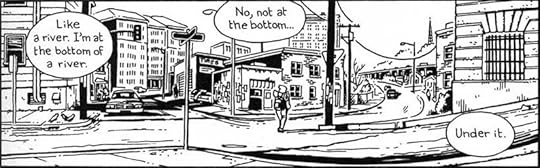
There are several motifs that play through the book, rendered against a crudely effective illustrative depiction of the city, with its unkempt apartments and rotting highway underpasses: electrical transformers and the web of wires radiating from them, birds, rain, and the rain reflected on the faces of sadness. Esther seems a melting phantom in Ernie's vivid alcoholic dreams; and when we see Esther despairing through the rain-soaked glass in her apartment, she seems to be literally melting.
Forgetfulness, memories, dreams, visions and obsessions are played out and developed beautifully in the book. Old Al thinks he sees his dead compadres from vaudeville, and in his confusions mistakes Ernie for his best old magician pal, Eddie.
Jar of Fools has a cast of characters who could have come from Burroughs or Bukowski or Selby; noble urban survivors surrounded by suicide who nonetheless choose the burden of life, in which old vaudevillians and film-flammers are like old cowboys still roaming the range past their prime; rustic characters out of their age, people who know the score but who cling to the last naive belief in the power of magic.
I really enjoyed this book despite the fact that author Lutes ends it in a very cliched cinematic way, with a redemption arc that's more than a little mawkish. Nonetheless, I loved these characters, especially old Al and young Claire, bookends representing a kind of continuity. I found Claire's desire to learn why adults act as they do--as though learning that would be as easy as mastering a magic trick--to be poignant. A wonderful story.
The artistic influences of Jason Lutes' "picture novel," Jar of Fools, are fairly easy to spot. The drawing style is European, with the clean lines of Herge of Tintin fame, while the storyline is contemporary Americana of such short story writers as Raymond Carver. But Lutes is good enough, and his story strong enough, that it transcends being merely a reflection of his study, and the combination of the disparete pair make this graphic novel something unusual among the others on the shelf.
The story is about a troubled young man whose brother was an escape-artist who failed a straitjacket-river trick, whose romance has failed, and whose stage magician mentor is further slipping into Alzheimer's daily. At the same time, his ex-girlfriend is attempting to put her life together. When these lives intersect with a young girl and her con-artist father, magic happens--but not the fantastic type, just the magic of people finally connecting to life.
I hate to simply keep comparing it to other works, but sometimes the mind just works that way. With its magician characters and realistic depiction of street life, it recalled for me Nicholas Christopher's Veronica much more than any previous graphic novel. And while the story was interesting and the art entirely appropriate, the sum of it all still left me with a slightly vauge dissatisfaction, likely due to the somewhat downer ending with its open-ended quality (again, reminiscent of modern short stories, where the end is as much a beginning as anything). It's not going to appeal to action-adventure readers at all, but if you liked Dan Clowes's Ghost World or Will Eisner's "A Contract with God and Other Tenement Stories, you might enjoy this one.
I read Jar of Fools five years ago and I have absolutely no recollection of it, which means that a re-read was necessary.
In a way I can see why I don’t have a strong recollection of this graphic novel, the art is okish, the plot is technically interesting but I felt that it’s an idea which could have been pushed further and after reading the book, I kinda shrugged my shoulders and thought it was an decent read but nothing else.
The plot focuses on a washed out magician who is desperately trying to increase hi audience, however his brother has committed suicide and his ex girlfriend has stopped contacting him and he’s asking help from his mentor, who escapes his retirement home and has orderlies hunting from him.
One day he meets a con man and his daughter and is blackmailed into teaching the daughter magic tricks so that she joins him in swindling people.
Jar of Fools overdoses on pathos and melodrama and sometimes that makes me not care about the characters, which was happening. Also I kind of wanted the story to finish as I had enough of the drama. In fact this sound clip kept going on in my head while reading Jar of Fools.
As said on the whole this comic is ok but it’s rather something one should borrow rather than buy.
A rain-soaked tale of an alcoholic, nearly homeless, brother-haunted, lovelorn magician; his mentor, a fugitive from the retirement home; a confidence man and his young daughter; and the troubled source of the magician's lovelorn-ness; and, of course, the ways they all come together and pull each other back up. Both beautifully drawn and skillfully constructed, as the best graphic novel should be.
My biggest problem with it was that the ending is slightly corny, but that didn't detract too much from how impressed I was with the book as a whole. I can't wait to read Berlin now.
This unusual graphic novel deals with elements of depression, anxiety, loss, heartache, mental illness, suicide, nightmares, failure, and disappointment.
Damn. That was a punch in the face. Pun intended. From the very beginning of the book, you know you're gonna be crushed. You know your heart is going to get ripped out of your chest. But something about the story and art compels you to continue towards the expected pain. It's a phenomenal story. Following a depressing cast of characters. A washed up heartbroken magician. His senile old mentor. His ex who wishes to disappear from the world. A con-man and the con-man's daughter. There's nothing happy or rewarding about this story. You get a few funny glimpses of hope. But it's somber and dark from start to finish. The more you find out about each character, the more you sink down with them. Each character is trying their hardest to keep the one thing in their life that keeps them going. The one thing they still care about. It's fantastic. And the art is masterful. The art reminds me why I fell in love with comics. Requiring a keen eye and attention to the art. Not just the words. There are hints and storylines in the art that you can only get from the art. And so many little details of brilliant cartooning. From panel layouts, to lighting, to just the beautiful moments of foreshadowing. The art is absolutely a master class in cartooning. Anyway this book is unbelievable. I didn't know anything about it going in. Never even heard of the artist before I picked it up. And I was completely blown away. A true must read! Highly highly recommend!
Sometimes the phrase “astonishingly mature” sounds like patronising hooey, but for once I think critics of this have it right. Because it’s really beautifully written and drawn, with enough references to classic books, cinema and art (hey, isn’t that the antique shop from Red Rackham’s Treasure?) to ground it in a certain milieu but enough creativity to surpass merely being pastiche. The magicians/ homelessness aspects give it a certain kind of tone - the former being all about style over content, which especially resonates with Al’s Alzheimer’s where there is increasingly no content at all, and the latter being about a certain kind of rootlessness that sort of flows from a life spent dazzling but rarely considering the smaller details. I was particularly taken by Lutes’ skill at signposting possible future plot lines that he then doesn’t follow on through. It’s that raggedness that I think gives it much of its maturity, because these are not things that get resolution in the real world. It’s definitely the work of someone barrelling their way to something special, but it’s so clever in its own right to be something of a minor classic
Picked this up back in 94-95 and it has haunted me ever since. Growing up on superhero comics, every time I tried the independent stuff, it was all drugs and gonzo artwork. Never my thing. Then i found Jar of Fools and realized how artful a graphic novel can be.
Is it magic or a con? Is it depression or grief? Is there understanding or just acceptance? The answers aren't always clear, but the stories of these people living in the nadir... a drunk stage magician and his aged mentor on the run from the old folks home... the con man and his spunky daughter living under a bridge... a coffee shop, the echoes of suicide and one helluva punch.
Jason Lutes entwines all of these elements into a heartbreaking story of loss and bad decisions and maybe a few hints of redemption. Set in the gritty, pre-digital days of the early '90s, there is a more now than before... an entire world left behind over the past thirty years... an era of recession and desperation and very few choices.
Jar of Fools is a wonderful graphic novel. If you can find a copy, read it.
Another one of those realistic stories that are really heart warming and never fail to get the feels going. The characters all have dark pasts, and presents, and most of their relationships are destructive to say the least, but somehow they still stick together. One is haunted both by a failed romance and death of his brother, one is senile, one is running from the police, one is a conman, and the last is the conman's daughter. They build up an interesting dynamic, and even though there are no mind blowing plot twists it's the attention to minor changes that lead to big developments that make all the difference. It may not actually be true to real life, but it sure feels like it is. Through a unique art style and sincere story Lutes ensures that the reader develops a personal connection to the characters, and when things don't turn out the way we want them to it's sad, yet he still manages to create a satisfying ending by tying up the seemingly loose threads.
This entire review has been hidden because of spoilers.
This story about distinct individuals, all experiencing difficulty in their own unique, troubled ways, and how they come together and disband over the course of short, kind of unspecified period of time feels like a longer short story by Raymond Carver, Richard Ford, or Amy Hempel or a tiny independent film from the early 90s. Much of what occurs is real and feels genuine, with a a dash of the surreal, and a conclusion that makes more sense from a literary perspective than a realistic one, but by then it no longer mattered.
This is a quiet, beautiful, heartbreaking work and can easily be read in one sitting, but may benefit from slower and/or more readings.
„La Berlin am descoperit lumea - lumea cea măreață, neorânduită și frumoasă de dincolo de gardul ce înconjoară căminul burghez al tinereții mele. Câteodată mă sperie - câteodată mă îngrozește - dar tot mă trezesc în fiecare dimineață așteptând ca orașul să mă surprindă. Așa că nu, dragă mamă, nu mă voi întoarce la Koln. Sper să înțelegi. Rămân acolo unde am descoperit iubirea; unde oameni se bat pe stradă, unde simt cum lumea se învârtește sub picioarele mele. Unde pot asculta jazz!”
The art is lovely black and white and terrifically structured. However, in order to create mystery a little too much is sometimes left in the gutters. I felt like there was both too much and not enough story. Don't read the forward first - a curse of mine to want to move from front to back always. I think the forward really increased my expectations. I will allow that I was perhaps a bit tired and not focused enough when I was reading this, so three stars might be a bit harsh. Also, Al totally looked like Ed Asner to me....
An engaging premise - a failing alcoholic magician mourning the death of his escapologist brother and sheltering his mentor on the run from a elderly care facility - but somehow with the addition of an estranged girlfriend, also on the run, and a conman living in a car with his young daughter, the plot lost coherence and ultimately didn’t really resolve any of its issues satisfyingly. That’s true to life I guess, and I applaud the author for his ambition in rendering realism, but it didn’t really hit the mark narratively for me.
My friend found this book on the street and brought it to me because of my known affinity for fools. I think from the street, pages off the spine is the right way to get this book about some down trodden and broken people. Not everything tracks, the end is a little elliptical, but I really liked this story. The characters (a con man, magicians, a plucky daughter) are compelling and in combination with the art really conveys an emotional experience. I wanted these people to be happy.