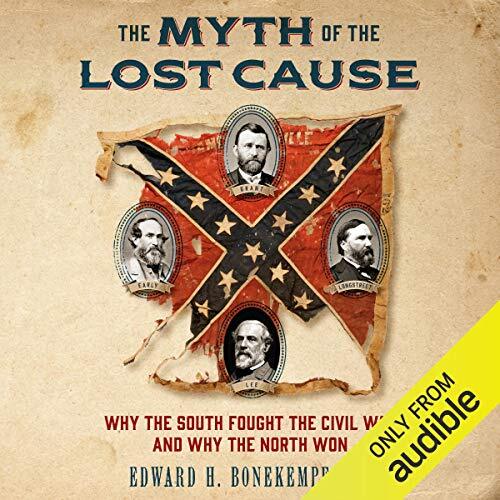
Hi everyone, it’s been almost 4 months since I last read a book; I’ve recently taken time off to find myself in the local goth music scene, so I’ve spent time going to concerts, and also I’ve been interested in politics a great deal. Here is my review for this amazing book.
Next month is going to be April; for most, it’s going to be an ordinary April, but for those of us who are history buffs, this is the 160th anniversary since General Robert E Lee of the confederate army of northern Virginia surrendered to United States lieutenant general Ulysses S Grant at Appomattox Courthouse. We’re still very much living with the consequences of this cataclysmic event known as the American Civil War, socially, politically, and culturally as a people. It’s important that we as human beings seek truth and higher understanding of the world, so it’s important for the historian to present the truth.
For many years, the narrative of the American Civil War was one that was not truth but rather mythology, this mythology is now referred to as the lost cause. Even to this day, there are many who believe in this Lost Cause myth, and I hate to say it, but some of its tenets I believed until very recently. Edward Bonekemper’s book discusses the lost cause, what it was, what are the tenets of it, and explains what the truth is. Each chapter focuses on a specific tenet, and then Bonekemper refutes the said tenet with facts he’s found and presents.
Basically, the Lost Cause believed:
1. Slavery was a dying institution by 1861, and the war was unnecessary. The truth is that it was thriving, and southerners had plans to continue and grow the institution. Bonekemper enlightened me a great deal on this.
2. The southern states seceded not because of slavery but because of states rights. The truth is that all of the southern states in question seceded because of slavery, they didn’t secede because of states rights, but rather, as Bonekemper hammers at, the fact that they didn’t receive enough federal rights to protect slavery and/or retrieve their lost “property” from the states in the north. The south feared the election of Lincoln, because he wasn’t prepared to let them expand their slave empire into new territories. The whole premise of states rights for me is now a farce; the confederate politicians used it post war instead of saying slavery
3. The south couldn’t have won the war; the north was too strong and the south was overwhelmed by numbers. The truth of the matter is that the south could’ve won the war if it had fought defensively. Bonekemper explains that the south had the advantage of fighting a defensive war; all it had to do was not be conquered, whereas the north had to conquer the south. All the south had to do was fight defensively, not invade the north, and use its terrain and vast area of territory to its advantage against the north. Sure, the north had higher numbers of men and was an industrial nation, but if the south had competently fought defensive battles against the Union armies, and shifted troops from various commands to vital points, the north would’ve eventually grown war weary and possibly by 1864, Lincoln might not’ve been reelected and the south may have won the war.
4. Robert E Lee was the greatest general of all time. Basically, there’s this mythos around Lee, that basically makes him into being some heroic, Christlike figure. I have to admit, for a long time I’ve held Lee is a high regard, and yet after reading this book, I don’t think I can say that anymore. The truth is that Lee was a poor general. Lee lacked the understanding of advances in modern weaponry, which gave the advantage to defense. Lee held onto the Napoleonic idea of a grand army fighting a decisive battle or campaign against another army, and one decisive battle would lead to victory in the war. Not just this, but Lee was very haphazard in regards to how he used Frontal assaults against his opponents at places like Seven Days, Malvern Hill, Antietam (counter-attacks), Chancellorsville, Gettysburg, the wilderness, and Fort Stedman. Lee was poor in terms of giving commands, and coordination of his troops, we see this at Gettysburg and at the Seven Days Battles. Lee did not use his staff effectively, they were more like clerks. Lee was a myopic, one theatre general, who didn’t see the bigger picture of the war. This point about Lee, I’ve always believed; he was Virginia-centric, several times he was offered command in the west, several times he was asked to reinforce other armies in Tennessee, Georgia and Mississippi, but each time he refused and therefore led to the defeat of the Confederacy. The most important point is that Lee as a command was a disaster for the confederacy. His way of waging war was inconsistent with the points I made in point number 3. He didn’t use his army defensively, and he instead waged an aggressive war, which caused him to incur heavy casualties on his army. Those casualties were experienced, and brave men, who could’ve been used efficiently.
5. Longstreet is to blame for the loss of Gettysburg, which lost causers believe is the battle that determined the loss of the war. The truth is that Longstreet was a scapegoat for the lost cause myth makers, because he was not a Virginian, and he was against Lee’s decision to invade the north again, and fight an aggressive battle that day. Longstreet didn’t delay, Longstreet followed his orders. The real blame could be laid at the feet of Jubal Early, Richard Ewell, JEB Stuart, and Robert E Lee, all of whom made umpteenth mistakes here, but certainly not Longstreet. While Gettysburg was an important battle, the real turning point was in Vicksburg and out in Tullahoma.
6. The lost cause claims that Ulysses S Grant was a “butcher”, who only won by brute force and was not as skilled at all. This is a very fictitious argument. Grant did not incur more casualties than Lee did. Bonekemper shows that based on numbers calculated, Grant was efficient with his troops whereas Lee incurred heavy casualties that were irreplaceable. Grant as a general was truly the best of the war, right next to George Thomas in my opinion. Grants greatest campaign at Vicksburg saw him use a winning formula in a Napoleonic vein: deception, Maximum use of numbers, maneuver, defeat in detail against a numerically superior force, and relentless adhesion to his foes. The five major battles of his Vicksburg campaign leading up to the siege are all examples of a general who is skilled in the art of warfare. Grant used his staff efficiently, Grant was a master of terrain, he could visualize very well, and he was not afraid or uncertain. Grant stood on high stead with Lincoln, and realized the need to keep him in his good graces. Grant realized that logistically, he had to forage off the land, and did so effectively. Grant wasn’t afraid of the fog of war; he of course would want to know the numbers he was facing against, but he never let it stop him from doing the job. (What I love about Grant is this dogged relentless determination, his adhesion, and his confidence, it inspires me in my life as a human being.) When it comes to the Overland campaign, Grant used his army effectively; he knew he had to remain adhesively to Lee’s army, he had to continually engage him and maneuver him, which he did all the way to Petersburg and eventually to Appomattox in 1865. One other trait is that Grant wasn’t just a one theatre general; Grant saw the need to attack the Confederacy at multiple points at multiple times. For example, while Grant was in Virginia, Sherman was fighting Johnston in Georgia, Benjamin Butler was fighting Beauregard at Bermuda Hundred, Phil Sheridan was facing Jubal Early in the Shendoah Valley, and the Union navy was taking Mobile and the army was attacking fort fisher. With all of these points being attacked simultaneously, the south was paralyzed and couldn’t help itself. Grants strategy guaranteed Lincoln his re-election in 1864 and guaranteed the south’s defeat in 1865.
7. The last point made by the lost cause myth is that the North made total war against the south and committed war against the civilian population. The truth is that the north did not do any of these things. In the beginning of the war, the Lincoln administration had a very moderate approach to everything, so there was no foraging, no war crimes, and abolition of slavery wasn’t even in practice yet, but in 1862, after Shiloh, after the peninsula, second Manassas, and Antietam campaigns, Lincoln and others realized this war was going to need to be a war fought hard. This meant that slavery would have to end, free blacks would be recruited in the army and fight against the confederacy; the northern armies would have to forage liberally in the south, and most importantly, the north had to defeat southern armies and force their surrender. It wasn’t about taking Richmond, or really Vicksburg, but destroying every southern army in the field and making the war so difficult that southerners would not want to fight it anymore. Grant and Sherman knew this and they executed the idea with the utmost determination, But when they did, there was no condoning of war crimes, no support for rapine or violence against civilians. In fact, the only times such war crimes were happening was out in Kansas, Missouri and Arkansas, where confederate guerillas like Bloody Bill Anderson, and William Quantrills raiders were burning towns, and killing innocents. Oh, and you can’t forget Nathan Bedford Forrest and his deliberate murder of an entire garrison of black troops at Fort Pillow in 1864. To sum up, no southern city experienced a Dresden, or a Hiroshima, and no northern army was as vicious as the Wehrmacht or Genghis Khan, but the confederates had no problem in many instances committing vile acts. On a side note, from my own perspective and research, it wasn’t all one sided in Kansas-Missouri, as Union raiders did retaliate.
Thinking about this book, thinking about my summarization of it all, and giving some final thought to it all, I think it is a masterpiece. I love it when Historians come forth and challenge an old narrative and ask questions, and present efficient and effective arguments and evidence for their views. For me, this is an eye opener and a reckoning for myself. As someone whose ancestors were on both sides of the war, I’ve had a mixed feeling about it all; I’ve always tried to give the confederate side a little sympathy, specifically the soldiers and generals, because from all the books I’ve read before this , they seemed to not fight for slavery but rather for their homes, their families, and worried they would lose these things. I think now that my confederate ancestors were good soldiers, brave, but they were conned into fighting for a racist and Slave holding government that deserves no respect from me anymore. I think it’s time the confederate monuments go, and I think it’s time we start looking at the war for what it was, a war to save the Union and end slavery. Slavery is a sin which will haunt this nation forever, but we must seek to love one another, work together and stop all of this fighting. We may not heal the wound, but we can salve it.