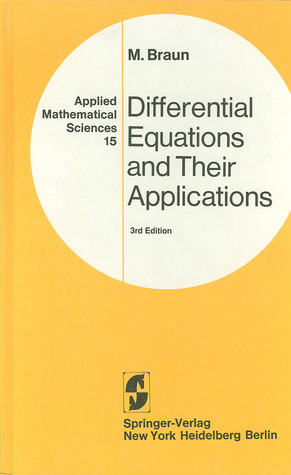
There are three major changes in the Third Edition of Differential Equations and Their Applications. First, we have completely rewritten the section on singular solutions of differential equations. A new section, 2.8.1, dealing with Euler equations has been added, and this section is used to motivate a greatly expanded treatment of singular equations in sections 2.8.2 and 2.8.3. Our second major change is the addition of a new section, 4.9, dealing with bifurcation theory, a subject of much current interest. We felt it desirable to give the reader a brief but nontrivial introduction to this important topic. Our third major change is in Section 2.6, where we have switched to the metric system of units. This change was requested by many of our readers. In addition to the above changes, we have updated the material on population models, and have revised the exercises in this section. Minor editorial changes have also been made throughout the text. New York City Martin Braun Nooember, 1982 Preface to the First Edition This textbook is a unique blend of the theory of differential equations and their exciting application to "real world" problems. First, and foremost, it is a rigorous study of ordinary differential equations and can be fully understood by anyone who has completed one year of calculus. However, in addition to the traditional applications, it also contains many exciting "real life" problems. These applications are completely self contained.
Braun’s classic text is noteworthy for its combination of rigorous pure mathematical formalism and real-world applications. The mathematical underpinnings of the Tacoma Narrows Bridge collapse, international conflict, syphilis outbreaks, and the propagation of waves are carefully derived and proved. The preponderance formal definitions, lemmas, and theorems do not prevent the interested non-specialist from understanding the models, however, because their qualitative descriptions are clearly presented in plain English prose.
This probably isn’t the best book to self study the math of differential equations—especially if you haven’t completed upper-division real analysis coursework. But Differential Equations and Their Applications is a sterling example of why you would want to complete such a course of study: Braun’s magnum opus leaves little doubt that the Book of Nature is indeed written in the language of diff EQs.