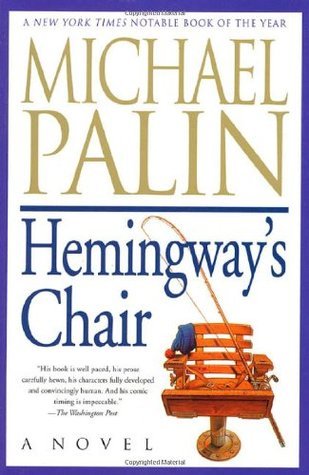
Martin Sproale is an assistant postmaster obsessed with Ernest Hemingway. Martin lives in a small English village, where he studies his hero and putters about harmlessly--until an ambitious outsider, Nick Marshall, is appointed postmaster instead of Martin. Slick and self-assured, Nick steals Martin's girlfriend and decides to modernize the friendly local office by firing dedicated but elderly employees and privatizing the business. Suddenly, gentle Martin is faced with a choice: meedly accept defeat as he always has, or fight for what he believes in, as his hero, Hemingway, would. Filled with Michael Palin's trademark wit and good humor, this novel is for anyone who has ever dreamed of triumphing over the technocrats and backstabbers of the world. Hilarious, touching, and ultimately inspirational, Hemingway's Chair will make readers stand up and cheer.
Sir Michael Edward Palin, KCMG, CBE, FRGS is an English comedian, actor, writer and television presenter best known for being one of the members of the comedy group Monty Python and for his travel documentaries.
Palin wrote most of his material with Terry Jones. Before Monty Python, they had worked on other shows such as The Ken Dodd Show, The Frost Report and Do Not Adjust Your Set. Palin appeared in some of the most famous Python sketches, including "The Dead Parrot", "The Lumberjack Song", "The Spanish Inquisition" and "Spam". Palin continued to work with Jones, co-writing Ripping Yarns. He has also appeared in several films directed by fellow Python Terry Gilliam and made notable appearances in other films such as A Fish Called Wanda, for which he won the BAFTA Award for Best Actor in a Supporting Role. In a 2005 poll to find The Comedian's Comedian, he was voted the 30th favourite by fellow comedians and comedy insiders.
After Python, he began a new career as a travel writer. His journeys have taken him across the world, the North and South Poles, the Sahara desert, the Himalayas and most recently, Eastern Europe. In 2000 Palin became a Commander of the Order of the British Empire (CBE) for his services to television.
I love Michael Palin's travelogues,and his sense of humour.I was,therefore,interested to read his first novel,Hemingway's Chair.Palin has a Hemingway obsession,which led him to write the travelogue,Michael Palin's Hemingway Adventure.In that one,he visited all the places around the world,where Hemingway lived and worked.But this time,he tries to bring Hemingway,somehow into this novel.It doesn't work. The only thing exceptional about the protagonist is his obsession with Hemingway.Martin Sporale is an assistant post master,who lives a straightforward life.Then his organization becomes subjected to privatization plans,and he plots the ultimate Hemingwayesque act of revenge. A pretty dull,and disappointing book.Palin's humour is nowhere to be seen.He should stick to travelogues.
Take one small English town, add pubs with much gossip, a seaside location, a tad of sex, a large helping of Hemingway, and an average man who wants to save the town's old post office. Give yourself an afternoon or two, dress your hot tea with a nip (or so) of your favorite addition, and enjoy! I kept waiting for Jane or Hercule or Hamish to appear, but alas, it's Hemingway's fishing chair that ultimately saves the day. A nice, comfortable read.
I really wanted to love this book. I am huge Michael Palin fan. When I look back at almost all of my favorite Python skits, he is almost always in them. I also enjoyed the first volume of his memoirs. But here...the story started out well enough but things were not well flushed out meaning I wanted more background on some of the characters and, at times, things felt like they jumped around but it moved along smoothly for the first two acts. It was the third act which hurt the book in my view. The wrap up felt very rushed. The story was building and building and then it was wrapped up in a way that left me feeling meh.
I've read this book about once a year since I bought it when it came out about 12 years ago. I consider it part of my Hemingway collection and keep it on my shelves with Papa's works.
It is about a meek man finding his worth and his strength to live the life he always dreamed about.
At first he studies Hemingway as a way to escape his terribly boring life as a postal worker in a small town in England. He gathers old items that are similar to what Papa used, like a typewriter that is almost like Papa's, and a medical cabinet like those used when Hemingway was in WW1 that he fills with the kind of drinks that Hemingway drank instead of medical supplies. He even has a life sized poster of Papa filling most of one wall in his bedroom.
He sits in his room after work and drinks from the cabinet and sometimes writes his own journal on the typewriter.
One day his life changes and his job and his chosen life is threatened. Then he gets an opportunity to purchase a one legged chair that Hemingway actually used for two months to fish for marlin in the ocean. He buys the chair and it transforms him little by little into how he envisions Hemingway would be. It gives him strength to fight for what he wants at his job and with a woman he has recently met. After a time he leaves trying to be Hemingway but keeps the qualities he admires in Papa and makes them his own.
I love watching the transformation. I love seeing him go from a doormat into a strong and slightly crazy man of his own choosing. I love watching the people around him being forced to adjust to the new man. He looses some relationships but gains other better ones.
By the end of the book he causes disruption for the people who disrupted his life at the beginning. He takes what he wants from the takers.
I love stories where people find their own strengths and become full and vibrant people. This story exemplifies that perfectly.
Hemingway's Chair was the New York Times Notable Book of the Year in 1998. Ten years hence, I saw the book at a knocked-down price, and considering that I am a fan of New York Times' recommendations, the book moved through the sale, and on to my bedside table faster than Hemingway could write.
Hilarious at times, the book has a dry British humor, a play on words, and oddly lovable characters. All except one. The hero of the book, the main character, Martin Sproale. Engaging at first, there is something about the ordinary in him, and I don't mean to criticize that. He is meant to be Everyman. With his own strange quirk - his love and adoration for Hemingway. Martin is devoted to his post office, but is just as susceptible to the odd greediness as any of us. His life begins to unravel when young, unscrupulous Nick Marshall is appointed Manager denying Martin what was rightfully his. Nick is all for modernizing the post office, and that means an end to tradition as we know. Righto. The story was interesting till now, and would have continued to be so if it had stuck to its plot.
But no. Suddenly, there is a bizarre sub-element -Nick, surprise surprise, is two-timing the post office, and in some complicated way is out to implement a networking system that will revolutionize the world. In the middle we have Ruth, an American novelist who is writing a book on Hemingway's women, flashing the proverbial apple to poor Martin in the form of Hemingway's chair up for sale. It costs a 1000 quid, and Martin has not the money. So what does he do? Well, he falls in with Nick. The old post office goes. The new one comes up. Martin takes up the cause of getting back the post office, and loses his girlfriend to Nick, gains another one in Ruth, loses his mental balance completely, and somehow apparently obtains his revenge...or does he?
The language is superb, but the plot is a bit too thin. I could not understand why not one, but two women would fall in love with Martin, who is not I assure, you, likely to capture your imagination. I mean, he walks around talking of "Papa" (Hemingway), collects Papa's knick knacks, and lives more in Papa's world than this own and I am not sure that is fact enough to love him. In the end, I was a tad disappointed. For a novel that started so well, it unfortunately didn't quite have Hemingway's own characteristic punch in the end.
1: 4 Extra Debut. Assistant postmaster Martin conceals a secret all-consuming passion for the words of Papa. Written and read by Michael Palin. 2: Assistant postmaster Martin conceals a secret all-consuming passion for the words of Papa 3: As pressure mounts at work, Martin finds himself being challenged in his private life, too 4: Martin finds himself drawn more and more to Ruth, but Elaine has some curt words for him. 5: Nick continues to make his clandestine plans for the Post Office, and Elaine isn't happy. 6: Nick has an offer for Martin, but will he take it? If so, what will it mean for him and Ruth? 7: Martin finally stirs into action, but has Nick been ahead of him all along? Where is Elaine? 8: Martin succumbs more and more to the power of the chair, but soon gets his comeuppance. 9: Martin's drunken antics lead him into a field of bulls, and Ruth starts to worry about him 10: Martin returns to the Post Office, seeking Geraldine. Meanwhile Nick anticipates a big day
Good enough for a 2* Much prefer his travel writing. Hasn't he the most adorable face! So soft and trustworthy.
This was neither a terrible book nor a great book, but somewhere right in the middle, and I'm totally okay with that. I picked it up because I was curious to know what former Python Michael Palin's fiction was like, and though there is definitely quite a bit of humor in it, "Hemingway's Chair" is not quite as zany or side-splittingly funny as some of Palin's Monty Python sketches. That's not necessarily a bad thing, though.
Martin Sproale lives a dull life as assistant postmaster in the small, quiet English town of Theston. He has two pleasures in life: his job, which he takes pride in, and his obsession with Earnest Hemingway, which has resulted in a collection of Hemingway artifacts and replicas. Martin expects to be promoted to head postmaster when the current one retires; however, when the time comes, Martin is passed over in favor of an outsider, Nick Marshall. Nick makes sweeping changes to the Theston post office that force Martin to take action - as a Hemingway hero would - and defend his town.
Though not an outstanding book, this is a nice one to pick up if you're looking for something light and quick to read. My only real disappointment was with the ending, which felt a little rushed and anticlimactic. I also felt that, as someone who hasn't read much Hemingway, I probably missed out on most of the references and inside jokes aimed at Hemingway fans. With that being said, this is still an enjoyable book regardless of how much or little Hemingway you've read.
Martin Sproale ist ein unauffälliger Typ Mitte 30, der noch bei seiner Mutter wohnt, auf dem lokalen Postamt arbeitet und dort eine etwas holprige Romanze mit einer Mitarbeiterin am Laufen hat. Nun steht der Rentenantritt seines Chefs an und Martin rechnet sich gute Chancen aus, die Leitungsfunktion zu übernehmen. Doch statt einer Beförderung sieht er sich mit einem jung-dynamischen Managertypen konfrontiert, der das gemütlich-verschlafene Postamt ins 21. Jahrhundert katapultieren soll.
Und noch etwas erregt seine Aufmerksamkeit: eine Amerikanerin, die sich für ihre Arbeit an einem Buch über Ernest Hemingway nach Theston zurückgezogen hat. Denn Martin hegt eine grenzenlose Leidenschaft für alles, was mit Ernest Hemingway zu tun hat. Er ist nicht nur Fan seiner Bücher, sondern hat in seiner Wohnung eine Hemingway-Gedenkecke eingerichtet mit Bildern und diversen Gegenständen, die mit dem großen Meister zu tun haben. Sollte er in Ruth tatsächlich eine Gleichgesinnte gefunden haben? Zumindest ist sie es, die ihm erfolgreich den Floh ins Ohr setzt, für teures Geld einen Angelstuhl zu erwerben, auf dem einst "Papa" Hemingway höchstpersönlich gesessen haben soll.
Bei Palin, auch bekannt als Mitglied der Monty-Python-Truppe, hatte ich ein Gagfeuerwerk mit hoher Witze-Schlagzahl erwartet. Bekommen habe ich aber zunächst ein eher ruhiges, aber durchaus ironisch-witzig geschriebenes Kleinstadtpanorama mit diversen skurrilen Persönlichkeiten. Palin ist ein ausgezeichneter Beobachter und nimmt mit herrlich spitzer Feder die Privatisierungswelle der 90er Jahre aufs Korn, die bei der Umgestaltung des liebenswert altmodischen Postamts von Theston zum hochmodernen Postdienstleister besonders üble Blüten treibt. Da ist am Ende im wahrsten Sinne des Wortes kein Stein mehr auf dem anderen.
Der eigentlich zurückhaltende Martin selbst channelt mehr und mehr seinen inneren Hemingway beim Versuch, von seiner geordneten alten Welt zu retten, was zu retten ist, was sich größtenteils amüsant liest, am Ende aber doch ein bisschen arg überdreht auf mich gewirkt hat. Auch wenn die Schlusspointe zugebenermaßen ein ziemlicher, schön böser Knaller ist. Das letzte Viertel war mir insgesamt ein bisschen zu überspitzt, aber bis dahin habe ich mich ausgesprochen gut unterhalten und mochte auch den kleinen Nostalgiefaktor, der mich selbst an unser Dorfpostamt von früher erinnert hat.
HEMINGWAY'S CHAIR by Michael Palin is a 1998 book that is hard to get into but manages to steal you away in the second half. Martin Sproale has worked at the Theston post office for the past 16 years but now, just on the brink of a promotion to postmaster, he finds himself passed over in favor of an aggressive outsider. Martin is a pale man, interested in all things Hemingway, and has a slight passion for his co-worker, Elaine. But with the new manager, things change, and not for the better. Modernization is the name of the new game, much to the displeasure to both the workers and the residents of this small British town. Clerk after clerk are let go or retired early, computers and security screens appear like omens of evil, and the new boss tries to manipulate Martin into doing the dirty work for him. Into this turmoil appears Ruth, an American working on a book about Hemingway. Together she and Martin start a low-keyed relationship. But as things get more dire at the P.O., Martin finds himself falling back on a "What would Papa do?" mantra to get him along the path. In this, his first outing as a novelist, Mr. Palin has played the entire affair in a very low keyed manner. Fully the first half of the novel is a depiction of quiet English countryside living and the eccentrics that visit the P.O. all too often. The second half of the story perks up and you may find yourself rooting for this unassuming man who wants nothing more than to continue his quiet life and hero-worship Papa in his own way. But all good things must come to an end, which is the hard lesson Martin must learn.
3.5 out of 5 stars. Palin makes his readers fall in love with this community. Although the overall story isn't especially clever or imaginative, it's light and inviting and charmingly humourous. Be forewarned it does take a bit of a darker humoured turn toward the end. This book is best described as a comfort read. It's exactly perfect for a rainy afternoon, cozy under the covers with a hot cup of tea.
Read this book years ago, when it first came out, and remember that I didn't like it QUITE as much as I had hoped. Decided to re-read -- and came to same conclusion. Good story, started out well, but just got weirder and kind of disappointing. But overall, would recommend. Michael Palin wrote another novel later on ("The Truth" in 2013) that I liked much, much better.
I’m a Python fan, and I liked Michael Palin’s diary from his Around the World in 80 Days: Companion to the PBS Series program, but I hesitated to try this one – partly for fear of disappointment, and partly because the book-jacket synopsis didn’t sound like the kind of thing I normally read: mild-mannered, loyal post-office employee and Hemingway fanboy Martin Sproale has his life upended when new manager Nick Marshall shows up to modernize the old post office. But I gave it a try. And the good news is at least it wasn’t what I expected. On the other hand, I’m not sure to make of what I got.
To be sure, Palin is a good writer (although he goes a little overboard on description, and there’s at least one key continuity error in the plot, unless I missed something) and the pages move quickly for a story about a post office in small-town Britain. But it’s not full-on comedy, but rather a wry and sometimes surreal satire about the modernization of traditional institutions at the community level, and I suppose a satire of hero worship, warning that our pop culture heroes are often poor role models. Indeed, Martin’s Hemingway obsession grow stronger as Marshall executes his nefarious plan, and when Martin meets American Hemingway scholar Ruth (who is in town writing a book about Hemingway’s women), he undergoes a rather disturbing transformation that ultimately leads to a plan to get revenge on Marshall.
I think this is where the book loses me – the more Martin starts to emulate his hero, the less likeable he becomes, especially regarding the way he treats women. Maybe that’s part of the satire as well – Hemingway’s treatment of women was misogynist yet complicated, a theme that Palin explores via Ruth’s research for her book. I don't know – maybe you have to like Hemingway (which I don’t) to appreciate what Palin is doing here. And mind you, Palin pulls off the character and the transformation rather well. Anyway, it’s not a bad novel, but it’s a strikingly bleak one.
It is a strange book. The idea of bringing together British postal system and Hemingway is ingenious. However, at the same time, the effort feels somewhat belaboured. The characterisation of a small English town is superb, but the protagonist and some of the main side characters are quite one dimensional. The crescendo of the book (taking place just a couple of pages before the end) is quite spectacular, but the book itself should maybe have ended fifty pages beforehand. So, all in all, it is a quick read and hard to put down, but at the same time it leaves you feeling somewhat empty. I do, however, wish to pick up something by Hemingway next :)
I really enjoyed this book. I must admit I did pick it up because of Palin being one of the founders of Monty Python. I also have always been intrigued by Hemingway. It took me a while to actually start it but once I did I was captured by the characters and their little town. A most enjoyable read - with a cup of tea in the garden.
I read this 1999 novel shortly after it came out and found it quite delightful. Who could fail to be enamoured of its protagonist: an assistant postmaster who is rather set in his quiet, unobtrusive ways, but is then challenged both professionally and romantically by an ambitious outsider who not only disrupts his placid workplace environment but also his relationship with his girlfriend? Cue the heroic impulse garnered via the embodiment of macho in the titular writer whose subjects included about boxing and bullfighting. And more specifically, the chair on which he used to be strapped in while deep sea fishing in the West Indies. One almost gets the feeling from the Monty Python sketch: ‘Arthur Pewty: Are you a man or a mouse?!?!’
Palin is nothing is not witty and his dry humour frequently rises to the fore in this work of deft characterization and quite intricate plot construction. But it is in the underlying sense of social justice that I found the greatest degree of emotional resonance in reading of his protagonist’s erstwhile efforts to write what he feels to be unconscionable wrongs.
An enjoyable foray into a small town post office and it's changes when one manager leaves and a new and completely different one is assigned to take his place. Some pretty off-the-wall changes begin to shake up this close knit group, who prefer its family-friendly feel. Also central to the story is one employee's obsession with the importance of being the author Ernest Hemingway. Not wanting to give away just how these two points contribute to the story, I'll just say they're important and leave it there. Palin is a delightful writer, willing for his debut novel to go out on a limb, just a bit not far enough to hit the mark dead center in aiming for the truly compelling novel this could have been. That said, it was an engaging & funny, 1st effort, capable of keep my interest and enjoyment through to the very end. Most importantly, I can't help but associate Mr Palin with his many precocious and priceless moments as a member of Monty Python, and the years of snort-laughing he and the other Pythons subjected me to. I even have every episode for eternity on DVD. And most of the movies also. The point is, though 'Chair' may not have reached the levels of Palin's previous works (a seriously sky-high standard to meet in a brand NEW medium; think Literature; writing about Papa! I, for one am willing to give this incarnation of his talent some space to grow. After all, his resume reads like a menu in an exotic restaurant! The 2nd novel by Palin was released a short while back, and this one sounds really very exotic. It's called "The Truth," I think I'll be sure to give it a try, and a open mind!
A NOTE: IMO, those who will appreciate "Hemingway's Chair" most include the following: Anglophiles; Python Devotees; Palin's Silver Fox Club Members (all chapters) and last but not least Hemingway Fans & Devotees throughout the whole planet. A 2nd NOTE: Please take the above information in the spirit intended: to sound plausible, while being WHOLLY UNTRUE. To those still crazy enough to pursue any of the above for any reason, this writer disavows any responsibility, but would love to hear any extremely interesting tales or adventures!
Reading this book was like putting on a comfy sweater. One of those thick, woolen turtlenecks Hemingway wore. It was very natural and very comfortable (for both good and bad). Of course, Michael Palin is my favorite Python (or tied with the late Graham Chapman) and I've watched his travel programs and some of his memoirs before too, so it was likely that I was going to get around to reading his novel. Then when I learned it was about a mild mannered Mr. Pither-esque mailman who is obsessed with Ernest Hemingway, I couldn't wait to get through it.
Once again, for good or bad, it is a very easy read. It kind of just sucks you in, which really is a feat, considering it's about the politics of privatization in a small town in post-Thatcher Britain. However, the characters are largely interesting and well developed and there's much subtle humor and Palin's humanist touch behind it all. I would only say I gave this book four stars instead of five was because it's not really a "great" book. It won't change your life. It was a fun read that really took not much longer than watching a movie. For Hemingway or Palin fans, certainly worth checking out.
This novel is one of those surprising pieces of fiction that when you start reading the story you assume you know where this is going; but you would be wrong. A small boring British town with a small boring man at the center of an unassuming story. This is a smart and feeling novel about a permanent wimp discovering he can channel his own macho bad ass Ernest Hemingway. There is a great host of support characters. You don't have to be a Ernest Hemingway fan to like this book, in fact the one American in the story, writing her thesis on Hemingway kinda loves to hate Hemingway. Some back round knowledge on "Papa" {Hemingway's self-given nick name in his later years} would be helpful I believe since Hemingway himself is a character in this book. This novel succeeding to be both quaint small town and psychologically insightful. Great, surprising, satisfying end. The author does a great job to purposely leave the big question of who REALLY was Hemingway {and all the women he slept with} dangling because despite how many biographies are written about him, we will never really know. Five stars!
It's taken just six and half years to get around to reading this. For some reason I kept putting it off when I went hunting in my stacks for the next bedtime book, but about a week or two ago I saw it and was interested enough to give it a go. I found it strangely absorbing. Strangely, because it is about a small town with people living small lives (including the principle character who, ironically, harbours a secret fascination with Ernest Hemmingway and with it a Hemmingway-like feeling of superiority over others - although unlike the famous author his is well hidden). Events unfold in a small-town way and yet are oddly compelling. By the mid-point I was genuinely curious to know how it was all going to work out; three-quarters of the way through I realised I wasn't going to know until the very end. And that makes this a really good book. Palin captures the characters brilliantly and adds touches of pure genius along the way. I found the end surprising and not quite right but I won't spoil it for you. A thoroughly good read.
An enjoyable book but not riveting. Wonderful character development, not surprisingly from the lovable Palin. It was fun checking out Suffolk on google maps and trying to figure out where the (I presume) fictional town of Theston is. It was easy to imagine the main street with the post office in the old building, the miserable(?) weather, and the cottage where Martin lived with his mother out on the coast. I felt Martin's growing frustration and disgust as the story unfolded, and enjoyed his transformation, but I was a bit frustrated with not being let in on the final plot for revenge until the last few pages, mind you, it was well worth it!
Michael Palin attempts an homage of the master in a story where Hemingway's presence figures prominently in main character's life. Obsessed with Ernest Hemingway, Martin Sproale sacrifices all to sit in his fishing chair and form himself into an adventure of which the Nobel Laureate would be proud. He's a assistant postmaster in a small coastal town and his unsatisfying work life is filled with backstabbing, deceit, and manipulation and all he wants is to handle all relationships straight-forward and honest, like a man, like Hemingway would have.
The book kind of bogs down in the homage, but the ending is pure heroism.
An amusing, light read. If you are expecting irreverent Python humor, this book is far more tongue-in-cheek. There are a few amusing descriptions, but the main focus is on the main character's obsession with Ernest Hemingway and how that affects his life--especially when another enthusiast comes rolling in. It's probably a lot more interesting if you can directly relate to it; if you can recall a time where the love of a single person made up this large, yet secret part of your life, like when you were a teenager crushing on a celebrity, or if you have someone in your life that you deeply respect but fear that others may judge you for where your respect is placed.
The word that first comes to mind to describe this book is pleasant. I did not find it spectacular, but there is a certain effortless humour (since they are British) to the characters. This is hardly surprising considering the author was a Monty Python member. The protagonist in this book, Martin Sproale, often reminded me of Palin characters in various Python roles. Perhaps it was the name and the office setting of parts of the book, but I always pictured Sproale as Martin Freeman of The Office and The Hobbit fame. The ending was a little abrupt for my tastes, but all and all a nice read.
I read this during a stay in hospital and I found it to be a lovely comforting read and although I wasn't exactly blown away by it, it was easy to sink into. While this story about the mild mannered village post office worker who harbours an obsession with Hemingway wasn't at all life altering as such, I could argue that- for me- in 1 particular way, it was absolutely quite life altering as it directly introduced me to Hemingway. Immediately after reading this book, and because of this book, I read Hemingway's 'Garden of Eden' and my love affair was born. My entire Hemingway journey started entirely because of this book and for that, I will always be glad of it.
An enjoyable, light-hearted read. Palin captures the essence of the English mindset in his spectrum of characters from the "down on his heels" Lord of the Manor who buys his suit from a second hand stall to the Postal clerks eating frozen TV dinners in front of the telly for their date night. I couldn't help but wonder if his writing for the screen (big and small) affected the way he wrote this book. It seemed like it would lend itself to a comedy movie along the lines of "A Fish Called Wanda" - which is one of my favorite comedies.
Kind of an average book. Not to overly exciting, not bad either. I liked a lot of Palin's non-fiction so I thought I would give this a try.
It is about Martin, a guy who has worked in a small town post office in England, and what happens to this meek mild mannered man when a new boss comes in and starts changing things. Martin only seems to live for two things, his post office and his strong admiration for Hemingway.
It was an easy fast read, but I didn't feel like it was the best book I could be reading as I made my way through it.
It's not what I expected from Michael Palin. It's not particularly funny although it has it's ironic and satiric moments. I found it particularly poignant as it is about the privatization and change in the British post office and we are fighting cuts in service in Fulford's post office at the moment. The unifying theme is the protagonist's obsession with Ernest Hemingway and I expect I missed some allusions as I am not very well informed about his life, but there is enough explanation to make it credible. The style is easy to read and I enjoyed it.
Michael Palin can almost do no wrong, especially when it comes to comedy, acting, and travel writing; and in many ways this novel is a decent addition to his long and impressive resume, but it does not reach the level of enjoyment I have experienced from his other offerings. It is not bad by any measure, but just not as quirky or funny as I was expecting it to be, possibly an unfair expectation. I thought it would be more witty, but it is a nice domestic tale of obsession. He did an impressive bit of research in crafting the main character's love for Hemingway.