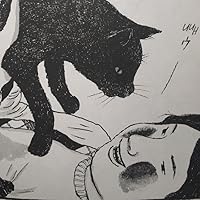
Caza, the pseudonym for Philippe Cazamayou, is a French comics artist. Caza began to publish work in Pilote magazine, starting with his series Quand les costumes avaient des dents (When Costumes had Teeth) in 1971, followed by other short work. The series of stories Scènes de la vie de banlieue (Scenes of Suburban Life) was published in 1975, followed by the L'Âge d'Ombre stories, Les Habitants du crépuscule and Les Remparts de la nuit. With the emergence of the magazine Métal Hurlant in 1975, Caza began to supply work within the science-fiction genre, with titles such as Sanguine, L'oiseau poussière, initially working with an exhaustive black and white dot technique. This was later abandoned for a style of colour use which would become a trademark, as seen in later work such as Arkhê, Chimères and Laïlah.
Oh la la mais j'ai encore plus un coup de cœur pour cette BD, j'adore la tournure space opera que ça a pris et qui colle trop bien au rythme et aux graphismes (la compo, les contrastes... mais quel régal), des personnages toujours plus attachants et puis l'action, ce gros cliffhanger... je vais pas m'en remettre!!
A collection of the odds and ends of Caza's works, most of which has been published in the likes of Métal hurlant (and reprinted in Heavy Metal). As an avid reader of the magazine in my younger days, it was artists like Caza, Claveloux and Dionnet that stood out to me more than the more legendary cartoonists like Mœbius or Druillet. Caza's work in particular stood out to me due to their vivid detail that seemed to reach the heights of classical Renaissance artists but repackaged in the gonzo sensibilities of Métal hurlant and '70s bande dessinée. Though Arkhê is missing strong narrative driven comics, it's the gorgeous compositions, both painted and drawn, that makes this an enjoyable experience. Caza is one of the best to have graced the pages of Métal hurlant, so fans of his will definitely enjoy this repackaged collection of his works.
Now I did not expect to find this on Kindle Unlimited, republished in digital format some forty years after the original print run!
Caza’s extraordinary work exemplifies the sudden liberation of graphic artists in the early 1970s, when anything and everything became publishable in France. These short stories are amazing in their visual detail - Caza long was the go-to cover illustrator for sci-fi novels in French - and notable by their treatment of sexuality, religion, spirituality, and sheer wildness of imagination.
I had originally come across his work as a child, decades ago, in various magazines and collections, but never quite understood it. Rereading as an adult is an interesting experience, especially knowing the context, but this is not a book I’d reread again. It relies primarily on first impressions, on an emotional response to the graphic exuberance, as illustrations do. However, there is no story to return to and interest quickly wanes.
El dibujo es fantástico. El guion, allí donde existe, no demasiado. La obsesión del autor con los coños y las tetas resulta un poco preocupante, pero bueno, supongo que era la época.
My first (very clumsy and Google translate powered) read of a book in another language. Wow! Caza's art is breathtaking and the stories feel like Tarantino teaching Sunday school.