

What do you think?

Cyrus #2
The King and the Slave
Ten years after the fall of Babylon, Cyrus's army is on the march again. His slave Croesus, no longer a young man, accompanies him as always, as does the king's son and heir Cambyses, who has inherited none of his father's diplomacy or charisma and all of his vanity and violence. When the warriors of Persia are unexpectedly crushed in battle Cyrus is put to death, and Cambyses assumes the throne. Croesus, once a king himself, is called upon to guide the young man; but the young man cannot be guided, and after taking offense at an insult by an Egyptian ruler, Cambyses takes the full force of his father's empire to Africa for vengeance.
288 pages, Paperback
First published September 4, 2014
About the author
Tim Leach
13 books67 followersWriter, climber, whisky drinker, chess dabbler and general purpose layabout. London exile currently encamped in the North and loving it. I've studied and taught creative writing at the University of Warwick and worked in bookshops in London and Greece.
If you'd like to know any more about me or my books, just ping me a message. Thanks for stopping by!
If you'd like to know any more about me or my books, just ping me a message. Thanks for stopping by!
Ratings & Reviews
Friends & Following
Create a free account to discover what your friends think of this book!
Community Reviews
Displaying 1 - 17 of 17 reviews

April 18, 2015

Narrated by: Barnaby Edwards
Length: 9 hrs
Description: Ten years after the fall of Babylon, Cyrus's army is on the march again. His slave Croesus, no longer a young man, accompanies him as always, as does the king's son and heir Cambyses, who has inherited none of his father's diplomacy or charisma and all of his vanity and violence.
When the warriors of Persia are unexpectedly crushed in battle Cyrus is put to death, and Cambyses assumes the throne. Croesus, once a king himself, is called upon to guide the young man; but the young man cannot be guided, and after taking offence at an insult by an Egyptian ruler, Cambyses takes the full force of his father's empire to Africa for bloody and brutal vengeance...
 Buggrit! this is the second in a series based upon Herodotus' writings and I am thoroughly enjoying it so will have to find that first book...
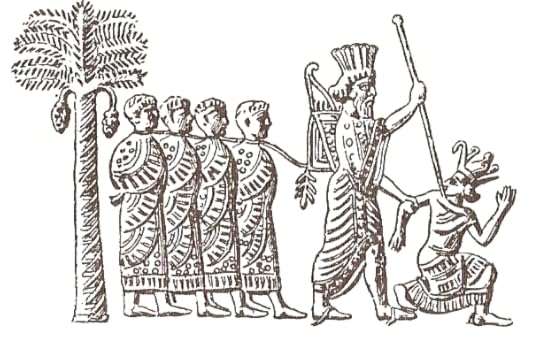 Cambyses II of Persia capturing pharaoh Psamtik III. Image on Persian seal, VI century BC.
Cambyses II was a cruel, bloodthirsty tyrant which makes for a great read.

Juggling two hist-fics from ancient Hellene at the same time was rather fun and they yearn to be contrasted.
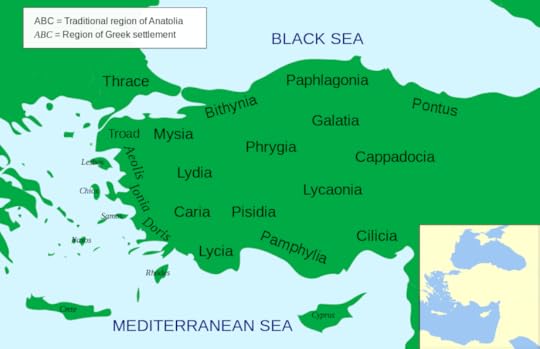
The King and the Slave: Croesus at the age of 70 and slave first to Cyrus and then to the son, Cambyses, so this must be ~525BC. The setting is Lydia, which is western modern day Turkey and the philosopher mentioned is Solon. Croesus is attributed with inventing the first coins.
Fictionalised from Herodotus' writings engagingly conveyed and nicely narrated in the audio form. Recommended.
The Ionia Sanction: Socrates is a young man so this must be ~450BC. The other philosopher mentioned is Anaxagoras. The setting is Ephesus in Ionia and the Persian King is Artaxerxes.
An historical-fiction mystery, written in an amusing upbeat manner yet falls short of the slapstick, thank heavens. Recommended.
TF The Last King of Lydia
4* The King and the Slave

August 30, 2015
This is the sequel to The Last King of Lydia which is excellent and was always going to be a hard act to follow. It focuses on the period following Cyrus' death when his weirdo son, Cambyses, is king. In the first half, there is interesting historical content but the second half has a lot of padding. Croesus is an old man now, as are his friends Isocrates and Maia. Much of the second half is about their relationship and so is pure conjecture. I'll look forward to Leach's next book but this one didn't quite hit the spot for me. 3.5/5.

June 16, 2015
We shall not cease from exploration, and the end of all our exploring will be to arrive where we started and know the place for the first time. (T. S. Eliot)
The tale of Croesus, begun in The Last King of Lydia, comes full circle in Tim Leach's second book. At a recent talk I went to, Tim promised that his sequel to The Last King of Lydia would contain more villains and he doesn't disappoint. The King and the Slave is an altogether darker novel than his first book, and indeed all life (or should I say death) is here - war, incest, fratricide and cannibalism just for starters!
This was a worthy sequel and I absolutely loved it. Cyrus is dead and Croesus is left, still in his capacity as slave, to mentor the young Cambyses in the ways of kingship. However, a bitter and irrational Cambyses, desperate to be taken seriously and aware that he is constantly being judged against the successes of his father, has his own ideas as to how he should make his mark; none of these involve making friends and influencing people and Croesus constantly treads a fine line between life and death.
Both of Tim’s books are based on the writings of Herodotus and whilst reading, I have sat with my copy that I have dipped in and out of over the years and looked up the various characters and events. It works brilliantly as a companion to both books and if you are interested in the ancient world, you can’t go wrong by buying a copy of The Histories.
The tale of Croesus, begun in The Last King of Lydia, comes full circle in Tim Leach's second book. At a recent talk I went to, Tim promised that his sequel to The Last King of Lydia would contain more villains and he doesn't disappoint. The King and the Slave is an altogether darker novel than his first book, and indeed all life (or should I say death) is here - war, incest, fratricide and cannibalism just for starters!
This was a worthy sequel and I absolutely loved it. Cyrus is dead and Croesus is left, still in his capacity as slave, to mentor the young Cambyses in the ways of kingship. However, a bitter and irrational Cambyses, desperate to be taken seriously and aware that he is constantly being judged against the successes of his father, has his own ideas as to how he should make his mark; none of these involve making friends and influencing people and Croesus constantly treads a fine line between life and death.
Both of Tim’s books are based on the writings of Herodotus and whilst reading, I have sat with my copy that I have dipped in and out of over the years and looked up the various characters and events. It works brilliantly as a companion to both books and if you are interested in the ancient world, you can’t go wrong by buying a copy of The Histories.

August 1, 2014
The Last King of Lydia by Tim Leach is one of my very favourites novels. I'm delighted, but not surprised, to say that its sequel The King and the Slave is every bit as wonderful. Beautifully written and imagined. The portraits Leach paints are remarkable. Hugely moving, a mix of grand and small scales, above all believable and at home in this ancient distant setting. Fabulous.

Read
September 5, 2021The sequel to The Last King of Lydia, this one is by necessity more narrative. There's no loss to the spare elegance of the prose, and it was a pleasure to revisit established characters, but for once we have an outright villain. There was a grayness to kings and their morality before, with their conquests balanced with justness and occasional benevolence; Cambyses commits purely evil acts, although the potential to excuse (or at least pity) him due to madness or a lack of a loving childhood hovers about like an uncertain cloud. Croesus faces questions of courage and power and finally, the evolution of his quest for the meaning of happiness.
"And what is a good death?"But I think that by the end, he would add at least one other worthy death to the list.
"There are only two that I know of. One is to die an old man, with your children at your side. The other, to fall in battle, a great enemy dead at your feet."
"And which do you seek?"
Croesus paused. "I have no children left," he said.

September 27, 2019
Mediocre !
This book is a sequel to the author's first venture "The last king of Lydia" which I find quiet interesting,and provocative. The characters in the story are same as in the prequel and are well defined and developed in the first part.There are few new characters coming into the picture,who add more flavor and texture to the story(Perxapses, Pamtesk, Parmida, Bardiya etc).
The story revolves around an incapable and unstable emperor of Persia(Second emperor of Achemenid Persia-Cambesys), and how the power corrupts him. The new emperor unleashes a reign of terror and the hero(who happen to be his favorite slave)successfully navigate through intrigues and confines of his court .
I would rate this book 3/5
This book is a sequel to the author's first venture "The last king of Lydia" which I find quiet interesting,and provocative. The characters in the story are same as in the prequel and are well defined and developed in the first part.There are few new characters coming into the picture,who add more flavor and texture to the story(Perxapses, Pamtesk, Parmida, Bardiya etc).
The story revolves around an incapable and unstable emperor of Persia(Second emperor of Achemenid Persia-Cambesys), and how the power corrupts him. The new emperor unleashes a reign of terror and the hero(who happen to be his favorite slave)successfully navigate through intrigues and confines of his court .
I would rate this book 3/5

December 14, 2018
An interesting and fulfilling read, well-wriiten and researched, and worth the time! Would recommend both this and Leach's earlier book to soak up the history of the early persian and surrounding world. The phrase 'as rich as Croesus' comes from this main character - it's only fair we know why!
February 18, 2020
Fantastic!
August 7, 2021
Wonderful book.

December 18, 2025
3,80 stars

October 28, 2015
A beautiful book - the sequel to 'The Last King of Lydia' which tells the story of Croesus, King of Lydia, who followed the Delphic Oracle's prophecy that if he were to cross the river Halys, he would destroy a great kingdom. He assumed it would be the Persian Kingdom, but it was his own. He became a slave under King Cyrus after the King relented when Croesus was on the pyre, facing his execution. This book tells the story of Cyrus' death and the succession of Cambyses, his son. Croesus serves both because he promised Cyrus he would look after his son, but Cambyses becomes increasingly mad, paranoid and cruel.
The book describes vividly the life of a slave, the Persian Court, the mad expedition to Egypt and the complex relationship between Croesus and Cambyses, and Croesus and two of his former slaves, Maia and Isocrates. It is both compelling and moving, and I'd certainly like to read more historical fiction from Tim Leach in the future.
The book describes vividly the life of a slave, the Persian Court, the mad expedition to Egypt and the complex relationship between Croesus and Cambyses, and Croesus and two of his former slaves, Maia and Isocrates. It is both compelling and moving, and I'd certainly like to read more historical fiction from Tim Leach in the future.

March 5, 2015
This book starts ten years after the fall of Babylon and King Cyrus is on the march again. His slave, Croesus, once king of Lydia, is no longer a young man, but he continues to support his king and Cyrus's heir, Cambyses. When Cyrus is defeated and killed in battle, Croesus attempts to guide the new king with disastrous results as Cambyses is every bit his father's son but without the essence of mercy.
This is a continuation of the author's first book The Last King of Lydia and continues the theme of mixing ancient mythology with a more modern rendition of historical fiction.
If I'm honest, I preferred the first book to this one, which I felt was rather hard going in places. However, if you enjoy classical history then do give these stories a try.
This is a continuation of the author's first book The Last King of Lydia and continues the theme of mixing ancient mythology with a more modern rendition of historical fiction.
If I'm honest, I preferred the first book to this one, which I felt was rather hard going in places. However, if you enjoy classical history then do give these stories a try.
August 22, 2022
Another book I wish I remember more of to give it a fair review. I noted at the time that the book was good, but that is more usually a sign of scant praise. Unfortunately the book left me few memories except that the author has a big down on Alexander III of Macedonia otherwise known as 'the Great'. Making fun of Alexander as a egoist, maniac, petty tyrant and mass murderer, which makes a nice contrast to the usual eulogistic praise he tends to receive, but the author never really makes the idea swing, so what I remember of the novel wasn't as funny as it thought it was.
Otherwise I remember the book as unmemorable. Not a bad read, but not a great or special one.
Otherwise I remember the book as unmemorable. Not a bad read, but not a great or special one.
September 2, 2015
The book was in the vein of the 'Nero/Caligula' abuse tales, only involving Cambyses. It's somewhat interesting, but we get sparing little of the cities of Babylon, Parsagadae, or the Egyptian kingdoms the stories take place in.
Cambyses marriage to his sister was not anything verboten in classical Aryan religions, especially not for someone who represented an apex. The history on this era is doubtful in many ways, but the author has simply used the names and general circumstances to tell an old story about a mad king, this time from the perspective of his slave.
Cambyses marriage to his sister was not anything verboten in classical Aryan religions, especially not for someone who represented an apex. The history on this era is doubtful in many ways, but the author has simply used the names and general circumstances to tell an old story about a mad king, this time from the perspective of his slave.
October 22, 2015
I enjoyed this book, but I have to admit not quite as much as its predecessor, The Last King of Lydia.
I still thought the writing was absolutely beautiful, with some poetic imagery, but I was less engaged by the story this time - it seemed much more brutal and cold.
Keen to see what the author does next.
I still thought the writing was absolutely beautiful, with some poetic imagery, but I was less engaged by the story this time - it seemed much more brutal and cold.
Keen to see what the author does next.

December 27, 2014
I did enjoy this book, admittedly not as much as the first one. If you enjoyed The Last King of Lydia, then you will most likely get something out of it.

January 19, 2015
A fantastic read, looking forward to seeing that the author does next
Displaying 1 - 17 of 17 reviews