Course Lecture Titles Archaeologys Big Bang Ode on a Grecian Urn A Quest for the Trojan War How to Dig First Find Your Site Taking the Search Underwater Cracking the Codes Techniques for Successful Dating Reconstructing Vanished Environments Not Artifacts but People Archaeology by Experiment Return to Vesuvius GourniaHarriet Boyd and the Mother Goddess TheraA Bronze Age Atlantis? OlympiaGames and Gods Athenss AgoraWhere Socrates Walked DelphiQuestioning the Oracle KyreniaLost Ship of the Hellenistic Age RiaceWarriors from the Sea RomeFoundation Myths and Archaeology Caesarea MaritimaA Roman City in Judea TeutoburgBattlefield Archaeology BathHealing Waters at Aquae Sulis Torre de PalmaA Farm in the Far West Roots of Classical Culture The Texture of Everyday Life Their Daily Bread Voyaging on a Dark Sea of Wine Shows and CircusesRomes Virtual Reality Engineering and Technology SlavesA Silent Majority? Women of Greece and Rome HadrianMark of the Individual Crucible of New Faiths The End of the WorldA Coroners Report A Bridge across the Torrent
Oh, the good old courses by The Teaching Company (TTC) -- they almost never make them like this anymore at what has since become The Great Courses and even The Great Courses Plus!;) "Classical Archaeology of Ancient Greece and Rome" is definitely one of these golden old courses (in quality, not in price).
As I dived into these 36 half-hour lectures, I realized I had already listened to this course many years ago, before Goodreads era, at the dawn of my discovery of the TTC treasure trove. I loved this course back then, and I enjoyed it immensely now all over again.
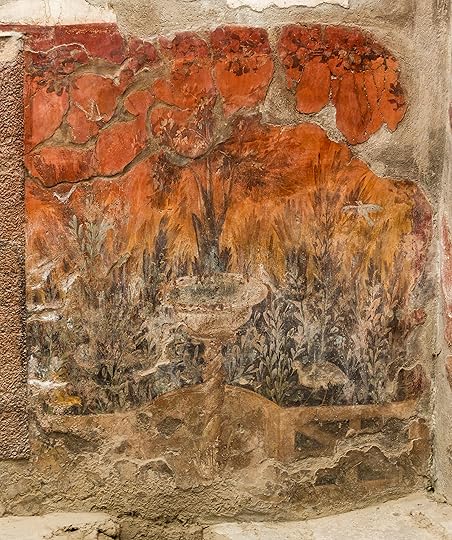
Ancient roman fresco in Herculaneum, Italy. (Image credit: Jebulon, CC0, via Wikimedia Commons).
John R. Hale is a top-notch lecturer, truly passionate about archaeology. Also, the course has been recorded in these "archaic" times when the professors actually spoke to the audience (relating their personal experiences, sometimes improvising, joking, getting carried away) and not just read out loud their lecture notes from a printed page (for the audio only courses) or a teleprompter. Of course, courses taught by some of the Great Course professors still feel "alive", but nowadays it's rather a precious exception than a general rule.
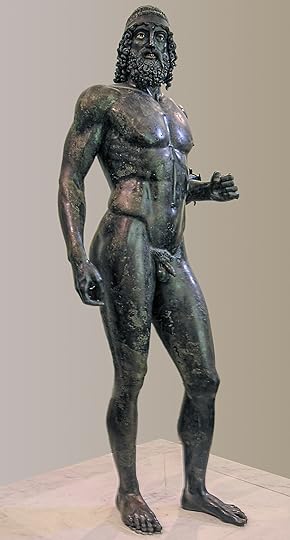
Riace Bronzes, statue A. Circa 460 BCE. H. 1.98 m. Museo Archeologico Nazionale Di Reggio Calabria. (Image credit: Ismoon (talk) 17:59, 14 November 2021 (UTC), CC BY-SA 4.0 , via Wikimedia Commons).
The course is divided into three equal parts, twelve lectures each:
Part I: Creating a Science of the Past looks through the lens of classical archaeology at the history of archaeology in general, from its early birth to its evolvement into a rigorous scientific discipline.
Part II: An Archaeologist’s Casebook peruses twelve fascinating digs. Just look at these enticing titles: Gournia—Harriet Boyd and the Mother Goddess Thera—A Bronze Age Atlantis? Fifteen Olympia—Games and Gods Athens’s Agora—Where Socrates Walked Delphi—Questioning the Oracle Kyrenia—Lost Ship of the Hellenistic Age Riace—Warriors from the Sea Rome—Foundation Myths and Archaeology Caesarea Maritima—A Roman City in Judea Two Teutoburg—Battlefield Archaeology
Part III: A View from the Trenches looks at different aspects of ancient Greek and Roman society and everyday life through the prism of classical archaeology: Roots of Classical Culture The Texture of Everyday Life Their Daily Bread Voyaging on a Dark Sea of Wine Shows and Circuses Rome’s “Virtual Reality” Engineering and Technology Slaves—A Silent Majority? Women of Greece and Rome Hadrian—Mark of the Individual Crucible of New Faiths The End of the World—A Coroner’s Report A Bridge across the Torrent
All in all, "Classical Archaeology of Ancient Greece and Rome" is a goldmine of information and a feast for thought. The streaming service The Great Courses Plus, the latest crowd-pleasing reincarnation of what started as The Teaching Company, has now managed to bury the video version of this course deep in its colorful bowels, making it unavailable unless you had already acquired it the pre-Plus times. Fortunately, the audio version is still very much alive and readily available on audible, together with a few other courses by John R. Hale, which I'm now looking forward to listen to.
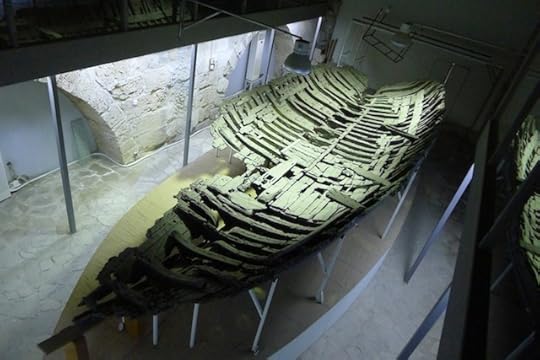
Kyrenia—lost ship of the Hellenistic Age. (Image credit: Ansgar Bovet, CC BY-SA 3.0 , via Wikimedia Commons).
Because the description of this lecture series includes the different topics covered, I will dispense with a discussion of that material. Rather, I consider it appropriate to comment on other aspects. First, I was impressed by Dr. Hale's humility in how he presents the material. I recently read a book by Dr. William Dever and couldn't help noticing how he treated archaeology as a primary source and texts as secondary at best. In contrast, Dr. Hale pointed out the fallibility of the interpretations made by archaeologists. I loved how he described sending students into various churches around town to draw conclusions about church teaching based solely on physical evidence such as iconography, essentially what a future archaeologist might be expected to dig up. One student's conclusion about Catholic doctrine was absolutely laughable. In discussing such matters, he avoided putting his discipline and its experts on a pedestal, and I applaud him for doing this. Second, it was really good to hear his respect for the foundations of western civilization. Our current culture has an exceedingly unjust bias against western civilization. While it is appropriately critical of our education system's historical emphasis on the history and literature of western civilization to the exclusion of the legacy of other cultures and civilizations, it seems to go to the extreme of assuming that western civilization has nothing of value to contribute. So, I was glad to hear Dr. Hale's respect for our heritage.
This is a review of the 36 audio lectures (30 minutes a piece).... This 3-part series (12 lectures in each series) covers different aspects of the science of archeology of the classical period (ancient Greece and Rome). Part one gives a review of the history of archeology, using examples from some of the 'founding fathers' of the science sprinkled with examples of their 'digs' (places like Pompeii and Herculaneum). Part two examines a more detailed look at the archeology of specific examples from around the Mediterranean, from Olympia to the Roman baths in Britain. Part three brings in the social aspects that are defined in the archeological studies of these (and other sites)...like the role of slaves and women (it was just an accident I put those two topics together ...honest), as well as the importance of games to the ancients. Some of the conclusions are pertinent to current environmental concerns that make me wince a bit (particularly the impact to the ancients of the wide-spread anthropogenic deforestation of the Mediterranean basin).
All in all, This is a great set of lectures, presented clearly, by a guy (Dr Hale) who can easily be seen as a field-base scientist, who clearly loves his profession.
Everything You Wanted to Know about Ancient Greek and Roman Archeology
I fully enjoyed all of Classical Archaeology of Ancient Greece and Rome (2006) by John R. Hale, the first Great Courses audiobook I’ve listened to. It consists of thirty-six thirty-minute lectures: twelve about the history, development, and current state of archeology as a “mature science,” including things like site finding, dig organizing, and artifact dating, preserving, and displaying, as well as profiles of important figures in the history of archeology (I loved Harriet “I was never a collector—only a detective” Boyd) and explanations of key branches of it like battlefield archeology, underwater archeology, and experimental archeology; twelve about seminal, stunning, and still ongoing discoveries and sites and wrecks and digs etc., from the Bronze age to the Roman age; and twelve about archeological answers to larger questions about classical civilization like what is unique and original about ancient Greek culture, what happened to the Roman Empire, and why we should study the past.
Throughout, Professor Hale is refreshingly unpretentious, explaining his preference for saying “tree ring dating” instead of “dendrology,” occasionally tossing in references to popular culture like Mordor, Madonna, and Yogi Berra, clearly and concisely defining technical words (like stratigraphy) or difficult words (like adumbrated), making regular spicy or witty asides, like “There’s nothing that the archeological mind loves more than a status symbol” (like ancient pots decorated for public display rather than for private use), using plenty of demotic English like “A pile of flour in a baker's shop [in Pompeii] was found--I can't imagine the care with which this stuff was hacked away to leave this kind of stuff visible,” and quoting here and there great literary sources, like Tolstoy (War and Peace), Gibbon (Decline and Fall), Shelley (Ode to Naples), Homer (the Iliad), etc.
I liked his clear delivery and contagious enthusiasm, as when he says something like, “the humble implements, tools, carpenter’s saws, weapons, jewelry, these small finds, these little bits of people's lives revealing an ancient world that nobody thought existed... We could feel that we were present at the time and the place where archaeology was born.” Or like, “Go to the Reggio museum!
Throughout, he provides interesting touches on things like the differences from and convergences among archeology and geology, anthropology, history, literature, mythology and other disciplines; the etymologies of words like village, capital, palace, martyr, rostrum, pornography, and aqueduct; the links between ancient peoples and us; and the exciting or funny or amazing stories and anecdotes he has accumulated and told his students in his classes (e.g., “You can do this at home: take off your clothes and stand in front of a full length mirror in contrapposto like the Riace bronzes”).
His lectures are chock full of cool information, like pagans had outdoor altars for their temples (cause they sacrificed and burnt meat etc.), while Christians put their altars inside their churches, or the Pythagorean theorem was in use 1000 years before Pythagoras, or that ancient Greeks and Romans colorfully painted their statues, or why tripods were so popular for ancient Greeks and Romans, or that many of the Pompeii houses frozen by lava were already 200 years old (belonging to pre-Roman civ) when Vesuvius erupted, or that the Pompeii plaster casts of dead body spaces revealed trimmed pubic hair, or that Socrates probably ate bread made from grain imported from Ukraine, or that if you imagine our own tea, coffee, chocolate, alcohol, medicine, and drugs all combined into ONE thing, it still wouldn’t come close to what wine was for Greeks and Romans, and how the Greeks (on pottery) and Romans (on frescoes) glorified everyday life.
The Course Guidebook pdf accompanying the audiobook is a detailed 276-page outline of all the lectures, followed by historical and archeological timelines, a glossary of key terms, biographical notes on important archeologists, and an annotated bibliography.
Note that this is not really an audiobook but a series of lectures, so that Professor Hale makes occasional mistakes in speaking that he corrects on the fly, like “Out there on the Thames—sorry—out there on the Seine.” There are about one or two per lecture. He begins each lecture after the first by saying, “Welcome back,” and each lecture is introduced by a brief loop of peppy baroque music and is concluded by audience clapping. Despite it being a lecture series audiobook, apart from clapping, you can only hear Professor Hale during each lecture, which is a little odd because you’d expect to hear people laughing at his occasional witty asides (like “This is what graduate students are for”), all of which leads me to suspect that he is reading his lectures in a studio after which the producers overlay canned clapping. I would like it better without the music and clapping.
It’s an enriching, entertaining, and stimulating series of lectures, and now I am looking forward to Professor Hale’s lectures on the Greek and Persian wars.
In 2006 The Great Courses released University of Louisville archaeologist and ancient history Prof. John Hale’s 36 lecture course “Classical Archaeology of Ancient Greece and Rome.” The course is divided into three parts. Part 1 has twelve lectures that overview the classical Greek and Roman period from the middle Stone Age (10,500-7,000 BC); to Hadrian’s wall; the volcanic eruption of Mt. Vesuvius; and the economic collapse of western Roman Empire in the 3rd century AD. These lectures end with archaeology discoveries in the Heuli Black Sea invasion of Greece (267 AD). The second part of the course are lectures on archaeological techniques ,the discoveries of Harriet Boyd, Greek Olympic Games, Athens’ Agora, and the foundation of Roman cultures. Prof. Hale concludes the course with Part 3 lectures about Greco-Roman engineering, slavery social structures, economics, and the impact archaeology has on religious beliefs and rituals. Prof. Hale is a master story teller. He also has exceptional technical archaeological insights that are linked to our modern understandings of political and social thought. The course guides, timelines, and annotated bibliography are wonderful. (P)
This series was 50% longer than the average audio scholar series. But the length (19 hours) did not disappoint.
Professor Hale relieved me of many rumors I'd believed to be true: Ionian hoplites were not Jeffersonian farmers, but more commonly mercenaries hired in far-away Egypt or Spain, the Victorian "invention" of children as something other than tiny adults would have been news to Athenians and Romans who coddled their young oftentimes, and Michelangelo spent his early years making forgeries. The handmaid of history--Archaelogy--has a lot more to say to us moderns than I thought.
I loved this course! Prof. Hale is an excellent, engaging lecturer who has both knowledge and unique experiences from his time working in the field as an archaeologist to share, with a great perspective that makes him very enjoyable to listen to. I learned so much about the history of archaeology as a field and really felt the excitement that accompanied so many of these discoveries. As soon as I finished this course I started another one of his (Exploring the Roots of Ancient Religion) and I'm really enjoyed it as well. Recommended!
Very good course in combination with other courses or books on the greek and roman era as this is an overview of the practical side of archaeology and some famous archaeologists and sites that are part of forming the understanding and narrative of the history you've been reading. While this does of course dovetail said history, it's nearly always in the context of the sites and finds. Therefore, it's probably not a good stand-alone.
A truly great course. Split in 3 parts, the first about the history of archaeology, the second a look at very interesting sites and the third a look at different topics like daily life or technology. The professor is enthusiastic for this topic and knows how to evoke the same passion in you. Absolutely loved it.
I immediately want to listen to it all over again. It is well organized and well presented. You never get tired of listening to Dr. Hale. Each lecture is organized around a theme and a site, and it all comes together in the end. This was a great lecture series.
This was such a good listen. The professor is very engaging and passionate about the subject, and the chapters are well-structured and interesting. I learned a lot and enjoyed it.
The course were originally in three parts, and I think it'll be best if you listen to it in three parts too. Easier to digest. After the course, I learned that archaeology is something that's interesting to me but not as interesting as some other stuff. But I'm really glad I listened to it, and Professor Hale did a great job.
One of my favorite things about the course was a quote from, incidentally, Winckelmann (a former school teacher and an art historian and often associated with Pompeii and archaeology), "Don't be like schoolboys Who simply look at their masters to criticize and point out all the faults Until you have fully understood the good that a person has achieved You are not ready to look at the bad. "
I have listened to a number of John Hale's lectures and really enjoyed his book "Lords of The Sea". He is a truly fantastic lecturer who emotes at the right moments, provides the correct textualization for the topics he is covering and offers insights that are often unexpected. This course covers three sections in a total of thirty-sex 30 minute lectures. The first 1ectures introduce the methodology of archaeology - and the history of its development into a science. The next 12 are a series of archeological case studies of various digs, methods, finds and individuals both current and in the last century. The last 12 lectureas address the more cultural motifs, demographics and things absent or well represented in the archeological record including sport, slaves, women, religion and even an entire lecture dedicated to the emperor Hadrian. This course is available from the Thegreatcourses.com and would cost about 40-80 bucks depending if there is a sale or not. I enjoyed the audio version, but there is also a video version on dvd or streaming that could be beneficial for someone who does not already have a basic knowledge of these topics.
I bought this book because I was looking for something about Greece. I thought it was about Greek architecture because I wasn’t paying that much attention since it was the only choice in Audible in the category of Greek history. So when I first started to listen to it, I was a little disappointed that it was about Greek and Roman Archaeology. Boy did my opinion change.
This audio book has 36 chapters covering the history of archeology, examples of different sites and social aspects (slaves and women).
The author, John Hale, is absolutely amazing. He tells stories in the old tradition, where you sit back and enjoy his voice, and lyrical tale. He somehow is able to wrap up the ending of each chapter with a wonderful bow that leaves you satisfied yet wanting more.
I came from very little knowledge about archaeology and left with a good basic understanding of the study. I will definitely try more of his lectures.
The author is a master of storytelling, and now I regret that I didn't take archaeology as my major. Currently we are cycling through turkey and Greece, this course became our main inspiration to visit the sites. "Peace, Love, Archeology!"