I was Top Gear's script editor for 13 years and all 22 series. I basically used to check spelling and think of stupid gags about The Stig. I also got to hang around with Jeremy Clarkson, Richard Hammond and James May. It didn't feel like something you should get paid for. From the disastrous pilot show of 2002 to the sudden and unexpected ending in 2015, working on Top Gear was quite a rollercoaster ride. We crossed continents, we made space ships, we bobbed across the world's busiest shipping lane in a pick-up truck. We also got chased by an angry mob, repeatedly sparked fury in newspapers, and almost killed one of our presenters. I realised that I had quite a few stories to tell from behind the scenes on the show. I remembered whose daft idea it was to get a dog. I recalled the willfully stupid way in which we decorated our horrible office. I had a sudden flashback to the time a Bolivian drug lord threatened to kill us. I decided I should write down some of these stories. So I have. I hope you like them. And now, a quote from James 'Richard Porter has asked me to "write a quote" for his new book about the ancient history of Top Gear. But this is a ridiculous request. How can one "write a quote"? Surely, by definition, a quote must be extracted from a greater body of writing, for the purpose of illustrating or supporting a point in an unrelated work. I cannot "write a quote" any more than I could "film an out-take".'Porter, like Athens, has lost his marbles.'
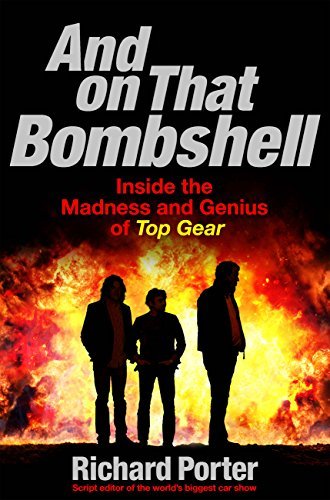
And on that Bombshell is a look back at the golden years of Top Gear from 2002 to the disastrous events of 2015 by the series script editor Richard Porter. As a big fan of the show I enjoyed the book immensely. As you might expect from a show writer, the book is just as witty and silly as the series was as it dives into the history of the show and how it became a global phenomenon. I loved hearing about the origin of the Stig and how the show managed to put stars in their reasonably priced car. It also answers the one question I always had about the series - yes the three presenters are basically the same in real life as you see them on tv. Overall it was a wonderful, nostalgic look back at Top Gear that made me want to go watch some reruns. This is definitely a must read for fans of the show.
I listened to the audio book narrated by Ben Elliot.
An interesting and chill read about the workings and rise and fall of Top Gear (the good one). It was interesting also to see just how much thought went into making the silly VTs become silly and it wasn’t just a bunch of man children zooming around the place spontaneously blowing things up. There was a bit of repetition but this didn’t really matter, and I enjoyed reading immensely. It becomes apparent just how close the whole crew was together, whilst also not shying away from the mistakes and bad parts.
I inhaled this book. It is a fantastic combination of silly but witty jokes, amusing but insightful anecdotes, and genuine historical lore about Top Gear. Porter's clean style and clear voice make for a quick read that takes you into pretty much every aspect of the show you'd always wondered about.
Was it scripted? How the hell did The Stig coach celebrities without revealing his identity? What was it like to get famous? What was it like to get really famous? Is Jeremy really like that? Is James really like that?
(I don't think anyone wonders about Hammond—he's pretty clearly just a really nice guy.)
The great part about this book isn't just that it gives you these answers, it's that the answers are way better, funnier, and more revealing than you'd have expected.
A good read. The book is written with a Top Gear voice outlining the hard work that goes into a seemingly effortless television series. Laddish culture that was also very funny for us females. I miss the programme.
Five stars because I couldn't put this down, losing track of time whenever I picked it up. I've been a fan of the 2002 series of Top Gear since being shown one of their crazy pieces of racing motorhomes on a track in 2008. I still watch old pieces, now over ten years later. Reading about the qualifications, or rather, lack of them and experience that guided them to the insane orbit of Clarkson, Wilman and co was fascinating, as was reading about all of the bad parts as well as the good.
“I was wise enough never to grow up, while fooling people into believing I had”.
Más allá de ser un programa de televisión sobre coches, hay algo de Top Gear que transluce destellos de lo que es vivir: crecer sin madurar, tener por propósito vital hacer reír a tus amigos, y recorrer el mundo con ellos al volante de un Mustang.
This would be my usual in depth style review but by the time Goodreads put it on here I'd read quite a few more books.
That said, I absolutely loved this book, for any fan of the show it's an essential read. It tells the reader how Top Gear used to be and how in its new format how it became the global phenomenon it was right up until the end. But it's also so much more, we get backstage stories, how The Stig came to be, the preparation that went into creating the challenges that became as much a staple of the show as car reviews as well as the pros and cons of working for the BBC.
There is so much more but words can't do it justice. I flew through this book in a matter of days and found it an utter joy. One of the best I've read this year.
Top Gear, in its Clarkson-Hammond-May incarnation, was a show that helped define the stereotype of “blokiness” from 2002-2022, and it grew in appeal, scale, absurdity and weirdness over those two decades of both its presenters’ and the nation’s lives.
Richard Porter wrote for the show more or less from the beginning of its 21st century renaissance until its end, through the inception of The Stig and several incarnations of the character, through the various iterations of a star in a reasonably priced car, and through the longer “adventure” episodes where three slightly heightened versions of fundamental car numpties tried not to get killed on absurd journeys which, in contrast, did their best to kill them.
And On That Bombshell is the story of Porter’s journey through the life of what became a TV cash cow and an international legend.
There are elements of what you want in the book: things like the conversations around how The Stig got his name (according to Porter, there was serious consideration to calling him The Gimp originally), through the American special where the presenters came startlingly close to being Actually Lynched (one of Porter’s proudest moments, he claims, as the liberal slogans they painted on their cars were apparently his idea), through the Indian adventure with which Porter expresses continual frustration for its lack of narrative journey and overall point.
It also includes the likes of Hammond’s ill-fated attempt to drive a jet-powered car, and takes the story all the way upto and just barely through the incident with Jeremy Clarkson apparently lamping a staffmember, which not only ended the era, but shifted the trio to the less successful Amazon iteration of their automotive silliness, The Grand Tour.
But it’s also a frustratingly slight affair, belting through twenty years of television-making like a Stig around Gambon, and leaving you with the overarching sensation of a smoke-stinking, student-flattish production office full of fairly intelligent blokes behaving more or less like giggling teenagers. For a living.
It’s in this dichotomy that the book is most vexing – clearly, the three presenters each knew their stuff, for all that (particularly) Clarkson veiled that knowledge in an (at least slightly exaggerated) caricature of boorishness. But as on screen, so in the book, they come across as people you mostly wouldn’t want to hang about with even if you were deeply into cars.
As such, you get a portrait of a show that came to symbolise a particular strand of “blokiness” during a time when that was indulged by mainstream British (and clearly, world) culture as a lodestone of the human experience. That was the people, that was the show, and to some extent, that’s the book.
But read or heard with just a little hindsight, it works better as the cultural history of a baffling anomaly than a particularly tenable strand of international enthusiasm or programming. A testament to on-screen chemistry, rather than anything like a robust or repeatable format - which might explain why neither newer versions of Top Gear, nor extended adventures with the three ultra-blokes, have since done anywhere near the same volume of business.
Where perhaps the book is at its most cringeworthy is in the fairly consistent plea from Porter that while to all intents and purposes, Top Gear presented as three caricatures of British petrolheadedness titting about and insulting each other, it only worked so well because of both the consistent hard work of lots of people (which feels valid) and the notion that it all had to have some sort of consumer journalistic angle that added genuine value to the world, which as a claim feels dubious in the extreme.
Most episodes may have ended on a “bombshell”, a point proven or a discovery conclusively if ludicrously made. But the thinness of those bombshells belies the notion of any serious focus on consumer journalism, and it’s a thinness that translates to the book, too.
There are no genuine bombshells here – it’s the equivalent of the team asking “Can you write a bone-basic book about twenty years writing for the leading car programme in the world? And more to the point, would anyone buy it if you did?”
The result of the consumer journalism experiment here is the bombshell that “Yes… yes, you can. And remarkably, yes they will.”
And On That Bombshell, we’ll gloss over the question of whether anyone who did go ahead and buy it actually got anything much FROM the experience. Goodnight.
This is the story of Top Gear's triumphant run where it became the most-watched show worldwide and the most popular car show of all time, rewriting what many of the rules and style of television in the process. It is written by the script editor Richard Porter, who worked with the three main hosts to build each show.
At times Porter waxes so Top Gear-comedy-writer that its hard to read. Getting a zinger once in a while is funny, but non stop for several paragraphs in a row (or the entire intro and first chapter) gives no space for the funny to build or work, so its just too much at a time. At other times its so heartfelt (particularly the last two chapters) you almost feel embarrassed reading about the events.
That makes the book less of a breezy fun fest than one would expect given the writer and the topic, which is probably why I was able to pick the book up at the Dollar Tree for one whole buck.
Plus, he's kind of a jerk. What I mean is this: you know the parts of Top Gear where you go "why would anyone do that to their friend???" or the episode where they painted their cars outrageous and insulting provocative slurs and drove through the deep south to show how bigoted and awful Americans are? That's him all the way through. He thinks being an a-hole is funny, that you backstab to show affection, that being mean, degrading, and insulting is high comedy. And it shows in his writing.
Yes, he's self-deprecating, but never in a way that feels honest or compelling. He talks about how his blog on cars was never funny, but then describes all these high profile people telling him how hilarious it was.
On the other hand it is an interesting and entertaining overview of the Top Gear show from the 1970s until it suddenly and abruptly shut down in 2015 with the firing of Jeremy Clarkson. Clarkson is a very complex figure in this book: brilliant, likable, hard working, and energetic, but at the same time very difficult to be around. Porter states that while they are a somewhat exaggerated TV version of themselves, James May, Richard Hammond, and Jeremy Clarkson are really like that. And Clarkson would be difficult to be around in large doses.
Overall I recommend this book to Top Gear fans for tons of inside info and background to how the show came about and why it was the way it was, but be ready for it to be less hilarious than the show.
I, like many, was a fan of Top Gear. So a book that promises to take you “inside the madness and genius” of the programme was naturally of interest, especially if it was funny too (and how could it not be?).
The author was there before Andy Wilman took over as producer and the ‘new’ Top Gear was born, so has some insight into the whole affair from start to end. The chapters that largely flow chronologically through the series, but with the occasional step out to cover a specific topic (like The Stig, for example).
All well and good, punchy and amusing if not belly-laugh funny. I certainly had a few chuckles. What it lacked was a great deal of depth. You get the feeling the author didn’t want to reveal too much for fear of accusations he ‘sold out’ the family, although this may equally have been due to rushing to get this out while the headlines were still fresh.
The finish is a little brusque, we go from ‘all things swimming along’ to ‘a bad year’, to ‘it’s over, there’s not much to say.’ He then adds ‘by the way, I got a job on their new show.’
It does reaffirm what fans of the show hoped — that the three presenters are basically the same in real life and that the whole thing was as much fun to produce as it was to watch (if much harder work). It’s like discussing all your fondest memories of the show with more dedicated fan who has a better memory.
You forget how long the show ran for (22 series over 13 years!) and that it stumbled a bit in the early days (James May didn’t join until the second series). It became such a staple and changed car shows so much that you don’t remember what a revolution it was.
A good, if wistful, look back at the childish antics that often wrought entertainment gold.
I have recently been on a bit of a Top Gear universe (for lack of a better word) binge after rewatching Clarkson's Farm at the end of last year. This led me to reading Mr Wilman’s Motoring Adventure: Top Gear, Grand Tour, Clarkson and Me, which I really enjoyed. In the recommendations on that book's Goodreads page was this one, and it was highly rated, so I decided to keep the binge going despite fearing it might just be a retread of already covered ground. On the whole, I'm glad I picked up this book, but I was also right to worry.
Truth be told, Andy Wilman's book was far more enjoyable, as I feel like Andy Wilman is a better storyteller. Richard Porter is a talented writer, but not the best storyteller. A lot of his anecdotes were funny and witty, but they weren't always interesting. Mr Wilman's, on the other hand, weren't always so witty or funny, but they were always engaging because he has a better sense for what works as an interesting story and what is best left on the cutting room floor.
That's actually the only real flaw of this book. A lot of the anecdotes felt like inconsequential stories or petty grievances. As a fan of the Top Gear show and the people surrounding it, I found them enjoyable enough to read, but if you're not a fan of the show, I don't think you'll enjoy this book quite as much as you would the Mr Wilman book.
Overall, this is a good book that's worth reading if you are a big fan of the show.
This was a fun and engaging read, but only if you're into Top Gear haha I'm not British, so I do think some of his connections/anecdotes sometimes lost something in the translation (references to TV shows "everyone" has watched or actors who are not as well known here, etc). While roughly linear, the organization of the book is also somewhat haphazard, with each chapter kind of its own little essay. However, for the most part this worked, as I felt that I could delve in and out of this book easily.
Porter comes through as overall good guy - his writing is not pretentious, and he doesn't attempt to "cash in" by telling any shocking stories about any of the presenters - in fact, the presenters also come through as regular guys as well, and I enjoyed hearing about their hands-on involvement in the show, beyond just standing in front of a camera. As the scriptwriter, Porter handles the "is this scripted" question pretty well (answer: depends on how you define "scripted" haha), with insights into the way such an ambitious, daft, entertaining, and even sometimes educational, show comes together.
I also felt like he handled the final kerblam of the show's abrupt ending gracefully, not excusing Clarkson at all, but also not casting him in the role of some horrific villain.
All in all, some entertaining and engaging reading that has made me really want to watch this entire show straight through all the seasons.
I received this book as a surprise Christmas present from my son and, being a big fan of Top Gear, it was perfect for me! It's written from the memoirs of Richard Porter, a young man who had no TV experience when he was hired by the team of the newly-relaunched 'Top Gear in a hangar' show of 2002 1 but who did have his own quirky car website which had caught the eye of the team.
He soon rose to the role of script-editor, and worked on all the series until its demise in 2015. This book makes then for a fascinating read as we get to see the real genesis of new Top Gear and how, from rather a shaky start, it grew to be the world's top car show.
Working as close to the team and presenters as he did, we get some juicy insider-knowledge from Richard - and lots of fun along the way as you can imagine. The whole slightly 'men-in-a-shed' way of the Top Gear office and its unique way of creating the shows is wonderfully described here by Richard. He also worked with the team on many of the funny bits too, and deserves huge credit for that.
It all comes across as a dream job for a young man who's passionate about cars, and that's exactly how it comes across for Richard. It was good to see at the end that he continued to work with the boys on their big comeback show 'Grand Tour' too. All in all, a must for any fan of this classic show that brightnes up our Sunday evenings for 13 years.
I'll be the first to admit that I'm one of the biggest Top Gear fans in the USA and have been since I discovered it in about 2009, so I was predisposed to like this book. (Though on the other hand, you could say I was predisposed to hate it if it didn't meet my preconceived preferences; but it did, so that doesn't matter). As he says in his cover blurb, author Porter was the script editor for the entire run of "new" Top Gear from 2002 to 2015, so he saw it all and knew everyone. His funny writing style makes it easy to see how he got and kept that job, and why he was also one of the idea guys dreaming up segments and challenges for the show. Even with the British idioms (I still don't think there's an American who can adequately define what "taking the piss" means) and name-dropping of British celebrities we've never heard of over here, this book is a delight to read from cover to cover.
A very funny and extremely interesting look into the inner machinations of Top Gear, I love that Porter was there for the whole run and didn't miss a beat. I laughed out loud quite a few times and the anecdotes were so clear and true I could see them playing out like an episode.
I especially appreciate Porter acknowledging one of the biggest appeals of the show is the utterly ADORABLE Richard Hammond.
I did think Porter sucked Jeremy Clarkson off in parts, I'm a bit hazy on his interpretation of the N-word incident but I do appreciate his take on Clarkson's firing, and it's quite a sobering note to end the book on. There was no Grand Tour at that point! Oh god and now that's over. Kill me.
The most spectacularly aged sentence in this entire book has to be In our worst nightmares, post-Clarkson Top Gear would become a hollow shell of itself, watched by seven uninterested people.
Five stars because I am a fan of the TV show "Top Gear" and the book is well written. You never forget your first love, your first job, your first car, and the actor you first saw portray "Doctor Who!" On that note, this book chronicles the glory days of Top Gear with Jeremy Clarkson, Richard Hammond, and James May as presenters. The author is the script supervisor for the show, and at the time of this writing had been for over a dozen years. The chapters are short and to the point. If you've never seen the show, this book will either leave you cold or have you running to your TV to seek episodes "On Demand." I'm the sort of guy that likes to watch shows about how things are made, so this book was right up my alley. I've even done "extra" or "background" work on a few movies just to see how they were made. And on that bombshell, I loved this book!
Memoirs seem to work well for audiobooks, so this seemed like a good choice to follow up Andy Wilman's book covering similar ground.
It's... fine
The problem was that I'd picked Andy Wilman's book first - and this one, just isn't as good.
It's still a good book - if you're a Top Gear fan then it's worth consuming both.
But while the content is (obviously) similar - there isn't as much in Richard Porter's version, and while the writing in this book is .... fine; it's basically just competent.
It's also surprisingly documentarian - it very much comes across as a record of things that happen, there is no real sense of storytelling.
So - definitely read this if you're a Top Gear fan.
But if you want to choose a single Top Gear memoir to consume - it probably shouldn't be this one.
I was captivated by the story of Top Gear, and how it ever came to be. To me, it felt like each chapter was the author at the pub, recounting the story of a slice of TG, partly to appease the eager listeners, but also to show his genuine pride and enjoyment in the project.
I listened to the audiobook and think that, although the narrator was good, the author would have been far more suited for a read.
Highlights for me included 'The bollocks hour' and 'The Sandero story'. Would i recommend this book if you dont like or don't care about TG? Obviously not. But if you do, definitely worth a read/listen (you probably don't need to do both)
This was a good, light read. If you are a fan of Top Gear you will enjoy the stories that Porter shares. Some really interesting stuff about the formation of the show and behind the scenes things that went on. There was an interesting reveal about the Patagonia special and a guest they had lined up.
Porter is also pretty candid on his feelings regarding the incident with Clarkson assaulting Oisin Tymon that caused the end of the show. I feel like Porter could have shared a bit more about some of the classic episodes but this is a worthwhile read.
Read this for insight into the much loved specials. But we get a single chapter on why he hated them (mainly as a writer because they were less scripted). Wanted more insight into the presenters themselves too but as they're mates it feels like (other than the Clarkson sacking fiasco) he veers away from making any criticism into their way of working and personality. The style of essays around a subject, rather than a chronological history, was also disappointing. Some great anecdotes, but there's surely a lot more story to tell.
3.5- A very interesting read about a very interesting show. The biggest let down of this book isn't so much the book itself but really more that, as the author stated, when interesting things happened, they didn't get hidden or scrapped as much as highlighted. This means the behind the scenes stuff was less new and exciting stories as much as it was details and factoids about the same things that made it on air. Never the less, for giant TG fans, it is valuable insight and a glimmer into the world of Clarkson, Hammond, & May.
Amazing insights into one of the best and quirkiest TV shows of all time. Having seen the episodes 10-15 years after they were released did not dampen the enthusiasm a bit. Richard porter breaks down the book into independent anecdotes of his time at Top gear which can be read in any order. Funny to know that such effort went Into what at most times seemed to be tomfoolery, and the rare gems where actual tomfoolery was allowed to be aired on screen. The go to book for ardent fans of TG deleted scenes and outtakes on youtube.
I don’t think many people know how much I loved cars growing up. I was obsessed with them, reading and memorizing as many facts about supercars as my mind could absorb. When I was 17, my buddy and I created a racetrack in our school parking lot furnished with a ton of hairpins, chicanes, and a couple of straightaways. It was the time of my life. When Top Gear died, I think my love of cars died with it. I am convinced that if JC, JM, and RH presented yoga poses, I would be in somewhere in Tibet right now with a mat and no shoes on.
This one took me a while to read because I was annotating it and with a toddler that can be challenging. I have lived on the periphery of the Top Gear world for many many years at its one of my husband’s top entertainment forms. He has a reference or quote for nearly every situation. I found this book to be enjoyable and quirky. It felt as if you were in a shabby pub having a rather one sided conversation with Richard. It gave great insight into the series and an appreciation for my husband’s love of the show and this book.