With the exhibition behind him, handsome young calligrapher Seishuu Handa returns safely from Tokyo. Between a full-moon night spent with the islanders, a grade-school recital, and a discussion of Hiroshi's career plans, life is plenty hectic as autumn arrives at the island! The evening sun warms straight to the heart in Volume 7 of this super-popular hot 'n' hearty island comedy!
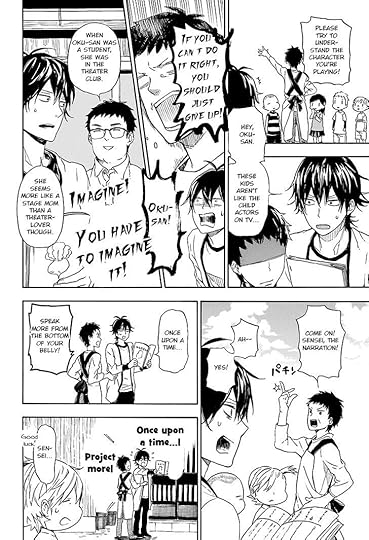
Handa is forced to take more of a parental role as the little kids want help preparing their performances for the school recital (apparently the village school is just 1st and 2nd grade) and Hiro wants advice about what to do after graduation, since the career counselor has quashed his dream of becoming a chef.
Naturally sensei is useless at both of these projects.
It turns out that Ma'am (Village Chief's wife) was a theater student.
Why does The Giant Turnip story come up so often in my reading recently?
World: Wonderful art once again that brings our beautiful character emotions. The world building is small and focused on character which is great. The focus on Hiro and his school was nice.
Story: The Naru and Sensei story was very well done this time. Though there is a large chunk in the middle about Hiro these two are still center stage and their relationship is so beautifully done. The emotions are earned and the satisfaction is real. The stuff with Hiro was also wonderful with coming of age found within these pages and him finding his path. It’s not over stated or melodrama but rather muted and well done.
Characters: Strong character moments this arc with small little emotions coming through in the art. I love seeing Naru stuff the invitation and Hiro and his hair.
Paling ngakak bagian bola karet yang digantung itu. Sensei dan Tama udah kayak berada di dunia sendiri aja sementara Hiro, sebagai orang "normal" gak bisa ngertiin apa seninya dari sebongkah bola karet yang digantung di lampu. Tenang, Hiro, saya juga gak ngerti kok. Pukpuk Hiro.
Yang lucu juga pas latihan drama sama Bu Kades. Ya ampun. Untung Wakil Kepsek-nya masih waras, gak sesableng Bu Kades soal drama. Anak-anak pun selamat(?). Meskipun jendela rumah Sensei gak terselamatkan lagi.
Ada momen-momen mengharukan juga. Pas Hiro galau soal masa depannya dan malah ngajak main lempar-tangkap bola sama Sensei. Handa Sensei udah kayak konsultan buat seisi desa yak. Ahahahaha... Saya eeer... gak bisa bilang suka juga gak suka mengenai Hiroshi yang udah ngecat hitam rambutnya. Tapi, saya suka julukan "Kuroshi"-nya Naru!!
Paling mengharukan itu pas usai pertunjukan drama anak-anak. Udah muncul benih-benih(?) kebapakan di dalam hati Sensei, tampaknya. Dia jadi sangaaaat memperhatikan Naru, macem anaknya sendiri. Ehehehe~ Suka hubungan Naru dan Handa di sini.
Waktu nyeritain soal Nenek Kiyo juga berkesan. Saya suka rasa "sendu-sendu bahagia"(?) di bab ini.
This is a really good manga. It’s a slice of life where the characters are all just decent people. There was a chapter where it looked like one of the kids was getting abused by a parent. And I was really surprised, because I didn’t think this was that kind of manga. I was right. It ended up being a misunderstanding.
There was another chapter where I worried we were going to witness the death of a character. To be fair, she’s 90+ years old, but still. As far as I could tell, she was still alive by the end of the volume.
It feels like we keep getting hints of a dark story creeping up on us, but then it doesn’t happen. I’m a little worried about that. I hope that if the author does decide to take on more serious topics, they balance it out so it doesn’t become traumatizing.
This is definitely one of my comfort reads. They’re funny stories with silly character who don’t mean any harm. I hope it stays that way.
I loved reading about some of the more obscure traditions, and I loved seeing Handa realise that Naru might not have all that many people looking out for her. I also really liked Handa and Hiroshi's interaction. At times it looked like the topic should get a bit darker, but it never actually did. It was lovely to see Handa care so much for the kids and try and protect them. I also like the kids trying to help the sick elderly woman. There's a lot I loved. But it felt a bit fractured and I kinda felt low something was missing.
It was so nice to return back to the island! Everyone is so happy that Sensi is back! Gosh I love the whole chapter with his axe and again with the breaking of the window!! We are starting to see more of Handa questioning where Naru's parents are along with Hiroshi trying to make decision for his futures!! But Handa doesn't disappoint with his continued struggles with the quirky islanders and we love to see it!!
Hiroshi really eats shit in this volume, and I hate his new hair.
Overall this one's a little bit heavier than the previous volumes with two major characters dealing with failure and the melancholy thread with Naru and the sick grandma.
These guys really sneak up on you and get comfortable in your feelings without being obvious about it.
OMG new characters such as Kiyoba, the village's bedridden elder is definitely a slice of life that runs so true of small towns. And Hiro dying his hair black just so he will be taking seriously as a chef.
Fun manga volume. There are a bunch of plot threads slowly moving along, and a few events building through the manga volumes (school recital, Hiroshi’s career, etc). Comedy is top notch as usual.
Whatever happened with Naru's parents, I'm sure it's gonna break my heart. At the same time I love this for my beloved fonud family trope. Sensei is great big brother for the kids.