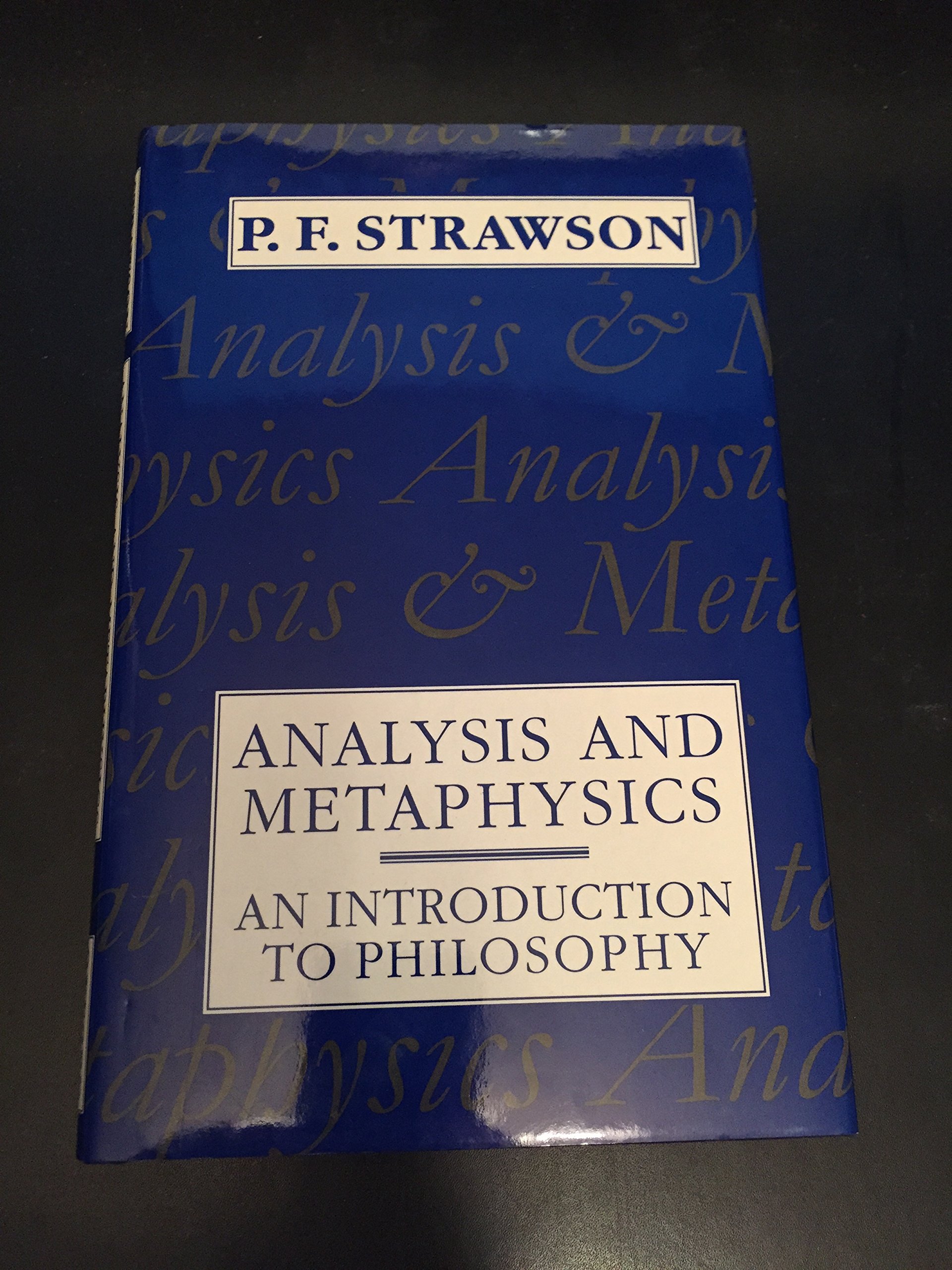
Sir Peter Frederick Strawson FBA was an English philosopher. He was the Waynflete Professor of Metaphysical Philosophy at the University of Oxford (Magdalen College) from 1968 to 1987. Before that he was appointed as a college lecturer at University College, Oxford in 1947 and became a tutorial fellow the following year until 1968. On his retirement in 1987, he returned to the college and continued working there until shortly before his passing.
Strawson is clever and I broadly agree with a lot of what he says, but this book felt unpersuasive and disjointed. He tries to fit a lot into a small book, and he tries to write very accurately but also open to newbies. A noble challenge, but neither appeared to work. It moves fast, jumping from argument to critique and back and onward, sometimes in overly awkward 'typical philosophical' sentences. Not an introduction for someone unacquainted with philosophy. Apart from the first 3 chapters. Those were good.
Another exciting episode of the critically acclaimed school of thought "Analytic Philosophy." In a surprising turn of events Strawson refutes the "latest theory" that "states" that there is "no distinction between analytic and synthetic in the first place" by saying that there IS a distinction. !. Thus Strawson keeps the case open like that jerk of a last juror. Inevitably, the series was canceled and replaced with the much sexier reality-philosophy "Philosophy of Mind." Other than that, summarizes philosophy well.
I would have given 5 stars, were it not for the failure of the book to fulfil its purported aim to be an introduction to its subject matter. It certainly cannot be fully understood, much less appreciated, without a prior acquaintance with many not-so-trivial philosophical themes, ideas and even terms (which, though, Strawson does make a reasonable attempt to explain, e.g. ontology, epistemology, correspondence theory, to name but a few). And although the book is generally a paragon of clarity – as is characteristic of ordinary language philosophy, which was Strawson’s intellectual environment – the arguments are often subtle and complex, and are made through regular contrasts with and critiques of other not-so-easy philosophers’ equally complex and technical ideas, and thus perhaps not very digestible for someone unaccustomed to such dense philosophising.
But then why the 4 stars, if the book fails to deliver on its basic promise? Well, first, the topics that the book deals with are by no means easy. They comprise some of the most fundamental questions of human existence that have perplexed people for millennia, with no agreement as to the right answer to this day. Thus, unless one resolves to merely state and describe what other people have said regarding those questions, rather than to critically engage and present one’s own views (which, by the way, is also an aim that Strawson sets out in the preface), the result will be a book that requires some effort on the part of the reader to parse through it. To be sure, there are introductions to such questions that take the former route of mere description, but then all one learns by way of introduction is *what* philosophy is, not *how* to do philosophy. It is a virtue of people like Strawson that by not only describing but critically engaging with other people’s work, they cover both territories, and do so with their characteristic clarity. There is of course the risk of having a lop-sided or partial or sometimes biased view of things in this way, but that is the reason why one reads more than one book in one’s life, and the tools of critical reasoning that such “biased” books impart to the reader ultimately serve to mitigate the effects of that very partiality.
Second, there are some absolute gems in the book. In particular, the second-last chapter, on causation and explanation, is a medicine of profound clarity against the illness of confusions and conundrums that anyone even with a vague knowledge of Hume’s and Kant’s excursions into the matter may have come to harbour. The last chapter, on freedom and causation, is another piece of brilliant insights. It thoroughly reassures us that our common-sense feeling and understanding of our free will and moral responsibility are after all fully justified, and, contrary to the ridiculous claims of some philosophers and scientists, are not in the slightest at odds with determinism or natural causation or modern science or whatever demon is conjured to haunt the undeniable sense of freedom that we humans possess.
It has some good aspects, but it is very dense and overly linguistic in its motivations compared to his earlier work "individuals". It is mostly engaged in defending some of the central theses of that former work in relation to what he thinks should be the central concerns of philosophy and philosophising. What he likes to think of as descriptive metaphysics, which I have never been convinced he has shown to be a clear cut position, it seems to waver between regular metaphysics when giving exposition of something followed by quickly retreating to linguistic philosophising whenever facing criticism on some point.
His views are also, compared to individuals, which at the time was quite advanced, have not seemed to advance with the times, in the light of thinkers like Putnam in philosophy of science and Quine and then Kripkes ideas in philosophy of logic and language. With his commitment to what he calls his descriptive metaphysical approach, he always seems to be very tentative in making claims to too extreme a degree for my liking, because he ends up never presenting an original view of his own in any detail. Largely he seems committed to some basic metaphysic of space and time as fundamentally real in some key sense along with persons, creating a dualistic structure. That view has not really changed, been modified or developed since his much earlier work "individuals".
It puts him really into line with the quite standard position of naturalistic epistemology for the most part as is seen in Quine and many other post-positivist types who still want to salvage something from that kind of physicalist and atomist approach. His addition of persons, adds a dualism lacking in many of those others ideas, but that part of his view is very rarely laid out in metaphysical detail, it is more something that is retreated to when under attack in line with certain common sense accepted, linguistic conventions and requirements of usage and the like. An unsatisfying defence to my mind.
e o serie de prelegeri ale lui strawson, de introducere in filosofie, in traditia analitica. relativ interesant - citeam undeva ca strawson a scos filosofia analitica din faza ei humeana si a inceput faza ei kantiana. e in stilul asta polemic al filosofiei analitice - in interiorul careia exista o gramada de explicatii alternative - dar asta face si ca lucrurile sa fie plicticoase. pentru el, filosofia e analiza conceptuala - ca si pentru majoritatea filosofilor analitici - dar el nu vede aceasta analiza ca pe o practica reductiva (a reduce conceptele complexe la elementele lor cele mai simple) dar ca o explorare a unor retele conceptuale pentru a descoperi acele concepte generale care fac posibil faptul ca noi sa vorbim (si sa ne gandim) intr-un anumit mod despre lucruri. aici e kantian :) o analogie pe care o foloseste e cea a gramaticii - tot asa cum un gramatician incearca sa scoata la iveala regulile implicite in utilizarea limbajului, un filosof scoate la iveala regulile implicite in utilizarea conceptelor in discursul pre- (sau non-) teoretic. dar asta e un scop cam prea putin ambitios pentru mine - adica nu vad prin ce mi-ar schimba asta viata sau intelegerea de sine sau intelegerea altora. si am din ce in ce mai mult senzatia ca filosofia analitica poate spune fie lucruri foarte complexe si tehnice si departe de experienta, fie platitudini. singurul capitol care mi-a placut intr-adevar este ultimul, despre necesitate si libertate, in care polemizeaza cu spinoza - si pare destul de convingator, si mai putin tehnic decat in restul capitolelor, in care incearca sa evidentieze interdependenta intre logica, teoria cunoasterii si ontologie si felul in care ele merg impreuna pentru a construi un tablou unitar al lumii. o sa ma m uit prin ea, in tot cazul.
P. F. Strawson's work has been instrumental in the Analytic appraisal of metaphysics as a worthwhile project. His criticism of empiricism, while loosely in the Humean tradition, mobilises the Kantian insight that the limits of causal explanation are not derived from the real world of objects but from the presupposition of it, i.e. causal explanations "...are already with us when anything which could be called experience begins" (1992, p. 124). His writing is pellucidly clear, his argumentation elegant, persuasive, and possessed of the modesty proper to a sober and gifted philosophic mind. Analysis and Metaphysics (1992) has compelled me to consider looking into Strawson's famous On Reference, and his expository works on Wittgenstein.