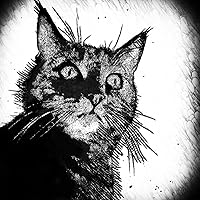
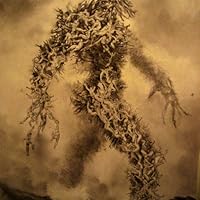
Ray Tyler, an unhappy bank clerk and self-sufficiency freak, buys an old book from his local bookshop. However, after reading it, he finds that he is gradually turning into a violent beast driven solely by murder and in short a werewolf. His increasingly erratic behaviour earns him the sack from the bank, and three rapes and two murders later, he is on the run from the police.
I was born on November 21, 1939, in the small village of Hopwas, near Tamworth, Staffordshire, England. My mother was a pre-war historical novelist (E. M. Weale) and she always encouraged me to write. I was first published at the age of 12 in The Tettenhall Observer, a local weekly newspaper. Between 1952-57 I wrote 56 stories for them, many serialized. In 1990 I collated these into a book entitled Fifty Tales from the Fifties.
My father was a dedicated bank manager and I was destined for banking from birth. I accepted it but never found it very interesting. During the early years when I was working in Birmingham, I spent most of my lunch hours in the Birmingham gun quarter. I would have loved to have served an apprenticeship in the gun trade but my father would not hear of it.
Shooting (hunting) was my first love, and all my spare time was spent in this way. In 1961 I designed and made a 12-bore shotgun, intending to follow it up with six more, but I did not have the money to do this. I still use the Guy N. Smith short-barrelled magnum. During 1960-67 I operated a small shotgun cartridge loading business but this finished when my components suppliers closed down and I could no longer obtain components at competitive prices.
My writing in those days only concerned shooting. I wrote regularly for most of the sporting magazines, interspersed with fiction for such magazines as the legendary London Mystery Selection, a quarterly anthology for which I contributed 18 stories between 1972-82.
In 1972 I launched my second hand bookselling business which eventually became Black Hill Books. Originally my intention was to concentrate on this and maybe build it up to a full-time business which would enable me to leave banking. Although we still have this business, writing came along and this proved to be the vehicle which gave me my freedom.
I wrote a horror novel for the New English Library in 1974 entitled Werewolf by Moonlight. This was followed by a couple more, but it was Night of the Crabs in 1976 which really launched me as a writer. It was a bestseller, spawning five sequels, and was followed by another 60 or so horror novels through to the mid-1990's. Amicus bought the film rights to Crabs in 1976 and this gave me the chance to leave banking and by my own place, including my shoot, on the Black Hill.
The Guy N. Smith Fan Club was formed in 1990 and still has an active membership. We hold a convention every year at my home which is always well attended.
Around this time I became Poland's best-selling author. Phantom Press published two GNS books each month, mostly with print runs of around 100,000.
I have written much, much more than just horror; crime and mystery (as Gavin Newman), and children's animal novels (as Jonathan Guy). I have written a dozen or so shooting and countryside books, a book on Writing Horror Fiction (A. & C. Black). In 1997 my first full length western novel, The Pony Riders was published by Pinnacle in the States.
With 100-plus books to my credit, I was looking for new challenges. In 1999 I formed my own publishing company and began to publish my own books. They did rather well and gave me a lot of satisfaction. We plan to publish one or two every year.
Still regretting that I had not served an apprenticeship in the gun trade, the best job of my life dropped into my lap in 1999 when I was offered the post of Gun Editor of The Countryman's Weekly, a weekly magazine which covers all field sports. This entails my writing five illustrated feature articles a week on guns, cartridges, deer stalking, big game hunting etc.
Alongside this we have expanded our mail order second hand crime fiction business, still publish a few books, and I find as much time as possible for shooting.
Jean, my wife, helps with the business. Our four children, Rowan, Tara, Gavin and Angus have all moved away from home but they visit on a regular basis.
Guy n smith is one of my 'fall back' authors, that is one of a select few who I can rely on for a good read when nothing else appeals. He has never disappointed me but he has occasionally surprised me. Wolfcurse is one such surprise. While having plenty of gore and sex in it as expected it does not follow the usual template. Instead this is an excellent study of one man's descent into madness. Is the catalyst internal or external, and is he really turning into a werewolf? I'll leave you to decide that for yourselves. Highly recommended. Loved it!
Guy N. Smith, best known for a long line of rather lurid but gloriously entertaining pulp thrillers, goes for something a little different with WOLFCURSE. This is the story of Ray Tyler, a frustrated but basically average Everyman whose life begins to change after he buys a book about werewolves. Soon after acquiring the weird but fascinating tome, Ray becomes more aggressive and sexually driven. Before long he's beating up punks and terrorizing his wife, and after a moonlit night of roaming the local wilderness Ray is forced to face the truth: he's become a werewolf.
Or has he? And that's the crux of the book. Smith has written other, more traditional werewolf novels before, but whereas those are creature features WOLFCURSE is more of a psychological drama. Is Ray actually becoming a monster? Is the book he acquired genuinely cursed? And if so, what can he do about it?
It's akin to Thomas Tessier's classic novel of lycanthropy, THE NIGHTWALKER. Unfortunately, Smith's take on the subject--a man who may or may not be a werewolf--isn't nearly as good as Tessier's. WOLFCURSE is still entertaining and bloody, but there's not really much depth to the story and the type of creature the cover art depicts never materializes. A little more action, better drawn characters, and perhaps a bit more ambiguity early on would have lent more substance to the drama and heightened suspense. As it is, WOLFCURSE is still worth a read, but only after you've read some of Smith's other, more conventional and far better werewolf books.
This New English Library novel from 1981 might look exactly like what we might expect from Guy N. Smith but it turns out to be something else entirely. The back cover blurb is split into two and that proves key: the first section is about an urge to savage, to taste blood, but the second is about the anguish that comes afterwards with realisation. And, while there's certainly savagery, what holds this book together isn't gore but the despair at discovering what's been done. It's a psychological drama more than a horror novel.
Smith started his career as a novelist with 'Werewolf by Moonlight', the first in a trilogy about an entirely English werewolf, something that was previously seen as far more continental. 'Return of the Werewolf' continued that saga and 'The Son of the Werewolf' wrapped it up. In between book one and book two, Smith published 'Night of the Werewolf', albeit only in German at that time, a fresh but entirely unrelated werewolf novel, this time set in Scotland.
And here, he returned to the werewolf genre for a fifth time, with another standalone novel, but this time it has quite a twist. In short, we don't actually know that Ray Tyler, mild mannered bank clerk who lives a dull life in the English Midlands, is a werewolf or not. Now, he's convinced that he is, but we never see him change physically. Not once does he transform into a hairy beast, and his nails don't extend into claws and his teeth into fangs. To anyone watching during one of his rages, he's simply psychopathic. And this whole angle, kept deliberately ambiguous, is never cleared up. The beast on the cover only exists, as far as we can tell, in Tyler's imagination.
Tyler, like so many of Smith's characters in the seventies and eighties, worked in a bank, this time as a chief cashier, a respectable but dead end position with no possibilities for advancement. He's married to Lil, who nags him silly, and his only real interest is a new fascination for self-sufficiency, another common Smith topic. He's bought a chicken coop and some hens. He plans to grow stuff in his back garden on the Mildenhall Estate. He dreams about getting away from it all but never has a real plan to do so. Traditional Smith characters in that vein have usually bit the bullet and moved to the countryside before the first chapter opens, so Tyler is a departure.
Another way in which he differs from typical Smith characters is that he's given up smoking. Sure, he used to smoke cigarettes and still has cravings, but he's a week into not smoking any more and he already hates the smell of tobacco smoke. That even prompts Lil to give up too. Nobody in this book smokes a pipe or wields a shotgun and, while there are characters Smith would have fleshed out with details from his own background, there isn't an obvious avatar for him this time. It's all a step into something new.
There's violence in the very first chapter, but it's unexpected. Tyler is leaving the bank one evening when he catches three youths trying to break into his car. Something snaps in him and, though one is carrying an iron bar, he takes them all on and surprises them with his savagery. He breaks arms. He breaks noses. He ruptures testicles. He nearly drives over one of them as he leaves. After he's safely home, we discover that his wife doesn't believe a word of it, because he's a pushover. Timid is her go to word for him. She soon changes her tune, of course.
While we never learn what triggers Tyler into becoming whatever it is that he becomes, that incident is only one possibility. There's tragedy in his life, as their six-year-old son died three years earlier, his scooter running out of control down their driveway until he's hit by a passing car. He also has a book that he picked up recently on self-sufficiency, but it's a beat up 19th-century volume that has chapters on herbal remedies from the middle ages and folklore of the period. That's how he finds out about werewolves, because there's a long section on the subject, which I actually recognise as an article that Smith wrote called 'The Werewolf Legend'. I guess you don't owe royalties if you're quoting yourself! Anyway, Tyler decides that the book is evil and thus has to get rid of it. Needless to say, that doesn't help.
He also becomes whatever he becomes relatively slowly. Sure, the scarlet curtain that he believes descends over his eyes does so in that first chapter, taking down the carjackers, but he can control it when it does. His wife nags him that night and he wants to hurt her, but he doesn't. Instead, he goes outside, runs around on all fours and howls at the moon. Henshaw, the bank manager where Tyler works unfairly calls him out about a transaction he made, and Tyler gets mad, but Henshaw slaps him first before he punches him back. Fred Walton next door reports his hens to the council, but he doesn't seriously throw a pitchfork at him. Not quite.
It gets serious in chapter three when he rapes his wife, taking her roughly. Two chapters later, he's raping another woman, who foolishly sees his troubles through the window and invites him over to seduce him. Suddenly Lil's going to see her mum and staying overnight because Ray is a dangerous man. And things gradually escalate, his rages coming more often, lost time more apparent, regret more acute in the morning when he wakes up and confronts what he's done.
However, Smith holds back until page 100 of 176 to give us an honest-to-goodness death scene and, even then, it's not at the hands of Ray Tyler. By comparison, Smith's previous novel, Manitou Doll, featured an Indian massacre in the prologue and multiple deaths in the first chapter, including an unborn baby that its mother didn't even know existed yet, a pair of beheadings caused by a curse and an outright biker gang war. This is uncharacteristic reticence on Smith's part to deliver death and destruction in copious quantities. He's clearly trying to do something different, during an era of his writing when he was trying all sorts of approaches to keep things fresh.
In one way, he succeeds. The psychological drama that torments Ray Tyler is fascinating and it's an impressive characterisation unlike anything Smith had written before. However, that's by far the best angle of the book. There isn't much of a plot beyond how the change in Tyler escalates as the chapters run on. It's literally all about him, even when it isn't. We discover late in the novel, as an aside, that he didn't actually kill someone he thought he had, because a youth has been arrested for the crime. We might wonder if the cops are inept or we're dealing with an unreliable witness, but the bottom line is that it doesn't matter. What matters is that Tyler thinks he did it and it's a perception that's tormenting him.
What you get out of this book is going to depend on whether you buy into that fundamental core characterisation. If you do, this is the deepest novel Smith had written up to this point and it'll be well worth your attention. If you don't, it's going to seem a little disappointing, especially if you'd already read at least some of the various other Smith books that came before it. It features less sex, less violence and fewer deaths than almost anything Smith had written before. Fortunately, if you're looking for that sort of thing, Smith's next novel would promise all of that, being a return to his most famous series with the gloriously named 'Crabs on the Rampage'.
Not as impressed with this one as I normally am with his books. Story felt disjointed and the origin of the werewolf curse could have been expounded on better. 2 stars means it was ok and it was just that, ok.
Conservative bank employed Ray goes on a rampage of rape and murder and is losing his shit. Is this a curse and is he becoming a werewolf enjoying the blood and destruction? Great gore and an enjoyable read as always for a Guy n Smith novel.