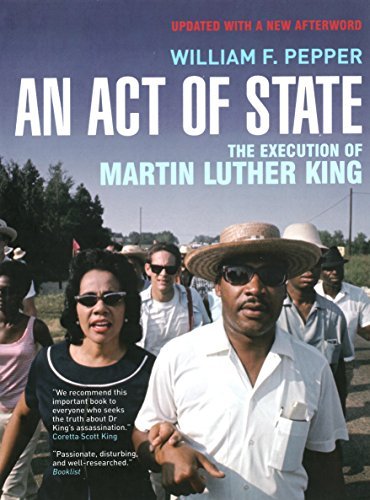
Martin Luther King Jr was a powerful and eloquent champion of the poor and oppressed in the US, and at the height of his fame in the mid-sixties seemed to offer the real possibility of a new and radical beginning for liberal politics in the USA. However,in 1968, he was assassinated; the movement for social and economic change has never recovered.
The conviction of James Earl Ray for his murder has never looked even remotely safe, and when William Pepper began to investigate the case it was the start of a twenty-five year campaign for justice. At a civil trial in 1999, supported by the King family, seventy witnesses under oath set out the details of the conspiracy Pepper had unearthed: the jury took just one hour to find that Ray was not responsible for the assassination, that a wide-ranging conspiracy existed, and that government agents were involved.
An Act of State lays out the extraordinary facts of the King story—of the huge groundswell of optimism engendered by his charismatic radicalism, of how plans for his execution were laid at the very heart of government and the military, of the disinformation and media cover-ups that followed every attempt to search out the truth. As shocking as it is tragic, An Act of State remains the most compelling and authoritative account of how King’s challenge to the US establishment led inexorably to his murder.
Attorney who is mostly known for his efforts to prove the innocence of James Earl Ray & Sirhan Sirhan.
Pepper is involved in Human Rights Law. He has written opinions on the German Border Guards case and more recently an opinion on the application of international law in the Spanish prosecution of individuals relating to war crimes committed post 9/11.
For a time he convened the International Human Rights Seminar at Oxford University, during which time individuals such as Hugo Chavez, the President of Venezuela, accepted invitations to address the seminar. He lives primarily in the United States.
There is a nagging disconnect that arises in Pepper's narrative. I read this book in response to a request from a friend, who offered it as an explanation of his rejection of the scientific evidence for climate change. He is a scientist, so I have found his refusal to accept the scientific consensus, well, baffling. But it is more baffling to try to see this book as an answer, directly, to the charge of global warming. Still, taking the book on its own terms, which set out to repudiate the "official" one-gunman theory behind the conviction of James Earl Ray, one needs accept a conspiracy theory of the US government, across different agencies and commands, conducting sinister machinations to destroy a single man who threatened the status quo.
Undoubtedly, there are several factors that make one want to give Pepper a full hearing. For instance, there is no question that the state, in the form at least of J. Edgar Hoover and perhaps an increasingly impatient LBJ, had become disenamoured with MLK's efforts. The fact that the King family, notably Coretta Scott and her son Dexter, has endorsed Ray's insistence of innocence, or at least that he wasn't the single perpetrator for which he served more than three decades in prison.
But there is a kind of digressive scattershot attention in Pepper's presentation here. He keeps flipping over stones and shouting loudly, without really addressing the larger likelihoods and conclusions found by an array of people who have examined, thoroughly, the same evidence. I read, at the same time as I read "An Act of State," several other books about KIng, the assassination, and the whole edifice of conspiracy claims. Some, like Gerald Posner's "Killing the Dream," Pepper confronts; others, like Hampton Sides' "Hellhound," he doesn't. But especially from reading the multiple accounts at the same time, it becomes almost painfully clear how much less lucid Pepper is than his opponents. He never seems to really accept why he lost the court case to defend Ray. Sure, he reiterates that it was a conspiracy, a collaborative skewing among the most powerful interests of government and national power, but he doesn't really substantively address the shortfall in compelling evidence that allows new observers to make objective, broad conclusions about the force of evidence. And that is, in the end, what his task as Ray's defendant was to do. I cannot ever truly know, of course, whether there were or were not some form of governmental interference, but for now, I have to admit not being convinced that it was other than the official record indicates.
In this book, written by the man who defended James Earl Ray and whom Coretta Scott King asked to write this story, you will find the America President Eisenhower warned us about in the Military/Industrial Complex. This is no conspiracy theory, and after you read this you will be ready to watch The Men Who Killed Kennedy available on Netflix.
This is a very informative and interesting book. Never having known much about the MLK assassination, I was ready to be given a plausible, but not altogether convincing theory of a conspiracy behind his murder. Being someone who neither accepts nor rejects outright most conspiracy theories, I was surprised to be completely convinced that MLK was not killed by James Earl Ray, but by the agencies and people named in the book. There is just too much evidence for it to be shrugged off as coincidental. Highly recommended, although statists probably won't like it, particularly the epilogue. My one beef is the fact that the book kind of jumps into the assassination without much background, which really confused me at first, along with the repetitive nature of going over the events in several different chapters. Nevertheless, I think everyone with an open mind should read this book.
This book presents a very plausible conspiracy theory. Like the man with one arm, we are given a series of views and pieces of information which contradict the official version of what happened.
To me, the most compelling evidence was the removal, at the behest of the MPD (Memphis Police Department) of all the bushes that would have, and quite probably did, provide cover for the assassin.
Did James Earl Ray kill Martin Luther King Jr? I suspect that anyone reading this book will become convinced that the answer is no.
The only reason this book gets three stars is that the story is much more succinct than the one presented in The Plot to Assassinate Martin Luther King Jr.
I am still unconvinced that Dr. King died as a result of the conspiracy portrayed in this book. I do believe the right man was convicted and spent the rest of his life in prison for being the coward he was. The troubling issue with the conspiracy against Dr. King is that it’s all over the place, with too many moving pieces to make sense. Based on how the book presents it, the supposed mastermind would have to be in the Southern Christian Leadership Conference while also wielding influence over the Memphis Police Department, the Marcello crime family, the U.S. Army, and the alleged handler of James Earl Ray. This person would have to be the ultimate puppet master.
Outside of the hearsay and conjecture, much information was omitted from this book that could have made for a stronger argument that: 1. James Earl Ray was innocent. 2. This was the precise conspiracy that assassinated Dr. King.
can at times be repetitive (it is written by a lawyer) but an illuminating story about a critical moment in history and the role the US government played in making sure everything went according to it’s own plan
As a case, Pepper's work is comprehensive and incisive. The US's miltary-industrial powers killed the people's best hope for a moral future. As a book, however, part 1 suffered from legal tedium and should have folded into part 2.
Pepper systematically and logically takes apart the official government story with decades of interviews and research.
He also spends a good chunk of time debunking a Department of Justice follow-up investigation began at the behest of the King family to Bill Clinton, an empassioned plea to find out the truth. Naturally, they don't.
Wake up call, eye-opener. Don't believe in conspiracies? Prepare to believe.
This entire review has been hidden because of spoilers.
If I could give this 10 stars, I would. It is the most thoroughly researched case that I have ever come across. As we near the 50th anniversary of Dr. King's most famous speech and are forced to endure ridiculous rose-colored memorials of his life and works as well as fairy tales about how far we've come, this book speaks a truth that truly honors the greatest man in American history.
This a wonderful book for anyone who wants to gain an inside look as to how the United States Government operates. When Dr. King shifted his agenda from civil rights to social justice, it was the beginning of the end for him.
I went into this already a skeptic on the theory that James Early Ray was a racist lunatic capable of shooting Martin Luther King, a prominent civil rights activist under police protection. In general I think single shooter assassination theories fall apart pretty quickly when examined critically. This book definitely fortified my belief in that and for that I give it props. That being said the information was presented in such a way that none of it really stuck with me, Pepper was name dropping left and right but it was not very organized. Having just read this book I don't think I would be prepared to convince a friend that MLK was not killed by James Earl Ray. This book also glossed over motive, briefly mentioning MLK's opposition to the Vietnam war, and that in most murders they always follow the money, but he never gave any specific examples of how the powers that be (such as Johnson or J Edgar Hoover) would have lost money if we left Vietnam. Furthermore the epilogue, instead of wrapping things together was just a vague condemnation of globalization I thought it was completely out of place. Overall I am going to give this book a 3.5, but I will round it to 4 because I am proud of Pepper's resilience despite his mediocre writing.
This could have been fascinating book but the author clearly needed to fill a certain amount of pages so basically rewrite the first of the book into the second half, then preached to everyone. He was capitalizing on knowing Dr. King and his family as much as possible and plugged his other work as much as possible, while making James Earl Ray sound as sweet and innocent as possible even though whether he was the assassin or not he certainly commuted other crimes!
At first difficult to follow, it then gets so repetitive that you want to stop following it at all. The structure (his own investigation, the court case, the states‘ argument in the case and then the findings of the DOJ investigation) literally means that everything is repeated four times. Four times. While this is an important book, a refuse to believe that there wasn’t a nether way of recounting the assassination of MLK and the ensuing cover up.
Pepper’s been indefatigable in pursuing justice and truth in this case. I am sure, myself, that the official story is a lie. I am not sure’s there is a stone Pepper has left unturned—but the most important aspects of his case seems to rest on unsteady shoulders. Worth reading, though.
Very interesting read. The refusal of Steve Tompkins to testify or his contacts to meet Pepper dampen the story. The actions of Shelby county are suspect. The DOJ task force very suspect. Maybe someday all the documents about this assassination will be unsealed.
Had a lot of great facts and some hauntingly true observations observations about the system even 20+ years later. The only thing that took away from it was that parts were so clearly written by a lawyer in both language and ego
This book is quite interesting and has a bias that will have the reader questioning the assassination of Dr. King. There should be questions regarding the murder; however, Pepper is scurrilous with his assertions. At one point, with no adequate proof, he makes a connection to Jack Ruby, the killer of Lee Harvey Oswald. The strength of this book is that he has researched some questionable shady Memphis underworld characters that ultimately were judged guilty of Dr. King's wrongful death. Therefore there is some merit to this book, but the book destroys what credibility it has with innuendo and unsubstantiated gossip. .
Gullible nonsense. No one can read this book with an open mind and not come to the conclusion that Pepper's "witnesses" are mostly opportunistic liars who provide absolutely no evidence. Pepper believes anyone who tells him what he wants to hear (even when it is later revealed that they have a commercial interest in spreading misinformation in the interest of self-enrichment). His acceptance of Beverly Oliver's veracity is sadly illustrative. Oliver was a dancer and singer who worked for club-owner Jack Ruby in Dallas, Texas. In the 70's she came forward and famously claimed that she had been in Dealey Plaza and had filmed the assassination of President Kennedy with a Yashica Super-8 Zoom camera. She also claimed that Lee Harvey Oswald had visited Ruby's club prior to the assassination and had been introduced to her by Ruby as "my friend Oswald from the C.I.A." The problem is that no such camera existed in 1963 and that secretive CIA agents usually don't get introduced to unimportant strangers by having their undercover status outed. Not to mention that Oswald's family always lived in poverty, not a problem for most people employed by U.S. intelligence. This type of gullibility pervades the entire book as Pepper elaborates on a vast government conspiracy involving President Johnson, military intelligence, JFK's *real* assassins, the mafia and others to assassinate King and frame James Earl Ray. The more prosaic truth is that James Earl Ray, a white supremacist, assassinated Dr. King. He may have had help from unknown conspirators (perhaps his brothers) but he undoubtedly pulled the trigger. One of Pepper's star witnesses is Loyd Jowers, a Memphis restaurant-owner, who came forward with a confession of involvement in the assassination conspiracy right after the release of Oliver Stone's pro-conspiracy blockbuster film "JFK." His co-workers later came forward to state that Jowers had asked them to publicly back up his fabrication in the hopes of making a lucrative movie deal. In the civil court case that followed, the defense (Jower and his lawyers) began the case by stipulating that the accused was guilty as charged. Thus, with the accused, his lawyers and the prosecution *all* agreeing to a conspiracy the jury had no choice but to find Jowers guilty. All that was requested in the suit was $100 from the accused. Undoubtedly, thanks to folks like Pepper, Ray went laughing to his grave.
MLK's killing in Memphis in '68 has been a dark unsolved mystery for me these past years. After reading the late Prof. Philip Melanson's 'The Assassination of Martin Luther King, Jr.' (New York: SPI Books, 1991). Paperback edition, 1994, which provided many pointers in the right direction, but left many strands of this complex case unexplained. 1998 saw Gerald Posner's 'Killing the Dream' and although Posner has been hailed as a great investigator, I've never been so gullible to waste my money on his pro-government propaganda books. 'Case Closed' says it all. Hampton Sides' 'Hellhound on his Trail' (2010) was another book to follow the 'official' line of the lone nut James Earl Ray/Eric Starvo Galt stalker. Finally I read Hancock & Wexler's 'The Awful Grace of God' that scrutinised racist militants but did include a brief section on Pepper's Civil Court conspiracy verdict.
'An Act of State' (2003), updated 2008 is the culmination of William Pepper's admirable and tenacious probe of over twenty years, that finally resulted in the King/Jowers Civil trial of 1999. The result is a compelling and highly disturbing monster collection of never before heard testimonies and convincing evidence that brings revelations to this case previously ignored. No longer the dark unsolved mystery. Although bringing Loyd Jowers' confessions of participation in King's murder to a public forum, Pepper aims his charge of conspiracy at FBI, CIA, Military Intell., Memphis Police and Mafia don Carlos Marcello. We learn that James Earl Ray was the usual innocent patsy. What a surprise! We also finally get a plausible identity for the mysterious patsy controller, Raul, as well as the real Eric S. Galt. In explaining the Machiavellian forces aimed at MLK in Memphis, the reader is hit with a veritable avalanche of names of suspects, bagmen, spooks and witnesses that piece together what really happened at the Lorraine Motel in April 1968, which crumbles the official fiction. The jury who heard the evidence over four weeks in the Civil trial took just one hour to reach their verdict. Jowers participated in the conspiracy to kill King, along with others including government agencies were parties to the conspiracy. I didn't need one hour to concur. As Pepper eloquently writes in his Epilogue, we certainly should not treat this state execution as unimportant old history. It's our own civil rights in the cross hairs now!
To say there's a hole in the government's explanation for Martin Luther King Jr.'s assassination is an understatement because their explanation is nothing but a giant hole. Whether you believe everything that Mr. Pepper proposes, the evidence is overwhelming that James Earl Ray didn't kill MLK and was actually just a patsy who knowingly played just a tiny role in the actual event. For that, I loved this book and it will be memorable for me. This is a must-read for anyone curious on the subject. I won't give away any more spoilers only to say that this cover-up is a shame not only for its effect on MLK, his loved ones, and his movement, but also the countless innocent people who were killed or whose lives were ruined for speaking the truth.
I read the first 200 pages or so and skimmed through the legalese in the final third of the book. Pepper is clearly a lawyer and not a narrator while I am clearly not a lawyer. I imagine most historical readers will see it like me where they'll find parts of the book tedious only because Pepper was being legally thorough. But if you don't care about that, just skip those parts and I think you will still be much enlightened by his book.
If you are of both a historical and legal bent, you can really get a lot out of it. Don't expect a free-flowing Bill O'Reilly/Sam Dugard true crime narrative or you will be disappointed. Read it because you want to know what happened!
As a mostly lifelong Memphian, I'm more than willing to believe there is an alternate narrative to the generally accepted story that James Earl Ray was the lone assassin of Martin Luther King, Jr. There are several disturbing details that have emerged since the House Select Committee on Assassinations all the way through several FOIA requests and National Archives declassifications.
And yet...
Pepper's narrative devolves into disjointed madness. I can't tell whether he is grasping at straws, has spent too much time down the proverbial rabbit hole or there's something else fundamentally wrong.
There are some interesting tidbits. But this isn't worth the cognitive load required to follow Pepper's story line.
Incredible. A generally very readable and comprehensive account of Pepper's thirty year investigation into the assassination, or more appropriately execution, of MLK that leaves little doubt as to the total involvement of the American state, establishment and organised crime.
Includes epilogue and afterwords that touch on the necessity of MLKs assassination from the states perspective, the void of progressive leadership thereafter and the progress of the American state towards totalitarian fascism today.