Ann Zwiger tells in beautiful and simple language, illustrated by her own superb drawings, of forty acres of meadow, lake, marsh and forest in the Rocky Mountains of Colorado - of the algae and dragonflies, of deer and jays that live in the clear air at 8,300 feet above sea level. Here summer is short and winter long and often harsh, and much of life exists on the margin: in good years the grasses are lush; in bad years even the mice starve. But always it is a place of all seasons.
This book is a must read for any nature-lover living in Colorado! She explains scientific concepts, like succession and a host of others, so helpfully and beautifully that you really walk away with a greater understanding of things that if you met first in a dry textbook would choke you. All of her illustrations are superb. I will definitely use this book to reference and help identify what I am seeing around me. This book is pretty much like opening up the most inspiring nature teacher's own nature journal. It is broken up into short sections that are easy to digest, so I will probably read again over a longer period of time chewing on one section at a time.
I've been reading this one at work on my breaks over a number of weeks.
Ann Zwinger is a great nature writer and her illustrations are superb. We get a real sense of place and setting from her writing, and the essence of seasonal change.
I really love her descriptive ability.
The book is only a 3 star however as there was a little bit of contradiction in there. For a family wanting a hands-off approach to the land, they certainly "meddled" their fair share, damming water sources and pissing about with chemicals to kill certain types of water weeds. Zwinger more than once mentions trying to re-route ants or insects to see how they'd react. This type of interfering didn't sit well so it zapped the star rating down for me.
Still a good nature read. A little bit too long but interesting.
Truly classic natural history, not only in it's prose but as a primer for field study at it's best. This will inspire any wanderer in nature in the true spirit of the quest for the endless bounty and curiosity to be found at your doorstep.
When I think about my goals as an aspiring writer, Beyond The Aspen Grove is my first thought. If I could create such a beautiful picture of an ecosystem, I would die happy. Zwinger know her ecosystem well and can draw it. What differs it from a science textbook is because it also lets you feel the ecosystem. And that is Zwinger's true accomplishment, few scientist truly base their work in peotry and few poets truly base their work in science. This is what sets this book apart.
To understand this mountain world, one must start far away at the Mississippi River where the Great Plains begin to slope toward the Rocky Mountains, come west across Missouri to Kansas, where there is more space than there are towns, where the horizon line is blurred by tall grass and grain, punctuated by silos, church spires, and cottonwoods growing along streams.
It is difficult for me to keep my mind on reading. The breeze disturbs the page, the birdsong disturbs my concentration, and all sounds combine to lure my eye away from the text. It is easy to lower the book, then turn it back up on my lap, and to look into the woods for what is written there. It is often then, when the mind is receptive and relaxed, that one sees the most.
I believe this was the author's first book, and it is surprisingly bare of many of the observations she will become famous for in later books, especially about the canyon country of Utah and Arizona. I had so looked forward to her eye on the land I have loved for almost 25 years now in Colorado, and there are gems of description and patterns to the life on the land in the mountains.
Fall comes at its own pace in this grove. Protected by surrounding ridges, these trees may not turn until the first week in October. All in a few days they become fired with blazing light, a torch holding back the winter frosts. On a Thursday they are still green; on a Sunday, they are golden. The leaves range from citron to copper, saffron to gilt, glowing with light. They shower down with each gust of coming winter, buttering the still-bloom-ing lupine, catching the purple asters and the last black eyed Susans. The mahogany-red rose bushes snag them. The juniper waylays them in needled branches, holding them upright in a card file of autumn. The Danain shower of gold enriches the ground. The sweet musty smell of fall is inches thick under the hammock. It is a fragrance of aspen dust and honey and sunshine. The air is golden, as rich and sweet and heavy as an old wine. The trunks, reflecting the light and the fallen leaves, are gilded. The silence is soft and warm and full, between intermittent rustlings of gold tissue paper wrapping up the glow of summer, dissolving in the permeating golden light.
This lake is the eye of the land. The land's changes are sea-onal, expected; the lake's are swift, expressive, momentary, subtle. The lake changes from rain-dimpled to sparkling blue to flat brown within the hour, from misty sheen to bottomless black within the day. Looking down from my ridge above the lake, I see the water, dark, clear, and deep. Sitting among the sedges at the edge, the surface gleams wide, flat, and opaque. The deepest part of the lake is about twelve feet and lies off center, toward the dam. The dam was built long before we came here, across the narrows of a ravine where a beaver dam had been.
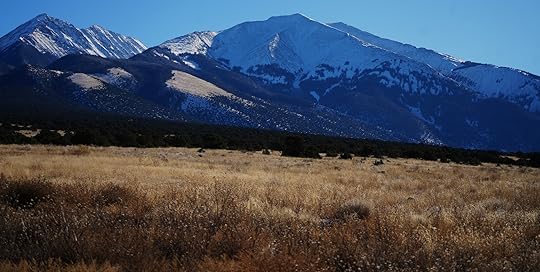
Not quite where she had a cabin, but here is recent photo of the San Luis Valley for an idea of what the lower land of her area could have been...
Superb. Anyone interested in the Rocky Mountains, and natural history in general, should find this book appealing. Zwinger's style is approachable and engaging. This book was a labor of love, and it's a work of art.
I discovered this illustrated (by the author) book because Barry Lopez considered Zwinger a mentor and friend and mentioned this book in his acknowledgments as one of the reasons he turned to writing natural history. Constant Friendship is the name of the 40 acres at 8300 feet in the Rockies her family owned. Her lyrical detail of the flora and fauna is like a guidebook. Every species of grass and wildflower, moss and lichen, tree and meadow is described and sketched. Yet, it is a very personal narrative as well--a place where she raised her children and enjoyed the company of many friends. Their campsite turned gazebo turned cabin and finally homesite evolves throughout the story. Written in 1970 with 80 pencilled illustrations, one engraved on the hardback cover, this is keeper.
An artist and her family in the 60's have a cabin on the front range at 8300 feet. She describes the various ecosystems and its' denizens thru the seasons. Beautiful sketch plant drawings
Literary Reflections Editor Andrea Lani adds a selection for lovers of the natural world: "I'm deep into Beyond the Aspen Grove, Ann Zwinger's lush and minutely detailed account of the flora and fauna of her family's home-away-from-home in the Colorado Rockies. Zwinger's passion for the tiniest and most lowly characters on the land (a whole page on the snow flea!) is contagious. Through a combination of precise, scientific terminology and accessible, humorous diction—not to mention gorgeous black-and-white illustrations—Zwinger manages to convey a wealth of natural history information without coming off as boring or pedantic. Her occasional references to her husband and three daughters and her life back home as a 'city housewife' make her writing relatable to those of us who wander after birds and bugs and wildflowers with a host of responsibilities tugging us back home."