

What do you think?

Works of J. Clark
John Clare is one of the foremost "peasant poets" of the English language. His fascination with the countryside, with nature and with the seasons and their changing moods marks a departure from the formal pastoral verse of the 18th century.
- GenresPoetry19th Century
176 pages, Paperback
First published January 1, 1872
About the author
John Clare
331 books114 followersJohn Clare was an English poet, in his time commonly known as "the Northamptonshire Peasant Poet", born the son of a farm labourer at Helpston (which, at the time of his birth, was in the Soke of Peterborough, which itself was part of Northamptonshire) near Peterborough. His poetry underwent a major re-evaluation in the late 20th century and he is often now considered to be one of the most important 19th-century poets.
For other authors with this name see: psychotherapist and artist John Clare, history educator John D. Clare and John Clare.
For other authors with this name see: psychotherapist and artist John Clare, history educator John D. Clare and John Clare.
Ratings & Reviews
Friends & Following
Create a free account to discover what your friends think of this book!
Community Reviews
Displaying 1 - 2 of 2 reviews

November 4, 2020
“If life had a second edition, how I would correct the proofs.”
Tomorrow, 5 November 2020, we will be confined to quarters for at least a month (except for exercise and essential food shopping) because of the ongoing Covid pandemic. It’s autumn, and I’m fortunate to live amid gorgeous countryside. I need to immerse myself and appreciate what I have. Maybe you do too.
John Clare was a 19th century agricultural labourer, who left school aged 12, spent many years in mental asylums, but was also a prolific poet, writing painfully beautiful poems about the natural world and also about his struggles with identity, estrangement, and reality. We will be locked down; he was locked up, and he speaks to us today.
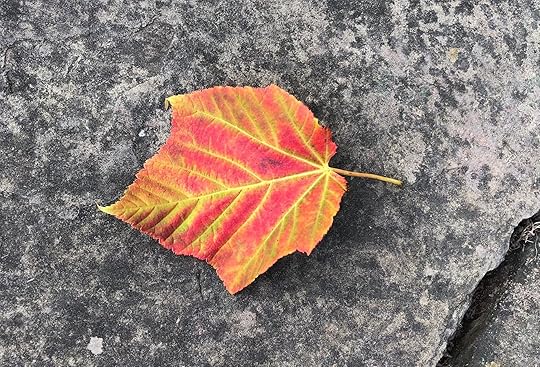
Image: Contrast at an arboretum, 12 September 2020
"All nature has a feeling"
We are creatures of the earth: our food and water come from it, the seasons determine the weather, the amount of daylight, our mood, what food is available, and one day, we will be part of the earth itself, as our forebears already are. The circles of life - and death. I think that’s why time immersed in natural environments is so restorative. For city-dwellers, it’s contrast and respite; for rural dwellers, it’s part of our conscious being. It may also connect us to memories of carefree childhood: making camps, building sandcastles, paddling in streams, following animal prints, identifying plants, listening for birdsong, and climbing trees.
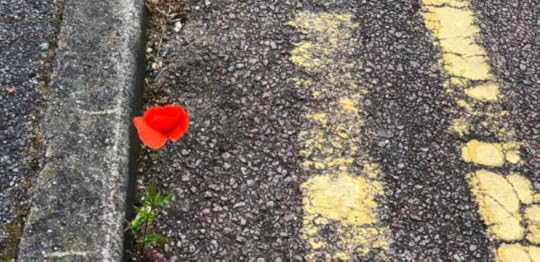
Image: Nature finds a way: wild poppy pushing through tarmac at the bottom of our road
"I Am!"
The title is one of the shortest, simplest sentences, a powerful statement of self, but also potentially blasphemous (in Exodus 3:14, when Moses sees the burning bush and asks its meaning, God replies “I am who I am. This is what you are to say to the Israelites: ‘I am has sent me to you.’”). It’s one of his final poems, and ends with his craving the peace of both childhood and death. In turbulent times, even those of us fortunate not to be as troubled as Clare can relate to that.
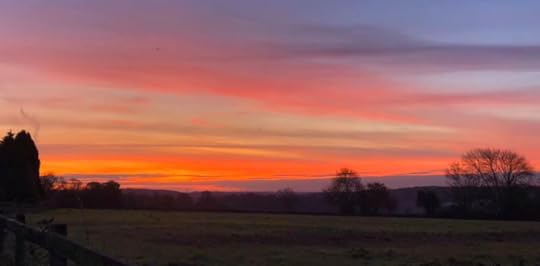
Image: Vaulted sunrise sky, driving to work, November 2019
"Autumn"
It’s autumn here. The sun is shining. Even in lockdown, I’m allowed to walk the rolling wooded hills, gasp at the gradually gilded palette of trees, and relish the crunch of fallen leaves.
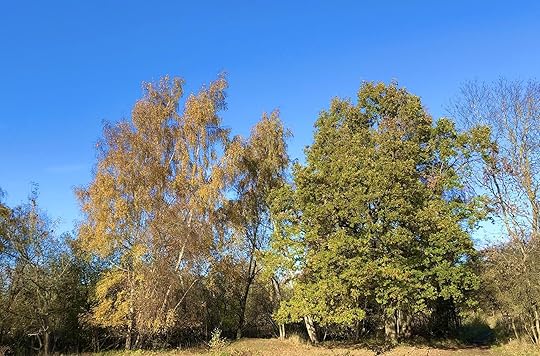
Image: Blue skies for first day of our second lockdown, 5 November 2020
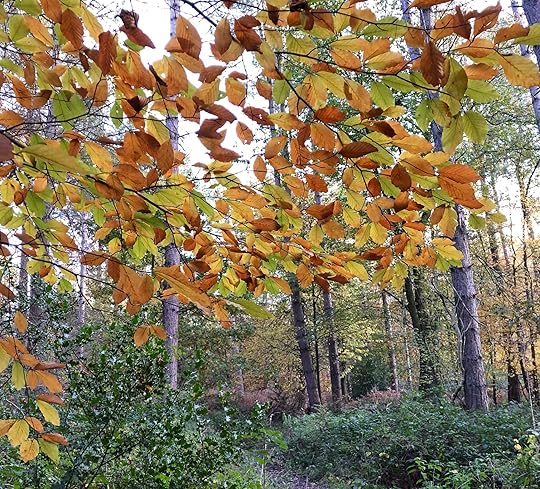
Image: Autumn leaves (mostly beech), 6 November 2020
There are five lovely photos above; apologies if you can't see them in the GR phone app, but they're fine in a laptop browser.
Tomorrow, 5 November 2020, we will be confined to quarters for at least a month (except for exercise and essential food shopping) because of the ongoing Covid pandemic. It’s autumn, and I’m fortunate to live amid gorgeous countryside. I need to immerse myself and appreciate what I have. Maybe you do too.
John Clare was a 19th century agricultural labourer, who left school aged 12, spent many years in mental asylums, but was also a prolific poet, writing painfully beautiful poems about the natural world and also about his struggles with identity, estrangement, and reality. We will be locked down; he was locked up, and he speaks to us today.
Image: Contrast at an arboretum, 12 September 2020
"All nature has a feeling"
We are creatures of the earth: our food and water come from it, the seasons determine the weather, the amount of daylight, our mood, what food is available, and one day, we will be part of the earth itself, as our forebears already are. The circles of life - and death. I think that’s why time immersed in natural environments is so restorative. For city-dwellers, it’s contrast and respite; for rural dwellers, it’s part of our conscious being. It may also connect us to memories of carefree childhood: making camps, building sandcastles, paddling in streams, following animal prints, identifying plants, listening for birdsong, and climbing trees.
Image: Nature finds a way: wild poppy pushing through tarmac at the bottom of our road
All nature has a feeling: woods, fields, brooks
Are life eternal; and in silence they
Speak happiness beyond the reach of books;
There's nothing mortal in them; their decay
Is the green life of change; to pass away
And come again in blooms revivified.
Its birth was heaven, eternal is its stay,
And with the sun and moon shall still abide
Beneath their day and night and heaven wide.
"I Am!"
The title is one of the shortest, simplest sentences, a powerful statement of self, but also potentially blasphemous (in Exodus 3:14, when Moses sees the burning bush and asks its meaning, God replies “I am who I am. This is what you are to say to the Israelites: ‘I am has sent me to you.’”). It’s one of his final poems, and ends with his craving the peace of both childhood and death. In turbulent times, even those of us fortunate not to be as troubled as Clare can relate to that.
Image: Vaulted sunrise sky, driving to work, November 2019
I am—yet what I am none cares or knows;
My friends forsake me like a memory lost:
I am the self-consumer of my woes—
They rise and vanish in oblivious host,
Like shadows in love’s frenzied stifled throes
And yet I am, and live—like vapours tossed
Into the nothingness of scorn and noise,
Into the living sea of waking dreams,
Where there is neither sense of life or joys,
But the vast shipwreck of my life’s esteems;
Even the dearest that I loved the best
Are strange—nay, rather, stranger than the rest.
I long for scenes where man hath never trod
A place where woman never smiled or wept
There to abide with my Creator, God,
And sleep as I in childhood sweetly slept,
Untroubling and untroubled where I lie
The grass below—above the vaulted sky.
"Autumn"
It’s autumn here. The sun is shining. Even in lockdown, I’m allowed to walk the rolling wooded hills, gasp at the gradually gilded palette of trees, and relish the crunch of fallen leaves.
Image: Blue skies for first day of our second lockdown, 5 November 2020
The thistledown's flying, though the winds are all still,
On the green grass now lying, now mounting the hill,
The spring from the fountain now boils like a pot;
Through stones past the counting it bubbles red-hot.
The ground parched and cracked is like overbaked bread,
The greensward all wracked is, bents dried up and dead.
The fallow fields glitter like water indeed,
And gossamers twitter, flung from weed unto weed.
Hill-tops like hot iron glitter bright in the sun,
And the rivers we're eying burn to gold as they run;
Burning hot is the ground, liquid gold is the air;
Whoever looks round sees Eternity there.
Image: Autumn leaves (mostly beech), 6 November 2020
There are five lovely photos above; apologies if you can't see them in the GR phone app, but they're fine in a laptop browser.

June 3, 2019
I enjoyed it.
Displaying 1 - 2 of 2 reviews