Jump to ratings and reviews
Rate this book

A Great and Glorious Game: Baseball Writings of A. Bartlett Giamatti

Rate this book
With a foreword by David Halberstam. He spoke out against player trading. He banned Pete Rose from baseball for gambling. He even asked sports fans to clean up their acts. Bart Giamatti was baseball's Renaissance man and its commissioner. In A GREAT AND GLORIOUS GAME, a collection of spirited, incisive essays, Giamatti reflects on the meaning of the game. Baseball, for him, was a metaphor for life. He artfully argues that baseball is much more than an American "pastime." "Baseball is about going home," he wrote, "and how hard it is to get there and how driven is our need." And in his powerful 1989 decision to ban Pete Rose from baseball, Giamatti states that no individual is superior to the game itself, just as no individual is superior to our democracy. A GREAT AND GLORIOUS GAME is a thoughtful meditation on baseball, character, and values by one of the most eloquent men in the world of sport.

121 pages, Paperback

First published January 4, 1998

4 people are currently reading
390 people want to read

About the author

David Halberstam

97 books857 followers
David Halberstam was an American journalist and historian, known for his work on the Vietnam War, politics, history, the Civil Rights Movement, business, media, American culture, and later, sports journalism. He was awarded a Pulitzer Prize for International Reporting in 1964.

Halberstam graduated from Harvard University with a degree in journalism in 1955 and started his career writing for the Daily Times Leader in West Point, Mississippi. In the late 1950s and early 1960s, writing for The Tennessean in Nashville, Tennessee, he covered the beginnings of the American Civil Rights Movement.

In the mid 1960s, Halberstam covered the Vietnam War for The New York Times. While there, he gathered material for his book The Making of a Quagmire: America and Vietnam during the Kennedy Era. In 1963, he received a George Polk Award for his reporting at the New York Times. At the age of 30, he won a Pulitzer Prize for his reporting on the war. He is interviewed in the 1968 documentary film on the Vietnam War entitled In the Year of the Pig.

Halberstam's most well known work is The Best and the Brightest. Halberstam focused on the paradox that those who shaped the U.S. war effort in Vietnam were some of the most intelligent, well-connected and self-confident men in America—"the best and the brightest"—and yet those same individuals were responsible for the failure of the United States Vientnam policy.

After publication of The Best and the Brightest in 1972, Halberstam plunged right into another book and in 1979 published The Powers That Be. The book provided profiles of men like William Paley of CBS, Henry Luce of Time magazine, Phil Graham of The Washington Post—and many others.

Later in his career, Halberstam turned to the subjects of sports, publishing The Breaks of the Game, an inside look at the Bill Walton and the 1978 Portland Trailblazers basketball team; an ambitious book on Michael Jordan in 1999 called Playing for Keeps; and on the pennant race battle between the Yankees and Red Sox called Summer of '49.

Halberstam published two books in the 1960s, three books in the 1970s, four books in the 1980s, and six books in the 1990s. He published four books in the 2000s and was on a pace to publish six or more books in that decade before his death.

David Halberstam was killed in a car crash on April 23, 2007 in Menlo Park, California.

Ratings & Reviews

What do you think?
Rate this book

Friends & Following

Create a free account to discover what your friends think of this book!

Community Reviews

5 stars
148 (43%)
4 stars
131 (38%)
3 stars
49 (14%)
2 stars
7 (2%)
1 star
4 (1%)
Displaying 1 - 30 of 61 reviews
Profile Image for Theo Logos.
1,270 reviews288 followers
June 11, 2025
”It breaks your heart. It is designed to break your heart. The game begins in the spring, when everything else begins again, and it blossoms in the summer, filling the afternoons and evenings, and then as soon as the chill rains come, it stops and leaves you to face the Fall alone. You count on it, rely on it to buffer the passage of time, to keep the memory of sunshine and high skies alive, and then just when the days are all twilight, when you need it most, it stops.”


A Great And Glorious Game belongs to the sub genre of erudite men writing about baseball. Giamatti, who was president of Yale prior to serving as president of the National League and briefly as baseball's commissioner, waxes poetically about the game, complete with references and allusions to Henry James, Jane Austin, Alexis de Tocqueville, and Odysseus.

At times Giamatti seems to trip over his own eloquence, and perhaps because this collection was assembled from his writings after his untimely death, it can sometimes feel repetitive. Yet his phrasing is beautiful, his passion for the game is palpable, and at least two of his short essays here collected (The Green Fields Of The Mind, and Recall As The Series Ends The Afternoon Of The Fall) are the most evocative and moving pieces you will ever read about baseball. If you love words and you love baseball, read this book.
Profile Image for Quo.
343 reviews
September 17, 2020
It seems fitting to do a review of A Great & Glorious Game: Baseball Writings of A. Bartlett Giamatti just after the Chicago Cubs have gained a 7th game victory in the World Series, their first World Series since 1945 & the first one where they were victorious since 1908, concluding rather a long stretch of futility. But as diehard Cubs fans like to say, "Any team can have a bad century!"


This is a book that, while somewhat narrowly focused & which might not interest anyone who does not find following the baseball season an important facet of their life, is exceedingly memorable for its prose. The book concerns itself with the fabric of life in general almost as much as baseball. A Great & Glorious Game is a baseball book I find very compelling, along with the writings of Roger Angell & perhaps the most memorable piece of writing about baseball I have ever read, "Hub Fans Bid Kid Adieu", John Updike's wonderful account of Ted Williams' final game at Fenway Park, a long-ago essay in The New Yorker. But unlike some other books on the game, Giamatti's writing is like a very reflective elegy for baseball, especially the chapter titled "The Green Fields of the Mind", serving as a kind of requiem at season's end. However, this book is also an eminent song of praise for the sport as well. As an example, consider these words:
It breaks your heart. It is designed to break your heart. The game begins in the spring when everything else begins again, and it blossoms in the summer, filling the afternoons & evenings, and then as soon as the chill rains come, it stops & leaves you to face the fall alone. You count on it, rely on it to buffer the passage of time, to keep the memory of sunshine & high skies alive, and then just when the days are all twilight, when you need it the most, it stops. Today, a Sunday of rain & broken branches & leaf-clogged drains & slick streets, it stopped, and summer was gone. Somehow, the summer seemed to slip by faster this time. Maybe it wasn't this summer, but all summers that have slipped by so fast.
Giamatti seems to assign such intense meaning to the game of baseball, employing the game as a tonic, with "the green fields of the mind" serving as a tool to deal with the forces of change and aging, as well as the long winters without baseball games to fall back on. But what could one expect from a man who left the presidency of Yale University to become the commissioner of baseball, not considering this move anything but a step up. He uses a particular heartbreaking playoff loss by the Red Sox to the Yankees to speak of a "rough justice, how slight & fragile are the circumstances that exalt one group of human beings over another." Giamatti goes on to write that the game....
breaks my heart because it was meant to, because it was meant to foster in me again the illusion that there was something abiding, some pattern & some impulse that could come together to make a reality that would resist the corrosion; and because, after it had fostered the most hungered-for illusion, the game was meant to stop & betray precisely what it had promised.

Of course there are those who learn after the first few times. They grow out of sports. And, there are those who are born with the wisdom to know that nothing lasts. These are the truly tough amongst us, the ones who live without illusion, or even without the hope of illusion. I am not that grown-up or up-to-date. I am a simpler creature, tied to more primitive patterns & cycles. I need to think that something lasts forever, and it might as well be that state of being that is a game; it might as well be that, in a green field, in the sun.
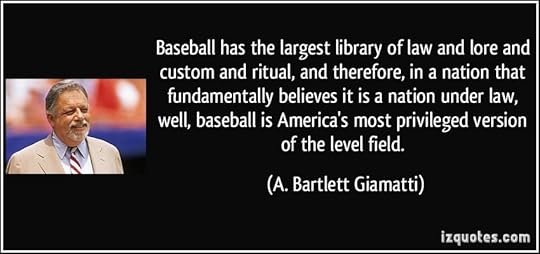
Prof. Giamatti would have reveled in the 2016 World Series, though he might have been more than a little distracted by the presence of Pete Rose as one of 3 former players assigned to interpret the World Series for the network that broadcast the games. For, it was A. Bartlett Giamatti who issued a lifetime ban from baseball on Pete Rose, who is the major league's all-time leader in hits, at bats & games played, thus far denying Rose entry into the Baseball Hall of Fame. Belatedly, Pete Rose, banned for gambling on baseball games, admitted that he had gambled on games almost incessantly but according to Rose, never on games that he was actively involved in. This book includes Giamatti's statement released to the press on the "Pete Rose Matter".


Giamatti's favored Red Sox finally broke the "Curse of the Bambino" (not having won the World Series since Babe Ruth was traded to the Yankees in 1919) in 2004, though the author had died several seasons before that World Series. And, for the Chicago Cubs to have finally surmounted a long history of assorted curses & decades of rather inept play at fabled Wrigley Field, the 2016 season represents for Cubs fans & many other baseball enthusiasts, a time that while perhaps not necessarily exalting a particular team, still did much more than just stall the passage of time, at least in the "green fields of the mind".
Profile Image for Colin O'Grady.
15 reviews5 followers
July 10, 2008
Everything you would expect from a man who was a comp lit professor, President of Yale, and Commissioner of baseball... maybe I'm biased because he combines my two passions--literature and baseball--but I have never found anyone who could put their finger on the ineffable transcendence of baseball the way that Giamatti could. In these essays, you get a picture of a man that loved baseball and life equally. The opening paragraph of "The Green Fields of the Mind" captures the game like nothing else I've ever read:

"It breaks your heart. It is designed to break your heart. The game begins in the spring, when everything else begins again, and it blossoms in the summer, filling the afternoons and evenings, and then as soon as the chill rains come, it stops and leaves you to face the fall alone. You count on it, rely on it to buffer the passage of time, to keep the memory of sunshine and high skies alive, and then just when the days are all twilight, when you need it most, it stops. Today, October 2, a Sunday of rain and broken branches and leaf-clogged drains and slick streets, it stopped, and summer was gone."

With the way he uses baseball as a symbol of both timelessness and finality, perhaps he was always meant to leave the game too early. I honestly believe that had he not passed away in 1989 after only six months in charge of the sport, we would never have gone through the strike or the steroid scandal; see his handling of Pete Rose, which he writes about in this collection, for his take on those who compromise the integrity of the game. Bud Selig and every owner and every player would do well to read the words of baseball's true renaissance man and to absorb some of the true love that he held in his heart for America's pastime.
Profile Image for Steve Kettmann.
Author 14 books98 followers
May 2, 2010
My review from the San Francisco Chronicle in 1998:

A. Bartlett Giamatti: Baseball's Great Mind -- and Heart
REVIEWED BY, Steve Kettmann

Sunday, July 5, 1998


A GREAT AND GLORIOUS GAME
By A. Bartlett Giamatti

Edited by Kenneth S. Robson Algonquin; 121 pages; $15.95


--------------------------------------------------------------------------------
If you're sick of the sad spectacle of watching Milwaukee Brewers owner Bud Selig carry on as baseball's clown-commissioner, take a look at this fascinating little reminder of what real passion from the game's leadership can mean.
A. Bartlett Giamatti, the former Yale comp lit professor and president, spent only five months as commissioner before his death in 1989. He should not have cast so long a shadow after so short a tenure, but this was a man with a burning moral imagination, and the clarity and force of that imagination remain accessible even today, as conveyed in ``A Great and Glorious Game.''

Giamatti's musings on the summer game were all over the map. They could be brilliant and insightful, and they were always learned and considered, but they could also venture well past mawkish. But so what? What's wrong with going overboard in love? Here's a representative flight:

``The game is quintessentially American in the way it puts the premium on both the individual and on the team; in the way it encourages enterprise and imagination and yet asserts the supreme power of the law,'' Giamatti wrote in 1981. ``Baseball is quintessentially American in the way it tells us that much as you travel and far as you go, out to the green frontier, the purpose is to get home, back to where the others are, the pioneer ever striving to come back to the common place.''

A strong argument can be made that this sort of heavy-duty theorizing has injured baseball. The game is undoubtedly an American institution, but one that may have been overburdened with the role of national religion that Giamatti and others (see under Will, George) have foisted upon it. The game, after all, is nothing if not simple: See ball, hit ball.

That's why the best parts of this book of collected writings come when Giamatti stops playing intellectual virtuoso and just has fun. Talk to baseball men about Giamatti and they laugh off his stylistic excesses the way you laugh off a charming maiden aunt's cloying perfume. They hand him the ultimate compliment one baseball man gives another: He loved the game.

Giamatti went to St. Louis during the Giants-Cardinals playoff series in 1987 and learned a truth he would later have trouble keeping uppermost in his mind: Baseball makes you want to tell stories about it, and those stories are as important as the game. His description of the the Marriott Hotel lobby, crowded with players' families and fans and reporters and agents and all sorts of baseball- lovers, is priceless. In fact, it's a thousand times more precious than all his references to de Tocqueville or the umpire as parent figure.

The Giants' manager and coaching staff ``are like chiefs at a gathering of the clan, planning strategy, ignoring the celebrants while absorbing their energy,'' Giamatti wrote. The scouts and other longtime baseball men ``have seamed faces and eyes that seem to squint even in shade'' and ``stand with the poised patience born of watching a dozen thousand baseball games.

``. . .(T)he sound is a high, constant hum, a vast buzz of a million bees, the sound almost palpable and, for hours, never varying in pitch or intensity as anecdote vies with anecdote or joke or gossip or monologue or rude ribbing, so reminiscent of the clubhouse. It is the sound of tip and critique and prediction and second-guessing, of nasty crack and generous assessment, of memory cutting across memory, supplementing and correcting and coloring the tale, all the crosscutting, overlapping, salty, blunt, nostalgic, sweet conversation about only one subject -- baseball.''

It's sad that the man who produced this passage did not have longer to expand on so bountiful a vision. Two years later, just one week after making the agonizing decision to ban Pete Rose from the game for the unpardonable offense of undermining its integrity, Giamatti was gone.

http://sfgate.com/cgi-bin/article.cgi...

This article appeared on page RV - 9 of the San Francisco Chronicle
Profile Image for Jeff.
873 reviews21 followers
January 16, 2011
A Great and Glorious Game is a small book, but it is "great and glorious." Filling only 121 pages, it includes a handful of articles, speeches and press releases from a previous Commissioner of Baseball, A. Bartlett Giamatti. I did not know, when I picked up this little book, that Mr. Giamatti was the Commissioner who made the decision to ban Pete Rose from baseball for life. The press release concerning that decision is the final writing in this book, and was written only a week before his death. I have to wonder if the difficulty of that decision contributed at all to Giamatti's death. I don't know. But I do know that he labored long and hard over the decision. "The banishment for life of Pete Rose from baseball is the sad end of a sorry episode," he wrote. He then referred to Rose as "one of the game's greatest players."

There is an article about Tom Seaver, who, apparently was Giamatti's favorite player, embodying everything good about America and baseball in his eyes.

I also wasn't aware that Giamatti was a Red Sox fan. There is a nice little piece called, "Recall as the Series Ends, the Afternoon of the Fall." About this piece, the editor says, "This charming essay, published in 1978, captures the internal anguish of a Red Sox fan whose order and hope are cut down yet again by the Yankees at the end of the season." 'nuf ced.

The book opens with a most beautiful piece about baseball, called "The Green Fields of the Mind," which opens with the words, "It breaks your heart. It is designed to break your heart." I will forever remember those words. Well, at least for a long time... And how true it is. My heart has been broken more by baseball than by any other thing on this earth.

I fell in love with A. Bartlett Giamatti as I read this little book. I wish I had known him.
404 reviews26 followers
December 23, 2015
Though A Great and Glorious Game is just 120 small pages, I read it over the course of a week, choosing to enjoy each essay separately rather than devouring the book in a single afternoon. My thinking: The book is a posthumous collection of separate pieces; Giamatti never intended for these works, published over 12 years, to be bound together into a single volume. Also, proceeding slowly allowed me to appreciate Giamatti's recurring themes and core arguments about baseball. I'm guessing that reading the collection in one sitting would be frustrating, turning the recurring motifs into a repetitive drone because he frequently revisits many of his central concepts. The charm of Giamatti's consistency could become a curse if the various pieces are evaluated as a single book.

So a contradiction: I praise the various parts but find some fault with the book as a whole. And the various parts are superb; they capture the wonder, the magic, the significance of baseball. They are intelligent, thought provoking, and enjoyable. They delight and entertain. The essays can be a treat for any baseball fan, serious or casual.

One caution: Giamatti's language may be an acquired taste for some. He is erudite and quick to make references to the world outside baseball, references both modern and ancient, both simple and complex. If his language seems too scholarly and ornate by today's telegraphic "Twitter standards," I encourage readers to read along and enjoy the ride. With Giamatti, there's a lot to be learned and a lot to be enjoyed, especially if you savor each essay one at a time.
Profile Image for CLW.
1 review1 follower
February 21, 2016
A. Bartlett Giamatti, professor of English, president of Yale, president of the National League, commissioner of baseball, banisher of Pete Rose and father of Paul Giamatti, brought an academic sensibility to the game of baseball -- which is to say passionate, erudite, cerebral, eloquent. Decades before Ken Burns' polyphonic documentary -- many voices speaking the collective (collected) thoughts of one voice -- espoused how baseball mirrors the national character, there were Giamatti's writings. This book, a compilation of his essays published in Harper's and elsewhere, argues, much like Jacques Barzun's essay, that to understand America one must understand baseball.
Profile Image for Cody.
27 reviews1 follower
March 1, 2021
This (short) book is a collection of essays written by Bart Giamatti. While his run as commissioner was short (due to an untimely death) his passion and words for baseball are nothing short of magical. He stood for integrity and understanding the narrative that baseball creates. He was a scholar and cared deeply for the game. He makes you understand why the game is special and why so many folks come back to the green field every spring.
Profile Image for Sally Mouzon.
121 reviews6 followers
September 23, 2015
The writing is lovely, and some of the pieces are truly charming. I am not sure that it works as a book, as there is a sameness to most of the pieces. One or two would work in any anthology (my favorite is "Recall as the Series Ends, the Afternoon of the Fall"), but it seems like too much of a good thing in one volume.
Profile Image for Oliver Bateman.
1,516 reviews84 followers
January 5, 2023
want to read some egglant-purple prose from paul giamatti's dad? here you go. seriously, this is some pretentious stuff, but there are paragraphs here and there of staggering beauty, and nearly all of it works better when read aloud (bart had a real ear, it seems). well worth the hour or two it takes to finish. the notorious ABG left us far too soon.
40 reviews1 follower
August 4, 2025
Eloquent musings about my favorite sport. It was a treat. RIP, Mr. Giamatti. You were a treasure.
Profile Image for Kev Willoughby.
578 reviews13 followers
August 28, 2017
Regardless of your affinity for baseball, this is an eloquent read. A Great and Glorious Game is a collection of essays (and one press release) that were written by the late Bart Giamatti, known most in academic circles as a president and alumnus of Yale University, where he received multiple degrees in literature. Giamatti is also quite well-known as a former commissioner of Major League Baseball, and specifically as the official who banished Pete Rose from baseball for life. Giamatti passed away from a heart attack only one week after Rose’s banishment was announced.

In A Great and Glorious Game, Giamatti is a writer whose subject happens to be baseball. However, he gracefully uses baseball as a metaphor for life and for our hopes and dreams. The very first essay, “The Green Fields of the Mind,” is, succinctly, the unfolding of a Red Sox loss to the Yankees, but the eloquence surpasses the classic “Casey at the Bat,” in a style reminiscent of Frost, Whitman, Thoreau, or even Oswald Chambers. This is poetry more than it is baseball—it is scholarly articulation. He captures perfectly the sorrow of lost hope that sometimes arrives when the last out of a game is recorded. In another essay, “Baseball as Narrative,” Giamatti analogizes baseball and Homer’s Odyssey, and beautifully uses the concept of “home” to portray the splendor of baseball. This gentleman was truly a scholar of literature and baseball and his prose is quite a tribute to both.

Reading Giamatti lends insight into his charge to keep the game pure and honorable, and it gave me a greater appreciation for the burden he must have felt in deciding Rose’s fate. Giamatti is a fan (as “Tom Seaver’s Farewell” will attest), but he was also ultimately responsible for the integrity of the game he loved. I came away from this book wishing that Giamatti were still with us, and I wonder how the game might be different today if he were at the helm for longer than the five months he served before his untimely death. But more so, I am challenged to write better because of his words. I recommend this book equally to both baseball fans and avid readers of romantic literature.
89 reviews7 followers
April 24, 2008
Any baseball fan should have this book. A collection of nine of the late, lamented Commissioner's writings on baseball, it is especially notable for two of them.

One is his statement on Pete Rose, released upon Rose's banishment from baseball. There is no bashing, no name-calling, no never-darken-our-door-again attitude. There is a concise outline of the events leading up to the banishment. And there is grief. Grief over the loss of a fine player through his own decisions and actions, grief over the damage done to the game. It should be read by management, the union, the players, and the Commissioner's office before every discussion of the steroids issue.

And then . . . and then there is "The Green Fields of the Mind." A prose poem to the joys and sorrows of The Game. I re-read this several times a year, at least once during the off-season. If you have never read it at all, well, that's your loss. And you need to do something about it.
Profile Image for Craig Werner.
Author 16 books218 followers
March 7, 2013
Charming book of occasional pieces by the former president of the National League and, for a very short time Commissioner. Giamatti was an academic who served as President of Yale, but his primary love was for baseball and it shows. Like many baseball writers, he writes in a romantic mode, waxing poetic on baseball, the American character, and the search for "home." He's near-medieval in his appreciation of the numerology and geometry of the game--fours and threes, circles and squares--, a tendency I definitely share. He sees baseball as a set of structures--laws--which provide room for individual assertion, and he was committed to enforcing fairness, a position he carefully articulated in a decision upholding the suspension of a pitcher (Kevin Gross) who used sandpaper to doctor the ball. Nice little book. Nothing really new and at times just a tad pedantic, but a quick rewarding read.
Profile Image for Thomas.
Author 5 books8 followers
September 6, 2010
This short book--A GREAT AND GLORIOUS GAME: BASEBALL WRITINGS OF A. BARTLETT GIAMATTI--is one of the most engaging and thoughtful books I've read on any subject. The topic, of course, is baseball, and the author is the late A. Bartlett Giamatti, a scholar, a former president of Yale, and the Commissioner of Major League Baseball at the time of his death in 1989.

Giamatti writes with the wisdom of a scholar and with the fluency of one who loves the English language as much as he loves baseball. The essays are nearly perfect in their evocation of the beauty of the game and their appreciation of the game's history. As the introduction notes, Giamatti deals with "the relationship of baseball to the history and character of America."

This is a wonderful book--a kind of love poem to the purity of a game that symbolizes much about the American experience.
Profile Image for Andrew Kubasek.
265 reviews17 followers
June 22, 2015
Likely the best writing about baseball ever composed. Giamatti was, debatably, the best commissioner in baseball history. He is, easily, the most articulate and most educated commissioner of all time. His elegantly expresses what makes baseball the national pastime and explains why it must be held to a higher standard than just a sport. He connects baseball to the human condition, to the Bible and mythology, and to the nature of the American spirit, but does so without losing sight of the fact that baseball is, at its most basic level, just a game. I look forward to revisiting this book - especially the essay "The Green Fields of the Mind" - many times.
Profile Image for Doug.
140 reviews
March 10, 2010
The end of baseball's regular season is always a bit of a bleak time for me. What better way to commemorate it than by plugging Bart Giamatti's famous and wonderful collection of essays, A Great and Glorious Game. He starts, "It breaks your heart. It is designed to break your heart. The game begins in the spring, when everything else begins again, and it blossoms in the summer, filling the afternoons and evenings, and then as soon as the chill rains come, it stops and leaves you to face the fall alone."
Profile Image for Matt Ely.
790 reviews55 followers
September 29, 2019
You're almost certainly reading this because of Giamatti's "Green Field of the Mind" essay, which opens the collection. At times, the author is able to recapture that level of heightened poetry, but it's not consistent. There's just not enough material to really create a unified impression. And although he has one paragraph that baseball fans quote with a sigh every September, the rest doesn't quite click as well. It's short and enjoyable, but not something I'll be inclined to return to in depth.
651 reviews5 followers
December 28, 2014
Bart Giamatti served as baseball commissioner for a very brief time. Mostly remembered for banishing Pete Rose for life. But Giamatti was far more than a brief commissioner. He was also President of Yale University, a lover of literature, and a moralist. The essays in this book reveal Giamatti's values and how he expected baseball to live up to them. A sentimentalist as well, Giamatti loved the game.

These essays are a beautiful reminder of what we fell in love with.
431 reviews5 followers
August 20, 2018
Bart Giamatti, the former Commissioner of Baseball, the man who issued the lifetime ban against Pete Rose for betting on games, wrote a handful of very fine essays about his favorite sport. The best of these have been collected into a slender book that you can easily read at one sitting. Read "The Green Fields of the Mind" out loud to a fellow baseball fan. It's heavenly.
Profile Image for Sergio.
2 reviews1 follower
September 29, 2017
One of the best baseball books I've read. In addition to being one of the game's greatest commissioners, Bart Giamatti was also a scholar, a philosopher, and a poet. This book was especially meaningful to me, as Paul Giamatti is one of my favorite actors.
10 reviews1 follower
November 16, 2022
Worth owning for "The Green Fields of the Mind", which, while certainly sentimental, remains one of the finest pieces of writing about baseball. Too bad there isn't too much else contained in this volume. Worth seeking out Giametti's brief appearance in Ken Burns Baseball.
29 reviews2 followers
June 4, 2015
Wow. Talk about being deep. At times you are wondering what the hell he is talking about. Yet other times his views are quite intriguing.
376 reviews1 follower
May 7, 2021
“It breaks your heart,” writes Bart Giamatti in the first paragraph of his first essay, “it is designed to break your heart. The game begins in the spring, when everything else begins again, and it blossoms in the summer, filling the afternoons and evenings, and then as soon as the chill rains come, it stops and leaves you to face the fall alone.” With that opening sentence, Giamatti’s words seize even casual fans of baseball and only releases them when his untimely death silences his pen.

A Great and Glorious Game is a collection of essays, speeches and executive decisions from Bart Giamatti, a Yale PhD in comparative literature who became President of the National League, then Commissioner of Major League Baseball, an office he held just five months before he died. Quite fortunately for fans of baseball—or of America—Giamatti is a PhD in literature who is also an exquisite writer (a rarer combination than it should be).

A reader will find his thoughts on the men of the game, both those of great character like Tom Seaver (“…among all the men who play baseball there is, very occasionally, a man of such qualities of heart and mind and body that he transcends even the great and glorious game, and that such a man is to be cherished, not sold.), those of flawed character: Kevin Gross (“Mr. Gross exhibited a reckless disregard for the reputation and good name of his teammates, club and league and for the integrity of the game.”) and Pete Rose (“One of the game’s greatest players has engaged in a variety of acts that have stained the game, and he must now live with the consequences of those acts.”) and even the umpires (“Spectator and fan alike may, perhaps at times must, object to his judgement, his interpretation, his grasp of precedent, procedure and relevant doctrine. Such dissent is encouraged, is valuable, and rarely, if ever, is it successful.”).

Likewise, a reader will hear Giamatti chide the owners and striking players of the league (“Go back to work. You will lose a country if you impose autumn on a people who need and deserve a summer…”) and the fans (“To sports fans: clean up your act.”)

But the heartbeat of the book is Giamatti’s lyrical contemplations on the game itself, its preeminent place in American character and baseball as a narrative. Here we find why the game breaks our heart. Here we find all the patterns of the game. We find why “home” (“an English word virtually impossible to translate into other tongues”) plate is a metaphor for the game and a nation (“Baseball is about going home, and how hard it is to get there and about how driven is our need.”). We discover how the game is tied to the earth and nature, and loosed from time. Likewise, the author crafts metaphors from Eden and ball parks, the autumn and the Fall.

Giamatti also reveals why the game is so enmeshed in our character: “the baseball field and the game that sanctifies boundaries, rules, and law and engages cunning, theft and guile; that exalts energy, opportunism, and execution while paying lip service to management, strategy, and long-range planning…for the immigrant, the game was a club to belong to, another fraternal organizatoin, a common language in a strange land…It was neither chic nor déclassé to care about baseball. It was simply part of being an American.”

Read the book if you love—or even are mildly interested in—baseball. Read it to learn something of the American character. Or read it just to enjoy excellent writing. But read it you must.

Baseball, says Giamatti, “is the Romance Epic of homecoming that America sings to itself.” This all-too-short collection of his writing is a Great and Glorious Book about a Great and Glorious Game.
Profile Image for Dawn.
947 reviews32 followers
August 1, 2025
Rated 4.25 stars on platforms that accommodate nuance.

Bart Giamatti has long been the gold standard by whom subsequent MLB Commissioners are now judged (at least in my personal sphere). His untarnished image may be the result of his uniquely short tenure in the position, cut short by the unexpected and abrupt ending of his very presence on this mortal coil. What I know is that for Mr Giamatti, this wasn't a power grab or a business move, but he was the consummate fan of the game, and that was evidenced by the way he respected it and wrote about it.

What I liked about A Great and Glorious Game:
A love story to my favorite sport
- I have immense appreciation for Giamatti's love of the game and his ability to express that love with the written word. Anyone who knows me personally will recall that my own love of baseball led me to incorporate little touches of it into even my wedding (subtle nods on the invitation, the place cards, the table numbers and centerpieces, the appetizers, and even our bridal party entrance music to the reception). Anything that waxes poetic on my roughly eight-month life soundtrack year after year is something that will grab at my heart.
My favorite essays - In this specific order: The Green Fields of the Mind; Men of Baseball, Lend an Ear; Recall as the Season Ends, the Afternoon of the Fall; and, surprisingly to me, Statement Released to the Press on the Pete Rose Matter.
The language - The way Giamatti could describe a scene in baseball in the most artistic and poetic fashion without it feeling contrived, or was able to use it as a metaphor for life without it seeming forced.

What I didn't care for:
The way the book was formatted
- They had a little editorial blurb introducing each essay. It was printed in an italics font that made my eyes cross trying to read it. Italics is fine for emphasis or denoting a title, but reading an entire paragraph in it, particularly in a small size was brutal.

What left me conflicted:
Some of these essays were really long
- Prolific comes to mind. I wanted more of them to be as concise as The Green Fields of the Mind, which was the prime length, enough to paint beautiful portraits of the game, without getting lost in any form of rambling. However, I also found myself wishing there had been more essays included. As I said: conflicted.

I have long enjoyed -- in all its bittersweetness -- reading his renowned essay The Green Fields of the Mind at the conclusion of every single Red Sox season for two decades now. I am pleased to own it in perpetuity and never need worry that I won't be able to locate it somewhere on the interwebs when that time comes each season with inevitability. I am sure I will reach for this little volume from time to time to read again some of his other essays as well, though none will eclipse my love for the essay that inspired my picking up this book in the first place.
Profile Image for Kevin Hogg.
409 reviews9 followers
July 21, 2021
This is a collection of 9 pieces from baseball's most literary and enthusiastic commissioner. Giamatti's love for the game is clear through essays, speeches, and even disciplinary reports.

Giamatti explores some of the psychological aspects behind the game's creation and development--the need for security and welcoming "home," the significance of the number three, the contrasts between conflicting desires and goals, and the frontier spirit in American history.

Admittedly, some of these ideas can get a bit repetitive. He didn't write these pieces to be compiled in a book, so the reader should remember that, while he repeats these ideas several times over the 121 pages, they were actually written over the span of 12 years.

Some of the discussion of American exceptionalism feels dated. With more attention to the true cost of colonialism and expansion into territories that were already settled, the ties that Giamatti draws to conquering new lands don't really hold up. With that said, there are some ideals in the founding of the United States that can certainly be seen in the rules of baseball.

Giamatti's writing style makes some of the pieces a bit difficult to read. I consider myself fairly literate, but his complicated phrasing and vast vocabulary (there were several words I've never encountered before) make some of the pieces fairly dense.

I thought it was interesting that the editor included discipline reports that Giamatti wrote about Kevin Gross and Pete Rose. While many commissioners would see these as strictly business, Giamatti used the opportunities to demonstrate his idealism. I came out of this wishing that we could go back to the days of league commissioners who served due to a genuine passion for the game rather than businessmen focused on increasing revenues at all costs. Giamatti was a once-in-a-lifetime figure who, unfortunately, passed away after only 5 months in his position. This book is a reminder of some of the best aspects of the game, and it leaves me wondering what the sport would look like had he lived longer.
Profile Image for Jack R..
113 reviews
Read
March 17, 2023
Giamatti, who we lost too soon, was the most erudite, eloquent, and evocative writers about the National Pastime. This little volume of occasional pieces, official announcements, and scholarly speeches is the "Platonic Ideal" of baseball writing, fully captures the game's excitement, narrative symbolism, and political significance (to Americans first and foremost). While Giamatti does not speak of Christianity explicitly, baseball is a game genuflecting towards the kingdom, the future Eden, the "restitution of all things." Our perilous journey, hoped for amidst untold failure, through the ordered universe and its random discontents will lead us back to the garden, back home.

He sums it up perfectly: "So much does our game tell us, about what we wanted to be, about what we are. Our character and culture are reflected in this grand game. It would be foolish to think that all of our national experience is reflected in any single institution, even our loftiest, but it would not be wrong to claim for baseball a capacity to cherish individuality and inspire cohesion in a way that is a hallmark of our loftiest institutions. Nor would it be misguided to think that, however vestigial the remnants of our best hopes, we can still find, if we wish to, a moment called a game when those hopes have life, when each of us, those who are in and those out, has a chance to gather, in a green place around around home."
218 reviews1 follower
December 30, 2020
I like baseball (a lot), but I don't love baseball. (College basketball is my true obsession.) But Bart Giamatti's essays about baseball makes me wish that I loved baseball as much as he did (if that is even possible). And his essays certainly make me appreciate baseball and its "deep, resonant pauses" more than I did before.
Even if you aren't a fan of baseball or sports, in general, the author's writing--deep, profound, yet accessible--makes this book worth reading. His love for baseball informs every sentence he writes, and his respect for the history and what the sport means to the fans--young and old, immigrant and 10th generation--is evident in his passion and his enthusiasm. I only wish I could write a tenth as well as he could.
From Yale professor to Yale president to National League president to baseball commissioner, Bart Giamatti's musings on baseball reflect the country as it is and the country as it would like to be. Never would I have thought that I would give 5 stars to a bunch of essays on baseball. Read this for yourself and see why it is beyond well-deserved.
Profile Image for Chris.
216 reviews3 followers
August 24, 2020
I wish we could've gotten more than 5 months of Giamatti as Commissioner of Major League Baseball. He was an intellectual and an idealist - a highly-educated romantic who believed baseball paralleled the narrative of the human spirit. Can you imagine this coming from Bud Selig or Rob Manfred?

"It would be foolish to think that all of our national experience is reflected in any single institution, even our loftiest, but it would not be wrong to claim for baseball a capacity to cherish individuality and inspire cohesion in a way that is a hallmark of our loftiest institutions. Nor would it be misguided to think that, however vestigial the remnants of our best hopes, we can still find, if we wish to, a moment called a game when those hopes have life, when each of us, those who are in and those who are out, has a chance to gather, in a green place around home."

Profile Image for Christopher.
65 reviews3 followers
April 2, 2018
Qualifier: I hold Mr. Giamatti in high esteem and admire the ideals and integrity he brought to his stewardship of MLB.

However..the quality and engaging essays on baseball contained within this collection could be included in a pamphlet rather than a book. There is very little insightful reading here to legitimize distribution of a book that asks a purchaser to shell out the best portion of a twenty dollar bill to take ownership. This feels like a money grab by the publisher and the developers of this idea, cashing in on the legacy of Mr. Giamatti. A good portion of the essays are overreaching in their concepts and limited in their audience (best loved by the ivy league literati, as they peruse the text with a bemused smirk from their paneled den, I would guess).
Displaying 1 - 30 of 61 reviews

Can't find what you're looking for?

Get help and learn more about the design.