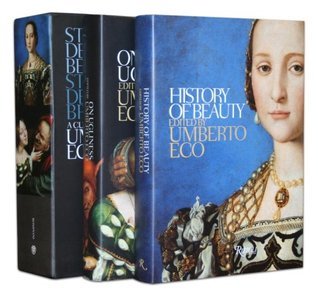
The first illustrated book by one of the world’s most acclaimed authors, History of Beauty presents an intriguing journey into the wonderful realm of aesthetics, exploring the ever-changing concept of the beautiful from ancient Greece to today with abundant examples. Closely examining the development of the visual arts and drawing on literature from each era, the range of Eco’s inquiry includes concepts such as the idea of love, natural inspiration versus numeric formulas, and the unattainable woman. In the mold of History of Beauty, On Ugliness is an exploration of the monstrous and the repellant in visual culture and arts. Eco’s encyclopedic knowledge and captivating storytelling combines in this ingenious study of the ugly, revealing that we often shield ourselves from what we’re most attracted to subliminally. With numerous examples of art, and quotations from the most celebrated writers and philosophers of each age, this provocative book explores in-depth the concepts of evil, depravity, and darkness in art and literature.
Umberto Eco was an Italian medievalist, philosopher, semiotician, novelist, cultural critic, and political and social commentator. In English, he is best known for his popular 1980 novel The Name of the Rose, a historical mystery combining semiotics in fiction with biblical analysis, medieval studies and literary theory, as well as Foucault's Pendulum, his 1988 novel which touches on similar themes.
Eco wrote prolifically throughout his life, with his output including children's books, translations from French and English, in addition to a twice-monthly newspaper column "La Bustina di Minerva" (Minerva's Matchbook) in the magazine L'Espresso beginning in 1985, with his last column (a critical appraisal of the Romantic paintings of Francesco Hayez) appearing 27 January 2016. At the time of his death, he was an Emeritus professor at the University of Bologna, where he taught for much of his life. In the 21st century, he has continued to gain recognition for his 1995 essay "Ur-Fascism", where Eco lists fourteen general properties he believes comprise fascist ideologies.