

What do you think?

The Buffalo Creek Disaster: How the Survivors of One of the Worst Disasters in Coal-Mining History Brought Suit Against the Coal Company--And Won
One Saturday morning in February 1972, an impoundment dam owned by the Pittston Coal Company burst, sending a 130 million gallon, 25 foot tidal wave of water, sludge, and debris crashing into southern West Virginia's Buffalo Creek hollow. It was one of the deadliest floods in U.S. history. 125 people were killed instantly, more than 1,000 were injured, and over 4,000 were suddenly homeless. Instead of accepting the small settlements offered by the coal company's insurance offices, a few hundred of the survivors banded together to sue. This is the story of their triumph over incredible odds and corporate irresponsibility, as told by Gerald M. Stern, who as a young lawyer and took on the case and won.
From the Trade Paperback edition.
From the Trade Paperback edition.
320 pages, Mass Market Paperback
First published January 1, 1976
Ratings & Reviews
Friends & Following
Create a free account to discover what your friends think of this book!
Community Reviews
Displaying 1 - 30 of 232 reviews

January 15, 2017
The Buffalo Creek flood was among the worst in West Virginia’s long and tragic history of calamities, both natural and man-made. When a coal slurry impoundment dam owned by the Pittston Coal Company gave way under the pressure of heavy rains on February 26, 1972, a 30-foot-high wall of coal-black waste water devastated sixteen different towns throughout the Buffalo Creek hollow of Logan County, West Virginia. The flood killed 125 people, injured over 1,100 more and left more than 4,000 survivors homeless.
Coal-related disasters had occurred before in this part of Appalachia, but Buffalo Creek somehow seemed different. Part of what may have made Buffalo Creek different from other events of its kind, author Gerald M. Stern suggests in a prologue, is that “This time it was not the strong, working male coal miners who died in the mines. That has become so commonplace in coal mining as to be expected. No, this time it was the miners’ defenseless wives and children, caught, unprepared for death, in their beds one Saturday morning” (p. xiv).
And something else was different on this occasion: a coalition of West Virginia natives and outsiders formed around the idea that a big coal company should not be able to treat disasters of this kind as just part of the cost of doing business; and they decided to take the coal company to court.
Stern, in 1972, was a young lawyer with the Washington, D.C., firm of Arnold & Porter. When the firm was recruited by that group of Buffalo Creek residents who felt that the coal company had behaved negligently, Stern found himself leading Arnold & Porter’s efforts to hold Pittston accountable.
Part of what makes The Buffalo Creek Disaster more than just a legal case study is the care with which Stern makes clear the scale of the disaster, as in this description of a first visit to Buffalo Creek:
Six weeks after the disaster it still looked like a war zone. The National Guard was everywhere, bulldozing destroyed homes into big piles for burning, directing traffic over temporary wooden bridges, searching the rubble for bodies. The U.S. Army Corps of Engineers had its big machines down in the creek, clearing out the debris and widening the channel. Houses here and there were marked with a large X, meaning they soon would be leveled and burned….Black water marks showed everywhere, on stores, churches, houses – even on the side of the hill. There was an eerie nothingness on each side of the road, what was left of it. Where towns had been, there now were only railroad signs, announcing that here once stood Latrobe or Crites or Lundale….[T]he smoke from the burning homes filled the narrow valley (p. 26).
Working out of a storage room in the back of a gas station, Stern interviewed survivors of the disaster, and observed how the flood had affected them psychologically: “They were crushed. Their whole demeanor demonstrated how overwhelming this disaster had been. It was hard for them to sit up straight or to talk for long periods of time without drifting off in their thoughts or without averting their eyes from my glance. Tears came quickly and often” (p. 38).
The psychological damage inflicted by the flood is strongly emphasized throughout The Buffalo Creek Disaster. Stern suggests that the Buffalo Creek flood “was unique in its combination of suddenness, destructive power within a limited circumscribed area, and resulting breakdown of community structure. It wasn’t a tornado that knocked out three blocks of a city…but left the rest of the community intact. The Buffalo Creek disaster destroyed everything, the entire community. There was nothing left to build on, no roots left to grow again. You couldn’t just move to the next street or next town in the Valley. The Valley was gone” (p. 103). So severe was the psychological impact of Buffalo Creek that a team of University of Cincinnati psychiatrists, some of whom “were survivors of Nazi concentration camps”, interviewed Buffalo Creek survivors and were themselves “overwhelmed by these disturbing tales which they themselves witnessed only secondhand through the stories of the survivors two years after the disaster” (p. 208).
In the context of the Buffalo Creek case, Stern shows the American legal system on the verge of accepting what is now known as post-traumatic stress disorder, but was then called “survival syndrome.” Stern points out that he and the members of his team “had difficulty trying to estimate a dollar value for mental suffering. We had no precedent to guide us. At that point, no one had ever attempted to collect damages for survivors, merely because they survived. We knew very little about the underlying psychiatric bases for the survival-syndrome claim” (p. 62). Years later, Stern says, the American Psychiatric Association’s addition of PTSD to the APA’s Diagnostic and Statistical Manual of Mental Disorders was “[o]ne of the most enduring legacies of Buffalo Creek” (p. 275).
For students of Appalachian history and culture, the book also provides a strong appeal on behalf of the ordinary people of West Virginia and other regions of Appalachia. Looking at a portrait of an imprisoned ex-governor of West Virginia on a wall in the state capitol building at Charleston, Stern reflects on his sense “that some companies didn’t mind paying some of West Virginia’s politicians to let them drag away most of the state’s vast wealth from under its ground. The owners in New York and the politicians in West Virginia grew wealthy on the state’s vast resources, while the people of West Virginia became the poor hillbillies and broken coal miners of American folklore” (p. 92). Later in the book, Stern suggests, forcefully, that “West Virginia is not owned by West Virginians. It is a colony, owned and controlled by absentee landlords”, and follows up his claim by pointing out that 76 percent of the land in Logan County, West Virginia, is owned by just ten companies (pp. 172-73).
President Bill Clinton, in a 2008 foreword to this new edition of Stern’s 1976 book, points out that The Buffalo Creek Disaster “has long been required reading for students at many law schools across the country”, and it is easy to see why. The book provides a clear, orderly, sensationalism-free, step-by-step recounting of the process of instituting a major suit at law. Stern concludes The Buffalo Creek Disaster by stating that “we did some good. We made the coal company pay, and pay well. Maybe the cost of our settlement will make them a little more careful in the future. And we proved that people acting together can have some effect. They can make the legal system work for them” (p. 272). Similarly, President Clinton, in his 2008 foreword, suggests that Stern’s book “shows that the legal system can work if it remains open to everyone, with practical, fair judges and good lawyers willing to take on difficult litigation on a pro bono or low fee basis” (xi-xii). I hope that the President is right about that.
Coal-related disasters had occurred before in this part of Appalachia, but Buffalo Creek somehow seemed different. Part of what may have made Buffalo Creek different from other events of its kind, author Gerald M. Stern suggests in a prologue, is that “This time it was not the strong, working male coal miners who died in the mines. That has become so commonplace in coal mining as to be expected. No, this time it was the miners’ defenseless wives and children, caught, unprepared for death, in their beds one Saturday morning” (p. xiv).
And something else was different on this occasion: a coalition of West Virginia natives and outsiders formed around the idea that a big coal company should not be able to treat disasters of this kind as just part of the cost of doing business; and they decided to take the coal company to court.
Stern, in 1972, was a young lawyer with the Washington, D.C., firm of Arnold & Porter. When the firm was recruited by that group of Buffalo Creek residents who felt that the coal company had behaved negligently, Stern found himself leading Arnold & Porter’s efforts to hold Pittston accountable.
Part of what makes The Buffalo Creek Disaster more than just a legal case study is the care with which Stern makes clear the scale of the disaster, as in this description of a first visit to Buffalo Creek:
Six weeks after the disaster it still looked like a war zone. The National Guard was everywhere, bulldozing destroyed homes into big piles for burning, directing traffic over temporary wooden bridges, searching the rubble for bodies. The U.S. Army Corps of Engineers had its big machines down in the creek, clearing out the debris and widening the channel. Houses here and there were marked with a large X, meaning they soon would be leveled and burned….Black water marks showed everywhere, on stores, churches, houses – even on the side of the hill. There was an eerie nothingness on each side of the road, what was left of it. Where towns had been, there now were only railroad signs, announcing that here once stood Latrobe or Crites or Lundale….[T]he smoke from the burning homes filled the narrow valley (p. 26).
Working out of a storage room in the back of a gas station, Stern interviewed survivors of the disaster, and observed how the flood had affected them psychologically: “They were crushed. Their whole demeanor demonstrated how overwhelming this disaster had been. It was hard for them to sit up straight or to talk for long periods of time without drifting off in their thoughts or without averting their eyes from my glance. Tears came quickly and often” (p. 38).
The psychological damage inflicted by the flood is strongly emphasized throughout The Buffalo Creek Disaster. Stern suggests that the Buffalo Creek flood “was unique in its combination of suddenness, destructive power within a limited circumscribed area, and resulting breakdown of community structure. It wasn’t a tornado that knocked out three blocks of a city…but left the rest of the community intact. The Buffalo Creek disaster destroyed everything, the entire community. There was nothing left to build on, no roots left to grow again. You couldn’t just move to the next street or next town in the Valley. The Valley was gone” (p. 103). So severe was the psychological impact of Buffalo Creek that a team of University of Cincinnati psychiatrists, some of whom “were survivors of Nazi concentration camps”, interviewed Buffalo Creek survivors and were themselves “overwhelmed by these disturbing tales which they themselves witnessed only secondhand through the stories of the survivors two years after the disaster” (p. 208).
In the context of the Buffalo Creek case, Stern shows the American legal system on the verge of accepting what is now known as post-traumatic stress disorder, but was then called “survival syndrome.” Stern points out that he and the members of his team “had difficulty trying to estimate a dollar value for mental suffering. We had no precedent to guide us. At that point, no one had ever attempted to collect damages for survivors, merely because they survived. We knew very little about the underlying psychiatric bases for the survival-syndrome claim” (p. 62). Years later, Stern says, the American Psychiatric Association’s addition of PTSD to the APA’s Diagnostic and Statistical Manual of Mental Disorders was “[o]ne of the most enduring legacies of Buffalo Creek” (p. 275).
For students of Appalachian history and culture, the book also provides a strong appeal on behalf of the ordinary people of West Virginia and other regions of Appalachia. Looking at a portrait of an imprisoned ex-governor of West Virginia on a wall in the state capitol building at Charleston, Stern reflects on his sense “that some companies didn’t mind paying some of West Virginia’s politicians to let them drag away most of the state’s vast wealth from under its ground. The owners in New York and the politicians in West Virginia grew wealthy on the state’s vast resources, while the people of West Virginia became the poor hillbillies and broken coal miners of American folklore” (p. 92). Later in the book, Stern suggests, forcefully, that “West Virginia is not owned by West Virginians. It is a colony, owned and controlled by absentee landlords”, and follows up his claim by pointing out that 76 percent of the land in Logan County, West Virginia, is owned by just ten companies (pp. 172-73).
President Bill Clinton, in a 2008 foreword to this new edition of Stern’s 1976 book, points out that The Buffalo Creek Disaster “has long been required reading for students at many law schools across the country”, and it is easy to see why. The book provides a clear, orderly, sensationalism-free, step-by-step recounting of the process of instituting a major suit at law. Stern concludes The Buffalo Creek Disaster by stating that “we did some good. We made the coal company pay, and pay well. Maybe the cost of our settlement will make them a little more careful in the future. And we proved that people acting together can have some effect. They can make the legal system work for them” (p. 272). Similarly, President Clinton, in his 2008 foreword, suggests that Stern’s book “shows that the legal system can work if it remains open to everyone, with practical, fair judges and good lawyers willing to take on difficult litigation on a pro bono or low fee basis” (xi-xii). I hope that the President is right about that.

September 11, 2021
The only reason that this book is even a 1.5 star is because it provides a semi-useful narrative overview into the procedural background of a large lawsuit. But I really feel that if you took the author's voice out of this book, it would be 10x better, I kid you not. A dry af procedural history would be more useful than this pile of shit.
Meet Gerald Stern:

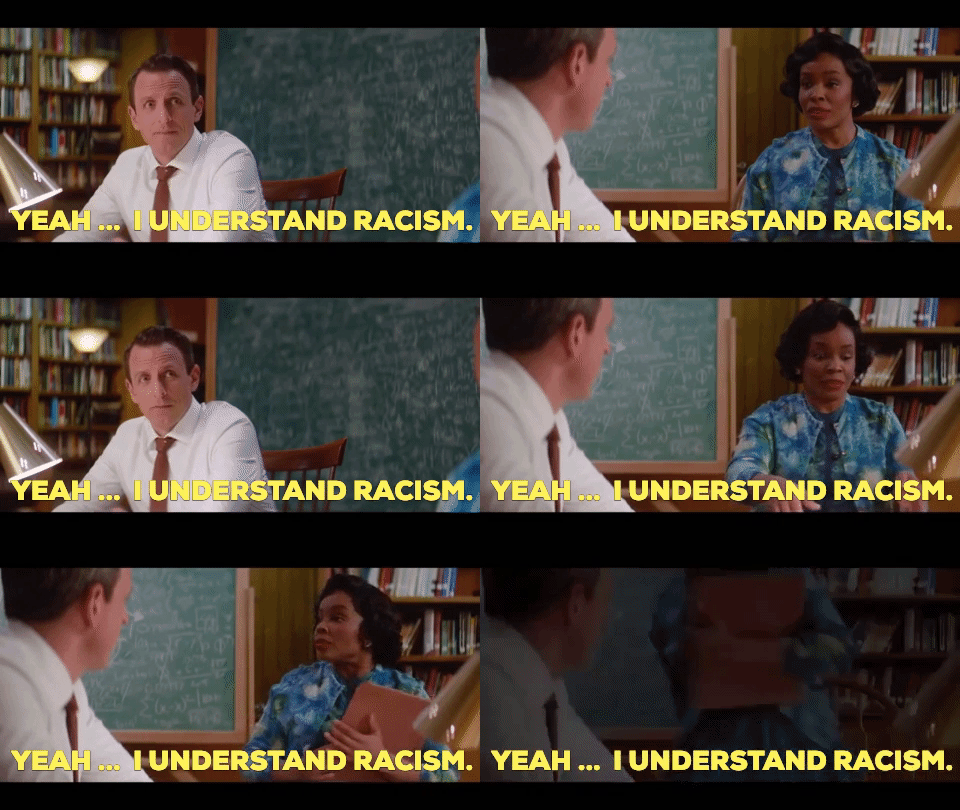
A man so full of himself that I totally understand Shakespeare's Henry VI line: "The first thing we do, let's kill all the lawyers."
Constantly, to the utter detriment of the reader, he drones on and on about he was a civil rights government lawyer in the South in the early 1960s helping the "voiceless blacks." Yup! :D You heard that right! We out here calling people the "blacks!"

The theme continues. A standout quote, "... when black families we visited looked upon as some kind of messiah. I recognized then how unusual it was for any family, and especially a poor, helpless black family in the South, to have a lawyer from the federal government in Washington come to their home and ask if ..."
This is literally how Gerald Stern sees himself:

Folks, that's not all! It's not just limited to Black folks! Today's deal also includes the poors! :o As he talks about the West Virginia coal mining families, he writes, "I had to go and help. And no one seemed better qualified than I." He just never stops droning on about the "defenseless wives and children" of these coal miners.
him to himself throughout this book:
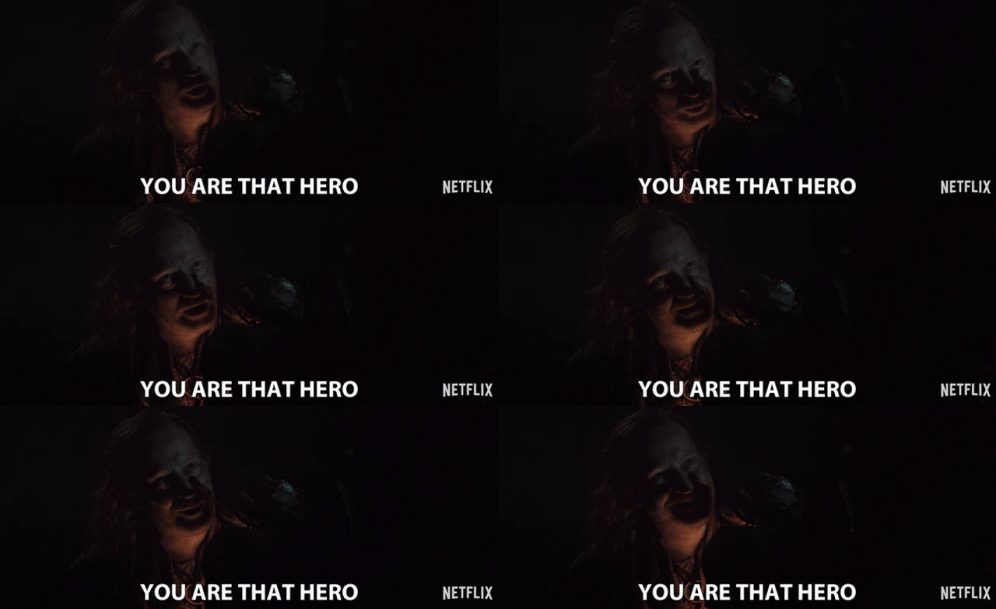

Seriously,

And do you want to know the kicker? You would think that this white man did this government civil rights lawyering for YEARS based on how he writes about it. But he only did it for 2 YEARS LMAOOOOOOOOO. He writes, "Two years with the Civil Rights Division exhausted me, and when President Kennedy was killed, I couldn't go on."

I was honestly torn between my eyes rolling to the back of my head and rolling on the floor laughing.
WHEW! This too much. But we haven't even gotten started on the substance of the case! :)
Introducing Arnold & Porter! The benevolent private law firm swooping into to save these poor, miner families! Except that this law firm is constantly trying to cut corners, constantly thinking "long and hard" on whether to approve expenses despite Stern's constant gushing otherwise that he has his full support of his firm, and consistently chomping for a paltry settlement that will provide chump change to the plaintiff-survivors while making it rich for the firm. Spoiler alert: they settle for chump change and call it a victory lmao. He literally negotiates down from a potential $64 million+ victory (and they had a good case too?!) to a shameful $13.5 million.
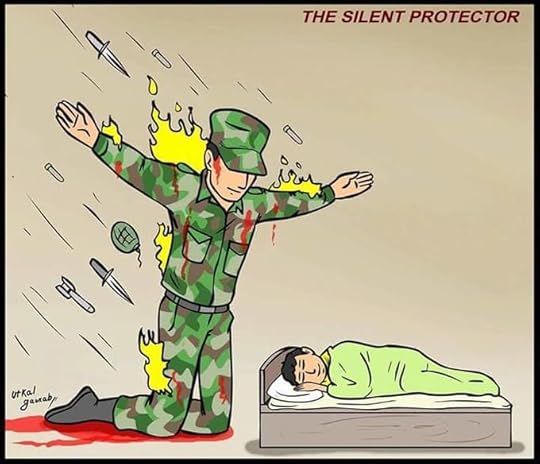
Stern is the solider and the person sleeping is Arnold & Porter lol:
After settling for paltry chump change that ultimately averages only $13,000 for each survivor (NOT INCLUDING LEGAL FEES LOL - interestingly Stern fails to disclose the specifics of the net recoveries after legal fees are taken out >_>) after 2 WHOLE YEARS of living in traumatic limbo after a social disaster that completely destroyed not just the families' whole lives, but also their entire communities, Gerald Stern has the GALL to title this book a victory.
Oh wait! It was a victory -- for Arnold & Porter. "For our time and effort ... we earned a legal fee of almost $3 million. Sometimes you do well by doing good." *vomit* The narcissism to even declare this so unashamedly after screwing these families over who placed so much trust in them is nauseating.
And the cherry on top? Stern literally ends the book with a quote from opposing counsel on how he was a hero. I can't make this shit up. "Lauck Walton [Pittson opposing counsel] told them, 'Stern was out to represent all plaintiffs everywhere who might get hurt by dirty, filthy coal companies. Most of our meetings began and ended with accusations of murder. Perhaps his attitude wore us down and speeded a settlement.'"
fin.

Meet Gerald Stern:
A man so full of himself that I totally understand Shakespeare's Henry VI line: "The first thing we do, let's kill all the lawyers."
Constantly, to the utter detriment of the reader, he drones on and on about he was a civil rights government lawyer in the South in the early 1960s helping the "voiceless blacks." Yup! :D You heard that right! We out here calling people the "blacks!"
The theme continues. A standout quote, "... when black families we visited looked upon as some kind of messiah. I recognized then how unusual it was for any family, and especially a poor, helpless black family in the South, to have a lawyer from the federal government in Washington come to their home and ask if ..."
This is literally how Gerald Stern sees himself:
Folks, that's not all! It's not just limited to Black folks! Today's deal also includes the poors! :o As he talks about the West Virginia coal mining families, he writes, "I had to go and help. And no one seemed better qualified than I." He just never stops droning on about the "defenseless wives and children" of these coal miners.
him to himself throughout this book:
Seriously,
And do you want to know the kicker? You would think that this white man did this government civil rights lawyering for YEARS based on how he writes about it. But he only did it for 2 YEARS LMAOOOOOOOOO. He writes, "Two years with the Civil Rights Division exhausted me, and when President Kennedy was killed, I couldn't go on."
I was honestly torn between my eyes rolling to the back of my head and rolling on the floor laughing.
WHEW! This too much. But we haven't even gotten started on the substance of the case! :)
Introducing Arnold & Porter! The benevolent private law firm swooping into to save these poor, miner families! Except that this law firm is constantly trying to cut corners, constantly thinking "long and hard" on whether to approve expenses despite Stern's constant gushing otherwise that he has his full support of his firm, and consistently chomping for a paltry settlement that will provide chump change to the plaintiff-survivors while making it rich for the firm. Spoiler alert: they settle for chump change and call it a victory lmao. He literally negotiates down from a potential $64 million+ victory (and they had a good case too?!) to a shameful $13.5 million.
Stern is the solider and the person sleeping is Arnold & Porter lol:
After settling for paltry chump change that ultimately averages only $13,000 for each survivor (NOT INCLUDING LEGAL FEES LOL - interestingly Stern fails to disclose the specifics of the net recoveries after legal fees are taken out >_>) after 2 WHOLE YEARS of living in traumatic limbo after a social disaster that completely destroyed not just the families' whole lives, but also their entire communities, Gerald Stern has the GALL to title this book a victory.
Oh wait! It was a victory -- for Arnold & Porter. "For our time and effort ... we earned a legal fee of almost $3 million. Sometimes you do well by doing good." *vomit* The narcissism to even declare this so unashamedly after screwing these families over who placed so much trust in them is nauseating.
And the cherry on top? Stern literally ends the book with a quote from opposing counsel on how he was a hero. I can't make this shit up. "Lauck Walton [Pittson opposing counsel] told them, 'Stern was out to represent all plaintiffs everywhere who might get hurt by dirty, filthy coal companies. Most of our meetings began and ended with accusations of murder. Perhaps his attitude wore us down and speeded a settlement.'"
fin.

April 4, 2020
In February 1972, in the rural mining area of West Virginia, a huge coal-waste pile (which was being used as a dam) broke apart, flowed downstream like a Tsunami and wiped out all the mining towns along the Buffalo Creek Hollow.
When I began this book, it felt to me like I was sitting with the author as he told the story of how he took on the conglomerate Pittson Coal. The writing was not so great, there were parts where I felt it dragged. However, the story itself examines the psychological aspect of what occurred and stayed with the survivors of this disaster . This was the first case of what we now know as PTSD to come before the courts. This part of the story intrigued me.
More of a Legal story than a survivor story, but still worth the time I spent learning about it.
When I began this book, it felt to me like I was sitting with the author as he told the story of how he took on the conglomerate Pittson Coal. The writing was not so great, there were parts where I felt it dragged. However, the story itself examines the psychological aspect of what occurred and stayed with the survivors of this disaster . This was the first case of what we now know as PTSD to come before the courts. This part of the story intrigued me.
More of a Legal story than a survivor story, but still worth the time I spent learning about it.

September 13, 2026
So even though I was assigned this book for Civil Procedure, I did actually like it. To summarize, a coal company in West Virginia built an unsafe dam, knew it was unsafe, and failed to fix it. It burst and swept an entire town away and killed a ton of people, and unsurprisingly, left the survivors with PTSD.
An interesting thing about this book, that tells the story of the lawsuit's life and process from the point of view of the lawyer defending the plaintiffs, is that they never actually go to trial. They get super close to having to bring a ton of plaintiffs to trial because the coal company keeps offering to settle at an insufficient number. Eventually, they do settle, after at least two years of discovery, for about 13.5 million dollars.
Another interesting thing about this book are the discussions regarding damages for "psychiatric conditions." Back when this lawsuit took place, in the 1970s, the author talks about how the law was only beginning, at least in West Virginia, to rule that you can receive damages for mental suffering induced as a result of an involvement in a traumatizing event without being physically injured. Mental health, and the general population and the court's understandings of mental illnesses like PTSD, are generally accepted as a legitimate thing today. However, to the point today in which courts will provide redress for someone's mental health or psyche being impacted, redress for "intentional infliction of emotional distress" a legitimate tort, does not usually result in wins for plaintiffs.
An interesting thing about this book, that tells the story of the lawsuit's life and process from the point of view of the lawyer defending the plaintiffs, is that they never actually go to trial. They get super close to having to bring a ton of plaintiffs to trial because the coal company keeps offering to settle at an insufficient number. Eventually, they do settle, after at least two years of discovery, for about 13.5 million dollars.
Another interesting thing about this book are the discussions regarding damages for "psychiatric conditions." Back when this lawsuit took place, in the 1970s, the author talks about how the law was only beginning, at least in West Virginia, to rule that you can receive damages for mental suffering induced as a result of an involvement in a traumatizing event without being physically injured. Mental health, and the general population and the court's understandings of mental illnesses like PTSD, are generally accepted as a legitimate thing today. However, to the point today in which courts will provide redress for someone's mental health or psyche being impacted, redress for "intentional infliction of emotional distress" a legitimate tort, does not usually result in wins for plaintiffs.

August 15, 2009
This was the first book assigned for my Civil Procedure class this Fall. Not hard to understand why. As the lengthy subtitle indicates, this is classic white knight lawyer stuff. A hard-won battle by a lawyer (Stern) with a background fighting for Af-Am voting rights in the south in the early 60s to demonstrate the "reckless negligence" of the Pittston coal company in maintaining a dammed reservoir of coal mining waste, leading to a substantial remedy awarded to the sympathetic victims of a terrible flood that devastated an entire West Virginia valley. Think "A Civil Action" and "Erin Brockovich," the major distinction being that Stern never appears in serious danger of being outspent by his opponents. Why his big DC firm was willing and able to throw so many resources into a pro bono case is not elucidated in as much detail as one would hope. Nevertheless, the obvious attraction is in showing a lawyer in the much maligned turf of tort law doing unquestionably good work. Not to mention a strong pre-echo of the reckless negligence attending maintenance of the levees in New Orleans prior to Katrina.
And the interest for a Civil Procedure class is that most of the narrative consists of a meticulously detailed account of how the author crafts his suit. I don't think I'm giving away too much to reveal that the case never makes it to trial. After two years of process, a settlement is reached. And it is a profound education in civil procedure just how much takes place to reach a settlement in such a complex place without a courtroom trial ever taking place.
It begins with a representative of the victims/plaintiffs contacting a lawyer in Stern's firm who had been involved with an earlier civil case against a corporate tortfeasor in the region. The author, who had become the beneficiary of a year of pro bono work at his firm, takes on the case. Much of the early part of the book precedes the drafting of a complaint as he follows the trail from the local Buffalo Creek Coal company to its parent corporation, Pittston, and attempts to figure out a procedural strategy for bringing suit against the latter in a federal district court so as to avoid the pervasive bias of the state courts in favor of the mining industry. The first major battle is thus to secure federal jurisdiction on the grounds of diversity (defendants and plaintiffs residing in different states-- one of two major grounds for federal jurisdiction established in the US Constitution).
Once this is achieved (with no small degree of luck, as it turns out), and Pittston retains its own counsel, the rest of the book details a two-year process of discovery (depositions, consultations with expert witnesses, examinations of the plaintiffs and lots and lots of research), motions to the federal judge to delay (Pittston's primary tactic), dismiss claims (Pittston's other tactic) or compel action, and negotiation towards settlement. Well, actually, until the bitter end the settlement talks consist of the Pittston attorney sticking to a wildly inadequate offer while our hero sticks to a wildly over-reaching demand. There's plenty of method on display as Stern pieces together a rich narrative establishing the necessary elements for a tort claim: a duty owed to the plaintiffs, breached through "reckless" negigence, leading to foreseeable and preventable damages for which they should be held liable. Then there's plenty of gamesmanship on display as the Pittston counsel resolutely ignores all his opponent's victories and Stern works feverishly to avoid the numerous procedural snares they set to derail the action before it can come to trial. Indeed, from an artistic standpoint, the main suspense of the book turns on whether it is possible despite what seems a smoking gun of liability for a major catastrophe, the perpetrating corporation will work the system to its advantage.
The over-arching lesson, I expect, for a Civ Pro class, is that the only defense against such misuse of our justice system is for litigators on the side of the righteous to be as shrewd in matters of procedure as they are in matters of substance.
And the interest for a Civil Procedure class is that most of the narrative consists of a meticulously detailed account of how the author crafts his suit. I don't think I'm giving away too much to reveal that the case never makes it to trial. After two years of process, a settlement is reached. And it is a profound education in civil procedure just how much takes place to reach a settlement in such a complex place without a courtroom trial ever taking place.
It begins with a representative of the victims/plaintiffs contacting a lawyer in Stern's firm who had been involved with an earlier civil case against a corporate tortfeasor in the region. The author, who had become the beneficiary of a year of pro bono work at his firm, takes on the case. Much of the early part of the book precedes the drafting of a complaint as he follows the trail from the local Buffalo Creek Coal company to its parent corporation, Pittston, and attempts to figure out a procedural strategy for bringing suit against the latter in a federal district court so as to avoid the pervasive bias of the state courts in favor of the mining industry. The first major battle is thus to secure federal jurisdiction on the grounds of diversity (defendants and plaintiffs residing in different states-- one of two major grounds for federal jurisdiction established in the US Constitution).
Once this is achieved (with no small degree of luck, as it turns out), and Pittston retains its own counsel, the rest of the book details a two-year process of discovery (depositions, consultations with expert witnesses, examinations of the plaintiffs and lots and lots of research), motions to the federal judge to delay (Pittston's primary tactic), dismiss claims (Pittston's other tactic) or compel action, and negotiation towards settlement. Well, actually, until the bitter end the settlement talks consist of the Pittston attorney sticking to a wildly inadequate offer while our hero sticks to a wildly over-reaching demand. There's plenty of method on display as Stern pieces together a rich narrative establishing the necessary elements for a tort claim: a duty owed to the plaintiffs, breached through "reckless" negigence, leading to foreseeable and preventable damages for which they should be held liable. Then there's plenty of gamesmanship on display as the Pittston counsel resolutely ignores all his opponent's victories and Stern works feverishly to avoid the numerous procedural snares they set to derail the action before it can come to trial. Indeed, from an artistic standpoint, the main suspense of the book turns on whether it is possible despite what seems a smoking gun of liability for a major catastrophe, the perpetrating corporation will work the system to its advantage.
The over-arching lesson, I expect, for a Civ Pro class, is that the only defense against such misuse of our justice system is for litigators on the side of the righteous to be as shrewd in matters of procedure as they are in matters of substance.

August 17, 2024
required reading for civ pro👩⚖️

October 27, 2018
Excellent chronicle of a great case; The narrative needed more style and polish
Stern does an excellent job chronicling the disaster and how the case proceeded from start to finish in excellent detail. For anyone interested to know how a case of this nature is handled by good trial lawyers, this book is an excellent resource. The storytelling aspect was good, but could’ve been much stronger. The ending chapters, in particular, seemed to devolve from narrative prose to bullet pointed paragraphs from Stern’s diary. The information is worthwhile so I still highly recommend the book.
Stern does an excellent job chronicling the disaster and how the case proceeded from start to finish in excellent detail. For anyone interested to know how a case of this nature is handled by good trial lawyers, this book is an excellent resource. The storytelling aspect was good, but could’ve been much stronger. The ending chapters, in particular, seemed to devolve from narrative prose to bullet pointed paragraphs from Stern’s diary. The information is worthwhile so I still highly recommend the book.

January 2, 2023
Although I read for law school (Civil Procedure), I would probably read this on my own. Ultimately this is an inspirational story about how legal minutiae can create a multimillion dollar settlement. This is also the main problem with the book: it is a wonky story about how legal minutiae can create a multimillion dollar settlement. Stern, as the main attorney on the case, offers detailed analysis on the play-by-play. While Stern describes technical minutiae in simple terms, his decision on what to include versus exclude is, ultimately, wonky. For an aspiring attorney, an inspired read. For anyone else, fifty pages could have been knocked off.

January 17, 2016
The story of an atrocious disaster and the response of the devastated survivors. This one should be a valuable lesson to those who feel trade unions are not needed in this country, or just for readers who think lawyers are bad people.
Read
July 14, 2008This was a great book. If you are at all interested in environmental law, read this. It goes into the work it takes to put together a case in a very encouraging way.

August 12, 2026
Really interesting and couldn’t put it down but -1 star because I couldn’t get past this one passage:
“This case was a serious matter for me, and as I got more into it, it became even more serious. I was beginning to identify directly with the suffering of these people. I suppose I suffer as a ‘survivor’ myself, as a Jew who survived the Nazi concentration camps, although I wasn’t in a camp. In fact, I was only a small child in America at that time, and I don’t know of any relatives who died in the concentration camps. But as a Jew, I still feel lucky, and guilty, that I survived while other Jewish children my age died.”
😭😭😭
- I’m sure you could do a bunch of math about inflation since 1974, relatively low cost of living in a West Virginian coal town, etc., but NET 13k/plaintiff (before legal fees) is a curious number to boast about. Maybe it’s about 50-60k today for losing your entire family and home and community in a coal sludge flood
- Interesting to read abt the whole “piercing the corporate veil” and the psychic impairment argument
- A lot of people seem to complain about his writing style/tone, but I actually enjoyed it. Not how boastful he was, but the dryness that I thought was funny at times
- He went on to work for Occidental Petroleum LMAO
“This case was a serious matter for me, and as I got more into it, it became even more serious. I was beginning to identify directly with the suffering of these people. I suppose I suffer as a ‘survivor’ myself, as a Jew who survived the Nazi concentration camps, although I wasn’t in a camp. In fact, I was only a small child in America at that time, and I don’t know of any relatives who died in the concentration camps. But as a Jew, I still feel lucky, and guilty, that I survived while other Jewish children my age died.”
😭😭😭
- I’m sure you could do a bunch of math about inflation since 1974, relatively low cost of living in a West Virginian coal town, etc., but NET 13k/plaintiff (before legal fees) is a curious number to boast about. Maybe it’s about 50-60k today for losing your entire family and home and community in a coal sludge flood
- Interesting to read abt the whole “piercing the corporate veil” and the psychic impairment argument
- A lot of people seem to complain about his writing style/tone, but I actually enjoyed it. Not how boastful he was, but the dryness that I thought was funny at times
- He went on to work for Occidental Petroleum LMAO

February 23, 2025
This was a slog. Written by the lead attorney for the plaintiff's, I was hoping or something that was a little more story-driven, eg would speak more about the disaster itself (the title of the book, ya know), and the individual plaintiffs' stories. This was not that.
For anyone about to start law school or someone who wants a short primer in Federal Civil Procedure, this would be a good tool (albeit a dated tool because the lawsuit took place in the first half of the 1970s). If you want to know about the actual tragic disaster, the environmental catastrophe, I think you'll want to look elsewhere.
One really significant aspect of this case was that it was among the early biggest lawsuits to involve damages for mental pain and suffering, known then as psychic damages. That's a pretty big deal, but again, that's a legal issue and I don't think Stern did a very good job or at least not a thorough enough job telling the human stories in this book. And, spoiler-alert, the case settled before it got to trial, so there's no appeal and, thus, no significant legal precedent about which to speak.
For anyone about to start law school or someone who wants a short primer in Federal Civil Procedure, this would be a good tool (albeit a dated tool because the lawsuit took place in the first half of the 1970s). If you want to know about the actual tragic disaster, the environmental catastrophe, I think you'll want to look elsewhere.
One really significant aspect of this case was that it was among the early biggest lawsuits to involve damages for mental pain and suffering, known then as psychic damages. That's a pretty big deal, but again, that's a legal issue and I don't think Stern did a very good job or at least not a thorough enough job telling the human stories in this book. And, spoiler-alert, the case settled before it got to trial, so there's no appeal and, thus, no significant legal precedent about which to speak.

Did Not Finish
November 7, 2025DNF pg. 106 (40%)
This book is not working for me. I went into this expecting a nonfiction book about the Buffalo Creek Disaster and the trial that followed. I was not expecting this to basically be a memoir from the main lawyer's POV about the events. Stern’s voice was grating and a bit pompous at times. I got so tired of hearing his POV and not just the facts of what happened that I keep putting this book down after only a few pages.
If the lawyer’s voice had been removed from this book and just the facts presented, I would have enjoyed this much more and actually felt like I could have finished it. Also it probably would have been shorter too because it felt like he rambled a lot.
Also, so many sentences were missing their punctuation at the end that it quickly became annoying. How was it not caught during the editing period?
This book is not working for me. I went into this expecting a nonfiction book about the Buffalo Creek Disaster and the trial that followed. I was not expecting this to basically be a memoir from the main lawyer's POV about the events. Stern’s voice was grating and a bit pompous at times. I got so tired of hearing his POV and not just the facts of what happened that I keep putting this book down after only a few pages.
If the lawyer’s voice had been removed from this book and just the facts presented, I would have enjoyed this much more and actually felt like I could have finished it. Also it probably would have been shorter too because it felt like he rambled a lot.
Also, so many sentences were missing their punctuation at the end that it quickly became annoying. How was it not caught during the editing period?
July 8, 2024
* Tell the story of flood disaster in WV through the eyes of the lawyer who helped the survivors sue the coal companies
* The whole story feels like it could be straight from a movie script but this all actually happened which is wild
* Although the legal jargon can be a little heavy at times he does a great job at making it all understandable for someone with very little experience in that world
* The whole story feels like it could be straight from a movie script but this all actually happened which is wild
* Although the legal jargon can be a little heavy at times he does a great job at making it all understandable for someone with very little experience in that world
Read
October 1, 2019I read this for school, but dammit I'm going to count it since it took away time I could have spent reading something else. The book reads like a well-written textbook and does a good job of laying out some complicated procedural issues. Stern inserts himself into the narrative a bit too much for my taste, but what can you do.

August 13, 2024
3.5. Easy read, well-explained

August 7, 2025
About to start law school and this fired me up so much. Fantastic (and extremely heartbreaking) read! Justice can be real. Gerald M Stern is a legend
August 25, 2021
I had to read this for class but it was honestly pretty interesting- 3.5!

August 27, 2025
Tell me something I didn’t already know — the law is a game for rich people and companies 🫠 And it literally takes soooo much luck and extraordinary tenacity for justice to actually be served.

February 5, 2022
read for class but was v interesting.

August 11, 2024
This book was a recommendation from my new Civil Procedure professor before the start of my first semester in law school (yay!!). Although definitely filled with legal writing and minutiae of federal procedure, this book is a quick and informative read. I was invested in the lawsuit as if it was my neighbors, a pretty incredible feat from a book about a disaster I was unfamiliar with only a few days ago!
I definitely recommend this book to any future law students or lawyers. It is engaging and exciting, and it’s a great reminder of WHY lawsuits are important (hint: it isn’t just for the money). It is humanizing and inspiring, and I’m so glad I got to read it before starting classes. Even if you aren’t an aspiring lawyer like me, you’ll probably learn a lot and get invested in the incredible bravery of the people of Buffalo Creek.
I definitely recommend this book to any future law students or lawyers. It is engaging and exciting, and it’s a great reminder of WHY lawsuits are important (hint: it isn’t just for the money). It is humanizing and inspiring, and I’m so glad I got to read it before starting classes. Even if you aren’t an aspiring lawyer like me, you’ll probably learn a lot and get invested in the incredible bravery of the people of Buffalo Creek.

January 27, 2018
Given to me by a friend after one of his college courses, it’s a picture window into the procedure behind a lengthy civil suit brought against a coal company. This case helped establish legal grounds for suing for psychological as well as physical damages in the state of West Virginia and later went on to help define PTSD.
This account of the lead lawyer from a Washington D.C. law firm retells all of the major pitfalls and victories of this at times harrowing case. There are some fairly gruesome descriptions of the events of the flood itself as told by survivors and the author is honest in his retelling, even including that he considered at times not settling out of court and bringing nearly 600 plaintiffs into a long court battle to elevate his own fame and status as a lawyer.
I also want to add this was fairly easy to read even being what is essentially a dramatized legal textbook. I did not find all that much legal jargon contained within the authors explanations of the case, and if jargon was used it was explained in laymen’s terms.
I found this to be a very informative and powerful story of true to life corporate greed and recklessness, the corrupt nature of local government and ultimately justice. I wouldn’t recommend this as a leisure read but if you’re looking to expand your knowledge of our court systems, this is a great starting point.
This account of the lead lawyer from a Washington D.C. law firm retells all of the major pitfalls and victories of this at times harrowing case. There are some fairly gruesome descriptions of the events of the flood itself as told by survivors and the author is honest in his retelling, even including that he considered at times not settling out of court and bringing nearly 600 plaintiffs into a long court battle to elevate his own fame and status as a lawyer.
I also want to add this was fairly easy to read even being what is essentially a dramatized legal textbook. I did not find all that much legal jargon contained within the authors explanations of the case, and if jargon was used it was explained in laymen’s terms.
I found this to be a very informative and powerful story of true to life corporate greed and recklessness, the corrupt nature of local government and ultimately justice. I wouldn’t recommend this as a leisure read but if you’re looking to expand your knowledge of our court systems, this is a great starting point.

January 10, 2021
An important read with many emotional highs and lows. Little did I know when I picked it up that: "One of the most enduring legacies of Buffalo Creek was the decision by the American Psychiatric Association to establish a diagnosis, in the association's Diagnostic and Statistical Manual of Mental Disorders, for the mental suffering of survivors of a disaster like Buffalo Creek. What we called 'survivors syndrome' or 'psychic impairment' is now called post-traumatic stress disorder, PTSD, and it's official recognition as a mental health disorder has enabled survivors of disasters like the Oklahoma City Federal Building bombing, as well as soldiers returning from war zones, to receive the mental health treatment the need to get no with their lives."

March 21, 2019
This wasn't my favorite book for "pleasure" reading, which is why I gave it the 2-star rating. I could see its usefulness for a Civil Procedure course, where it would be WAY more interesting than some of the cases we have to read, but, for pleasure reading, I find the author to be a bit boastful about himself and kind of a vaguely annoying narrator. The story of the Buffalo Creek Disaster itself is fascinating, but I wish the author had been someone who'd actually lived the disaster.

November 15, 2007
The law school classic. Not a bad account of the litigation of a class action suit.
And for those of you starting law school: get out while it's still early enough. This is not a joke.
And for those of you starting law school: get out while it's still early enough. This is not a joke.

September 7, 2016
Like everyone else, I read this for my 1L civ pro class. As law goes, it's a fairly exciting and easy read. Hashtag no regrets.

June 14, 2017
Who knew. What a fascinating procedural that gives a shockingly powerful glimpse into the cost of blood for oil, fossil fuel sport.

April 11, 2026
I enjoyed my second reading just as much as the first. I wish someone would make a movie of this story, something like a mash-up of The Impossible and Erin Brokovich.

December 29, 2017
Although this book will give you a summary of this ecological disaster, but it is less about the disaster itself and more about the litigation that would follow it. As such, it's a great book for those interested in the process of lawyering. As a book about ecology, it's not as engaging. What the book did do was remind me to a large extent why I dislike our court system so much.
The book is written from the point of view of the litigater who would bring suit on behalf of about six hundred people affected by the disaster. As one discovers, both sides are inherently interested in getting as much as they can (or giving as little as they can). The people affected by the disaster, indeed the problems that become inherent in the disaster, seem to fall into the background, even if the litigater's intent is both to make the disaster painful enough that the mining company responsible will take more careful actions in the future and to get better compensation for the people involved.
In the end, who makes the money? Who is hurt?
The disaster is the result of some poorly built slag dams that hold refuse from the mining process and hold back a river. Below these dams are several small communities. After a heavy rainfall, the dams give way and many watch their homes and families wash away. Over one hundred die.
The mining company offers people about $4,000 dollars in compensation to each family affected by the loss of a home. This is the early 1970s, so that's more like $24,000 in today's terms. This is rural West Virginia, but that's still not enough really to pay for the home, let alone the deaths caused by the disaster. That should be enough to make one angry.
The mining company claims what happened was an act of God, an accident, something out of its control. Stern shows the detective work involved in trying to find evidence that the company has been reckless, a point of importance if he is to get as much compensation for his clients as he wants. He eventually shows that the company knew of the problems with the dams, which the company itself refuses to call dams so as to prevent itself from being liable. Likewise, the company claims it can't be responsible, since it's just a holding company for the actual company responsible, another tactic to get off the hook for the disaster.
This is what's so disgusting to me about the whole process. The company does its utmost to avoid paying out fair compensation to those affected by using various legal maneuvers, all to preserve profit. At the same time, there's another part of me that has a hard time believing that the company (or at least a number of the people involved) is that cold hearted. Would it deliberately create weak dams? Compensation may be weak, but too generous a compensation would destroy the company completely.
I was reminded of a film about a small investment company that was mostly obliterated in the 9/11 attack. The president of the company, who'd lost his own brother in the attack, promised to keep paying families the salaries of the dead workers; in short order, however, he realized that he couldn't afford to do so, and cut the families off much earlier than expected. People were angry about his greed. But if the company was to survive, he had to stop compensation. Either way the victims lose out. Sometimes, there's greed, and sometimes there's making ends meet in order to keep people working who are still able to work.
Stern eventually gets about $13,000 in compensation for his clients, or about $81,000 in today's dollars, which might cover a house in the area. He does so by asking for about five times that much and then settling for the smaller sum. He does so by claiming psychological trauma (what would become known as PTSD) for his victims, even those away at the time of the disaster. From that $13,000, people have to pay legal fees of about $4000, leaving them with just roughly twice what the company was going to shell out anyway. They're moderately better off.
But who's much better off are the lawyers on both sides, who make essentially about $75 an hour on the deal (forty thousand hours of work for the litigater). Such a case provides lots of work--granted, work that Stern and his company would not have ever gotten paid for unless the case was won, since they were working pro bono. That's the sad part to me, that if the company had been a bit more generous and sympathetic to begin with, and if a lawsuit could have been avoided, the victims would have been much better off and the company too. Instead, third-party lawyers cost both parties a huge chunk of dough.
The book is written from the point of view of the litigater who would bring suit on behalf of about six hundred people affected by the disaster. As one discovers, both sides are inherently interested in getting as much as they can (or giving as little as they can). The people affected by the disaster, indeed the problems that become inherent in the disaster, seem to fall into the background, even if the litigater's intent is both to make the disaster painful enough that the mining company responsible will take more careful actions in the future and to get better compensation for the people involved.
In the end, who makes the money? Who is hurt?
The disaster is the result of some poorly built slag dams that hold refuse from the mining process and hold back a river. Below these dams are several small communities. After a heavy rainfall, the dams give way and many watch their homes and families wash away. Over one hundred die.
The mining company offers people about $4,000 dollars in compensation to each family affected by the loss of a home. This is the early 1970s, so that's more like $24,000 in today's terms. This is rural West Virginia, but that's still not enough really to pay for the home, let alone the deaths caused by the disaster. That should be enough to make one angry.
The mining company claims what happened was an act of God, an accident, something out of its control. Stern shows the detective work involved in trying to find evidence that the company has been reckless, a point of importance if he is to get as much compensation for his clients as he wants. He eventually shows that the company knew of the problems with the dams, which the company itself refuses to call dams so as to prevent itself from being liable. Likewise, the company claims it can't be responsible, since it's just a holding company for the actual company responsible, another tactic to get off the hook for the disaster.
This is what's so disgusting to me about the whole process. The company does its utmost to avoid paying out fair compensation to those affected by using various legal maneuvers, all to preserve profit. At the same time, there's another part of me that has a hard time believing that the company (or at least a number of the people involved) is that cold hearted. Would it deliberately create weak dams? Compensation may be weak, but too generous a compensation would destroy the company completely.
I was reminded of a film about a small investment company that was mostly obliterated in the 9/11 attack. The president of the company, who'd lost his own brother in the attack, promised to keep paying families the salaries of the dead workers; in short order, however, he realized that he couldn't afford to do so, and cut the families off much earlier than expected. People were angry about his greed. But if the company was to survive, he had to stop compensation. Either way the victims lose out. Sometimes, there's greed, and sometimes there's making ends meet in order to keep people working who are still able to work.
Stern eventually gets about $13,000 in compensation for his clients, or about $81,000 in today's dollars, which might cover a house in the area. He does so by asking for about five times that much and then settling for the smaller sum. He does so by claiming psychological trauma (what would become known as PTSD) for his victims, even those away at the time of the disaster. From that $13,000, people have to pay legal fees of about $4000, leaving them with just roughly twice what the company was going to shell out anyway. They're moderately better off.
But who's much better off are the lawyers on both sides, who make essentially about $75 an hour on the deal (forty thousand hours of work for the litigater). Such a case provides lots of work--granted, work that Stern and his company would not have ever gotten paid for unless the case was won, since they were working pro bono. That's the sad part to me, that if the company had been a bit more generous and sympathetic to begin with, and if a lawsuit could have been avoided, the victims would have been much better off and the company too. Instead, third-party lawyers cost both parties a huge chunk of dough.

September 22, 2026
There is an element of self-aggrandizement here, in how a simple country lawyer from a good law school, with a civil rights background, and is a partner in a white shoe DC law firm manage to break the chokehold the giant mining conglomerates had over West Virginian politics and law enforcement. A true David and Goliath tale. If David had a multimillion dollar commitment and an army of support staff to support him that is.
Look, obviously these resources and expertise were needed to hold Pittston responsible, no matter how clearly they were negligent and reckless. But to pretend this was any kind of uphill battle is silly. Stern essentially found documentary evidence of what everyone knew about Pittston's feckless management of the Buffalo Creek operation. Pittston barely even tried to cover anything up because they were that certain that the courts would do as they wanted. Then they were sure they could harass and exhaust the plaintiffs. Then when they saw that things were going against them they did the bare minimum and bought their way out of the trouble.
What Stern also doesn't cover is that the flood actually proved to be a boon to the mining company, because rather than allow the mining camps to re-establish themselves in their former locations several things happened while this court case was dragging out. First, the state moved to condemn a broad path through the valley to provide an easement for a wider, more modern and straightened highway up to the mine. Second, Pittston refused to yield any land back to the communities that they believed would be the site of a new coal pit or would be of use for those expanded operations. Further complications came from the health department which refused to allow rebuilding until water and sewerage could be installed, and of course it never was. People were still living in those temporary HUD trailers into the 1990s.
I don't blame Stern these outcomes, and I don't think he minimized any of the suffering he encountered. Instead he rightfully celebrates the good that was within his scope to accomplish. He did his job as an advocate for these people to the best of his ability and enjoyed enormous success where many others had repeatedly failed. This key thing to remember here is that all that money, all that truth that was revealed about a reckless company willing to cost out the lives of its victims, all the small steps toward remedying the flood damage didn't bring a single community, or life, back together.
It appears that one of the most valuable portions of the book are the inter-attorney negotiations and maneuvering. I can't speak to that since my interest in the law is generally limited to upholding a good law and wanting to revoke or change a bad one. The conversations reported herein may be accurate representations of how lawyers talk with each other, but it's not riveting.
Anyway, it's an important story and a unique viewpoint from which to dissect such a vast and holistic tragedy. It is also a chilling record of how perfectly psychopathic corporate decision making can be. Profits come from viewing people as exterior costs to operation.
Look, obviously these resources and expertise were needed to hold Pittston responsible, no matter how clearly they were negligent and reckless. But to pretend this was any kind of uphill battle is silly. Stern essentially found documentary evidence of what everyone knew about Pittston's feckless management of the Buffalo Creek operation. Pittston barely even tried to cover anything up because they were that certain that the courts would do as they wanted. Then they were sure they could harass and exhaust the plaintiffs. Then when they saw that things were going against them they did the bare minimum and bought their way out of the trouble.
What Stern also doesn't cover is that the flood actually proved to be a boon to the mining company, because rather than allow the mining camps to re-establish themselves in their former locations several things happened while this court case was dragging out. First, the state moved to condemn a broad path through the valley to provide an easement for a wider, more modern and straightened highway up to the mine. Second, Pittston refused to yield any land back to the communities that they believed would be the site of a new coal pit or would be of use for those expanded operations. Further complications came from the health department which refused to allow rebuilding until water and sewerage could be installed, and of course it never was. People were still living in those temporary HUD trailers into the 1990s.
I don't blame Stern these outcomes, and I don't think he minimized any of the suffering he encountered. Instead he rightfully celebrates the good that was within his scope to accomplish. He did his job as an advocate for these people to the best of his ability and enjoyed enormous success where many others had repeatedly failed. This key thing to remember here is that all that money, all that truth that was revealed about a reckless company willing to cost out the lives of its victims, all the small steps toward remedying the flood damage didn't bring a single community, or life, back together.
It appears that one of the most valuable portions of the book are the inter-attorney negotiations and maneuvering. I can't speak to that since my interest in the law is generally limited to upholding a good law and wanting to revoke or change a bad one. The conversations reported herein may be accurate representations of how lawyers talk with each other, but it's not riveting.
Anyway, it's an important story and a unique viewpoint from which to dissect such a vast and holistic tragedy. It is also a chilling record of how perfectly psychopathic corporate decision making can be. Profits come from viewing people as exterior costs to operation.
Displaying 1 - 30 of 232 reviews