Life isn’t always easy for Charlie Brown. Between that pesky kite-eating tree, a complete lack of valentines in the mailbox, and his troubles on the pitcher’s mound it can be downright disheartening! Fortunately he has Snoopy, Linus, Peppermint Patty, and the Peanuts gang to make the big world seem a lot friendlier. Now, for the first time in book form and in full-color, It’s a Big World, Charlie Brown presents a brand-new collection of your old favorites. It’s just like peanuts–nobody can read just one!
Charles Monroe Schulz was an American cartoonist, whose comic strip Peanuts proved one of the most popular and influential in the history of the medium, and is still widely reprinted on a daily basis. Schulz's first regular cartoons, Li'l Folks, were published from 1947 to 1950 by the St. Paul Pioneer Press; he first used the name Charlie Brown for a character there, although he applied the name in four gags to three different boys and one buried in sand. The series also had a dog that looked much like Snoopy. In 1948, Schulz sold a cartoon to The Saturday Evening Post; the first of 17 single-panel cartoons by Schulz that would be published there. In 1948, Schulz tried to have Li'l Folks syndicated through the Newspaper Enterprise Association. Schulz would have been an independent contractor for the syndicate, unheard of in the 1940s, but the deal fell through. Li'l Folks was dropped from the Pioneer Press in January, 1950. Later that year, Schulz approached the United Feature Syndicate with his best strips from Li'l Folks, and Peanuts made its first appearance on October 2, 1950. The strip became one of the most popular comic strips of all time. He also had a short-lived sports-oriented comic strip called It's Only a Game (1957–1959), but he abandoned it due to the demands of the successful Peanuts. From 1956 to 1965 he contributed a single-panel strip ("Young Pillars") featuring teenagers to Youth, a publication associated with the Church of God. Peanuts ran for nearly 50 years, almost without interruption; during the life of the strip, Schulz took only one vacation, a five-week break in late 1997. At its peak, Peanuts appeared in more than 2,600 newspapers in 75 countries. Schulz stated that his routine every morning consisted of eating a jelly donut and sitting down to write the day's strip. After coming up with an idea (which he said could take anywhere from a few minutes to a few hours), he began drawing it, which took about an hour for dailies and three hours for Sunday strips. He stubbornly refused to hire an inker or letterer, saying that "it would be equivalent to a golfer hiring a man to make his putts for him." In November 1999 Schulz suffered a stroke, and later it was discovered that he had colon cancer that had metastasized. Because of the chemotherapy and the fact he could not read or see clearly, he announced his retirement on December 14, 1999. Schulz often touched on religious themes in his work, including the classic television cartoon, A Charlie Brown Christmas (1965), which features the character Linus van Pelt quoting the King James Version of the Bible Luke 2:8-14 to explain "what Christmas is all about." In personal interviews Schulz mentioned that Linus represented his spiritual side. Schulz, reared in the Lutheran faith, had been active in the Church of God as a young adult and then later taught Sunday school at a United Methodist Church. In the 1960s, Robert L. Short interpreted certain themes and conversations in Peanuts as being consistent with parts of Christian theology, and used them as illustrations during his lectures about the gospel, as he explained in his bestselling paperback book, The Gospel According to Peanuts, the first of several books he wrote on religion and Peanuts, and other popular culture items. From the late 1980s, however, Schulz described himself in interviews as a "secular humanist": “I do not go to church anymore... I guess you might say I've come around to secular humanism, an obligation I believe all humans have to others and the world we live in.”
Я — крайне поверхностный потребитель комиксов о Снупи и Чарли Брауне. Знаю, что такой герой есть, что у него очень большая фан-база на Западе. И даже знаю имя желтой птички (его зовут Вудсток, 10 баллов Гриффиндору!). Зато лишь крайне примерно представляю взаимоотношения героев внутри этой вселенной. Так что чтобы полностью погрузиться во все эти истории — такого у меня никогда не было. Все-таки это слишком уж обширный мир, копившийся и создававшийся по крупицам десятилетиями. И да, именно по крупицам. Здесь очень редко были огромные полотна, вроде тех же мультфильмов. Все больше небольшие стрипы, с крошечными зарисовками.
Поэтому большое спасибо за подобные книги издательству Зангавар. Это первая их книга, которую я прочитал, но есть вероятность, что возьму еще две оставшиеся. Просто чтобы еще раз окунуться в эту уникальную атмосферу. А она меня здесь поразила. Такая, с одной стороны, детскость, нарочито грубая рисовка, но при этом какие-то невероятно милые способы рассмешить. Ирония, смесь детского юмора со смешными ситуациями и падениями и при этом каких-то глубокомысленных и даже в чем-то философских деталей. Та же сестра главного героя, которая каждый раз изобретает себе новую жизненную философию, все более и более абсурдную.
Кстати, насчет этого — сам формат стрипов не подразумевает какой-то сильной связанности между ними, но при этом в «Peanuts» существуют множество одновременно развивающихся сюжетов. И вот в этом сборнике таких историй около десятка. Впрочем, как я уже сказал — формат накладывает свои требования. Зачастую эти сюжеты не имеют какой-то завершенной арки. Просто история, которая начинается, продолжается и … все. Окончания у них обычно нет или оно хитро спрятано. Истории обычно плавно перетекают одна в какую-то другую историю, чтобы через некоторое время всплыть в другой части книги. Вроде истории, как Чарли Браун руководил командой бейсболистов. Или как Снупи представлял себя солдатом армии времен «Войны за Независимость» («Он спросил — Почему никто не сбегает в магазин? Я не смог объяснить»). Или даже злоключения братьев Снупи (вот, кстати, о них я даже и не знал), которые внезапно нагрянули к Чарли Брауну в гости. Да даже долгая и все не кончающаяся история со Снупи-писателем, которая, судя во всему целиком не вместиться ни в одну книгу. Все эти истории равномерно распределены по книге. И непонятно, а закончилась ли уже она, или еще проявится? Стоит тому же Снупи прекратить себя считать солдатом Джорджа Вашингтона, как тут же появляется стрип с воспоминаниями о D-Day. Это будет еще одна история? Или автор вставил этот кусочек лишь на один стрип. Неизвестно. Поэтому читать эти комиксы еще интереснее.
Небольшие такие зарисовочки. Кусочки жизни главных героев. И это, пожалуй, самое приятное в этой книге. Здесь особо не к чему привязаться, каждая из них оценивается не как часть чего-то большого, а сама по себе. Понимаю, что знатоки всех этих событий и героев получат гораздо интенсивное удовольствие от прочтения. И подозреваю, что какую-то часть юмора я пропустил и за незнания реалий, но и того, что мне предоставили — этого хватило для хорошего настроения. Я не смеялся во весь голос над замечаниями героев, но улыбался довольно часто. Да, шутки здесь обычно строятся на каких-то неожиданных репликах или событиях. Но они на удивление действенные и даже ожидая какой-то подобной развязки, все равно улыбка появляется. Просто, потому что все эти герои очень милы и их реакция жизненна и забавна.
В общем, я рад, что прочитал книгу. Теперь мне хочется больше. Я все еще не готов погрузиться в эту вселенную с головой и нырнуть до самого дна. Но хотя бы сделать еще пару шагов в направлении этой милой и забавной глубины она меня побудила.
Quel plaisir de retrouver Snoopy, Charlie Brown et ses amis dans ce livre de BD un peu du même format que les Garfield, trouvé au hasard dans une boîte à livres. En fait, je ne savais pas qu'ils avaient publié ce type de recueil de BDs pour Peanuts. Dans ce tome 2, c'est toute l'année '97 parue dans le journal qui y est rassemblée. Même si je préfère les Garfield, j'ai tout de même apprécié retrouver ces petits bonhommes.
Частично забавные, частично вялые, но всегда довольно милые комикс-стрипы, которые /пятьдесят лет/, с 1950-го и до самой смерти автора в 2000-м, ежедневно выходили в газетах США и других стран, и, как следствие, и поныне считаются одним из самых популярных и известных комиксов в мире.
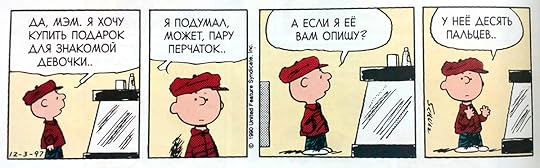
Одна книга представляет собой сборник стрипов с 1 января по 31 декабря определённого года (в данном случае - 1997-го), т.е. чтобы собрать полную коллекцию, нужно выпустить 50 книг. Другая примечательная деталь: вместе с мерчандайзом, "Чарли Браун" заработал для Шульца более чем миллиард долларов.
Также википедия отмечает, что именно "Чарли Браун" большей частью ответственен за формирование четырёхпанельного стандарта газетного комик-стрипа, в рамках которого вынуждены были потом работать все остальные авторы. Впрочем, здесь часто возникают сквозные мини-сюжеты продолжительностью в несколько стрипов, и даже глобальные макро-истории, разворачивающиеся иной раз месяцами и (подозреваю) годами.
Нам лично больше всего понравились "философии" Салли Браун. Ещё могу отметить вот этот стрип про снежок, который хорошо показывает уникальность формата комикса. В любом другом медиуме эта история смотрелась бы крайне тупо.
Но самый большой недостаток такой книги - перенасыщение. В концентрированном книжном сборнике от эксцентричных, странноватых героев "Чарли Брауна", от рваного повествования и частой смены сцен довольно быстро устаёшь, и в итоге получаешь, наверное, искажённое впечатление от серии, которая рассчитана на ежедневное потребление малыми дозами.
Its a Big World Charlie Brown is about Charlie Brown! In this book, there are many different comic strips of good ol' wishy-washy Charlie Brown. He looks at the world and tries to fit in. Things may get hard for him but he lives life the best he can.
My connection is for Charlie Brown. He sometimes feels that he doesnt have any friends. I feel that i dont fit in at times. It can be tough out in the real world.
I would give this book 7/5 stars!!!!! It is such an amazing collection and Charlie Brown is the most ideal/average person. Charles M. Schulz is my hero! Charlie Brown is the BEST EVER!!!
Charlie Brown is a classic comic strip. When you read it, you can laugh and relate, but poor Charlie Brown. In this book: Charlie deals with bad a baseball team; Lucy can't find a good writer for her letter to Santa; Lucy wants a dog for Christmas; Peppermint Patty and Marcie deal with friendship issues; and Linus has to deal with all the chaos. I love reading Charlie Brown, and this book just proves why. This book was very similar to the Charlie Brown Christmas episode, and it was cool reading through the strips and seeing the similarities. Also, Snoopy and Woodchuck have their own fun in the doghouse making up stories and playing in the snow, and of course, Snoopy is up to no good.
This was a Christmas present that I absolutely adore! I never understand why some people are just 'so-so' about Snoopy and the gang. They're great friends to know and love. Everyone knows a Sally and a Lucy and a Marcie for example, everyone can relate to experiencing Charlie's bad luck at some point in their lives. If not the books then I implore you to watch the TV show and the movies - you won't be disappointed.
I actually don't know how to rank comics on a five star rating, but I guess I enjoyed it. It cracked me up, you gotta love Linus and his security blanket and how Snoopy is always trying to steal it. The only drawback of the pictures though was that I couldn't tell the difference between Linus and Rerun.
You just can't go wrong with Peanuts and this book is no exception. If you love humor in many forms, Peanuts comic strips are a joy to read. You need this book in your collection for those days you need a quick smile or chuckle.