

What do you think?

An Unfinished Woman: A Memoir
Caustic, brilliant, uncompromising, accomplished, Lillian Hellman, one writer noted, can "take the tops off bottles with her teeth". Her career as a playwright began in 1938 with The Children's Hour, the first of seven plays that would bring her international attention and praise. Thirty years later, Hellman unleashed her peerless wit and candor on the subject she knew best: herself. An Unfinished Woman is a rich, surprising, emotionally charged portrait of a bygone world -- and of an independent-minded woman coming into her own. Wendy Wasserstein's introduction to this new edition provides a fascinating literary and historical context for reexamining Lillian Hellman's life and achievement.
304 pages, Paperback
First published June 1, 1969
About the author
Lillian Hellman
79 books209 followersLillian Florence "Lilly" Hellman (June 20, 1905 – June 30, 1984) was an American dramatist and screenwriter famously blacklisted by the House Committee on Un-American Activities (HUAC) at the height of the anti-communist campaigns of 1947–52.
Hellman was praised for sacrificing her career by refusing to answer questions by HUAC; but her denial that she had ever belonged to the Communist Party was easily disproved, and her veracity was doubted by many, including war correspondent Martha Gellhorn and literary critic Mary McCarthy.
She adapted her semi-autobiographical play The Little Foxes into a screenplay which received an Academy Award nomination in 1942.
Hellman was romantically involved with fellow writer and political activist Dashiell Hammett for thirty years until his death.
(from Wikipedia)
Hellman was praised for sacrificing her career by refusing to answer questions by HUAC; but her denial that she had ever belonged to the Communist Party was easily disproved, and her veracity was doubted by many, including war correspondent Martha Gellhorn and literary critic Mary McCarthy.
She adapted her semi-autobiographical play The Little Foxes into a screenplay which received an Academy Award nomination in 1942.
Hellman was romantically involved with fellow writer and political activist Dashiell Hammett for thirty years until his death.
(from Wikipedia)
Ratings & Reviews
Friends & Following
Create a free account to discover what your friends think of this book!
Community Reviews
Displaying 1 - 30 of 87 reviews

February 6, 2017
”I would say I wanted to get everything straight for the days after his death when I would write his biography and he would say that I was not to bother writing his biography because it would turn out to be the history of Lillian Hellman with an occasional reference to a friend called Hammett.”
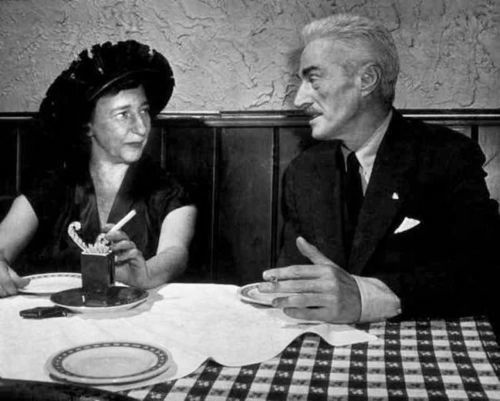
Lillian Hellman with her lover Dashiell Hammett.
Dash called it.
I picked this book up to read because I’d heard good things about it and was reassured by the fact that it had won the National Book Award. As a bonus, I was hoping to learn more about the enigmatic Dashiell Hammett. Fortunately, there were a few good stories about Dash confirming some of my own ideas of what kind of man he was. As I read more about their relationship, it became more and more baffling to me as to why Hammett was with her. For someone who had such access to brilliant, interesting people, Hellman seemed too self obsessed to really observe the world around her or really show much interest in the fascinating people she had the opportunity to meet. Why was Hammett so interested in her?
One of her nannies said to her when she was just a child, ”Don’t go through life making trouble for people”... because I’m sure they could tell that she was going to be one of those people who created turmoil and strife for her own amusement. She seemed rather proud of her prideful “I’ll do and say whatever I want whenever I want” attitude. Here is a scene from a fight she was having with Dash that will give you an idea of what it must have been like to deal with her on a daily basis:
”Many years later, unhappy about his drinking, his ladies, my life with him, I remember an angry speech I made one night: it had to do with injustice, his carelessness, his insistence that he get his way, his sharpness with me but not with himself. I was drunk, but he was drunker, and when my strides around the room carried me close to the chair where he was sitting, I stared in disbelief at what I saw. He was grinding a burning cigarette into his cheek.
I said, ’What are you doing?’
‘Keeping myself from doing it to you,’ he said.”
The always dapper and elegantly dressed Dashiell Hammett
Now, I’m not saying Hammett was a choir boy to live with either. He did drink to access, possessed acerbic wit, and had women fawning all over him. There was a scene where a woman prostrated herself before him and insisted on kissing his hand. He was highly embarrassed. Hellman flew into a rage later about the fact that he allowed that woman to do that to him. There were a mixture of things at play here: a smidge of jealousy, a bit of her own pride that she could never show him any reverence, and a dash of Dash not seeing what the big deal was. He wanted to forget about it, and she wanted to dig into it with a fork and knife until the plate was clean. Whenever she would find herself in a rage with someone, a lover, a friend, or even a woman who worked for her, she would run away for a week only to return to find that the world kept spinning just fine without her.
The best thing to come out of this relationship with Hammett is the book The Thin Man, which I started reading again to clear the taste of this book out of my mouth. I had to laugh, almost maliciously, over what he said about her role in the book, because hearing more about Hellman from Hellman was starting to sound like Freddy’s fingernails on a chalkboard in my head.
”So it was a happy day when I was given half the manuscript to read and was told that I was Nora. It was nice to be Nora, married to Nick Charles, maybe one of the few marriages in modern literature where the man and woman like each other and have a fine time together. But I was soon put back in my place---Hammett said I was also the silly girl in the book and the villainess.”
Wahaha!! Yes, I could almost see the look on her smug face as she realized that Dashiell didn’t just see her as Nora but also saw her as the immature Dorothy and her odious mother Mimi. I know I’m being almost unreasonable in my dislike for Hellman, but her flippant style of writing was also becoming wearisome. By the later third of the book, I was skimming ahead for the brief moments when she allowed Dash to at least be on stage, even if he was well away from the bright lights of center stage.
Hellman was somewhat redeemed in my eyes when she took Hammett in to take care of him in the last days of his life. He had cancer of the lungs and had so much trouble breathing that he couldn’t even read books, an obsessive pastime he enjoyed and indulged in usually late into the night every day. They had been apart for a while, but she still had feelings for the elegant thin man and showed some humanity that I frankly wasn’t sure she was capable of.
I’ve never read any plays by Hellman. I’m not even sure if they are performed anymore. Hammett often tinkered and helped with her plays. One was so bad, he ended up staying up all night trying to fix her dreadful prose. He found the play insultingly badly written. He wasn’t really a play writer, but it made him suffer to see words so misused. Many have tried their hand at playwriting only to fail miserably. (Henry James was always mystified that his success with writing novels did not transition to writing successful plays.) Hammett, though, was a notable screenplay writer and has 33 writing credits in movies. One of his gifts as a writer was his ability to write snappy, fresh dialogue.
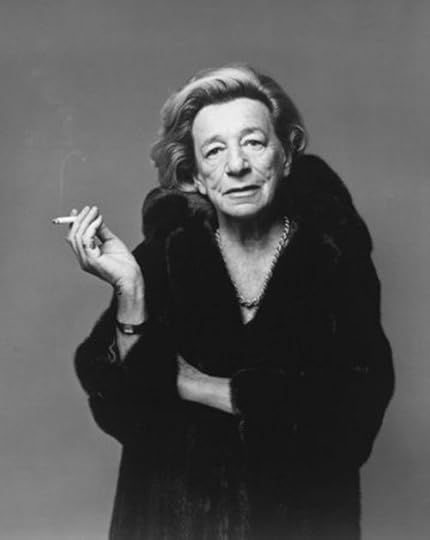
Lillian Hellman
I’ve never met a big Hellman fan, but if you are, then you probably need to read all three volumes of this memoir. If you are a big fan of Dashiell Hammett, I’d just skim for his name and read those few juicy moments when he flashes through her memories. I won’t be reading the other two volumes. I think I have had quite enough of Hellman from the first volume.
If you wish to see more of my most recent book and movie reviews, visit http://www.jeffreykeeten.com
I also have a Facebook blogger page at:https://www.facebook.com/JeffreyKeeten

Lillian Hellman with her lover Dashiell Hammett.
Dash called it.
I picked this book up to read because I’d heard good things about it and was reassured by the fact that it had won the National Book Award. As a bonus, I was hoping to learn more about the enigmatic Dashiell Hammett. Fortunately, there were a few good stories about Dash confirming some of my own ideas of what kind of man he was. As I read more about their relationship, it became more and more baffling to me as to why Hammett was with her. For someone who had such access to brilliant, interesting people, Hellman seemed too self obsessed to really observe the world around her or really show much interest in the fascinating people she had the opportunity to meet. Why was Hammett so interested in her?
One of her nannies said to her when she was just a child, ”Don’t go through life making trouble for people”... because I’m sure they could tell that she was going to be one of those people who created turmoil and strife for her own amusement. She seemed rather proud of her prideful “I’ll do and say whatever I want whenever I want” attitude. Here is a scene from a fight she was having with Dash that will give you an idea of what it must have been like to deal with her on a daily basis:
”Many years later, unhappy about his drinking, his ladies, my life with him, I remember an angry speech I made one night: it had to do with injustice, his carelessness, his insistence that he get his way, his sharpness with me but not with himself. I was drunk, but he was drunker, and when my strides around the room carried me close to the chair where he was sitting, I stared in disbelief at what I saw. He was grinding a burning cigarette into his cheek.
I said, ’What are you doing?’
‘Keeping myself from doing it to you,’ he said.”

The always dapper and elegantly dressed Dashiell Hammett
Now, I’m not saying Hammett was a choir boy to live with either. He did drink to access, possessed acerbic wit, and had women fawning all over him. There was a scene where a woman prostrated herself before him and insisted on kissing his hand. He was highly embarrassed. Hellman flew into a rage later about the fact that he allowed that woman to do that to him. There were a mixture of things at play here: a smidge of jealousy, a bit of her own pride that she could never show him any reverence, and a dash of Dash not seeing what the big deal was. He wanted to forget about it, and she wanted to dig into it with a fork and knife until the plate was clean. Whenever she would find herself in a rage with someone, a lover, a friend, or even a woman who worked for her, she would run away for a week only to return to find that the world kept spinning just fine without her.
The best thing to come out of this relationship with Hammett is the book The Thin Man, which I started reading again to clear the taste of this book out of my mouth. I had to laugh, almost maliciously, over what he said about her role in the book, because hearing more about Hellman from Hellman was starting to sound like Freddy’s fingernails on a chalkboard in my head.
”So it was a happy day when I was given half the manuscript to read and was told that I was Nora. It was nice to be Nora, married to Nick Charles, maybe one of the few marriages in modern literature where the man and woman like each other and have a fine time together. But I was soon put back in my place---Hammett said I was also the silly girl in the book and the villainess.”
Wahaha!! Yes, I could almost see the look on her smug face as she realized that Dashiell didn’t just see her as Nora but also saw her as the immature Dorothy and her odious mother Mimi. I know I’m being almost unreasonable in my dislike for Hellman, but her flippant style of writing was also becoming wearisome. By the later third of the book, I was skimming ahead for the brief moments when she allowed Dash to at least be on stage, even if he was well away from the bright lights of center stage.
Hellman was somewhat redeemed in my eyes when she took Hammett in to take care of him in the last days of his life. He had cancer of the lungs and had so much trouble breathing that he couldn’t even read books, an obsessive pastime he enjoyed and indulged in usually late into the night every day. They had been apart for a while, but she still had feelings for the elegant thin man and showed some humanity that I frankly wasn’t sure she was capable of.
I’ve never read any plays by Hellman. I’m not even sure if they are performed anymore. Hammett often tinkered and helped with her plays. One was so bad, he ended up staying up all night trying to fix her dreadful prose. He found the play insultingly badly written. He wasn’t really a play writer, but it made him suffer to see words so misused. Many have tried their hand at playwriting only to fail miserably. (Henry James was always mystified that his success with writing novels did not transition to writing successful plays.) Hammett, though, was a notable screenplay writer and has 33 writing credits in movies. One of his gifts as a writer was his ability to write snappy, fresh dialogue.

Lillian Hellman
I’ve never met a big Hellman fan, but if you are, then you probably need to read all three volumes of this memoir. If you are a big fan of Dashiell Hammett, I’d just skim for his name and read those few juicy moments when he flashes through her memories. I won’t be reading the other two volumes. I think I have had quite enough of Hellman from the first volume.
If you wish to see more of my most recent book and movie reviews, visit http://www.jeffreykeeten.com
I also have a Facebook blogger page at:https://www.facebook.com/JeffreyKeeten
January 2, 2018
...and an unwritten autobiography
Suppose you get sick as a dog for a few days. Nobody knows what's ailing you. So, you buy 25 bananas and scarf them all down. When asked why you did it, you say, "Oh, bananas are creamy delicious and they go down smooth as velvet." Kind of poetic, but why did you eat them ? Did you get cured ? Yeah, well, the first book of Lillian Hellman's three volume autobiography, AN UNFINISHED WOMAN, bears a close resemblance to this little scenario. It was on the best seller list for months, we are told. It's certainly well-written, I won't deny that. But does it really tell you much about Lillian Hellman ? That's another story.
Lillian Hellman came from a German-American background, growing up in both New Orleans and New York. Did she have any Jewish connection ? The book does not tell you. After dropping out of colleges, she got married. She stayed with the guy for seven years, but we learn zilch about him, nor about why she chose him then dropped him. Later, she became famous for writing a number of plays that were highly successful on Broadway. She became a nationally known author. Is there even a single word about how, why, where and when she wrote any of these plays ? No, nothing. In fact, if I hadn't heard of Lillian Hellman over many years, I would have no clue as to why reading this autobiography would be interesting. We learn of her close relationship to two black women, both servants in her home. This reflects the civil rights movement and political trends of the 1960s when she wrote the memoir. I am not sure they played such a central role in her life. She also talks a lot about Dorothy Parker and Dashiell Hammett, with the latter of whom she had a 30-year affair. (She had affairs with a number of other people, but they are not mentioned.) Hellman became a political activist early on and her heart went out to the left. She visited Spain during the Civil War and Russia several times. We get almost nothing of her political convictions; the book is apolitical. She finds the time, though, to show how she didn't have any interest in interviewing Stalin or in travelling with the Red Army. Did she have deep political commitments ? Was she a Communist sympathizer ? Other people say she was, but her beliefs play no role in this strange autobiography. What we get are very impressionistic, humorous, and self-centered portraits of Spain and Russia. Hellman defied the House Un-American Activities Committee but did not go to jail. Perhaps she was blacklisted afterwards, but the book does not tell us. On top of all this, she rarely introduces the people whose names she drops. There is no historical background to anyone and no information on how she knew many of the people either. I fear that this volume will, like O. Henry's stories, become so `period-specific' in future that the generations to come will not understand much due to lack of familiarity with the times, the people, and the issues. If little vignettes about famous people turn you on, you might like AN UNFINISHED WOMAN. To know Lillian Hellman, you'd better read something else.
Suppose you get sick as a dog for a few days. Nobody knows what's ailing you. So, you buy 25 bananas and scarf them all down. When asked why you did it, you say, "Oh, bananas are creamy delicious and they go down smooth as velvet." Kind of poetic, but why did you eat them ? Did you get cured ? Yeah, well, the first book of Lillian Hellman's three volume autobiography, AN UNFINISHED WOMAN, bears a close resemblance to this little scenario. It was on the best seller list for months, we are told. It's certainly well-written, I won't deny that. But does it really tell you much about Lillian Hellman ? That's another story.
Lillian Hellman came from a German-American background, growing up in both New Orleans and New York. Did she have any Jewish connection ? The book does not tell you. After dropping out of colleges, she got married. She stayed with the guy for seven years, but we learn zilch about him, nor about why she chose him then dropped him. Later, she became famous for writing a number of plays that were highly successful on Broadway. She became a nationally known author. Is there even a single word about how, why, where and when she wrote any of these plays ? No, nothing. In fact, if I hadn't heard of Lillian Hellman over many years, I would have no clue as to why reading this autobiography would be interesting. We learn of her close relationship to two black women, both servants in her home. This reflects the civil rights movement and political trends of the 1960s when she wrote the memoir. I am not sure they played such a central role in her life. She also talks a lot about Dorothy Parker and Dashiell Hammett, with the latter of whom she had a 30-year affair. (She had affairs with a number of other people, but they are not mentioned.) Hellman became a political activist early on and her heart went out to the left. She visited Spain during the Civil War and Russia several times. We get almost nothing of her political convictions; the book is apolitical. She finds the time, though, to show how she didn't have any interest in interviewing Stalin or in travelling with the Red Army. Did she have deep political commitments ? Was she a Communist sympathizer ? Other people say she was, but her beliefs play no role in this strange autobiography. What we get are very impressionistic, humorous, and self-centered portraits of Spain and Russia. Hellman defied the House Un-American Activities Committee but did not go to jail. Perhaps she was blacklisted afterwards, but the book does not tell us. On top of all this, she rarely introduces the people whose names she drops. There is no historical background to anyone and no information on how she knew many of the people either. I fear that this volume will, like O. Henry's stories, become so `period-specific' in future that the generations to come will not understand much due to lack of familiarity with the times, the people, and the issues. If little vignettes about famous people turn you on, you might like AN UNFINISHED WOMAN. To know Lillian Hellman, you'd better read something else.

March 17, 2014
The Communist Donald Trump ! ~~ A belligerent, lying Commie who wrote crummy plays. Her most famous (unactable today) - "The Little Foxes" - succeeded solely because of Tallulah Bankhead. ~~ Happily, Trump doesnt "do" plays.

January 13, 2009
"Thirty years is a long time, I guess, and yet as I come now to write about them the memories skip about and make no pattern and I know only certain of them are to be trusted. I know about that first meeting and the next, and there are many pictures and sounds, but they are out of order and out of time, and I don't seem to want to put them into place." This is a great passage about looking back back on a relationship (in her case, a long-standing affair with Dashiell Hammett).I love how Hellman's book examines memory itself. She makes no pretensions to analyze herself comprehensively - although the sharp lady is most talented at making fun of herself. One of the most outstanding episodes is of her trying to run away from home as a girl, though her travels in Civil War Spain and Soviet Russia are also fascinating.

September 20, 2013
A life where no living is done is a life not worth living. Like O'Neil, Shaw, Williams and Isben, Lillian Hellman (1905-1984, scriptwriter, playwrite, social and political activist and critic) wrote some of the most enduring and thought-provoking drama for the theatre in the 20th century, and the above 'proverb' could very easily have been her epitaph. An Unfinished Woman (Winner of the 1969 National Book Award for biography/Autobiography), the first memoir in her autobiographical trilogy (the two others being Pentimento: A Book of Portraits and Scoundrel Time), showcases a woman who had a 'steel rod' for a spine, a woman of stark liberty who would not compromise her beliefs nor truckle in the presence of those political, military and literary higher-uppers (Hemmingway is a case-in-point) whom she encountered who expected a cowering reaction due to their 'clout.' But that was something she never offered, for as Lillian Hellman said of herself when asked the question, "What are you made of, Lily?" Her cool response was, "Pickling spice and nothing nice." This 'confession' of glued-together memories and eloquent journal entries shimmers with quiet, concentrated reflection and introspection. Each chapter gleams and flashes like a beacon, slowly proffering insights into not simply a remarkable life but a frozen portrait of a bygone era - a period of class, dignity, wisdom, self-learning, an endless stream of wonderful things that are presently no more. She hobnobbed with the best and brightest, luminaries like: F. Scott Fitzgerald, Ernest Hemmingway, William Faulkner, Dorothy Parker, John Hersey, Averell Harriman, and of course, above them all, her truelove and literary confidant, Dashiell Hammett. As a globe-trotting cultural attache' to Russia, France, Germany, and other European lands, she lived and saw intrigue with those of her like mind. She was on the front lines (or very close to them) during World War II. She witnessed bombed out villages and destroyed lives, all the emotional and physical calamities that the horrors of war can funnel forth, broadcasting them for all to hear and imbibe. She participated (with some trepidation) in the PEN (Poets, Playwrites, Essayists and Editors and Novelists) Center Conference, conversing with intellectuals on the pressing issues of the time, but her reluctance was most unequivocal, for intellectual chitchat can, and for her, did quickly evolve into a bombastic mess on hyperbolic, pretentious proportions. She saw B.S., and she saw truth, not hesitating in the least to speak her mind or to write about it. From her reminiscences of her New Orleans girlhood with her beloved caretaker Sophronia, to her shuffling to New York, to her failed marriage and her father's infidelity, Hellman's life only crescendos. With corrosive verve, 'salty' wit and profound insight, Lillian Hellman lets the past truly come alive. In the end, she showed one and all that she was an 'empowered' woman before many thought that could ever be possible.

February 10, 2008
Thank you, Brother Ben, for giving me this book at Xmas. Incredibly incisive autobiography. Reminds me of when I read her "Pentimento" while at Nana's house in Denver during one arduous summer vacation. I was maybe 11, and I thought, "Good God! Adults really are as passively vicious as I think they are. I'm not crazy after all!" Hellman has a way of explaining very complex relationships in about two sentences, where most authors never get a handle on the causes of the complexity for entire novels.
Okay, now I've finally finished reading it. I've knocked a star off. Her diary entries from the Spanish Civil War aren't as well written as her writing about her childhood. But then when she relates the gruesome details of her trip to Moscow during WWII, it picks up again. Then it just turns depressing, what with her living with Dashielle Hammett, not the most likable guy in the world. But then neither was she. They were both tough.
The saddest scene is of her sailing back to the island with groceries. She sees Hammett standing at the dock & is overwhelmed with how beautiful a figure he is. And she lets go of the sail. He laughs. She yells angrily, "You're a Dostoyevsky sinner-saint!" They don't speak for several hours. That's pretty much real life. You're full of love, lost in a reverie, and you do something without thinking & then the person you love acts like an arrogant asshole & then you get very bitter that you ever felt love for this jerk & then the whole thing devolves into a vicious fight.
Also good is when Hemingway is being a prick, as usual, declaiming opinions, etc. She says to him, "I don't give a damn what you think," and leaves. That was good to read.
The part in Moscow is very upsetting. She writes of visiting a concentration camp on the way to the Front, and man, is that some kind of description. She's haunted by those images, and I am now too.
Okay, now I've finally finished reading it. I've knocked a star off. Her diary entries from the Spanish Civil War aren't as well written as her writing about her childhood. But then when she relates the gruesome details of her trip to Moscow during WWII, it picks up again. Then it just turns depressing, what with her living with Dashielle Hammett, not the most likable guy in the world. But then neither was she. They were both tough.
The saddest scene is of her sailing back to the island with groceries. She sees Hammett standing at the dock & is overwhelmed with how beautiful a figure he is. And she lets go of the sail. He laughs. She yells angrily, "You're a Dostoyevsky sinner-saint!" They don't speak for several hours. That's pretty much real life. You're full of love, lost in a reverie, and you do something without thinking & then the person you love acts like an arrogant asshole & then you get very bitter that you ever felt love for this jerk & then the whole thing devolves into a vicious fight.
Also good is when Hemingway is being a prick, as usual, declaiming opinions, etc. She says to him, "I don't give a damn what you think," and leaves. That was good to read.
The part in Moscow is very upsetting. She writes of visiting a concentration camp on the way to the Front, and man, is that some kind of description. She's haunted by those images, and I am now too.

July 14, 2013
Let me start by saying that I have been obsessed with Lillian Hellman since I first read An Unfinished Woman in college. I've read everything she ever wrote--every play, every memoir. I've watched the movie version of Pentimento about a hundred times. I've sought out every biography on her, authorized (Lily by Peter Fiebelman) and unauthorized. Mary McCarthy's famous remark about Lillian Hellman ("Every word she writes is a lie, including 'and' and 'the'") is maybe only a slight exaggeration. She was not well liked, even by her friends.
But her spare, bull's-eye writing resonated with me. Her terse mannerisms and way of confronting people and issues compelled me. I recognized the intense passion and sentiment beneath the anger and bravado. And her cranky gyrations made me laugh until I choked.
But her spare, bull's-eye writing resonated with me. Her terse mannerisms and way of confronting people and issues compelled me. I recognized the intense passion and sentiment beneath the anger and bravado. And her cranky gyrations made me laugh until I choked.

April 17, 2021
I love any works by any authors of this time. Of course, I love to hate some, as well (more of the men than the women). Lillian Hellman was a brassy, determined, unadorned gal with fewer pretenses than probably most in talented circles. Her relationship with Dash is, to me, precious, worthwhile, and in many ways, ideal. I really enjoyed the chapter about him.
But the writing. I can only imagine attaining such talent. I have no interest in plays or playwrights, and would love to discover someone/s in present day who are even remotely like Hellman. Such brilliance.
Two favorite quotes I loved:
"...wondering whether shabby jobs made people insensitive and arrogant, or whether arrogance doesn't usually lead to stupidity."
and
"The fur buyers are three men of no age except vague middle age, interchangeable in color and size."
But the writing. I can only imagine attaining such talent. I have no interest in plays or playwrights, and would love to discover someone/s in present day who are even remotely like Hellman. Such brilliance.
Two favorite quotes I loved:
"...wondering whether shabby jobs made people insensitive and arrogant, or whether arrogance doesn't usually lead to stupidity."
and
"The fur buyers are three men of no age except vague middle age, interchangeable in color and size."

Read
May 31, 2016به چشمهایم زل زد و گفت: "باهم درستش می کنیم.." چه لذتی داشت این باهم، حتی اگر باهم هیچ چیزی هم درست نمی شد، حتی اگر تمام سرمایه ام بر باد می رفت، حسی که به واژه ی "با هم" داشتم را با هیچ چیزی در این دنیا معاوضه نمی کردم. تنها کسی که وحشت تنهایی را درک کرده باشد، می تواند حس من را در آن لحظات درک کند.
April 29, 2018
Amazing book about an amazing life. I am glad I did get to know Lillian Hellman by reading this book first. Master of language, she is transfering her messages and feelings through beatifully constructed sentences.
Was more than impressed by their “out of the ordinary“ life with Dashiell Hammett.
And then there was her journey in survival mode to Moscow 1944 - thw trip that took fourteen days. And as Ms Hellman says “Those two weeks were, physically, the hardest time of my life.”
Was more than impressed by their “out of the ordinary“ life with Dashiell Hammett.
And then there was her journey in survival mode to Moscow 1944 - thw trip that took fourteen days. And as Ms Hellman says “Those two weeks were, physically, the hardest time of my life.”

September 30, 2014
Looking back on the Mary McCarthy/Hellman feud one is left to say, (1) Hellman was a playwright for decades before she wrote her "Memoirs." Why would anyone look to a brilliant literary artist for factual truth??? And, 2) WHO CARES if the Memoirs are factually correct? They are BRILLIANT stories!!!

January 21, 2011
It's no secret that Dashiell Hammett based the character Nora Charles (from "The Thin Man" series) on Lillian Hellman, and reading her memoir is like getting to see a deeper, more complicated side to the witty, tough-talking lady of Hammett's stories. Reading about Hellman's life in her own words is a delicious treat that I want to taste over and over. I so wish she had written more stories about her life, because her authentic, fearless re-telling of the past is consuming and fascinating. She can really immerse you in an experience (much like the writing of Hammett) and just when it feels like too much, she buoys you back up again with some smart, sharp humor that reminds you that we are all just trying to get through life the best we can.

January 11, 2018
A memoir from an era when writing seemed to have more meaning for daily life. And, a glimpse into the mind of someone who made her living at it, but didn't seem to be consumed by it. Contrarily, she seemed to need the stories around her from all sources as much as she had the talent for writing them. It was certainly a different age, but the memoir does show how celebrities have always congregated amongst themselves. We just don't happen to have folks like Hemingway, Fitzgerald, Parker, Murphy, or Hammett around--Kardashians and Tom Bradys and A-Rod don't seem to be in the same universe.

May 28, 2008
Lillian Hellman did not mince words. Not in her plays, and certainly not when it came to writing about herself. Her candor is probably what makes this book a bit of an uneven read, because topics she chooses to immerse herself in may not always be of as much interest to the reader. Hellman is a very fine writer, and this is a compelling biography.

February 8, 2013
First read 2/7/13 - 2/10/13
Fascinating and tough lady...
Now the film fest follows..The Little Foxes, Watch on The Rhine, and I tracked down a made for tv movie Dash & Lilly.
Fascinating and tough lady...
Now the film fest follows..The Little Foxes, Watch on The Rhine, and I tracked down a made for tv movie Dash & Lilly.
July 25, 2021
Nagyon jó eséllyel indulna a világ legrondább könyvborítója díjért ez a kötet, érthetetlenül ocsmány. Ehhez képest kitűnő a fordítása, és a szöveget sem kisebb név gondozta, mint Borbás Mária. Ráadásul egy igazán igényes névmutató is helyet kapott a kötet végén.
Lillian Hellmann önéletrajza számomra csak azért volt érdekes, hogy megtudjam, mit ír Hammettről. Ehhez képest ő néhány rövid említéstől eltekintve csak a kötet legvégén szereplő külön fejezetben szerepel - ami elfogult véleményem szerint a legérdekesebb szakasz. De viszonylag izgalmas volt betekintést nyerni a világháború korabeli Szovjetunió életébe is (már amennyit vendégként láthatott belőle egy amerikai), és a spanyol új leírása sem nélkülözött minden érdekességet. Említésre méltó, hogy budapesti kiruccanása során Ottlik Gézával is összefut a szerzőnő, bár találkozásuk nincs részletesen ecsetelve.
Lillian Hellmann önéletrajza számomra csak azért volt érdekes, hogy megtudjam, mit ír Hammettről. Ehhez képest ő néhány rövid említéstől eltekintve csak a kötet legvégén szereplő külön fejezetben szerepel - ami elfogult véleményem szerint a legérdekesebb szakasz. De viszonylag izgalmas volt betekintést nyerni a világháború korabeli Szovjetunió életébe is (már amennyit vendégként láthatott belőle egy amerikai), és a spanyol új leírása sem nélkülözött minden érdekességet. Említésre méltó, hogy budapesti kiruccanása során Ottlik Gézával is összefut a szerzőnő, bár találkozásuk nincs részletesen ecsetelve.

June 30, 2019
I’ve never read any of her work but for me was still an interesting memoir. She had a long relationship with Dashiell Hammett, worked at Boni Liveright publishing in her 20s, spent time in Russia, was friends with Dorothy Parker.
May 31, 2025
A gripping memoir, layered existential ennui that deeply resonated with me. Picked this up at a thrift shop years ago and glad I finally read it when I did!

March 31, 2012
This says "reading for the second time" - it's more like reading for the 10th time - I've read all Ms. Hellman's memoirs (An Unfinished Woman, Pentimento, and Scoundrel Time) many, many times over the past 40 or so years. I love them!
11/7/12: I really LOVE this book, as well as the rest of Ms. Hellman's memoirs. I've read them all many times and always love to go back and read them again. She was a modern woman back when there weren't that many modern women around.
11/7/12: I really LOVE this book, as well as the rest of Ms. Hellman's memoirs. I've read them all many times and always love to go back and read them again. She was a modern woman back when there weren't that many modern women around.

June 6, 2012
Hellman's talented, had an interesting, complicated life, is sometimes a hideous person - but always fascinating. I enjoyed her plays, and previous "memoirs", so recommend to those similarly interested in her work, for a take on her own experiences.

August 25, 2007
Lillian Hellman is probably more famous for her life than for what she wrote. This book is a dissapointment. But well written.
June 28, 2017
Well written memoir. Good read for me.
April 26, 2018
Lillian Hellman’s life is fascinating!

May 14, 2007
An Unfinished Woman is one of several autobiographical works penned by the American playwright, Lillian Hellman. It was published in 1969 and two others followed it: Pentimento in 1973 and Scoundrel Time in 1976. If you're wondering why there were multiple memoirs, I can't quite answer that (having not read the other two), but isn't it lovely to think that our lives require multiple volumes? It's not that they're first, second, and third acts, but rather, I imagine they each have a different focus, a particular gaze through a different lens so each might see an alternate perspective, and perhaps all together they come up with something disjointed but real. If nothing else, I do hope that the other two fill in the gaps on a few events that were not touched upon in this volume. There's no doubting that Hellman is, indeed, a hell of a writer, but she was quite selective in describing events within this memoir. She knows it and has no problem letting you know that, too, but it still doesn't mean she's giving you a complete picture. Ultimately, though, An Unfinished Woman is a unique work by one of America's great female playwrights whose life spanned remarkable events and the things she does have to say are quite fascinating in their telling... and, of course, beyond the events you have a perfect blend of wit, cynicism, and straight-forward observation that characterizes both her work and her own self.
I'll admit that prior to picking up this volume, my knowledge of Dashiell Hammett was greater than that of Lillian Hellman. My mother would send me care packages at college, but occasionally forget that she'd sent me something and I would wind up with doubles or triples of an item; the worst case included no fewer than six copies of the DVD Charade. (During break, I carted them home and lined them all up to impress upon her that we owned it -- stop buying it already.) Another such item that snuck into my care packages multiple times was Lillian Hellman's An Unfinished Woman. This particularly happened around the time that I took a month-long course on hardboiled crime fiction and so Hammett featured in heavily. Unsurprisingly, books that were not on my reading lists often went unread. I attempted to start it a few times (as evidenced by some occasional underlining and margin notes in the first few chapters), but a few days ago, I saw this on the shelves at my parents' home and decided it was time.
In An Unfinished Woman, Hellman selectively relates parts of her life and then closes with three chapters each focused on a separate person. These surprised me when I reached them, though ultimately I was pleased as I felt that at least two of these people had been short-changed by their limited presence in the rest of her narrative versus the impact even I knew they had on her life. Hellman begins her memoir right at the beginning: her parents, her family, and her childhood in the south. (This is perhaps the only part of the narrative that feels linear, but don't worry, she'll bounce back to it later on, too.) While she did spend time in both New York and Louisiana during her childhood (often bouncing between the two), she preferred her Louisiana upbringing and so it absorbs the majority of her focus. Bouncing between schools left her off balance, succeeding wildly in one and struggling to catch up in another. Despite that, though, she had a great love of reading and came to understand the benefits and trials of an only child. Having grown up in the south under the guidance of a strong black woman, it's no surprise that questions of race play an interesting role in her perspective. (Indeed, one of the three people she talks about at the end of the book is Helen, her black housekeeper who was a friend of a sort, but the relationship of employer/employee made things complicated.) Hellman's description of her first job in publishing is interesting for the fact that she paints a picture of a rather inept young woman, ultimately keeping her job as a result of sympathy from the men in charge after she has an abortion (which each of those men in charge speculate belonged to one of them, even though it actually belonged to the man Hellman would eventually marry a year later). Her first (and only) marriage is rather glazed over, but then, it seems as though the experience really just made her bored and she'd rather save her ink for other topics. She traveled, of course, but her motives for that travel were surprising, both for the lack of focus to start and then the actual focus that continued:
This youthful lack of direction is common, but seems strange coming from a woman whose writing seemed to truly convey the imperative need of the present as the world became an increasingly unstable place. "I watched other people go to a war I needed to be part of," she wrote, and then finally got her chance in the form of a "cultural mission" to Russia. She nearly died from the journey but went on to Moscow and joined the Russian army at the front. She wrote about the Spanish Civil War from various locations in Spain. Hellman uses excerpts from her journal in both of these locations to paint a very vivid picture of what it is to live in war beyond the heat of battles. She talks about the hunger, the struggle of each long day, and the people frightened to think about a future. "That's the way I remembered many nights during the way, somebody reciting Pushkin, long, long, long." I was repeatedly surprised by her front-row seat to such events... and by her way of talking about them, which cast her in the role of a rather unlikely spectator who didn't seem to much want to be in either location at the time. She traveled back to Russia twenty years later and had a very different experience, particularly dwelling on her age.
My understanding of her work focused primarily on her playwright status as opposed to any journalistic contributions. And as far as the writerly set is concerned, it would seem like name dropping if she hadn't really lived in an age and within a group where she got rides to parties from F. Scott Fitzgerald, spent time in Spain with Hemingway, fell asleep while Faulkner was talking, was the dear friend of Dorothy Parker, and spent thirty years together with Dashiell Hammett (who she still referred to as her "dear friend" in much of the book). I feared that we might lose Hellman to the stories of these others, but I shouldn't have worried -- even when focused on someone else, the reader is distinctly aware that this view is through Hellman's eyes and while she's content to let someone else have the spotlight, she never lets herself get pushed aside.
Hellman rarely tackles a topic in a conventional way, which is interesting as she still manages to see straightforward in her eventual discussion of things. One has to get used to her sidling up to a story and then being very direct. She's particularly like this when it comes to a discussion of emotions and people that she loves. Seeing Dorothy Parker through her eyes is quite fascinating, for such a legendary wit can gather an image that loses its humanity. Hellman presents "Dottie" as wonderfully human and flawed, the way a girlfriend can. Second to her wit, Dorothy Parker was known for her love affairs, and Hellman does not ignore this: "She had been loved by several remarkable men, but she only loved the ones who did not love her, and they were the shabby ones." Their friendship was uncommon and perhaps the more precious for that.
While time is spent on Parker, it's Hammett that naturally trumps all. Lillian Hellman certainly is not a woman "made" by her relationship with a man, but she does know that he had a remarkable influence on her, even as she maintained her individuality. She speaks a little about their political differences and how she could never quite reach Hammett's degree, which pained them both for the facts of their commitments to a cause and if it could influence their commitment to each other:
Hammett seems to have brought out the best in her, despite some lost years of parties that may have ruined them both and, indeed, Hammett didn't really recover. Perhaps the lasting tribute to these years of wit and booze is The Thin Man, which Hammett wrote using himself and Hellman as the models for Nick and Nora Charles. Hellman wrote, "It was nice to be Nora, married to Nick Charles, maybe one of the few marriages in modern literature where the man and woman like each other and have a fine time together. But I was soon put back in place--Hammett said I was also the silly girl in the book and the villainess. I don't know now if he was joking, but in those days it worried me: I was very anxious that he think well of me." But he was clearly the love of her life, even if she uses terms like "dear friend."
While Hellman does not in any way become explicit about her relationship with Hammett, what is obvious is the love they shared, despite what might have seemed an unconventional arrangement in a time when marriage was the norm. Her description of Hammett's declining years is terribly sad, and this is where Hellman ends her narrative, even if she's insistent about life continuing on.
While the memoir is wonderful, I would feel remiss if I didn't also admit to a feeling of surprise when Hellman left out certain things. She never talks about the writing experience much, the general experience of being a playwright as it directly contributed to her work. Sure, Hellman talks about how she didn't much like the theater even though it was her livelihood and every now and then she mentions working, but she never really specifically goes into her work... the inspirations, the writing of each, the initial reception (though once or twice she does give credit where credit is due, in citing the origin of a line that someone said to her and she then used). She occasionally uses the names of her plays as touchstones, such as an event taking place after The Little Foxes, but a description of opening night or debut performance is not to be found. The second (and perhaps even more surprising) gap was of everything surrounding the House Un-American Activities Committee and McCarthy. It's enough to make you think that you must have skipped some pages the way this period of time is so absent from her memoir. In one of the only places where she makes mention of that time, she is discussing the selling of her farm in Pleasantville.
Perhaps she wished that it never happened, but Hellman is not one to ever shy away from unpleasant things. Certainly, it would have been hard to write about, so perhaps other works deal with her experience here in a more comprehensive way, but it left me with the sense that things were incomplete.
Hellman's tone suggests that if you're reading this, then you must have some knowledge of the things that passed. There's no real implication that this will be read by those who might not be familiar with these figures and events, and thus, she has no need to explain about anyone or anything beyond herself. Her whole life, indeed, seemed to be lived with this same focus on the present -- the future was undetermined and likely to be snatched away at any moment, so it was the present that deserved her attention. Indeed, the book's last lines speak to this need to live in the present:
I underlined the hell out of my copy and I don't usually underline things in books anymore. Her turn of phrase and crystal-clear vision yields some fascinating observations about others and herself. If you have any interest in Lillian Hellman, then I suggest reading this very short memoir to gain some insight on a rather remarkable woman... and if you're only vaguely familiar with her, then it might be a great introduction. Either way, I don't think you can lose spending some time with the inspiration for Nora Charles. Her dry wit and cynical smirk are apparent on every page and while those might be the initial appeal, it's the heart and mind behind it all that prove to be the more engrossing elements.
I'll admit that prior to picking up this volume, my knowledge of Dashiell Hammett was greater than that of Lillian Hellman. My mother would send me care packages at college, but occasionally forget that she'd sent me something and I would wind up with doubles or triples of an item; the worst case included no fewer than six copies of the DVD Charade. (During break, I carted them home and lined them all up to impress upon her that we owned it -- stop buying it already.) Another such item that snuck into my care packages multiple times was Lillian Hellman's An Unfinished Woman. This particularly happened around the time that I took a month-long course on hardboiled crime fiction and so Hammett featured in heavily. Unsurprisingly, books that were not on my reading lists often went unread. I attempted to start it a few times (as evidenced by some occasional underlining and margin notes in the first few chapters), but a few days ago, I saw this on the shelves at my parents' home and decided it was time.
In An Unfinished Woman, Hellman selectively relates parts of her life and then closes with three chapters each focused on a separate person. These surprised me when I reached them, though ultimately I was pleased as I felt that at least two of these people had been short-changed by their limited presence in the rest of her narrative versus the impact even I knew they had on her life. Hellman begins her memoir right at the beginning: her parents, her family, and her childhood in the south. (This is perhaps the only part of the narrative that feels linear, but don't worry, she'll bounce back to it later on, too.) While she did spend time in both New York and Louisiana during her childhood (often bouncing between the two), she preferred her Louisiana upbringing and so it absorbs the majority of her focus. Bouncing between schools left her off balance, succeeding wildly in one and struggling to catch up in another. Despite that, though, she had a great love of reading and came to understand the benefits and trials of an only child. Having grown up in the south under the guidance of a strong black woman, it's no surprise that questions of race play an interesting role in her perspective. (Indeed, one of the three people she talks about at the end of the book is Helen, her black housekeeper who was a friend of a sort, but the relationship of employer/employee made things complicated.) Hellman's description of her first job in publishing is interesting for the fact that she paints a picture of a rather inept young woman, ultimately keeping her job as a result of sympathy from the men in charge after she has an abortion (which each of those men in charge speculate belonged to one of them, even though it actually belonged to the man Hellman would eventually marry a year later). Her first (and only) marriage is rather glazed over, but then, it seems as though the experience really just made her bored and she'd rather save her ink for other topics. She traveled, of course, but her motives for that travel were surprising, both for the lack of focus to start and then the actual focus that continued:
"I wandered around Europe in a jumble of passivity and wild impatience. I believed I was not doing or living the way I had planned. I had planned nothing, of course. I was bewildered: if I really felt there were a million years ahead of me, why then did I feel so impatient? So restless?"
This youthful lack of direction is common, but seems strange coming from a woman whose writing seemed to truly convey the imperative need of the present as the world became an increasingly unstable place. "I watched other people go to a war I needed to be part of," she wrote, and then finally got her chance in the form of a "cultural mission" to Russia. She nearly died from the journey but went on to Moscow and joined the Russian army at the front. She wrote about the Spanish Civil War from various locations in Spain. Hellman uses excerpts from her journal in both of these locations to paint a very vivid picture of what it is to live in war beyond the heat of battles. She talks about the hunger, the struggle of each long day, and the people frightened to think about a future. "That's the way I remembered many nights during the way, somebody reciting Pushkin, long, long, long." I was repeatedly surprised by her front-row seat to such events... and by her way of talking about them, which cast her in the role of a rather unlikely spectator who didn't seem to much want to be in either location at the time. She traveled back to Russia twenty years later and had a very different experience, particularly dwelling on her age.
"Twenty-two years later, the same week in October when I had arrived during the war, the plane lowered for the Moscow airport. I put out my cigarette, took off my glasses, closed my book and was shocked to find that I was crying. All women say they do not cry very much, but I don't because I learned long ago that I do it at the wrong time and in front of the wrong people. The two young English commercial travelers opposite me stared and then turned their heads away, but the German in the next seat made no secret of his interest, and a Russian across the aisle shook his head at me. I shut my eyes on all of them. What fragment at the bottom of the pot was the kettle-spoon scraping that it had not reached before?
"I told myself that maybe I was worried about seeing my old friend Raya: it is not easy to see an old friend after so many years, and certainly not women because they change more than men. But I knew the tears were not for Raya: they were for me who had, twenty-two years before, been able to fly across Siberia for fourteen days in an unheated plane, lying in a sleeping bag on top of crates, knowing the plane had few instruments even for those days, starting to be sick in Yakutsk, unable to explain in a language I didn't know, not caring, thinking that whatever happened the trip was worth it, although when the pneumonia did come, I changed my mind about that. The tears had to do with age and the woman who could survive hardships then and knew she couldn't anymore. I was sorry I had come back to Moscow."
My understanding of her work focused primarily on her playwright status as opposed to any journalistic contributions. And as far as the writerly set is concerned, it would seem like name dropping if she hadn't really lived in an age and within a group where she got rides to parties from F. Scott Fitzgerald, spent time in Spain with Hemingway, fell asleep while Faulkner was talking, was the dear friend of Dorothy Parker, and spent thirty years together with Dashiell Hammett (who she still referred to as her "dear friend" in much of the book). I feared that we might lose Hellman to the stories of these others, but I shouldn't have worried -- even when focused on someone else, the reader is distinctly aware that this view is through Hellman's eyes and while she's content to let someone else have the spotlight, she never lets herself get pushed aside.
Hellman rarely tackles a topic in a conventional way, which is interesting as she still manages to see straightforward in her eventual discussion of things. One has to get used to her sidling up to a story and then being very direct. She's particularly like this when it comes to a discussion of emotions and people that she loves. Seeing Dorothy Parker through her eyes is quite fascinating, for such a legendary wit can gather an image that loses its humanity. Hellman presents "Dottie" as wonderfully human and flawed, the way a girlfriend can. Second to her wit, Dorothy Parker was known for her love affairs, and Hellman does not ignore this: "She had been loved by several remarkable men, but she only loved the ones who did not love her, and they were the shabby ones." Their friendship was uncommon and perhaps the more precious for that.
"I enjoyed her more than I have ever enjoyed any other woman. She was modest--this wasn't all virtue, she liked to think that she was not worth much--her view of people was original and sharp, her elaborate, overdelicate manners made her a pleasure to live with, she liked books and was generous about writers, and the wit, of course, was so wonderful that neither age nor illness ever dried up the spring from which it came fresh each day. No remembrance of her can exclude it."
While time is spent on Parker, it's Hammett that naturally trumps all. Lillian Hellman certainly is not a woman "made" by her relationship with a man, but she does know that he had a remarkable influence on her, even as she maintained her individuality. She speaks a little about their political differences and how she could never quite reach Hammett's degree, which pained them both for the facts of their commitments to a cause and if it could influence their commitment to each other:
"For Hammett, as he was to prove years later, Socialist belief had become a way of life and, although he was highly critical of many Marxist doctrines and their past and present practitioners, he shrugged them off. I was trying, without knowing it, to crack his faith, sensed I couldn't do it, and was, all at one time, respectful, envious, and angry. He was patient, evidently in the hope I would come his way, amused as he always was by my pseudo-rages, cold to any influence. I do not mean there were unpleasant words between us. None, that is, except once, in 1953, after he had been in jail and gone back to teaching at the Jefferson School. I was frightened that his official connection with the school would send him back to jail and was saying that as we walked down 52nd Street. When we were a few steps from Sixth Avenue, he stopped as said, 'Lilly, when we reach the corner you are going to have to make up your mind that I must go my way. You've been more than, more than, well, more than something-or-other good to me, but now I'm trouble and a nuisance to you. I won't ever blame you if you say goodbye to me now. But if you don't, then we must never have this conversation again.' When we got to the corner, I began to cry and he looked as if he might. I was not able to speak, so he touched my shoulder and turned downtown. I stood on the corner until I couldn't see him anymore and then I began to run. When I caught up with him, he said, 'I haven't thought about a drink in years. But I'd like one. Anyway, let's go buy one for you.'"
Hammett seems to have brought out the best in her, despite some lost years of parties that may have ruined them both and, indeed, Hammett didn't really recover. Perhaps the lasting tribute to these years of wit and booze is The Thin Man, which Hammett wrote using himself and Hellman as the models for Nick and Nora Charles. Hellman wrote, "It was nice to be Nora, married to Nick Charles, maybe one of the few marriages in modern literature where the man and woman like each other and have a fine time together. But I was soon put back in place--Hammett said I was also the silly girl in the book and the villainess. I don't know now if he was joking, but in those days it worried me: I was very anxious that he think well of me." But he was clearly the love of her life, even if she uses terms like "dear friend."
"Even now as I write this, I am still angry and amused that he always had to have things on his own terms: a few minutes ago I got up from the typewriter and railed against him for it, as if he could still hear me. I know as little about the nature of romantic love as I knew when I was eighteen, but I do know about the deep pleasure of continuing interest, the excitement of wanting to know what somebody else thinks, will do, will not do, the tricks played and unplayed, the short cord that the years make into rope and, in my case, is there, hanging loose, long after death. I am not sure what Hammett would feel about the rest of these notes about him, but I am sure that he would be pleased that I am angry with him today."
While Hellman does not in any way become explicit about her relationship with Hammett, what is obvious is the love they shared, despite what might have seemed an unconventional arrangement in a time when marriage was the norm. Her description of Hammett's declining years is terribly sad, and this is where Hellman ends her narrative, even if she's insistent about life continuing on.
While the memoir is wonderful, I would feel remiss if I didn't also admit to a feeling of surprise when Hellman left out certain things. She never talks about the writing experience much, the general experience of being a playwright as it directly contributed to her work. Sure, Hellman talks about how she didn't much like the theater even though it was her livelihood and every now and then she mentions working, but she never really specifically goes into her work... the inspirations, the writing of each, the initial reception (though once or twice she does give credit where credit is due, in citing the origin of a line that someone said to her and she then used). She occasionally uses the names of her plays as touchstones, such as an event taking place after The Little Foxes, but a description of opening night or debut performance is not to be found. The second (and perhaps even more surprising) gap was of everything surrounding the House Un-American Activities Committee and McCarthy. It's enough to make you think that you must have skipped some pages the way this period of time is so absent from her memoir. In one of the only places where she makes mention of that time, she is discussing the selling of her farm in Pleasantville.
"I stopped there to look at the hundred French lilac trees in the nursery, the rosebushes waiting for the transplant place they would never get, the two extravagant acres of blanches asparagus, and standing there by the road that May afternoon of 1952, I finally realized that I would never have any of this beautiful, hardscrabble land again. Now, in the Moscow room, I was glad it was gone, but sorry that the days of Joseph McCarthy, the persecution of Hammett, my own appearance before the House Un-American Activities Committee, the Hollywood blacklist, had caused it to be gone. There could never be any place like it again because I could never again be that woman who worked from seven in the morning until two or three the next morning and woke rested and hungry for each new day."
Perhaps she wished that it never happened, but Hellman is not one to ever shy away from unpleasant things. Certainly, it would have been hard to write about, so perhaps other works deal with her experience here in a more comprehensive way, but it left me with the sense that things were incomplete.
Hellman's tone suggests that if you're reading this, then you must have some knowledge of the things that passed. There's no real implication that this will be read by those who might not be familiar with these figures and events, and thus, she has no need to explain about anyone or anything beyond herself. Her whole life, indeed, seemed to be lived with this same focus on the present -- the future was undetermined and likely to be snatched away at any moment, so it was the present that deserved her attention. Indeed, the book's last lines speak to this need to live in the present:
"But I am not yet old enough to like the past better than the present, although there are nights when I have a passing sadness for the unnecessary pains, the self-made foolishness that was, is, and will be. I do regret that I have spent too much of my life trying to find what I called the 'truth,' trying to find what I called 'sense.' I never knew what I meant by truth, never made the sense I hoped for. All I mean is that I left too much of me unfinished because I wasted too much time. However."
I underlined the hell out of my copy and I don't usually underline things in books anymore. Her turn of phrase and crystal-clear vision yields some fascinating observations about others and herself. If you have any interest in Lillian Hellman, then I suggest reading this very short memoir to gain some insight on a rather remarkable woman... and if you're only vaguely familiar with her, then it might be a great introduction. Either way, I don't think you can lose spending some time with the inspiration for Nora Charles. Her dry wit and cynical smirk are apparent on every page and while those might be the initial appeal, it's the heart and mind behind it all that prove to be the more engrossing elements.
January 6, 2026
I picked up this book for its aesthetic qualities—its thick yellow paper, its eye-friendly font. I knew nothing about the author.
After the first few pages, I almost gave up. The writing felt like a display of the author's privileged background. Yet, I persisted. The book's first section deals with her childhood, the second with her travels through European cities, and the last with the years she spent with her second husband. I truly connected with these final pages of memoir, where language and sentiment come together powerfully.
In the first two sections, covering her childhood and travels, there is a consistent mismatch. I didn't warm to the language or the content, though some passages about Hemingway were fascinating. I'm surprised so many reviewers praised the book for its writing. But I saw glimpses of it only in the final pages. Also, the author’s descriptions of Black people (particularly with the woman who raised her and with whom she remained in to touch until the woman died) often feel charged, even violent, as though she projecting her own anxieties and fears onto them, both at the individual and broader cultural levels. For instance, there was hardly anything about being a Jew in the early decades of the 20th century.
While reading the section on Russia, I looked at her Wikipedia page. She was indeed a significant cultural figure—but this image didn't align with the book I was reading. Perhaps she was important in other realms, but not, in my opinion, as a writer. The Wikipedia entry did nothing to change my impression of the book.
After the first few pages, I almost gave up. The writing felt like a display of the author's privileged background. Yet, I persisted. The book's first section deals with her childhood, the second with her travels through European cities, and the last with the years she spent with her second husband. I truly connected with these final pages of memoir, where language and sentiment come together powerfully.
In the first two sections, covering her childhood and travels, there is a consistent mismatch. I didn't warm to the language or the content, though some passages about Hemingway were fascinating. I'm surprised so many reviewers praised the book for its writing. But I saw glimpses of it only in the final pages. Also, the author’s descriptions of Black people (particularly with the woman who raised her and with whom she remained in to touch until the woman died) often feel charged, even violent, as though she projecting her own anxieties and fears onto them, both at the individual and broader cultural levels. For instance, there was hardly anything about being a Jew in the early decades of the 20th century.
While reading the section on Russia, I looked at her Wikipedia page. She was indeed a significant cultural figure—but this image didn't align with the book I was reading. Perhaps she was important in other realms, but not, in my opinion, as a writer. The Wikipedia entry did nothing to change my impression of the book.

March 17, 2020
When classes resume for the Fall semester, I’ll begin directing Lillian Hellman’s first play, The Children’s Hour. I discovered, read and loved all of her plays when I was an undergrad and am really looking forward to working on this one. As I so often do when prepping for a new project, I like to immerse myself in the world of the playwright and so I begin that journey with her memoir…one that is every bit as unique as its author.
Hellman is certainly no stranger to controversy and unconventionality. She dares to ask difficult questions in her plays and wrote about relationships that were often considered taboo. Perhaps not so unusual for someone who spent her childhood bouncing back and forth between New York City and New Orleans. I can’t imagine two more different cities! (Well, yes, I can, but still…)
I especially enjoyed the parts of her story that took me to places and people with whom I have a strong connection. Russia and Olga Berggolts. I vaguely recalled hearing about her spending time in Russia, but didn’t realize that it was first in 1944, just as the Siege of Leningrad was ending. I’ve written four plays about that siege and one of them is the story of the Soviet poet, Olga Berggolts. It was quite a surprise to see her briefly pop up in Hellman’s story. Odd (and untrue) as it is, I had a strong moment of “Hey, I know her!!”
Still to read: two more works of non-fiction, seven plays and someone else’s biography on her. Then I’ll be ready!
Hellman is certainly no stranger to controversy and unconventionality. She dares to ask difficult questions in her plays and wrote about relationships that were often considered taboo. Perhaps not so unusual for someone who spent her childhood bouncing back and forth between New York City and New Orleans. I can’t imagine two more different cities! (Well, yes, I can, but still…)
I especially enjoyed the parts of her story that took me to places and people with whom I have a strong connection. Russia and Olga Berggolts. I vaguely recalled hearing about her spending time in Russia, but didn’t realize that it was first in 1944, just as the Siege of Leningrad was ending. I’ve written four plays about that siege and one of them is the story of the Soviet poet, Olga Berggolts. It was quite a surprise to see her briefly pop up in Hellman’s story. Odd (and untrue) as it is, I had a strong moment of “Hey, I know her!!”
Still to read: two more works of non-fiction, seven plays and someone else’s biography on her. Then I’ll be ready!

March 5, 2021
1969. 1905-1984
Much more interesting than I expected, given I have read none of Hellman's plays or other work.
Aha! I see this is only the *first* of several memoirs she wrote! And this: Mary McCarthy said of her memoirs that "every word she writes is a lie, including 'and' and 'the'."
Fascinating account of her couple of visits to the USSR, one during 1944! where she visited the Front! [well, one of them]
She has a special kind of dry wit that I would not be able to characterize, let alone imitate. Her best friends greatly appreciated it, and others dropped off.
Dorothy Parker was a good friend of hers [though Parker was quite a bit older] and the chapter on their friendship is most interesting.
The last chapter is on her marriage to Dash[eill] Hammett, and is intriguing how she attempts to describe their relationship. They fought a lot yet each highly valued finding out what the other thought.
Another chapter is on "Helen", a long-time cook/housekeeper for them in NYC. Hellman [who grew up partly in New Orleans and whose mother was from Alabama] tried her best to have a good relationship with Helen while recognizing all the race factors. If Hellman were living today, she might have more tools to examine her level of white privilege and its effects, but she went a long way towards understanding how things really were.
To read: The Children's Hour 1934 and The Little Foxes 1939
Much more interesting than I expected, given I have read none of Hellman's plays or other work.
Aha! I see this is only the *first* of several memoirs she wrote! And this: Mary McCarthy said of her memoirs that "every word she writes is a lie, including 'and' and 'the'."
Fascinating account of her couple of visits to the USSR, one during 1944! where she visited the Front! [well, one of them]
She has a special kind of dry wit that I would not be able to characterize, let alone imitate. Her best friends greatly appreciated it, and others dropped off.
Dorothy Parker was a good friend of hers [though Parker was quite a bit older] and the chapter on their friendship is most interesting.
The last chapter is on her marriage to Dash[eill] Hammett, and is intriguing how she attempts to describe their relationship. They fought a lot yet each highly valued finding out what the other thought.
Another chapter is on "Helen", a long-time cook/housekeeper for them in NYC. Hellman [who grew up partly in New Orleans and whose mother was from Alabama] tried her best to have a good relationship with Helen while recognizing all the race factors. If Hellman were living today, she might have more tools to examine her level of white privilege and its effects, but she went a long way towards understanding how things really were.
To read: The Children's Hour 1934 and The Little Foxes 1939

January 9, 2019
Hellman seems, even from her own recollections, like a pretty difficult woman--and I don't think she would necessarily have argued with that assessment. But in spite of this, her memoir is remarkable--and sneakily charming. I came into it having read some of Hellman's plays, but knowing almost nothing of her life. She visited many places (Spain during the Spanish Civil War, the front lines in Russia during World War II, the anti-Communist hearings of the U.S. House Un-American Activities Committee) and knew many luminaries (Ernest Hemingway, Dorothy Parker, F. Scott Fitzgerald, Nathanael West, Sergei Eisenstein) still recognizable and noteworthy today. Perhaps most interesting, though, are some of her more personal recollections--her decades-long relationship with author Dashiell Hammett, her childhood in New Orleans, and her relationships with the African American women in her life (which, she astutely acknowledges, are fraught with the politics and white-privilege of mid-twentieth-century America). It seems like Hellman holds a lot to her chest, especially when it comes to Hammett, but there is much here that is fascinating to read.

December 5, 2018
Lillian Hellman, playwright, editor, friend, and so many other things in her life. What a history book this is! She takes the reader from her childhood in Nola to the early '60s. What a life she led. Among other travels, she visited Russia during WWII and went to the front lines. How brave (maybe foolhardy) was that? I like that she was so honest in her actions and desires. She did some things even though she didn't want to but she didn't do some things people wanted her to do and would tell them so. Another heroine of mine. I so admire her spirit, her loyalty to people. I especially liked her stories of Dorothy Parker, Helen, and Dashiell Hammett, and her revelations about them and her relationships with them.
I recommend this to people who don't mind a little dryness with the tales of her life. It picks back up. It's worth plowing through the difficult bits to get to the juicy ones. I could reread this, and I don't say that often.
I recommend this to people who don't mind a little dryness with the tales of her life. It picks back up. It's worth plowing through the difficult bits to get to the juicy ones. I could reread this, and I don't say that often.

March 27, 2022
I read Lillian Hellman once a decade on average, and have read this memoir several times before. Sure, read what others say -- especially those who don't like her as a human (or as a woman) -- but consider that Hellman is someone who never sought to please others. I have deep respect for her as a human, as a writer, and I imagine she was a good and honest friend to some. Not to everyone, and that's ok. I reread this book because Vladimir Putin is hammering the heck out of Ukraine (it's March 2022) and it's interesting to reflect on the many changed phases of Russia's relations with the United States.
Displaying 1 - 30 of 87 reviews