

What do you think?

History of Imperial China #2
China Between Empires: The Northern and Southern Dynasties
After the collapse of the Han dynasty in the third century A.D., China divided along a north-south line. Mark Lewis traces the changes that both underlay and resulted from this split in a period that saw the geographic redefinition of China, more engagement with the outside world, significant changes to family life, developments in the literary and social arenas, and the introduction of new religions.
The Yangzi River valley arose as the rice-producing center of the country. Literature moved beyond the court and the capital to depict local culture, and newly emerging social spaces included the garden, temple, salon, and country villa. The growth of self-defined genteel families expanded the notion of the elite, moving it away from the traditional great Han families identified mostly by material wealth. Trailing the rebel movements that toppled the Han, the new faiths of Daoism and Buddhism altered every aspect of life, including the state, kinship structures, and the economy.
By the time China was reunited by the Sui dynasty in A.D. 589, the elite had been drawn into the state order, while the imperial court had become more detached from society, transcending both regional ties and the concerns of daily life. The Chinese were incorporated into a new world system in which they exchanged goods and ideas with states that shared a common Buddhist religion. The centuries between the Han and the Tang thus had a profound and permanent impact on the Chinese world.
The Yangzi River valley arose as the rice-producing center of the country. Literature moved beyond the court and the capital to depict local culture, and newly emerging social spaces included the garden, temple, salon, and country villa. The growth of self-defined genteel families expanded the notion of the elite, moving it away from the traditional great Han families identified mostly by material wealth. Trailing the rebel movements that toppled the Han, the new faiths of Daoism and Buddhism altered every aspect of life, including the state, kinship structures, and the economy.
By the time China was reunited by the Sui dynasty in A.D. 589, the elite had been drawn into the state order, while the imperial court had become more detached from society, transcending both regional ties and the concerns of daily life. The Chinese were incorporated into a new world system in which they exchanged goods and ideas with states that shared a common Buddhist religion. The centuries between the Han and the Tang thus had a profound and permanent impact on the Chinese world.
258 pages, Hardcover
First published February 15, 2008
Ratings & Reviews
Friends & Following
Create a free account to discover what your friends think of this book!
Community Reviews
Displaying 1 - 30 of 39 reviews

March 30, 2019
This is the second volume Mark Lewis has contributed to Harvard’s History of Imperial China. It spans from the fall of the Han dynasty to the rise of the Tang. The period (220-618 AD) is not developed chronologically or comprehensively. It studies major themes and is organized topically, covering four centuries and dozens of dynasties in 350 pages. The entire six volume series is over 2000 pages, and is a detailed and fascinating account of Chinese civilization during more than 2000 years. It is not written for history specialists, but may be best for those with more than a general interest.
The essays focus on changes that occurred after a vast population migration from the Yellow to the Yangtze river basins. Geography, climate and agriculture in the south were factors for refugees from political upheavals in the north. Landed families and disenfranchised bureaucrats who allied against the emperor and his court eunuchs were most able to relocate. Power struggles following the collapse of the empire created military dynasties and warring princes. Nomadic warriors replaced the Han, and displaced elites gradually diverged from the customs of the north.
In the south, poetry, landscape painting and garden design flourished. City planning progressed from fortified cities and hunting parks to public temples, urban gardens and country estates. Ancient animism cults were replaced by Taoism and Buddhism. Family life metamorphosed from matriarchy to patriarchy. The Tang dynasty reverted to unified imperial rule, but retained many institutions and practices of the expatriates and their native neighbors. This is a good overview on a broad range of topics. Thankfully it is not a blow by blow account of dynastic reigns and campaigns.
The essays focus on changes that occurred after a vast population migration from the Yellow to the Yangtze river basins. Geography, climate and agriculture in the south were factors for refugees from political upheavals in the north. Landed families and disenfranchised bureaucrats who allied against the emperor and his court eunuchs were most able to relocate. Power struggles following the collapse of the empire created military dynasties and warring princes. Nomadic warriors replaced the Han, and displaced elites gradually diverged from the customs of the north.
In the south, poetry, landscape painting and garden design flourished. City planning progressed from fortified cities and hunting parks to public temples, urban gardens and country estates. Ancient animism cults were replaced by Taoism and Buddhism. Family life metamorphosed from matriarchy to patriarchy. The Tang dynasty reverted to unified imperial rule, but retained many institutions and practices of the expatriates and their native neighbors. This is a good overview on a broad range of topics. Thankfully it is not a blow by blow account of dynastic reigns and campaigns.

October 30, 2021
This is one of those books that’s difficult to like simply because of the topic it covers. When I started reading this series, this was the period of Chinese history I was least interested in due to what I perceived as its convoluted and opaque nature. With any history you start (or at least I do) with a basic narrative and then put meat on the bones by looking at narrower subtopics. Hard to do when the book provides no narrative to explain anything. And my opinion that this was an opaque and convoluted era comes from the fact that the basic narratives I’ve read don’t cover this period well either. After reading this book I don’t think I’ve changed my mind. But I will at least concede that the centuries of chaos after Han’s fall was important in setting up the successive empires.
This book does make some effort to establish the background. Oddly, the clearest narrative we do get is the background to the fall of Han, which I really would have thought would belong in the last book, but I guess it makes a certain sense. The issues arising from the fall will define the subsequent era more than the former. The second and third chapter contains a lot of description as well where Great Families and Military Dynasticism try to explain the general type of elite rule in place in the north and south. It’s a limited summary. We learn about Cao Cao’s Wen dynasty in reasonable detail, but we learn nothing about the Jin who briefly unified China. The focus is on elite kinship groups and the question of what defined power. The conclusion is that it was hereditary but not aristocratic since one family rarely remained powerful for more than a few generations.
Other than the problems that come from covering dozens of different short-lived and local dynasties instead of one or two universal ones, the book feels very similar to the last one. It continues the same topics where possible: cities, rural life, foreign relations, culture, and geography. This stresses very much the idea of continuity. The main area where China’s concerns are different from the past is the chapter on Daoism and Buddhism looks at the development of China’s first populist religions. I have to say that the narrow, thematic approach is alive and well within these chapters as well, and I wouldn’t recommend them for anybody trying to learn what these religions actually believe.
The last chapter is all tied up in literary theory. Literary theory! Ugh. Very much not my sort of thing.
And that’s the book: a somewhat disjointed and confusing look at China between empires that fails to engage not because of the writing so much as the innate difficulties in the period and the way this conflicts with the approach adopted. I just don’t see how you can write a book about a China divided into dozens of kingdoms without explaining something of how those kingdoms functioned. Not even a summary of all the maneuverings, just one or two examples. As I said in my review of the last book: these books are great for expanding on existing knowledge but terrible for establishing that knowledge in the first place. And since this is likely to be the period people know the least about, this book will likely be a frustrating one for many.
This book does make some effort to establish the background. Oddly, the clearest narrative we do get is the background to the fall of Han, which I really would have thought would belong in the last book, but I guess it makes a certain sense. The issues arising from the fall will define the subsequent era more than the former. The second and third chapter contains a lot of description as well where Great Families and Military Dynasticism try to explain the general type of elite rule in place in the north and south. It’s a limited summary. We learn about Cao Cao’s Wen dynasty in reasonable detail, but we learn nothing about the Jin who briefly unified China. The focus is on elite kinship groups and the question of what defined power. The conclusion is that it was hereditary but not aristocratic since one family rarely remained powerful for more than a few generations.
Other than the problems that come from covering dozens of different short-lived and local dynasties instead of one or two universal ones, the book feels very similar to the last one. It continues the same topics where possible: cities, rural life, foreign relations, culture, and geography. This stresses very much the idea of continuity. The main area where China’s concerns are different from the past is the chapter on Daoism and Buddhism looks at the development of China’s first populist religions. I have to say that the narrow, thematic approach is alive and well within these chapters as well, and I wouldn’t recommend them for anybody trying to learn what these religions actually believe.
The last chapter is all tied up in literary theory. Literary theory! Ugh. Very much not my sort of thing.
And that’s the book: a somewhat disjointed and confusing look at China between empires that fails to engage not because of the writing so much as the innate difficulties in the period and the way this conflicts with the approach adopted. I just don’t see how you can write a book about a China divided into dozens of kingdoms without explaining something of how those kingdoms functioned. Not even a summary of all the maneuverings, just one or two examples. As I said in my review of the last book: these books are great for expanding on existing knowledge but terrible for establishing that knowledge in the first place. And since this is likely to be the period people know the least about, this book will likely be a frustrating one for many.

August 29, 2019
China between empires is a book I picked up because of the recently released strategy game Total war three kingdoms that starts when the notorious frontier general Dong Zuo and his accomplice Lü Bu took control of the crumbling Han state. He was opposed by a warlord coalition led by Yan Shao and included often romanticized figures such as Cao Cao, Liu Bei and Sun Jian two of whom would, when the fighting finally fizzled out, become the emperors of their own carved out empire and Sun Jian’s second son would as well. However these empires have never been considered real empires, they have been called the three kingdoms. Easy to understand why this period in Chinese history has received so much popular attention and I will admit I did jump on the hype train for the new game and I did play Dynasty warriors in the past.
Mark Eward Lewis book unfortunately collapses under its own weight. His book covers everything between the Han and the Tang dynasties: the Yellow Turban Rebellion, the warlords, the three “kingdoms”, the Sima led Jin empire, the civil-war of the Eight Jin princes, the southward fleeing of the Jin dynasty and the northern kingdoms up until new Zhou kingdoms conquest of China and failure of the Sui dynasty to remain the rulers of the reunified China. If it had been up to me, this would have been two books one that ends with the savage inter familial civil war of the eight princes the second that ends with the downfall of the Sui. There is simply too much material, too many factors, too many characters, too many societal and governmental developments that either get brushed aside or lumped together in big chapters on covering the whole time period. I have to admit that after reading I struggle to place the many discussed changes and societal developments in the exact timeslot. At some point the whole hundred years period starts to mingle and that shouldn’t happen and I would not have if there had been two books that would have allowed for a more coherent picture for every part of this period.
As it is now, it resulted not only in the aforementioned mingling but also in serious underdevelopment of other facts obviously due to space constraints. The most disappointing underdeveloped facts for me where; the Daoist kingdom in Sichuan that Lewis briefly covers in his chapter on the changing nature of and the institutionalization of religion in China. This is something I had never heard off yet besides the assurance that this theocracy was crucial in the development of Daoism, we don’t get any details on the how and why. I was waiting for a comparison between this state building attempt and how this differed from the surrounding “secular” states bordering it, yet it never came. The Fall of the Sui is also something that gets rushed at the very end of the book making this even more of a sideshow in Chinese historiography as it has always been, even if he underlines it had been the Sui who had constructed the grand canal linking the politically dominant north to the new demographic and economical dominant south. The third disappointment for me was his choice to leave out the memory of the warlords in later Chinese society. Cao Cao, Dong Zhuong, Lu bu and others all became figures in theater, novels and popular stories, heck Liu Bei and his general Guan Yu have been the focus of religious ceremony even up to this day. That these warlords have stuck around in Chinese culture is a testimony of the lasting emotional and cultural impact these figures have made in their time.
Having said all of that, it would be unfair to only say negative things about this book and even if I firmly believe it collapses under its own ambition and scope, it is still one of the more rare academic books to cover this period, especially the Jin empire and events up until the Sui. Even if he does not include the cultural impact of the warlords he does gives the reader plenty of insight in the societal changes that coincided with the often romanticized clash of characters. The rise of millennialist religion, the foundation of the hereditary soldiery, a separate military elite, the integration of non Chinese peoples in the Chinese elite and society (via military service, conquest, assimilation and intermarriage) new Chinese influenced states in Korea, Japan and Vietnam, growing importance of long distance trade and cultural interaction ( Turks and Buddhism). One of the most surprising aspects for me was the genesis of what we call today civil society; the public space between household and politics as generated by a proliferation of writing, poetry and appreciation of fruit and flower gardens among elites a large portion of whom, did not seek out government careers.
One other aspect I found interesting in particular was how the warlords dealt with refugees; Either as Cao Cao and his Wei/ Sima clan successors via use of rural colonies to serve agricultural, logistical and governing needs or as Liu Bei and Sun family by turning them in a military recruitment pool. Even more interesting was the account of the friction caused by the fleeing of the Jin court, after the disastrous eight princes civil war, to the south. The local elites who had been used to a life of local importance far away from the courts and the peasants used to living in a low population density area did not particularly like a million refugees escorting the Jin court. The accommodations made between the elites, the new appreciation of southern elite culture/cuisine by emigré northern elites and the choice to expand the rice, tea and silk agriculture into the previously shunned hills made possible the high population density and intensive integrated commercialized agriculture that would come to define Chinese society for centuries to come.
China between empires for me does not quite succeed in leaving a lasting impression for the entire period it covers. It does however inspire me delve deeper and learn more. I consider this a starting point for any to study this period.
https://www.youtube.com/watch?v=jj_VM...
Mark Eward Lewis book unfortunately collapses under its own weight. His book covers everything between the Han and the Tang dynasties: the Yellow Turban Rebellion, the warlords, the three “kingdoms”, the Sima led Jin empire, the civil-war of the Eight Jin princes, the southward fleeing of the Jin dynasty and the northern kingdoms up until new Zhou kingdoms conquest of China and failure of the Sui dynasty to remain the rulers of the reunified China. If it had been up to me, this would have been two books one that ends with the savage inter familial civil war of the eight princes the second that ends with the downfall of the Sui. There is simply too much material, too many factors, too many characters, too many societal and governmental developments that either get brushed aside or lumped together in big chapters on covering the whole time period. I have to admit that after reading I struggle to place the many discussed changes and societal developments in the exact timeslot. At some point the whole hundred years period starts to mingle and that shouldn’t happen and I would not have if there had been two books that would have allowed for a more coherent picture for every part of this period.
As it is now, it resulted not only in the aforementioned mingling but also in serious underdevelopment of other facts obviously due to space constraints. The most disappointing underdeveloped facts for me where; the Daoist kingdom in Sichuan that Lewis briefly covers in his chapter on the changing nature of and the institutionalization of religion in China. This is something I had never heard off yet besides the assurance that this theocracy was crucial in the development of Daoism, we don’t get any details on the how and why. I was waiting for a comparison between this state building attempt and how this differed from the surrounding “secular” states bordering it, yet it never came. The Fall of the Sui is also something that gets rushed at the very end of the book making this even more of a sideshow in Chinese historiography as it has always been, even if he underlines it had been the Sui who had constructed the grand canal linking the politically dominant north to the new demographic and economical dominant south. The third disappointment for me was his choice to leave out the memory of the warlords in later Chinese society. Cao Cao, Dong Zhuong, Lu bu and others all became figures in theater, novels and popular stories, heck Liu Bei and his general Guan Yu have been the focus of religious ceremony even up to this day. That these warlords have stuck around in Chinese culture is a testimony of the lasting emotional and cultural impact these figures have made in their time.
Having said all of that, it would be unfair to only say negative things about this book and even if I firmly believe it collapses under its own ambition and scope, it is still one of the more rare academic books to cover this period, especially the Jin empire and events up until the Sui. Even if he does not include the cultural impact of the warlords he does gives the reader plenty of insight in the societal changes that coincided with the often romanticized clash of characters. The rise of millennialist religion, the foundation of the hereditary soldiery, a separate military elite, the integration of non Chinese peoples in the Chinese elite and society (via military service, conquest, assimilation and intermarriage) new Chinese influenced states in Korea, Japan and Vietnam, growing importance of long distance trade and cultural interaction ( Turks and Buddhism). One of the most surprising aspects for me was the genesis of what we call today civil society; the public space between household and politics as generated by a proliferation of writing, poetry and appreciation of fruit and flower gardens among elites a large portion of whom, did not seek out government careers.
One other aspect I found interesting in particular was how the warlords dealt with refugees; Either as Cao Cao and his Wei/ Sima clan successors via use of rural colonies to serve agricultural, logistical and governing needs or as Liu Bei and Sun family by turning them in a military recruitment pool. Even more interesting was the account of the friction caused by the fleeing of the Jin court, after the disastrous eight princes civil war, to the south. The local elites who had been used to a life of local importance far away from the courts and the peasants used to living in a low population density area did not particularly like a million refugees escorting the Jin court. The accommodations made between the elites, the new appreciation of southern elite culture/cuisine by emigré northern elites and the choice to expand the rice, tea and silk agriculture into the previously shunned hills made possible the high population density and intensive integrated commercialized agriculture that would come to define Chinese society for centuries to come.
China between empires for me does not quite succeed in leaving a lasting impression for the entire period it covers. It does however inspire me delve deeper and learn more. I consider this a starting point for any to study this period.
https://www.youtube.com/watch?v=jj_VM...

September 2, 2017
He refers to the period by one of the names by which it is known, but he points out that there are several.
Covers its chaotic history -- in particular, of course, the effective division between the two river valleys -- the love of gardens in the elite (generally depictions of mountain scenes, not with flowers), the various styles of withdrawal from society, the changes in agriculture, like a plow needing only one ox, interactions with the rest of the world, the massive influx and influence of Buddhism, which was still treated as an alien, foreign influence contaminating their purity, changes in literary fashions, and more. Divided up by topic.
Covers its chaotic history -- in particular, of course, the effective division between the two river valleys -- the love of gardens in the elite (generally depictions of mountain scenes, not with flowers), the various styles of withdrawal from society, the changes in agriculture, like a plow needing only one ox, interactions with the rest of the world, the massive influx and influence of Buddhism, which was still treated as an alien, foreign influence contaminating their purity, changes in literary fashions, and more. Divided up by topic.

March 22, 2013
I've read both this and Early Chinese Empires and I recommend them highly. One thing to note while reading, is that it's helpful to keep referring to the timeline in the back of the book, since Lewis doesn't write chronologically. At first I thought his thematic approach a little odd and I was more than a little confused. However, by the end of each book, I found the chronology and the major places, people, and events had sunk in somewhere along the way without my realizing it. I would say this thematic approach detracts from the book, but the one advantage of his method is that I was left with something that most history textbooks don't offer, and that is a real sense of the culture. I feel like I can practically see, feel, and hear what it might have been like to walk around in ancient China. In the end, I wouldn't trade the excellent sense of culture for a book that offers perfect chronology. After all, culture is much harder to impart.

April 18, 2018
Studded with statistics and neato poetry, this is an elegant overview of Chinese history between 220 and 589 AD. (We're talking after the Han dynasty crumbled; but before the next unifying dynasty, the Sui, got established.)
Did we ever party with measures of wine?
Today we party with measures of wine
But tomorrow dawn I will stand at the head of the canal …
with the water flowing east and west…
Thus starts the chapter on Urban Transformation --with one of the many beautiful poems set throughout this book like prisms in a window.
Here's some more verse, in the chapter on the Geography of South and North China. On migration routes between the Yellow and Yangzi rivers:
The road to Shu is high,
Higher than scaling the sky…
Alas, you poor traveler from a distant land
Why on earth have you come?
So why 3 stars? It's not fault of the author or the subject. I simply don't possess the context into which to place these ideas. For example, the author tells us: According to available records, the Yellow River has burst its dikes on 1,593 occasions. The precision of this figure baffles me. Why do these dike breaks matter so much? So I need to set down the book and ask Google about the history of the Yellow River. This kind of question occurs to me a lot while reading. But I can't always run to the internet to get educated by whichever 14-year-old happens to be editing Wikipedia at the time.
But back to the poems! Can't resist. An emperor challenges his little bro to a poetry fight. Little bro immediately pwns him with:
Boil beans to make a soup;
Strain lentils for the stock.
Stalks burn beneath the pot
while beans shed tears within.
Originally from a common root,
Why such haste to burn the other?
Legume genius!
Did we ever party with measures of wine?
Today we party with measures of wine
But tomorrow dawn I will stand at the head of the canal …
with the water flowing east and west…
Thus starts the chapter on Urban Transformation --with one of the many beautiful poems set throughout this book like prisms in a window.
Here's some more verse, in the chapter on the Geography of South and North China. On migration routes between the Yellow and Yangzi rivers:
The road to Shu is high,
Higher than scaling the sky…
Alas, you poor traveler from a distant land
Why on earth have you come?
So why 3 stars? It's not fault of the author or the subject. I simply don't possess the context into which to place these ideas. For example, the author tells us: According to available records, the Yellow River has burst its dikes on 1,593 occasions. The precision of this figure baffles me. Why do these dike breaks matter so much? So I need to set down the book and ask Google about the history of the Yellow River. This kind of question occurs to me a lot while reading. But I can't always run to the internet to get educated by whichever 14-year-old happens to be editing Wikipedia at the time.
But back to the poems! Can't resist. An emperor challenges his little bro to a poetry fight. Little bro immediately pwns him with:
Boil beans to make a soup;
Strain lentils for the stock.
Stalks burn beneath the pot
while beans shed tears within.
Originally from a common root,
Why such haste to burn the other?
Legume genius!

March 14, 2014
Mark Edward Lewis has become one of my most trusted guides on Chinese history. As I attempt to make my way through his heavy-duty books on the emergence of the state and its appurtenances (Sanctioned Violence in Early China, Writing and Authority in Early China) I can also bask in the entries he has in this wide-audience series.
I found the political history incisive, and then the large coverage of culture and society (this series known for its themed chapters) felt like a close-up look at actual life. It’s well-illustrated and enlists every kind of material for its portrait. To date I’ve only read the Song volume of this series, but that too was fabulously informative and wide-ranging and simply interesting to read.
The period of this book saw much engagement with the foreign, which makes for fascinating times.
Recommended without reservation.
I found the political history incisive, and then the large coverage of culture and society (this series known for its themed chapters) felt like a close-up look at actual life. It’s well-illustrated and enlists every kind of material for its portrait. To date I’ve only read the Song volume of this series, but that too was fabulously informative and wide-ranging and simply interesting to read.
The period of this book saw much engagement with the foreign, which makes for fascinating times.
Recommended without reservation.

December 31, 2019
Another solid entry in the series. This is the second of six books covering the history of Imperial China. They all follow a formula with chapters covering various topics of the period. History, religion, urban and rural life, government, writings, etc. They are about 250 -280 pages in length. I found this one rather interesting, covering the somewhat chaotic post Han period. Plenty of upheaval, a general movement of people to the south, Chinese style kingdoms forming from the barbarians in the north. It was also a time of growth for Buddhism and Daoism, and a growth of the arts, particularly poetry. An interesting series that I look forward to continuing.

February 21, 2019
I was tremendously impressed with -- and consistently engaged by -- this book. It's a knowledgeable, thorough, nuanced, and lucid look at a complex and neglected period. It highlights important issues of continuity and change, avoids getting bogged down in political minutiae, and treats its sources transparently. I loved it. And I really think it should teach well, though my students seemed a bit hesitant in what was for them unfamiliar territory.
August 12, 2023
A fair amount of depth in covering this disunified period of Chinese history between the Han and Sui dynasties. The chapters describe the history from various perspectives, including military, religion, rural, urban, literature and more. I was most intrigued by the early Taoist thought (philosophical, before becoming an institutionalized religion), "Dark Studies" and "pure conversation".

October 16, 2024
This follows the pattern of the first volume in the series: a brief overview of political events followed by social and cultural developments. They are excellent overviews, but if you're looking for a gripping narrative, I don't recommend them. John Keay or Jacques Gernet would be better choices.

September 8, 2026
Borrow.
As with it's predecessor, it has great content that is hard to find in English in this form but the writing is dry and without spirit.
As with it's predecessor, it has great content that is hard to find in English in this form but the writing is dry and without spirit.
May 6, 2021
China Between Empires is by far a better book compared to the previous first volume. Reading this book is quite entertaining although I do still find the information presented somewhat lacking and incomplete as the author decided to squash roughly four centuries of internecine wars and different dynasties into just three hundred pages. The content of this book follows the same thematic style similar to that of the first volume and thus the essays were not presented chronologically but according to the topic chosen for each chapter.
Following the collapse of the Eastern Han dynasty, China found itself divided geographically and politically among ambitious warlords, nomadic conquerors, and the remnant of imperial lineages as well as emerging military commanders from humble origins who strive to obtain the emperorship. During this divisive period of interchanging dynasties, the cultural separation between the north and south gradually took shape as the nomadic conquerors overran the northern region around the Yellow River, whereas the Chinese imperial court fled to the southern region around the Yangzi River and henceforth made their base there. Each of these northern and southern dynasties attempted to conquer the other region so as to reunify back the Chinese realm and claimed legitimacy as the Emperor of unified China although from time to time they failed to even solidify their own position in their own local imperial court, culminating in their own demise and being replaced by yet another different dynasties.
The majority of topics discussed in this book were about the rise of aesthetic and religious pursuit. These aesthetically pleasing activities such as creating a new genre of literature and poetry, landscape painting, escaping to the mountain to seek solitude, designing harmonious-looking gardens, and building high-rise Buddhist temples and pagodas were all defined by the elite. While it’s rare for the common folk to follow these elite-defined activities, they developed new agricultural techniques and opened new economically beneficial activities such as the production of oils, fine flours, and teas. In short, both the elite and the peasantry raised their own standard of living during one of the most chaotic periods in China.
Ultimately, this is quite a broad overview of such huge scope of tumultuous events in Chinese imperial history. The Three Kingdoms period was certainly not discussed as much but was important to the political and cultural evolution of the dynasty that followed it. Jin Dynasty and the Sixteen Kingdoms period, whose institutions and land policies supplanted the old Han models, were mentioned briefly as important preceding events before the emergence of the Northern and Southern Dynasties. Moreover, the Sui’s unification of China was treated poorly and explained in a very short chapter. While the book offered a lot of cultural insights, it shied away from many major historic events and important rulers.
Following the collapse of the Eastern Han dynasty, China found itself divided geographically and politically among ambitious warlords, nomadic conquerors, and the remnant of imperial lineages as well as emerging military commanders from humble origins who strive to obtain the emperorship. During this divisive period of interchanging dynasties, the cultural separation between the north and south gradually took shape as the nomadic conquerors overran the northern region around the Yellow River, whereas the Chinese imperial court fled to the southern region around the Yangzi River and henceforth made their base there. Each of these northern and southern dynasties attempted to conquer the other region so as to reunify back the Chinese realm and claimed legitimacy as the Emperor of unified China although from time to time they failed to even solidify their own position in their own local imperial court, culminating in their own demise and being replaced by yet another different dynasties.
“More important, the prestige of reconquering the Yellow River basin would enable victorious generals to make claims to the emperorship. In subsequent decades the tension grew even stronger between ambitious military men who hoped to use a successful northern expedition as a prelude to establishing a dynasty, and an anxious court for whom reunification now meant disaster.” ~Chapter 3: Military Dynasticism, page 64-65.
The majority of topics discussed in this book were about the rise of aesthetic and religious pursuit. These aesthetically pleasing activities such as creating a new genre of literature and poetry, landscape painting, escaping to the mountain to seek solitude, designing harmonious-looking gardens, and building high-rise Buddhist temples and pagodas were all defined by the elite. While it’s rare for the common folk to follow these elite-defined activities, they developed new agricultural techniques and opened new economically beneficial activities such as the production of oils, fine flours, and teas. In short, both the elite and the peasantry raised their own standard of living during one of the most chaotic periods in China.
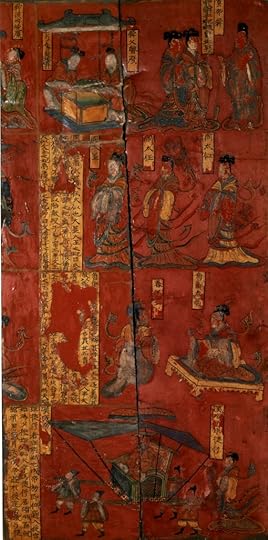
Lacquer painting on wood portraying Filial Sons and Virtuous Women, from the tomb of Sima Jinlong in Datong, dated to the Northern Wei Dynasty (386-534 AD)
Ultimately, this is quite a broad overview of such huge scope of tumultuous events in Chinese imperial history. The Three Kingdoms period was certainly not discussed as much but was important to the political and cultural evolution of the dynasty that followed it. Jin Dynasty and the Sixteen Kingdoms period, whose institutions and land policies supplanted the old Han models, were mentioned briefly as important preceding events before the emergence of the Northern and Southern Dynasties. Moreover, the Sui’s unification of China was treated poorly and explained in a very short chapter. While the book offered a lot of cultural insights, it shied away from many major historic events and important rulers.

July 25, 2011
This was another excellent book by Mark Lewis. It was the same style and his book on the Qin and the Han but looking at the period of disunion that followed. I think the one thing that struck with me the most while doing my MA was how important the period of disunion between the Han and the Sui was. This was the time where Buddhism and Taoism really began to take hold. There was a strengthening of culture within the south and contributions from the "barbarians" in the north. I borrowed this book from Senate house but think I will have to buy my own copy as it's a great reference to the period, as well as being a very interesting read. I actually finished this book a month ago but have been slow to write up non-fiction. As a result it is now full of lots of bookmarks that I can't remember why they are important. But will try to figure out some of the major points here. It was Cao Cao's family that developed the new lyric poem, in particular his son Cao Pi. This was not only a new style of poetry but also covered new topics such as banquets, moments of parting and the sights of mountains at dusk (19). Cao Pi is regarded as the "Father of literary critical theory in China" (41). They also wrote on the aesthetic grounds of character assessment including "dancing, juggling, fencing, reciting humorous fiction, discoursing on the origin of the universe, classifying and ranking people through history, and composing and criticising verse" (41). Lewis challenges ideas that the state was the much more important than civil society (45) There is an interesting discussion on the intellectual movement which Lewis translates as "dark studies" which consisted of studying the daodejing, zhuangzi and the yijing. (48). The chapters on urban development was interesting. I love reading about old cities. There was a beautiful example of a poem by a woman about blighted love which uses the elements of the city, including a drinking party to talk of the woman's despair (87). I hear you have a new love and so have come to say farewell our whole life in the city did we ever party with measures of wine? Today we party with measures of wine, But tomorrow dawn I will stand at the head of the canal... (A poem which actually comes from another book I have! Birrell early ballads) The chapter on the city also talked about the important role that women had within the Northern cities, how they were responsible for decision "maintaining their family's status, handle legal disputes, make formal calls and receive the powerful" (92). 163 talks about how foreigners became linked with ghosts and spirits. And how ghost writing produced by possessed mediums often took the form of horizontal writing resembling that of the western barbarians (163). 192-193 talk about the role of women in religion, particularly Buddhism, and the fact that this was the first time where women were given an alternative to marriage. 202-203 talk about Ge Hong, and different forms of Taoism. and 211 talks of the different roles of Buddhist monks within the community. An interesting book. One that would be good for people who have knowledge about the period as well as for those who want a good starting point.

July 11, 2019
A decent overview of the history of this era in China. From what I gather during it Buddhism and Daoism became a big thing, the grand canal was made, calligraphy became important and a critical piece that put this period to an end was removing the 'great families' and instead giving government positions based on scholastic examinations.
Also the burial became less lavish, as reincarnation was better understood.
Also the burial became less lavish, as reincarnation was better understood.

October 31, 2020
Compared to the previous book, this was much better in terms of how it was set out and presented. This covers the period between the collapse of the Han dynasty and the subsequent Three Kingdoms Period through to the period between the establishment of the Tang. I was hoping for a little more detail on the Three Kingdoms period rather than the short overview, but still an interesting read.
March 8, 2021
Excellent
A very interesting history of China in a fascinating period of its history, between the end of the Han Dynasty and the rise of the Sui. This is perhaps not a book for the general reader, but anyone who is interested in China apart from a cursory overview will find it invaluable.
A very interesting history of China in a fascinating period of its history, between the end of the Han Dynasty and the rise of the Sui. This is perhaps not a book for the general reader, but anyone who is interested in China apart from a cursory overview will find it invaluable.
November 22, 2012
I already had basic knowledge of Chinese history, and this book filled in some of the gaps that I had. I especially enjoyed the section on Buddhism and Daoism. Can't wait to read the rest of the series.

January 25, 2017
A detailed description of an era not discussed in Chinese history as much as clear dynastic societies. Important to get a clear picture of historical continuity. Would have preferred a more linear approach in terms of timeline.

March 30, 2024
"China between Empires: The Northern and Southern Dynasties" presents a very different Chinese world compared to that of earlier Chinese periods. This is a much more diverse China: one that incorporates multiple non-Han peoples (nomadic and semi-nomadic people ruling the Northern dynasties and the Chinese and Sui ruling the Southern dynasties); one with significant trade and cultural connections to the outside world, including India, Central Asia, Korea, and Japan (as well as the aforementioned northern nomadic and southern Sui peoples); and one with cultural and literary sensibilities that expand from the court and capital into celebrating regional particularities and nature. Finally, this is a period that involves significant philosophical and religious shifts with the rise of organized Daoist religious movements and of Buddhism as central to Chinese religion and culture.
The book, like all others in this Harvard "History of Imperial China" series, is not chronological, which is a drawback to the reader who likes chronological history. The book mostly covers the chronology of the period in abbreviated form in the first two chapters (and late developments in the Conclusion). This is a diverse and eventful period of history, starting with the collapse of the Han dynasty and the Three Kingdom period - later famously memorialized by a Ming Dynasty historical novel - and continuing with the Northern And Southern dynasties period (the first part of which is also called the Sixteen Kingdoms period) - and culminating with the Sui reunification of China. A book of less than 300 pages cannot cover this span of political and cultural change in any kind of depth, but it does serve as a useful introduction. It also makes me want to read more about this period, as one can barely begin to understand the diversity of dynastic/political and cultural change through an introductory text only (and the dynastic/political treatment definitely takes a backseat to the cultural here). Sadly, two books I think would be particularly helpful for this period are way too over-priced and also not currently available via interlibrary loan: "Northern Wei (386-534): A New Form of Empire in East Asia" and "The Jiankang Empire in Chinese and World History."
One aspect that I think the book covered particularly well is the significance and evolution of poetry in this period: poetry that spoke to the regional particularities of the period, that celebrated the common life and nature, and poetry that became increasingly self-conscious and experiential compared to the past (though the experiential was never fully absent from Chinese poetry, as is clear from several poems in the Shijing). Lewis did a great job reviewing the main poets of their area, explaining some of the philosophical foundations of their poetry, and including some of their verses - making me, otherwise not generally into poetry, more interested in the subject. I look forward to reading more about the developments within Chinese literature in later books in this series.
The book, like all others in this Harvard "History of Imperial China" series, is not chronological, which is a drawback to the reader who likes chronological history. The book mostly covers the chronology of the period in abbreviated form in the first two chapters (and late developments in the Conclusion). This is a diverse and eventful period of history, starting with the collapse of the Han dynasty and the Three Kingdom period - later famously memorialized by a Ming Dynasty historical novel - and continuing with the Northern And Southern dynasties period (the first part of which is also called the Sixteen Kingdoms period) - and culminating with the Sui reunification of China. A book of less than 300 pages cannot cover this span of political and cultural change in any kind of depth, but it does serve as a useful introduction. It also makes me want to read more about this period, as one can barely begin to understand the diversity of dynastic/political and cultural change through an introductory text only (and the dynastic/political treatment definitely takes a backseat to the cultural here). Sadly, two books I think would be particularly helpful for this period are way too over-priced and also not currently available via interlibrary loan: "Northern Wei (386-534): A New Form of Empire in East Asia" and "The Jiankang Empire in Chinese and World History."
One aspect that I think the book covered particularly well is the significance and evolution of poetry in this period: poetry that spoke to the regional particularities of the period, that celebrated the common life and nature, and poetry that became increasingly self-conscious and experiential compared to the past (though the experiential was never fully absent from Chinese poetry, as is clear from several poems in the Shijing). Lewis did a great job reviewing the main poets of their area, explaining some of the philosophical foundations of their poetry, and including some of their verses - making me, otherwise not generally into poetry, more interested in the subject. I look forward to reading more about the developments within Chinese literature in later books in this series.

March 7, 2022
As someone who grew up learning the systematic, chronological, political-centric teaching of Chinese history, I quite appreciated and enjoyed this book's emphasis on patterns in society, religion, literature across the time period. It gave me a much more in-depth, nuanced understanding of the time as opposed to facts and political figures that usually dominate. The main focus of the book seem to be observing how Chinese society transformed from the Han dynasty to the Tang dynasty through various cultural innovations and changes that took place in the North and Southern Dynasties.
I highly recommend this book. It will not teach you chronology, or go in depth into any political or famous figures, but it does very well in capturing an objective observation of the changing of eras.
I highly recommend this book. It will not teach you chronology, or go in depth into any political or famous figures, but it does very well in capturing an objective observation of the changing of eras.

November 28, 2022
This is the second volume of the History of Imperial China series and is a good follow-up to the first volume- the Qin and Han Dynasty volume. This volume looks at what happens to China after the Han dynasty and before the Tang dynasty could re-establish stability for a few centuries. The period is distinguished by smaller kingdoms, vying for control and by a burst of cultural creativity.
The structure of the book is similar to the first volume- analytical rather than narrative. That does mean that it is easy to lose track of the chronology, especially in a period as confused as this one. Lewis does keep the sense of continuity, but it can still be confusing to a novice.
This is worth reading and I'm already plotting to get the Tang Dynasty volume and continue the story.
The structure of the book is similar to the first volume- analytical rather than narrative. That does mean that it is easy to lose track of the chronology, especially in a period as confused as this one. Lewis does keep the sense of continuity, but it can still be confusing to a novice.
This is worth reading and I'm already plotting to get the Tang Dynasty volume and continue the story.
January 4, 2024
Quite boring to read. It is an uninteresting period of Chinese history though. The opening part of the book was good, but it grew tedious after about 30% of the way through it; too much details about poetry, religion, farming for my taste. The book also felt a little disjointed jumping back and forth between time periods. I prefer a more linear style of history.

August 25, 2025
A very good summary of important details from the end of the Han (Three Kingdoms) up until the establishment of the Sui. There are a few details that I think would have been valuable to include such as Guo Xiang's emphasis on "footprints" not being the same as the sage, but I think that this work is good for gaining an overall understanding of the era.

October 29, 2024
3.5.
The poetry/literature chapter was way too dense to make sense of in this context. Explaining the philosophy of nothingness Vs the naming of names in 4th century China is just undoable in so few pages. I got what was meant to be achieved, but understood nothing!
The poetry/literature chapter was way too dense to make sense of in this context. Explaining the philosophy of nothingness Vs the naming of names in 4th century China is just undoable in so few pages. I got what was meant to be achieved, but understood nothing!

September 21, 2022
宗教部分还挺不错的 不过还是不太行
September 18, 2024
Not an easy read, but interesting - especially on the development of southern China and the influence of foreign influences (for exqample Buddhism).

May 26, 2026
4.5 Excellent read. Hit the spot.

December 22, 2021
1.與本系列第一冊相同,內容有些瑣碎、雜亂。
2.本書其實花不少篇幅在講秦漢。
3.較著重描述文學、思想的發展。
2.本書其實花不少篇幅在講秦漢。
3.較著重描述文學、思想的發展。
October 22, 2023
读到这个系列的第二册还是被内容的丰富所惊讶到。本来想着作者会着重于讨论政治上朝代更替的经过与内因,但是作者却仿佛要覆盖到南北朝时期每一个方面的信息。这种展现历史的方式确实更为“西方”,也更有以开阔眼界为目的而达到的价值。但是这种方式却也失去了一种历史的纵深感,使得这样一个中国历史上极为特殊、极为多彩的时代展现的过于扁平,流失了中国历史特有的沧桑感。
Displaying 1 - 30 of 39 reviews