A cradle-to-the-grave of one of the most intriguing rulers in history, King Frederick the Great who raised the small kingdom of Prussia to major power status in the turbulent military and political struggles of the 18th century. A cruel childhood forced him to lie, deceive and cheat in order to enjoy, if only for brief periods, the life of an intellectual. Once on the throne he spent many years of often brilliant field command of his army in seemingly endless campaigns. He remained an intellectual, however, an essayist, historian, poet, flautist, consorting when possible with the French writer Voltaire.
Robert Brown Asprey was an American military historian and author, noted for his books on military history published between 1959 and 2001.
Asprey received a bachelor's degree from the University of Iowa in 1949, after serving in World War II. He also studied at New College, Oxford, at the University of Vienna, and at the University of Nice.
In World War II, Asprey was a member of the secret Marine Beach Jumper Unit, then joined the 5th Marine Division. In the 1950s, he served in U.S. Army Intelligence in Austria before returning to the U.S. Marine Corps in the Korean War with the rank of captain. He received a Purple Heart and a Presidential Unit Citation for his service.
Hmmm, an ambitious ruler in Berlin, insecure but arrogant, hungering for new territories, Poland dismembered and split up with Russia, surrounded by enemies, a professional German army, launching preemptive attacks against neighbors, outnumbered, fighting on two (or more) fronts, winter wars, scorched earth…..and it happens in the 18th Century, foreshadowing the 20th Century repeats.
Based on my clearly substandard knowledge of early to mid-18th century Europe, I will have to give this one 4.5 Stars, only taking a little back for lack of maps when they were absolutely needed. You may ask why the bleep should I read about some Prussian autocrat in the 1700’s. Good question. My answer would be to look at the rise of German military prowess and traditions that will have such a devastating impact on the 20th Century. You will see the turmoil in Europe that precedes the American and French Revolutions and the rise of Napoleon, the shifting alliances and balance of power calculations that went on, the widespread death and destruction at the whim of the rulers trying to expand or hang on to their provinces and fiefdoms. A couple areas stand out: Prussian military performance, diplomacy as a true element of power, and irregular (guerrilla) warfare.
He should be called Frederick the Lucky, not “the Great”. He isn’t “magnificent” and I didn’t find much “enigma” about him. I would call him remarkable. He is definitely unique, not typical of your average monarch. He corresponds with Voltaire, brings him and other intellectuals to his Potsdam palace, San Souci, and yearns to have Berlin become as culturally dynamic as Paris. He constantly careens between intellectual pursuits and war to expand his dominion over territories belonging to others. He writes a book on Machiavelli and devises a work on “The General Principles of War”, a secret document meant to help guide Prussian rulers and military leaders in the tactical and strategic European environment. He drilled his troops often, both on the parade ground and in realistic exercises.
Prussian military performance: Prussia is a rising power, insecure and vulnerable to attack from all directions. King Frederick William, Frederick’s father is a cruel man to his son but he is an adept ruler, never tying himself to one ally or another. He builds an army to respect:
The army that Frederick rejoined in 1732 numbered over seventy-five thousand, which made it the fourth largest in Europe after the armies of France, Russia, and Austria. It was incontestably the best in appearance and drill. Its guiding genius, Prince Leopold of Anhalt-Dessau — known to the troops as der Schnauzbart (the Mustache) and to others as Old Dessauer — had introduced iron ramrods, which did not break like wooden ones and, when used by trained and disciplined troops, increased the speed of loading and thus the rate of fire. Perhaps as important, he had also improved the bayonet so that it remained attached to the musket during firing, and he had introduced marching in step (the Gleichschritt), which eventually led to the precision close order drill so greatly admired by foreign visitors and so helpful in battlefield maneuverability.
When Frederick becomes king, he forges the army into a real weapon and sets out to use it to capture Silesia from Austria in 1740. He seems to realize he will get better results by treating his soldiers tough but fair. And he learns from his mistakes (mostly). Better weapons, better logistics, better transport, better tactics all consume him in preparing for and executing his wars. Even at war, he takes time to correspond with Voltaire:
Throughout the coming battles over Silesia and the Seven Years’ War, Frederick’s army will mostly fight and win but will also fight and lose. Often outnumbered and fighting on multiple fronts, the Prussians will build a reputation as fierce fighters. How many brave men went to their deaths at his command. It is easy to see why Hitler and the Nazis were so admiring of Frederick for his military exploits.
Diplomacy as an element of national power: The dizzying pace of alliances, treaties, betrayals, making demands, supporting or withdrawing support to various rulers is something to behold. Asprey takes you into almost every effort to make an alliance or counter an opposing one. This era is marked by a number of relatively equal powers in France, Austria, England and the Ottoman Empire. Prussia could be split up between several of them and must be strong to deter this happening. At the same time, Frederick wants to expand into Silesia and takes advantage of Austria’s weakness when Emperor Charles VI dies, the last male descendent of 5 centuries of Hapburgs . Archduchess of Austria and Queen of Hungary Maria Theresa, ruling in her father’s place, will oppose Frederick for many years. She is his greatest rival, a young girl with very little training in 'kingsmanship' or military strategy who is grappling with a divided kingdom and being assaulted on all sides by greedy nations. Frederick will eventually ally with France for his early wars, but will then fight France and others in the Seven Years’ War. How Frederick maneuvers and schemes for survival among all the powers of the day is often at the brink of failure only to suddenly succeed. He even tries to get the Turks to attack Austria and Russia so they would have to take forces away from fighting Frederick’s army.
Irregular (guerrilla) warfare: One very effective force that Austria deploys against Frederick is an army made up of brigands, bandits and guerrilla fighters. These are drawn from the Balkans, Hungary, and other areas. They are very effective and I didn’t see Frederick come up with an effective counter. Gathering intelligence and reconnaissance is essential for success in war. Frederick is kept blind to his enemies’ moves much of the time. In the Seven Years’ War, Frederick’s army is besieging a fortress and needs resupply:
Frederick is the cause of so many deaths and so much suffering. His armies often take heavy casualties even when they win. Yet he is able to rebuild his battalions and corps many times. Ultimately he is successful in adding territory to the Prussian kingdom. On a different note he had a major impact on Russia: Frederick the Great picks a minor princess from an obscure house to marry into the Russian nobility...who, in time, becomes Catherine the Great.
One reviewer said he thought the framers of the US Constitution must have had Frederick in mind when they made it hard to go to war by instituting the separation of powers. I had a similar thought but mine was that so many people from Europe wanted to get out from under the thumb of despots who could take their countries to war on a whim and cause so much destruction. This book definitely gives you a vivid picture of a violent century in Europe. It is a substantial book but the action moves along quickly, it was never boring.
The "Magnificent Enigma" was a man who, though raised by a martinet in a militarist society, turned out to be a man of the Enlightenment, a flautist, composer, philosopher, a man who summoned Voltaire in order to be taught by him.
He survived a youth being continually ridiculed and beaten by his coarse father, Frederick William, who thought him effeminate, a cardinal sin for a man, let alone a king, in Prussia. The author devotes a good part of the book describing continual humiliations, such as being slapped to the floor by his father at a formal dinner in front of guests, that could easily have produced a hopelessly neurotic adult. Yet Frederick finally took an interest in the military, studying tactics and training with a will, to the point that his father embraced him.
If you are left cold, as I usually am, by long descriptions of battle tactics, then this book might not not be for you. I'd estimate that over half of it is detailed description of how army X moved to engage the right flank of army Y, etc., that gets tedious fast when one isn't familiar with the area where the battle was fought.
But I stuck with it and survived the Seven Years War! In the process I became familiar with the location of Bohemia, Silesia, Moravia, Bavaria, Hanover, Pomerania and several of the other components of the Holy Roman Empire - all pawns in the power plays of Austria, Prussia, Russia, France and England. What hit me in particular was the way Poland was considered a piece of pie to be divided up between Austria, Russia and Prussia. Hitler and Stalin played the same game.
Asprey goes into fascinating detail about the military, which is clearly the author's love. Did you know that because muskets were so difficult to load and fire rapidly, it wasn't unusual for troops with firearms to attack with their muskets used only for the bayonets; the rush of a mass of men was so quick and effective without fumbling with firearms that it could overrun the enemy without a shot fired by the offense.
Artillery was another matter - after Asprey describes how the different cannon balls and canister shot are made and used, we get to experience their terrible destructive power in battle where heads are easily taken off bodies by cannon balls and infantry ranks shredded by the shotgun-like effect of hundreds of tiny iron pellets. Frederick is shocked and repulsed by the carnage when visiting a battlefield after the battle. Yet, as with all generals, this is never an impediment to the next battle.
It is in the details of the times that the author wins over my admiration for this book. One can only marvel at how the lives of thousands are thrown away in the power plays of royalty - the rich and powerful of the time that are more than likely to be related to each other even as they send the peasantry of their respective domains to horrible massed slaughter. Though nothing can ever compare to the carnage of WW1, in the Seven Years War it wasn't unusual to lose 10,000 men on each side in one battle.
At the same time the countryside was devastated. Armies would take what they wanted from the populace - a populace that had already been decimated by forced recruitment into what might be the very same army doing the pillaging. Agents would venture far afield, even into the lands of the enemy, to recruit soldiers. Soldiers would readily desert to fight for the other side. It was expected that simply being a male would mean fighting for one side or another. In one case, Frederick defeated the Saxon army and gleefully took on the whole into his own army. Remember the song "oh it's 1-2-3 what are we fighting for?"
As is related in the book, an army would be ordered to smash all ovens, break all windows and doors in a region in order to deny an opposing force the use of the area for winter quarters. What the local people would do for the winter was irrelevant. And how about boarded soldiers? Your barn and even your house were quite eligible to house members of the occupying army. This was in the 1740's. Is it any wonder that the U.S. Constitution of 1788 specifically bans the practice?
Frederick died in 1786, so the reader gets to see the period of the American Revolution and King George III of England from a different perspective. Frederick could never understand why the French and English were expending so much effort on the New World, to him a wilderness of little value.
Today, we are used to hearing about how the United States was a friend and supporter of Saddam Hussein until it wasn't. This friend today/enemy tomorrow has always been a fact of politics among nations and never more so than in the 18th century when personal likes and dislikes between kings and queens could change overnight, where military slaughter could come from a slight to a royal ego. Again, this gives insight into the thinking of the U.S. founding fathers.
This book might be titled "A Whole Lotta War...and More!"
Whomever designed the dustjacket of Robert Asprey’s book deserved an award. It’s a superb use of Adolph von Menzel’s 1852 painting depicting Frederick the Great playing the flute in accompaniment with C. P. E. Bach on the harpsichord. Together with the graceful font, it promises to the reader an elegant, nuanced study of the Prussian king, one that examines not just his roles as ruler and commander, but those as a cultural and intellectual figure as well.
Unfortunately, what the cover promises the book fails to deliver. What Asprey provides instead is a standard cradle-to-grave narrative of Frederick’s life that focuses on his personal relationships and his military career. He devotes particular attention to his relationship with his father Frederick William I, who comes across as little more than an abusive lout who torments his son for his passion for the arts and his relationship with Hans Hermann von Katte. While Asprey offers some consideration of the impact of this treatment on Frederick’s character, this soon gets shunted aside in favor of an extensive treatment of his military campaigns during the War of the Austrian Succession and the Seven Years War. Reflecting Asprey’s background as a military historian, these chapters are the highlight of his book, yet they fail to improve on Christopher Duffy’s far superior analysis in his Frederick The Great: A Military Life, and with the absence of any consideration of Frederick’s administrative reforms provides only a distorted assessment of his achievements and legacy. Anyone seeking to understand this enigmatic figure and his role in the history of Prussia and Europe are better advised to read Tim Blanning’s Frederick the Great: King of Prussia, rather than this work, which only proves the old adage about not judging a book by its cover.
This biography reads like a long (LONG) lecture by a professor who speaks in a monotone but somehow captivates the room. There's a strong wit buried under all those words. The book opens strong, with lots of family drama and biographical detail, and introduces you to a number of personalities (August the Strong, in particular, comes to mind) who you kind of wish had greater parts to play in the story of Frederick's life. Asprey offers excellent accounts of the major battles in the Silesian Wars and explains quite clearly what each monarch has at stake on the political front. There's a little drag toward the end. That can be forgiven; it's a long life to narrate. It's a great introduction to a part of Europe (and a part of history) often overlooked in high school curriculum. Reading about those battles in detail also makes one appreciate how capitalism and industrialism have (after a century or so of tinkering) taken so much peril out of daily life.
The author wins my eternal respect for managing to explain the Silesian wars, the Seven Years war, and make them not just understandable, but interesting to read about. This may sound like faint praise, but given my relatively low prior interest in military history it really isn't, trust me.
What an undertaking! I thought I knew something about military history but of course there are huge gaps there and this lengthy bio of Frederick II (the Great) went some ways toward redressing some of those. To say that he saw a lot of fighting is a gross understatement. Robert Asprey covers his horrible childhood and youth under his rather brutal father, King Frederick William, in fair detail. But the wars start almost immediately upon Frederick's ascent to the throne. The First (1740-41) and Second (1742-46) Silesian Wars were a vicious knife-fight, followed by the main event of the Seven Years War (1756-63), wherein the Austrians attempted to undo the results of the first two. Prussia was virtually alone, well they had England who was busy mopping up in North America in what we call the French and Indian Wars, which was literally a skirmish compared to the titanic struggles in Central Europe. The lineup opposed to Frederick's Prussia included all the Euro heavyweights--France, Austria, Russia, Sweden, Spain. The list of battles is huge and Asprey does a pretty good job describing them, although the maps are abominable. These were complex and ferocious battles, Mollwitz, Chotusitz, Soor, Hohefriedberg, Rossbach, Letheun, Zorndorf, Hochkirk, Kunersdorf to name a few. Usually 40-80 thousand troops on each side, or something close to Gettysburg size. The Prussian Army, one of the great fighting machines in history is the other star of this book, but it was ground almost to dust under the relentless onslaught, yet somehow persevered along with Frederick. Asprey's book is a long and fairly dense narrative with endless descriptions of diplomacy and campaigns interspersed with personal anecdotes about Frederick. He was of course known for his erudition and intellectual endeavors, and his long friendship with Voltaire. But it is necessarily Frederick the Warrior who dominates and his achievements are legendary. Yes, he made mistakes and lost a few battles but he held off against the seemingly impossible odds and managed to more or less prevail, by not losing.
A biography that tries to cover many aspects of this Prussian king. the man, the king, the general, the son, the brother..... As such it can be a bit shallow at parts because subject is so wide. the main focus is on Frederick as a person. So more about what kind of books he liked, what his daily routine was, what he wrote in letters rather than what his diplomacy was. Military aspects are given more of a cursory glance, rather than an in depth analysis. Which is a bit odd, given author's background. In that regard it's also interesting that War of Bavarian Succession is not covered at all, it feels as if author need to wrap the book up and there simply wasn't room for it anymore. Similarly 7 Years War is not treated in great detail. Battles get 2-3 pages at the most, there is little attempt to give them context or to weave entire thing into a story.
As such it's not a bad book about the person or the king and his kingdom, but not so much about the king and diplomacy. also I suppose it's a sign of the time it was written (1986) that Frederick's homosexuality is pretty much ignored. The aspects that are well known (Katte, his stated attitudes toward women....) are covered briefly but there is no real desire to dig deeper into it.
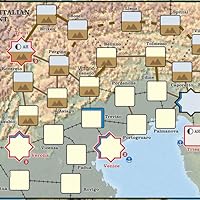
A big shortcoming is almost complete lack of maps. We get two general ones in the beginning and that's about it. Battles get a pretty bad map where both sides are shown with shades of same colour. It's hard to track the progress of the war with this. And on top of that he uses German names for towns (understandable) but given that Silesia where most of his fighting was done is now in Poland these towns have Polish names. Which makes it hard to use modern maps to try to get a bigger picture.
A nicely written book that does a good job of combining biography with military history. I read this one many years ago in preparation for developing the European half of "Soldier Kings," (Crucible of War was my main source material for the global part), and the bios of the rulers and generals plus the extensive battlefield maps and descriptions were very helpful. Also of great value was the narrative of events beyond the generals' control that steered the course of the war; those went into the event cards. Overall, a very rewarding book on the Seven Years War in Europe and the main players involved.
My review of this book is mixed, I'll put it in the following way:
Firstly, this book is Yuuuge! ~650 pages, took me at least ~50 hours to finish (I'm not a native English speaker). Be sure you DO want to know a lot about King Frederick II to spend a lot of time in it.
Secondly, it's not very comprehensive. This book heavily leans on military aspects, partly (I guess) due to the author's own background. Nearly ALL of the battles in the three Silesian wars are covered in great details, to the extend that they are described in the precision of hours of the battle day. Logistics, routs, campaigns are all vividly depicted, quite enjoyable in reading.
The parts that are not so detailed are the civil works of King Frederick II. As to his personal activities, his life in Sans Souci, etc, are covered to some extend, but not as much as I would like to read about, certainly far less detailed than the military campaigns. Many of these aspects rely heavily on direct quoting from various correspondence at the time.
Thirdly, the general style of the text is relatively unattractive. Many words, sentences, paragraphs about the same topics, such as the European political environment at the time, recurrently occur in different but quite similar style throughout the text. I'm afraid that I could not say that the author's story telling is particularly engaging.
A very good side of this book is that it feels like very authentic, serious historic text, with lots of references, quotations from the king and people related. Perhaps the style that the author has chosen for this book is the best way to write about such a complex historic person. Certainly, one could expect to learn a LOT about the facts, events, words, sometimes even thoughts about this great king. But only if you really want to read through it.
A comprehensive history of the Prussian king and his tumultuous times. There is a lot of focus on the military side of Frederick's reign, with particular attention to the Seven Years' War. Asprey provides detailed accounts of many battles and analyses of tactics and strategies. It is easy to get lost in some of these details, as the tide of each battle turns on a clever move by a commander or through pure luck. There are also numerous personalities here as well, from Voltaire to Catherine the Great. The economic and administrative aspects of Frederick's rule are also covered, as is his fraught relationships with his father and siblings. Overall, this is a solid history for those interested in a "high politics" look at the rise of 18th Century Prussia. It is not, however, a light read.
Frederick the Great: The Magnificent Enigma tells the story of an impactful Prussian monarch against the backdrop of the second half of eighteenth century Europe. The book reads like a combination of Risk and chess, with alliances forming, falling apart, and reforming based on the military and political convenience of the moment. Author Robert Asprey delved deep into the history of a formative era in Europe to create a serviceable retelling of the period's high points.
Frederick II’s chief adversary is the Habsburgs, the rival Germanic family whose power base is to the south in Vienna. Their division from the north German Hohenzollerns creates the backdrop for much of the struggle throughout the book. Through the personage of Maria Theresa and Emperor Francis, the Habsurgs are able prove a frequent thorn in Frederick’s side. Their primary military commander, Prince Charles, clashes repeatedly with Frederick the Great’s armies on one battlefield after another.
The battles of the First Silesian War are richly described, with troop movements and commanders’ decision-making analyzed with precision. The Prussian win at the Battle of Mollwitz in April 1741 is recounted in seemingly second by second detail as the tactics employed by Field Marshal Kurt von Schwerin and Prince Leopold lead Frederick's troops to victory. The Battle of Chotusitz in May 1742 is another clash from this war that the author expended ample paragraph space analyzing.
The Second Silesian War and its battles-Prussian wins like Hohenfriedberg and Soor-are also given fairly lengthy analysis. At times, it felt as if the book could do with a tad less when it came to every thrust and withdrawal, but lovers of military lore will especially enjoy the eye for the martial elements displayed in its pages. Despite playing critical roles in the campaigns, commanders like Count Podewils and Prince Henry essentially become interchangeable cogs in the Prussian leader’s war machine.
The Seven Years’ War is a conflict of particular note, with its ferocious campaigns delved into with the competent writing of an author familiar with the military craft.
Russia, France, England, and Russia play musical chairs when it comes to forming anti-Austrian alliances. These are the most enjoyable sections to read given how uncompelling much of the book's other elements prove to be. After all, the personal life of Frederick is one-dimensionally presented and he never really comes across as a human being. His wife Elisabeth Catherine barely qualifies as a periphery figure, their marriage seemingly loveless and cold. The military portions become so in-depth that the forest begins to be lost through the trees. But Frederick’s back and forth with the likes of King George II (to whom he was related and a man for whom the lands of Hanover were an obsession) and Romanovs like Elizabeth II and Catherine the Great, in addition to the frequent political tug-of-war over the Polish lands, make for particularly intriguing sections to read.
Attempts to win over King August III, King of Poland and Elector of Saxony, make up one of many elements of intrigue in the political gamesmanship that is omnipresent throughout the book. The First Partition of Poland took place under the watch of Frederick, and the massive Polish-Lithuania state was a frequent locus of European power politics struggle.
Frederick's friendship with Voltaire and the sections featuring their interactions do the best work bringing Frederick to life. The love for the life of the mind is most evident when it comes to the priority he gave in the Prussian court to philosophers like Voltaire, and his flute playing underscored the range of talents he possessed. (Considering the lack of a fulfilling intellectual life in Berlin and throughout Prussia, it was little surprise he turned to a foreigner like Voltaire to fulfill a longing for intellectual companionship.)
To his credit, Frederick did not display a zeal for persecuting religious dissidents that his contemporaries often seemed to show, instead settling for being accomplished in the musical and martial sphere. He even took care to attend the first performance at Berlin’s new acclaimed opera theater and promoted the arts through encouragement of this venue’s embellishment.
The whole of Frederick the Great: The Magnificent Enigma is better than many of its parts. The final product is a deeply researched accounting of war and statecraft, but many of the individual sections are slow moving and laboriously bogged down with granular detail. The patchwork story of Europe as it stood in the mid-to-late 1700s comes through better than the biographical element of Frederick's life. Whether this was intended by Asprey or not, his book is still a worthwhile addition to the body of knowledge about Prussia's contributions to world affairs during its apogee of power.
100 pages in: holy sassafras this is difficult to read. first of all there are at least 6 different Fredericks to keep track of, not to mention the various Sophias, Elizabeths, Williamses and Charleses, and many many other characters. second, Europe looks nothing like today (which is fascinating, yes, but confusing!), and third, I think it goes too far back in time (for me) - when people are pretty damn cruel to each other - and that reality is tedious, at best.
the book was written in the 80's so there's a bit of style and cultural norm difference in the writing, especially regarding the sexes and races. in general, historians often force language in a grating way - no exception here.
obviously there are layers and layers of historical knowledge that the author has sifted thru with great effort and time, which is admirable (and reassuring), but it's too much to take in so quickly and thus not an easy read. this is probably what Adderall is for. I'm no historian, so 4 stars nonetheless, out of respect. a thome indeed. this book is not for amateurs.
250 pages in. finally got the hang of this, AMAIEW. take notes, keep wikipedia handy. reread reread. eventually, it reads like the a political soap opera (GOT). so much packed in to these pages.
While I can start to get a sense of how the royal political mind & machinations work (or not), this is so far from everyday life at that time it makes you wonder. since much/most descriptions from this time skew this way (I guess peasants didn't write so much). given the density of this book it seems a passage or 2 of what it was like to not be of nobility in these times. if only to take a break from the firehose of minutia.
the book turns to war, in all its detail. but, again nothing about what average people experience. "..armed peasants of Wallachia happily plundered and killed their own people, particularly protestants..." a rare mention among the glory, intrigue and strategy of aristocrats.
Frederick the Great by Robert Asprey is an authoritative biography on the man who would unite early Germany and form Prussia. Form his sickly childhood years to his strained if not abusive relationship with his father Frederick’s early years lead you to believe he might not even live to adulthood. Asprey tracks the wars against Austria and the face off between Frederic and Maria Theresa. The balancing of power between Russia, England, France, Austria, Bavaria, Saxony and groups like Denmark, Sweden and Hanover is on full display. Asprey’s ability to capture military history, make it readable and track the rise of Prussia with modern military techniques are on full display here. This is definitely for those interested in European history and military history. He captures the ups and downs of war, the tactical decisions made and the training that made Prussia stand out amongst its peers. He takes time to look at the political situations as well as economic to provide a full picture in the over 700 page book. Very well done!
This is a great book to read to get details about Frederick the Great's life both on and off the battlefield. There is a lot of military detail on the battles that I didn't really need, but the coverage of the Seven Years War particularly helped me understand what was going on politically in Europe in the eighteenth century. There are a lot of great quotes from Frederick's letters and other writings. The author has traveled to the battlefields and leaves lovely notes about how things had changed or not by 1986 when the book was written. All in all, a helpful primer on Frederick and his times.
Yikes. Interesting man but sooooo much violence. People are cannon fodder for the European nobility. Asprey does a great job of showing Frederick as a product of his time. But what a cruel, barbaric time. Sad picture of a superior person in a brutal time or brutal royal idiots.
This is more a book of gossip and sensationalism about Freidrich II of Prussia than a serious biography. Also, the author is woefully ignorant of 18th century culture and language habits. While Freidrich II may well have been bisexual or homosexual, the means the author uses to 'prove' this are laughable. Aristocrats of this era almost universally wrote to their friends of either gender in extremely affectionate terms which, while they look sexual to a prudish 20th century American, didn't seem anything of the sort to them. Similarly, sexual innuendo and vulgarity in speech and letter writing is a rather poor proof of promiscuity. Nothing offered in the book demonstrates conclusively whether Freidrich and von Katte were lovers, or just good friends, yet the author asserts the clear proof of a sexual relationship. That is bad scholarship, and shows a very poor knowledge of friendship in that milieu. And if you think my critique focuses too much on Freidrich's sex life, well, that's because the book has the same problem. However, the battle descriptions are lacking as well, and also unbalanced. The author seems to want to show Freidrich's bad side as much as possible, and make him seem as ruthless and careless as he can, which doesn't match the objective evidence of a man whose meticulousness, insight and concern for the common people far exceeded his contemporaries. A balanced view, complete with criticism is essential in such a subject, but this reads more like a tabloid than an objective assessment, and the biases and assumptions of the author's 20th century worldview bleed through at every opportunity.
A very fascinating figure, though it's always interesting to read the ins and outs of someone called "the Great." His military successes were good, but not exactly astounding. He was more paranoid, arrogant, and capricious, but it's rare to see an 18th century monarch who isn't. Compared to the crop of rulers of the day, Frederick certainly is at the top. Had he ruled lands such as France, with its wealth and resources, he would have likely shaken Europe to its core. As it stands, he took a fractious kingdom and left to his terrible heir a stable and powerful state. With what he had, Frederick did work miracles.
As far as the book itself, it is incredibly detailed at 630 pages. I'd say half of it concerns wars, which occupied most of Frederick's reign, and it got incredibly tedious and confusing (remembering who was who was incredibly difficult). The tone is definitely more academic, but that suits me. Asprey admires Frederick, for certain, but definitely does not go easy on him. When Frederick was at fault, Asprey made sure the reader knew it. Called out when he lied, when he blundered, and when he genuinely succeeded.
Excellent book, although I didn't give it five stars due to the fact there was so much detail about the battles and the army, whereas I would have liked more information on Frederick's personal life (although there was a lot included about it, just nothing about if he had a "love of his life" or a close companion). One thing that was interesting was the fact the author had traveled to several locations that he wrote about and included notes about the present day locations in his foot notes. I would recommend this for anyone who wants to learn about Frederick and how the Prussian army became notorious.
Who knows what came over me to make me want to read about some very dead white guy? I just learned that what we call the French and Indian War was the same as the Seven Years War in Europe (and a few other names in other parts of the world). Hearing that there was some sort of philosopher king in charge (or flautist-general) piqued my interest. This seemed the most readable of the books at the Duluth library; into the second chapter and I'm still reading it.
This book certainly falls into the same category as War of the Two Emperors for me: gorgeous dustcover, delightful prose, falls a bit flat when it comes to actual history -- Asprey uses quite a bit of court gossip from Frederick's sister. However, I do give it a higher rating that Emps by the fact that it really stirred my mind and raised questions. As an immature scholar, it gave me some food for thought, which is an important part of the process.
This was a review of the man not so much on the battlefields but overall. It went into great detail about his victories and defeats on the battlefields, in the political areans of the foreign courts and with the men and women he interacted with on a regular basis. This book is more for a fan of Frederick and not for the casual interested reader.
Very informative and interesting. I was surprised to find that I found the peaceful time of Frederick's life much more interesting than the moments of war (of which there were many). Lots of insightful details and amusing antidotes. Over all if you are interested in the topic I would recommend the book and if you are interested in a man who tried to be a good king I would recommend the topic.
Good information about a period I didn't know much about. Not a page turner, but not boring either. A good book to read if you have a strong interest in the material (I read it for a class).
Solid account of the legendary ruler. While I wanted to know more about the battles, that would have made the this into a multi-volume work, so I'll have to search elsewhere.
A good place to start for studying the life of Frederick.