Piet and soldier, misanthrope and philospher, Frederick the Great was a contradictory, almost unfathomable man. His conquests made him one of the most formindable and feared leaders of his era. But as a patron of artists and intellectuals, Frederick re-created Berlin as one of the continent's great cities, matching his state's reputation for military ferocity with one for cultural achievement.
Though history remembers Frederick as a "Potsdam Fuhrer," his father more rightly deserved the title. When, as a youth, Frederick attempted to flee the elder man's brutality, the punishment was to watch the execution of his friend and co-conspirator, Katte. Though a subsequent compromise allowed Frederick to take the throne in 1740, he would remain true unto himself. His tastes for music, poetry, and architecture would match the significance of his military triumphs in the Seven Years' War. Drawing on the most recent scholarship, Giles MacDonogh's fresh, authoritative biograhy gives us the most fully rounded portrait yet of an often misunderstood king.
Giles MacDonogh (born 1955) is a British writer, historian and translator.
MacDonogh has worked as a journalist, most notably for the Financial Times (1988–2003), where he covered food, drink and a variety of other subjects. He has also contributed to most of the other important British newspapers, and is a regular contributor to the Times . As an historian, MacDonogh concentrates on central Europe, principally Germany.
He was educated at the City of London School and Balliol College, Oxford, where he read modern history. He later carried out historical research at the École pratique des hautes études in Paris.
MacDonogh is the author of fourteen books, chiefly about German history; he has also written about gastronomy and wine. In 1988 he won a Glenfiddich Special Award for his first book, A Palate in Revolution (Robin Clark) and was shortlisted for the André Simon Award. His books have been translated into French, Italian, Bulgarian, German, Chinese, Slovakian, Spanish, Russian and Polish. Reviewing 1938: Hitler’s Gamble in Spectator Magazine , Graham Stewart said: "Giles MacDonogh has repeatedly shown himself to be in the front rank of British scholars of German history. The depth of his human understanding, the judiciousness of his pickings from source material and the quality of his writing make this book at once gripping and grave."
frederick is my fave gay right after king james and this was very much a bio to my liking - maximum culture and saucy gossip and minimum crappy wars and smelly horses (i mean the author does talk about the major wars later in the book but i skipped those parts so idk if they are any good).
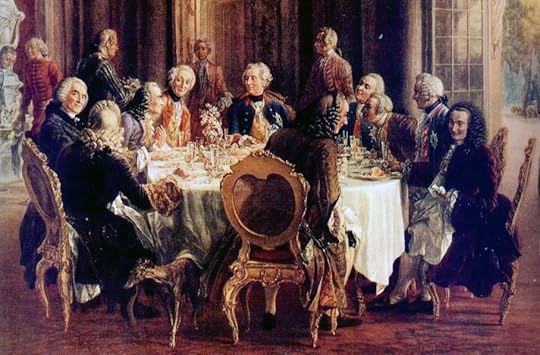
tea and crumpets at frederick's with the bois:
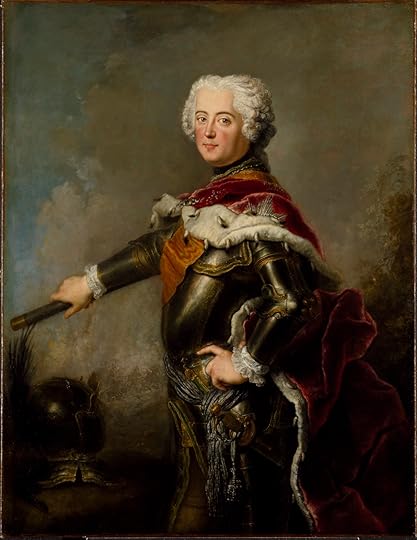
ruddy cheeked and blue eyed prince showing off his best assets:
ill probably be rereading some parts of it in the future. also, frederick wasn't the only lover of male company in the family. his brother henri was even more open about his proclivities. one would think they must have been each other's best wingmen or smth? well, not quite. like many of his other family members, henri hated frederick's guts - old fritz just had that effect on people close to him.
I became interested in learning more about Frederick the Great, the Prussian king during the Seven Years War, because his name popped up in other history books I read, including about Hitler and the Russian czars. Frederick's legacy has been reinterpreted as it suited the purposes of those how came after him, whether as an enlightened monarch, a military genius, a poet-leader, or as the creator of a German nation (something he did not foresee or intend).
This book unquestionably gave me a wealth of information about Frederick, but it was slow reading at times. I found the author's writing unclear at times, sometimes intentionally. The writing frustrated me when the author used pronouns like "he" when I needed him to be clearer about which male he was talking about. Most annoyingly (and this is where the author is unclear intentionally), the author often (but, curiously, not always) provided quotes in languages other than English without providing a translation. Perhaps it's a personal failing, but I only speak English, but I did pick up a book about Frederick in English so please don't assume I will understand quotes in German or French. What good is it to provide me with Frederick's last words in French only?
Despite these issues, I did enjoy the book and was glad to learn about Frederick, a monarch who has perhaps earned "the Great" after his name because of his accomplishments as a military leader and in the arts, reform, and other areas, although I don't find him to be as "Great" as Napoleon or Julius Caesar. And, although, like most European leaders from the time, he had some anti-Semitic feelings, he certainly does not deserve to have his name linked with Nazis, even if Hitler admired him.
One more criticism: Books like this benefit greatly from maps, and I wish this book had some! I tried printing maps of Prussia and its neighboring states off the Internet to help, but the author kept referring to places that were not on those maps.
Frederick the Great was an interesting character. Since his youth he wanted glory as a battle field commander. He read books voraciously as well. In fact, he divided his books into read, to read and to read again sections. He also wrote poetry to relax. He became friends with the great French philosopher Voltaire and they shared many letters both being skeptical of religion. Frederick considered the Catholic Church superstitious and even had doubts about his Lutheran church. He ridiculed his own father for fox hunting as wasting time.
His first battlefield success was winning Silesia from the Austrians as Silesia was a productive part of the German speaking people. Soon after, enemy bordering states sought to contain Frederick’s Prussian Army although England became a big fan of his. To combat his enemies he first struck Saxony and easily overtook another German speaking country. As a result however, Austria, France, Russia, Saxony, Sweden and several minor German states combined to attack Frederick’s Prussia. He is able to hold then off until his arch enemy Queen Anna of Russia died and her son Peter III succeeds her. Peter III admired Frederick so much that he switched sides joining the Prussians and turned the tide around for Prussia.
Frederick even became a hero of the German peasants for siding with a peasant over a baron in a squabble. Near the end of his reign he made agreements with all the German speaking people starting the process for Bismarck’s unification and the second Reich of Germany.
An interesting man with an interesting life. And complex, very complex. Going in disguise at times as an "ordinary man" he was annoyed when people recognized him. Yet he was an autocrat who loved war. Treated badly by his father as a child--his father had his best friend executed for helping him run away, and forced him to watch--he didn't have children and had a loveless marriage. A poet, a philosopher, a musician, he did many of these things badly. But he was that much more interesting for his love of them.
Book Summary of Giles MacDonogh “Fredrick the Great: A Life in Deed and Letters” by Peyman ADL DOUSTI HAGH.
Frederick II (German: Friedrich II; 24 January 1712 – 17 August 1786) was the King of Prussia from 1740 until 1772 and the King of Prussia from 1772 until he died in 1786. He was a significant military strategist and accomplished several feats, including the reorganization of the Prussian Army, military victories in the Silesian wars, the First Partition of Poland, and his support of the arts and the Enlightenment. Frederick's most significant territorial expansion came in 1772 when he declared himself the King of Prussia after annexing Royal Prussia from the Polish–Lithuanian Commonwealth. Under his reign, Prussia expanded its territories and established itself as a significant military power in Europe.
Despite his father's authoritarian rule, Frederick was more interested in music and philosophy during his youth than in the art of war. However, after ascending to the throne, he attacked and annexed the wealthy Austrian province of Silesia in 1742, bringing military success to himself and Prussia. He became an influential military theorist whose writings emerged from his battlefield experience and covered strategy, tactics, mobility and logistics issues.
Frederick was a proponent of enlightened absolutism, stating that the ruler should be the first servant of the state. He modernized the Prussian bureaucracy and civil service and pursued religious policies throughout his realm that ranged from tolerance to segregation. He reformed the judicial system and made it possible for men of lower status to become judges and senior bureaucrats. Frederick also encouraged immigrants of various nationalities and faiths to come to Prussia, although he enacted oppressive measures against Catholics in Silesia and Polish Prussia. He supported the arts and philosophers he favoured and allowed freedom of the press and literature.
Additionally, Frederick was almost certainly homosexual, and his sexuality has been the subject of much study. Since he died childless, his nephew, Frederick William II, succeeded him. He is buried at his favourite residence, Sanssouci, in Potsdam.
Frederick the Great's legacy has been subject to various interpretations. For example, Thomas Carlyle's History of Frederick the Great emphasized the power of one great individual to shape history. Frederick became a national icon in Germany, with many Germans considering him the greatest monarch in modern history, particularly in the 19th century. German historians often praised his leadership, administrative efficiency, devotion to duty, and success in building Prussia as a leading role in Europe, making him a romantic model of a glorified warrior; even after World War I, Frederick's popularity as a heroic figure remained high in Germany.
However, from 1933 to 1945, the Nazis glorified Frederick as a precursor to Adolf Hitler, presenting him as holding out hope that another miracle would save Germany at the last moment. Propaganda Minister Joseph Goebbels commissioned artists to create fanciful images of Frederick, Bismarck, and Hitler together to create a sense of historical continuity among them. Throughout World War II, Hitler often compared himself to Frederick the Great, and he kept a copy of Anton Graff's portrait of Frederick with him in the Führerbunker in Berlin.
After Germany's defeat in 1945, the role of Prussia in German history was minimized, leading to a downgrade in Frederick's reputation in both East and West Germany, partly due to the Nazis' fascination with him and his supposed connection with Prussian militarism. During the second half of the 20th century, political attitudes towards Frederick's image were ambivalent, particularly in communist East Germany. Immediately after World War II, images of Prussia were removed from public spaces, including Frederick's equestrian statue on the Unter den Linden. Still, in 1980, his statue was re-erected in its original location. Since the end of the Cold War, Frederick's reputation has grown in the now-reunified Germany.
In the 21st century, military historians still view Frederick as a capable and effective leader. However, the originality of his achievements remains a topic of debate, as many were based on developments already underway. He has also been studied as a model of servant leadership in management research and is highly regarded for his art patronage. He has been seen as an exemplar of enlightened absolutism, though this label has been questioned in the 21st century, as many enlightenment principles directly contrast with his military reputation.
This is my second Frederick's biography, first one was Asprey's "Frederick the Great: The MAgnificent enigma". I was hoping this one will be able to provide some fresh perspective on the man as Asprey wrote his in mid 1980s. Boy was I wrong.
First waring sign about this book is that's it's short. With 386 pages it wants to cover Prussia as it was when Frederick was born, his youth, relationship with his father, growing up, assuming the crown, his wars, his reforms and his freindship with various philosophers.
And in all that it fails. Badly. Author tries to show us severel Fredericks, Frederick the king, Frederick the philospher, Frederick the poet, Frederick the general..... While latest one is one he is most famous for MacDonough clearly wishes he wouldn't exist. His wars are recounted in briefest of details. Battles are usually described as "two sides met on such and such day at such and such place, vicory went to this side while each side suffered such casualties". And sometimes place an date is omitted as well. Rossbach and Leuthen are covered in roughly 5 pages but subsequent letters Frederick wrote taker three tiems as much. Second Silesian war is covered in couple of pages but Frederick's choosing his opera singers and decorating one of his plaaces is described in great detail and takes several times as much space.
And that is where MacDonogh focuses. Who Frederick chose to be his literary friend, how to decorate his palaces, how to assemble choirs, operas, theatre staff.... Politics take second place, war making distant third. While it's true title of the book is "A Life in Deed and Letters" the latter get's most of attention.
This book is not worth your money or time. I'd say there are plenty of better biographies out there but the fact is pretty much any one is better than this one
I absolutely loved the series, I will admit, part of it was based on my bias as Frederick The Great is my favorite historical figure and he had been something akin to a comfort character for quite a while, however I do believe that the book, whilst slow in the beginning (going over the reign of Frederick William I from the perspective of Frederick The Great), once you get to his reign, it is a delight and I only wished to go further. I would absolutely recommend it for anyone who is a student of history.
The book started off wonderful but about halfway through it plateaued. Each additional chapter was just more of the same stories without much needed ups and downs and political context or intrigue that makes a King’s life interesting.
So I jumped on Giles MacDonogh’s lavishly detailed biography of Frederick the Great after a bit of inspiration from one of ERB’s amazingly good Epic Rap Battles of History (seriously … watch it … right now … at http://tinyurl.com/gn4c9qp). Old Fritz is pretty great in the video and, after digesting his biography, the real-life Frederick certainly lives up to his pedigree. Enlightened monarch, prolific author, accomplished musician and a fair militarist, Frederick’s dawn-to-dusk level of energy and far-reaching pursuits are pretty amazing.
Of course, the flutist king certainly has his rough spots -- which biographer MacDonogh doesn’t entirely gloss over -- as offers a complete and amazingly detailed history of the monarch’s life. And while the depth of historical research is impressive, the real magic of the book is just how well MacDonogh lets the king speak for himself. Drawing from Frederick’s voluminous correspondence, Frederick opines on everything from agriculture to tactics. And while you expect the king to be smart, it is his saucily ribald sense of humor that made me laugh-out-loud. By the book’s end, its not hard to sense some of the charisma that made Frederick “great,” reminding me of a curmudgeon of a grandfather you might find supping soup in the back corner of a greasy-spoon diner and yelling at kids to "get off my lawn."
Despite its exhaustive nature, the book has three highlights for me. Certainly the future king’s brash battle with his austere father – despite its high stakes consequences – is tragically understandable to any parent who has raised a rebellious adolescent. Second is Frederick’s duel with his mentor Voltaire, an odd friendship between two people whose egos just can’t let them get along completely. And lastly, there are the trials of the Seven Years War – a forgotten world war – that saw Frederick islotated on the world stage with powers of France, Austria and Russia arrayed against him. Of course, MacDonogh also addresses the elephant in the room – namely the rumor of the king’s homosexuality -- but whether straight, gay or bisexual, it’s pretty clear that Frederick distrusted and disliked most members of the fairer sex.
Fair warning to armchair historians: this book is quite dense and it took me a chapter or two to warm-up to the text. After that, though, I have only two minor niggles: namely, the annoying habit of the scholarly writer to leave the occasional quote, book title, or scrap of poetry in its original language – (i.e. I don’t speak French, German or Latin so can you not translate these?) and second, good gosh St. Martin’s Press, add a map to this! How many people have an intuitive grasp of Prussian geography?
That being said, MacDonogh’s biography of Frederic the Great is probably everything you need to know about the king and it certainly got me jonesing for a military history of the Seven Years Wars!
P.S. For the benefit of those of you don’t speak French (like me) and wondered what Frederick’s last words actually meant, they were, “The mountain is passed; now we shall get on better.”
This biography of Frederick the Great, King of Prussia from 1740 to 1786 is decently written, but I did not like the author’s style very much. However, the eventful life of Frederick soon pulled me in.
He had a very troubled relationship with his father (Frederick William) in his early and teenage years as Frederick William sought to bring up his boy in a martial, German speaking, practical manner, which he thought would best equip Frederick to become King. Frederick was rebellious though; preferring to speak and write in French, learn philosophy, listen to music and engage in a much more contemplative life. Things came to a head when Frederick made plans to run away from Prussia, but he was captured and locked in a fortress at Kustrin until he surrendered his will to his fathers. One of his best friends was executed in front of him due to the wrath of King Frederick William. Frederick was eventually released, and though he got on better with his father he never lost his philosophic and more cultured inclinations. He was forced to marry Elisabeth Christine of Brunswick, whom he disliked and almost never saw.
Upon becoming King he did many notable things, including a reform of the legal system and codification of the laws, land reclamation projects and many building projects in his cities, but what he is most famous for is his invasion of Silesia, which was the main cause of Prussia’s involvement in the Seven Years War. The rich province of Silesia was owned by the Austrians, whom Frederick was not too fond of. Before the invasion he had a large army and treasury built up by his father, and seizing Silesia ‘made sense’ - if you were open to using war as an instrument of policy, which Frederick was. It would increase tax revenue, ‘liberate’ many Protestants from Catholic rule and help consolidate Prussia’s scattered borders. The Austrians of course were none too pleased about this, and recruited the French and the Russians to help them attack Prussia. The English took on the French in North America and had some military expeditions on the European mainland but it was a tough time for Frederick for many years, fighting a three front war. He triumphed over the French at Rossbach and the Austrians at Leuthen, but also suffered defeats and saw the countryside of Prussia devastated. Berlin was even briefly occupied by the Austrians. Late in the war Frederick had an amazing stroke of luck when the Tsarina Elizabeth died and her pro-Prussian son Peter replaced her as Tsar. He concluded hostilities with Prussia and allowed Frederick to concentrate on the French and Austrians. In the end he kept Silesia, rebuilt his shattered country and much later divided Poland between the Austrians, the Russians and himself.
Biographies and history are my favorite reading genres and I hoped this book would fill in a lot of holes in my knowledge about Frederick the Great and this time period. Unfortunately, I found the writing choppy and the organization of the book disjointed. The one tidbit I did come away with was that Voltaire was a real prima donna and pain in the ass.
This was an odd book. An incredible amount of information that no one needs when there could have been so much more written about this very interesting character. Whether it be play by play of battles, or minutiae about his diet this book just didn't hit the bells for me. I actually couldn't wait to finish and move on to something else.
An interesting and engaging, multi-faceted biography of Frederic the Great. The Polish translation which I've read is rather mediocre and at times flawed, but the book as such is well worth reading for those interested in the period.
Read for school, not for pleasure so no formal review. While this is packed with information about Frederick, it was pretty boring and I fell asleep twice while reading it.