Leonhard Euler was one of the most prolific mathematicians that have ever lived. This book examines the huge scope of mathematical areas explored and developed by Euler, which includes number theory, combinatorics, geometry, complex variables and many more. The information known to Euler over 300 years ago is discussed, and many of his advances are reconstructed. Readers will be left in no doubt about the brilliance and pervasive influence of Euler's work.
An American writer who was originally trained in topology but became interested in the history of mathematics and specializes in Leonhard Euler. He has received several awards for writing and teaching on this subject.
Leonhard Euler was one of those stratospheric geniuses that gets thrown up occasionally in any field. A pastor's son from Basel, he distinguished himself by the quality of his work – his name is attached to dozens of mathematical formulas and equations – as well as by its quantity, which is almost inconceivable. No one ever did more maths than Euler. And this against a background of personal disability: he started losing his sight in the 1730s and was functionally blind by 1771. Like Beethoven composing music that he couldn't hear, Euler was writing mathematics that he couldn't see.
In 1775, into his sixties – blind, remember – he was still producing more than one academic paper a week. So huge was the backlog after he passed away that Euler managed to publish fully 228 papers posthumously – they were still coming out decades after his death.
Yes. Euler published more papers dead than most mathematicians manage while alive.
In 1911, the Swiss Academy of Sciences decided to publish Euler's complete works. They brought the first volume out that year, and they are still not done. Eighty volumes so far and counting.
When he turned his attention to a problem, he blew it out of the water.
A simple example is the so-called ‘amicable numbers’. Amicable numbers are pairs of numbers whose proper divisors sum to each other. What does that mean? Well, the classic example is 220 and 284. The number 220 can be divided into the following smaller numbers:
1, 2, 4, 5, 10, 11, 20, 22, 44, 55, 110
…and if you add all those together, you get 284. Coincidentally, 284 divides into the following smaller numbers:
1, 2, 4, 71, 142
…which, added together, make 220. 220 and 284 are therefore said to be ‘amicable’.
This is a completely pointless property, but nevertheless intriguing if you're a mathematician. It is also very rare. The pair 220 and 284 was known to the Greeks, but after that no one in Europe could find another example until Fermat in 1636 – he managed to show that 17,296 and 18,416 are also amicable. At which point Descartes, Fermat's great rival, was determined to find a pair as well – he worked on it for two years and eventually came up with 9,363,584 and 9,437,056.
Three examples in more than 1500 years.
So a hundred years after Descartes, Euler decides to have a go. He publishes a paper in 1750 in which he finds 58 more pairs!
This was the Euler way. ‘Let me just have a quick look at this problem you've all been worried about – OH NO HERE'S EVERYTHING THERE IS TO KNOW ABOUT IT. Also, I just invented a new branch of mathematics to deal with the matter. Bored now…’
Euler is particularly associated with the number e, the base of the natural logarithm. Roughly equal to 2.718, e emerged from studying compound interest and is not difficult to understand in itself. But it's a very strange number all the same. It crops up everywhere in mathematics, though it's independent of any counting system; clearly, it is one of the fundamental values of how the universe fits together, indeed of how numbers work as a concept.
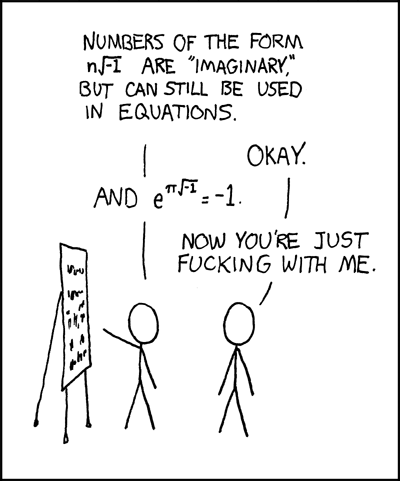
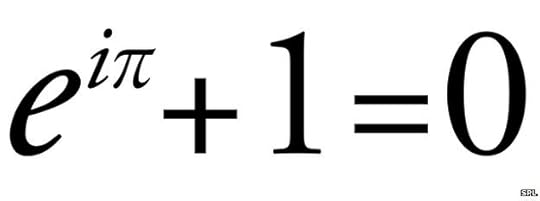
It's this that makes Euler's most famous equation so extraordinary. Known as ‘Euler's identity’, it emerged from his work on complex analysis and is, first of all, breathtakingly simple:
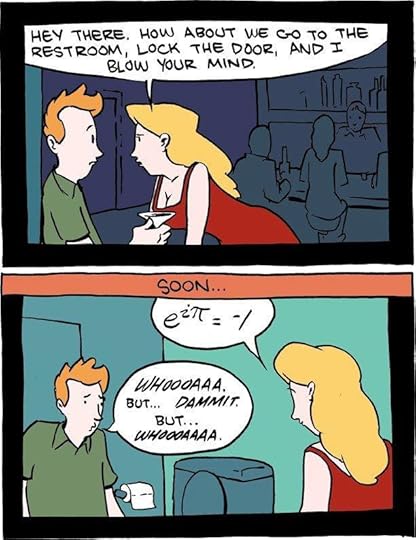
The reason mathematicians get so dewy-eyed over this is that it shows a beautiful and completely unexpected link between the worlds of pure maths and trigonometry – a bizarre, unintuitive relationship between the five most important numbers in mathematics (0, 1, i, e, and pi). There is no reason these numbers should be related, and no one really understands what it means that they are, except that it tells us something fundamental about reality.
This equation regularly tops mathematical polls of the most beautiful result of all time.
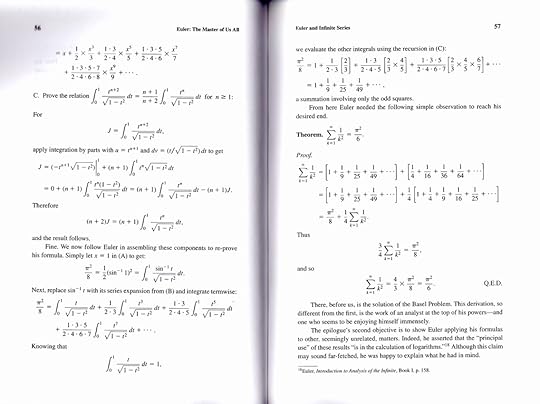
William Dunham is quite an Euler enthusiast and expert; if you're interested in the subject, I recommend his TED-like video tribute on YouTube. But this is a small book and can only touch on a few of the most impressive of Euler's accomplishments. Also, it is very very focused on the maths. I had been hoping for details of Euler's life in Switzerland, why he had a bust-up with Voltaire, and who he was sleeping with. In actual fact, every page of this book looks like this:
A lot of it is way above my A-level understanding of maths. But in the absence of any other good biographies of Euler, it'll do – and if you have the skills to follow the proofs, it's likely to give you a lot of delighted, mind-blown moments.
This book is not a biography of Leonhard Euler, although it is prefaced by a brief account of his life, but a discussion of a few of his discoveries. It is organized into eight categories, with chapter titles beginning "Euler and . . .": Number Theory, Logarithms, Infinite Series, Analytic Number Theory, Complex Variables, Algebra, Geometry, and Combinatorics. Each chapter deals with one or two questions, with a prologue outlining previous work and the state of the question before Euler, and an epilogue explaining how it has been treated since Euler's time. The book concludes with an appendix on Euler's Opera Omnia, the complete works which since beginning publication in 1909 had reached over seventy large (400 to 700 page) volumes by the end of the century. Euler was such a prolific writer that the journals were still publishing the backlog several decades after his death, so many of his discoveries carry the names of later mathematicians. (And he wrote much of it after going completely blind.) Naturally, a short book like this one can only deal with a small fraction of his work, but every chapter would have made the reputation of another mathematician.
I am currently reading Roger Penrose's massive book, The Road to Reality, which promises to teach all the math needed to understand modern physics (including string theory, twistors, etc.) -- I'm sure I will have something to say about that in my review, IF I actually finish his book -- but already less than a tenth of the way through I am finding it somewhat too complex for my current knowledge. Literally too complex; I haven't dealt with complex numbers since high school. It was Penrose's discussion of complex exponents that sent me to this book; Dunham's explanation was much clearer than Penrose. Of course, I ended up reading the whole book, and found it quite fascinating.
The book is not light reading; I read it "pencil in hand" and had to work through many of the calculations before I understood all the "obvious" steps that were assumed. It reminded me of the classic story of the math professor who said, "Now it is obvious that. . .", stopped short and disappeared into his office for forty-five minutes, then reappeared, said, "Yes, it is obvious" and continued with his lecture. The actual concepts, though, are not too difficult; I think anyone who has had a good high school ATA or pre-calculus course and a first year high school or college calculus course, would have no real trouble understanding anything in this book -- with a little effort.
The title of the book is a quote of Lagrange: "Read Euler, read Euler. He is the master of us all." Euler and Gauss are the only two mathematicians I know to have appeared on currency.
At the time this book was written, 73 volumes of Euler's collected works (the Opera Omnia) were in print, most of them 400-500 pages (though some over 700). There are over 25,000 pages published so far. The publishing effort has been ongoing for the past 97 years, now, and much still remains unpublished. In the year of 1775, after Euler had already gone completely blind, he managed to publish a paper a week.
Nobody is crazy enough to even pretend to summarize Euler's life work in 180 pages.
This short book only gives a little taste of Euler's results and style, but it's an enlightening taste. After an introductory chapter on Euler's life, Dunham writes a chapter each on one of Euler's contributions to number theory, logarithms, infinite series, analytic number theory, complex variables, algebra, geometry, and combinatorics. The arguments given are those due to Euler, though Dunham sometimes interjects to shore up technical details where Euler's arguments fail modern standards of rigor. Though the book is written for a mathematically mature audience, almost all the technical chapters will be accessible to anyone who has gone through a rigorous undergraduate analysis class.
This book takes and unusual and very satisfying approach to presenting the mathematician: Leonhard Euler. Following a very brief biography, William Dunham presents proofs of a dozen or so high points from among Euler's vast oeuvre, demonstrating Euler's interest in number theory, series, complex analysis, algebra, combinatorics and geometry. The proofs are chosen to show off Euler's innovation and style. They are surprising and, at least in the first six chapters, easy enough to follow without accompanying calculations.
What emerges is Euler's striking impetuousness. Most mathematicians shy away from potential solution paths beyond a certain threshold of computational complexity. Sound judgement argues that such paths are likely to lead into an unresolvable thicket. Again and again, Euler marches in undeterred, at the key moment arriving at a unique insight, yielding some key simplification and ultimate resolution.
William Dunham is a talented expositor and it's easy to be infected by his enthusiasm. He has some excellent videos on Youtube, in case you want a sample before deciding on this short book.
This is a brilliant mathematical biography that brings Leonhard Euler's genius within reach of educated readers who have college-level mathematics background. William Dunham masterfully selects eight major mathematical domains where Euler made revolutionary contributions, and he explains both the problems Euler faced and his ingenious solutions. The book is challenging but never condescending, making complex mathematics accessible without watering it down.
Who Euler Was and Why He Matters ◆ Leonhard Euler lived from 1707 to 1783 and represents one of the most prolific mathematicians in human history. His collected works, the Opera Omnia, comprise 73 published volumes, with more still being published. Despite his conventional personality and lack of dramatic flair compared to other 18th-century figures, Euler was an adventurer of the mind who explored mathematics with breathtaking vision and confidence.
◆ Dunham establishes early that Euler was far from infallible. He operated in an era with primitive standards of mathematical rigor compared to modern mathematics. Some of his arguments were questionable, others simply wrong. Understanding this human side of Euler makes his achievements even more remarkable.
The Eight Mathematical Domains Explored Chapter 1: Euler and Number Theory
◆ The book opens with perfect numbers, which Euclid studied 2300 years ago. Dunham then shows how Euler completed Euclid's work by proving the converse: every even perfect number has this exact form. A fascinating unanswered question remains: do odd perfect numbers exist? Despite exhaustive computer searches, none have been found, yet none have been proven impossible.
Chapter 2: Euler and Logarithms
◆ Euler revolutionized how we understand logarithms by making the function concept fundamental to mathematics. The chapter explains logarithms as the inverse of exponentials and shows how Euler transformed a computational tool into a theoretical concept.
Chapter 3: Euler and Infinite Series
◆ This chapter tackles the famous Basel Problem, which had stumped mathematicians for nearly a century. Dunham provides two different proofs Euler developed, demonstrating both his creativity and his mastery of infinite processes.
Chapter 4: Euler and Analytic Number Theory
◆ This chapter reveals one of Euler's most creative leaps: applying calculus to number theory. This seems backwards (analysis studying discrete numbers), yet it became one of mathematics' most fruitful areas.
Chapter 5: Euler and Complex Variables
◆ The implications of this discovery revolutionized mathematics, though Dunham notes that Euler's lack of rigor regarding complex numbers left gaps that later mathematicians had to fill.
Chapter 6: Euler and Algebra
◆ His attempt was valiant but ultimately unsuccessful, with the first complete proof coming from Gauss nearly 20 years after Euler's death. Dunham uses this failure to humanize Euler and remind us that even genius has limits.
Chapter 7: Euler and Geometry
◆ These results demonstrate that Euler's contributions extended even to classical geometry, where his analytic techniques offered new insights into ancient problems.
Chapter 8: Euler and Combinatorics
◆
Strengths of This Book ◆ Accessible Complexity: Dunham achieves the difficult balance of explaining genuinely advanced mathematics without excessive jargon. Readers with solid calculus background can follow most chapters, though some sections require patience and careful rereading.
◆ Historical Context: The biographical sketch is excellent, explaining how Euler's life circumstances shaped his mathematics. This demonstrates not just brilliance but remarkable human determination.
◆ Honest About Limitations: Rather than glossing over Euler's mistakes or gaps in rigor, Dunham directly addresses them. He explains why Euler's cavalier approach to infinity, while productive, fell short of modern standards. He also doesn't hide when Euler's attempts failed.
◆ Structure and Presentation: Each chapter follows an excellent formula: what was known before Euler, what he discovered, how he proved it, and what happened afterward. The epilogues extend the narrative to show how mathematics developed beyond Euler's work.
◆ Mathematical Authenticity: The mathematics is genuinely presented. This gives readers a true sense of what Euler's mind could accomplish.
Weaknesses of This Book ◆ Prerequisite Requirements: The book demands serious mathematical background. While Dunham claims an undergraduate level suffices, readers unfamiliar with calculus, series, complex numbers, and algebraic manipulation will struggle. Some chapters (especially analytic number theory and complex variables) are genuinely difficult.
◆ Selective Presentation: The book covers "the tip of the mathematical iceberg" of Euler's work. Dunham explicitly acknowledges omitting vast portions, including differential equations, calculus of variations, graph theory, and applied mathematics. Readers wanting comprehensive coverage will be disappointed.
◆ Limited Euler Biography: While the biographical sketch is helpful, it doesn't deeply explore Euler's personal life, relationships, or thoughts. The focus remains firmly on mathematics, which may disappoint readers seeking more human detail.
◆ Some Proofs Are Dense: A few proofs, particularly in the analytic number theory and algebra chapters, proceed quickly through multiple steps. Readers may need to work through the mathematics carefully rather than passively reading.
Who Should Read This Book ◆ Mathematicians and Mathematics Students: This is essential reading for anyone seriously studying mathematics. It provides historical perspective on how modern mathematics developed and demonstrates the creative problem-solving of a master.
◆ Readers with Strong Quantitative Background: Engineers, physicists, statisticians, and others with advanced mathematical training can appreciate both the historical significance and the mathematical elegance.
◆ Those Interested in History of Science: The book provides insight into how science and mathematics progressed in the 18th century and how individual genius contributes to intellectual progress.
◆ Readers Interested in Intellectual Biography: This is a thought-provoking exploration of how a brilliant mind works, what problems captured his attention, and how he approached seemingly impossible challenges.
Not Recommended For: Casual readers without mathematical background, those seeking light reading, or anyone who dislikes detailed mathematical proofs.
The Lasting Impact of Euler ◆
◆ Dunham ends with a profound observation: Euler took risks that might have been forestalled by modern standards of rigor. Had he insisted on proving every detail before proceeding, he would have accomplished far less. The mathematical world owes much to his willingness to explore boldly, even if his foundation sometimes needed later strengthening.
"Euler: The Master of Us All" succeeds brilliantly at its stated goal: introducing educated readers to Euler's mathematical genius through carefully selected examples. William Dunham demonstrates masterful pedagogical skill, explaining sophisticated mathematics with clarity without condescension. The book is challenging but rewarding, offering genuine insight into one of history's greatest minds.
The book loses one star primarily due to its demanding prerequisites and selective coverage. Readers seeking a comprehensive Euler biography or a more accessible introduction will be frustrated. However, for those willing to engage seriously with mathematics, this book is outstanding.
The greatest strength is that it doesn't just tell readers what Euler did, it shows them how he did it. This is not passive reading but active engagement with genuine mathematics.
I have loved math since third grade. The joy of solving a riddle with pencil and paper has followed me into my sixties. Although I was a student of mathematics, I was never a student of its history. The first time I remember hearing Euler's name was when I was introduced to a website named Project Euler. It is a series of incrementally difficult software challenges that require both knowledge of math and efficient algorithms to solve. Whenever I had a spare moment at work, you could find me chipping away at a problem from Project Euler.
Over time, Euler became my default favorite mathematician. And it seems I am not alone. I ordered William Dunham's "Euler: The Master of Us All" hoping to hear more about this master. I wanted to read stories about how he and the geniuses of the past pondered mathematical mysteries and then shared their thoughts and queries via postal mail that took weeks to arrive, written by candlelight with goose quills and bottles of ink. The discoveries Euler made in the 18th century under those conditions still seem to dwarf anything we are doing today with supercomputers and instantaneous correspondence, much like the pyramids still make us wonder "How in the world …" It is easy to forget that Euler wasn't reading Euler. He was inventing Euler. Every insight had to be discovered for the first time.
But Dunham's book was lighter on the stories than I would have liked; he focused more on mathematics, distilling some of Euler's more famous proofs down to readable chunks that a college freshman with a STEM aspirations could follow. I diligently followed along with the first few proofs, trying to validate that every line passed muster, wanting to ensure I could replicate each proof on my own. I soon realized I would never finish the book with this approach and decided to just skim the proofs and marvel at the ingenuity.
Many great mathematicians are known for their contributions to specific areas of math; Euclid and geometry, Newton and calculus, Gauss and number theory. Euler's work is so vast that he is seldom associated with any single branch. 20th-century mathematician André Weil stated of Euler, "No mathematician ever attained such a position of undisputed leadership in all branches of mathematics, pure and applied, as Euler did for the best part of the eighteenth century." Dunham's appendix reveals 80+ volumes of Euler's work spread across many disciplines, pure mathematics, mechanics, astronomy and physics, with each volume consuming between 300 and 700 pages. His work is so vast that there is a backlog of items yet to be published, some of which he needed to dictate after losing his eyesight.
Among all his writings, there are two that consistently stand out. The first is his solution to the Basel problem. Posed 65 years before Euler tackled it, the problem asks for the sum of the reciprocal of the squares of all positive integers. At age 28, the master deduced the solution to be (pi^2)/6. The world was stunned. Why did pi suddenly appear? This discovery linked branches of mathematics that had never before seemed related.
The second is Euler's identity, e^(i*pi) + 1 = 0. This follows immediately by substituting pi into Euler's more general formula, e^(ix) =cos(x)+i sin(x). This identity combines the five most important numbers in all of math, again linking different branches: geometry, logarithms and complex numbers.
One thing that struck me as odd was learning that Euler played surprisingly fast and loose with mathematical rigor. One would think that a master of his craft would adhere to the strictest rules of the game. Not so fast. "… his mathematics did not always display the rigor and precision of today, most particularly in the cavalier use of the infinite.". In this light, one must view some of Euler's work for its beauty and ingenuity rather than its precision and solidity of foundation. But as early 20th century mathematician Sir Horace Lamb points out, "A traveler who refuses to pass over a bridge until he has personally tested the soundness of every part of it is not likely to go far; something must be risked, even in mathematics." Every mathematician stands on the shoulders of those who came before. And if Euler had stopped to check the soundness of everything he ever wrote, we would not be standing so tall today.
"Euler: The Master of Us All" is a great book. It is a difficult task to explain the inner workings of one of history's greatest minds to the rest of us mere mortals. Here Dunham mostly succeeds. I will not be able to regurgitate all the proofs in this book, more likely none of them. But I have come away with a deeper appreciation for the beauty of Euler's work. His approach to mathematics seemed as artistic as it was logical. Dunham refers to him as the master of us all. Perhaps he should be the Da Vinci of mathematics.
Euler: The Master of Us All is a book by William Dunham. It attempts to chronicle Leonhard Euler's contributions to various fields of Mathematics. As far as that goal, I would say Dunham does a magnificent job. However, the book is less than 200 pages. Euler requires a more thorough study, but I am not a scholar.
Euler was incredibly prolific during his lifetime. Although he had 13 children, he still managed to find the time to write over 800 mathematical papers. Even blindness didn't stop his productivity. Euler's children and wife would read him mathematical correspondence, and he would dictate to them how to respond. In addition, Euler possessed an uncanny memory and incredible mental math ability.
Dunham works with what he has, explaining Euler's insights and accomplishments. The book is not for the layman. Dunham demonstrates Euler's prowess with infinite series, logarithms, and pure analysis. The book has eight chapters, each one focused on a specific mathematical field. The fields are Number Theory, Logarithms, Infinite Series, Analytic Number Theory, Complex Variables, Algebra, Geometry, and Combinatorics. Sadly, the only way to be more thorough would be to expand the book to a ridiculous length.
I enjoyed the book. Thanks for reading my review, and see you next time.
I was hoping for more. This book provided a light biography up-front and then touched on a few subjects Euler worked on. I would have preferred a longer, more contoured story with biography and works interwoven.
The author did well with the mathematical explanations, providing sufficient context and fairly clear examples. If you read this, come prepared to work. Understanding what is being discussed means following along with the math. It's not galaxy-brain stuff but some of it is a little tedious if you're not into the particular topic.
Speaking of topics, Euler was prolific so it's hard to fault the author for not covering every topic I was most interested in. OTOH, how do you not talk about the bridges of Königsberg problem in a book about Euler? (The author does acknowledge this in the conclusion.)
Este libro me encantó por qué estaba justo a mi nivelsin ser ser demasiado wordy para beginner y simultabeanmente confuso ni demasiado dificil que no entendia nada. A veces los proofs eran un poco dense to follow along pero en general me daba que estaba ganando insights a todos estas zonas de las mates y al talento de euler. Aunque no me encanto el capitulo de geometria y puede ser que me lo esquive, me gusto especialmente el de analytic number theory, revisitando lo qie habia echo en el essay para el essay comeptition, y el de algebra y y el combinatorics, pq todos utilizabam como especially simple tricks y bua me parecio muy cool. Mas eso, los tid bits de su biografia y menciones de cosas que reconocia pero no entendia al principio lo hizo un great read
What an excellent and fascinating read. Euler pushed the boundaries of mathematics in diverse fields in the 18th century, and the 30 some odd proofs in this book are just a sampling of his genius and elegance. Dunham also had a gift for communicating. As much as any math book, this kept me on the edge of my seat. Highly recommended.
The top of the top... a feast to the heart as well as to the mind... a must in building math knowledge... Leonardo Euler is one of the greatest genius of the humankind... inspiring, motivating, moving... influential...
I completely enjoyed this book. Beautiful mathematics exquisitely presented. Provocative discussion of deeper meaning of theorem and the creative development of conceptual ideas.
Leonhard Euler born in Basilea Suize was one of the greatest mathematicians, this excelent book tells his life and his works that cover theory of numbers ,infinite series, analitic theory of numbers trhoug the Euler product related whith the riemans zeta function ,complex varible,algebra and geometriy. Euler completly charactericed the perfect numbers related whith mersenne primes ,solved the Basel problem posed by the Bernouillis,discovered the Euler formulae that relates the real trigonometric functions with the complex exponential function that origined the beautifull formula e^îpi+1=0 that relates the five more important numbers in mathematics and bring the foundations of the modern mathematical analysis
This book begins with a preface and a short biographical sketch before setting off into a series of chapters which examine a significant contribution Euler made to each of 7 major branches of mathematics. Each chapter starts with background info on the topic, proceeds through Euler's reasoning on the matter (complete with very accessible proofs), and wraps up with a brief summary of later work in the field.
If nothing else, this book was worth reading just to confirm that infinite series are totally fucking awesome.
Mind-blowing. The elegance, simplicity, and absolute genius of Euler's mathematical mind kept me dumbfounded and intrigued that I finished the book in one sitting -- and wished that I didn't. If you are at all interested in tasting the beauty of a mathematical proof, this book is for you. It will only be the beginning, though, for your hunger for Euler's work will not be satisfied. Highly recommend!
Shorter than I'd hoped, but a nice exposition on Euler's life, including the various fields he improved upon in mathematics. Interesting and informative, just as William Dunham's other books are. If you like this, I recommend Journey Through Genius and his other books.
Fantastic! One of the rare books that adds a nice bit of humanity behind all the mathematics. That's a pretty common trait for Dunham's stuff. If you have a bit of a background in mathematics and you don't mind reading some proofs along with the exposition, this book is tops.
Spectacular. I feel as though I learned too much to write in this little space. If I wrote down every neat thing I learned in that book, I would be forced to copy the book verbatim.
Lo he releído, esta vez en su traducción al castellano, y lo he vuelto a disfrutar mucho. Para mí, Euler es a las matemáticas lo que Bach es a la música.
This is a great book for a former Calculus student. No vector Calc prerequisite. The historical context and significant results of Euler are presented in a rich exposition.