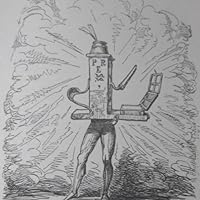
William Godwin was the son and grandson of strait-laced Calvinist ministers. Strictly-raised, he followed in paternal footsteps, becoming a minister by age 22. His reading of atheist d'Holbach and others caused him to lose both his belief in the doctrine of eternal damnation, and his ministerial position. Through further reading, Godwin gradually became godless. He promoted anarchism (but not anarchy). His Political Justice and The Enquirer (1793) argued for morality without religion, causing a scandal. He followed that philosophical book with a trail-blazing fictional adventure-detective story, Caleb Williams (1794), to introduce readers to his ideas in a popular format. Godwin, a leading thinker and author ranking in his day close to Thomas Paine, was enormously influential among famous peers.
He and Mary Wollstonecraft, author of A Vindication of the Rights of Woman, secretly married in 1797. She died tragically after giving birth to daughter Mary in 1797. Godwin's loving but candid biography of his wife, Memoirs of the Author of A Vindication of the Rights of Woman (1798), further scandalized society. Godwin, caring not only for the baby Mary, but her half-sister Fanny, remarried. He and his second wife opened a bookshop for children. Godwin, out of necessity, became a proficient author of children's books, employing a pseudonym due to his notoriety. His daughter Mary, at 16, famously ran off with poet Percy Shelley, whose Necessity of Atheism was influenced by Godwin. Mary's novel Frankenstein also paid homage to her father's views. Godwin's life was marked by poverty and further domestic tragedies. Godwin's prized manuscript attacked the Christian religion and was intended to free the mind from slavery. The Genius of Christianity Unveiled: in a Series of Essays was published only many years after his death.
I've had this one on the shelf for years, but something tells me that, in this day and age, it's an interesting time to finally crack it open. Here's the opening excerpt from the introduction by editor, Dr. Isaac Kramnick:
"Every political philosophy has its prophet and sacred text. For liberalism it is Locke and The Second Treatise on Civil Government; for democracy it is Rousseau and his Social Contract; for conservatism Burke and the Reflections on the Revolution in France; for socialism Marx and the Communist Manifesto. Anarchism is no exception. Its prophet is William Godwin and its first sacred text, his Enquiry Concerning Political Justice. James Joll, historian of anarchism, writing in 1964 describes the 'one English writer who, starting from the commonplaces of eighteenth century philosophical belief, elaborated the most complete and worked-out statement of rational anarchist belief ever attempted, a philosophy of anarchism carried through to its logical conclusions, however surprising and absurd these might be. This was William Godwin.'"
Should be an interesting read. I'll let you know what I think.
William Godwin is a name that nowadays receives more mention in relation to his famous wife, daughter and son-in-law than any personal merit, and yet with the republication of this book it is not hard to see that he is a philosophical and literary giant in his own right. His ideas rebel against the moral decay of man (something as prevalent today as it was in his) and while I cannot help but feel the apparent naïveté in much of his writing, I also cannot deny the sheer magnetism and optimism that flows throughout it.
Godwin's theories concerning political justice centre more on the moral condition of man as an individual rather than on any specific rules set by a few. It was his belief that it was within all men to be virtuous and veracious; to put their own needs and wants aside in favour of what was greater for mankind as a whole. From this stems what man's position should be concerning slavery, war, property, crime and punishment, etc. And as Government stands as representative of the people, it must also stand as morally upright representatives of a morally upright people. In such a case all decisions would be simple, for everyone would see the right and wrong of all things. Political justice would always stand as true justice. An ideal world view penned by a talented thinker.
An Enquiry concerning Political Justice (1793) is the Enlightenment-run-wild. William Godwin, a minor British Enlightenment figure, decided to apply the ideas of his French precursors – mainly Jean-Jacques Rousseau and Voltaire – as well as his English colleagues – John Locke and David Hume – to the question of society. All throughout the eighteenth century, bright minds in Europe started to reflect on the (recent) breakthroughs in the scientific method – Galileo, Newton, Locke, among others – and to build up a new worldview and philosophy, in place of the demolished Christian-Aristotelean philosophy of the Middle Ages.
In short: Nature, and Nature’s laws, can be known through observation and mathematical analysis. Through postulating theories and then testing these in practice, we can improve our knowledge of the universe. By applying this knowledge, we can increase our control over Nature, and improve our lives. This idea of progression was finally taking flight in the eighteenth century – never before was this idea of development and progress so leading; before the Scientific Revolution, the world was deemed eternal, and life was nothing but waiting for the afterlife.
Of course, since mankind is part of Nature, and Nature can be known through investigating her workings, Man could be known through the same means of discovery. People like Montesquieu, Hume and Adam Smith should be viewed through this lens – they are the precursors to modern sociology, psychology and economics.
Godwin, writing around the time of the French Revolution, was in the historical position to synthesize all the knowledge and ideas of the previous 150 years or so. His aim, from the outset, is to establish politics as a science. Politics, the government of society, is nothing but ethics – once government is reduced to the individual human being, that is. By studying man, we can find the principles of justice, on which to found a new society, one that is an improvement to the current society that was pestered by inequality, unfreedom and oppression of the many by the few. A noble goal, indeed. The problem with such attempts is that facts easily become entangled with ideology; and that the end result is nothing short but a utopian idea, teared loose from its roots.
An Enquiry Concerning Political Justice can easily be summarized. The first four books establish the principles of justice; the latter four books apply these principles to society.
Godwin starts with convincing us of the possibility (and necessity) of improving the human mind – man is a perfectible creature. Looking back thousands of years, and then returning to 1793, Godwin sees much improvements; and uses this as proof that man is capable of improving his lot. The only precondition is that reason is used; only knowledge – ‘truth’ – will discover what is ‘just’, and through this lead to better morals – ‘virtue’.
Then, in Book II, Godwin establishes the principles of society. The forms of society are historically explainable, but this is a task for historians. Godwin focuses on the substance of society – ethics – and treats of it as a philosopher. According to him, society is an aggregation of individuals, and the duties of society comprise the aggregate of the individual duties. And what are these individual duties? Well, every person should do whatever can contribute to the welfare of others. And since welfare is mostly defined by the mind, the pursuit of truth through reason is the most important duty. Everything else, such as sharing food or shelter, should be approached from this perspective: the utility of such things should be assessed – with the help of reason – in light of the whole population.
This, by the way, is utilitarianism: the greatest happiness of the greatest number is the leading principle, for Godwin, in justice and goodness. This approach to ethics aggregates all people into one community, and has its foundations in the universality of man. People are physically and morally not very different, so we all have the same wants and desires, and hence the same duties to others. This leaves no room for inequality, parties or distinct interests.
In Book III, Godwin then proceeds to establish the principles of government. Government is founded on either strength, divine right, or a social contract. After demolishing all three foundations, Godwin establish some sort of Locke-Rousseau-blend of government: the population delegates its control and authority to a government for the greater good – the function of this government consists in cultivating truth and destroying falsehood. It has only executive powers, since legislative powers don’t exist (no man can subdue another man through coercion). An important observation that Godwin makes, is that the form of government determines the manners of a nation, and not – as is usually claimed by conservatists and other misanthropes – the other way around. Since man is a universal being, all human beings are capable of liberty and virtue.
Then, in Book IV, Godwin adds some miscellaneous principles to the mix: resisting government and reformation of human beings should both be accomplished through reason. Bad governments and bad behaviour spring from corrupt opinions; expose these opinions as false and replace these with just and true opinions, and all is solved. Enlighten the people, and when the opportunity arises, they will revolutionize their society – in peace.
The principles established in Books II-IV on the hand are gems of humanism and reason, and are characterized by the love for man and by a passionate search for truth. On the other hand, it is easy to see how such principles can give rise to utopian ideas when they are applied to the real world. And this is, of course, what happens in the second part of the book.
In short, Books V-VIII detail how the established principles of justice are applied to the questions of what is an government? what is the place of public debate and opinion in a just society? what should we do with criminals? and lastly, what system of property distribution fits a just society? Godwin uses a huge part of the book (Book V) to demolish the ideas of monarchy and aristocracy. These systems of government are, ultimately, rooted in falsehoods and they foster corruption of those in power, those longing for power, and those without power. They also are the primary causes of war.
A just society lays the responsibility for decisions with the individual. In practice, this is not always possible, and here the representative democracy through open elections is preferable. Democracy has its flaws, but it stimulates equality and truth, which makes it preferable to the other, corrupting, forms of government (i.e. despotism). Within this democracy, there should be no multiple chambers, and no division of powers. The government is only endowed with executive powers; and its ministers are primarily the channels of information (i.e. informing the people) and only secondarily occupied with minor day-to-day responsibilities such as revenue and spending. The end goal of such a democracy is to cultivate reason and virtue in the minds of the people, and when the people are enlightened in their ways, government will be superfluous and disband. For the important matters – such as war waged by an external despot or sporadic internal transgressions – temporary assemblies can be convened, preferably within a framework of a confederate system of small districts.
In book VI, Godwin treats of freedom of opinion. Since truth leads to virtue, free and open discussion and critical analyses of all ideas are characteristics of a just society. Hence, the current practices of religious and political censure, the taking of tests and oaths, the criminalization of criticism (as libel), should all be abolished. As a matter of fact, state-sponsored education should be abolished, and so do salaries and pensions of civil servants. And since we’re already abolishing: let’s do away with constitutions – rights don’t exist, only individual duties. In human discourse, everything can be said – absolute freedom of speech. Even inciting violence and slandering others is allowed. The former is nothing but thought-crime and the latter should be approached as a man (i.e. slander should be countered with true information, presented in a calmly, exposing way).
It is not hard, from the preceding topics, to guess Godwin’s stance on crime and punishment. Crime doesn’t exist, since the law doesn’t exist. Law is nothing but a species of promises, which pretends to foretell future events; fixed laws are no remedy for the passions of man.
Punishment comprises either restraint, or reformation, or else example, through coercion. Forced restraint is unjust, since it forces future suffering on a human for past deeds. Forced reformation is unjust, since it presupposes knowledge (and hence virtue) of the future on the part of the community. Forced example is unjust, since it is nothing more than retribution for retribution’s sake – degrading the community to the same level as the convict, i.e. to animal passions. Coercion fosters alienation and resistance in the convicted, while not solving anything.
Godwin’s approach is – again – centred on the reasonableness of mankind. Behaviour springs from opinion; bad behaviour springs from bad opinion. Vice is nothing but error. The remedy to criminality is the enlightenment of the criminal: change his opinion, change his behaviour. Vice is remedied through knowledge. In other words: teach him why his acts are wrong, and he will see that these dispositions are nothing but animal passions.
Alright, so step by step, the contours of a just society become visible: no government, no censure, no law, no punishment. What about property? Well, here it becomes problematic for Godwin, since property is directly related to the human needs of food, drink, shelter, sex and social status. Book VIII is at once a criticism of the current system of property distribution and a proposition of a new system of property distribution. The current system is highly unequal. It is founded on property accumulation – opulence and charity are heralded, at the costs of the sufferings of millions. Every agricultural worker produces for twenty people – labourers, merchants, nobility, etc. Charity, by the way, is nothing but vanity on the part of the rich and is ineffective to alleviate poverty anyway. In short: this is a highly unreasonable system, fostering a spirit of servility, oppression and crime.
What is to replace it? The new system is founded in the principles of utility and equity. Man is universal. The needs of man – food, drink, shelter, even mates – should be the guiding principle of the new system of property. Every man should produce for himself what he needs in terms of food, drink and housing. In this way, luxury will be superfluous, and we can do away with all professions (like merchants, capitalists, government officials, etc.). Every person spends 1/20 part of his or her time producing his or her own means of subsistence; the rest of the time is spent on cultivating the mind, pursuing the truth and in social interaction with others.
This, by the way, is no communism. No shared meals, no shared production, no shared magazines. Individuality trumps everything. It is a system in which every person produces enough for himself to live a healthy, normal life. All forms of property are abolished: manual labour, marriage, education are eradicated and this will introduce a new, happier way of life.
Initially, the introduction of this system will lead to problems (sloth, luxury, inflexibility), but these are temporary problems. Individual responsibility will lead to education through experience (i.e. not producing makes you hungry, so it is reasonable to start producing). Gradually, reason kicks in, and then this system can run, for perpetuity, on its own.
So, based on the principle of duty (virtue) through reason (truth), we end up with a society without government, without wars, without censure and law, without punishment, and without property. This state of society leads to the happiness of all people within the community, and it will be based on nothing but free and open discourse, a passionate search for truth, and a progression of the lot of mankind.
The only problem is that this society will never be reached. The weakness of Godwin’s essay lies neither his critical examination of contemporary society and justice, nor in his sketch of an ideal society, but in the question: how to get from here to there?
How to get from a despotism (monarchy, aristocracy) to anarchy? Through a temporary establishment of representative democracy. Well, this is begging the question. Or rather, two questions. How to get from the current despotism to democracy? Here it is easy to see the influence of contemporary events: Godwin was witnessing the French Revolution, the overthrow of the despotism of the Ancien Régime by the people and the subsequent establishment of a democratic government. (Of course, in this case too, realism trumped idealism, and they ended up with a new despot.) It is entirely unknown how to reach anarchy from the point of democracy. According to Godwin, democracy will cultivate the minds of the community, and this will lead to more and more individual responsibility and a lesser and lesser need for a government. But of course democracy only creates new parties with interests (even philosopher-kings are corrupted by power – witness Plato’s attempt to educate the ruler of Sicily).
How to get from the current system of property distribution to the new, utopian one? This is sheer absurdity. No one with any amount of property will give up his or her possession, pack his or her bags and find a spot to become an agricultural labourer for the rest of his or her life. Godwin’s utopian society is a longing for simplicity; the longing for a simply, agrarian life; a life where everything is monotonous and basic. Karl Popper wrote a huge book (The Open Society and its Enemies, 1945), in which he traced the roots of totalitarianism and human misery back to the longing for a simple, self-sustaining life – the romanticizing of the lives of our agrarian ancestors. We can see, in Godwin, another example of this.
Godwin’s stance is comparable to the average teenager, who – due to lack of experience, knowledge and wisdom – looks at the world unfiltered, like a child, and then revolts against every perceived injustice and inequality. The current Social Justice Warrior-craze has its roots in teenagers who grew up in safe spaces and bubbles of health and wealth, and then are exposed to the big, bad world. They can’t believe that in the real word inequality and injustice run rampant, and so they overstretch themselves in trying to bring these truths to light. Their solution? Censure all opponents, enforce equality through banning words and concepts and progressive taxation, and build up an authority (i.e. the state) with the power to make people equal. Cultural-Marxism springs from the same root as all totalitarian ideologies, as well as anarchy. It is not to be wondered that anarchism, communism, socialism, fascism and Nazism, while acknowledging their differences, have so much in common. The motivation of adherents is usually perceived injustices and the agreement on theoretical principles of justice. The problems start when reality becomes too complex, when it becomes an obstacle. Now reality has to bend to ideology. And soon afterwards the suffering begins.
Godwin’s utopia is founded on humanism, science and reason – all laudable – but his society, in pursuing justice, forgets about human nature. Human beings want more than simple living, simple subsistence. People want thrills, violence, danger, competition, desires and pleasures. The human being is a highly emotional subject (‘Reason is a slave of the passions” – David Hume), and any model that perceives human beings as rational agents is doomed to failure. Godwin – and people like him – was in bad need of the future results of sociology and psychology. Although it has to be admitted that the economic theories preached from the Universities’ pulpits nowadays are built on the same flawed assumptions. Human beings aren’t rational. Utopia’s won’t work. Karl Popper’s piecemeal social engineering – improving our society step by step, taking subsequent experiences into account and adapting the rules/system where necessary – is a much better approach, with much less suffering attached to it, and has led to much better results, than quick jumps to utopias.
Nevertheless, An Enquiry Concerning Political Justice is an extremely interesting book to read for someone interested in the Enlightenment. Godwin’s enquiry is a continuous discussion with the intellectuals of his time. He discusses the ideas of Locke, Hume, Montesquieu, Rousseau, Voltaire, Smith, Burke, Paine, among others, and he gives his own thoughts on their ideas. The book, although a bit abstract and dry, is also written in beautiful eighteenth century English, and even though one might not agree with Godwin, he does make you ponder certainties and to critically examine your own beliefs. One cannot ask more from a book that is steeped in the Enlightenment.
it is my new-found belief that, if you can pick this book and not settle for the summary of principles at the beginning (thus commiting yourself to read seven-hundred-odd pages), then you're entitled to skip the less interesting passages. you've earned it.
i thought this book much less drier (the opposite being humid and nonsensical for the context) than i was expecting. of course, not everything was as interesting/incisive as its strongest sections. although i feel tempted just to present the summary of principles directly quoted from my edition, i will refrain the temptation and leave it to you to decide whether to settle for this or read seven hundred more pages of the same content said with many more (i mean, many more ) words.
i will say, though, that the first three books are certainly the strongest of the bunch and probably where most of the meat lies: of the powers of man considered in his social capacity, principles of society, and principles of government. in that sense, i much preferred this book when it acted as a treatise on political theory and less when it became a how-to book on multiple detailed aspects of society; the books on the operation of of opinion in societies and individuals and on opinion considered as a subject of political institution were my most skimmed-through sections for this reason.
would certainly recommend to anyone with both the time and the highlighter pens for it.
One of the finest minds and most celebrated political thinkers of his time, when he published this book in 1793. And, it's simply a most enjoyable, quite refreshing read.
Most of his comments and observations in late-Eighteenth Century England are relevant to what we see about us today in America. And arguably a good deal more so!
His anarchist principles have never been sufficiently understood or tested over the last 222 years.
It's about time they were, right here in this country!
“It is earnestly to be desired that each man should be wise enough to govern himself, without the intervention of any compulsory restraint; and, since government, even in its best state, is an evil, the object principally to be aimed at is that we should have as little of it as the general peace of human society will permit” (187).
I am enamoured by William Godwin: a partner to Mary Wollstonecraft, an inspiration to Peter Kropotkin, and a theorist who anticipated the ideas of Proudhon and Marx decades before them. The fact that this work was less influential or popular historically than those treatises of Hobbes or Locke is a tragedy. I feel like I could review this book on two entirely different accounts: first for its epistemology, and second for its politics. Godwin’s philosophy begins very similarly to Locke’s and yet it is fascinating to see how the two thinkers diverge, the former becoming a pioneer of anarchism and the latter liberalism. Godwin’s empiricism is clearly influenced by Locke and Hume, which is evident in arguments like those against free will:
“A knife is as capable as a man of being employed in purposes of utility; and the one is no more free than the other as to its employment. The mode in which a knife is made subservient to these purposes is by material impulse. The mode in which a man is made subservient is by inducement and persuasion. But both are equally the affair of necessity.”
Godwin argues that the doctrine of necessity, then, has fallaciously rested on the assumption that punishment is an effective means of ‘inducement and persuasion’:
“The more the human mind can be shown to be under the influence of motive, the more certain it is that punishment will produce a great and unequivocal effect.”
We have over 200 years of empirical evidence since Godwin to vindicate his criticism of punishment. Instead, Godwin advocates for appealing to the empathy, reason, and passions of others in order to affect their will.
Turning to private property for his final critique was the right choice, in my opinion. We finally arrive at the deathblow to government and capital. Godwin identifies three types of property: personal possessions characterized by their use by an individual; products of an individual’s own labour; and finally, the appropriated products of one’s labour by another and deemed property only by patent. These latter two types of property are in direct contradiction, and only the first should be determined just and equitable (p. 633)
Furthermore, it is fascinating to read Godwin’s analysis of the division of labour (“The object, in the present state of society, is to multiply labour; in another state, it will be to simplify it”); as well as an anticipation, albeit an unmaterialistic one, of what could be read as the withering away of the state (“A long period of time must probably elapse before [this state of society] can be brought entirely into practice… The state of society we are describing must, at some time, arrive”). These of course were only seeds yet to be germinated by later communist thinkers, however, the potential was there in Godwin’s thought.
It's a tough-going tome, but if you're interested in some of the more radical political theorists and theories of the late eighteenth century, or even just in anything related to the Godwin-Shelley family, then it's well worth a go. Godwin was a huge influence on Percy Shelley through the early/middle period of his life.
When I was fourteen I thought I was an anarchist. This book convinced me how boring anarchism is. Anarchy is better in small doses and with no 5 dollar words. Interesting thing though, William Godwin is Mary Shelly's Dad.
There’s ſomething ſort of funny about reading eighteenth century literature, but ſo far I'm enjoying this ahead-of-its-time and inſightful take on political philoſophy and ethics.
William Godwin was way ahead of his time. He imagined a world when the men would not plow the fields, but that the plows would plow the fields by themselves. How close are we to that time?
William Godwins’s An Enquiry Concerning Political Justice is both a fascinating and frustrating read. Godwin presents a philosophical system that pushes Enlightenment faith in rationality to its most extreme political conclusions. It’s just that those conclusions, while inspiring in their principled optimism and dedication to equality, rests on a belief in the power of truth that does not bear out in social experience. His is a system of utilitarian liberal anarchism that simultaneously prioritizes the common good and elevates the integrity of the individual’s private judgment, calls for unfettered inquiry and honest discussion into all things, excoriates oppression and political inequality, and genuflects to a progressive gradual improvement inevitable in all human affairs. More radically, he calls for the abolition of punishment, property, law, and marriage. There’s an encouraging prefiguration of central socialist ideas here, especially regarding the absurd injustices of class inequality, the evils of traditional social institutions upheld by ideological common sense, and the influence of social structure over human behavior. But these are attended with a squeamishness towards revolutionary political organizing and a quasi-religious conviction in rational discourse as the only legitimate vehicle for change. Godwin’s politics seem to present a core of liberalism in its most “radical” flavor. The result is a menagerie of views as idiosyncratic and unpopular in the 1790s as they are now, making Godwin reminiscent of a wizened, admirable, and ineffectual hippie.
As a contribution to Britain’s “pamphlet wars” following the commencement of the French Revolution, Godwin writes in support of the republican cause and against conservatives such as Edmund Burke who find much more value in the wisdom of tradition and ancestry than in progress and experimentation. He sees the French Revolution as part of humanity’s progress towards truth and justice, which demands political equality and the elimination of ruling class privilege. But Godwin’s is not so much a straightforward endorsement of the revolution or even the British radicalism of the time. Though he writes extensively on the ills of monarchy and aristocracy and celebrates the equality of men promised by democracy, he is averse to revolutionary violence and even to political association. In another sense, he goes further than the revolutionaries, proclaiming that all government itself is an evil that, if necessary in the present state of human imperfection, should be minimized and eventually abolished wholesale.
Godwin abhors all forms of force and undue influence because he stresses the importance of the development of individual, private judgment. He is no relativist - there is an “irresistible” and “singular” truth, but he believes humans must achieve that truth by thinking for themselves and coming to their own conclusions through intense and free inquiry and discussion. The guiding and most constant argument in the work (such that the book could be 100 pages shorter) is that truth is an inevitable outcome of human reason and discussion, that we are in fact incapable of resisting true ideas and arguments when we encounter them. He stakes his system on this most untenable belief, which makes the work as a whole hard to swallow after the historical emergence of fascism and in the midst of our contemporary political crises.
Even so, there are aspects of the work that continue to have revolutionary purchase. Despite his suspicion of political organizing as inflaming the people with anger and corrupting the functions of independent thought, he acknowledges the need for total social transformation to facilitate conditions of improved life for all. He recognizes that social experiences drive human expectations and shape their behavior, arguing that political institutions form the manners of a nation rather than the other way around. He realizes that for public discourse to have the effects he imagines, the working class must be freed from toil in order to partake in intellectual engagements. He acknowledges that crime is born from oppression, need, and resentment and that criminal punishment is an evil that fails to reform individuals or prevent crimes from occuring, because it’s a form of persuasion in strict opposition to reason. He argues that the current system of property must be abolished, such that all things belong to whoever needs them most. He all but says “from each according to his ability, to each according to his need.”
I could go on for many paragraphs about Godwin’s more idiosyncratic beliefs and arguments (some of which are better than others): his weird and sexist argument about the justice of saving a famous writer in a fire over his chambermaid; his hatred of promises as foreclosing the dictates of one’s future conscience; his opposition to marriage as the worst type of promise; his lengthy diatribe about how it’s wrong to make a servant tell an annoying neighbor that you’re not home when you really just don’t want to see him. Etc., etc. Oh, and that human progress is such that as we figure out the best political arrangements, we will also eliminate disease, become immortal, and no longer have children - and that some living in 1793 might experience this. (!!!) These examples may be particularly striking, but many more specific arguments tied to Godwin’s system live in these rich pages. An abstract and repetitive writing style and lengthy metaphysical digressions make the entire work somewhat of a slog, but the ideas themselves are nothing if not provocative, making Godwin a fun thinker to wrestle with in both appreciation and exasperation.
Lots of interesting ideas here and fairly lively, accessible prose (even if it is characteristically of the period in its meandering and wide-ranging nature). Could definitely see myself raising my rating on future, closer reads. Very intriguing. Would love to read more about the influence of Godwin's thinking and to see him brought up a bit more in contemporary American political discourse.
Anarhizam, ili potraga za čovjekovim razumom + Prvi politički triler
* Istraživanje političke pravde i njenog uticaja na opštu vrlinu i sreću (Enquiry Concerning Political Justice and Its Influence On Morals and Happiness), William Godwin; priredio: Ajzek Kramnik; Penguin Classics; London, 2015; 740 str.
* Stvari kakve jesu, ili Pustolovine Kejleba Vilijamsa (Things As They Are, or The Adventures of Caleb Williams), William Godwin; priredio: Moris Hindl; Penguin Classics, London, 2005; 384 str. https://www.goodreads.com/book/show/1...
„Vlast“, napisao je Vilijam Gadvin (1756-1836) u Istraživanju političke pravde i njenog uticaja na opštu vrlinu i sreću (1793), „ne može imati više od dvije legitimne svrhe: spriječavanje nepravde protiv pojedinca unutar zajednice, kao i kolektivnu odbranu od vanjske invazije.“ To načelo, ni nakon 223 godine, nije moguće poboljšati. Ako tu prišljamčimo i Darvina, ono što je Gadvin htio da kaže u ovom prvom anarhističkom djelu jeste da je centralni cilj vlade da ublaži borbu oko preživljavanja – da njeguje i štiti čovjekovu čast usljed njegovog svakodnevnog brutalnog bivstvovanja.
No, sve to je, naravno, nemoguće. Zbog toga se taj glasnogovornik individualističkog liberalizma odvažio da kritikuje državni autoritet, njegove zakone, a zatim i kazne. Čovjek je za Gadvina bio tabula rasa kojeg nepobitno oblikuje država, na taj način tvoreći nepouzdanog pojedinca; polovina ljudi su, napisao je, ionako „puki papagaji“ koji ponavljaju ono što čuju, ne shvatajući šta se time pokušava reći. Umjesto države je zato trebalo iskovati novu vrstu političkog tijela; u suštini, ljude je trebalo ostaviti na miru. Idejna srž gadvinijanske filozofije nalazi se i u romanu Frankenštajn (1818), koji, ne samo što je donio slavu njegovoj ćerci Meri Šeli, nego je donio i suprugu Persiju Šeliju, Gadvinovom štićeniku.
Ajzek Kramnik, priređivač ovog izdanja, besprijekorno sumira vezu između Gadvina i Šelija: „Šeli je živio od Gadvinovih ideja, a Gadvin od pozajmica i poklona mladog poete.“ Premda vaspitavan u kalvinističkom duhu sandemanizma što je na kraju dalo maha negodovanju i prema vlastitom ocu i protestantskom bogu, a onda, prirodno, i prema državi i Crkvi, Gadvin je bio ateista dok je pisao Političku pravdu. Knjiga mu je istovjetno donijela slavu i ozloglašenost, ali, srećom, nikada nije hapšen.
Možda zato što su mu zaleđinu činili uticajni intelektualci ondašnjeg engleskog društva? A možda i zato što je Gadvinov anarhizam bio tako iskren i krepostan i, na mahove skoro utopijski i elitistički naivan, no definitivno bezazleniji od tvrdokorne političke ekonomije Adama Smita – nešto što su vladari, htjeli ili ne, morali da pročitaju ako su željeli da sačuvaju svoje investicije odn. vlast.
Gadvin ne samo što nije zagovarao bilo kakav vid nasilja, kao što su mu protivnici u startu zamjerali, smatrajući da je zanesen Francuskom revolucijom, nego je u suštini bio pozitivan u pogledu ljudskih bića: njih jeste bilo moguće prepraviti i izvesti na pravi put, uprkos brojnim manama; on je odista vjerovao da je čovjeka bilo moguće naučiti moralnosti. Taj prvi anarhistički traktat je, shodno tome, pokrenuo ozbiljno pitanje smjene državne vlasti novim političkim tijelom koje bi odista brinulo o svojim stanovnicima i oblikovalo ih da prije svega postanu pošteni, obrazovani, dobrostojeći i razumni ljudi.
Izvjesni prezir koji je o državi ostavio njegov prijatelj, Tomas Pejn, u pamfletu Zdrav razum (1777), gdje se zalagao za nezavisnost američkih kolonija, Gadvin je iznio na viši stepenik. Narodne mase su nasamarene „tajanstvenom i komplikovanom prirodom društvenog sistema“, te je poredak stoga trebalo drastično simplifikovati.
Najveći neprijatelj za njega je aristokratska privilegija, (rang i status), a najveće racionalno pomagalo u ostvarivanju idealne politike su ujedno i najveće ljudske zaostalosti: „istraživanje, komunikacija, diskusija.“ Lako je reći.
Gadvin potvrđuje da se zakoni ne rađaju iz dobrote i pameti vladara, već iz njihovih ambicija i strasti; samim tim, ti zakoni podstiču korupciju i vode do bezakonja, umjesto do pravde koju propagiraju. Na koncu, zakoni se prave za one kojima trebaju da služe. Bogataši su, dodaje on, „u svim ... zemljama direktno ili indirektno vezani za zakonodavstvo države“. Međutim, takva (opresivna) država je, recimo, za Hobsa bila srodna utopiji, isto kao što je za Platona, u Republici, idealno mjesto bilo tlo lišeno stihoklepaca. Kod Gadvina je te zakone trebalo ukinuti i zamijeniti nečim što je on nazvao „situacionim mudrostima“ gdje će, na žalost, trebati da prednjači isti taj kvarljivi ljudski razum.
On je vremenom modifikovao najradikalnije tačke svoje ideologije, držeći da život jednog intelektualca treba da se sastoji od učestale promjene mišljenja. Njegovo najtrajnije zavještanje ipak je bilo da etičnost i sreću predstavi kao najznačajniji čovjekov cilj bez uticaja natprirodnih sila, ali i bez loših okolnosti po druge.
Nedugo poslije objavljivanja Političke pravde, Gadvinova filozofija je pala u zaborav, ali nikada nije prestala da se doštampava, što pak dokazuje i ovo namjerno neskraćeno Pingvinovo izdanje iz prošle godine. Zaborav neosporno još traje, čim se Gadvin ne uvrštava u većinu kompilacija o anarhističkim spisateljima, gdje, čak i kod Čomskog, jednog od istomišljenika, najvećma prednjači Prudon (1809-65), prvi koji je sebe nazvao anarhistom. U Političkoj pravdi, gdje je autor odmah uočio kardinalne greške i ispravljao ih do trećeg izdanja, ovaj politički filozof je oštro skrenuo s progresivnog mišljenja u Britaniji, a i od filozofa Prosvijetiteljstva poput Rusoa, Helvecijusa, Didroa i Kondorseta.
S te strane, Gadvin je odista prezirao fundamentalne poroke (pohlepu; nepravdu; neodgovornost; licemjerne vidove patriotizma; materijalizam...), ali nikada nije moralizatorski tvrdio da je iole bio imun na njih. Njemu je, recimo, novac konstantno bio potreban zbog namirivanja dugova, te nije prezao da pozajmljuje veće svote i da ih nikada ne vraća. Ironično ili ne, najposlije mu je prva vigovska vlada nakon Francuske revolucije, dodijelila doživotnu penziju. Njegov anarhizam o jednakosti među ljudima, koji će odjeka imati i kod Marksa, propagirao je upravo egalitarizam.
Pomenuta Meri Šeli, ćerka Vilijema Gadvina i Meri Volstonkreft, filozofkinje i jednog od prvih boraca za ženska prava, prilikom tvorbe Čudovišta dr Frankenštajna, njegovu životnu priču poistovjetila je s konceptom očeve filozofije: da je tom novostvorenom biću bilo dozvoljeno pristojno školovanje, katastrofa se mogla izbjeći. Uistinu, da je Frankenštajn bio iole bolji psiholog, i da je društvo, u kome je Čudovište takoreći prohodalo, bilo pravično i predusretljivo – grozni džin bi vremenom vjerovatno postao uzor učtivosti.
Neskriveni antivjerski uticaj njenog oca, vidi se i u ostatku Šelinog romana, barem kad je u pitanju sasvim racionalna teorija sukobljavanja obrazovanja sa metafizičkim, odn. faustovski ili prometejski problem (ova metafizička perspektiva dominira posljednjim stranicama Frankenštajna).
Od pet romana koje je Gadvin objavio nakon Političke pravde, danas je opstao samo jedan, i to onaj koji je došao odmah poslije njegove vrlo popularne političke knjige gdje se odvažno odrekao ne samo svojih prethodnih uvjerenja i raskrstio sa porodičnom kalvinističkom prošlošću, nego gdje je osudio sve postojeće institucije i autoritete – društvene, moralne i vjerske – osim, dapače, oštrog principa pravde.
Gadvinov roman – proto-psihološki triler s elementima tada popularnog gotika – Kejleb Vilijams, ili stvari kakve jesu, napisan odmah nakon Političke pravde, 1794, krije ključ autorove ideologije.
Biograf Vilijam Sen Kler u knjizi Gadvinovi i Šelijevi (1989), uvrštava ga u najkvalitetniju prozu u bogatom intervalu engleske književnosti između Semjuela Ričardsona, Džejn Ostin i Valtera Skota. To je djelo morbidne imaginacije koje govori o emotivnoj cijeni što se mora platiti zbog želje za slobodnom misli, pravdom za svakoga, spokojnim životom, mirom i ljubavi prema istini. Kao i u Političkoj pravdi, Gadvin je sjedinio svoju kritiku političkih institucija sa psihologijom individualaca zatečenim pod njenim uticajem.
Kejleb Vilijams u nekim kritičkim krugovima slovi za prvu detektivsku priču na engleskom jeziku, premda bih kazao da se prije radi o prvom političkom trileru; detekcija u romanu, ako ju je uopšte moguće i detektovati, zamamno je latentna. Gadvinova premisa od tada nikada nije pala u zapećak, nego se i danas bez presedana štancuje i haba – počev od Igoovih Jadnika, ako ne i prije toga.
Kejleb je samouki narator porijeklom iz najniže društvene klase koji, kao sekretar, radi na posjedu vlastelina Foklanda. Uvaženi gospodin Ferdinando Fokland, sa jakim vezama u državnoj vlasti i tobožnji filantrop, u prošlosti je bio uhapšen za ubistvo perfidnog susjeda Barnabasa Tajrela, ali je ubrzo oslobođen optužbe. I nekako baš zbog toga, život Kejleba Vilijamsa, valjda zbog njegovog klasnog mjesta u društvu, predodređen je da bude „pozorište nedaća“. On će ubrzo otkriti istinu iza Tajrelovog ubistva (u jednu ruku, ono jeste bilo opravdano), a onda će ga Fokland ucijeniti kako bi jezik držao za zubima. Ovdje vrijedi napomenuti da, iz nekog razloga, Kejleb mnogo cijeni svog gospodara Foklanda.
Nedugo potom, Fokland će smjestiti Kejlebu da bude optužen za krađu s kojom ovaj nema nikakve veze. Jadni Kejleb će biti bačen u zatvor, pobjeći će iz njega i onda se udružiti sa lopovima na čijem čelu stoji policijski špijun. Dva čovjeka će razmatrati pitanja zločina i kazne („okolnosti rađaju nemile situacije“), kao i društvene pravde, a onda će ga špijun poslati u zatvor i po drugi put.
Priča će se ubrzati kada Kejleba počne juriti kriminalac Džons koji želi da ga ubije. U isto vrijeme, za petama će mu biti neumorni i paranoični Fokland koji mu ne želi ništa bolju sudbinu i za svoj cilj na raspolaganju ima svako „pravo“ koje može imati građanin visokog porijekla.
Čitajući naknadno dopisani svršetak romana jasno je da je Gadvin, na žalost, naivno vjerovao u generalnu dobrotu ljudskih bića i pored toga što je prethodno isfabrikovao filozofiju gdje na 800 stranica zaključuje da je minimum polovina svjetske populacije kvarna do srži (a pogotovo povlaštena manjina), pa je prvobitni svršetak romana bio umnogome drugačiji od pravog. Tu ne samo što Kejleb uspijeva da na sudu dokaže svoju nevinost, nego, apsurdno, dolazi i do pomirenja sa Foklandom, a naposljetku i do Kejlebove grižnje savjesti – pošto je uništio život tako jednog uzoritog čovjeka!
U odbačenom svršetku: Kejleb ne uspijeva ni u čemu, a tako bi, vjerujem, bilo i u pravome životu. Štaviše, tu Kejleb, oslabljenog razuma, ponovo završava iza svojevrsnih rešetaka (u kućnom pritvoru), sa Džonsom kao tamničarem, a Foklandom kao njegovim trovačem. Srećom pa u Pingvinovom izdanju imamo inkorporiran prvobitni realni svršetak, ali i Gadvinov esej o tome kako je napisao roman.
Čitaocima na kraju XVIII vijeka, Kejleb je neminovno izgledao kao slabo zamaskirana dramatizacija represivnih mjera uperenih na političke neistomišljenike u Engleskoj tokom 1790-ih, a sve u odgovor na revoluciju u Francuskoj. (Primjera radi, Gadvinov prijatelj i autor, Tomas Holkroft, poslije radikalnog romana Hju Trevor, osuđen je za veleizdaju, a zbog čega je dva mjeseca proveo u tamnici.)
Baš iz tog razloga, Gadvin je napisao svoje romane tek kad je postao poznati politički filozof, dakle nakon Francuske revolucije što je misliocima dozvolila da razviju osjetno naprednije ideje o politici, moralnosti i religiji, a što su bezmalo opsijedale drugu polovinu XVIII vijeka, u vrijeme kad su politički pisci poput konzervativca Edmunda Burka i Tomasa Pejna formulisali političke maksime koje i danas odzvanjaju u vokabularima političkih partija. Ta priča o mladiću opterećenom tajnom svojeg bogatog dobročinitelja koji se izvukao sa ubistvom (neko drugi je pogubljen zbog tog zločina) i koji ovog jadnika goni svim silama zakona, zapravo je priča o konstantnoj prismotri: o tome kako taj izopačeni entitet – država – bez imalo problema može da se umiješa u nečiji život, i da individualca, ni krivog ni dužnog, postepeno uništi. Besmrtna tema.
A kako je političko ratovanje uvijek bilo gorka pilula za gutanje, Gadvin odlučuje da jedan dio svoje fikcije, baš kao i pomenuti Holkroft, iskroji prema vlastitim fiksacijama. Najbolji primjer za to je avantura Kejleba Vilijamsa – ondašnje mješavine Loganovog bjekstva i Državnog neprijatelja.
Neki ne-anarhista kazao bi da je Kejleb Vilijams sam po sebi klinički paranoidan – da se radi o bolesnom posrnuću čovjeka koji, za razliku od Hobsa, nije uspio da shvati/prihvati nužnost državnog terora, pretjerano komplikovane birokratije, neumoljivog zakona i nehumane penologije, a posebno neprekidno vrenje antagonizma i straha. Vizavi toga, svakom apolitičnom čovjeku roman će demonstrirati način na koji je politička praksa, kao što je mi znamo, isfabrikovala čovječanstvo gdje pojedinci moraju biti zatrovani paranojom iz prostog razloga što je njihova uljudnost obeshrabrena, ugrožena.
Uprkos isforsiranom hepiendu, Stiven Mur u drugom tomu Alternativne istorije romana 1600-1800 (2013) jedne od najbitnijih literarnih publikacija u posljednjih nekoliko decenija, Kejleba opisuje kao „veoma uzbudljiv i zapanjujuće originalan tekst koji funkcioniše na nekoliko nivoa […] ubjedljiv roman sa snagom i intezitetom jednog Dostojevskog.“ Dok Martin Simor-Smit primjećuje da se radi „o paranoji i strahu od birokratije dostojnom jednoga Kafke“.
Zbog toga je, dvije stotine i trideset godina kasnije, još uvijek u prodaji. 2016/2022
A CLASSIC ARGUMENT FOR THE ELIMINATION OF GOVERNMENT IN FAVOR OF ANARCHY
The Introduction by Isaac Kramnick explains, “Every political philosophy has its prophet and sacred text. For liberalism it is Locke and ‘The Second Treatise on Civil Government’; for democracy it is Rousseau and his ‘Social Contract’; for conservatism Burke and the ‘Reflections on the Revolution in France’; for socialism Marx and the ‘Communist Manifesto.’ Anarchism is no exception. Its prophet is William Godwin and its first sacred text, his ‘Enquiry Concerning Political Justice.’” (Pg. 7)
Godwin explains in Book I, Chapter I, “The object proposed in the following work is an investigation concerning that form of public or political society, that system of intercourse and reciprocal action, extending beyond the bounds of a single family, which shall be found most to conduce to the general benefit. How may the peculiar and independent operation of each individual in the social state most effectually be preserved? How may the security each man ought to possess, as to his life, and the employment of his faculties according to the dictates of his own understanding, be most certainly defended from invasion? How may the individuals of the human species be made to contribute most substantially to the general improvement and happiness? The enquiry here undertaken has for its object to facilitate the solution of these interesting questions.” (Pg. 79)
He outlines, “the voluntary actions of men are in all instances conformable to the deductions of their understanding, are of the highest importance. Hence we may infer what are the hopes and prospects of human improvement. The doctrine which may be founded upon these principles may perhaps best be expressed in the five following propositions: Sound reasoning and truth, when adequately communicated, must always be victorious over error; Sound reasoning and truth are capable of being so communicated; Truth is omnipotent: the vices and moral weakness of man are not invincible; Man is perfectible, or in other words, susceptible of perpetual improvement.” (Pg. 140)
He states, “justice is reciprocal. If it be just that I should confer a benefit, it is just that another man should receive it, and, if I withhold from him that to which he is entitled, he may justly complain… There is no law of political institution to reach this case, and transfer the property from me to him. But in a passive sense, unless it can be shown that the money can be more beneficently employed, his right is as complete … as if he had my bond in his possession, or had supplied me with goods to the amount. To this it has sometimes been answered ‘that there is more than one person who stands in need of the money I have to spare, and of consequence I must be at liberty to bestow it as I please.’ By no means. If only one person offer himself to my knowledge or search, to me there is but one. Those others that I cannot find belong to other rich men to assist (every man is rich in reality who has more than his must occasions demand), and not to me…. It is therefore impossible for me to confer upon any man a favor; I can only do him right.” (Pg. 175-176)
He asserts, “Few things have contributed more to undermine the energy and virtue of the human species than the supposition that we have a right… to do what we will with our own. It is thus that the miser, who accumulates to no end that which diffused could have conduced to the welfare of thousands, that the luxurious man, who wallows in indulgence and sees numerous families around him pining in beggary, never fail to tell us of their rights, and to silence animadversion and quiet the censure of their own minds, by observing ‘that they came fairly into their wealth…’ We have in reality nothing that has not a destination prescribed to it by the immutable voice of reason and justice; and respecting which, if we supersede that destination, we do not entail upon ourselves a certain portion of guilt.” (Pg. 194)
He argues, "Upon the first statement of the system of a social contract various difficulties present themselves... If the consent of every individual be necessary, in what manner is that consent to be given? Is it to be tacit, or declared in express terms?... upon what principle is that obligation founded? Surely not upon the contract into which my father entered before i was born?" (Pg. 212-213) He adds, "if government be founded in the consent of the people, it can have no power over any individual by whom that consent is refused. If a tacit consent be not sufficient, still less can I be deemed to have consented to a measure upon which I put an express negative." (Pg. 216)
He observes, “Government in reality, as has abundantly appeared, is a question of force, and not of consent. It is desirable that a government should be made as agreeable as possible to the idea and inclinations of its subjects; that that they should be consulted, as extensively as may be, respecting its construction and regulations. But, at last, the best constituted government that can be formed, particularly for a large community, will contain many provisions that, far from having obtained the consent of all its members, encounter even in their outset a strenuous, though ineffectual, opposition…” (Pg. 239) Later, he adds, “The true supporters of government are the weak and uninformed, and not the wise. In proportion as weakness and ignorance shall diminish, the basis of government will also decay.” (Pg. 247-248)
After citing an objection to ‘democratical government,’ he says, “this is no sufficient reason for depriving men of the direction of their own concerns. We should endeavor to make them wise, not to make them slaves. The depriving men of their self-government is, in the first place, unjust, while, in the second, this self-government, imperfect as it is, will be found more salutary than anything that can be substituted in its place.” (Pg. 533-534)
He suggests, “If juries might at length cease to decide, and be contented to invite, if force might gradually be withdrawn and reason trusted alone, shall we not one day find that juries themselves and every other species of public institution may be laid aside as unnecessary? Will not the reasonings of one wise man be as effectual as those of twelve? Will not the competence of one individual to instruct his neighbors be a matter of sufficient notoriety, without the formality of an election?” (Pg. 554)
He notes, “Has society then any particular advantage, in its corporate capacity, for illuminating the understanding? Can it convey… a compound or sublimate of the wisdom of all its members, superior in quality to the individual wisdom of any? If so, why have not societies of men written treatises of morality, of the philosophy of nature, or the philosophy of mind? Why have all the great steps of human improvement been the work of individuals?” (Pg. 558)
He observes, ‘coercion, absolutely considered, is injustice. Can injustice be the best mode of disseminating principles of equity and reason? Oppression, exercised to a certain extent, is the most ruinous of all things. What is it but this that has habituated mankind to so much ignorance and vice for so many thousand years?” (Pg. 645)
He summarizes, “in the worst anarchy… [Men] will be rigorous, unfeeling an fierce; and their ungoverned passions will often not stop at equality, but incite them to grasp at power. With all these evils, we must not hastily conclude that the mischiefs of anarchy are worse than those which government is qualified to produce. With respect to personal security, anarchy is perhaps a condition more deplorable than despotism; but then it is to be considered that despotism is as perennial as anarchy is transitory. Despotism… never failed t convict the accused of every other crime…” (Pg. 664)
He acknowledges, “Anarchy may and has terminated in despotism; and, in that case, the introduction of anarchy will only serve to afflict us with variety of evils. It may lead to a modification of despotism, a milder and more equitable government than that which had gone before.” (Pg. 665-666)
He proposes, “The change we are here contemplating consists in the disposition of every member of the community voluntarily to resign that which would be productive of a much higher degree of benefit and pleasure when possessed by his neighbor than when occupied by himself. Undoubtedly, this state of society is remote from the modes of thinking and acting which at present prevail. A long period of time must probably elapse before it can be brought entirely into practice.” (Pg. 740)
Godwin’s vision of Anarchism will not appeal to many modern Libertarians, and ‘free-market Anarchists.’ But it is ‘must reading’ for anyone seriously studying Anarchism.
He's a wordy bugger. Some interesting ideas here, many have gone on to bigger and better things. Justice and equality are his main focus but his views on the state and education were particularly worthy of further thought. That the world will be perfect once we've all sat around and thought about it a bit better is a rather unconvincing notion; whilst the 20th Century may have been written by arm-chair socialists, Godwin was an 18th Century mild-mannered anarcho-pacifist. Kroptkin next, of course...maybe he'll have a bit more oomph.
The grandfather of anarchist thought, an interested tidbit in the timeline of anarchist theory, and worth the read for the ideas and language he crafts. Godwin paved the way for Bakunin, Kropotkin, and Proudhon.
Read for my university course. Interesting In comparison with the views of Burke, Hazlitt, Wollstonecraft, and other metaphysical/Romantic figures on the subject. It is a fascinating dialogue to overhear.
In 1793 William Godwin published his lengthy treatise, "An Enquiry Concerning Political Justice." His basic claim is that human society can and should be organized around and by reason and justice. He spins out the implications of this claim in directions that might not be evident from the start: he advocates the end of government, laws, courts, prisons; almost the abolition of private property; the leveling of wealth; and a passel of other reforms that if ever enacted would, he insists, create the kind of society people truly need and, whether they recognize it or not, want.
Despite its learning, vigorous advocacy, and forceful argumentation, "An Enquiry" is in many ways a strange, disconnected, and self-contradictory treatise. Godwin spends many pages establishing that free will does not exist but rather that we are governed by necessity; yet when it suits his case he seems to forget what he's argued and returns to free will, as, for instance, when he writes, arguing that one's attitude determines one's health, "If volition can now do something, why should it not go on to do more and more?" (455). There are many similar instances scattered throughout.
His insistence that reason conquers all perhaps reaches its height of absurdity in his discussion of population. Trying to answer an objection to his scheme, that population growth will undermine and eventually destroy his propertyless utopia, he suggests that as we become fully committed to reason as the arbiter of all our acts, our desire for sexual intercourse will vanish. In exchange, our cheerfulness, buttressed by right thinking and a society of equality, will lead to immortality: so a stable and permanent population. The absurdity of this claim seems even to have penetrated Godwin's consciousness, for he describes it as a "matter of probable conjecture" (459).
Godwin's chapter on population (452-459), in which this argument about the disappearance of sexual desire is embedded, provoked Thomas Malthus to respond with his devastating retort in "An Essay on Population." Godwin found Mathus's response so troubling he wrote two entire books trying to refute him: "Thoughts Occasioned by the Perusal of Dr. Parr's Spital Sermon" (1800) and "Of Population. An Enquiry Concerning the Power of Increase in the Numbers of Mankind, Being an Answer to Mr. Malthus's Essay on the Subject" (1820). Malthus got the better of the case.
Godwin argued also for the abolition of marriage and the free association of the sexes (446-448) in the context of his case against property. All well and good -- but when his own personal life presented him with an instance of just this practice, his philosophy didn't hold. When his daughter Mary ran off with Shelley, without benefit of matrimony, Godwin cut the couple off and refused to see them till after they were properly wed.
There is much good in "An Enquiry." Godwin argues powerfully against corporal punishment, executions, and solitary confinement. He calls out corruption and self-dealing. His rather naive conviction in the perfectibility of people and their willingness to be governed by reason and justice are a comforting antidote to the negativity that we see so often these days. I don't doubt he influenced the nineteenth-century socialists and Marxists, though he did not go as far as they did. He is certainly worth a read. But his scheme is, fundamentally, fatally flawed.
I read this work to see the foundations of anarchism/libertarianism and was sorely disappointed. While the prose is wonderful, given Godwin's penchant for writing, the ideas expressed are pretty poor and reliant on conjecture rather than evidence. Essentially, Godwin proposes that governmental intervention has robbed people of reasoning for themselves and thus societies are stupidly heading towards evil exploitation. However, to make this claim Godwin first would have to define what good/evil is. He explains morality as fulfilling rational desire (thus denying most philosophy of his day and ours) and ignores how humans incline towards evil (i.e. he does not bother to explain how a rational government who has not given up its rationality to rule suddenly becomes immoral). He utterly fails to understand his statement that power corrupts means that human beings are corruptible at all stages in life in nature, including when more autonomy is given to individuals. He also fails to understand that people do not act rationally most of the time, which he should understand from his wife, Mary Wollstonecraft, who he married a couple years after this book. So, when Godwin admits there will be immense evil done when the central government overturns power to the populace who then try to harm everyone around them before making their own anarchist system (which won't actually happen since they always form rudimentary hierarchies and then larger governments in history), he has no plan other than "people will reason through all this". He just wants authority figures to stop telling him to do things and tries to justify it with fanciful words.
Godwin’s idealistic liberalism was based on the principle of the absolute sovereignty and competence of reason to determine right choice. An optimist regarding man’s future perfectibility, he combined cultural determinism with a doctrine of extreme individualism. Here he reject conventional government by demonstrating the corrupting evil and tyranny inherent in its power of manipulation. He proposed in its place small self-subsisting communities and argues that social institutions fail because they impose on man generalized thought categories and preconceived ideas, which make it impossible to see things as they are.
The germ, of both communism and anarchy, though undeveloped, are present here. Godwin advocated neither the abolition nor the “communalization” of property; property was to be held, a sacred trust, at the disposal of him whose need was greatest.
I wish we were as reasonable as Godwin thought. Most people today that hold his reservations of the political power scoff his idea that it is our duty to see to the common good.
Classic for anyone interested in political theory and government. He is, however, infuriating in his belief in the power of Truth to prevail. I wish I could share his optimism.