

What do you think?

Aśoka and the Decline of the Mauryas: With a new afterword, bibliography and index
First published in 1961, this classic work is based largely on the edicts of Asoka, whose policies are analyzed against the background of Mauryan civilization during the third and fourth centuries B.C. The present edition has been thoroughly revised with a new afterword and archaeological site
map.
map.
356 pages, Paperback
First published January 1, 1961
About the author
Romila Thapar
98 books388 followersRomila Thapar is an Indian historian and Professor Emeritus at the Jawaharlal Nehru University, New Delhi.
A graduate from Panjab University, Dr. Thapar completed her PhD in the School of Oriental and African Studies at the University of London.
Her historical work portrays the origins of Hinduism as an evolving interplay between social forces. Her recent work on Somnath examines the evolution of the historiographies about the legendary Gujarat temple.
Thapar has been a visiting professor at Cornell University, the University of Pennsylvania, and the College de France in Paris. She was elected General President of the Indian History Congress in 1983 and a Corresponding Fellow of the British Academy in 1999.
A graduate from Panjab University, Dr. Thapar completed her PhD in the School of Oriental and African Studies at the University of London.
Her historical work portrays the origins of Hinduism as an evolving interplay between social forces. Her recent work on Somnath examines the evolution of the historiographies about the legendary Gujarat temple.
Thapar has been a visiting professor at Cornell University, the University of Pennsylvania, and the College de France in Paris. She was elected General President of the Indian History Congress in 1983 and a Corresponding Fellow of the British Academy in 1999.
Ratings & Reviews
Friends & Following
Create a free account to discover what your friends think of this book!
Community Reviews
Displaying 1 - 18 of 18 reviews

Read
November 30, 2015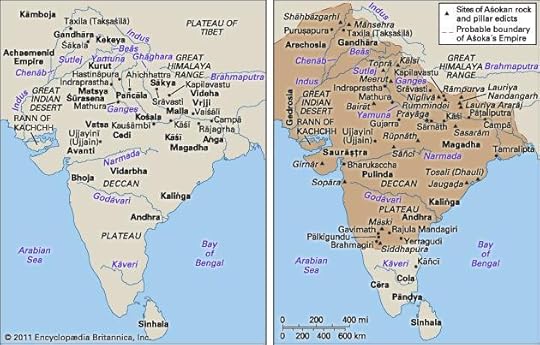
When he had been consecrated eight years the Beloved-of-the-Gods, the king Piyadassi, conquered Kalinga. A hundred and fifty thousand people were deported, a hundred thousand were killed and many times that number perished. Afterwards, now that Kalinga was annexed, the Beloved-of-the-Gods very earnestly practised Dhamma, desired Dhamma and taught Dhamma. On conquering Kalinga the Beloved-of-the-Gods felt remorse, for, when an independent country is conquered the slaughter, death, and deportation of the people is extremely grievous to the Beloved-of-the-Gods, and weighs heavily on his mind. - excerpt from the 13th Major Rock Edict of Ashoka ()
The legendary Indian ruler Ashoka Maurya (Aśoka, 304–232 BCE) - if one is to believe some of these legends - made the transition from the slaying of ninety-nine of his one hundred brothers during a war of ascendancy and the construction of a "Hell" in which he had people tortured by refined and unspeakably cruel means he had learned during a little sidetrip to the real Hell, to a sudden conversion to Buddhism and transformation to perfect Goodness. Is there enough scientifically founded evidence to try to determine who the actual Ashoka was? And even more interesting to me, what does one know about Mauryan India during this historically first unification of nearly all of greater India?
The noted Indian historian Romila Thapar (b. 1931), a specialist in ancient India, has drawn the ire of certain of her compatriots because she has objected to re-writings of Indian history that she claims to have been motivated more by religious, ideological and political reasons than by factual ones.(*) Her opponents have called her a Marxist, but there is no sign of that ideology in this carefully scholarly text in which she must comb through unreliable, incomplete sources shot through with legends, which she relates for the reader to contrast the often widely disparate versions and then to deconstruct them.
Ashoka was the third and in important respects the greatest member of the Mauryan dynasty, founded by Ashoka's grandfather, Candragupta, who had encountered both Alexander the Great and Seleucus I during their attempts to conquer India.(**) On the advice of his remarkable advisor, Kautalya (whose great text of statecraft, Arthashastra, has survived and is an invaluable source for many aspects of Mauryan India), Candragupta set up a highly centralized bureaucracy that impinged on nearly all aspects of social and economic life in the empire, at least in principle. Ashoka's father, Bindusara, was apparently a great conqueror and significantly increased the expanse of the realm. Thapar carefully dates Ashoka's coronation to 269-268 BCE after a nearly four year interregnum of war with his brothers for the rule. After his ascent to power, the sole war of Ashoka for which we have solid evidence - the Kalinga War in 260 BCE - was a source of deep regret for him (see the above quote from one of his edicts carved into stone). It would appear that he renounced war thenceforth.
What he did instead was to promote religious tolerance and social responsibility in an attempt to meld an empire of many peoples, religions and cultures into a harmonious whole (ultimately failing, at least in the latter goal). One of the ways in which he did so was to have moral "edicts" carved into pillars and stones all over the empire in the local languages and regularly read out to the people. Ashoka's extant edicts are translated in an Appendix and are strongly infused with a Buddhist respect for all life and with appeals for tolerance. The very embodiment of the enlightened ruler, he travelled throughout the realm preaching the Dhamma and listening to the problems of the people. He also promoted the spreading of the Buddhist Word to other countries, called the (for Buddhism extremely important) Third Buddhist Council together, and endowed the Buddhist infrastructure. An ancient ruler who held a vast empire together not by force but by moral suasion is indeed noteworthy, particularly since his suasion was based on respect for all living beings and not on threats of horrible afterlives for transgressors.
Thapar ties Ashoka's views and actions into his social, political and economic context, and it is her nuanced description of this context (insofar as it can be reconstructed at this time) that is the main point of interest for me in this text and has helped me to begin to understand the foundations of the unique Indian social structure. Though the beginnings of the caste system were pre-Mauryan, there was still a great deal of social mobility prior to the rise of the Mauryas. It was during the Mauryan dynasty that the ramification into finer and finer castes and the crystallization of the caste system preventing any movement between the castes really started, despite the fact that none of the important Mauryan monarchs were followers of the mainline brahmanical religion. Though Thapar writes that Ashoka's political and social vision failed to hold the empire together long after his death, the nearly thirty years of peace during his reign, the extensive construction of roads and the trade-facilitating empire-wide administration set up by the Mauryas spawned an era of economic growth that lasted well after the collapse of the unwieldy empire. She ends the book with a brief overview of the rapid decline and end of the Mauryan dynasty during the half-century following Ashoka's death.
The text of the original version of Aśoka and the Decline of the Mauryas published in 1961 is supplemented with an updated bibliography and an extensive Afterword that brings the text up to the stand of 1997. I am very favorably impressed with Thapar's scholarly balance and clarity of expression and have already started another of her books.
() Piyadassi is one of Ashoka's names. The Dhamma (Dharma) is the Way or Law of the universe for Buddhism and Hinduism, very roughly speaking, at least ordinarily. But Ashoka appropriated the word to denote also his own Buddhism-inspired view of social order, which he promoted in his edicts.
(*) Signs of such ire even here in GR, noticed by accident: a certain "Ruchi" one-starred at least five of Thapar's books in one day. Really? Let me say in advance that anyone making an ad hominem attack on either the author or myself in any thread of mine will find their comment deleted and themselves blocked permanently. I just underwent such an attack because of my recent discussion of Abu Nuwas' "transgressive" poetry and find I have no tolerance for it. If you have scholarly objections, fine, but since I have read almost none of Thapar's sources, even in translation, I am in no position to engage in a meaningful response. Just so you know.
(**) The report of the encounter with Alexander has been questioned, and the encounter was of no particular significance anyway. But Candragupta (known to the Greco-Roman world as Sandracottus) and Seleucus I definitely met in a war which resulted in Seleucus ceding the Greek possessions in greater India in return for a huge number of war elephants he then used to defeat most of his Greek competitors for Alexander's empire. One of the things I have learned over the past few years is just how closely linked the ancient world actually was.

January 27, 2023
Ashoka was the greatest king of the Maurya dynasty in ancient India. India is a bit of a blank spot in English historiography, surprisingly so since the region was occupied by Britain for over a century and they did the first serious scholarship on it. But since they left English scholarship has dried up (embarrassment?) while it is difficult to get a handle on Indian scholarship without diving deep into the original languages. The majority of books that get translated into English seem to be of the (complete rubbish) Hindu nationalist type, and while these are certainly popular within India I know for a fact that there are also a lot of serious scholars out there. They’re just not getting translated. So if you want to get a feel for Ancient India you have to turn back to the 1960s when respected historians like Romilla Thapar were still able to reach a broad English-language audience. The book has been updated since then, but only in an afterword and the original text remains largely that of the 1961 edition. You just have to take what you can get.
The coverage of the book is somewhat unexpected, although it wasn’t obvious until near the end. From the title you assume this is a biography of Ashoka and his time. This is in fact the core focus, but not the overall one. Only the second and fifth chapter are focused on Ashoka specifically. This is expected to a degree – biographies of ancient figures (even kings) are too short on private details to truly capture their subject’s character so they usually tell of their reign instead and something of their intents and motivations. But even by those standards the focus is odd – Ashoka is dead by the end of chapter five and the final two chapters cover the Mauryan decline and fall. Not what you expect in a biography. This book then is more of a look at the Mauryan Empire than any one king. Yet this isn’t quite true – we get only limited detail about the beginning of the empire and Chandragupta’s founding of the dynasty. So it’s a sort of 50/50 thing – half biography, half dynastic history. I think it would have been better as one or the other. My personal preference (given the limited data) would be for it to have served as a guide to the Maurya rather than just one king. It’s halfway there already.
One thing I’ve come to appreciate (if that’s the right word) about Indian history it’s that every assertion is dubious and needs qualifying. The need to constantly refer to rival interpretations is historiographicaly sound, it’s just massively confusing. I like source analysis much as the next guy, but you have to build on something. Introductory texts are notoriously light on source criticism and scholarly debate, and for good reason: the purpose of an introductory text is to, well, introduce you to a period. You take in a lot of disputed facts as truth to build yourself a picture of how the society works and only when this general sense is firm do you start looking into and questioning how you know. Without that sense of understanding beneath your reading it’s all just a blur of names and facts. A said this, but B said that, and Scholar 65 suggested we need to take this figuratively. A foundation made of sand. This book does the best it can, but it has to be admitted that it is not necessarily aimed at the absolute beginner. There is only a barebones discussion of Chandragupta and the founding of the Maurya dynasty and knowledge of Buddhism/Brahmanism (or Hinduism) is pretty much taken for granted. You may want to check out her other book, Early India: From the Origins to AD 1300 to get some background on what’s going on here.
Because of the lack of historical material (we have literally no Indian sources from Ashoka’s time apart from his rock edicts and maybe part of a book written down 500 years later) the book relies a lot on a few specific sources. There is also much use of comparative material. Some of this is useful. Megasthenes is the only contemporary who wrote about Mauryan India and so a look at his preconceptions and views is naturally vital. But the other main figures are Constantine and Charlemagne. My problem with this isn’t so much that they are bad choices for comparison but that this reflects an outdated approach to history. Constantine the Great and Charlemagne (Charles the Great) were chosen because they were both “Greats” and therefore have much in common with Ashoka the Great. This is in keeping with the Great Man school of thought which holds that history is just an account of great men. Great Men are assumed to shape the course of their societies and determine the path their civilization follows. This was a popular view in Victorian times and was just beginning to crumble entirely at the time this book was written. Now Thapar is not ignorant of the problems with this view. In fact, she has a sophisticated understanding of how far an individual can change society at all. As she sees it, Great Men become titans of their age not by opposing historical trends but by embodying them. Nonetheless, I feel it is still entirely the wrong question to ask and that better conclusions might be drawn from the study of cultures and society. For example, as in Ashoka’s rock edicts, the Romans banned social organizations wherever they could because they feared a rival source of power arising. This seems a much more reasonable source of comparison than Charlemagne banning the Saxon’s freedom of assembly after their conquest.
If Constantine must be the comparison there are better examples to be found. As near as I can tell, all of her references come from two biographies: Richard Winston’s Charlemagne (1954) and Jacob Burckhardt’s The Age of Constantine the Great (1853). The latter in particular is vastly outdated. Looking to the original sources or then-current scholarship might have yielded more compelling results. Many of Constantine’s laws were written in a moralizing tone not dissimilar to Ashoka’s. For example:
The book itself is relatively short at just over 200 pages, but it is followed by a string of appendices and, most importantly, an afterword. Rather than alter what was in the book to bring it up to date with modern scholarship, this edition chose to put a wide-ranging discussion of post-publication discoveries in the field at the end. Reading this it is quite clear that a new biography of Ashoka is badly needed and that it would be very different from this one which is based almost solely on textual evidence. There is fifty pages(!) of material here and that merely represents a summary of what others had found. A detailed archaeological survey which could tell us more about Ashoka’s time and the environment he found himself it would form the core of any new book on the Maurya. So far as I know none exists in English.
You’re not exactly overwhelmed with choices when it comes to books on the Maurya, so that alone means that this book is probably worth reading. Despite some of my equivocating this book does do a lot to explore what Mauryan society was like and what Ashoka’s goals were. I never doubted the author’s scholarship or obvious good sense. On the whole the book did a good job of outlining what I have always found to be a murky era.
The coverage of the book is somewhat unexpected, although it wasn’t obvious until near the end. From the title you assume this is a biography of Ashoka and his time. This is in fact the core focus, but not the overall one. Only the second and fifth chapter are focused on Ashoka specifically. This is expected to a degree – biographies of ancient figures (even kings) are too short on private details to truly capture their subject’s character so they usually tell of their reign instead and something of their intents and motivations. But even by those standards the focus is odd – Ashoka is dead by the end of chapter five and the final two chapters cover the Mauryan decline and fall. Not what you expect in a biography. This book then is more of a look at the Mauryan Empire than any one king. Yet this isn’t quite true – we get only limited detail about the beginning of the empire and Chandragupta’s founding of the dynasty. So it’s a sort of 50/50 thing – half biography, half dynastic history. I think it would have been better as one or the other. My personal preference (given the limited data) would be for it to have served as a guide to the Maurya rather than just one king. It’s halfway there already.
One thing I’ve come to appreciate (if that’s the right word) about Indian history it’s that every assertion is dubious and needs qualifying. The need to constantly refer to rival interpretations is historiographicaly sound, it’s just massively confusing. I like source analysis much as the next guy, but you have to build on something. Introductory texts are notoriously light on source criticism and scholarly debate, and for good reason: the purpose of an introductory text is to, well, introduce you to a period. You take in a lot of disputed facts as truth to build yourself a picture of how the society works and only when this general sense is firm do you start looking into and questioning how you know. Without that sense of understanding beneath your reading it’s all just a blur of names and facts. A said this, but B said that, and Scholar 65 suggested we need to take this figuratively. A foundation made of sand. This book does the best it can, but it has to be admitted that it is not necessarily aimed at the absolute beginner. There is only a barebones discussion of Chandragupta and the founding of the Maurya dynasty and knowledge of Buddhism/Brahmanism (or Hinduism) is pretty much taken for granted. You may want to check out her other book, Early India: From the Origins to AD 1300 to get some background on what’s going on here.
Because of the lack of historical material (we have literally no Indian sources from Ashoka’s time apart from his rock edicts and maybe part of a book written down 500 years later) the book relies a lot on a few specific sources. There is also much use of comparative material. Some of this is useful. Megasthenes is the only contemporary who wrote about Mauryan India and so a look at his preconceptions and views is naturally vital. But the other main figures are Constantine and Charlemagne. My problem with this isn’t so much that they are bad choices for comparison but that this reflects an outdated approach to history. Constantine the Great and Charlemagne (Charles the Great) were chosen because they were both “Greats” and therefore have much in common with Ashoka the Great. This is in keeping with the Great Man school of thought which holds that history is just an account of great men. Great Men are assumed to shape the course of their societies and determine the path their civilization follows. This was a popular view in Victorian times and was just beginning to crumble entirely at the time this book was written. Now Thapar is not ignorant of the problems with this view. In fact, she has a sophisticated understanding of how far an individual can change society at all. As she sees it, Great Men become titans of their age not by opposing historical trends but by embodying them. Nonetheless, I feel it is still entirely the wrong question to ask and that better conclusions might be drawn from the study of cultures and society. For example, as in Ashoka’s rock edicts, the Romans banned social organizations wherever they could because they feared a rival source of power arising. This seems a much more reasonable source of comparison than Charlemagne banning the Saxon’s freedom of assembly after their conquest.
If Constantine must be the comparison there are better examples to be found. As near as I can tell, all of her references come from two biographies: Richard Winston’s Charlemagne (1954) and Jacob Burckhardt’s The Age of Constantine the Great (1853). The latter in particular is vastly outdated. Looking to the original sources or then-current scholarship might have yielded more compelling results. Many of Constantine’s laws were written in a moralizing tone not dissimilar to Ashoka’s. For example:
License is granted to no person, indeed, contrary to good morals, to appropriate the property of the living or to divide such property.The language of laws like this is preachy and pedantic in the extreme, but we know from other sources that Constantine did not always comport himself in a moral manner – most notably when he had his wife and son executed, which happened less than a year before this law was issued. Hypocrisy is hardly a modern curse. Examples like this serve as a useful check on how seriously we should take pronouncements like this. I see no reason to doubt either man believed in what they said, but while laws and edicts may express ideals they do not reflect the full reality. Ashoka promoted his vision with far more regularity and passion, which may suggest a more sincere conviction than Constantine whose theology was always a little spotty and who was more interested in God’s role as bringer of victory anyway, but it seems likely that Ashoka was just as capable of violating his stated principles when it suited him. Autocrats are like that, and studies of political autocracy in general might help. If comparisons must be made, Theodosius I is an interesting one. He ordered the audience of a chariot race massacred but when confronted by St. Ambrose of Milan he repented and submitted to public penance for his act. If seeking historical parallels for Ashoka’s behavior this seems the place to start. One has to wonder whether any Buddhist monks served as Ambrose to Ashoka’s Theodosius.
The book itself is relatively short at just over 200 pages, but it is followed by a string of appendices and, most importantly, an afterword. Rather than alter what was in the book to bring it up to date with modern scholarship, this edition chose to put a wide-ranging discussion of post-publication discoveries in the field at the end. Reading this it is quite clear that a new biography of Ashoka is badly needed and that it would be very different from this one which is based almost solely on textual evidence. There is fifty pages(!) of material here and that merely represents a summary of what others had found. A detailed archaeological survey which could tell us more about Ashoka’s time and the environment he found himself it would form the core of any new book on the Maurya. So far as I know none exists in English.
You’re not exactly overwhelmed with choices when it comes to books on the Maurya, so that alone means that this book is probably worth reading. Despite some of my equivocating this book does do a lot to explore what Mauryan society was like and what Ashoka’s goals were. I never doubted the author’s scholarship or obvious good sense. On the whole the book did a good job of outlining what I have always found to be a murky era.

August 11, 2012
"Ashoka and the Decline of the Mauryas" by Romila Thapar is outstanding work of historical analysis & interpretation. She has dissected the available evidence on the subject with a clinical precision not seen in the study of humanities. That she has also been able to add an element of thrill and suspense in her narration, is also unparalleled. Its a MUST READ book.

November 16, 2021
My second and last book in the Maurya empire series. Before reading this title, I had finished Chandragupta Maurya and his times by RK Mokehrjee.
Asoka and the decline of the Mauryas by Romila Thapar is a detailed look at the Maurya empire and especially Asoka's reign over entire India. The book is divided into different chapters on the Mauryan empire and how Asoka ran it with an insightful look into economics, governance and the policy of dhamma.
Thapar concludes the book by placing a portion of the blame for the decline of the Maurya empire on Asoka. She writes that it was due to Asoka's caste-based policy's which resulted in the Maurya empire being thrown off by the Shunga empire.
I believe that the two books which I have read on the Maurya empire have greatly increased my understanding of the Indian region and has provided me with more reasons to understand and love history.
Asoka and the decline of the Mauryas by Romila Thapar is a detailed look at the Maurya empire and especially Asoka's reign over entire India. The book is divided into different chapters on the Mauryan empire and how Asoka ran it with an insightful look into economics, governance and the policy of dhamma.
Thapar concludes the book by placing a portion of the blame for the decline of the Maurya empire on Asoka. She writes that it was due to Asoka's caste-based policy's which resulted in the Maurya empire being thrown off by the Shunga empire.
I believe that the two books which I have read on the Maurya empire have greatly increased my understanding of the Indian region and has provided me with more reasons to understand and love history.

May 27, 2026
An exhaustive treatment of Ashoka and the Mauryan empire from one of the leading historians of the country. It is always a delight to read the work of a master. Even a cursory look at the long list of footnotes and references suffice to support the claim of erudition. And she has chosen an apt subject to apply her supreme analyzing skills. Every Indian knows about Ashoka in one form or another. Most of us have heard about him through childhood legends while some has read about his times in history. Still another set might have wondered how the national symbol of India came about in the present shape. In any case, the tradition of Ashoka transcends centuries of history and still touches the Indian psyche. Professional historians from abroad had also been mesmerized by his legend and left wonderstruck at the unique aspects which are not witnessed anywhere. Have you ever heard of a king expressing remorse at the terrible bloodshed and dislocation caused to virtuous people in a battle he had actually won? This book answers several questions in the minds of enthusiasts and provides material for further research into the old king’s story.
Thapar develops history into the nature of science. She begins with historiography, the method by which later historians make out a logical sequence of events from available data. Ashoka was a prolific issuer of edicts in the form of rocks and pillars, the remains of which still exists. Being a pragmatic ruler he employed scripts which are comprehensible locally, even when the language was Prakrit, a popular form of Sanskrit. Brahmi and Kharoshti scripts are used at many places. In the North West, which possessed a mixed population of Greeks and Persians, owing to the invasion of Alexander the Great hardly half a century earlier, the language of inscription was Greek and Aramaic. The edicts were usually a manifesto of the king as he declared it to his subjects rather than decrees. However, the historians are never certain whether Ashoka always practiced what he preached. Another source of information are the Buddhist texts compiled around the period, most notably Dipavamsa and Mahavamsa of Sri Lanka and the works of Taranatha of Tibet. India’s first ever historical text, Kalhana’s Rajatarangini composed in the 12th century in Kashmir also contains brief mention of the ancient emperor. However the Buddhist texts follow a fixed pattern of demonizing Ashoka before his conversion to the faith and beatifying him after it. They call him Kamashoka for his lust, Chandashoka for his cruelty and Dharmashoka when he followed the Buddhist path. One thing is certain from all these tomes. Ashoka was indeed a hardy ruler during the initial stages of his reign. Fratricidal warfare is mentioned in the struggle for the throne. It is equally certain that there was no overnight conversion after the Kalinga war as is made out in popular accounts. His change was gradual and without doing away with his imperial obligations which sometimes demanded violence or coercion. The historian has an unenviable task of separating wheat from the chaff by going about carefully with a sieve on the available texts.
A lengthy discussion on the economy and polity of the Mauryan state is presented but almost all of it taken from Arthashastra. Apart from references in some edicts and quotations from Megasthenes’ Indica there is no other work to rival Kautilya’s masterpiece on statecraft. Thapar’s handling of the subject is masterly and illustrates the rudiments of many modern institutions taking shape during Ashoka’s enlightened reign. Mauryan administration and foreign policy is also commendable, the most noted success of it evident in Sri Lanka. Though it is clear that Buddhism in Lanka preceded Ashoka, it was during his reign at Magadha that he could persuade Tissa, the ruler of the island kingdom to embrace the religion through a mission by his son/brother Mahinda.
Ashoka’s rock and pillar edicts constitute an archaeological curiosity in the form of establishing literary continuity over two millennia. The script has charged but only in form. The rules of combining vowels with consonants remain the same and illustrates the umbilical cord shared by the modern Indian languages with the matriarch of them all, Sanskrit. The author painstakingly goes through each edict and brings out the significance of each and the neat pattern in which all of them mesh together. The edicts tell the story of a broadminded monarch illuminating the path of Dhamma (which may loosely be translated as righteousness in English). But Ashoka’s Dhamma is not that of Buddhism, even though he was an ardent adherent of the religion. In a path breaking initiative that was to serve as a beacon to the multi-ethnic, multi-religious and multi-linguistic conglomeration that crystallized as modern India, Ashoka propounded the path of tolerance and introduced Dhamma which he distilled out from the essence of all sects prevailing in his kingdom. He was not a puritan in the sense that he didn’t advocate impossible goals. Slaughter of animals was proscribed in the edicts, but elsewhere the king accedes to the killing of two peacocks and a deer daily in the royal kitchen, with a caveat that such practices must stop in the near future. Ashoka’s Dhamma was well suited for the socio-political transition that was going on in Magadha. Pastoral nomadism was giving way to rural agriculture and the social tensions engendered by agglomeration of people in villages and towns could only be addressed through the all-encompassing mantle of Dhamma. We may note here the word Dhamma is a Prakrit version of the Sanskrit term Dharma. Thapar skillfully assesses the geographic extent of the Mauryan Empire which reached its zenith under Ashoka by the presence of edicts. In the North West, it included Taxila and in the rugged South, we may suspect that it girdled all the provinces judging from the awe-stricken tone exhibited by Tamil inscriptions of the period.
Thapar’s assessment of the reasons behind the empire’s downfall in uncharacteristically wide off the mark and displays lack of focus and anachronistic assignment of reasons. The dynasty lasted barely 50 years after Ashoka’s death. The reasons include a highly centralized administration falling into the hands of weak rulers, foreign aggression in the form of Bactrian Greeks from the North West, resentment among Brahmins as a direct result of the state policy of patronizing Buddhism and public insurrection owing to a very high land tax of 25%. The most astonishing fact is that Thapar assumes lack of national awareness and the non-development of the idea of the superiority of the state over that of king. This is incomprehensible coming from an eminent historian of the stature of Romila Thapar. The concept of states or nation was far ahead in future and there is no way the Magadha of 200 BCE could get stimulated by post-Renaissance European concepts of the 1700s CE. The reasons cited are so broad based that if we take the historian’s argument at face value, we also have to accept the same justifications for the downfall of any reign in ancient or medieval history.
The book is a hoard of information comprehensively collected from numerous sources. Six appendices provide immense value to the narrative and give a detailed translation of every edict issued by Ashoka. The book was originally published in 1961 and a thoughtful ‘Afterword’ summarizes and brings the reader up to date on the progress obtained in the intervening period. Maps and monochrome plates provided along with the text is highly appreciated in terms of utility. Kautilya’s Arthashastra is a priceless document in learning about the Maurya period, but controversies exist between scholars regarding the historical date of the tome. Thapar subjects this to a careful analysis in one of the appendices. What can be summarized in a nutshell is the vivid image of Ashoka as a man that is conveyed to us through the edicts and mentions in contemporary texts.
The book is thoroughly recommended.
Thapar develops history into the nature of science. She begins with historiography, the method by which later historians make out a logical sequence of events from available data. Ashoka was a prolific issuer of edicts in the form of rocks and pillars, the remains of which still exists. Being a pragmatic ruler he employed scripts which are comprehensible locally, even when the language was Prakrit, a popular form of Sanskrit. Brahmi and Kharoshti scripts are used at many places. In the North West, which possessed a mixed population of Greeks and Persians, owing to the invasion of Alexander the Great hardly half a century earlier, the language of inscription was Greek and Aramaic. The edicts were usually a manifesto of the king as he declared it to his subjects rather than decrees. However, the historians are never certain whether Ashoka always practiced what he preached. Another source of information are the Buddhist texts compiled around the period, most notably Dipavamsa and Mahavamsa of Sri Lanka and the works of Taranatha of Tibet. India’s first ever historical text, Kalhana’s Rajatarangini composed in the 12th century in Kashmir also contains brief mention of the ancient emperor. However the Buddhist texts follow a fixed pattern of demonizing Ashoka before his conversion to the faith and beatifying him after it. They call him Kamashoka for his lust, Chandashoka for his cruelty and Dharmashoka when he followed the Buddhist path. One thing is certain from all these tomes. Ashoka was indeed a hardy ruler during the initial stages of his reign. Fratricidal warfare is mentioned in the struggle for the throne. It is equally certain that there was no overnight conversion after the Kalinga war as is made out in popular accounts. His change was gradual and without doing away with his imperial obligations which sometimes demanded violence or coercion. The historian has an unenviable task of separating wheat from the chaff by going about carefully with a sieve on the available texts.
A lengthy discussion on the economy and polity of the Mauryan state is presented but almost all of it taken from Arthashastra. Apart from references in some edicts and quotations from Megasthenes’ Indica there is no other work to rival Kautilya’s masterpiece on statecraft. Thapar’s handling of the subject is masterly and illustrates the rudiments of many modern institutions taking shape during Ashoka’s enlightened reign. Mauryan administration and foreign policy is also commendable, the most noted success of it evident in Sri Lanka. Though it is clear that Buddhism in Lanka preceded Ashoka, it was during his reign at Magadha that he could persuade Tissa, the ruler of the island kingdom to embrace the religion through a mission by his son/brother Mahinda.
Ashoka’s rock and pillar edicts constitute an archaeological curiosity in the form of establishing literary continuity over two millennia. The script has charged but only in form. The rules of combining vowels with consonants remain the same and illustrates the umbilical cord shared by the modern Indian languages with the matriarch of them all, Sanskrit. The author painstakingly goes through each edict and brings out the significance of each and the neat pattern in which all of them mesh together. The edicts tell the story of a broadminded monarch illuminating the path of Dhamma (which may loosely be translated as righteousness in English). But Ashoka’s Dhamma is not that of Buddhism, even though he was an ardent adherent of the religion. In a path breaking initiative that was to serve as a beacon to the multi-ethnic, multi-religious and multi-linguistic conglomeration that crystallized as modern India, Ashoka propounded the path of tolerance and introduced Dhamma which he distilled out from the essence of all sects prevailing in his kingdom. He was not a puritan in the sense that he didn’t advocate impossible goals. Slaughter of animals was proscribed in the edicts, but elsewhere the king accedes to the killing of two peacocks and a deer daily in the royal kitchen, with a caveat that such practices must stop in the near future. Ashoka’s Dhamma was well suited for the socio-political transition that was going on in Magadha. Pastoral nomadism was giving way to rural agriculture and the social tensions engendered by agglomeration of people in villages and towns could only be addressed through the all-encompassing mantle of Dhamma. We may note here the word Dhamma is a Prakrit version of the Sanskrit term Dharma. Thapar skillfully assesses the geographic extent of the Mauryan Empire which reached its zenith under Ashoka by the presence of edicts. In the North West, it included Taxila and in the rugged South, we may suspect that it girdled all the provinces judging from the awe-stricken tone exhibited by Tamil inscriptions of the period.
Thapar’s assessment of the reasons behind the empire’s downfall in uncharacteristically wide off the mark and displays lack of focus and anachronistic assignment of reasons. The dynasty lasted barely 50 years after Ashoka’s death. The reasons include a highly centralized administration falling into the hands of weak rulers, foreign aggression in the form of Bactrian Greeks from the North West, resentment among Brahmins as a direct result of the state policy of patronizing Buddhism and public insurrection owing to a very high land tax of 25%. The most astonishing fact is that Thapar assumes lack of national awareness and the non-development of the idea of the superiority of the state over that of king. This is incomprehensible coming from an eminent historian of the stature of Romila Thapar. The concept of states or nation was far ahead in future and there is no way the Magadha of 200 BCE could get stimulated by post-Renaissance European concepts of the 1700s CE. The reasons cited are so broad based that if we take the historian’s argument at face value, we also have to accept the same justifications for the downfall of any reign in ancient or medieval history.
The book is a hoard of information comprehensively collected from numerous sources. Six appendices provide immense value to the narrative and give a detailed translation of every edict issued by Ashoka. The book was originally published in 1961 and a thoughtful ‘Afterword’ summarizes and brings the reader up to date on the progress obtained in the intervening period. Maps and monochrome plates provided along with the text is highly appreciated in terms of utility. Kautilya’s Arthashastra is a priceless document in learning about the Maurya period, but controversies exist between scholars regarding the historical date of the tome. Thapar subjects this to a careful analysis in one of the appendices. What can be summarized in a nutshell is the vivid image of Ashoka as a man that is conveyed to us through the edicts and mentions in contemporary texts.
The book is thoroughly recommended.
March 23, 2021
Authoritative text on Ashoka
After reading this book it remains no mystery why Romila Thapar is counted amongst foremost historians of ancient India. It is a scholarly work on demystifying Ashoka as a ruler and a person, and also reconstructing Mauryan history during his reign.
Ashokan edicts form the backbone of Dr. Thapar's research for this book. These are suitably supported with textual and archeological evidences. Scientific approach is followed in the historical reconstruction that provides the account fair objectivity enabling it to largely stand up to multiple scrutinies in the 60 years following it's publication.
Other than the main body of work; prelude, afterword and appendix are most relevant and provide additional depth and understanding to the overall context.
It should also be highlighted that this book is a scholarly work dealing in detail with historiographical aspects of studying history, thus making it a difficult read for some enthusiasts who are not accustomed to serious commentaries on history. Therefore, a certain background understanding of early India, and specially of Nandas and Mauryas, will be helpful in this regard.
Overall it is a book par-excellence extremely interesting and thoroughly researched which was hard to put down till it was finished.
After reading this book it remains no mystery why Romila Thapar is counted amongst foremost historians of ancient India. It is a scholarly work on demystifying Ashoka as a ruler and a person, and also reconstructing Mauryan history during his reign.
Ashokan edicts form the backbone of Dr. Thapar's research for this book. These are suitably supported with textual and archeological evidences. Scientific approach is followed in the historical reconstruction that provides the account fair objectivity enabling it to largely stand up to multiple scrutinies in the 60 years following it's publication.
Other than the main body of work; prelude, afterword and appendix are most relevant and provide additional depth and understanding to the overall context.
It should also be highlighted that this book is a scholarly work dealing in detail with historiographical aspects of studying history, thus making it a difficult read for some enthusiasts who are not accustomed to serious commentaries on history. Therefore, a certain background understanding of early India, and specially of Nandas and Mauryas, will be helpful in this regard.
Overall it is a book par-excellence extremely interesting and thoroughly researched which was hard to put down till it was finished.

November 4, 2015
Too academic
April 25, 2020
Read this well researched book on Aśoka and his contributions during Mauryan Empire with subsequent decline. The book is written by famous historian Romila Thapar. The book is divided into 7 chapters which focuses on Background, Society, Economy, Policy of Dhamma, Internal Administration, Later Mauryas and Subsequent Decline. It has aptly differentiated Aśoka's personal life as a devotee of Buddhism and his public life as an emperor which got overlapped wrongly in other texts. Further his policy of Dhamma is beautifully anlayzed. Dhamma in early years acted as binding force for the public with its emphasis on tolerance and non-violence.
The author has also critically analyzed the Major and minor rock edicts issued by Aśoka, Arthashastra, Dipavamsha, Aśokavadana, Rajataringini, writings of Megasthenes, Huan Tsang , Fa Hein and others to come to conclusion that Mauryan period during rein of Aśoka had provided stability to society. This was possible through centralised administration, reasonable taxation, religious tolerance, and promotion of trade. Further its major causes of decline were weak rulers, overcentralised administration, forceful implementation of Dhamma policy. A must read book for those who want to understand rein of Aśoka and Mauryan Empire to the fullest.
My Ratings: 9.8/10
#booksconnectus
The author has also critically analyzed the Major and minor rock edicts issued by Aśoka, Arthashastra, Dipavamsha, Aśokavadana, Rajataringini, writings of Megasthenes, Huan Tsang , Fa Hein and others to come to conclusion that Mauryan period during rein of Aśoka had provided stability to society. This was possible through centralised administration, reasonable taxation, religious tolerance, and promotion of trade. Further its major causes of decline were weak rulers, overcentralised administration, forceful implementation of Dhamma policy. A must read book for those who want to understand rein of Aśoka and Mauryan Empire to the fullest.
My Ratings: 9.8/10
#booksconnectus
January 11, 2024
Knowing researched history related to the extraordinary and important personalities of any nation, who can be appropriated or misappropriated for socio-political purposes, is necessary. This not only helps one to understand the past but gives a perspective for current. Distorted history when fed for politics and to the young mind, with lack of interest in curiosity plus the practical constraints in life for an average citizen to find out alternative narrations, is corrupting the society. Since the subject of the book is an extraordinary Indian king, the risk above is contemporary and of much relevance in Indian context. The book is a wealth of knowledge to travel in distant past, know Asoka the man as a human being and as monarch. And in the process, to provoke the quest to question and probe many other ancient texts including the Hindu religious writings. Books like this must be read and somehow made more accessible.

July 12, 2019
Excellent work! Exemplary!! The author has done commendable research and awe-inspiring critical analysis of Mauryan and post-Mauryan era. It is one of a kind research of a time about which very less information is available and whatever is available is scattered. The author has my utmost respect for researching through all texts and accumulating them in one place and analyzing that era from all the perspectives.

March 30, 2025
Really liked this book. It’s not meant for the average reader, mind you, but for the serious student of history. And for them, it really packs a punch. Romila Thapar does a great job of taking very fragmentary evidence and piecing together something coherent. She argues against rival theories and presents her own with clarity and cogency, and in the process presents a vivid portrait of a king who lived many many centuries ago.

August 13, 2020
She had ignored many Buddhist and Sanskrit source regarding Ashok reign.
Selective writing ...
Selective writing ...
May 2, 2021
Good
December 26, 2023
Not able to read

February 11, 2025
This book is more about Ashoka than the decline of the Mauryas. If you can't get enough of Ashoka, you'll get a lot out of the book.
Want to Read
June 21, 2015Is it possible to read a book online?
Read
November 25, 2015good
This entire review has been hidden because of spoilers.
Read
September 11, 2016want to read it
Displaying 1 - 18 of 18 reviews