In an exploration of modern existential experience unparalleled in the history of art, Edvard Munch, the internationally renowned Norwegian painter, printmaker and draftsman, sought to translate personal trauma into universal terms and in the process to comprehend the fundamental components of human existence: birth, love and death. Inspired by personal experience, as well as by the literary and philosophical culture of his time, Munch radically reconceived the given world as the product of his imagination. This book explores Munch's unique artistic achievement in all its richness and diversity, surveying his career in its entire developmental range from 1880 to 1944. The comprehensive volume features a lavish selection of color plates, an introduction by Kynaston McShine, Chief Curator at Large at The Museum of Modern Art, and essays by Patricia Berman, Reinhold Heller, Elizabeth Prelinger, and Tina Yarborough, as well as in-depth documentation of Munch's art and career. It will accompany the most extensive exhibition of Munch's art in America in three decades.
Kynaston McShine (born 1935) is a Trinidadian-born museum curator. In 1966, as curator at the Jewish Museum, he organized the first museum survey of minimalist art, Primary Structures (1966 exhibition). At the Museum of Modern Art, where he became associate curator in 1968, he initiated the innovative Projects series and has organized some of the museum’s most important exhibitions, including the early survey of conceptual art, Information (1970); exhibitions of Marcel Duchamp (1973), Joseph Cornell (1980), and Andy Warhol (1989); The Museum as Muse: Artists Reflect (1999); Edvard Munch: The Modern Life of the Soul (2006); Richard Serra Sculpture: Forty Years (2007). He has held positions in the MOMA's Department of Painting and Sculpture as Associate Curator, 1968–71; Curator of Exhibitions, 1971–84; Senior Curator, 1984–2001; Acting Chief Curator 2001-03 and Chief Curator at Large, 2003-2008. In 2003, McShine was the recipient of the CCS Bard for curatorial excellence.
A decade ago, I bought this catalogue in the museum shop of the Munch Museum in Oslo, and read it straight away. Then I put it on one of the endless bookshelves in my art section, and forgot it, until I went to see La Bohème in the Stockholm opera with my family and was immersed in a stage transferred from Paris to Stockholm, from unidentified bohemian artists to known Scandinavian men like Strindberg, Munch, and Grieg.
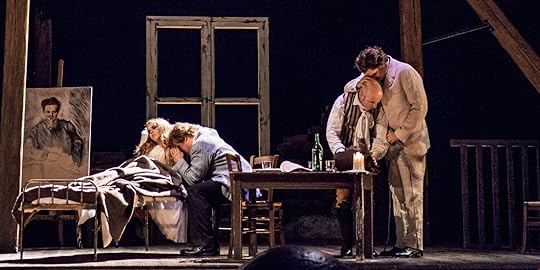
The excellent performance was enhanced by the local interpretation of the characters, and it was a delight to realize my children recognized the Munch portrait of Strindberg and could relate it to his stormy, emotionally unstable character. Puccini's music, the singers' strong rendering of the dramatic lyrics, all the drama of the opera was made visible, almost physically tangible, by the overlarge backdrop consisting of giant Munch paintings.
The loneliness of the modern poet or painter, the pain of poverty and crushed dreams, the isolation from other human beings despite a desperate longing for community and meaning, it all played out in a auditory, visual, dramatic and sensual Gesamtkunstwerk.
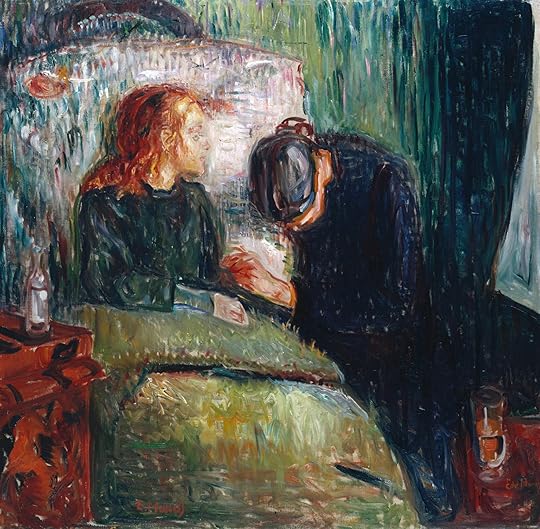
So after the opera, we took out this catalogue and realized just how close the opera interpretation stuck to the Munch universe. Mimi's dresses were influenced by his portraits of ladies. Strindberg and Munch himself were accurately modeled on painted male bohemians. The sick child, existing in endless variations, was shown on stage in Mimi's last pose.
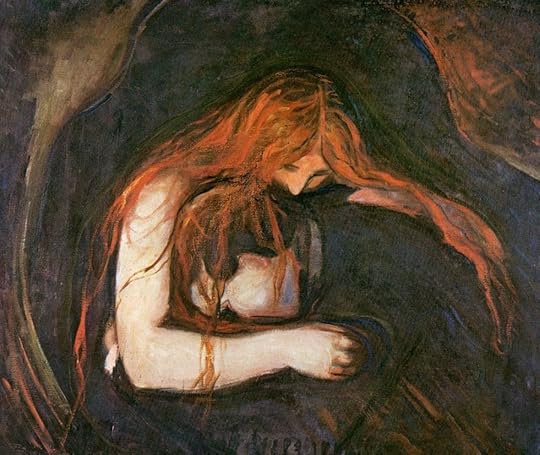
The scream of despair - in the voices of the singers - echoes through the streets of Stockholm, where solitary, angry, jealous men fight the modern demons in art. The Stockholm opera version of La Bohème shows Edvard Munch painting his mistress as a vampire on stage, and to find the original in the catalogue puts art and life into a fruitful relationship, telling the story of male-female love and antagonism in several layers at the same time: the sung words, the orchestra music, the art - all adding to the experience of life drained of blood, as symbolized in Mimi's illness as well.
Art creates art, life copies it and is copied, in an eternal circle of art(life). The ugliness of bohemian poverty, as described in Zola's The Masterpiece, is rendered in perfect realism in Munch's visual panorama of the time, and just like Zola, or Strindberg, he gets under the surface of things, and describes the psychological development of modern madness in facial expressions, gestures and emotive colours and lines.
Sometimes I wonder why I keep buying catalogues and essay collections in museums, as they often remain untouched on shelves for years afterwards, but my experience with Munch on stage confirms the erratic dialogue with art that needs to be spontaneously revived whenever it happens to be fed by new experience. My children were babies and toddlers when we visited the Munch Museum, and their wish to go there after the impressive exposure to his art as a highlight of the Puccini opera is partly due to the fact that they were able to spend time with this catalogue, comparing details in the reproduced paintings with the props, backdrops and costumes in La Bohème.
Oslo is too far away for a day trip, so our Saturday will be dedicated to a Stockholm collection of Munch in Thielska Galleriet, where Munch's Despair, the main theme from the opera, will be a highlight:
I guess we will pass by Strindberg's corner of Stockholm as well.
It took me quite a while to find a decent monography on Munch, including high quality pictures and information. Granted, it's not a monography as such, but it is a stunning publication with a wealth of information that one does not drown in - quite exceptional. The essays are relevant, the comments on the paintings are to the point and enhance the enjoyment of browsing through Munch's work. I'd recommend it to anyone, fans or sceptics alike.