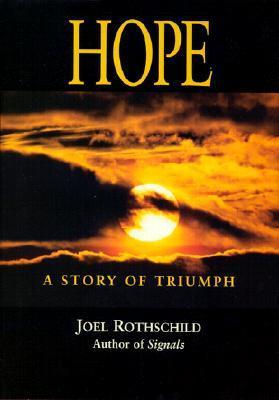
On the morning of April 22, 1986, Joel Rothschild was rushed to the hospital suffering from AIDS-related pneumonia. From that day, his life became a weary and surreal maze of experimental drug trials, support groups, memorial services for lost loved ones, opportunistic infections, and hospital stays. Through all of this, Rothschild refused to succumb to what he saw so many of his peers fall victim to: the stigma of AIDS, the emotional isolation, or worst of all, the final end of suicide.
Instead, he chose to live as simply as possible, continually trying to see beyond fear and self-sabotaging thoughts to what each day brought. Rothschild gained hope and strength knowing he'd survived so much loss and physical suffering, growing more confident with each bout of depression or illness he overcame.
The power and inspiration readers will take away from Hope comes from knowing how he has survived when millions of others have not. In his arduous process to "re-join the land of the living, " Joel realized that physical suffering and pain is a circumstance that will always come to an end. We can choose to escape it, however it is only by meeting this suffering head-on that we will truly see our life as a wondrous existence and know peace.
-- The miraculous journey beyond fear of one of the world's longest living AIDS survivors -- A noted activist and talk-show guest, Rothschild received the prestigious TV Cares Award from the National Academy of Television Arts and Sciences in 2001
Scratching the Surface of the Divine - An Interview with Joel Rothschild By Alina Oswald
Article originally published in A&U Magazine--America's AIDS Magazine.
Joel Rothschild is the longest AIDS survivor, activist, and bestseller writer. In 2001, he received the Ribbon of Hope Award for philanthropic work related to AIDS. In 2000, his first book, Signals, reached the number one place on Amazon.com.
Diagnosed with full blown AIDS on April 22nd, 1986, a time when little was known about this fatal disease, Joel Rothschild was faced with two choices - to close his eyes, let go and die, or to fight AIDS one day at a time and survive. He chose to live and, almost two decades later, he survived his doctor's prognosis, his friends and peers, and learned to live a positive life.
Hope, his second book, is his story triumph over the devastating, terminal disease. It is Joel's personal lesson on positive living and cherishing life as a gift, a lesson he chooses to share with his readers. Hope is a powerful book, an inspiring and, most of all, a real story that covers Joel's struggle with the disease and his continuous fight to survive AIDS through belief and acceptance, gratitude and forgiveness. Hope is an inspirational story, a model of positive living for everybody facing challenges in life, a read I'll remember for the rest of my life.
Still, I have to know where he found those "droplets of hope" to move on, the strength to change his life for the best and survive.
"I've been asked this question by doctors more than a hundred times," Joel explains. "On the 22nd of April, 1986, I had ten T-cells, was given a life expectation of six months. By then, life expectancy was less than a year." Joel's voice is warm and welcoming. "You ask me how I survived ... " Wearing jeans and shirt, he relaxes into a comfortable armchair. "For many years I didn't know what the answer was. I survived my lover, my friends and peers. When I read Victor Frankl's Man's Searching for Meaning I recognized an internal optimism. I never see the glass half empty, I always see it half full."
I sit face to face with an AIDS patient, who's been given the so-called death sentence some seventeen years ago. Yet, there is no sign of the disease. His passion for living reflects into his warm eyes. The "internal optimism" he describes so clearly in his book vibrates into his voice.
"I learned very early in AIDS to live in the moment." His face relaxes from a smile. "The magic is in two things..." As he explains, Joel comforts Billy in his arms.
First, is the optimism he talks about in Hope, the living in the moment, learning forgiveness, and gratitude. The second is a balance between seeing the "ray of sunshine" at all times, and the medicines.
"I've always taken the medications," Joel says, "I'm on Fuseon now and a firm believer in medical care."
The AIDS diagnostic marked the beginning of Joel's spiritual transformation. Recognizing "internal optimism" he reached an elevated spiritual level as he just started to "scratch the surface of the Divine," to connect to his "higher self" and to God.
The way Joel Rothschild survived AIDS is a valuable model of living a positive, peaceful life while suffering from a terminal disease. His example extends to each one of us, sick or healthy. He learned to let go of the self-sabotage while focusing on the positive. From very painful opportunistic infections, Joel realized the value of living in the moment and remaining at peace. He discovered that physical pain doesn't have to translate into emotional suffering, that all in life have a meaning, a purpose, that doesn't always have to feel right.
"I have survived several deadly opportunistic infections," Joel explains, "internal Kaposi's sarcoma, meningitis."
Both Billy and Gerttie, the two enthusiastic terriers, now rest peacefully in their master's arms. A sense of serenity envelops the bright living room, filled by the round intonations of Joel's voice.
"I think you can't underestimate the value of living in the moment and letting go of the self sabotage," he says. "Those things are as important as any medication. You will not survive unless you believe you'll survive."
Joel's words remind me about Doctor Peter Anton's, M.D forward to Hope. He talks about "psychoneuroimmunology," a new area of fighting AIDS, a new field investigating how attitudes, beliefs, mind sets influence the body and health outcomes. I wonder if it can also be used in the fight of other fatal illnesses.
Joel absolutely agrees. "The way that I survived AIDS is advantageous to any terminal illness," he says, "and it's a better way to live your life, even if you are not sick. If you can't eliminate the stress and find peace, you can't survive."
During his seventeen years of surviving with AIDS, Joel tried different medications and volunteered for several experimental drugs. He survived them all. Since 1986, many advances have taken place in medicine because of AIDS/HIV research. What about a vaccine, a cure?
Joel believes in the possibility of a vaccine, "one day, for people HIV negative." There's hope in his eyes. "It's well worth researching."
Throughout the interview and in his book, Joel talks about the importance of living in the moment. Yet, he has plans for the future. He continues to help others, work as an AIDS activist, and to write. Also, currently, he is working on a third book. How does he do it? How does he balance staying in the moment, with his dreams and goals?
"It's a good question." Joel offers me something to drink. He needs to drink something, to take his medication. "You can stay in the moment and still have goals," he explains.
We agree that is good to have goals, hope, and aspirations in life. But aspirations are different from expectations. If we don't reach the expectations in life, we become fearful and guilty, depressed.
Joel believes that the more we can stay in the present, the stronger we become. "Anxiety, fear, depression, guilt are deadly with AIDS, they are the direct result of not living in the moment," he explains, "more deadly than any disease."
There's never been a one hundred percent fatal disease. AIDS is. Joel is its one percent anomaly, its survivor. But every terminal disease has its own one percent survivor. Survivors. He'd met some of them. Their secret to survive, like his, is optimism, hope, and acceptance.
By reaching "true optimism" and healing through forgiveness, Joel "scratched the surface of the Divine" and learned how to live a positive life. Can we do the same? How?
Many people believe that the only way to learn is beating their heads against the wall. Some, though, learn from others' experiences. Joel favors the learning by example.
"I've tried to capture seventeen years of death, disease, suffering and loss in a short book. It's my dream that people would read it and learn from it without suffering." I can hear the passion in his voice and see the optimism in his eyes. "I certainly believe that people who've just become positive will read my book." He suggests other readings, Victor Frankl or someone else's who experienced death and loss. Or go to a cancer ward. "You'll learn to value what you have," he concludes.
AIDS/HIV is a taboo issue most people prefer to ignore, thinking it can never happen to them. It can happen to anybody. People, in general, need to become more aware of this pandemic.
"Each time we share our truth, we change the world." Joel's face looks determined. "I have been open and honest about the HIV status from first day. I think it is very important and healthy."
The story of a man with AIDS living to the highest potential of the human spirit. Very uplifting and wise book, but as a Christian it left me wishing the author would experience the Holy Spirit who could take him even further than the human spirit.