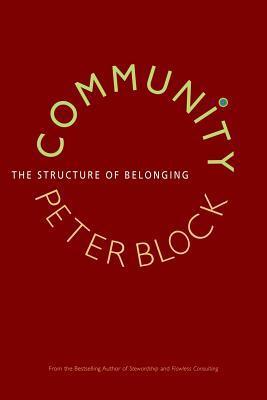
Finally got round to reading Peter Block's Community after a number of people I know working in the fields of community building and organisational development recommended it. In Community, Block tries to answer the question of how we might build connection and community from a state of fragmentation, where our "business, schools, social service organizations, churches, and government operate mostly in their own worlds. Each piece is working hard on its own purpose, but parallel effort added together does not make a community. Our communities are separated into silos; they are a collection of institutions and programs operating near one another but not overlapping or touching". Electronic connections and other technologies may provide benefits such as diverse information, convenience and contact, but these "do not create the connection from which we can become grounded and experience the sense of safety that arises from a place where we are emotionally, spiritually and psychologically a member". (Just think of how ordering your groceries online saves you a trip to the store but reduces your contact with the butcher, cashier etc.).
I can see why so many people recommended the book to me; Block provides useful conceptual frames and techniques to build connection and community amongst individuals. But what made this more of a three and a half star rather than a four star read for me is that his slightly crunchy style, his way of using words, didn't resonate with me. (In the same way that I sometimes roll my eyes with the turns of phrase that Brene Brown uses). Phrases like "each step has to embody a quality of aliveness" (to be fair, Block was citing the work of Christopher Alexander here but the fact that he reproduced the phrase is noteworthy) made my high T brain wince slightly.
But there were many points that did resonate, or at least, provoke a rethinking of existing mental models on community building approaches?
First, that systems are not the right starting point to build community. Citing John McKnight's work, Block argues that "[organised, professionalised] systems are capable of service but not care'. He notes that in the "professional world of service providers, whole industries have been built on people's deficiencies. Social services and most of medicine, therapy, and psychology are organised around what is missing or broken in people." However, this view of people, as problems to be solved, diminishes their capacity; McKnight's work on Asset Based Community Development argues that in order to build community, we need to focus on people's assets and gifts, not their deficiencies.
Block notes that "the conventional approach to community building and development is to create programs, blueprints and funding to keep us safe, keep us working, keep us housed and healthy. Every city has thousands of institutions, programs, and agencies all committed to serving the public good." Yet, that fact that we still see fragmentation suggests that this approach isn't working.
Instead, it is what McKnight terms "associational life", where groups of people voluntarily choose to build connections for their own sake, that can build community and deliver care. And associational life stems from citizens themselves choosing to build connections for their own sake, sometimes for coffee, but sometimes for a common purpose. Whether in clubs, associations, informal gatherings, special events, or just on the street or at breakfast, neighborly contact constitutes "an uncounted and unnoticed glue and connection that makes good communities work". It is in associational life that "creating connectedness becomes both an end and a means", whereas for systems, building connection would be a means and not an end in itself. (Block notes that ironically, associations are under constant pressure to be more corporate: to merge, become more efficient, submit to greater accountability, etc.) Not that there isn't a role for systems like business, government and social services - Block notes that we do need systems to deliver certain outcomes. But they are "not essential to community transformation."
Referencing David Bornstein's work, Block argues that sustainable change in the community starts not via a government or large system sponsored programme, but from small scale, ground up efforts that slowly grow until they achieve a level of scale that touches large numbers of people. Top down efforts invariably start with clear outcomes, pre-determined steps to achieve those outcomes, and an emphasis on producing "quick wins". But these do not produce lasting results.
Instead, it is "the small group [that] is the unit of transformation." Block suggests that we can only create "social fabric [and social capital]… one room at a time." That community building "occurs in an infinite number of small steps, sometimes in quiet moments that we notice out of the corner of our eye. It calls for us to treat as important many things that we thought we incidental…The key to creating or transforming community, then, is to see the power in the small but important elements of being with others. The shift we seek needs to be embodied in each invitation we make, each relationship we encounter, and each meeting we attend."
Block argues that the challenges for community building is that while "visions, plans, and committed top leadership are important, even essential, no clear vision, nor detailed plan nor committed group leaders have the power to bring this image of the future into existence without the continued engagement and involvement of citizens. In most instances, citizen engagement ends when the plan is in place. The implementation is put in the hands of the professionals".
Building community therefore requires changing our context (i.e. our mental models) and structure of how we engage with each other. Shifting from a mindset of identifying problems to one of exploring possibilities, from a mindset that focusses on deficiencies to one that focusses on gifts and potential, shifting from a stuck, retributive community to a restorative one, from law and oversight to social capital and "chosen accountability", from the dominance of systems to the centrality of associational life.
In practical terms, this means not treating citizens like "cases" or passive followers but letting them drive the agenda. Block argues:
"The political agenda of the stuck community says that citizens and employees are incapable of monitoring themselves and controlling each other, and that more careful oversight, institutionally mandated and installed, will build community and provide for the common good. It is in fact an argument against building community. It ends up leaving us more dependent on security specialists and professionalized control.
…We speak endlessly, both in the public conversation and privately, about the rise and fall of leaders. The agenda this sustains is that leaders are cause and all others are effect. That all that counts is what leaders do. That leaders are the leverage point for building a better community. That they are foreground, while citizens, followers, players, and anyone else not in a leadership position are background. This is a deeply patriarchal agenda, and it is this love of leaders that limits our capacity to create an alternative future. It proposes that the only real accountability in the world is at the top. They are the only ones worth talking about. The effect of buying into this view of leadership is that it lets citizens off the hook and breeds citizen dependency and entitlement…If we keep engaging citizens in this traditional way, then no amount of involvement will make a difference. The way we currently gather has no transformational power."
The role of leaders, Block argues, is not, as we have traditionally conceived, to shape and drive the agenda. When it comes to the material world, Block acknowledges that our traditional notions of leadership and hierarchies work quite well. Civil servants are generally well trained at providing public services and delivering on public infrastructure like roads, economic development, master planning. But when it comes to human systems - like building the social fabric of the community, our traditional hierarchies and notions of leadership fare less well. Governments organise townhalls and meetings but these platforms fail to encourage citizens to connect with each other or "be engaged as productions of the future. Citizens [instead] show up as critics and consumers". Instead, leaders need to see their role as creating the conditions for civic or institutional engagement - to convene and design gatherings. Where these gatherings are not about "explanation, persuasion, and problem solving, rather than engagement", but on "creating the experience of belonging" and on "communal possibility". Block asks "how many conferences, summits, and events have we attended where the small group discussion is relegated to the breaks and thereby left to chance?"
Block notes that the conventional definition of citizenship, which focusses on the act of voting and the promise to uphold the laws of a country, is "narrow and limiting". When we think of citizens as just voters, "we reduce them to being consumers of elected officials and leaders". There is no power in this conception of a citizen. What if, Block asks, we were to invert this notion of the citizen and see citizens as the ones who create their leaders? Block gives an interesting example here:
"At the core, police get into a problem when they think they are responsible for public safety - and when this belief is matched by citizens. The police are not responsible for my safety. Citizens who believe that the police are responsible for safety are avoiding their own accountability. Citizens are responsible for public safety; citizens commit crimes, prevent crimes, and create the conditions where crime is high or low. As long as police take responsibility for safety, they are going to stay in a defensive stance, which moves nothing forward. Police are responsible for enforcing the law, apprehending criminals, and mediating or stopping violence. Police are not suppliers of safety to a passive citizenry….[One police chief observed that] for 80 percent of the calls [the police] received, people do not need a uniformed officer; they need a neighbour".
Block further argues that "all transformation is linguistic", which means that community building entails engaging in "a new conversation, one that we have not had before". (However, Block subsequently clarifies that his definition of conversation encompasses not only how we listen and speak but also how we communicate meaning to each other. It therefore includes "the architecture of our buildings and public spaces, the way we inhabit and arrange a room when we come together, and the space we give to the arts'). Instead of a retributive conversation, which breeds entitlement and centres around "what's in it for me"?, might we transform our conversation to one which focusses on creating relatedness and accountability?
Block identifies the kinds of conversation we need, where:
- We experience an intimate and authentic relatedness
- The world is shifted through invitation rather than mandate
- The focus is on the communal possibility
- There is a shift in ownership of this place, even though others are in charge
- Diversity of thinking and dissent are given space
- Commitments are made without barter
- The gifts of each person and our community are acknowledged and valued.
Specifically, Block identifies six different categories of conversation that can contribute to transformation (unlike conventional "just talk" conversations): Invitation, Possibility, Ownership, Dissent, Commitment and Gifts. We create the conditions for such conversation by asking powerful questions.
Block makes a distinction between questions with little power - familiar questions like "how do we get people to be more committed?", "how to we bring people on board?", "how do we get people to change?" - and those that have the power to create accountability and commitment by opening up a different kind of conversation. Like:
- What is the choice you made by being here (Invitation)
- How much risk do you plan to take and how participative do you plan to be in this gathering or project (Ownership)
- What are the crossroads you/we are at that are appropriate to the possibilities of the gathering (Possibilities)
- To what extent do you see yourself as cause of the problem you are trying to fix (Ownership)
- What are your doubts and reservations (Dissent)
- What promises are you willing to make to your peers. What promises are you unwilling to make. (Commitment)
- Why was it important for you to show up today?
- What is it about you or your team, group, neighbourhood that nobody knows (Gifts)
Block rounds off with some points on designing a gathering for connection. He clarifies that starting off a gathering with an ice breaker creates contact but not connection. He suggests max mix groupings to "give people the freedom to be who they truly are" and not who those familiar with them think they should be. Meanwhile, affinity groupings are helpful for planning actions and making promises. Create opportunities for connecting over food. Design the space thoughtfully to emphasise human connection - bringing people close to each other in circles, having movable chairs, finding spaces with windows, having roving mikes so that everyone who wants to speak can be heard (instead of making people line up behind a mike).