Jump to ratings and reviews
Rate this book

The Subsidiary

Rate this book
“Powerful, beautiful, and haunting. Every time I read  The Subsidiary , it feels both timeless and painfully, undeniably contemporary.” —Alejandro Zambra 

In the subsidiary offices of a major corporation, the power suddenly goes the lights switch off; the doors lock; the phone lines go dead. The employees are trapped in total darkness with only cryptic, intermittent announcements over the loud speaker, instructing all personnel to remain at their work stations until further notice.

Terrified, one lone worker uses the implements on his desk to give testimony to the horrors that occur during the days he spends trapped in the building, testimony told exclusively --- and hauntingly --- through the stamps he uses to mark corporate documents.

Hand-designed by the author with a stamp set he bought in an bookstore in Santiago, Matías Celedón's The Subsidiary is both an exquisite object and a chilling avant-garde tale from one of Chile's rising literary stars.

201 pages, Hardcover

First published January 1, 2012

2 people are currently reading
555 people want to read

About the author

Matías Celedón

7 books6 followers

Ratings & Reviews

What do you think?
Rate this book

Friends & Following

Create a free account to discover what your friends think of this book!

Community Reviews

5 stars
37 (10%)
4 stars
76 (21%)
3 stars
136 (38%)
2 stars
72 (20%)
1 star
30 (8%)
Displaying 1 - 30 of 76 reviews
Profile Image for karen.
4,012 reviews172k followers
March 31, 2019
here is the story of me reading this book:

i left my house to run some errands, checking the mailbox on my way out. this book was inside. "hooray!," i exclaimed, "a book for me!" i flipped through it as i walked down the street. "man, this is short," i thought to myself. i began to read the book while walking. i ran three errands: organic store, dollar store, dunkin' donuts, reading the whole time, and by the time i got home - lo! i had finished the book!

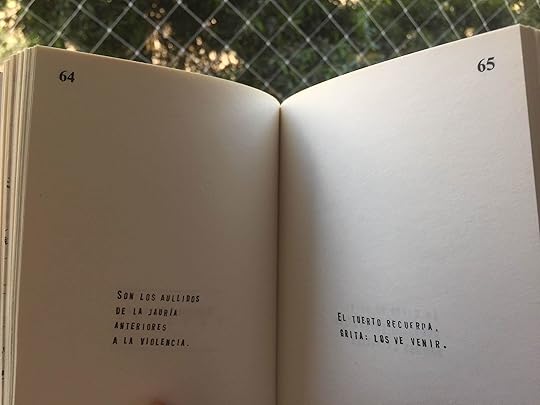
which sounds like i am the most impressive reading-machine ever, but before you start side-eyeing me with thoughts of "cyborg" running through your mind, you should know that this story is written entirely using a stamp set with movable type and the pages look like this:

 photo IMG_5255_zps0br0otjw.jpg

and this:

 photo IMG_5256_zpsqiydhxuh.jpg

and this:

 photo IMG_5257_zps0zeyueii.jpg

but feel free to be impressed with me anyway; i could use the esteem-boost.

now, you may be tempted to cry "gimmick!" on this book, but please hold your catcalls until the end. because while, yes, part of the book's appeal is absolutely tied to its unusual style, to write it off as just an experimental whim would be to underestimate it. i'm not a fan of gimmickry for the sake of gimmickry - i've poo-pooed books who rely on "look at me!" antics at the expense of, you know, telling a story. eyes have been rolled.

but this one isn't all flash - there's a dark haunting quality to it that transcends its novelty. and i admit, it's a bit of a creeper of a book. perhaps because of the circumstances in which i read it, i closed the book and thought, "huh." (not "huh?," but "huh.") but then, i found myself thinking about it later - certain scenes were returning to my mind as i was doing other things, and i reached for it again and gave it a second pass, and then i really started appreciating how much work this book does with so little actual text.

it's a dark surrealistic/absurdist office story - a bit kafka, a bit bartleby, maybe a bit The Room or The Regional Office Is Under Attack!, neither of which i've read, so don't quote me on that. but it's a violent and gruesome brand of surrealism, despite how sparingly the violence is detailed.

it features an unnamed narrator in an unnamed country in latin america who works for an unnamed "major Latin American corporation." it's just an ordinary day until a power outage kills the lights and phones, and, as our narrator records:

 photo IMG_5267_zpsgg6rivbc.jpg

the use of "they" implies a deliberate act and not something connected to the outage, but in any event, the employees are trapped inside the office with no explanation other than periodic announcements that this situation will continue "indefinitely," and the distant sounds of shouting in the streets outside.

which kind of locked-room/no information setup would be the foundation for a great horror novel, like Horrorstör, and it is, but it's not that kind of horror. it's part psychological horror and part historical horror, but only if you're familiar with 20th century latin american history. i'm an american asshole, so i knew nothing about argentina's dirty war until i read The Case of Lisandra P. recently, and was motivated to research the topic. (by which i mean i read the wikipedia page and a few top-result articles in my casual google search - i told you i was an american asshole)

and while this takes place in 2008, more than thirty years after those events, military death squads and their secret assassinations and 'disappearing' of private citizens have a way of lingering in the cultural memory, so as the days of these characters' imprisonment pass without further information, and the attack dogs start appearing, the reader supplies the context and the implications that are as unnamed as everything else in this book.

 photo IMG_5261_zps1stqs2lf.jpg

because it's not just the location or narrator or specific threat that are nameless/undefined - all of the other employees are synecdochically referred to by their sensory or physical limitations: a blind girl, a deaf girl, a mute girl (although she does speak, so draw your own conclusions there), a one-eyed man, a one-armed man, a lame man. even the narrator is himself color-blind. there's also a "boy."

everything in this story is vague, unspecified, hinted-at; what is happening now, what has happened to the narrator in the past, even the narrator's job, when he is asked by the deaf girl, is nebulous:

 photo IMG_5266_zpskx4gya8y.jpg

very little happens at first - people have sex, they look for candles, they steal ink - there's the boredom of waiting, the passage of time marked by the death of a fly.

 photo IMG_5260_zpsyocge1j5.jpg

but once things slip into darker tones, there's no coming back.

 photo IMG_5262_zpsb4fdz0ie.jpg

it often reads like poetry, with a cadence belying the often-horrific events

 photo IMG_5263_zpsjup8q7tz.jpg

even the ending is a slippery thing, but it's no less affecting for that. it's a brief and haunting story that uses a gimmick to get your attention, but it's not resting on that gimmick - it's more atmosphere than narrative, but it's a pretty impressive atmosphere, and the half-hour you spend reading it will give you plenty to chew over.

okay, you may now catcall if you still wish to.

thank you for your patience.

****************************************
how much do i love that this book, written entirely in stamps, arrived at my house in an envelope covered in stamps??

 photo IMG_4103_zpsbzpy2afb.jpg

bunches. i love it bunches.

review to come!

come to my blog!
Profile Image for Deborah.
419 reviews37 followers
June 4, 2016
You don't so much read a book like Matías Celedón's The Subsidiary as experience it, and what a mind-bending experience it is.

As the publisher explains, Celedón hand-designed his book using an old stamp set, individually typesetting the brief text of each page into a stamp and then stamping them himself into the pages of the book. Given its format, it's not surprising that the book's actual word count is very low. What is surprising is how much fear and paranoia Celedón manages to convey in those few words. The reader proceeds through the story with a clenched fist in the stomach, wondering whether the Subsidiary's employees are destined for the same fate as the "desaparecidos," the thousands of their Argentinean countrymen who disappeared during the Pinochet regime.

The book is set in June, 2008, some 35 years after Argentina's "Dirty War," leaving the reader to wonder whether the employees trapped at their work stations in the dark have been stranded by a new military coup (as the use of dogs suggests) or an equally sinister corporate takeover. Regardless of the cause, the employees rapidly lose their civilized facades, reduced to their broken essence: the deaf girl, the lame man, the one-armed man, the one-eyed man, the blind girl, the mute girl, and our unnamed narrator, who once was a bank teller but now stamps "the orders, the instructions, the mandates." But who issues the orders, what are the mandates? All we know is how the narrator describes his job: "I save people." And why are all of the Subsidiary's employees disabled?
The one-eyed man remembers, screams: He sees them coming.
I read The Subsidiary in digital form on my computer, so I can only imagine how much more powerful it will be in its published hardbound form. Whether as a physical artifact or a work of literature, The Subsidiary is a true work of art.

I received a free copy of The Subsidiary from the publisher in exchange for an honest review.
Profile Image for jeremy.
1,204 reviews310 followers
June 10, 2016
on one hand, matías celedón's the subsidiary (la filial) is a cleverly constructed novel(la), yet, on the other, fails to match the promise of its aesthetic appeal. created using a stamp set with movable type, nearly every page features a single sentence 'written' in this analog form. the story itself, however, is too sparsely composed to transcend or overcome the challenges of employing this artistic style.

celedón, a chilean screenwriter, journalist, and author, sets his brief tale within the offices of an unnamed company. following an alert to all employees that the power supply is about to be interrupted, personnel are instructed to remain at the workstations. from there, darkness devolves into violence and uncertainty. while the narrator, using his stamp set to record the goings-on, strives to make sense of the situation along with his office mates (comprised of a deaf girl, a blind girl, a mute girl, a lame man, a one-eyed man, a one-armed man, and a boy), we, too, are left to wonder what actually has transpired.

celedón's tale creates great tension, yet ultimately fails to deliver on its promise. without the creative choice of using the stamp set to frame the story, there wouldn't be much to the subsidiary. it's an interesting narrative choice, certainly, but feels a little too contrived to more fully explore either the style or its effects. nonetheless, the subsidiary, even after a second read, is enjoyable, though leaves the reader (or, at least this reader) wishing celedón would have made more of an otherwise strong premise.
it is impossible to tell apart the animals.
*translated from the spanish by samuel rutter
Profile Image for Nenúfares ☽.
207 reviews8 followers
May 30, 2024
La experiencia de leerlo me recordó mucho a Psicosis de Sarah Kane. No sabemos quienes son los personajes, dónde están, ni por qué, ni el tipo de relación que mantienen entre ellxs. La forma en que está construido el relato (a través de timbres) aporta a la sensación de claustrofobia que acompaña la historia. recomendadísimo.
Profile Image for Biblio Curious.
233 reviews8,254 followers
June 12, 2017
I found this more creepy than House of Leaves. If you like dystopians or 'found footage' films where you only get part of the story. This book is one to be experienced rather than read. The typesetting is extremely efficient.
Profile Image for Helen.
735 reviews106 followers
June 12, 2017
This is an experimental work of fiction/design which describes what happens when there is an extended power outage at an office - the chaos that breaks out, people described as either blind, lame, one-eyed, one-armed, dogs running up and so forth. It's a nightmare scenario - and must be the way the author wishes to express the idea of the sub conscious breaking through when darkness/sleep/night descends - transforming the "orderliness" of the office routine and routine inter-action with co-workers into a violent, and sexual "jungle." The nightmare only ends when the power outage is over - and light (that is, daytime/wakefulness) has returned.

The work can be read in a few minutes, but the reader no doubt will think about what it meant for a while afterwards. The way I made sense of it is as stated above - as a metaphor for the unconscious/night time/sleep vs. consciousness/day time/wakefulness. It's a cute book - but to me,somewhat gimmicky. The idea of conveying the information by means of official looking stamps - as if the world of work has intruded or taken over the unconscious is cute. In fact, when I was working, I would sometimes actually dream of work, even mundane tasks like filing or putting index cards in order. Of course, by now, such mundane tasks have all been automated, but even by the time I finished my work career, some of us (actually, I was just about the last person to still use index cards) still kept track of some things in an analog form. But we were the last of the old timers - since all the info that was in company tel directories or customer index cards, was obviously by the time I left the job (laid off) also available digitally in our computer system. Still it once was common to date stamp incoming correspondence, and so forth. Rubber stamping all sorts of information was once very "satisfying" - I suppose it represented visually that the office was organized and someone was paying attention to information coming and going etc. So the book under discussion transforms the official looking rubber stamp that was once so ubiquitous into brief stamped often disturbing sentences (such as "the dogs are coming" etc.). The veil of the quotidian is ripped off to reveal a seething animal-like layer beneath the "normalcy" - we're told at the end of the book that everyone was still at their work stations, as before, when the power was restored.. so the violent story told via stamps is made-up, a fiction, or perhaps meant to represent a dream state people enter at night when they sleep.
Profile Image for natasha.
286 reviews55 followers
December 22, 2023
Me siento tonta cuando leo este tipo de libros porque no entiendo nada, y lo que interpreto probablemente esté equivocado.

Lo leí de pura curiosidad y sí puedo decir que me gustó harto la propuesta. Me gustó la sensación de pasar las páginas y encontrar distintas variaciones, y que la capacidad imaginativa es grande.

Interesante👍🏻
Profile Image for LG (A Library Girl's Familiar Diversions).
1,293 reviews25 followers
March 31, 2019
I went into this looking for office/corporate horror. I suppose I got that, to a certain extent, but this turned out to be a much more artsy and experimental book than I had hoped for.

The book's gimmick is that it's written/produced using actual office stamps. As a result, each page usually only has about 1-4 short lines of text.

At the beginning, readers are told that this is being written by an office worker at the subsidiary, using only the stamps found around the office. On June 5, 2008, workers are told that there will be a power supply interruption between 8:30 AM and 8:00 PM and that they are to remain at their workstations. The doors are locked, and the phone lines are down. The power outage goes on for a good deal longer than planned, but things at the subsidiary become hellish for the women in only 24 hours, if I interpreted things correctly.

All characters were disabled in some way and were only referred to by their disabilities: the blind girl, the mute girl, the lame man, the one-eyed man, and the one-armed man. The narrator never spoke of himself in the third person, but he'd have been "the colorblind man." I got the impression that the narrator was forced to work for the subsidiary after being diagnosed with colorblindness, but the book's setup forced readers to do a lot of interpretation, so I could be wrong. For example, I disagree with those reviewers who thought that the dogs mentioned in the text were a literal pack of wild dogs running around in the building - I think it was a metaphor for the animalistic behavior of the workers.

While reading this, I was reminded of issue #6 of Neil Gaiman's Sandman, "24 Hours," in which customers and employees in a diner become increasingly animalistic and brutal over the course of 24 hours. However, I felt that Gaiman did it better. Things became nasty pretty quickly in both stories, but in Gaiman's there was a solid reason for it. In The Subsidiary, the reason seemed to be "it's dark and people are scared," but that didn't work for me. In only 24 hours, the narrator was telling the deaf girl to pay for the candle he gave her with sex. After three days, the lame man captured a boy who, from the sounds of things, he periodically raped. (I assumed all instances of "girl" actually meant "woman," since the deaf girl was another employee, but the one instance of "boy" seemed to indicate an underage character, in which case the lame man was a pedophile.)

There were no mentions of any of the practicalities of trying to survive in a building where the power had been cut and the doors locked so that no one could leave - nothing about food, water, restrooms, etc. Instead, the text's entire focus was on the things the characters did to each other, which culminated in one character's death. I'm not sure what Celedón was aiming for, but it didn't work for me on any level.

(Original review posted on A Library Girl's Familiar Diversions.)
Profile Image for Rodrigo Pérez.
Author 18 books184 followers
January 14, 2020
Un libro-objeto que logra con el uso de los sellos burocráticos como elemento de impresión, y la contención lingüística como forma de crear un paisaje siniestro; contar un oscuro pasaje de la historia chilena. Lejos de un afán histórico, Celedón usa los espacios vacíos y las indeterminaciones como potenciadores del horror; pudiendo jugar con elementos del terror o la ciencia ficción, sin caer en obviedades o clichés. Es un libro raro, especial, único (por la elección en su forma de edición) y gratamente incómodo.
Profile Image for audrey.
695 reviews74 followers
October 22, 2016
Confusing, misogynistic and unpleasant, but mercifully short.
Profile Image for Valentina Salvatierra.
270 reviews29 followers
November 12, 2019
Un texto ingenioso que condensa en poquísimas palabras, todas en mayúsculas, un ambiente opresivo que se va tornando ominoso y opresor. La forma del texto se ejecuta mediante "un sello Trodat 4253, con tipos móviles de 3 mm y 4 mm, en dos tablillas de seis líneas con un máximo de 90 caracteres por impresión" (Nota de edición). El uso de un recurso tan banal para contar esta historia tan oscura y confusa es obviamente lo que hace distintivo a este texto, pero no se agota en el gimmick como uno podría sospechar antes de leerlo.

[Un extracto para que se hagan una idea de la forma. Se me hizo especialmente significativo en este momento en Chile, dada la violencia que se ha dado en las calles por más de 3 semanas ya, dados los muchos tuertos que ha dejado el estado de Chile.]

La historia que se narra parte de la cotidianeidad de una oficina, "la filial" misteriosa de giro jamás especificado, y se va volviendo cada vez más macabro. Se asoma la monstruosidad que subyace a la cotidianeidad: cuerpos mancos, tuertos, ciegos, violencia injustificada, animales humanos y no-humanos en extraña convivencia.
Profile Image for Patricio Valenzuela.
70 reviews26 followers
Read
June 24, 2019
No puedo juzgar este libro con estrellas o notas ya que más que una novela o relato es un experimento o un artefacto literario el cual a través de imágenes nos hace navegar por la incertidumbre y esa sensación de ahogo y angustia.
Profile Image for S. Wilson.
Author 8 books15 followers
December 7, 2020
An interesting work of experimental post-modern fiction bordering on poetry in which a bureaucratic desk-jockey imprisoned in an office building during an extended blackout documents his ordeal using desk stamps. If you like your novels unusual, this is definitely for you.
Profile Image for yomara naomi.
158 reviews9 followers
November 23, 2023
Qué libro!

Amo cuando la edición y el contenido van de la mano. Cada página está hecha con la violencia del texto. Un historia a sellazos, a golpeteos.
Profile Image for Julianne (Leafling Learns・Outlandish Lit).
141 reviews211 followers
September 23, 2016
It is impossible to tell apart the animals.


I wanted to like this novella a lot more than I did. Despite being over 200 pages, The Subsidiary took around 20 minutes to read max. That's because each page is no more than a sentence. We've got an experimental format on our hands!! Our main character is an office worker trapped in his building when there's a mysterious power outage. The gimmick? He's writing the book using stamps. So, visually, this book is quite stunning. The story gets a little bit dark, a little bit absurdist. Some weird shit goes down in this Latin American subsidiary office. A lot is unexplained: all of the workers seem to be disabled, there's a child there (??), there's some weird sex stuff. So it seems as if none of us, the readers nor the characters, know fully what's going on. And that's totally fine with me. There just wasn't enough substance to carry the gimmick, in my opinion.

Full review with two others: Outlandish Lit's Quick Reads, Quick Reviews
Profile Image for Susan.
1,699 reviews38 followers
October 14, 2016
This is an easy book to read in one sitting. It took me about 20 minutes. I was intrigued by a story written entirely in desk stamps. It's creative and artistic and the story itself is very weird. I love weird but I feel like I didn't understand a lot that was going on. Apparently it has to do with the local political and social history of which I am embarrassingly ignorant. Without this knowledge the story was ominous and strange but I didn't get why everyone had a disability or what it all really meant. Great concept but it wasn't as compelling as I was hoping.
198 reviews2 followers
September 29, 2016
Eeeeeh, I was excited for this one because of the way it's written in stamps, but it was more confusing than anything I thought. You need to really be willing to think about every line and every possible connotation/symbolism within it, and I wasn't. From what I did grasp it was more real-life horror than spooky stuff that couldn't actually happen, which is not really the kind of horror I wanna read.
Profile Image for Leah (Jane Speare).
1,478 reviews434 followers
June 14, 2016
Soon to be published in English this fall, The Subsidiary is a very unusual read. It's told entirely in memo stamps, which is creative and artistic, but also a bit like poetry. An interesting read, but not quite my type of weird.
Profile Image for Carey.
677 reviews58 followers
September 17, 2016
This is a book that happened. It was adequate and I did not throw up.
Profile Image for Justin Goodman.
183 reviews13 followers
May 19, 2020
If there's any book that evokes the sense that you get what you put into it, The Subsidiary is that book. Concise narration of a hazy experience where office workers are trapped in a corporate subsidiary and quickly devolve, where the narrator stamps "it is impossible to tell apart the animals" upon looking at his coworkers and dogs that had begun hunting them, gives an impression of a sharp critique of dictatorial violence and its relationship to corporate dictatorship. That's both what Minor Literature and Hyperallergic draw on in their reviews. That parses well.

But the other side of this is that this book feels too easy. Not to read. Breezy reads can be brilliant and complex. By easy I mean how familiar and grey both the narrative and characters are. It required reading hype reviews to engage the book because there's a violent plainness to its madness. Which, while being the point, also makes it uninteresting. That the capitalist subject lives in fast and violent times is obvious, and that people give way to the pressures of needs is obvious - even if The Subsidiary comes across as a pastiche of this criticism with how rapidly the crime scene that is this powerless office building develops. It's one of those books that you get what you put into it precisely because it is the kind of book that becomes interesting only after reading other people's takes on it. It's very possible that's a failing on my part. Nonetheless, it barely registered beyond a sense that it parses well.
Profile Image for Alanna McFall.
Author 9 books22 followers
November 2, 2021
Bonus Reading: The Subsidiary by Matías Celedón

List Progress: 32/30

The Subsidiary, a book by Chilean author Matías Celedón, has a very cool premise, one that almost makes it more of an art piece than a novel. A factory has cut off their power and locked all their employees in, and the only way the narrator can tell his story is by arranging the type-set rubber stamps that he usually uses for official documents. Each page only has a few short lines of text, along with occasional illustrations, color changes, or stains (possibly blood, possibly red ink). It is a fascinating concept, a sort of “found text” novel, as much a record of a brutal time as a found footage horror movie. But that same brevity and sketchy nature works against the book having much in the way of actual story.

The workers in the factory are referred to by what various disabilities they have (the blind woman, the mute woman, the one-armed man, ect), which makes them feel more like symbolic archetypes than characters. The plot similarly feels like it has a lot of grand sweeping statements about the nature of man and animals, and little of how people actually behave. Not every story has to be literal, but with an already-abstract format, some grounding with real people would have been nice.

I admire The Subsidiary more than I actually enjoy it. It is a stylistic swing for the fences, and I appreciate when authors try new things, even if they don’t always pay off. And at the very least, it is a very short time commitment, so it is worth the time.

Would I Recommend It: Yes, especially since you can read the whole thing in a fifteen minute sitting.
Profile Image for Julie Mestdagh.
874 reviews42 followers
January 30, 2022
If return on investment in literature were measured by comparing time spent on time spent reflecting on the book compared to time spent actually reading the book, this book would have a very high rating. It being written in "stamps", literally, stamps, allowing for a max amount of letters per page, is read in its entirety in 20 minutes time. I actually read it three times in a row in less than an hour, not only because the lay out and the visuals are so cool (big part of the reading experience), but also because there is SO MUCH told, especially in between the stamps, that you keep thinking and wondering if there is something that you missed. A very peculiar reading experience.
The story ? One day, the office of the subsidiary of a big South American corporate is shut off from power. The employees are informed about this via some info system and are then left to fend for themselves. One of the unfortunate ones decides to document the event by using the stamps he usually uses at work to stamp official documents. This gives a very limited space for the author to work with, yet an entirely different dimension to the book. The story itself is difficult to grasp. Nothing is really explicitly told, so there is a lot of assuming and guessing, but it added to the experience. Having read other reviews, I understand there are references to the political situation in Argentina and the book supposedly suggests another military coup or something of the kind. This makes me think there is a lot more to this book that I simply do not grasp. And yet, it was a fun experience.
Profile Image for Michael Brown.
Author 6 books21 followers
December 24, 2018
I guess this is considered a novel, but it is extremely brief. It consists of stamps on each page so you race through it. It tells the story of a group of individuals trapped in an office building while some kind of chaos reigns outside and the building is in darkness due to a blackout. Everybody lets their guard down and does things they would not ordinarily (hopefully) do under daily conditions. There is a story in these stamps, but not so much that I would recommend anybody purchasing this for full price. It's one of those tricky projects that for this reader is not equal to the sum of its parts. If you want something very brief of this nature, but still an actual novel(la), read Bonsai by Alejandro Zambra.
Still, I'll add it to the count for this year's reads myself, as I spent the ten minutes necessary to get through it.
Profile Image for Janday.
277 reviews101 followers
May 28, 2017
Stuck inside an office building with no power and no escape: a postmodern horror story. This glimpse underneath mundane office life is simultaneously absurd and eerie. Using only office supplies, Celedon, and his narrator, don't so much write a story as create impressions. Like the nameless characters themselves, the narrative is incomplete--damaged. The characters' colossal failures to connect in a humane way remind me of Stanislaw Lem's 1961 bureaucratic nightmare Memoirs Found In A Bathtub. Recommended lunchtime reading.
Profile Image for Sal.
155 reviews4 followers
January 8, 2018
Very, very fast read. I really enjoy the experimental format. Power goes out. Stuck in a building. Write by stamps, candles, flashlight. Where I get a little lost is where all the weird things go down. You have a mute girl, a one-eyed man, a one-armed man, etc. You have roaming dogs. People become animals. Very unusual, short journey.

The book carries well enough in this short of a format, but there's something missing, and it certainly would be far more difficult to make work in a larger format. Cool concept, though.
Author 10 books7 followers
September 22, 2018
I read the english translation of this, I don't know why there isn't a page for that because it is of course going to be different than reading it in Spanish. It's all written in rubber stamps on pages. People at a corporation are locked in and the power goes out. Things go bad, but things are not very clear of what is going on which might be the point but I found it obtuse for obtuse sake. It is a very interesting read none the less. Some the lines are beautiful and the concept of self and identitiy do come across, but it just was too slippery for me to love
Profile Image for Michelle Tackabery.
Author 1 book12 followers
May 16, 2017
I tried so hard to like this book. But honestly, the premise was ridiculous--who has time to type notes (or even print them) on post-its? And the story just doesn't work. It goes too fast and doesn't give one enough sense of the character or characters in the story. I didn't find it avant-garde, amusing, sarcastic, or even haunting. I ultimately found it a complete waste of my time and money.
Displaying 1 - 30 of 76 reviews

Can't find what you're looking for?

Get help and learn more about the design.