Before introducing the modern version of The Sandman, Neil Gaiman wrote this dark tale that reinvented a strange DC Comics super hero in the Vertigo mold. Featuring spectacular art by Gaiman's frequent collaborator, Dave McKean, BLACK ORCHID. After being viciously murdered, Susan Linden is reborn fully grown as the Black Orchid, a hybrid of plant and human, destined to avenge her own death. Now, as this demigoddess attempts to reconcile human memory and botanical origins, she must untangle the webs of deception and secrets that led to her death. Beginning in the cold streets of a heartless metropolis and ending in the Amazon rain forest, this book takes the reader on a journey through secrets, suffering and self-rediscovery.
Black Orchid is more or less the same kind of thing I've come to expect from Gaiman. In other words, if you love his Don'tNeedToExplainEverything style of storytelling, then this will more than likely be a winner with you. I prefer to be told or shown what the author is trying to convey, and quite often I think Gaiman likes to leave things to the reader's imagination a bit too much for my taste. I'm not saying that this story was particularly confusing or that it leaves you hanging when the volume is over, but something about the way it was told just left me wanting more. And not in a good way.
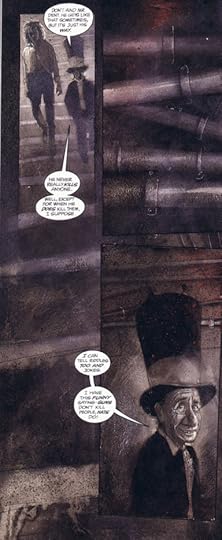
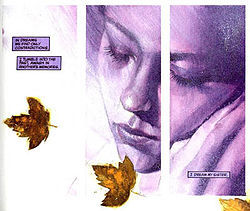
But. I thought the art was stunning. The faces were drawn with so much detail and emotion in them, that it's hard to describe without showing you what I mean.
I know, right?! Whoa!
It starts with the death of the 'original' Black Orchid, a crime-fighter who had been undercover in one of Lex Luthor's companies, and was subsequently killed by his right hand man. Her death triggers the next Orchid's birth, and although she is initially confused, some of the original Black Orchid's memories start to surface.
The majority of the book is Orchid trying to figure out who and what she is, while at the same time trying to avoid being captured by Luthor (he wants to experiment on her) and Susan's ex (he can't stand to look at her).
As a bonus, quite a few characters from the DCU make an appearance, including Poison Ivy, Batman, and Swamp Thing.
I didn't love it or hate it, but I certainly found it interesting. It was cool to read about one of origin stories for the Black Orchid, especially considering she's now popping up in the New 52's Justice League Dark. If you're a fan of Gaiman's graphic novels, I think you'd love this one.
Keep your love beads in your patchouli-reeking denim vest, hippie, this is a super hero comic. Of sorts.
Oh, and the pony tail combined with the receding hair line doesn’t do much for you either.
Neil Gaiman, the guy who writes comics for real smart people (myself not included) tries to re-invent the titled D-list superhero, and bring her kicking and screaming into the “modern” world of comics.
Since Neil Gaiman doesn’t write comics for shallow people like you, does this mean there’s some sort of underlying message here as well, Jeff?
Dig it, unspecified and random Goodreader, you’re more on the ball than I.
The storyline is grounded in the DC superhero universe as the original Black Orchid is murdered (this isn’t a spoiler, it’s on the back cover), but no worries, because a creepy guy who had a lifelong fixation on a girl whose DNA/RNA is patterned into Black Orchid, has a whole green house in his back yard full of copies just like her.
Her replacement doesn’t quite have it all together as she wanders around the DC world looking for answers. That evil bastard Lex Luthor is right behind her. Because he wants to “study” her plant abilities.
She runs into Batman…
…makes a visit to Arkham in order to get answers from Poison Ivy…
…and treks the bayou to say hi to Swamp Thing (who makes her heart sing)
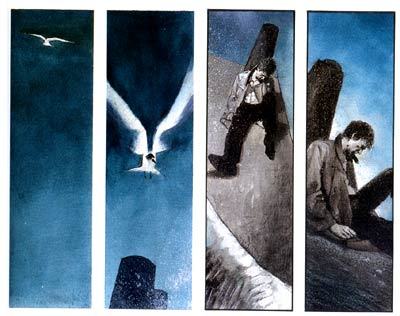
The eye-catching art combines a sort of photo realism with a huge dash of water coloring.
Wow, Jeff, you continue to impress with your vast knowledge of art.
Shaddup!
Even though she’s pursued by evildoers, Black Orchid firmly believes in a non-violent, non-confrontational approach to crime fighting.
Does it work? You’ll have to read this to find out.
Peace out.
Bottom Line : I’ve never read Neil Gaiman, for the simple reason the copies of Sandman at my library have had the volume numbers on their spines erased over time and I’m too lazy to actually pull them out and open them up to see what order they should be read in, so this a Gaiman first for me. My brain feels a little bigger having read this. Am I going to pursue other Gaiman. Maybe. I guess.
In the same (very much) sense that Alan Moore (close friend of Neil Gaiman) re-invented The Swamp Thing character when he took the comic book, in this miniseries, Neil Gaiman re-invented Black Orchid, while he had more latitude to work since Black Orchid, while existing since 1973, it was known very little about the character, and it was until 1988 that Gaiman got the chance to tell the origin of the obscure comic book character.
Black Orchid was a super-heroine which MO was to disguise as a secondary female character in a story, investigating some crime, and even many times, she wasn’t exposed, but just leaving a calling card, while the police was already on the way to arrest the villains.
She appeared in several titles (even the non-canon Super Friends!), but not her original creators (Sheldon Mayer & Tony DeZuniga) nor the other creative teams, shown much about her background, and therefore she was easily one of the most mysterious DC Comics characters.
Due the close friendship of Gaiman with Moore, it wasn’t strange that this miniseries shared some similarities with Moore’s works ((the death of a hero unleashes the story like in Watchmen) and (the nature of the main character is tied to “The Green” (an elemental force of nature) just like in The Swamp Thing)).
However, Gaiman’s goal in the miniseries is a different one, since instead to set in a “real world” the comic book super-hero genre like in Watchmen, in Black Orchid, the target is to go against the usual expected clichés of the mentioned genre…
…therefore, elements like heroes falling into traps, revenge’ issues, climax battles, etc…
…won’t work as you usually expect in a comic book title.
But that’s not a critique but an acomplishment for Gaiman, developing a very mature tale, where you won’t be able to predict where the reading will take you or which known characters will make cameos, but…
…One thing is certain, the exceptional work by the creative team (Gaiman’s words, McKean’s art & Klein’s lettering) won’t going down but soaring here, and yes, the story will grow into you.
And finally, like in The Hobbit, an act of piety can be crucial in the most desperated times.
I haven't read this since it was originally released in the early 90's. Dave McKean provides some of the best artwork of his career.
Gaiman touches on the original Black Orchid before moving onto his own creation. She's a human / plant hybrid of the original and goes on a journey to find out what she really is. I like how unlike later Vertigo comic books, this is grounded in the DC universe. Black Orchid's creator hung out with Poison Ivy, the Floronic Man, and Swamp Thing back in college and she goes in search of them for answers. Meanwhile, Lex Luthor is trying to capture her to dissect her.
Ethereal and poetic as anything else Gaiman has done with beautiful, subtle artwork.
I was prepared not to like this, as I happened to see a reviewer I immensely respect, Sam Quixote, give it two stars (though I also know he dislikes Gaiman, and Gaiman's mentor Alan Moore, though does seem to like another superstar compadre of sorts, Grant Morrison). I see this book, which I had never read, as part of the whole rethinking comics project I associate with Moore in Watchmen, Millers' Dark Knight, and part of this opportunity many took to rethink earlier comic heroes like Moore with Swamp Thing, Morrison with Animal Man.. and this was a little known, minor person, almost unknown, which I take it is a reason Gaiman would have wanted to do it, because he wouldn't be too burdened with all the known history… so this is ala Moore and Gaiman, a mash-up meeting of various superheroes, Arkham Asylum folks, Joker, Harvey Dent, and three "organic" kind of creatures: Swamp Thing, Poison Ivy, and Black Orchid. There are obviously few women comics stories, even now, but here is one, and a pretty good one. The tone is interesting, in part created by the art, of course. This may not be a major story, for true DC fans, but when you have Gaiman as storyteller, and Dave McKean as artist, amazing things can happen, and it is a pretty beautiful thing to behold, in my opinion.
An important example of the re-creation and reimagining of comics by British authors during the mid eighties, Black Orchid combines Gaiman's mythology with McKean's powerful artistic visions in the series which made their careers.
Like Moore's 'Swamp Thing' or Morrison's 'Animal Man', Gaiman was given the opportunity to place his stamp on a pre-existing hero; and like the others, by betraying cliche and embracing a suitably mystic sense of realism, succeeds admirably. (as an aside, Watchmen was supposed to be such a recreation of old heroes, but was dubbed too different from the original; of course, that decision is questionable as Watchmen is the most well-respected comic there has ever been)
From the very beginning of the three chapter series, Gaiman powerfully informs the reader of his intent to leave behind tradition and embark on a psychological exploration of the limits of the genre. This brave errancy is ably illustrated by the higher art aesthetic of McKean's, whose own sense of both magic and realistic depiction provides Gaiman's words an excellent partner.
In this highly experimental attempt, Gaiman does not fall to the usual high-falutin storylines, which is instead replaced with the vague and spiritual. Likewise, his often choiceless, lead-along stories become less recognizable in the emotional and intellectual extremes of Black Orchid.
The story does often move at a vague and paceless rate, and denies the simple morality or causal chain which we are so used to even out of comics. He also moves along a dangerous path: that of the romanticization of ecology and tribal life; however, he does not quite fall to it.
His story is emotional and personal in a way that super hero comics rarely attain, and part of this is because of the absolute denial of standard methods which McKean makes available to him by an alternate artistic representation. If it doesn't look like comics, is it still comics? Gaiman would say yes--so would McCloud--and so do I; but we are all a bit odd for it.
Gaiman also does proud the old comic fan with a score of intertwined heroes and villains of the past, though a reader without the foreknowledge may have to take his word a bit too often. The superior plan is to begin with Alan Moore's aforementioned Swamp Thing before tackling Black Orchid.
Though Sandman will undeniably reign as Gaiman's signature series, it is sometimes preferable to boldly make your 'X' and move along, rather than dither over the serif. In Black Orchid, Gaiman makes his mark.
I've been meaning to read this for a long time. I've never read a comic by Neil Gaiman before but I wanted to. And Dave McKean, who's the illustrator, has done a marvellous job with several of Gaiman's novels so when I saw the cover of Black Orchid I knew I had to have it.
I don't know many details about DC's superheroes but I know Batman and Arkham and Poison Ivy so I was doing fine with the cameos in this comic. Susan / Black Orchid seems to have been fighting crime until her untimely death. However, death was only the beginning. As the title suggests, this story has something to do with flowers and since it's in the same universe as Batman, it's also about superheroes. Sort of (I don't want to give away too much). Apart from that, and this impressed me a lot, "mundane" topics such as domestic violence were also addressed and incorporated seamlessly into a superhero story.
The beginning was very weird and confusing but I realized soon that that was on purpose since it's exactly how the Black Orchid felt herself. Moreover, it also reminded me a bit of Memento. While the plot unfolds, more and more is revealed. There is, however, no actual action in this; no big-ass explosions and lots of fighting by our heroine. Instead, this is a bit of a quiet story. Still with its message and quite unique as far as I can tell and definitely very imaginative but the lack of action might be one reason for the low ratings.
However, the true gem here is the art anyway! Art with a capital "A"! What Dave McKean created here is nothing short of beautiful and mesmerizing. Especially the panels about the greenhouse, the Bayou and later the Rain Forest were stunning and gorgeous, but his depiction of Arkham and people were wonderful too. The colours were vivid and alternated with bleak panels for a more dramatic effect.
So although this was definitely not what I had expected, I enjoyed it quite a lot and am glad I picked it up.
Black Orchid was a very enjoyable read which delved into themes of trauma and revenge. Throughout the novel there were many DC characters that made cameo appearances which I wasn’t expecting at all!! Overall I found it to be a complex and interesting read.
"If anyone else had destroyed a project I could've profitted from like this, they'd currently be trembling under an assumed name in some obscure third-world nation! You...you wake me out of bed to examine your handiwork...and then you ask me for a job!" - Lex Luthor
Brilliantly crafted revival of a forgotten heroine...Black Orchid's chilling walk through Arkham Asylum alone makes this worth reading!
Hands down the most beautiful comic/graphic book I have ever read. The artwork is stunning, and the story is complimentary to it. There are a few familiar characters (Poison Ivy, Swamp Thing, Lex Luthor, Batman etc) but it's is Black Orchid who makes it really worth reading. Though to be honest, the art is so gorgeous I'd probably read it even if the story was crap. Luckily, the story and writing is equal to its illustrations. I'm pretty sure I'm just repeating myself but there isn't really a lot more to say. Read it.
It's hard for me to review comic books and graphic novels because I don't know all the lingo even though I've been reading both on and off for years (Thor comics specifically since at least by my preteen years). My boyfriend knows the shit out of comic books and puts everyone to shame - he knows the lingo, he knows the people, he's collaborated himself with others and done some of his own solo work. He's in the know. I, on the other hand, can converse as far as "This was pretty" and "That was bad-ass".
This graphic novel is pretty. And it is bad-ass.
In the 80s, Neil Gaiman and Dave McKean reimagined the Black Orchid character from DC Comics of the 70s. I don't know all the different connections and relationships the Black Orchid had, but some of the connections I could recognize in this graphic novel made me smile in that super dorky way that happens when anyone feels like they're a part of something cool. Batman? Hey, I know him. Christian Bale, right? (Kidding.)
McKean's art is absolutely spectacular and (sorry, Gaiman fans) I would have enjoyed the shit out of this even without any text (even though the story is also really good). But I am a very visual person anyway, and I am generally attracted to the sorts of colors that filled these pages. So, nothing personal. It's just really purty.
See, I don't know what I'm talking about. Purple, green, blue, some other stuff. Good stuff in these pages. I promise.
This was not on my list to read but I learned of its existence and some GR friends had already read this so I thought I’d give it a go.
The art alone is worth the extra pages. It’s gritty but the realistic faces and picturesque landscapes are beautiful. I really like how intentional the colour palette feels.
This story says a lot without actually saying it. While I don’t typically mind a few poetic phrases and some vague mentioning's, I do prefer more out-right storytelling.
I really enjoyed how connected this felt to the wider DC universe. So many great appearances from, well mainly villains, but other characters as well.
Black Orchid isn’t as well known as Wonder Woman and the like but this was an intriguing story with great visuals.
I’d recommend this if you like beautiful art and want to read about a lesser known DC hero (with a few other cool characters mixed in).
Side note: I love that there are page breaks between issues!
It's kind of adorable to read this because I didn't think it was that great. If I'd started out with this book instead of Sandman, I would've taken some convincing to continue with Gaiman's oeuvre. It's not that I didn't like the story; in fact, I really like how he weaves Batman & Lex Luthor & Swamp Thing & all of that together. It was just a little too vague, a little too much moping by Black Orchid. Too much f-a-all-ll-ing - seriously, once would've been enough for that page layout. But on the other hand, if I'd started with this I would've become even more of a Dave McKean fangirl than I already am, because holy heck, his artwork here is totally breathtaking & it knocked my socks right off.
Neil Gaiman'ın yazdığı, Dave McKean'in çizdiği, Ezgi Keskinsoy'un dilimize kazandırdığı, İthaki Yayınları tarafından basılan "Siyah Orkide" bakış açısı, çizimleri, bir taraftan kendine diğer yandan bilindik başka kahramanların, şeytanların dünyasına dokunan bir evrene ve kurguya sahip. Başladıktan, kurguya alıştıktan sonra elinizden bırakamıyorsunuz. İthaki Yayınları'nı bir kez daha gerek seçtiği eserler gerekse de baskı ve çevirideki ilgi, özen, başarıları için kutlarım.
Black Orchid was since the start on my reading list but I always found something else to read, partly because I did not know much about the character, and everything I knew was not that exciting. That said this was a very nice surprise as this had me really hooked.
The were some things here and there to criticise but nothing too major, it has a very sloooow pace which somewhat fits the theme and might be to the liking of some but compared to today's comic sphere it just feels outdated. Also the tone is extremely realistic and grounded, to the point that it feels more brutal than hellblazer or his other work "sandman", I almost want to say it felt out of place in the DC universe. Again this could be for some people a plus.
I am trying to appreciate graphic novels, but I don't think my visual artistic intelligence works well in combination with my literary intelligence. For one thing, my visual artistic intelligence is severely limited.
I liked the concept of the Black Orchid, like Poison Ivy, one of the familiar DC Comics characters that appeared (as did Batman, Harvey Dent, the Mad Hatter, etc.). However, I think the story was on a deeper level (or trying to be), that I could not appreciate. (How did it all of a sudden become an environmental moral tale with Amazonian "Indians" becoming saviors of nature by their "worship" of the plant-human hybrids?)
Also, the insertion of not-exactly-obscure song lyrics seemed artistically a little pretentious, if their inclusion wasn't meant to be facetious. I expect that kind of thing from a high school senior taking introductory creative writing and philosophy courses from the local community college.
Not my thing but I certainly don't deny the opportunity for Black Orchid to be something great to the right reader.
Malo sam razočaran ovom grafičkom novelom. Očigledno su moja očekivanja bila prevelika - Gaiman, likovi,... A na kraju se svelo na osrednju priču koja teče veoma sporo... I sama Orhideja deluje kao jednodimenzionalna paćenica koja ni sama ne zna šta hoće. Ono što je dobro jesu epizodne uloge Betmena, Džokera,... a celu stvar iz mulja vadi odlična grafika. Kada sve sumiram sve se svodi na neku osrednju trojčicu...
Aura abstrakcyjnego blasku wypływa ze stron tej historii. Połączenie szorstkości codziennego języka, mistycyzmu mowy natury i fenomenalnych, klimatycznych ilustracji tworzy piękną, w pełni satysfakcjonującą całość. Pomimo niepozornej formy komiksu, to opowieść, która skłania do wielu przemyśleń na temat natury świata. Który poświęca dobro w imię naturalnego piękna. Który dąży do doskonałości, uzależniając się od cierpienia. Bo to w cierpieniu świata tkwi jego siła.
Można przeczytać, aczkolwiek spodziewałam się czegoś lepszego. 3⭐
BTW. znowu komiks Gaimana, w której wstęp powinien być posłowiem, ale tym razem nauczyłam się na błędach i przeczytałam go na końcu, więc nie dostałam spojlerów z dosłownie całej historii.
Kada god sam se susrela sa nekim Gejmenovim delom, uvek je bila prisutna neka magična atmosfera, kao da joj čujem melodiju sve vreme dok čitam. Takav je bio slučaj i sa Crnom orhidejom. Ona odudara od nekih ustaljenih i očekivanih okvira, što po stilu crteža, što po samom građenju priče i ličnosti glavne junakinje. Ona počinje stereotipno, kao superheroj koji se bori protiv zla, i onda BUM, biva ubijena bez ikakve nade za spasenjem, ovoga puta, u suprotnosti sa svim stereotipima. Zatim se ponovo rađa u "cvetnoj bašti" svog prijatelja iz detinjstva, naučnika koji je i odgovoran za njeno postojanje u tom obliku, bez sećanja na ono što je bilo, samo sa emocijama koje ne može da protumači. Tako počinje njena priča i tako mi počinjemo da je upoznajemo. Ona ne traga za osvetom ili pravdom, ona traga za spoznajom. Na svom putu sreće mnoge, nama već dobro poznate, likove i oni daju dodatnu draž ukupnom utisku jer su, takođe, prikazani u njima atipičnom izdanju. Još jedna od stvari koje mi se jako dopadaju u stripu je način na koji su različite scene povezane tekstom, nova scena se nadovezuje na tekst iz prethodne i to je toliko prirodno da se čini kao da nikako drugačije ne bi imalo smisla. Ljubiteljima klasičnog stripa ovo možda neće biti dovoljno uzbudljivo, ali od mene najviša ocena.
Crna Orhideja se prvi put pojavila u univerzumu DC-ijevih superheroja 1973. godine, ali je kultni status obezbedila tek 15 godina kasnije, kada su scenarista Nil Gejman i crtač Dejv Mekin uradili trodelni strip koji je nosio njeno ime. Crna Orhideja je, kako u uvodniku tačno primećuje Mikel Gilmor, strip koji je pomerio granice superherojskog žanra. Novine su brojne. Elegični ton i nemogućnost da se predvidi dalji tok događaja su zbunili mnoge poklonike stripa. Iako u Crnoj Orhideji gostuje nekoliko poznatih junaka (Betmen, Otrovna Ajvi, Čudovište iz močvare), strip deluje sveže i drugačije. Gejmanov scenario je hrabar i inovativan. Crtač Dejv Mekin, gost ovogodišnjeg BeoKona, vrhunski je umetnik i njegov prepoznatljiv, očaravajući stil Crnu Orhideju čini nezaboravnim vizuelnim iskustvom. Darkwoodovo deluks izdanje oduševiće kolekcionare i posvećenike. Štampa je vrhunska, otisak i povez su besprekorni, a kao bonus se mogu pročitati prepiska i beleške koje su nastajale pre i za vreme rada na stripu. Uz to, treba pohvaliti nadahnuti prevod/adaptaciju Draška Roganovića.