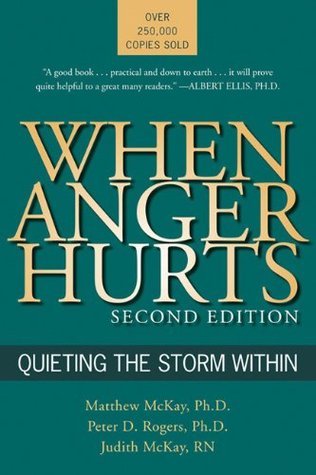
A major revision of the best-selling classic — a quarter of a million copies sold. This new edition of When Anger Hurts is a complete, step-by-step guide to changing habitual anger-generating thoughts while developing healthier, more effective ways of meeting your needs. It includes new chapters on emergency anger control, the interpersonal and physiological costs of anger, road rage, and parental anger. •Discover how to create your own personal intervention strategy for controlling angry impulses •Recognize anger-triggering thoughts and learn ways to challenge them •Learn how to control anger-generating stress •Recognize the early warning signals of anger and find out how to cool down before things get really hot When you work through the exercises and lessons in this book, you will immediately see positive change in every aspect of your life.
Matthew McKay, PhD, is a professor of psychology at the Wright Institute in Berkeley, and author of more than 30 professional psychology and self-help books which have sold a combined total of more than 3 million copies. He is co-founder of independent self-help publisher, New Harbinger Publications. He was the clinical director of Haight Ashbury Psychological Services in San Francisco for twenty five years. He is current director of the Berkeley CBT Clinic. An accomplished novelist and poet, his poetry has appeared in two volumes from Plum Branch Press and in more than sixty literary magazines. His most recent novel, Wawona Hotel, was published by Boaz Press in 2008.
This book teaches you what anger is, why you feel angry and how you can you react differently to anger provoking situations. First thing is to understand that things and people don't make you angry. It is your perceptions of things that make you angry. Just as you CHOOSE to be angry, you can chose not to be angry in a particular situation. Anger is a way to escape the pain of some kind...like fear of rejection, frustration, stess, depression etc. If we chose not to be angry we will have to face the unpleasant things of life and if we do that with alertness we will understand how to deal with them bravely without resorting to anger. The authors also teach how to be more assertive in our communication with people which can reduce the urge to be angry. This book gave me a good insight into my own attitudes and behaviours. I am also able to see what causes people to act angryily and I don't take it personally what they say in anger. We need to take full responsibility of how we feel in order to change anything about our anger. If we blame others for our anger then we make ourselves victims who can do nothing about how they react. The book is precise and teaches a lot not just about anger but also about how can we make ourselves better person living a more fulfilling life.
It has methods of communication that I believe are effective and easy to remember. It has only a few methods to help you stop losing your temper. Still, I found this book effective in helping me to control my temper and see life's occurrences in a different light. I feel that I have better phrases to use when I will need to be assertive and let my needs be known.
The problem I have with the book is that it tells you to forget about your "shoulds" when dealing with other people, as this will help to diminish your anger. For example, getting angry in traffic because someone cut you off. You feel that they should be driving more courteously. The authors would tell you that your thinking is wrong, because the other driver has his own needs to take care of, and his needs are as important as yours. The authors are wrong. In many circumstances of daily life, there is a protocol of behaviour. Some of these protocols are written, and they are called, for example, the law. An example is the expectation that people will stop at a red light. When you are driving through a green light, you presume, let's face it, that the cars going in the other direction are stopped for their red, you do not slow down just before the intersection to ensure that they are truly stopped. Some protocols are simply presumed, for example, that you do not let out a loud, flatulent noise in public. The authors would say that the other person had a need to take care of. My argument is that even with that need, it is still damn rude, wrong, and worthy of my anger.
Also, a flowchart would have been nice to indicate under what circumstances the authors felt this technique or that technique should be used, instead of making the reader determine this on their own.
I really like the approach this book takes. It helps you get out of "victim" mode and get into a "personal responsibility" mode. Basically, you are responsible for your own anger. If your needs are not getting met, you need to find other ways to meet your needs. This book gives several scenarios on how to do so. I very much recommend it for people dealing with past hurts.
It said in the beginning that anger is actually hiding a negative emotion. That in itself was an eye-opener. It made me think about what emotions lie underneath my anger. Then, anger is much easier to deal with or it disappears behind the real emotion that I need to deal with. Another good practical book.
This book is excellent. Many of the concepts and skills seem to be derived from cognitive and dialectical behavior therapy models, which drew helpful connections for me. I found this book very beneficial. The examples are pivotal to the concepts, and they are clear and plentiful. Highly recommended for anyone dealing with anger or an angry person, and anyone simply interested in becoming more skillful in self exploration and interpersonal communication.
If you or someone you know has an anger issue or has been hurt..... read this book. I read it, and am rereading it again... I'm finding greater depth and understanding as a re-read the book
It is tough to admit that one has the issues that this book addresses. It's very good and gives great insight and techniques to calm down and be more level-headed.
If you approach it as the workbook it is and invest the time required to learn and apply the truths within, it may change your life. Its use and application has begun to do so for me.
On the other hand if read, for example, just to read, I predict it will make little difference in your life.
It takes work. Mental and emotional work. The work of being honest with oneself. The work of letting go of how you like to think of yourself and instead seeing yourself for what your behaviors suggest.
That said, the content and applications exercises, were presented in a manner to facilitate my desire to learn and apply.
I found the 1st printing of this book years ago in a halfprice book store. Heaven only knows how many copies I have purchased since them. I have done anger management groups for years as a LCSW, this is the book I use to doing with. I have worked with persons in the criminal justice system, incarcerated, and domestic violence. Anyone can tell people how to count to 10 or leave. But this has helped me teach people WHY and HOW they become angry and how not to let their anger control them.
Parenting can be very tricky under the best circumstances. This book helped me navigate some essential challenges I was having that stemmed from when I was a child myself, and I'm glad to have the tools of this book to reference throughout my own parenting journey.
Highly helpful whether you or someone you love have anger problems. It breaks down common myths about the causes of anger and how to deal it. Useful for anyone—we all are angry sometimes and deal with anger all the time!
I really enjoyed this book it's helped me so much when it comes to my anger and how to deal with it in a positive manner without letting it get out of control or hurt anyone around me, I'm so happy this book came into my possession 😊
A book that everyone should have ready and accessible. Matthew McKay, Judith McKay, and Peter D. Rogers explain the detrimental effects of anger. The book provides exercises that aide gaining control over your anger, and tools to begin healing from learned behavior and anger-addiction. This is a must-read.