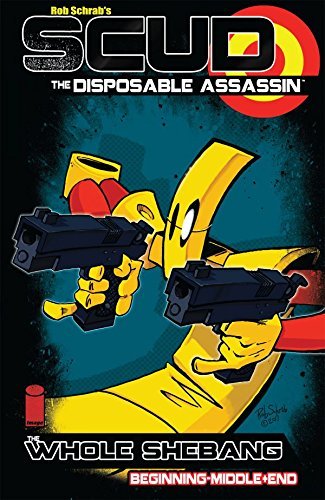
Scud is an interesting little series that starts out rough but ultimately evolves into something complex and interesting. Scud takes place in an absurdist sci-fi future where you can buy robot assassins from vending machines, and they self-destruct upon killing their target. If that sounds a lot like Mr. Meeseeks from Rick and Morty, you shouldn't be surprised to find out that Dan Harmon actually wrote a number of issues early on.
The first four or five issues are a bit rough. There's a lot of "random for the sake of random" going on and while you can get the general gist of what's going on, the early issues are a little too dense to follow and it feels like it tries a little too hard at first. But around issue six, the series pulls back a little and things really take off. The action stays intricate, but becomes easier to follow, the plot gives itself a little more time to breathe, and in trying less hard to be funny it becomes a lot funnier and more endearing. The art is great from the start, but also becomes noticeably cleaner and more expressive around this time as well. Schrab's character designs are consistently excellent and I loved looking at every page of this series. Ultimately, the story grows into something huge and the ending is pretty much a perfect send-off for the series, making for a great ride that won't let you down.
What surprised me the most however, is how much every seemingly random or one-off bit from those early issues actually does come up and start to make sense in retrospect and I expect I'll appreciate them more if I ever re-read the series. Scud's universe, for all the weird anything-goes bizareness that goes on, becomes very tangible. Aside from the people getting assassinated, almost every character becomes a recurring element, and I really grew to love Scud's supporting cast. I think Drywall might be my new favorite sidekick in comics now. Each side character is given a fleshed out, complex life and it's surprising how much depth we get out of them in the 25 or so issues, in addition to Scud's own journey.
While this collection is titled The Whole Shebang, it's not quite every bit of Scud material out there, and Rob Schrab actually includes a note on this being due to printing limitations. Dan Harmon wrote a spinoff about some of the Mafia characters called La Cosa Nostroid and while this series never finished, Issue 6 happens concurrently with Issue 18, and I highly recommend hunting down the issues (The real issues are hard to get but .pdfs are floating out there if you don't mind that). Cosa Nostroid is a fascinating character study, showing how Scud's mafia friend goes from being an eager young upstart to a vicious monster, and it truly feels like a multiyear epic. Even though it ends on a cliffhanger, it's an excellent read and in some ways tells a cleaner tale than the main book. While Nostroid is the only spinoff that affects the main storyline in any way, I'd be remiss not to mention Tales from the Vending Machine, which is a fun series of one-shots each telling about other Scuds taking their targets. Lastly, there was a two-issue series called The Drywall and Oswald Show, which unfortunately never seemed to get to whatever it was building to. It has some fantastic art, but the story you do get isn't that interesting and it's pretty inconsequential.
I actually found out about this series while researching Sega Saturn Light Gun games, and while I never got around to buying the game, I'm glad it gave me the recognition to pick this up. I'd imagine with Dan Harmon having become really popular over the past decade fans may pick this up due to his involvement, and I really hope Schrab does something with Scud in the future. I don't think I'd want more comics, the ending is just too perfect, but I loved my time in this world and I think it would lend brilliantly to an animated series. If you want to get into Scud, this collection will definitely give you what you need to enjoy the story, but definitely check out some of the spinoffs as well. Scud really develops into something intricate and beautiful while maintaining a clear sense of fun throughout. Word of warning though, despite the bright colors on the cover and cute robots, it's not for kids.