

What do you think?

Chariots Of The Gods? Was God an Astronaut?
All over the world there are fantastic ruins and improbable objects which cannot be explained by conventional theories of history, archaeology, and religion.
Why, for instance, do the world's sacred books describe Gods who came down from the sky in fiery chariots and always promised to return? How could an ancient Sanskrit text contain an account which could only be of a journey in an alien craft? Compare photographs of American space centre launch sites to the constructions on the plains of Nazca in Peru.
In order to understand the mysteries which Erich Von Daniken has cataloqued we must go back to these ancient relics with an open mind. We must call in the resources and experience of sciences other than archaeology. Read Von Daniken's classic work and make up your own mind.
Why, for instance, do the world's sacred books describe Gods who came down from the sky in fiery chariots and always promised to return? How could an ancient Sanskrit text contain an account which could only be of a journey in an alien craft? Compare photographs of American space centre launch sites to the constructions on the plains of Nazca in Peru.
In order to understand the mysteries which Erich Von Daniken has cataloqued we must go back to these ancient relics with an open mind. We must call in the resources and experience of sciences other than archaeology. Read Von Daniken's classic work and make up your own mind.
179 pages, Paperback
Published January 1, 2011
About the author
Erich von Däniken
330 books924 followersGreek: Έριχ φον Νταίνικεν
Erich Anton Paul von Däniken (1935–2026) was a Swiss author of several pseudoscientific books which made claims about extraterrestrial influences on early human culture, including the best-selling Chariots of the Gods?, published in 1968. Däniken was one of the main figures responsible for popularizing the "paleo-contact" and ancient astronauts hypotheses.
The ideas put forth in his books are rejected by virtually all scientists and academics, who categorize his work as pseudohistory, pseudoarchaeology, and pseudoscience. Early in his career, he was convicted and served time for several counts of fraud or embezzlement, and wrote one of his books in prison.
Erich Anton Paul von Däniken (1935–2026) was a Swiss author of several pseudoscientific books which made claims about extraterrestrial influences on early human culture, including the best-selling Chariots of the Gods?, published in 1968. Däniken was one of the main figures responsible for popularizing the "paleo-contact" and ancient astronauts hypotheses.
The ideas put forth in his books are rejected by virtually all scientists and academics, who categorize his work as pseudohistory, pseudoarchaeology, and pseudoscience. Early in his career, he was convicted and served time for several counts of fraud or embezzlement, and wrote one of his books in prison.
Ratings & Reviews
Friends & Following
Create a free account to discover what your friends think of this book!
Community Reviews
Displaying 1 - 30 of 1,658 reviews

July 9, 2019

There are some popular books that will disappoint you when you read them for the first time due to your expectations, but you will be totally impressed by them and the author's writing skills when you reread them after a few years. The Great Gatsby was such a book for me. It took me almost ten years after the initial read to understand its beauty. Then some books belong to the other end of this spectrum. They are the books you will love during your first reading when you were young but won't impress you that much after rereading them after a few years. It might be because when you are mature, you will start questioning the problematic parts of the book which you missed when you read it earlier. This book sadly belongs to the latter category.
Is Erich von Däniken a genius we can't still understand or is he a charlatan who can't distinguish between myths, facts or conspiracy theories? We can't answer this question now as we still don't know whether all those written in the book are correct. It is only a question that we will be able to answer in the future if we fully unravel the mysteries behind ancient civilizations and time travel.
In this book, the author tries to tell us the mysteries behind the Egyptian civilization and Mayan civilizations. He postulates the relationship between the aliens and the origin of these civilizations.
What I learned from this book
1) How did the Egyptians build Pyramids when the technology was not advanced as today?
There are several controversies and conspiracy theories connected with Pyramids. Erich von Däniken is one of the first to come up with multiple conspiracy theories regarding pyramids. Pyramids form a major topic in this book.
The onsite quarrying for stones and also canal transportation of the stones is the most accepted hypothesis regarding the construction of Pyramids. Still, the Pyramidion (uppermost stone) of Khufu's pyramid (height 146.7 meters) is a massive and heavy one, and no one is sure how they raised it to that height at that time despite many hypotheses like Lohner's rope roll and all. It remains a mystery, and multiple interpretations show that no one is sure about it. We can see the author trying to discuss this topic.
The second school of thought is that the burning of the library of Alexandria destroyed many important documents and books regarding the construction of pyramids. It is said that some technologies mastered by the Egyptians were more advanced than those we possess today.
The third school of thought is that the scientists already know how the pyramids were made, including their architectural design and blueprints. It is true that some scientists and engineers were able to describe the secret behind the Pyramids to a certain extent. But only a few people are ready to accept these explanations.
"I shall be told that the stone blocks used for building the temple were moved on rollers. In other words, wooden rollers! But the Egyptians could scarcely have felled and turned into rollers the few trees, mainly palms, that then (as now) grew in Egypt, because the dates from the palms were urgently needed for food and the trunks and fronds were the only things giving shade to the dried-up ground. But they must have been wooden rollers, otherwise there would not be even the feeblest technical explanation of the building of the pyramids. Did the Egyptians import wood? In order to import wood there must have been a sizable fleet, and even after it had been landed in Alexandria the wood would have had to be transported up the Nile to Cairo. Since the Egyptians did not have horses and carts at the time of the building of the Great Pyramid, there was no other possibility. The horse-and-cart was not introduced until the seventeenth dynasty, about 1600 B.C. My kingdom for a convincing explanation of the transport of the stone blocks! Of course, the scholars say that wooden rollers were needed.
There are many problems connected with the technology of the pyramid builders and no genuine solutions."
2) What should you do if you don't understand a concept?
There are different types of people living in this world with different capabilities. Some people are born geniuses, while some become one after continuous education and hard work. Some people are unfortunately born with very low IQs. There are many people who fall between these two categories. The author intelligently tells us how we should react when we don't understand a concept discussed by a genius.
"There is nothing to be ashamed of if you cannot follow Einstein; one scientist called him the great solitary because he could discuss his theory with only a dozen or so of his contemporaries."
Ironically the author doesn't show the same common sense while discussing myths that we cannot understand. Instead of trying to understand and study deeply about it, he tries to put forward the myths, gossips, and controversies as facts and theories without any solid research.
3) The ancient alien question
I remember reading a book under the above name by Philip Coppens after a younger version of me was so fascinated by this topic after reading this book by Erich von Däniken. I had to pay double the price of the book as shipping fees and import duty as it was not available in my country at that time. Looking at these two books and the topics the authors discussed from here in the future with a more solid background helps me to consider them from an analytical point of view.
The topics of aliens and ancient civilizations have been hot topics for conspiracy theory perpetrators for a long time now. We can see a similar discussion in this book.
"Could it be that God was an extra-terrestrial? What do we mean when we say that heaven is in the clouds? From Jesus Christ to Elvis Presley, every culture tells us of high-flying bird men who zoom around the world creating magnificent works of art and choosing willing followers to share in the eternal glory from beyond the stars. Can all these related phenomena merely be dismissed as coincidence?"
My favourite three lines from this book
"The positive thing about the skeptic is that he considers everything possible!"
“What was valid yesterday is obsolete tomorrow.”
"I imagine an as yet unidentified form of energy which will one day make the incomprehensible comprehensible."
What could have been better?
The problem with this book is how the author has written some highly controversial statements without solid research or backup information. This makes this book look like a collection of conspiracy theories in front of many people, including his critics.
This book will hurt your feelings if you are from Latin America or Egypt as some of the ideas shared by the author might appear racist as it seems to devalue the achievements of their ancestors and put a black mark on their heritage. He is also not even leaving behind the Great Indian epics, the Mahabharata and the Ramayana and is criticizing the vimanas mentioned in the Ramayana.
Rating
3/5 On my first read many years ago, I loved this book more and even recommended it to a few of my friends. I think it doesn't deserve anything more than three stars after rereading it.
—————————————————————————
You can also follow me on
Instagram ID - Dasfill | YouTube Channel ID - Dasfill | YouTube Health Channel ID - Dasfill - Health | YouTube Malayalam Channel ID - Dasfill - Malayalam | Threads ID - Dasfill | X ID - Dasfill1 | Snapchat ID - Dasfill | Facebook ID - Dasfill | TikTok ID - Dasfill1

April 21, 2024
A must read for everyone!
Ok. Not really.
But I have always wondered about the book that spawned such a huge cult following. I mean, how do you get so many people to take things like this seriously?
And then I remember what kind of people populate the earth, and it all becomes a little clearer.
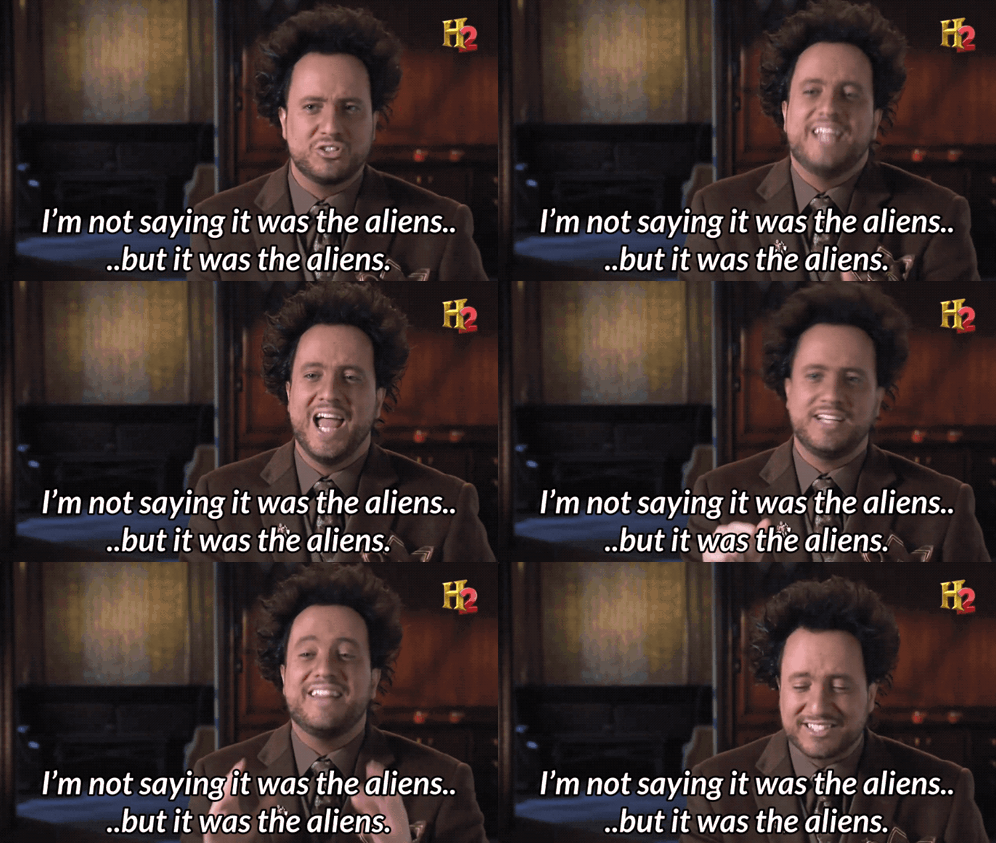
Full disclosure: I absolutely adore the Ancient Aliens tv show.
Don't judge, it makes me smile. And in a world full of things that make me frown, that's a goddamn gift.
A gift from...aliens?

A lot of what Erich von Däniken postulated back in 1968 has pretty much been proven false at this point. The rest of it is the kind of hummina hummina gibberish that you might expect from a toothy youth pastor telling you why you should load up in the van with the group as they head off to see a Christian rock band.
He's an ex-Catholic who found the flaws in the Bible to be a bit too much for him, so he started looking elsewhere to find the origin of life.
Basically, it seems as though he traded "finding God in the cracks" for "finding aliens in the cracks".
For everything that was mysterious or unknown about prehistoric civilizations, Däniken saw the potential that our entire species had been seeded by an ancient race of superior alien life forms.

Because duh.
If nothing else, you'll get to look at things from civilizations that I find fascinating in whole new ways.
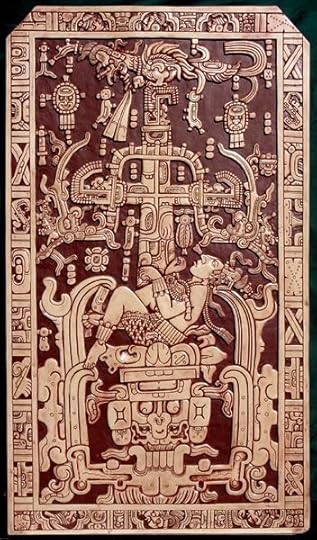
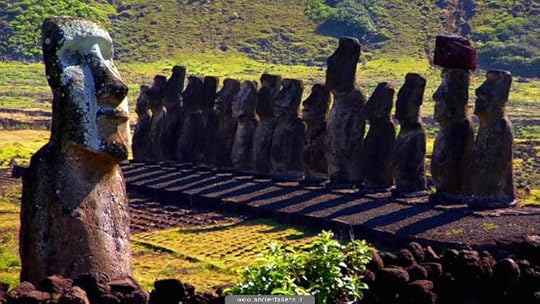
It's not just the Egyptian pyramids that were constructed using lasers. From the heads on Easter Island to the Palenque "Astronaut" of the Mayan civilization, there's nothing that Erich thinks wasn't a product of our betters from the stars.
To be fair, NASA had plans for landing on Mars by the 1980s. He was writing this during the height of the space craze, thinking that his great-grandkids would look at space travel in the same way he thought of getting on a plane.
Sadly, the space program was hit with budget cuts.
But hey, we got TikTok!

I don't know how to actually rate something like this, but out of my love for the concept of Ancient Aliens, I'll have to give it at least 3.
And for people like myself who enjoy the absurd, I think this is definitely a bucket list book.
Recommended for Ancient Astronauts.
PS - the audio version I listened to was high fun due to the narrator pronouncing gods in this highly sarcastic way that came out as gawds 99% of the time.
Ok. Not really.
But I have always wondered about the book that spawned such a huge cult following. I mean, how do you get so many people to take things like this seriously?
And then I remember what kind of people populate the earth, and it all becomes a little clearer.
Full disclosure: I absolutely adore the Ancient Aliens tv show.
Don't judge, it makes me smile. And in a world full of things that make me frown, that's a goddamn gift.
A gift from...aliens?
A lot of what Erich von Däniken postulated back in 1968 has pretty much been proven false at this point. The rest of it is the kind of hummina hummina gibberish that you might expect from a toothy youth pastor telling you why you should load up in the van with the group as they head off to see a Christian rock band.
He's an ex-Catholic who found the flaws in the Bible to be a bit too much for him, so he started looking elsewhere to find the origin of life.
Basically, it seems as though he traded "finding God in the cracks" for "finding aliens in the cracks".
For everything that was mysterious or unknown about prehistoric civilizations, Däniken saw the potential that our entire species had been seeded by an ancient race of superior alien life forms.
Because duh.
If nothing else, you'll get to look at things from civilizations that I find fascinating in whole new ways.
It's not just the Egyptian pyramids that were constructed using lasers. From the heads on Easter Island to the Palenque "Astronaut" of the Mayan civilization, there's nothing that Erich thinks wasn't a product of our betters from the stars.
To be fair, NASA had plans for landing on Mars by the 1980s. He was writing this during the height of the space craze, thinking that his great-grandkids would look at space travel in the same way he thought of getting on a plane.
Sadly, the space program was hit with budget cuts.
But hey, we got TikTok!
I don't know how to actually rate something like this, but out of my love for the concept of Ancient Aliens, I'll have to give it at least 3.
And for people like myself who enjoy the absurd, I think this is definitely a bucket list book.
Recommended for Ancient Astronauts.
PS - the audio version I listened to was high fun due to the narrator pronouncing gods in this highly sarcastic way that came out as gawds 99% of the time.

December 9, 2014
اريك فون دانيكن محقق و نويسنده ای است كه هزينه های زيادی را متحمل مي شود تا به رازهايی در مورد گذشته بشر دست يابد

كليسا و دانشمندانی او را به سخره گرفتند و عقايدش را نوعي تخيل بچه گانه دانستند ولی اين محقق سمج دست از تلاش نكشيد و توانست با چاپ چندين كتاب نظريه اش را به جهان نشان دهد و علاقمندان و طرفداران زيادي پيدا كند
وي با هزينه خود به نقاط دور دنيا سفر مي كند تا از نزديك شواهد را بررسي كند و بخاطر مستند بودن كتاب هايش، برنامه تلويزيونی هم از آثارش ساخته شده است
مدارك و مستندات كتاب واقعا جالب و در خور تامل هستند.ستوني دوهزار ساله كه زنگ نزده و تنها با جديدترين روشهاي نوين علمي ميتوان چنين ستوني ساخت
سنگهاي غول پيكري از سر انسان هايي غول مانند كه بزرگترين جرثقيل ها شايد
...قادر به حملش نباشند و
:نتیجه
راستش هنوز اعتقادی به وجود آدم فضائی ندارم ولی بنظرم اگر بگوئیم ما تنها ساکنان این جهان بزرگ هستیم احتمالا این هم حرف کاملا درستی نباشد
بیان چنین نظریه ای که فضائی ها در زمان گذشته به زمین آمده اند و همان خدایان می باشند جرات زیادی می خواهد. بنظرم باید به دیدگاه فون دانیکن احترام گذاشت و اگر حرف درستی می زند آنرا پذیرفت و اگر حرف نادرستی می زند با دلیل و منطق آنرا رد کرد
در چند سایت خواندم که خیلی از حرفهایش ناشی از تخیل یا دروغ می باشد و این ستون فلزی که زنگ نمی زند وجود ندارد. حالا درست یا غلطش را نمیدانم
چند تا عکس می آورم. قضاوت با خودتان
فونیکن ادعا می کند این نقش لامپ در مصر باستان است و مخالفان وی آن را گل نیلوفر می دانند
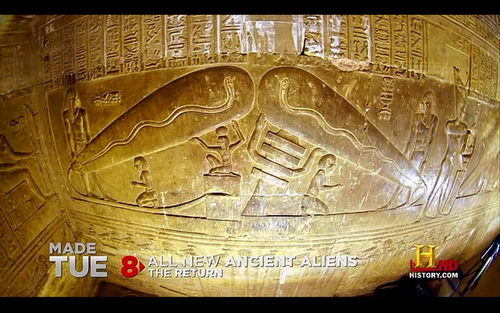

آدم فضائی یا فقط تصوری ذهنی؟
Nazca Lines:
تصاویر زیر بوسیله عکس هوایی از بیابان های پرو گرفته شده و به خطوط نازکا مشهورند.حدوود سیصد نقش از جانوران گوناگون چون ماهی ، میمون ، پرنده و مار که در مقیاسی وسیع بوجود آمده اند وبرخی از آنها صدها متر طول دارند
آیا این آثار کهن توسط انسانها بوجود آمده؟
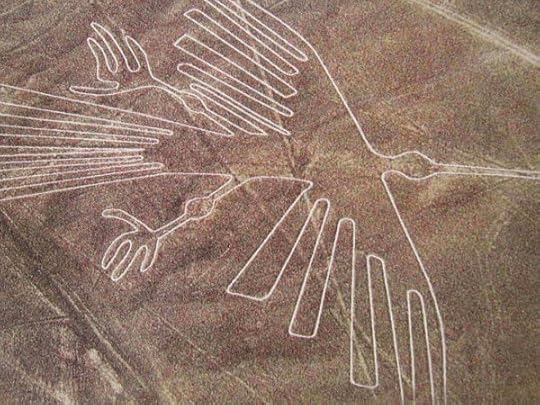
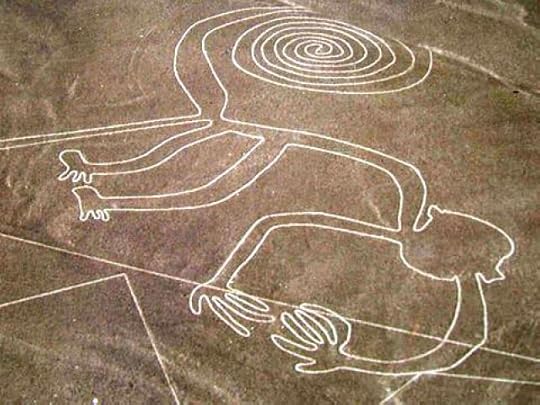
باستانشناسانی چون "ماریا ریچه" بر این باورند که این خطوط در اثر راه پیمایی انسانها و احتمالا زائران نوعی مراسم مذهبی ایجاد شده اند
كليسا و دانشمندانی او را به سخره گرفتند و عقايدش را نوعي تخيل بچه گانه دانستند ولی اين محقق سمج دست از تلاش نكشيد و توانست با چاپ چندين كتاب نظريه اش را به جهان نشان دهد و علاقمندان و طرفداران زيادي پيدا كند
وي با هزينه خود به نقاط دور دنيا سفر مي كند تا از نزديك شواهد را بررسي كند و بخاطر مستند بودن كتاب هايش، برنامه تلويزيونی هم از آثارش ساخته شده است
مدارك و مستندات كتاب واقعا جالب و در خور تامل هستند.ستوني دوهزار ساله كه زنگ نزده و تنها با جديدترين روشهاي نوين علمي ميتوان چنين ستوني ساخت
سنگهاي غول پيكري از سر انسان هايي غول مانند كه بزرگترين جرثقيل ها شايد
...قادر به حملش نباشند و
:نتیجه
راستش هنوز اعتقادی به وجود آدم فضائی ندارم ولی بنظرم اگر بگوئیم ما تنها ساکنان این جهان بزرگ هستیم احتمالا این هم حرف کاملا درستی نباشد
بیان چنین نظریه ای که فضائی ها در زمان گذشته به زمین آمده اند و همان خدایان می باشند جرات زیادی می خواهد. بنظرم باید به دیدگاه فون دانیکن احترام گذاشت و اگر حرف درستی می زند آنرا پذیرفت و اگر حرف نادرستی می زند با دلیل و منطق آنرا رد کرد
در چند سایت خواندم که خیلی از حرفهایش ناشی از تخیل یا دروغ می باشد و این ستون فلزی که زنگ نمی زند وجود ندارد. حالا درست یا غلطش را نمیدانم
چند تا عکس می آورم. قضاوت با خودتان
فونیکن ادعا می کند این نقش لامپ در مصر باستان است و مخالفان وی آن را گل نیلوفر می دانند
آدم فضائی یا فقط تصوری ذهنی؟
Nazca Lines:
تصاویر زیر بوسیله عکس هوایی از بیابان های پرو گرفته شده و به خطوط نازکا مشهورند.حدوود سیصد نقش از جانوران گوناگون چون ماهی ، میمون ، پرنده و مار که در مقیاسی وسیع بوجود آمده اند وبرخی از آنها صدها متر طول دارند
آیا این آثار کهن توسط انسانها بوجود آمده؟
باستانشناسانی چون "ماریا ریچه" بر این باورند که این خطوط در اثر راه پیمایی انسانها و احتمالا زائران نوعی مراسم مذهبی ایجاد شده اند

March 20, 2010
I read Erich von Däniken's Chariots of the Gods many many years ago (I borrowed it from my college roommate in the late 1980s) and even giving this book one star, is basically (at least in my opinion) just one star too many. Now aside from the fact that the information presented by the author is at best wildly speculative and weirdly imaginative, Chariots of the Gods also and more importantly has a to me profoundly anti-humanistic (and even perhaps borderline racist) feel to it. For to me, it has ALWAYS seemed as though the author, as though Erich von Däniken simply cannot and will not accept the fact that the great civilisations of the past were or could have been created by humans (that humans, but perhaps more specifically the great non Caucasian civilisations of the past, such as the Maya or the Aztecs could simply not have been intelligent and/or advanced enough to create monuments, art, music, whatever), that therefore, the great civilisations of the past must have been the product of alien invasions, alien contact (and that even religion itself must therefore also be a product of the latter, that deities, angels, mythological beings were originally aliens, the aliens who supposedly taught humanity, because humanity itself was somehow not imaginative, intelligent and capable enough to create civilisation, buildings, independent thought). And yes indeed I do well realise that there are some (and perhaps even many) who actually seem to believe in von Däniken's theories, and I also know that there are others who find his theories interesting and entertaining (albeit also unbelievable). But his speculations, the assertions as they are shown and presented in Chariots of the Gods (and his other and similar books) have always left a rather nastily bitter taste in my mouth, a feeling that the author in many ways actually tends to actively despise humanity, and that he especially despises and cannot accept the fact that individuals like the Mayans, the Egyptians, the Aztects were able to create, to think with cleverness and intelligence (read their OWN cleverness and intelligence).

December 10, 2012
Däniken must have won some mighty awards for this one, right? Right?
I have to admit that it was seriously entertaining though, mostly in imagining who it was who played the practical joke on Däniken each time he sticks his neck out on an imagined 'fact'.
Just to sum up the book: how can anyone imagine a concept like Time Travel without having experienced/seen it? Surely Victorian England was visited and ruled by the Time Lords who then vanished. leaving us to roil in our longing stories. People who have read the book, please laugh along with me...
This is not to deny that there are mysteries in the past, but then so are there in any field of human study - that does not mean that we have to postulate such excesses based on so little evidence. I can't resist going off on the same vein again - How can anyone imagine talking animals? Surely ancient India was home to intelligent (and highly literate) animals as well as the sporadic aliens, all conspiring to befuddle the poor humans into worshiping them and then mythologizing them.
The mistake is to rigidly try to classify the myths as facts or stories. If only Däniken had taken the time to understand the power of symbolism in myth-making... hell, he could have done that purely by reading a few comic books!
By the way, was it only me or was Däniken's usage of the word "utopia" just all over the place and far away from the accepted meaning?
I have to admit that it was seriously entertaining though, mostly in imagining who it was who played the practical joke on Däniken each time he sticks his neck out on an imagined 'fact'.
Just to sum up the book: how can anyone imagine a concept like Time Travel without having experienced/seen it? Surely Victorian England was visited and ruled by the Time Lords who then vanished. leaving us to roil in our longing stories. People who have read the book, please laugh along with me...
This is not to deny that there are mysteries in the past, but then so are there in any field of human study - that does not mean that we have to postulate such excesses based on so little evidence. I can't resist going off on the same vein again - How can anyone imagine talking animals? Surely ancient India was home to intelligent (and highly literate) animals as well as the sporadic aliens, all conspiring to befuddle the poor humans into worshiping them and then mythologizing them.
The mistake is to rigidly try to classify the myths as facts or stories. If only Däniken had taken the time to understand the power of symbolism in myth-making... hell, he could have done that purely by reading a few comic books!
By the way, was it only me or was Däniken's usage of the word "utopia" just all over the place and far away from the accepted meaning?

December 11, 2010
brilliant psychedelic wonderous book.
even if you dont believe a word of it.
if you enjoy it there is a book called 'the spaceships of ezekiel', by j.f. blumrich (a NASA engineer), in response to daniken. "for me, an engineer who began his career in aircraft desgin in 1934, and who was working on large rockets and spacecraft, such books provide wonderful entertainment, and no more; they discribe exciting events that occured at times and in places that cannot be checked. so, when the "daniken" arrived, i read, i smiled, grinned and laughed - until i found a passage in which daniken write about the prophet ezekiel. here were the technical statements and claims right in the fields of my own professional knowledge! suddenly it seemed very easy - i would take a bible and would explain why a certain von daniken was wrong. how sure i was!
I soon lost my grin, became profoundly curious, and what followed was a wonderful experience, unusual in evert respect, an undertaking which was done exclusively in my spare time, since NASA, my employer, is not engaged in such matters.
Hardly ever was a total defeat so rewarding, so fascinating, and so delighful!"
i think this is the perfect response to daniken. it doesn't matter if you think it's real. it fascinates the mind and it expands the depths in which you think and it causes you to question aspects of our history. our history which is written on cave walls and ancient texts. a whole civilisation which is so far away, we cannot comprehend, we dismiss it all as a mythical superstitions.
perhaps civilisation has devolved. perhaps we really have forgotten the teachings of beings from another cosmos. or it might be a load of shit. either way, an unforgettable book.
even if you dont believe a word of it.
if you enjoy it there is a book called 'the spaceships of ezekiel', by j.f. blumrich (a NASA engineer), in response to daniken. "for me, an engineer who began his career in aircraft desgin in 1934, and who was working on large rockets and spacecraft, such books provide wonderful entertainment, and no more; they discribe exciting events that occured at times and in places that cannot be checked. so, when the "daniken" arrived, i read, i smiled, grinned and laughed - until i found a passage in which daniken write about the prophet ezekiel. here were the technical statements and claims right in the fields of my own professional knowledge! suddenly it seemed very easy - i would take a bible and would explain why a certain von daniken was wrong. how sure i was!
I soon lost my grin, became profoundly curious, and what followed was a wonderful experience, unusual in evert respect, an undertaking which was done exclusively in my spare time, since NASA, my employer, is not engaged in such matters.
Hardly ever was a total defeat so rewarding, so fascinating, and so delighful!"
i think this is the perfect response to daniken. it doesn't matter if you think it's real. it fascinates the mind and it expands the depths in which you think and it causes you to question aspects of our history. our history which is written on cave walls and ancient texts. a whole civilisation which is so far away, we cannot comprehend, we dismiss it all as a mythical superstitions.
perhaps civilisation has devolved. perhaps we really have forgotten the teachings of beings from another cosmos. or it might be a load of shit. either way, an unforgettable book.

July 2, 2016

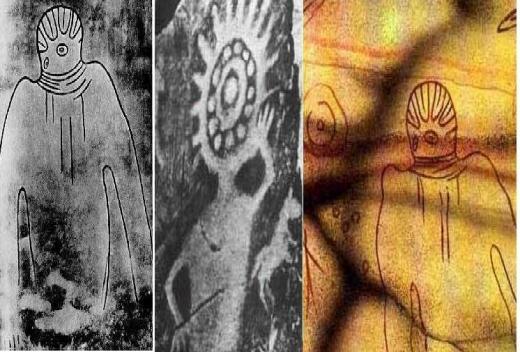
تصویر فوق مربوط به مقبره ی "پاکال" حاکم مایایی است، تمدن بزرگ فراموش شده ای در امریکای جنوبی. این لوحه با قدمتی دو هزار و ششصد ساله، طرح بسیار غریبی را نشان می دهد که بسیاری از باستان شناسان را دچار حیرت و سر در گمی کرده است. این تصویر که بنا به عقیده ی عمومی یکی از تجربه های "مذهبی-عرفانی" پاکال و سفر "روحانی" او به عالم بالا را توصیف می کند، با کمی دقت مشخص می شود که در حقیقت شرح یک سفر "جسمانی" به فضاست. پاکال ابزاری به دهان خود زده است که به طرز شگفت انگیزی مشابه یک "ماسک اکسیژن" است و بر دوش خود چیزی انداخته که شبیه کپسول هایی است که فضانوردان امروزی بر دوش می اندازند. در نتیجه به راحتی می توان حدس زد مرکب پر نقش و نگار او که وظیفه ی خطیر سفر آسمانی او را بر عهده دارد، چیزی نیست جز یک سفینه ی فضایی.
متأسفانه محققان به جای دیدن این شواهد واضح که به روشنی ارتباط تمدّن های باستانی با موجودات فضایی را اثبات می کنند، سعی کرده اند با توجیهات نامعقول و ناپذیرفتنی به نحوی این حجم عظیم دلایل را انکار یا فراموش کنند. اما این کتاب حقیقت را برای شما فاش خواهد کرد، حقیقتی که محققان در این مدت طولانی سعی به کتمان آن داشته اند.
فقط یک نکته ی کوچک هست:

October 9, 2016
When I was young I was convinced that aliens had visited us on many occasions. I have changed the way I think about the facts now, but this book was one of the first books I ever read that made me consider an alternate narrative to mainstream thought...and for that it will always have a special place on my 'life bookshelf.'

November 10, 2015
دوستانِ گرانقدر، نوشتن و نقد از این کتاب هم دشوار است و هم به نوعی تکراری
بهتر این است که این نوع کتاب ها را علمی و تخیلی، قلمداد کنیم.. چراکه نویسنده در قسمتهایی از کتاب مانندِ صفحۀ 183 الی 190 ، تکیه بر داستانِ موهوم و تخیلی آدم و حوا و نوح و پسرانش دارد و برایِ توضیح در مورد شرمِ جنسی، به لخت یا برهنه بودن آنها اشاره میکند و در قسمتهایِ دیگر بارها به هر دلیل به افسانه هایِ کتب به اصطلاح آسمانی رجوع میکند ... پس اگر بخواهیم این کتاب را در دسته بندیِ ادبیاتی وارد کنیم، به دستۀ علمی و تخیلی نزدیکتر است، همچون آثارِ "آرتور سی كلارك" یا "ژول ورن" یا "آیزاك آسیموف" و ... چراکه نوشته های مربوط به دانش، ممکن است در آینده، درستیِ آنها اثبات شود و البته اگر هم اثبات نشود ایراد ندارد
ولی جالب اینجاست که خیلی ها بدونِ آنکه این کتاب را خوانده باشند و بدون آنکه کوچکترین پژوهش تاریخی انجام داده باشند، این نوشته ها از "فون دنیکن" را افسانه ای و موهوم میدانند و میگویند: به عقل جور در نمیاد.. این عدۀ نادان و بیخرد به عقل کرم خورده و کلۀ پوشالیشان جور در می آید که عیسی از آسمان برایش سفرۀ غذا به پایین آمد و هرچه یارانش خوردند تمام نشد و یا عیسی پس از مرگ به آسمان رفت... یا محمد رسولِ اللهِ اکبر، با موجودی شبیه یابو و الاغ (نام این یابو سفید براق بوده است) همراه جبرییل رفت آسمان هفتم و یا سنگها و درخت جلویِ محمد تعظیم میکرده و سلام میداده اند... یا موسی عصایش را انداخت و اژدها شد و اژدهاهایِ دیگر را خورد و یا دریا (رود نیل) را شکافت و از آن عبور کردند... یا خدا دنیا را در 6 روز آفرید، که اگر به هر کودکی داستان آفرینش را بیان کنید نمیداند بخندد و یا گریه کند... و کلی چرت و پرت و موهوماتِ اینچنینی را باور میکنند... با صوت و تلاوت و فریاد از اعماق وجودِ نادانشان، میگویند در روز قیامت ستاره ها بر سر موجودات فرو میریزند... آنقدر بی خرد هستند که نمیفهمند کوچکترین این ستاره ها از زمین بزرگتر است و تعداد آنها به میلیاردها ستاره میرسد.. و برخی از آنها احتمالاً الان وجود ندارند، ولی ما نور آنها را مشاهده میکنیم... البته از کتاب هایِ آسمانی و سردمدارانشان همچون حلّی و شیخ مفید و کافی و مخصوصاً علامۀ علامه ها مجلسیِ نادان و بیشعور که میگوید: هر قطرۀ باران را یک فرشته بر رویِ دوش خود تا رویِ زمین حمل میکند، بیش از این انتظار نمیتوان داشت
پس عزیزانم، این کتاب را بخوانید و برخی از آنها را به عنوانِ نظریه هایِ علمی و حتی تاریخی، قبول کنید، نه اینکه آنها را موهوم بدانید و خیال کنید که داستانی فانتزی میخوانید... کتاب در نوعِ خودش، کتابِ ارزشمندی میباشد
-----------------------------------------
امیدوارم از خواندنِ این کتاب لذت ببرید
<پیروز باشید و ایرانی>
بهتر این است که این نوع کتاب ها را علمی و تخیلی، قلمداد کنیم.. چراکه نویسنده در قسمتهایی از کتاب مانندِ صفحۀ 183 الی 190 ، تکیه بر داستانِ موهوم و تخیلی آدم و حوا و نوح و پسرانش دارد و برایِ توضیح در مورد شرمِ جنسی، به لخت یا برهنه بودن آنها اشاره میکند و در قسمتهایِ دیگر بارها به هر دلیل به افسانه هایِ کتب به اصطلاح آسمانی رجوع میکند ... پس اگر بخواهیم این کتاب را در دسته بندیِ ادبیاتی وارد کنیم، به دستۀ علمی و تخیلی نزدیکتر است، همچون آثارِ "آرتور سی كلارك" یا "ژول ورن" یا "آیزاك آسیموف" و ... چراکه نوشته های مربوط به دانش، ممکن است در آینده، درستیِ آنها اثبات شود و البته اگر هم اثبات نشود ایراد ندارد
ولی جالب اینجاست که خیلی ها بدونِ آنکه این کتاب را خوانده باشند و بدون آنکه کوچکترین پژوهش تاریخی انجام داده باشند، این نوشته ها از "فون دنیکن" را افسانه ای و موهوم میدانند و میگویند: به عقل جور در نمیاد.. این عدۀ نادان و بیخرد به عقل کرم خورده و کلۀ پوشالیشان جور در می آید که عیسی از آسمان برایش سفرۀ غذا به پایین آمد و هرچه یارانش خوردند تمام نشد و یا عیسی پس از مرگ به آسمان رفت... یا محمد رسولِ اللهِ اکبر، با موجودی شبیه یابو و الاغ (نام این یابو سفید براق بوده است) همراه جبرییل رفت آسمان هفتم و یا سنگها و درخت جلویِ محمد تعظیم میکرده و سلام میداده اند... یا موسی عصایش را انداخت و اژدها شد و اژدهاهایِ دیگر را خورد و یا دریا (رود نیل) را شکافت و از آن عبور کردند... یا خدا دنیا را در 6 روز آفرید، که اگر به هر کودکی داستان آفرینش را بیان کنید نمیداند بخندد و یا گریه کند... و کلی چرت و پرت و موهوماتِ اینچنینی را باور میکنند... با صوت و تلاوت و فریاد از اعماق وجودِ نادانشان، میگویند در روز قیامت ستاره ها بر سر موجودات فرو میریزند... آنقدر بی خرد هستند که نمیفهمند کوچکترین این ستاره ها از زمین بزرگتر است و تعداد آنها به میلیاردها ستاره میرسد.. و برخی از آنها احتمالاً الان وجود ندارند، ولی ما نور آنها را مشاهده میکنیم... البته از کتاب هایِ آسمانی و سردمدارانشان همچون حلّی و شیخ مفید و کافی و مخصوصاً علامۀ علامه ها مجلسیِ نادان و بیشعور که میگوید: هر قطرۀ باران را یک فرشته بر رویِ دوش خود تا رویِ زمین حمل میکند، بیش از این انتظار نمیتوان داشت
پس عزیزانم، این کتاب را بخوانید و برخی از آنها را به عنوانِ نظریه هایِ علمی و حتی تاریخی، قبول کنید، نه اینکه آنها را موهوم بدانید و خیال کنید که داستانی فانتزی میخوانید... کتاب در نوعِ خودش، کتابِ ارزشمندی میباشد
-----------------------------------------
امیدوارم از خواندنِ این کتاب لذت ببرید
<پیروز باشید و ایرانی>

July 27, 2013
3.5 Stars
I think this sums up the book

Don't misinterpret my rating. I gave it 3.5 stars based on entertainment value alone. To sum up the belief the author, in the past, aliens visited pre homo sapien man, bred with the women and came back later to check up on us and breed a bit more.
The author attempts to prove his theory that aliens visited ancient man by stating repeatedly that ancient man, given the knowledge they apparently possessed, could not have accomplished, without help, many of the wondrous things they have been credited with or have obtained. Clearly the author believed that ancient man was a stupid religious being.
I could rant on the stupid theories in the book but I will let you do it yourself. Although many of the theories are nothing but wild postulation, the subject matter is interesting. I have always been intrigued about the possibility of alien life, so, crazy as this guy is, its a fun subject.
I read the book like a wild piece of fiction and was not disappointed.
I think this sums up the book
Don't misinterpret my rating. I gave it 3.5 stars based on entertainment value alone. To sum up the belief the author, in the past, aliens visited pre homo sapien man, bred with the women and came back later to check up on us and breed a bit more.
The author attempts to prove his theory that aliens visited ancient man by stating repeatedly that ancient man, given the knowledge they apparently possessed, could not have accomplished, without help, many of the wondrous things they have been credited with or have obtained. Clearly the author believed that ancient man was a stupid religious being.
I could rant on the stupid theories in the book but I will let you do it yourself. Although many of the theories are nothing but wild postulation, the subject matter is interesting. I have always been intrigued about the possibility of alien life, so, crazy as this guy is, its a fun subject.
I read the book like a wild piece of fiction and was not disappointed.

July 11, 2017
As most of the reviews here have said this was a 5* book - when you were a naïve pre-teen looking for excitement and mystery in an apparently hum-drum world.
I spent hours looking at the pics therein - the words were less important as I could SEE the truth with my own eyes in those black and white photos that peppered this and other of his books.
Thank goodness Arthur C Clarke and Carl Sagan were around to point out his short-comings.
His legacy was unfortunately largely responsible for the plethora of bad-science 'investigative' documentaries that hide behind the 'but what if?' phrase to twist facts, posit untruths to make a false narrative that provides an hour of cheaply made nonsense for many third-rate TV channels.
Looking back it was EVD who was really the naïve one. He was not a charlatan with an agenda like some of todays woo-woo peddlers and 'mystery-mongers' (and thank-you Arthur C Clarke for this wonderful phrase) but a simple man who wanted things to be extraordinary.
Young-teen me would have given it a 5* but it gets a 1* to deter any minors or impressionable adults from treating this book too seriously.
I spent hours looking at the pics therein - the words were less important as I could SEE the truth with my own eyes in those black and white photos that peppered this and other of his books.
Thank goodness Arthur C Clarke and Carl Sagan were around to point out his short-comings.
His legacy was unfortunately largely responsible for the plethora of bad-science 'investigative' documentaries that hide behind the 'but what if?' phrase to twist facts, posit untruths to make a false narrative that provides an hour of cheaply made nonsense for many third-rate TV channels.
Looking back it was EVD who was really the naïve one. He was not a charlatan with an agenda like some of todays woo-woo peddlers and 'mystery-mongers' (and thank-you Arthur C Clarke for this wonderful phrase) but a simple man who wanted things to be extraordinary.
Young-teen me would have given it a 5* but it gets a 1* to deter any minors or impressionable adults from treating this book too seriously.

December 14, 2012
I am not ashamed to say that there was a time when I took Erich von Däniken seriously (now, stop the sniggering, it's not funny!). Maybe it was a side-effect of my mother's crazy theory, which she narrated to me again and again, that the Pushpaka Vimana in the epic Ramayana was a real aeroplane; and the sights described as Rama, Lakshmana and Sita flew back to Ayodhya from Sri Lanka was really written from first hand accounts. Well, you must admit it was a really pretty fantasy.

Now here was a guy who was apparently presenting "scientific" evidence for the same! I was overjoyed. I devoured the book...
...and slowly, doubts began to appear.
Because there is very little science in the book, you see. What we have is a book-long rant of a crackpot enthusiast who cannot even get his mythology correct. After some time, even the most gullible reader will feel that this is (to borrow from Wodehouse) "pure apple-sauce".
Oh well... I'll give him three stars for entertaining me.
Now here was a guy who was apparently presenting "scientific" evidence for the same! I was overjoyed. I devoured the book...
...and slowly, doubts began to appear.
Because there is very little science in the book, you see. What we have is a book-long rant of a crackpot enthusiast who cannot even get his mythology correct. After some time, even the most gullible reader will feel that this is (to borrow from Wodehouse) "pure apple-sauce".
Oh well... I'll give him three stars for entertaining me.

July 13, 2022
There are many things in ancient history that can't be properly explained by mainstream archaeology and this book shines a light on a few.
This interesting concept of aliens on earth is very thought-provoking.
I've read so many similar books so there wasn't much in here that I've not read about before but I still enjoyed reading it because it's very well put together and I find it interesting.
If you watch Ancient Aliens a lot of the information comes from this book.
This interesting concept of aliens on earth is very thought-provoking.
I've read so many similar books so there wasn't much in here that I've not read about before but I still enjoyed reading it because it's very well put together and I find it interesting.
If you watch Ancient Aliens a lot of the information comes from this book.
January 23, 2013
I am sure most people will pan this book - unsubstantiated, inaccurate, baseless, ridiculous, blah, blah, blah. The fact of the matter is that the author does not prove that aliens visited Earth at any time in our past, nor does he claim to have proof of it - ever. Not once in this book does he claim to have such proof, and he repeats that over and over. Anyone who argues otherwise formed their judgments before reading this book. As far as inacuracies, the book was written in the late 1960's. It is not fair to bash a work for inacuracies from the viewpoint of the 21st century, Of course there are inacuracies! Baseless - hardly... many of the questions he brings forth are very valid questions even today for which I would love to hear good, rational explanations. A great deal of our real history has been occluded by the irrational zealotries of past (and maybe not so past) religious and politcal authorities - an immeasurable shame. Our picture of our past (and even of our present, with such near-sighted and limited technology at our disposal) is woefully underdeveloped. Were we visited by little green men in the past? I don't know if I'd go that far just yet, but I certainly cannot say that it is an impossibility. I think for us to stand here on one infinitely insignificant world among countless billions (or trillions) in the "known" universe and state "we are it and we are the best" is ridiculous beyond my ability to put into words. What I do know is that any civilization advanced enough to visit us would be so far beyond us at this point that it is perfectly feasible that they would be able to do so undetected (as we already have stealth technologies that evade our own detection to a large degree and we are centuries, if not millenia from deep space travel). Have they already intermingled with us? Seems far fetched from naked observation, but far less far fetched than the childlike story of Adam and Eve, or just about any other cultural story of creation, which are, one and all, stories to placate minds far more ignorant than any of those alive in the 21st century should be. To look at the mysteries of our own past with closed minds is a mistake and the questions raised in this book (a book written for the sole purpose of raising the questions, not offering proof of their concrete veracity) is a mistake, and it is irresponsible. Why and how our ancient peoples did things that would be extraordinarily difficult to do even with the advent of 21st century technology is not an unknown to be scoffed at, and we do not even now have the answers. In that, this book holds true even today.

Read
August 6, 2011I think the quick answer to this is “Probably not”. Coming at this from the background of astrophysics I can see enough misrepresentation of facts, falsities and misconceptions within his description of basic physics to lose trust in the author. There were some terrible errors in this book. The thing that had me shaking my head in amusement was when the author tried to draw some deep meaning about how these certain temples are connected to the length of the year on Venus and then get that figure wrong. Not only get it wrong, but gave it a year longer than Earth’s year!
The fact that he really demonstrated a lack of knowledge on the space part is one thing, but I got the distinct impression that he had misunderstood what the past was like. Throughout the book he underestimated the ingenuity of the people of the past and tries to create a image of them as being stupid and helpless. He even refers to them as “savages” which made me cringe. One thing to think about is that they could survive without technology and we could not. Who really is the more advanced, them or us?
I feel that every grey area, every part of history obscured by the fog of time, is exploited and made to fit somewhere into his sprawling untidy theory. Half way through I lost track of what the theory was supposed to be. “Is this a book about surviving nuclear bombs in prehistory?” I would ask myself.
Throughout the book I noticed that he would insert his theory into conversations about real science and drop in discussion by real scientists and yet not draw the distinction between the established idea and his idea. It was almost as if his idea was taking a credibility piggyback on established science.
Ultimately this book is worth reading so that you can observe all the twists, turns and sidesteps the author goes through to try and convince you. You could look at it as training in how to build a good healthy scepticism. If you read his book and survive, you may well make a good scientist.
The fact that he really demonstrated a lack of knowledge on the space part is one thing, but I got the distinct impression that he had misunderstood what the past was like. Throughout the book he underestimated the ingenuity of the people of the past and tries to create a image of them as being stupid and helpless. He even refers to them as “savages” which made me cringe. One thing to think about is that they could survive without technology and we could not. Who really is the more advanced, them or us?
I feel that every grey area, every part of history obscured by the fog of time, is exploited and made to fit somewhere into his sprawling untidy theory. Half way through I lost track of what the theory was supposed to be. “Is this a book about surviving nuclear bombs in prehistory?” I would ask myself.
Throughout the book I noticed that he would insert his theory into conversations about real science and drop in discussion by real scientists and yet not draw the distinction between the established idea and his idea. It was almost as if his idea was taking a credibility piggyback on established science.
Ultimately this book is worth reading so that you can observe all the twists, turns and sidesteps the author goes through to try and convince you. You could look at it as training in how to build a good healthy scepticism. If you read his book and survive, you may well make a good scientist.

March 18, 2012
I have to clarify my rating here: One star for "scholarship" and five stars for entertainment value. Erich von Daniken's Chariots of the Gods is, of course, one of, if not the, classic works of pseudoarchaeology and UFOlogy. Von Daniken blithely ignores close to a century of archaeological and anthropological theory so that he can tilt at the windmills of some imagined scientific "establishment." Most of his "arguments" consist of something along the lines of "We're not really sure how pre-historic people built this, so aliens did it. QED." As with all of the other works in this genre, there is a strong undercurrent of ethnocentrism and racism implicit in these arguments. Surely such "primitive" people could never construct such great monuments! (Yes, he does even use the term "savages" in a few places.) Nearly every sentence in the book contains some error, misrepresentation, or downright howler. To document all of them would take an entire book and, what do you know, someone bothered to do it. Go check out Ronald Story's The Space-Gods Revealed: A Close Look at the Theories of Erich von Däniken. But if you want to read pure, concentrated bullshit, pick up Chariots of the Gods.

June 7, 2007
Baseless, factless, and filled with ridiculous presumptions. It's amazing that with arguments to poorly presented that this book seemed to have such an affect on American culture in the early 70's. It's simply a get-rich-quick scheme from a Swiss ex-con that paid out good. It fed upon people's need to feel that we come from something "out there." Be that out there from a god or from aliens... it's really all the same. von Daeniken just gives another "Intelligent Design" myth.
I give it one star for the good laugh you can get out of reading it.
I give it one star for the good laugh you can get out of reading it.

November 17, 2012
This is pseudo-science and story telling at its very best. This best selling book was probably the water shed moment in the proliferation of conspiracy theories and other pseudo-scientific stuff in the popular literature. And one can see why.
To be fair, the author does know how to spin a yarn. It is an enjoyable read, fast paced, if you consider it more as a fiction novel and don't take it seriously.
But the disturbing fact is the sheer confidence of the author in his most ridiculous and logic-defying assumptions and hypotheses. With a condescending view towards the historians, he goes on blabbering about one misinterpreted archaeological evidence after the other, citing numerous out-of-context mumble-jumble about this Physics principle and that astronomical data with a stunning conviction.
Though you feel sorry for the hapless millions who have actually religiously accepted this book as a treatise on human evolution and birth of civilization.
It shows the sheer absence of clear, scientific thought among the masses and the adherence to half-truths, myths and conspiracy theories. As long as that prevails, works like these will keep on attaining best-selling status.
To be fair, the author does know how to spin a yarn. It is an enjoyable read, fast paced, if you consider it more as a fiction novel and don't take it seriously.
But the disturbing fact is the sheer confidence of the author in his most ridiculous and logic-defying assumptions and hypotheses. With a condescending view towards the historians, he goes on blabbering about one misinterpreted archaeological evidence after the other, citing numerous out-of-context mumble-jumble about this Physics principle and that astronomical data with a stunning conviction.
Though you feel sorry for the hapless millions who have actually religiously accepted this book as a treatise on human evolution and birth of civilization.
It shows the sheer absence of clear, scientific thought among the masses and the adherence to half-truths, myths and conspiracy theories. As long as that prevails, works like these will keep on attaining best-selling status.

Read
September 10, 2026Als scholier heb ik dit boek al eens gelezen. Geen idee meer wat ik er toen van vond. Waarschijnlijk vermoeiend, langdradig en achterhaald. We waren immers nog steeds niet op Mars... En Star Trek was toch veel leuker! Mijn stiefvader was groot fan, dus ik heb het vast doodgezwegen.
En misschien hadden echte wetenschappers dat ook kunnen doen. Onze Erich heeft veel geld verdiend met de “strijd” om zijn reputatie. De heruitgave bevat een uitgebreid voor- en nawoord met een hoog Calimero-gehalte. En voor iemand die “alleen maar vragen stelt” is hij nogal gekwetst (?) als iemand het (goed onderbouwd soms zelfs) niet met hem eens is.
Nu is papier geduldig en positief gezien was Von Däniken een erg optimistisch kind van zijn tijd. De kerk verloor haar macht. Mensen gingen de ruimte in. En de Beatles zorgden voor een muzikale omlijsting. Alles was mogelijk, toch?
Misschien kun je het zo lezen. Als tijdsbeeld. Of om je innerlijke complottheorie-verslaafde te voorzien van nieuwe ideeën! Maar maakt iemand zich nog druk over het gegeven of Ezechiël een visioen heeft gehad of niet.
Uitstekend voorgelezen overigens door Cees van Ede.
En misschien hadden echte wetenschappers dat ook kunnen doen. Onze Erich heeft veel geld verdiend met de “strijd” om zijn reputatie. De heruitgave bevat een uitgebreid voor- en nawoord met een hoog Calimero-gehalte. En voor iemand die “alleen maar vragen stelt” is hij nogal gekwetst (?) als iemand het (goed onderbouwd soms zelfs) niet met hem eens is.
Nu is papier geduldig en positief gezien was Von Däniken een erg optimistisch kind van zijn tijd. De kerk verloor haar macht. Mensen gingen de ruimte in. En de Beatles zorgden voor een muzikale omlijsting. Alles was mogelijk, toch?
Misschien kun je het zo lezen. Als tijdsbeeld. Of om je innerlijke complottheorie-verslaafde te voorzien van nieuwe ideeën! Maar maakt iemand zich nog druk over het gegeven of Ezechiël een visioen heeft gehad of niet.
Uitstekend voorgelezen overigens door Cees van Ede.
July 8, 2013
I think Chariots of the Gods was a wonderful and very informative book. Honestly, I have a lot more respect for Erich von Daniken than I do bloats like the so-called "genius" Stephen Hawking. At least Erich traveled to all of these destinations, done hands-on thorough research, and has proof of all of his claims.
What I like most about Erich and his books is that instead of trying to disprove ancient "mythology" (quotations are necessary because technically it is not mythology, but very old religion and events that took place in the ancient world) like many researchers seem to do these days, he proves that all of it is very much real. Ask yourself why you may (or one) tend to disregard his information as rubbish. For one, the media and the government that controls it (and not only to think of the Roman Catholic Church) has taught us over centuries that such "irrational" theories are impossible and sometimes thought of as an evil, be it that we are product of extraterrestrials (note that in this case the term can be interchanged with the Gods or God(dess)), that many creatures not recognized by science (otherworldly beings as in "mythical" or magickal creatures that have appeared countless of times in every ancient society around the globe, including Judaism and Christianity) exist, or even that magick/prayer is not a conception invented by humanity to dupe ourselves to feel protection and comfort (seems like a lame excuse to go not where one fears, specifically a fear of losing one's credibility and pride as a "scientific mind"). In my opinion, I feel that these kinds of things being told to us is just another way to brainwash people into thinking that it's non-existent. People who automatically disregard Daniken because his notions may sound "bizarre" need to do their own research and experience things. Just doing research won't carry one completely to the end of one's journey, but only half way. One must fully experience and understand what the sacred texts that Daniken speaks of and quotes from in his in his books. If one is not willing to delve deep into this matter then she/he should not make comments against Daniken or his books, and especially not insult him. It is the equivalent of skimming through a text book that, for instance, says that a particular event in history happened one way while there are many other books that say the event happened differently with each book stating its own either biased or credible theories, while walking away and claiming that you know everything that happened based upon one book and your own opinions. I would have more respect for people who have actually studied the matter and went in a little deeper on a spiritual level and then critcized his thinking and/or books rather than one who "brushes" upon the superficial side of it all.
I proudly give this book a 5 star rating because he dared what most notable scholars wouldn't do- to PROVE the existence of otherworldly and seemingly strange things in all cultures and religions whether it'd be things from the Bible, Bhagavad Gita, Torrah, ancient ruins and scrolls, and so forth.
What I like most about Erich and his books is that instead of trying to disprove ancient "mythology" (quotations are necessary because technically it is not mythology, but very old religion and events that took place in the ancient world) like many researchers seem to do these days, he proves that all of it is very much real. Ask yourself why you may (or one) tend to disregard his information as rubbish. For one, the media and the government that controls it (and not only to think of the Roman Catholic Church) has taught us over centuries that such "irrational" theories are impossible and sometimes thought of as an evil, be it that we are product of extraterrestrials (note that in this case the term can be interchanged with the Gods or God(dess)), that many creatures not recognized by science (otherworldly beings as in "mythical" or magickal creatures that have appeared countless of times in every ancient society around the globe, including Judaism and Christianity) exist, or even that magick/prayer is not a conception invented by humanity to dupe ourselves to feel protection and comfort (seems like a lame excuse to go not where one fears, specifically a fear of losing one's credibility and pride as a "scientific mind"). In my opinion, I feel that these kinds of things being told to us is just another way to brainwash people into thinking that it's non-existent. People who automatically disregard Daniken because his notions may sound "bizarre" need to do their own research and experience things. Just doing research won't carry one completely to the end of one's journey, but only half way. One must fully experience and understand what the sacred texts that Daniken speaks of and quotes from in his in his books. If one is not willing to delve deep into this matter then she/he should not make comments against Daniken or his books, and especially not insult him. It is the equivalent of skimming through a text book that, for instance, says that a particular event in history happened one way while there are many other books that say the event happened differently with each book stating its own either biased or credible theories, while walking away and claiming that you know everything that happened based upon one book and your own opinions. I would have more respect for people who have actually studied the matter and went in a little deeper on a spiritual level and then critcized his thinking and/or books rather than one who "brushes" upon the superficial side of it all.
I proudly give this book a 5 star rating because he dared what most notable scholars wouldn't do- to PROVE the existence of otherworldly and seemingly strange things in all cultures and religions whether it'd be things from the Bible, Bhagavad Gita, Torrah, ancient ruins and scrolls, and so forth.

September 11, 2012
WHERE DO I BEGIN? THE FACT THAT THIS BOOK IS A 7-MILLION-COPY BESTSELLER REALLY SAYS EVERYTHING. I HAVE ALWAYS BEEN INTERESTED IN AND FASCINATED BY ANCIENT CIVILIZATIONS,TECHNOLOGIES,AND RELIGIONS. I HAVE SO MANY QUESTIONS REGARDING EXTRATERRESTRIAL EXISTENCE AND VISITATION TO OUR EARTH. I AM A BELIEVER AND AS A TOPIC THAT HAS NOT BEEN WIDELY DISCUSSED OR TAKEN SERIOUSLY BY THE EVERYDAY HUMAN BEING IT IS ENCOURAGING TO KNOW THAT I AM NOT ALONE IN MY WONDER,BELIEF,AND INTEREST. ERICH VON DANIKEN INCLUDES SOME COMPELLING PHOTOGRAPHIC EVIDENCE OF THE RUINS OF ANCIENT CIVILIZATIONS AND THE INCREDIBLE TECHNOLOGIES THAT MUST HAVE BEEN AVAILABLE TO PRODUCE THEM. HAVING BEEN TO EL CASTILLO AT CHICHEN ITZA,MEXICO MYSELF, IT IS VERY OBVIOUS TO ME THAT THESE ANCIENT CIVILIZATIONS SUCH AS THE MAYANS POSSESSED TECHNOLOGIES FAR ADVANCED OF WHAT WE BELIEVE THEM TO BE CAPABLE OF.I LOVE THAT IF YOU GET NOTHING ELSE FROM THIS BOOK,IT IS VERY THOUGHT PROVOKING AND ALLOWS YOU TO EXAMINE ON YOUR OWN,THE AGE OLD QUESTIONS OF, ARE WE ALONE? WHERE DID WE COME FROM? AND WHAT WILL OUR FUTURE HOLD? AN EXCELLENT READ!

March 8, 2008
In one Goodreads group which some of my friends belong to, they're having a discussion of the ethics of giving a book a one-star rating with no explanatory review; one person likened the practice to a drive-by shooting. I could see her point; but in my case, on the rare occasions I've done it, it's been with nonfiction books read in the past that I didn't have leisure to review, but didn't want people who might browse my shelves to think I agreed with or endorsed, just because I'd read them. This book is a prime example. :-) Books like it might also be a prime example of why one of these Goodreads friends observes that he sometimes has trouble deciding whether to classify a book as "nonfiction" or fiction; the author certainly wants readers to view it as nonfiction, but a factual basis isn't one of its attributes.
Von Daniken's thesis (which sold a surprising number of books, and has made him a prosperous man) is that, from the Old Stone Age down into the ancient Iron Age, Earth was repeatedly visited, on all parts of the globe, by advanced aliens who are responsible for all of mankind's religions, and for virtually all the architectural and scientific achievements of the ancient world. Every detail of early history and prehistory, and an array of physical artifacts, are interpreted in light of this claim, and these interpretations are then advanced as "evidence" for it. (His claims regarding at least two of these "artifacts" were demonstrated, and subsequently admitted by him, to be false; the PBS series Nova unmasked one of them as a deliberate fraud, and he subsequently defended the fraud as an ethically legitimate way of getting people to believe him.) He constantly portrays himself and anyone who believes him uncritically as heroes of free inquiry and bold unfettered thought, while any doubts as to his claims (such as the skepicism of the entire scientific community) is ascribed to obvious intellectual cowardice and obscurantist conformism. (Von Daniken himself has no scientific or archaeological credentials --the blurb on one edition of this book calls him an "autodidact" in archaeology, which means self-taught, but sounds more impressive in Greek-- but he does have two documented prison terms for fraud and embezzlement under his belt.) Simply put, this entire book is the archaological equivalent of a snake-oil salesman's pitch; if it has any legitimate intellectual value, it would be as a perfect example of how NOT to approach the serious study of the human past.
Von Daniken's thesis (which sold a surprising number of books, and has made him a prosperous man) is that, from the Old Stone Age down into the ancient Iron Age, Earth was repeatedly visited, on all parts of the globe, by advanced aliens who are responsible for all of mankind's religions, and for virtually all the architectural and scientific achievements of the ancient world. Every detail of early history and prehistory, and an array of physical artifacts, are interpreted in light of this claim, and these interpretations are then advanced as "evidence" for it. (His claims regarding at least two of these "artifacts" were demonstrated, and subsequently admitted by him, to be false; the PBS series Nova unmasked one of them as a deliberate fraud, and he subsequently defended the fraud as an ethically legitimate way of getting people to believe him.) He constantly portrays himself and anyone who believes him uncritically as heroes of free inquiry and bold unfettered thought, while any doubts as to his claims (such as the skepicism of the entire scientific community) is ascribed to obvious intellectual cowardice and obscurantist conformism. (Von Daniken himself has no scientific or archaeological credentials --the blurb on one edition of this book calls him an "autodidact" in archaeology, which means self-taught, but sounds more impressive in Greek-- but he does have two documented prison terms for fraud and embezzlement under his belt.) Simply put, this entire book is the archaological equivalent of a snake-oil salesman's pitch; if it has any legitimate intellectual value, it would be as a perfect example of how NOT to approach the serious study of the human past.

September 12, 2016
ارابهٔ خدایان، نخستین کتاب اریک فون دنیکن ، منتشر شده در سال ۱۹۶۸ است.
تلاش نگارنده در این کتاب بر این است که به رازهای دنیای باستان پی ببرد و تاثیر نیروهای فرا زمینی (خدایان) را بر زندگی بشر کشف کند. "او معتقد است که در گذشتههای بسیار دور، فضانوردانی از سیارات دیگر به ملاقات اجداد ما آمدند و به آنها تمدن و راه و روش زندگی را آموختند. اما نیاکان ما که بسیار ابتدایی و وحشی بودند، آنان را خدایان فرض کردند و به پرستش آنان پرداختند و هزاران فرقهی خرافی با رنگ و بوی مذهبی را به وجود آوردند و این گونه از درک وجود خدای راستین به دور ماندند و زندگی خود را به کجیهای بسیار آلودند".
تلاش نگارنده در این کتاب بر این است که به رازهای دنیای باستان پی ببرد و تاثیر نیروهای فرا زمینی (خدایان) را بر زندگی بشر کشف کند. "او معتقد است که در گذشتههای بسیار دور، فضانوردانی از سیارات دیگر به ملاقات اجداد ما آمدند و به آنها تمدن و راه و روش زندگی را آموختند. اما نیاکان ما که بسیار ابتدایی و وحشی بودند، آنان را خدایان فرض کردند و به پرستش آنان پرداختند و هزاران فرقهی خرافی با رنگ و بوی مذهبی را به وجود آوردند و این گونه از درک وجود خدای راستین به دور ماندند و زندگی خود را به کجیهای بسیار آلودند".
March 7, 2024
[edited July 2026]
Despite my shelving this book as bogus history I have a tremendous soft spot for this book which is why I have given it three stars even though it is a complete load of rubbish because I read it after seeing the film made to promote it back in Christmas 1970 at a cinema in Patrick Street in Cork (it was in double bill with 'The Railway Children') and I bought the book and read it shortly afterwards. I loved it and thought it was fascinating and incredibly interesting, but I was 12 years old! It inspired me to read more and learn more and in doing so I realised its flaws and limitations - particular its Eurocentric views - all that cultural diffusionism about ancient Egyptians, spacemen or Atlanteans, etc., which unacknowledged or not meant Europeans, going off and bringing reading and writing and other skills and knowledge to the ignorant masses of the new world. It's not like they could create a civilization without outside help?!
Quite how ridiculously insulting and down right racist all this nonsense is doesn't need explaining. Was von Daniken a racist - of course not - he was a silly man with some silly ideas that fit into the zeitgeist of the times. As an inspiration to learn more history this book had, for me, a use but as the foundation for any sort of understanding of history and the rise of cultures and civilisations it is dangerous twaddle. Fairy tales are great for inspiring the imagination of children but not as a system of adult belief or thought.
Despite my shelving this book as bogus history I have a tremendous soft spot for this book which is why I have given it three stars even though it is a complete load of rubbish because I read it after seeing the film made to promote it back in Christmas 1970 at a cinema in Patrick Street in Cork (it was in double bill with 'The Railway Children') and I bought the book and read it shortly afterwards. I loved it and thought it was fascinating and incredibly interesting, but I was 12 years old! It inspired me to read more and learn more and in doing so I realised its flaws and limitations - particular its Eurocentric views - all that cultural diffusionism about ancient Egyptians, spacemen or Atlanteans, etc., which unacknowledged or not meant Europeans, going off and bringing reading and writing and other skills and knowledge to the ignorant masses of the new world. It's not like they could create a civilization without outside help?!
Quite how ridiculously insulting and down right racist all this nonsense is doesn't need explaining. Was von Daniken a racist - of course not - he was a silly man with some silly ideas that fit into the zeitgeist of the times. As an inspiration to learn more history this book had, for me, a use but as the foundation for any sort of understanding of history and the rise of cultures and civilisations it is dangerous twaddle. Fairy tales are great for inspiring the imagination of children but not as a system of adult belief or thought.

June 21, 2012
I'm a fan of the first season of Ancient Aliens and I wanted to read this book because it seems to be the one that started it all.
Perhaps when it first came out, it was ground-breaking and intriguing, so people ignored how poorly it was written.
But now that the ancient alien theory has been explored more fully - and made into an entire television series - this book falls flat.
I found the writing difficult to read. Not because of large words or the difficulty of the issues. Rather, the prose is so stilted, the editing so horrible, the sentences so run-on, it was hard to plod through.
Putting aside the shortcomings of the prose, the book also did not fulfill its promise of showing evidence for aliens having visited Earth in the ancient past. The author would present intriguing mysteries from the historic record and archeological sites, then lead the reader to question it (often making extreme assumptions), then drop a bunch of questions.
It's more of a pamphlet that raises questions. The author raises some important and intriguing questions, but I can't recommend that readers pay for a book of questions.
If you're interested in this topic, you can skip this book and read up on it in more recent books and by viewing the Ancient Aliens series on the H2 and/or Netflix.
Perhaps when it first came out, it was ground-breaking and intriguing, so people ignored how poorly it was written.
But now that the ancient alien theory has been explored more fully - and made into an entire television series - this book falls flat.
I found the writing difficult to read. Not because of large words or the difficulty of the issues. Rather, the prose is so stilted, the editing so horrible, the sentences so run-on, it was hard to plod through.
Putting aside the shortcomings of the prose, the book also did not fulfill its promise of showing evidence for aliens having visited Earth in the ancient past. The author would present intriguing mysteries from the historic record and archeological sites, then lead the reader to question it (often making extreme assumptions), then drop a bunch of questions.
It's more of a pamphlet that raises questions. The author raises some important and intriguing questions, but I can't recommend that readers pay for a book of questions.
If you're interested in this topic, you can skip this book and read up on it in more recent books and by viewing the Ancient Aliens series on the H2 and/or Netflix.

January 10, 2022
Dit boek was zo populair, en ik had er al zoveel over gehoord, dat ik vond dat ik het moest gelezen hebben. Von Däniken weet zijn theorieën geloofwaardig te brengen, maar het blijven ten slotte theorieën...

owned-unread
June 25, 2020There's really no point adding any further mockery of this book... except I accidentally opened it on a random page and felt the stupidity was too overwhelming not to comment on. On page 83, the author discusses with incredulity the fact that the Egyptians had a calendar that counted from the first rising of Sirius; for what possible conceivable reason could the Egyptians have cared about Sirius, he asks in perplexity, rather than, say, the moon? Sirius can clearly have no significance to anybody, unless their civilisation was founded by space aliens...
...and he asks this, incredulously, in exactly the same paragraph that he mentions that the first rising of Sirius each year occurs at more or less exactly the time that the annual Nile floods, the central fact of Egyptian culture and economics, begin. Yes indeed, for what possible reason could a civilisation count their year as starting from a regular, easily perceptible astronomical event that coincides with the most important economic period of the year, it's truly unfathomable. [Von Daeniken rules out the possibility of a connexion to the flooding, because Sirius doesn't necessarily predict the exact day of the first flood each year, and hence the calendar matching the flooding must be a coincidence. Presumably he also thinks that, because our solar calendar doesn't have the coldest day of the year fall exactly on January 1 each year, there can be no relation between our calendar and the passage of the seasons?]
Lots of crackpots have ideas that collapse when you actually look at the real fact. Von Daeniken is almost impressive in how he's able to have his ideas totally collapse even just by looking at the 'facts' that he himself presents in the same paragraph as his ideas...
Although, to be fair, 'ideas' is stretching it. Looking at a few pages, his strategy is not so much 'having ideas' as 'asking questions, refusing to answer them, and then just assuming that therefore aliens'.
Here's an actual sample of his prose, from p.84:
The tomb in which a gold necklace and the skeleton of an entirely unknown animal were found probably belonged to King Udimu. Where did the animal come from? How can we explain the fact that the Egyptians had a decimal system already at the beginning of the First Dynasty? How did such a highly developed civilisation arise at such an early date? Where do objects of copper and bronze originate as early as the beginning of Egyptian culture? Who gave them their incredible knowledge of mathematics and a ready-made writing?
Before we deal with some monumental buildings which raise innumerable questions, let us take another glance at the old texts.
Where did the narrators of The Thousands and One Nights get their staggering wealth of ideas? How did anyone come to describe a lamp from which a magician spoke when the owner wished?
What daring imagination invented the 'Open Sesame?' incident in the tale of Ali Baba and the forty thieves?
Of course, such ideas no longer astonish us today, for the television set shows us talking picture at the turn of a switch.
It's fascinating. Not what he's saying, but how he's saying it. See, most sane people, having lead with the skeleton of an unknown animal, would have talked about it. But he sees it just as a jumping-off point for a question about the decimal system. He throws in tiny 'facts' (the king was called Udimu) to give the impression of detailed knowledge, but really he's just asking elementary questions. He implies the questions are unanswerable, because he doesn't give himself time to answer them*; it reads like an extreme case of ADHD, as he zips from one thing to another without any buildup or connection (and coming from the writer of MY reviews, that's saying something!)
Ancient egyptians... Arabian Nights (thousands of years later!)... the next page suddenly he's talking about Norse mythology. In the sagas, apparently, the Earth is "remarkably" described as a disc or ball (what should they have described it as!?), and Thor, the leader of the gods (he wasn't) is shown with a hammer. "Professor Kuehn", we're told (who? maybe he was mentioned in another chapter, but not in the several pages before or after this paragraph) believes that the word 'hammer' meant 'stone' in the stone age (actually it's obviously from a word that meant approximately 'stone-ish', 'stone-oid' or the like, and originally meant any stone-headed tool - but this transparent derivation happened in the Bronze Age), and therefore Thor must have been worshipped in the stone age (wait, what? HOW DOES THAT INFERENCE EVEN PRETEND TO MAKE SENSE!?). And since Thor is known as the Thunderer, he must be a reference to space aliens who make the sky unsafe for human travel (because the alternative theory, that people were aware of the existence of thunder, is too ludicrous for him to even consider). Anyway, the page after that we're on to the Apocryphal Books of Abraham and Moses, and this wonderfully contemptuous dismissal of all other writers: "a number of scholars would like to stick to the so-called realities". a page later, we're on to "63rd Inca ruler Pachatui IV".
[he loves details. 63rd ruler. When he, in between these topics, dismisses the Theory of Relativity on the grounds that "19th century mathematicians" proved that trains were impossible because passengers would die when the train reached 21 miles an hour. 21. See, details - that means he knows what he's talking about! You couldn't just make up a detail like that. So who cares how ridiculous it is to blame 'mathematicians' for their theories on the human ability to withstand high-speed travel? (In reality, "mathematicians" means Dionysius Lardner, an astronomer, who did indeed believe that travelling at a sufficiently "high speed" would result in asphyxiation - but the 21 mph is a random figure plucked out of the air by von Daeniken to make himself look more informed. Interestingly, although there was a hysterical fear of early train travel, including a few notes of concern from doctors about things like the level of pollution inside tunnels, the fearmongering was almost entirely drummed up by politicians, businessmen, quacks and madmen, and the train companies had to hire actual doctors to calm the public. The lesson here is not that the nebulous establishment of intellectuals was suppressing progress through pessimism and the 'so-called realities' of the scientific method, but rather that people like von Daeniken have always existed, have always been exploited by political forces, and have always had to be combated by actual people who know what they're talking about)]
Well, if you want to stick to 'the realities', this isn't the book for you. More than that, though, it's not just wrong, it's not just insane, it's palpably incoherent. It's a guy ranting on the street corner.
But it is interesting how he seems to have homed in on the characteristics of a conspiracy theory, not just in content, but in style. The endless questions - if we object, he can say "hey, I'm just asking questions! Why don't you want me asking questions? What are you trying to hide!?". The pointless (and often fictitious) details. The appeals to authority and popularity - the various 'Professor Kuehn's - that are too vague to actually be a form of accountability. The hostility to intellectuals and their attempts to control (in this case I think through hubris rather than malice?) what people are taught. The negative argument - rather than methodically putting out a case, he just tries to raise enough skepticism in the mainstream 'theory' that eventually people will go 'ugh, ok, it must have been aliens'.
[this is a recognised flaw in human reasoning, particularly important in things like chess. When you consider an option intently - a move in a game, a theory asking for belief, a politician - and eventually decide against that option, there's a strong tendency for you to immediately latch on to a new alternative option with limited scrutiny, even if you would never have accepted that option had you given it the same amount of thought you gave the first option.]
Anyway, since I have you on tenterhooks with all those questions above (is it aliens? it must be aliens, right?), here's a few answers for them, which von Daeniken somehow overlooked:
- I can't find any reference to an unusual animal in the tomb of Udimu (better known as Den). However, exotic animal skeletons, included hippos, leopards, baboons and elephants, are common in early Egyptian tombs. These animals were either caught locally, or imported through trade.
- the Egyptians probably had a decimal number system because they, like most people, had ten fingers
- the civilisation developed at such an 'early' date from earlier, less developed forms of the civilisation. It's not really an 'early' date at all, when you consider that humans had been around for tens if not hundreds of thousands of years by that point, and near-humans for much longer. Why was Egypt quicker to develop than anywhere else (other than Sumer)? Probably because of its climate - too barren for a high population of hunter gatherers, but with a river, the Nile, that when properly managed could feed very large numbers of people. This lead to large, dense populations.
- copper and bronze objects in early Egypt are, I suspect, mostly Egyptian in manufacture, shockingly. The copper was at first largely from the Sinai; the bronze was at first probably arsenic-contaminated copper, while long-distance tin trading developed later, including with a large tin mine in southern Turkey.
- it was mathematicians who gave Egyptians their mathematical concepts. Their writing system was developed by scribes.
- the narrators of the Thousand and One nights drew on their own imagination, and on a rich heritage of folk tales. Storytelling was a popular activity in an age with few sources of entertainment. However, neither of the stories von Daeniken knows - Ali Baba and Aladdin (which is set in China!) - are actually from the Arabian Nights. They only first appear in the 18th French 'translation' of the compilation by Galland. Galland learnt the stories, probably already in French, from a famous Syrian, Hanna Diyab, who was then staying in Paris (where he even lived in the palace at Versailles for a while); given that the stories are not attested before then, but rapidly became popular in the middle east after the French text was published (and after Hanna Diyab returned to Syria), and given that apparently the stories incorporate details from Hanna Diyab's own life, it's likely that they are either the invention of Hanna Diyab or at least heavily modified by him. There's no reason to think that they are of any great age, and I think that if the flying saucers had visited 18th century Paris, people would have noticed...
[the idea of 'open sesame' seems just to be a magical extension of the common practice of requiring a passcode to enter a camp]
------
ANYWAY. It's a load of bollocks.
But I will credit the author with one thing: the title. Later editions were published as "Chariot of the Gods"; but this early edition I have is instead entitled "Chariot of the Gods?", which is both a superior marketing hook and a much more honest guide to the nature of the contents... ?
...and he asks this, incredulously, in exactly the same paragraph that he mentions that the first rising of Sirius each year occurs at more or less exactly the time that the annual Nile floods, the central fact of Egyptian culture and economics, begin. Yes indeed, for what possible reason could a civilisation count their year as starting from a regular, easily perceptible astronomical event that coincides with the most important economic period of the year, it's truly unfathomable. [Von Daeniken rules out the possibility of a connexion to the flooding, because Sirius doesn't necessarily predict the exact day of the first flood each year, and hence the calendar matching the flooding must be a coincidence. Presumably he also thinks that, because our solar calendar doesn't have the coldest day of the year fall exactly on January 1 each year, there can be no relation between our calendar and the passage of the seasons?]
Lots of crackpots have ideas that collapse when you actually look at the real fact. Von Daeniken is almost impressive in how he's able to have his ideas totally collapse even just by looking at the 'facts' that he himself presents in the same paragraph as his ideas...
Although, to be fair, 'ideas' is stretching it. Looking at a few pages, his strategy is not so much 'having ideas' as 'asking questions, refusing to answer them, and then just assuming that therefore aliens'.
Here's an actual sample of his prose, from p.84:
The tomb in which a gold necklace and the skeleton of an entirely unknown animal were found probably belonged to King Udimu. Where did the animal come from? How can we explain the fact that the Egyptians had a decimal system already at the beginning of the First Dynasty? How did such a highly developed civilisation arise at such an early date? Where do objects of copper and bronze originate as early as the beginning of Egyptian culture? Who gave them their incredible knowledge of mathematics and a ready-made writing?
Before we deal with some monumental buildings which raise innumerable questions, let us take another glance at the old texts.
Where did the narrators of The Thousands and One Nights get their staggering wealth of ideas? How did anyone come to describe a lamp from which a magician spoke when the owner wished?
What daring imagination invented the 'Open Sesame?' incident in the tale of Ali Baba and the forty thieves?
Of course, such ideas no longer astonish us today, for the television set shows us talking picture at the turn of a switch.
It's fascinating. Not what he's saying, but how he's saying it. See, most sane people, having lead with the skeleton of an unknown animal, would have talked about it. But he sees it just as a jumping-off point for a question about the decimal system. He throws in tiny 'facts' (the king was called Udimu) to give the impression of detailed knowledge, but really he's just asking elementary questions. He implies the questions are unanswerable, because he doesn't give himself time to answer them*; it reads like an extreme case of ADHD, as he zips from one thing to another without any buildup or connection (and coming from the writer of MY reviews, that's saying something!)
Ancient egyptians... Arabian Nights (thousands of years later!)... the next page suddenly he's talking about Norse mythology. In the sagas, apparently, the Earth is "remarkably" described as a disc or ball (what should they have described it as!?), and Thor, the leader of the gods (he wasn't) is shown with a hammer. "Professor Kuehn", we're told (who? maybe he was mentioned in another chapter, but not in the several pages before or after this paragraph) believes that the word 'hammer' meant 'stone' in the stone age (actually it's obviously from a word that meant approximately 'stone-ish', 'stone-oid' or the like, and originally meant any stone-headed tool - but this transparent derivation happened in the Bronze Age), and therefore Thor must have been worshipped in the stone age (wait, what? HOW DOES THAT INFERENCE EVEN PRETEND TO MAKE SENSE!?). And since Thor is known as the Thunderer, he must be a reference to space aliens who make the sky unsafe for human travel (because the alternative theory, that people were aware of the existence of thunder, is too ludicrous for him to even consider). Anyway, the page after that we're on to the Apocryphal Books of Abraham and Moses, and this wonderfully contemptuous dismissal of all other writers: "a number of scholars would like to stick to the so-called realities". a page later, we're on to "63rd Inca ruler Pachatui IV".
[he loves details. 63rd ruler. When he, in between these topics, dismisses the Theory of Relativity on the grounds that "19th century mathematicians" proved that trains were impossible because passengers would die when the train reached 21 miles an hour. 21. See, details - that means he knows what he's talking about! You couldn't just make up a detail like that. So who cares how ridiculous it is to blame 'mathematicians' for their theories on the human ability to withstand high-speed travel? (In reality, "mathematicians" means Dionysius Lardner, an astronomer, who did indeed believe that travelling at a sufficiently "high speed" would result in asphyxiation - but the 21 mph is a random figure plucked out of the air by von Daeniken to make himself look more informed. Interestingly, although there was a hysterical fear of early train travel, including a few notes of concern from doctors about things like the level of pollution inside tunnels, the fearmongering was almost entirely drummed up by politicians, businessmen, quacks and madmen, and the train companies had to hire actual doctors to calm the public. The lesson here is not that the nebulous establishment of intellectuals was suppressing progress through pessimism and the 'so-called realities' of the scientific method, but rather that people like von Daeniken have always existed, have always been exploited by political forces, and have always had to be combated by actual people who know what they're talking about)]
Well, if you want to stick to 'the realities', this isn't the book for you. More than that, though, it's not just wrong, it's not just insane, it's palpably incoherent. It's a guy ranting on the street corner.
But it is interesting how he seems to have homed in on the characteristics of a conspiracy theory, not just in content, but in style. The endless questions - if we object, he can say "hey, I'm just asking questions! Why don't you want me asking questions? What are you trying to hide!?". The pointless (and often fictitious) details. The appeals to authority and popularity - the various 'Professor Kuehn's - that are too vague to actually be a form of accountability. The hostility to intellectuals and their attempts to control (in this case I think through hubris rather than malice?) what people are taught. The negative argument - rather than methodically putting out a case, he just tries to raise enough skepticism in the mainstream 'theory' that eventually people will go 'ugh, ok, it must have been aliens'.
[this is a recognised flaw in human reasoning, particularly important in things like chess. When you consider an option intently - a move in a game, a theory asking for belief, a politician - and eventually decide against that option, there's a strong tendency for you to immediately latch on to a new alternative option with limited scrutiny, even if you would never have accepted that option had you given it the same amount of thought you gave the first option.]
Anyway, since I have you on tenterhooks with all those questions above (is it aliens? it must be aliens, right?), here's a few answers for them, which von Daeniken somehow overlooked:
- I can't find any reference to an unusual animal in the tomb of Udimu (better known as Den). However, exotic animal skeletons, included hippos, leopards, baboons and elephants, are common in early Egyptian tombs. These animals were either caught locally, or imported through trade.
- the Egyptians probably had a decimal number system because they, like most people, had ten fingers
- the civilisation developed at such an 'early' date from earlier, less developed forms of the civilisation. It's not really an 'early' date at all, when you consider that humans had been around for tens if not hundreds of thousands of years by that point, and near-humans for much longer. Why was Egypt quicker to develop than anywhere else (other than Sumer)? Probably because of its climate - too barren for a high population of hunter gatherers, but with a river, the Nile, that when properly managed could feed very large numbers of people. This lead to large, dense populations.
- copper and bronze objects in early Egypt are, I suspect, mostly Egyptian in manufacture, shockingly. The copper was at first largely from the Sinai; the bronze was at first probably arsenic-contaminated copper, while long-distance tin trading developed later, including with a large tin mine in southern Turkey.
- it was mathematicians who gave Egyptians their mathematical concepts. Their writing system was developed by scribes.
- the narrators of the Thousand and One nights drew on their own imagination, and on a rich heritage of folk tales. Storytelling was a popular activity in an age with few sources of entertainment. However, neither of the stories von Daeniken knows - Ali Baba and Aladdin (which is set in China!) - are actually from the Arabian Nights. They only first appear in the 18th French 'translation' of the compilation by Galland. Galland learnt the stories, probably already in French, from a famous Syrian, Hanna Diyab, who was then staying in Paris (where he even lived in the palace at Versailles for a while); given that the stories are not attested before then, but rapidly became popular in the middle east after the French text was published (and after Hanna Diyab returned to Syria), and given that apparently the stories incorporate details from Hanna Diyab's own life, it's likely that they are either the invention of Hanna Diyab or at least heavily modified by him. There's no reason to think that they are of any great age, and I think that if the flying saucers had visited 18th century Paris, people would have noticed...
[the idea of 'open sesame' seems just to be a magical extension of the common practice of requiring a passcode to enter a camp]
------
ANYWAY. It's a load of bollocks.
But I will credit the author with one thing: the title. Later editions were published as "Chariot of the Gods"; but this early edition I have is instead entitled "Chariot of the Gods?", which is both a superior marketing hook and a much more honest guide to the nature of the contents... ?

December 23, 2021
تجربه خواندن ارابه خدایان تجربه بدی نبود. دانیکن در این کتاب موفق شد توجه خواننده را به موضوع تاریخ باستان و فضانوردان جلب کند و این شاید جرقهای باشد برای علاقمندان تا بتوانند در صورت تمایل این موضوع را پیگیری کنند.
اما فرضیهی وجود موجودات هوشمند فضایی باعث شده او از همین دریچه به تاریخ و تمدن گذشته نگاه کند و بالطبع همه شواهد را از این منظر ببیند البته اشکال کار اینجاست که این مورد فقط مختص این نویسنده نیست و اغلب کسانی که در زمینه های مختلف فرضیه سازی میکنند دچار این معضل میشوند و از جاده بیطرفی که لازمه یک تحقیق دقیق است خارج می شوند ضمنأ در این نوع بررسی ها صبر و حوصله و عجله نکردن برای رسیدن به جواب بسیار ضروریست که متأسفانه این کتاب فاقد این شرایط است.
علیرغم اغراق در بسیاری موارد، تلاش اریک فون دانیکن و سفر او به نقاط مختلف برای کاوش درباره فرضیه فضانوردان جالب توجه است اما بیارزش دانستن کار باستانشناسان و تخطئهی ضریب هوشی و تواناییهای انسانهای اولیه برای اثبات فرضیهاش منصفانه نیست و جای سوال دارد.
یک نکته جالب توجه در ارابه خدایان متون برگرفته از کتابهای کهن بود مثل سفر خروج، حزقیال نبی و دوم سموئیل؛ من از سر کنجکاوی آیهها را با اصل کتابها مطابقت دادم که تقریباً مطابق با متن اصلی بودند و علاقمند شدم که در این زمینه( متون کهن) هم مطالعاتی داشته باشم.
ایراد دیگری که بر نوشتههای کتاب وارد میدانم پراکندهگویی و از این شاخه به آن شاخه پریدن و بی جواب ماندن بسیاری از سوالات مطرح شده است.
در کل خواندن کتابهای دانیکن را چندان ضروری نمی دانم چون مطالبش تاریخ مصرف دارد و در صورت نیاز میتوان به منابع معتبر اینترنتی و یا منابع مکتوب درباره موضوعات طرح شده مراجعه و از مطالبش استفاده کرد.
امتیاز واقعی: ۲/۵ !
اما فرضیهی وجود موجودات هوشمند فضایی باعث شده او از همین دریچه به تاریخ و تمدن گذشته نگاه کند و بالطبع همه شواهد را از این منظر ببیند البته اشکال کار اینجاست که این مورد فقط مختص این نویسنده نیست و اغلب کسانی که در زمینه های مختلف فرضیه سازی میکنند دچار این معضل میشوند و از جاده بیطرفی که لازمه یک تحقیق دقیق است خارج می شوند ضمنأ در این نوع بررسی ها صبر و حوصله و عجله نکردن برای رسیدن به جواب بسیار ضروریست که متأسفانه این کتاب فاقد این شرایط است.
علیرغم اغراق در بسیاری موارد، تلاش اریک فون دانیکن و سفر او به نقاط مختلف برای کاوش درباره فرضیه فضانوردان جالب توجه است اما بیارزش دانستن کار باستانشناسان و تخطئهی ضریب هوشی و تواناییهای انسانهای اولیه برای اثبات فرضیهاش منصفانه نیست و جای سوال دارد.
یک نکته جالب توجه در ارابه خدایان متون برگرفته از کتابهای کهن بود مثل سفر خروج، حزقیال نبی و دوم سموئیل؛ من از سر کنجکاوی آیهها را با اصل کتابها مطابقت دادم که تقریباً مطابق با متن اصلی بودند و علاقمند شدم که در این زمینه( متون کهن) هم مطالعاتی داشته باشم.
ایراد دیگری که بر نوشتههای کتاب وارد میدانم پراکندهگویی و از این شاخه به آن شاخه پریدن و بی جواب ماندن بسیاری از سوالات مطرح شده است.
در کل خواندن کتابهای دانیکن را چندان ضروری نمی دانم چون مطالبش تاریخ مصرف دارد و در صورت نیاز میتوان به منابع معتبر اینترنتی و یا منابع مکتوب درباره موضوعات طرح شده مراجعه و از مطالبش استفاده کرد.
امتیاز واقعی: ۲/۵ !

August 27, 2024
Check out my full, *spoiler*, video review HERE. Reading this in 2024 is interesting. While I want to believe that we were visited by aliens in the ancient past, this book doesn’t provide any factual evidence to prove that. The ideas are interesting but it’s purely speculation. Daniken uses a few tactics to persuade the reader, one is a shot gun style assault of different evidence that he tries to tie together, the other is trying to guide the reader to his conclusions by the overuse of questions. While I want to believe his thesis there is nothing in this book that makes me a true believer. Still fairly entertaining and I’m glad I read this to see what sparked the whole ancient alien phenomenon.

Read
July 26, 2008يادم ميآيد " اريك فون دنيكن " زماني در ايران بسيار هوادار و خواننده داشت. فون دنيكن با تئوريهاي تخيلي و جذاب خود بر اين اعتقاد بود كه اهرام مصر را انسانها با دانش و امكانات محدود آن زمان نشاختهاند بلكه موجوداتي ديگر با دانشي بيشتر از سيارات ديگر پا بهزمين گذاشتند و اين بناها را ساختند. تب آثار اين نويسنده فرو كش كرد
Displaying 1 - 30 of 1,658 reviews